"1a0e4ac4dc71d030"{"id":"1000206","slug":"survivor-girl-1-modular","title":"Survivor Girl 1 (Modular)","category":"Humans","engine":"4.26+,5.0+","assetVersion":"","engineVersion":"Engine Version: 4.26+,5.0+","tag":"Humans","accent":"blue","visual":"mech","summary":"A fully rigged, modular female character model designed for apocalyptic survival games, featuring facial blendshapes, 4K PBR textures, and low-poly weapons.","platform":"Unreal Engine","publishedAt":"2026-06-23T19:35:44.835Z","updatedAt":"2026-06-23T19:35:44.835Z","sourceNotes":[],"fileContents":[],"compatibility":["Unreal Engine","Engine Version: 4.26+,5.0+"],"featuredImage":{"alt":"Survivor Girl 1 (Modular)","src":"/wp-content/uploads/published/2026/06/ea003c542fdd-d82dc264-87e2-40e6-a96c-2a4b916b4cb7-25e2910de6.webp"},"hasDownloadLink":true,"downloads":2,"terms":[{"taxonomy":"category","slug":"humans","name":"Humans"}],"galleryImages":[{"src":"/wp-content/uploads/published/2026/06/2cf8fc69e11c-565572be-b18b-4ba1-a460-857c506f2b8d-eaff70e471.webp","alt":"Survivor Girl 1 (Modular)"},{"src":"/wp-content/uploads/published/2026/06/62033137edee-26fb8d8b-ad3c-4297-aeb3-8ff8dc9189c3-63ec5effc5.webp","alt":"Survivor Girl 1 (Modular)"},{"src":"/wp-content/uploads/published/2026/06/ab934be627fb-073512db-757f-457c-9879-7d35dc2c581b-cf3e337c99.webp","alt":"Survivor Girl 1 (Modular)"},{"src":"/wp-content/uploads/published/2026/06/ba3444c8d164-b3280b45-a09b-4f05-b459-6d5b84610844-daf3ef6cb2.webp","alt":"Survivor Girl 1 (Modular)"},{"src":"/wp-content/uploads/published/2026/06/0dfa3efb6b4f-6524e93f-4c2f-4955-8380-cad59d864131-a691ce1850.webp","alt":"Survivor Girl 1 (Modular)"},{"src":"/wp-content/uploads/published/2026/06/0122c1bf4b06-eef789a7-b8d3-46a3-8c85-d12ad2b9f0f4-587900c95e.webp","alt":"Survivor Girl 1 (Modular)"},{"src":"/wp-content/uploads/published/2026/06/e33b9c74892c-5f778b9a-ea46-49a5-9b56-b220c5569c43-f245600868.webp","alt":"Survivor Girl 1 (Modular)"},{"src":"/wp-content/uploads/published/2026/06/5c25c9c1bf52-7b79900d-285d-4f1b-bff8-670057a301d3-6c74673854.webp","alt":"Survivor Girl 1 (Modular)"},{"src":"/wp-content/uploads/published/2026/06/7e5e189d3302-cc1baa40-3f0f-45f7-9390-a4f2032146e1-328ba224fe.webp","alt":"Survivor Girl 1 (Modular)"},{"src":"/wp-content/uploads/published/2026/06/11aec847df95-d9f5a9f1-16b2-4e71-8267-5d68bc9f5c15-5ebc9d58a0.webp","alt":"Survivor Girl 1 (Modular)"}],"accessPanel":{"kind":"resource","title":"Download this resource","eyebrow":"Free Download","message":"Log in or create a free account to start your download.","fileName":"Content.7z","safetyNote":"Resources are manually reviewed before listing to improve quality and reduce obvious risks.","actionLabel":"Download Free","resourceType":"Resource archive"},"contentHtml":"\u003ch2\u003ePopulating Apocalyptic Environments\u003c/h2\u003e\n\u003cp\u003eDeveloping character rosters for survival, apocalyptic, and zombie-themed games often forces teams to manually rig custom meshes and hunt down matching melee weapons. The Survivor Girl 1 (Modular) package addresses this pipeline bottleneck by providing a fully rigged realistic female warrior equipped with built-in facial morphs and a dedicated low-poly arsenal.\u003c/p\u003e\n\u003cp\u003eBy consolidating character geometry, modular clothing, and themed weaponry into a single asset, developers can drop the model directly into combat or exploration scenarios. The character fits neatly into recovery and perseverance narratives, serving as either a player-controlled protagonist or an interactable NPC in military or wasteland environments.\u003c/p\u003e\n\u003ch2\u003eRigging Survivor Girl 1 (Modular) to the Epic Skeleton\u003c/h2\u003e\n\u003cp\u003eAnimation compatibility dictates how quickly a character can move from a static mesh to a fully playable state. This model is rigged directly to the Epic Skeleton, ensuring straightforward animation retargeting within Unreal Engine.\u003c/p\u003e\n\u003cp\u003eBeyond the standard humanoid hierarchy, the rig includes several supplementary bones designed to handle specific deformations. The skeleton features dedicated entries for Face_Root, Eye_Lf1, Eye_Rt1, Mouth, and LipDn_m to drive fine head movements. Additional bones for Breast_l and Breast_R are present in the hierarchy, though they remain deliberately unconnected to allow developers to configure custom physics assets or spring controllers based on their specific project requirements.\u003c/p\u003e\n\u003ch2\u003eDriving Conversation Animations and Face Mocap\u003c/h2\u003e\n\u003cp\u003eModern survival games rely heavily on close-up dialogue to drive narrative, requiring character models to support complex facial deformations. To facilitate this, the character is equipped with a comprehensive set of Morph Targets and Blendshapes.\u003c/p\u003e\n\u003cp\u003eThese integrated facial expressions allow the mesh to perform detailed conversation animations without needing a separate head rig. The blendshapes are specifically configured to support face mocap workflows, enabling developers to utilize live stream performance capture to drive the character's reactions in real-time. This structural setup reduces the time spent manually keyframing emotional responses during cinematic sequences.\u003c/p\u003e\n\u003ch2\u003eManaging Polycount Across the Modular Mesh\u003c/h2\u003e\n\u003cp\u003eFlexibility in character assembly allows a single asset to serve multiple roles across a project. The model is completely modular, meaning developers can freely add or remove any part of the mesh to fit the exact requirements of a scene.\u003c/p\u003e\n\u003cp\u003eAt LOD 0, the full set maintains a detailed but optimized footprint of 30,170 vertices, 25,041 faces, and 47,772 triangles. When broken down into separate structural components, the polycount distributes logically across the character. The base body accounts for 20,948 triangles (10,947 vertices, 11,600 faces), while the cloth elements remain highly optimized at 9,122 triangles (4,998 vertices, 4,590 faces). The hair geometry, which often requires dense topology for realistic rendering, utilizes 17,702 triangles (14,225 vertices, 8,851 faces). It should be noted that the underlying body model is censored to comply with standard marketplace regulations.\u003c/p\u003e\n\u003ch2\u003e4K PBR Texturing and Material Customization\u003c/h2\u003e\n\u003cp\u003eMaterial definition plays a critical role in grounding characters within realistic environments. The asset utilizes a standard PBR Metallic/Roughness workflow, delivering high-resolution 4K textures across the board.\u003c/p\u003e\n\u003cp\u003eTo maximize texture density and allow for granular material adjustments, the character is divided into seven distinct texture sets: Body, Head, Cloth, Teeth, Hair, Eyes, Lashes, and Weapon. Each set includes dedicated maps for normal, metallic, roughness, and albedo data. A distinct workflow advantage is found in the hair materials; the basic hair textures are authored in white, allowing developers to easily tint the material to any desired color directly within the engine without needing to edit the source textures externally.\u003c/p\u003e\n\u003ch2\u003eEquipping the Low Poly Weapon Set\u003c/h2\u003e\n\u003cp\u003eA survival character requires appropriate tools, and this package includes four distinct melee weapons built specifically for game and mobile project performance. The arsenal consists of a bat, shovel, hammer, and ax.\u003c/p\u003e\n\u003cp\u003eEach of these low-poly weapons comes with three distinct color variations—usual, blood, and dirt—allowing developers to swap states based on combat encounters or environmental conditions. The entire weapon collection shares a single texture set, weighing in at a highly optimized general polygon count of 1,177 vertices, 1,241 faces, and 2,334 triangles. Individually, the models are exceptionally light: the ax uses 872 triangles, the shovel requires 610 triangles, the bat sits at 600 triangles, and the hammer needs only 252 triangles.\u003c/p\u003e\n\u003ch2\u003eBuilding Out a Survival Roster\u003c/h2\u003e\n\u003cp\u003eScaling up an apocalyptic game world requires maintaining a consistent art style across multiple human characters. Integrating this asset establishes a baseline visual standard that aligns with other themed models in the same series, such as Survivor Girl 2, Survivor Girl 3, and the rigged Survivor Man.\u003c/p\u003e\n\u003cp\u003eUtilizing these standardized meshes ensures that animation blueprints, material setups, and retargeting logic can be shared seamlessly across a broader cast. The modular nature of the clothing and the standardized Epic Skeleton foundation mean this character can immediately slot into active production environments, handling everything from basic walk cycles to complex combat scenarios.\u003c/p\u003e\n\n\u003ch2\u003eRelated Resources Worth Checking\u003c/h2\u003e\n\u003cul\u003e\n\u003cli\u003e\u003ca href=\"https://3dcghub.com/kitsune/\" title=\"Kitsune\"\u003eKitsune\u003c/a\u003e\u003c/li\u003e\n\u003cli\u003e\u003ca href=\"https://3dcghub.com/modular-elf-archer-girl/\" title=\"Modular Elf Archer Girl\"\u003eModular Elf Archer Girl\u003c/a\u003e\u003c/li\u003e\n\u003cli\u003e\u003ca href=\"https://3dcghub.com/cat-girl-101/\" title=\"Cat girl 101\"\u003eCat girl 101\u003c/a\u003e\u003c/li\u003e\n\u003cli\u003e\u003ca href=\"https://3dcghub.com/base-girl-various-outfits/\" title=\"Base Girl - Various Outfits\"\u003eBase Girl - Various Outfits\u003c/a\u003e\u003c/li\u003e\n\u003cli\u003e\u003ca href=\"https://3dcghub.com/amazon-female-warrior-native-knight-realistic-girl-mmorpg-stylized-character/\" title=\"Amazon Female Warrior, Native Knight Realistic Girl MMORPG Stylized Character\"\u003eAmazon Female Warrior, Native Knight Realistic Girl MMORPG Stylized Character\u003c/a\u003e\u003c/li\u003e\n\u003c/ul\u003e","contentTextLength":5696,"navigation":{"current":1096,"total":3200,"previous":{"id":"5852","slug":"rogue-volume-2","title":"Rogue Volume 2","category":"Combat","platform":"Unreal Engine","updatedAt":"2026-06-23T20:52:30.022Z"},"next":{"id":"1000205","slug":"studio-lighting-kit-vol-3-dmx","title":"Studio Lighting Kit - Vol. 3 (DMX)","category":"Lighting","platform":"Unreal Engine","updatedAt":"2026-06-23T19:30:50.020Z"}},"relatedResources":[{"id":"1000717","slug":"xiao-jue-asian-girl","title":"Xiao Jue - Asian Girl","category":"Humans","engine":"4.26+,5.0+","assetVersion":"","engineVersion":"Engine Version: 4.26+,5.0+","tag":"Humans","accent":"blue","visual":"mech","summary":"Xiao Jue is a fully rigged, modular Asian girl character for Unity, Unreal, and Substance Painter, featuring 52 ARKit blendshapes, 4K textures, Epic Skeleton ri","platform":"Unreal Engine","publishedAt":"2026-07-24T12:37:39.846Z","updatedAt":"2026-07-24T12:37:39.846Z","sourceNotes":[],"fileContents":[],"compatibility":["Unreal Engine","Engine Version: 4.26+,5.0+"],"featuredImage":{"alt":"Xiao Jue - Asian Girl","src":"/wp-content/uploads/published/2026/07/ffa17768091c-29071cfa-7475-41d7-a8ee-0dae6795a052-b8ba4430a8.webp"},"hasDownloadLink":true,"downloads":5},{"id":"1000421","slug":"assassin-girl-modular","title":"Assassin Girl Modular","category":"Humans","engine":"4.27,5.0+","assetVersion":"","engineVersion":"Engine Version: 4.27,5.0+","tag":"Humans","accent":"blue","visual":"mech","summary":"Modular rigged female assassin character with Epic Skeleton, facial blendshapes, PBR 4K textures, and Unreal Engine physics. Includes dagger and multiple body t","platform":"Unreal Engine","publishedAt":"2026-07-09T20:16:25.138Z","updatedAt":"2026-07-09T20:16:25.138Z","sourceNotes":[],"fileContents":[],"compatibility":["Unreal Engine","Engine Version: 4.27,5.0+"],"featuredImage":{"alt":"Assassin Girl Modular","src":"/wp-content/uploads/published/2026/07/571d57f12c7f-2b2ffcf1-fa74-4d6a-81c3-00378fd516a0-1a49c79810.webp"},"hasDownloadLink":true,"downloads":3},{"id":"1000197","slug":"modular-elf-archer-girl","title":"Modular Elf Archer Girl","category":"Humans","engine":"4.26+,5.0+","assetVersion":"","engineVersion":"Engine Version: 4.26+,5.0+","tag":"Humans","accent":"blue","visual":"mech","summary":"A modular female elf archer character with Epic Skeleton rigging, facial blendshapes, 4K PBR textures, separated bow and arrow, and armor color variants.","platform":"Unreal Engine","publishedAt":"2026-06-23T11:13:13.917Z","updatedAt":"2026-06-23T11:13:13.917Z","sourceNotes":[],"fileContents":[],"compatibility":["Unreal Engine","Engine Version: 4.26+,5.0+"],"featuredImage":{"alt":"Modular Elf Archer Girl","src":"/wp-content/uploads/published/2026/06/be7f554506e0-1c33a7e5-3b94-42e5-b8f0-224995758e1d-f080b04b74.webp"},"hasDownloadLink":true,"downloads":1}]}
Humans
Survivor Girl 1 (Modular)
A fully rigged, modular female character model designed for apocalyptic survival games, featuring facial blendshapes, 4K PBR textures, and low-poly weapons.
Category:Unreal Engine, HumansPlatform: Unreal EngineEngine Version: 4.26+,5.0+Published: Jun 23, 2026
Humans
Resource overview
Populating Apocalyptic Environments
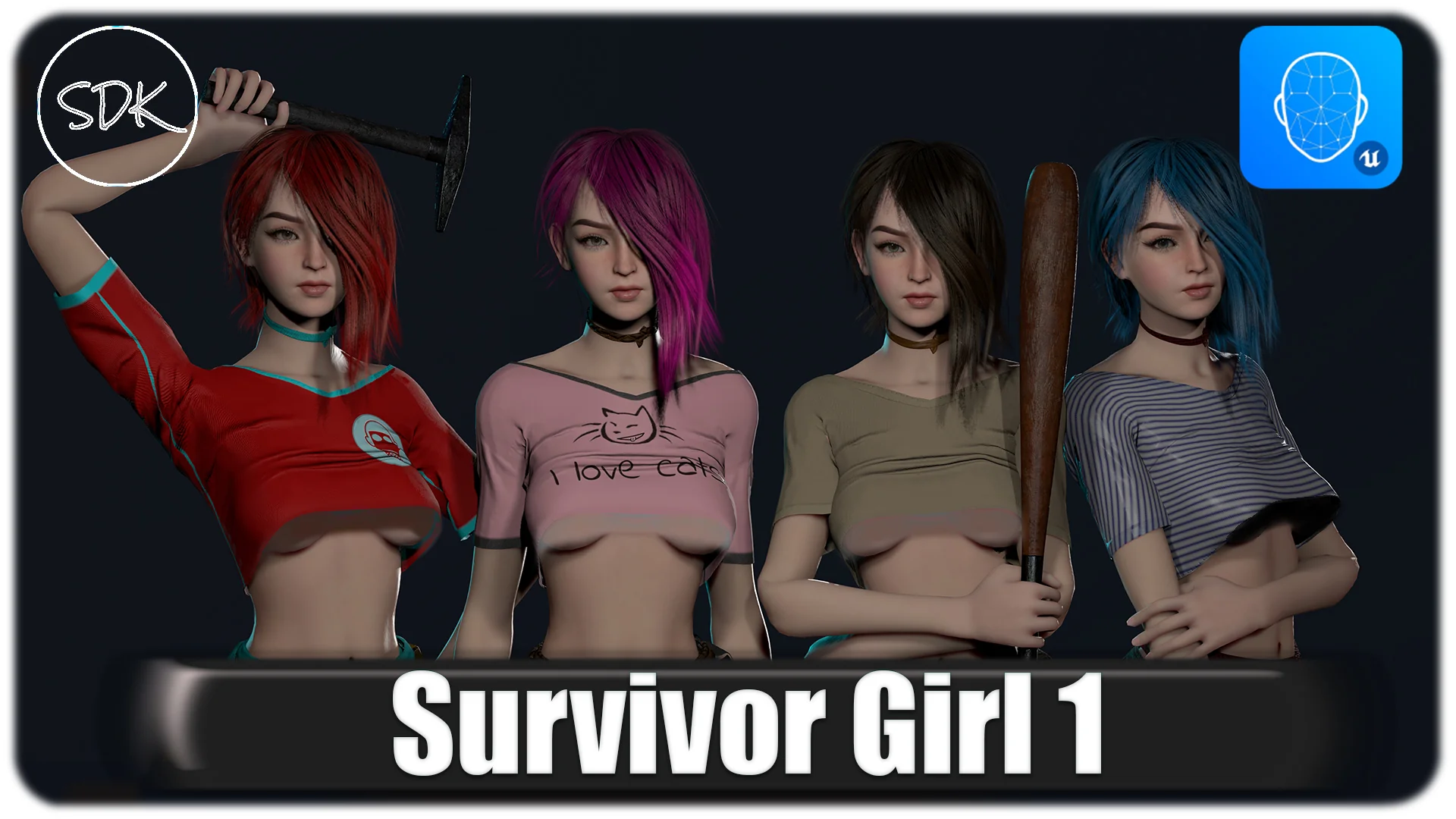
Developing character rosters for survival, apocalyptic, and zombie-themed games often forces teams to manually rig custom meshes and hunt down matching melee weapons. The Survivor Girl 1 (Modular) package addresses this pipeline bottleneck by providing a fully rigged realistic female warrior equipped with built-in facial morphs and a dedicated low-poly arsenal.
By consolidating character geometry, modular clothing, and themed weaponry into a single asset, developers can drop the model directly into combat or exploration scenarios. The character fits neatly into recovery and perseverance narratives, serving as either a player-controlled protagonist or an interactable NPC in military or wasteland environments.
Rigging Survivor Girl 1 (Modular) to the Epic Skeleton
Animation compatibility dictates how quickly a character can move from a static mesh to a fully playable state. This model is rigged directly to the Epic Skeleton, ensuring straightforward animation retargeting within Unreal Engine.
Beyond the standard humanoid hierarchy, the rig includes several supplementary bones designed to handle specific deformations. The skeleton features dedicated entries for Face_Root, Eye_Lf1, Eye_Rt1, Mouth, and LipDn_m to drive fine head movements. Additional bones for Breast_l and Breast_R are present in the hierarchy, though they remain deliberately unconnected to allow developers to configure custom physics assets or spring controllers based on their specific project requirements.
Driving Conversation Animations and Face Mocap
Modern survival games rely heavily on close-up dialogue to drive narrative, requiring character models to support complex facial deformations. To facilitate this, the character is equipped with a comprehensive set of Morph Targets and Blendshapes.
These integrated facial expressions allow the mesh to perform detailed conversation animations without needing a separate head rig. The blendshapes are specifically configured to support face mocap workflows, enabling developers to utilize live stream performance capture to drive the character's reactions in real-time. This structural setup reduces the time spent manually keyframing emotional responses during cinematic sequences.
Managing Polycount Across the Modular Mesh
Flexibility in character assembly allows a single asset to serve multiple roles across a project. The model is completely modular, meaning developers can freely add or remove any part of the mesh to fit the exact requirements of a scene.
At LOD 0, the full set maintains a detailed but optimized footprint of 30,170 vertices, 25,041 faces, and 47,772 triangles. When broken down into separate structural components, the polycount distributes logically across the character. The base body accounts for 20,948 triangles (10,947 vertices, 11,600 faces), while the cloth elements remain highly optimized at 9,122 triangles (4,998 vertices, 4,590 faces). The hair geometry, which often requires dense topology for realistic rendering, utilizes 17,702 triangles (14,225 vertices, 8,851 faces). It should be noted that the underlying body model is censored to comply with standard marketplace regulations.
4K PBR Texturing and Material Customization
Material definition plays a critical role in grounding characters within realistic environments. The asset utilizes a standard PBR Metallic/Roughness workflow, delivering high-resolution 4K textures across the board.
To maximize texture density and allow for granular material adjustments, the character is divided into seven distinct texture sets: Body, Head, Cloth, Teeth, Hair, Eyes, Lashes, and Weapon. Each set includes dedicated maps for normal, metallic, roughness, and albedo data. A distinct workflow advantage is found in the hair materials; the basic hair textures are authored in white, allowing developers to easily tint the material to any desired color directly within the engine without needing to edit the source textures externally.
Equipping the Low Poly Weapon Set
A survival character requires appropriate tools, and this package includes four distinct melee weapons built specifically for game and mobile project performance. The arsenal consists of a bat, shovel, hammer, and ax.
Each of these low-poly weapons comes with three distinct color variations—usual, blood, and dirt—allowing developers to swap states based on combat encounters or environmental conditions. The entire weapon collection shares a single texture set, weighing in at a highly optimized general polygon count of 1,177 vertices, 1,241 faces, and 2,334 triangles. Individually, the models are exceptionally light: the ax uses 872 triangles, the shovel requires 610 triangles, the bat sits at 600 triangles, and the hammer needs only 252 triangles.
Building Out a Survival Roster
Scaling up an apocalyptic game world requires maintaining a consistent art style across multiple human characters. Integrating this asset establishes a baseline visual standard that aligns with other themed models in the same series, such as Survivor Girl 2, Survivor Girl 3, and the rigged Survivor Man.
Utilizing these standardized meshes ensures that animation blueprints, material setups, and retargeting logic can be shared seamlessly across a broader cast. The modular nature of the clothing and the standardized Epic Skeleton foundation mean this character can immediately slot into active production environments, handling everything from basic walk cycles to complex combat scenarios.
 Humans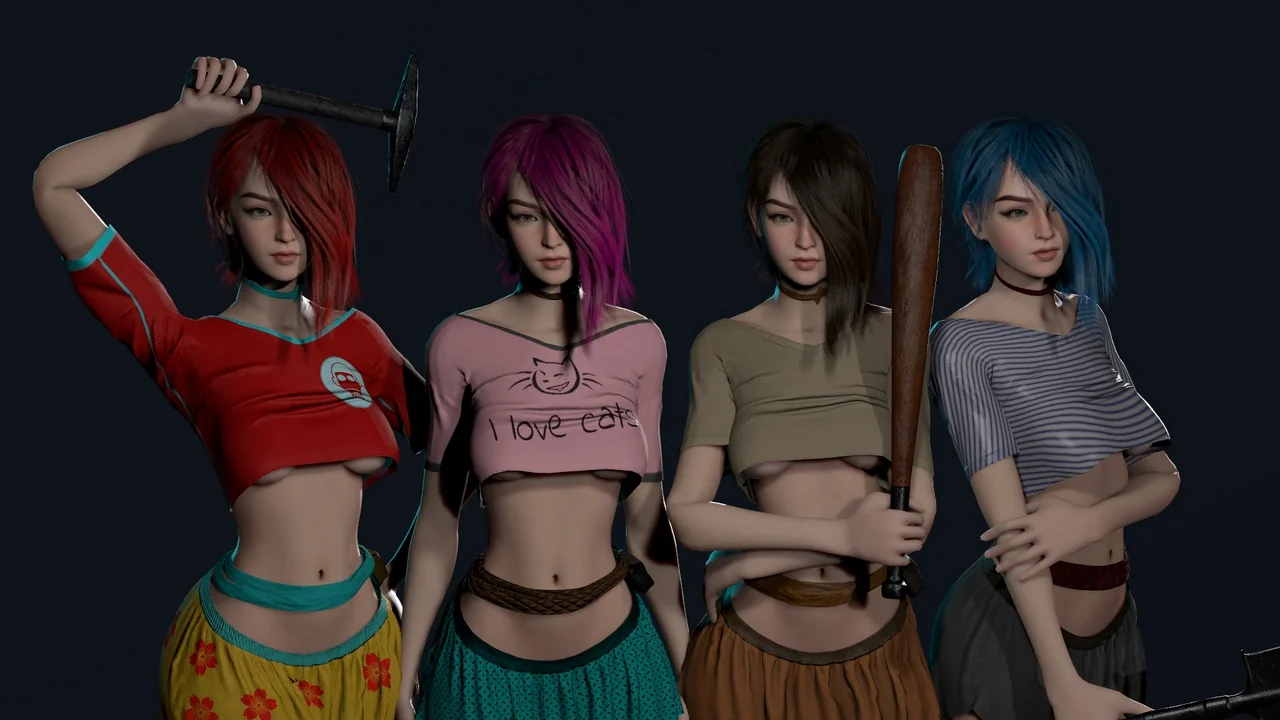
 Humans
 Humans
 Humans