"fb5ea1e7d1b41445"{"id":"1002406","slug":"death-archer-girl-morgana","title":"Death Archer Girl Morgana","category":"Humans","engine":"4.24+,5.0+","assetVersion":"","engineVersion":"Engine Version: 4.24+,5.0+","tag":"Humans","accent":"blue","visual":"mech","summary":"Death Archer Girl Morgana is a modular, fully rigged UE5 character with 52 ARKit blendshapes, MatID color swaps, 4K textures and a bow for dark fantasy scenes.","platform":"Unreal Engine","indexPolicy":"index","publishedAt":"2026-11-10T12:02:23.586Z","updatedAt":"2026-11-10T12:02:23.586Z","sourceNotes":[],"fileContents":[],"compatibility":["Unreal Engine","Engine Version: 4.24+,5.0+"],"featuredImage":{"alt":"Death Archer Girl Morgana","src":"/wp-content/uploads/published/2026/11/ea8636dbb6df-2816da73-8314-4654-b908-7327f7cfd95e-bbd131ee7b.webp"},"hasDownloadLink":true,"downloads":0,"terms":[{"taxonomy":"category","slug":"humans","name":"Humans"}],"galleryImages":[{"src":"/wp-content/uploads/published/2026/11/11cc29ed6620-1305c9ee-72ee-4cf2-9740-db874edda0bf-47f0885f4e.webp","alt":"Death Archer Girl Morgana"},{"src":"/wp-content/uploads/published/2026/11/c2490f5459b7-a9d2e925-d06e-42f7-a4f3-c347da63a081-0eea3ba4bd.webp","alt":"Death Archer Girl Morgana"},{"src":"/wp-content/uploads/published/2026/11/d10a4bb324c3-2b66fbf7-9ee1-4318-b301-163441130452-425f3dbd09.webp","alt":"Death Archer Girl Morgana"},{"src":"/wp-content/uploads/published/2026/11/3174f3d0fd63-fe87c670-c43e-4dc0-9a41-8121de32d097-df362145f2.webp","alt":"Death Archer Girl Morgana"},{"src":"/wp-content/uploads/published/2026/11/369da43c589f-6d74a06e-a915-4bb0-a2da-3727bff839ec-86f6b18f4a.webp","alt":"Death Archer Girl Morgana"},{"src":"/wp-content/uploads/published/2026/11/57ece4137394-898e2c15-013b-4732-a630-85454c06477d-fae3dd26e6.webp","alt":"Death Archer Girl Morgana"},{"src":"/wp-content/uploads/published/2026/11/107753b0f7b8-7b497f21-0749-401a-b795-3deca8285d0e-0bb40b6c4b.webp","alt":"Death Archer Girl Morgana"},{"src":"/wp-content/uploads/published/2026/11/03df052d663a-dbf7059b-cd55-4bf6-942c-aef216b9e8cc-f71b9ed81e.webp","alt":"Death Archer Girl Morgana"},{"src":"/wp-content/uploads/published/2026/11/be58c117c258-32142e53-274f-4a38-a8a6-2c8401750735-e1e5e237cc.webp","alt":"Death Archer Girl Morgana"},{"src":"/wp-content/uploads/published/2026/11/4ce48285c0ab-082220d1-8d2f-43a1-bf7d-5b20b8975c32-0f37afa423.webp","alt":"Death Archer Girl Morgana"}],"accessPanel":{"kind":"resource","title":"Get this resource","eyebrow":"Free resource","message":"Download this resource in your browser.","fileName":"Content.7z","safetyNote":"Resources are manually reviewed before listing to improve quality and reduce obvious risks.","actionLabel":"Get this resource","resourceType":"Resource archive","versions":[]},"contentHtml":"\u003cp\u003eRigging a female archer for a dark fantasy project usually forces a choice: a static sculpt that cannot hold a pose, or a rigged mesh that falls apart the moment a sleeve is hidden. Morgana sidesteps that trade-off. The character arrives fully rigged on an Epic Skeleton (UE5) base with additional bones, carries 52 ARKit blendshapes, and wears a clothing stack that can be dismantled piece by piece. One asset covers a gameplay character, a cinematic close-up and a face-capture avatar without being rebuilt for each role.\u003c/p\u003e \u003cp\u003eThe tag set around the release places it among elven, gothic and medieval fantasy archetypes — a bow-carrying figure that reads as an assassin or ranger rather than a clean heroic knight.\u003c/p\u003e \u003ch2\u003eMorgana's Modular Body and the Sliced Clothing Setup\u003c/h2\u003e \u003cp\u003eModularity here is literal. Any part can be added or removed, and the clothes can come off entirely if a scene calls for it. To keep the body from pushing through garments, the mesh is sliced into pieces; the sections sitting beneath clothing have to be switched off or hidden. That is not just a cleanup step — it is the main lever for controlling density, since the character ships without an LOD system.\u003c/p\u003e \u003cp\u003eThree body states are included, and their counts differ enough to matter when budgeting a scene:\u003c/p\u003e \u003cul\u003e\n\u003cli\u003eMorgana, fully dressed: 32,016 faces, 60,237 triangles, 33,878 vertices\u003c/li\u003e\n\u003cli\u003eMorgana nude: 28,248 faces, 53,358 triangles, 29,469 vertices\u003c/li\u003e\n\u003cli\u003eMorgana in lingerie: 31,424 faces, 56,718 triangles, 31,424 vertices\u003c/li\u003e\n\u003c/ul\u003e \u003cp\u003eBecause there is no LOD chain, a crowd of archers has to be managed by hiding the buried body pieces rather than by swapping to lower-detail meshes. A full-body version, underwear, the weapon and a bonus idle animation all ship together, so a first playable setup does not require hunting for a bow or a starting pose.\u003c/p\u003e \u003cp\u003eThe body texture is censored by default, with an uncensored version available as a request-based variant. Adult parts are not modelled and carry no morphs or rig — they exist only as texture, which keeps the skeleton clean for animation work.\u003c/p\u003e \u003ch2\u003eRigging Notes for the Death Archer Skeleton\u003c/h2\u003e \u003cp\u003eThe rig is based on the Epic Skeleton (UE5) with additional bones, and the main bone hierarchy has been left untouched. That single decision is what makes retargeting straightforward: existing locomotion, combat and interaction animations can be pointed at the character without a rework of the core skeleton. Additional bones extend the figure beyond the standard humanoid set, and physics can be applied to different parts of the body as needed.\u003c/p\u003e \u003cp\u003eThe rig was built in Maya without plugins and does not include animator controls. There are no IK/FK switches or custom pickers to hand to an animation team — movement is expected to arrive through the engine's animation systems. Physics are also not included in the project; a plugin such as KawaiiPhysics is suggested for hair and secondary motion, which is the more realistic path for anyone wanting believable cloth and hair sway.\u003c/p\u003e \u003cp\u003eMorgana shares its skeleton with the creator's earlier female base releases, including the Roxy base character, so animation sets and body parts can move between them. Older releases are being migrated to the UE5 skeleton over time, which means a mixed library will gradually converge on one hierarchy.\u003c/p\u003e \u003ch2\u003eAnimation Tests Behind the Archer's Movement Set\u003c/h2\u003e \u003cp\u003eThe rig has been run through a wide spread of animation content beyond one sample: Lyra Starter Game, the Game Animation Sample Project, Advanced Locomotion System v4, standard third-person animations, Female Interactions Animations, a Mocap Library, ARLS with the Horse Animset, Succubus AnimSet, Valley of the Ancient and Close Combat: Swordsman. For a bow-carrying character, the ARLS plus Horse Animset test is the interesting one — it points toward mounted scenes and open-world traversal rather than corridor combat alone.\u003c/p\u003e \u003cp\u003eStandard third-person animations are included in the Unreal project, so a working character exists before any external pack is added. Separated meshes for Master Pose or Leader Component setups are also provided, which helps when the character is assembled from several parts and needs to follow a single driving skeleton.\u003c/p\u003e \u003ch2\u003eMorgana's ARKit Blendshapes and Face Capture\u003c/h2\u003e \u003cp\u003eFacial animation is handled through 52 calibrated ARKit blendshapes, exposed as Morph Targets inside Unreal. The set has been tested with Live Link Face in Unreal Engine 5 and with Face Capture in Unity, which covers the two most common real-time pipelines. Uses extend past cutscenes: live stream facial animation, LiveLinkFace and FaceWare driven performances, facial mocap sessions, VTuber avatars, VRChat and MMD.\u003c/p\u003e \u003cp\u003eA short dialogue scene and a streamed avatar performance can therefore share the same head mesh. The calibration matters most in close shots, where a blendshape that drifts becomes obvious within seconds.\u003c/p\u003e \u003ch2\u003eMatID Maps and the 4K Texture Sets\u003c/h2\u003e \u003cp\u003eColour changes run through MatID maps covering skin, eyes and outfit parts. A MatID map divides the BaseColor into sections, and an advanced shader or material instance can recolour those sections without repainting textures. That is how a single archer becomes a squad: shift the outfit tones, adjust the skin and eye values, and the silhouette stays consistent while the palette reads as a different character.\u003c/p\u003e \u003cp\u003eNine 4K texture sets cover body, head, eyes, lashes, clothes, bow, straight hair and wavy hair, packed for optimization. Each set contains BaseColor, Normal, Roughness, Metallic, MetallicSmoothness, MaskMap and Ambient Occlusion, and may include MatID, Opacity and Emissive maps where the material needs them. Two distinct hair options — straight and wavy — sit alongside the wider hairstyle selection, and the Unreal project adds wind simulation for hair so the strands respond to scene movement rather than sitting rigid.\u003c/p\u003e \u003cp\u003eThe Unreal Engine project supports 4.24 and up and includes a demo render scene with a blueprint, advanced materials, material instances with the MatID map wired in, and the Epic Skeleton rig with its extra bones.\u003c/p\u003e \u003ch2\u003eWhere Morgana Fits in a Production\u003c/h2\u003e \u003cp\u003eBringing the character into Blender, Cinema 4D or 3ds Max is possible through FBX, though the rig and blendshapes originate in Maya and some software may not read them correctly — a caveat worth testing before committing a shot to it. Inside Unreal, the character is closest to a drop-in for dark fantasy and medieval projects that already animate on the Epic Skeleton, especially where a bow-carrying female lead needs face capture, swappable outfits and quick palette variants. The absence of an LOD chain and of built-in physics are the two gaps to plan around; both have workarounds in hiding buried body pieces and adding a physics plugin. For a hero character, a vendor NPC or a streamed avatar, the modular build does most of the setup work before the first animation is applied.\u003c/p\u003e\n\n\u003ch2\u003eMore From The Same Workflow\u003c/h2\u003e\n\u003cul\u003e\n\u003cli\u003e\u003ca href=\"https://3dcghub.com/modular-elf-archer-girl/\" rel=\"noopener noreferrer\"\u003eModular Elf Archer Girl\u003c/a\u003e\u003c/li\u003e\n\u003cli\u003e\u003ca href=\"https://3dcghub.com/samurai-girl-tomoe/\" rel=\"noopener noreferrer\"\u003eSamurai Girl Tomoe\u003c/a\u003e\u003c/li\u003e\n\u003cli\u003e\u003ca href=\"https://3dcghub.com/customizable-school-girls/\" rel=\"noopener noreferrer\"\u003eCustomizable School Girls\u003c/a\u003e\u003c/li\u003e\n\u003cli\u003e\u003ca href=\"https://3dcghub.com/nun-girl-modular/\" rel=\"noopener noreferrer\"\u003eNun Girl Modular\u003c/a\u003e\u003c/li\u003e\n\u003cli\u003e\u003ca href=\"https://3dcghub.com/anime-girl-cleric/\" rel=\"noopener noreferrer\"\u003eAnime Girl Cleric\u003c/a\u003e\u003c/li\u003e\n\u003c/ul\u003e","contentTextLength":6972,"navigation":{"current":13,"total":4340,"previous":{"id":"1002407","slug":"g2-monk","title":"G2: Monk","category":"Humans","platform":"Unreal Engine","updatedAt":"2026-11-10T12:03:25.219Z"},"next":{"id":"1002405","slug":"samurai-girl-tomoe","title":"Samurai Girl Tomoe","category":"Humans","platform":"Unreal Engine","updatedAt":"2026-11-10T07:07:18.175Z"}},"relatedResources":[{"id":"1000197","slug":"modular-elf-archer-girl","title":"Modular Elf Archer Girl","category":"Humans","engine":"4.26+,5.0+","assetVersion":"","engineVersion":"Engine Version: 4.26+,5.0+","tag":"Humans","accent":"blue","visual":"mech","summary":"A modular female elf archer character with Epic Skeleton rigging, facial blendshapes, 4K PBR textures, separated bow and arrow, and armor color variants.","platform":"Unreal Engine","indexPolicy":"index","publishedAt":"2026-06-23T11:13:13.917Z","updatedAt":"2026-06-23T11:13:13.917Z","sourceNotes":[],"fileContents":[],"compatibility":["Unreal Engine","Engine Version: 4.26+,5.0+"],"featuredImage":{"alt":"Modular Elf Archer Girl","src":"/wp-content/uploads/published/2026/06/be7f554506e0-1c33a7e5-3b94-42e5-b8f0-224995758e1d-f080b04b74.webp"},"hasDownloadLink":true,"downloads":1},{"id":"1002405","slug":"samurai-girl-tomoe","title":"Samurai Girl Tomoe","category":"Humans","engine":"4.19+,5.0+","assetVersion":"","engineVersion":"Engine Version: 4.19+,5.0+","tag":"Humans","accent":"blue","visual":"mech","summary":"Modular 3D warrior character Samurai Girl Tomoe featuring 52 ARKit blendshapes, 4K packed textures, and an Epic Skeleton rig for action games.","platform":"Unreal Engine","indexPolicy":"index","publishedAt":"2026-11-10T07:07:18.175Z","updatedAt":"2026-11-10T07:07:18.175Z","sourceNotes":[],"fileContents":[],"compatibility":["Unreal Engine","Engine Version: 4.19+,5.0+"],"featuredImage":{"alt":"Samurai Girl Tomoe","src":"/wp-content/uploads/published/2026/11/5c46690700c0-95be6877-7081-4ad3-b57c-fd636373f3cb-40e5943225.webp"},"hasDownloadLink":true,"downloads":0},{"id":"1002403","slug":"customizable-school-girls","title":"Customizable School Girls","category":"Humans","engine":"4.19+,5.0+","assetVersion":"","engineVersion":"Engine Version: 4.19+,5.0+","tag":"Humans","accent":"blue","visual":"mech","summary":"Explore Customizable School Girls, a modular 3D character featuring 4K PBR textures, Live Link blendshapes, cloth simulation, and Epic Skeleton rigging.","platform":"Unreal Engine","indexPolicy":"index","publishedAt":"2026-11-10T05:14:18.764Z","updatedAt":"2026-11-10T05:14:18.764Z","sourceNotes":[],"fileContents":[],"compatibility":["Unreal Engine","Engine Version: 4.19+,5.0+"],"featuredImage":{"alt":"Customizable School Girls","src":"/wp-content/uploads/published/2026/11/e27de06de645-c3c2e3d3-1425-47ac-a056-100d6670b067-63cb3abe64.webp"},"hasDownloadLink":true,"downloads":0}]}
Humans
Death Archer Girl Morgana
Death Archer Girl Morgana is a modular, fully rigged UE5 character with 52 ARKit blendshapes, MatID color swaps, 4K textures and a bow for dark fantasy scenes.
Category:Unreal Engine,HumansPlatform: Unreal EngineEngine Version: 4.24+,5.0+Published: Nov 10, 2026
Humans
Resource overview
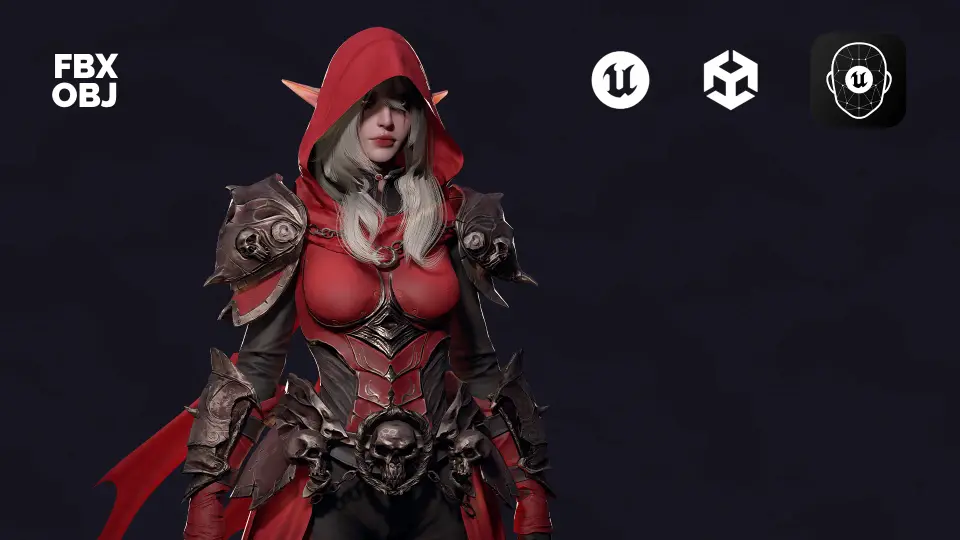
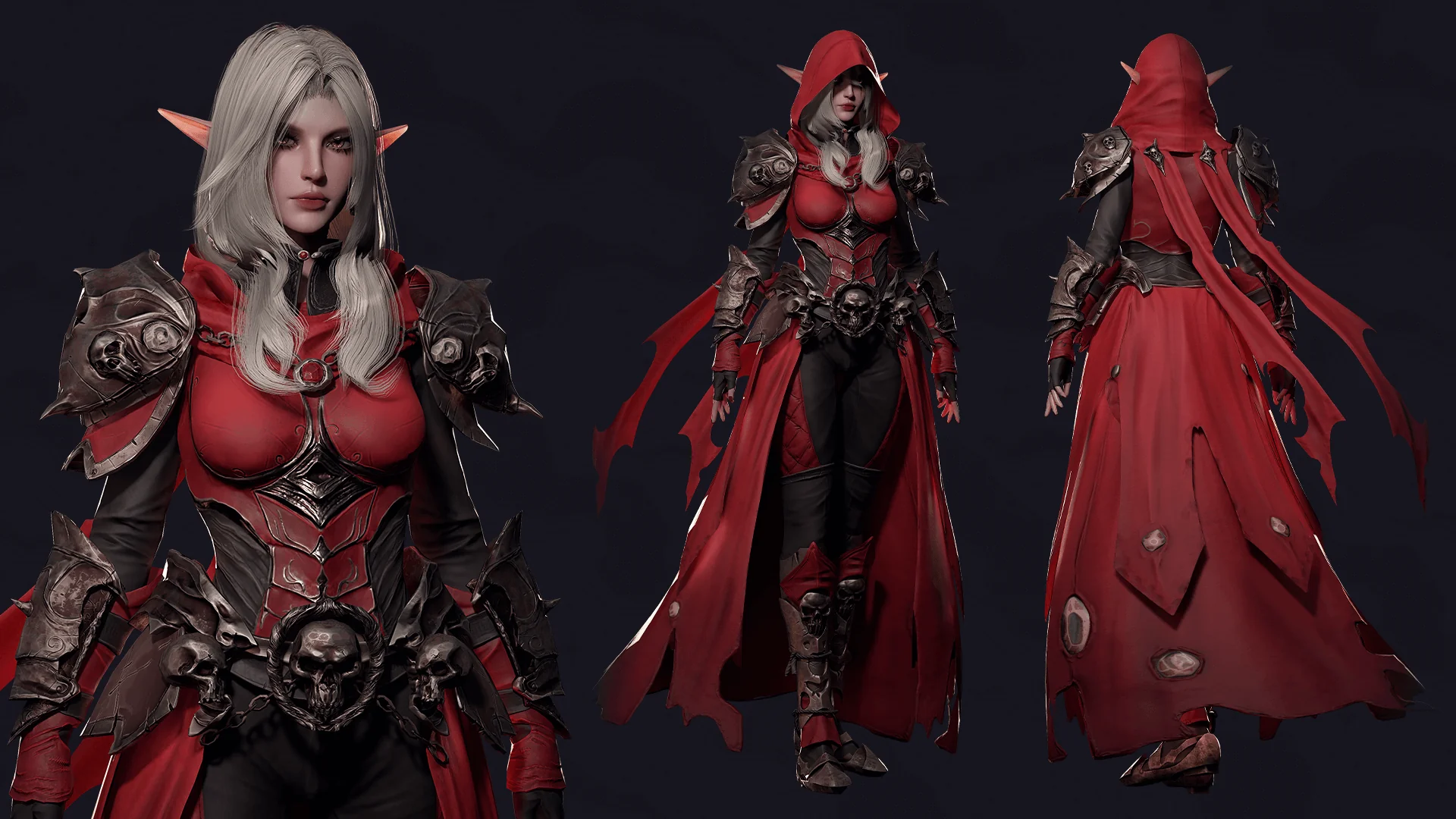
Rigging a female archer for a dark fantasy project usually forces a choice: a static sculpt that cannot hold a pose, or a rigged mesh that falls apart the moment a sleeve is hidden. Morgana sidesteps that trade-off. The character arrives fully rigged on an Epic Skeleton (UE5) base with additional bones, carries 52 ARKit blendshapes, and wears a clothing stack that can be dismantled piece by piece. One asset covers a gameplay character, a cinematic close-up and a face-capture avatar without being rebuilt for each role.
The tag set around the release places it among elven, gothic and medieval fantasy archetypes — a bow-carrying figure that reads as an assassin or ranger rather than a clean heroic knight.
Morgana's Modular Body and the Sliced Clothing Setup
Modularity here is literal. Any part can be added or removed, and the clothes can come off entirely if a scene calls for it. To keep the body from pushing through garments, the mesh is sliced into pieces; the sections sitting beneath clothing have to be switched off or hidden. That is not just a cleanup step — it is the main lever for controlling density, since the character ships without an LOD system.
Three body states are included, and their counts differ enough to matter when budgeting a scene:
Morgana in lingerie: 31,424 faces, 56,718 triangles, 31,424 vertices
Because there is no LOD chain, a crowd of archers has to be managed by hiding the buried body pieces rather than by swapping to lower-detail meshes. A full-body version, underwear, the weapon and a bonus idle animation all ship together, so a first playable setup does not require hunting for a bow or a starting pose.
The body texture is censored by default, with an uncensored version available as a request-based variant. Adult parts are not modelled and carry no morphs or rig — they exist only as texture, which keeps the skeleton clean for animation work.
Rigging Notes for the Death Archer Skeleton
The rig is based on the Epic Skeleton (UE5) with additional bones, and the main bone hierarchy has been left untouched. That single decision is what makes retargeting straightforward: existing locomotion, combat and interaction animations can be pointed at the character without a rework of the core skeleton. Additional bones extend the figure beyond the standard humanoid set, and physics can be applied to different parts of the body as needed.
The rig was built in Maya without plugins and does not include animator controls. There are no IK/FK switches or custom pickers to hand to an animation team — movement is expected to arrive through the engine's animation systems. Physics are also not included in the project; a plugin such as KawaiiPhysics is suggested for hair and secondary motion, which is the more realistic path for anyone wanting believable cloth and hair sway.
Morgana shares its skeleton with the creator's earlier female base releases, including the Roxy base character, so animation sets and body parts can move between them. Older releases are being migrated to the UE5 skeleton over time, which means a mixed library will gradually converge on one hierarchy.
Animation Tests Behind the Archer's Movement Set
The rig has been run through a wide spread of animation content beyond one sample: Lyra Starter Game, the Game Animation Sample Project, Advanced Locomotion System v4, standard third-person animations, Female Interactions Animations, a Mocap Library, ARLS with the Horse Animset, Succubus AnimSet, Valley of the Ancient and Close Combat: Swordsman. For a bow-carrying character, the ARLS plus Horse Animset test is the interesting one — it points toward mounted scenes and open-world traversal rather than corridor combat alone.
Standard third-person animations are included in the Unreal project, so a working character exists before any external pack is added. Separated meshes for Master Pose or Leader Component setups are also provided, which helps when the character is assembled from several parts and needs to follow a single driving skeleton.
Morgana's ARKit Blendshapes and Face Capture
Facial animation is handled through 52 calibrated ARKit blendshapes, exposed as Morph Targets inside Unreal. The set has been tested with Live Link Face in Unreal Engine 5 and with Face Capture in Unity, which covers the two most common real-time pipelines. Uses extend past cutscenes: live stream facial animation, LiveLinkFace and FaceWare driven performances, facial mocap sessions, VTuber avatars, VRChat and MMD.
A short dialogue scene and a streamed avatar performance can therefore share the same head mesh. The calibration matters most in close shots, where a blendshape that drifts becomes obvious within seconds.
MatID Maps and the 4K Texture Sets
Colour changes run through MatID maps covering skin, eyes and outfit parts. A MatID map divides the BaseColor into sections, and an advanced shader or material instance can recolour those sections without repainting textures. That is how a single archer becomes a squad: shift the outfit tones, adjust the skin and eye values, and the silhouette stays consistent while the palette reads as a different character.
Nine 4K texture sets cover body, head, eyes, lashes, clothes, bow, straight hair and wavy hair, packed for optimization. Each set contains BaseColor, Normal, Roughness, Metallic, MetallicSmoothness, MaskMap and Ambient Occlusion, and may include MatID, Opacity and Emissive maps where the material needs them. Two distinct hair options — straight and wavy — sit alongside the wider hairstyle selection, and the Unreal project adds wind simulation for hair so the strands respond to scene movement rather than sitting rigid.
The Unreal Engine project supports 4.24 and up and includes a demo render scene with a blueprint, advanced materials, material instances with the MatID map wired in, and the Epic Skeleton rig with its extra bones.
Where Morgana Fits in a Production
Bringing the character into Blender, Cinema 4D or 3ds Max is possible through FBX, though the rig and blendshapes originate in Maya and some software may not read them correctly — a caveat worth testing before committing a shot to it. Inside Unreal, the character is closest to a drop-in for dark fantasy and medieval projects that already animate on the Epic Skeleton, especially where a bow-carrying female lead needs face capture, swappable outfits and quick palette variants. The absence of an LOD chain and of built-in physics are the two gaps to plan around; both have workarounds in hiding buried body pieces and adding a physics plugin. For a hero character, a vendor NPC or a streamed avatar, the modular build does most of the setup work before the first animation is applied.
 Humans
 Humans
 Humans
 Humans