"7b46a695175d8694"{"id":"1001463","slug":"npc-queue-system","title":"NPC Queue system","category":"Gameplay Features","engine":"5.8+","assetVersion":"","engineVersion":"Engine Version: 5.8+","tag":"Gameplay Features","accent":"blue","visual":"mech","summary":"Implement organized crowd lines and tycoon waiting systems with the spline-driven NPC Queue system for smart AI pedestrian management.","platform":"Unreal Engine","publishedAt":"2026-10-08T07:53:54.377Z","updatedAt":"2026-10-08T07:53:54.377Z","sourceNotes":[],"fileContents":[],"compatibility":["Unreal Engine","Engine Version: 5.8+"],"featuredImage":{"alt":"NPC Queue system","src":"/wp-content/uploads/published/2026/10/f1164b0c9d94-d3857132-70c7-4190-9237-ae36d28b474a-2f82d8c864.webp"},"hasDownloadLink":true,"downloads":0,"terms":[{"taxonomy":"category","slug":"gameplay-features","name":"Gameplay Features"}],"galleryImages":[{"src":"/wp-content/uploads/published/2026/10/b245976d1de0-786886d9-4e3e-446c-a9d6-4eb1726da1df-e1bfb76d74.webp","alt":"NPC Queue system"},{"src":"/wp-content/uploads/published/2026/10/21af5c466665-a6159cec-b360-4891-b260-3690646ce52a-d9081ef9a9.webp","alt":"NPC Queue system"},{"src":"/wp-content/uploads/published/2026/10/fc58ea7d80b7-25fda586-488d-4ab6-affc-14e16eb6b406-bcf3de0307.webp","alt":"NPC Queue system"}],"accessPanel":{"kind":"resource","title":"Download this resource","eyebrow":"Free Download","message":"Log in or create a free account to start your download.","fileName":"NPC Queue system.7z","safetyNote":"Resources are manually reviewed before listing to improve quality and reduce obvious risks.","actionLabel":"Download Free","resourceType":"Resource archive"},"contentHtml":"\u003ch2\u003eSpline-Driven Paths and Line Layouts\u003c/h2\u003e\u003cp\u003eOrganizing moving characters into orderly lines presents distinct spatial challenges in interactive environments. The NPC Queue system addresses this by utilizing splines as the foundational framework for queue geometry. Instead of forcing rigid, coordinate-bound paths, the blueprint setup allows developers to lay out lines directly in the level viewport by shaping spline curves to fit counters, ticket booths, theme park attractions, or transport hubs.\u003c/p\u003e\u003cp\u003eUsing splines makes altering the footprint of a waiting line straightforward. Designers can bend, extend, or compress paths around architectural obstacles such as walls, stanchions, and service desks without breaking character awareness. AI agents assigned to the queue follow the spline trajectory naturally, maintaining consistent directional orientation as they advance through the designated path toward their destination.\u003c/p\u003e\u003ch2\u003eCustomizable Queue Entry: Start-Only versus Free-Entry\u003c/h2\u003e\u003cp\u003eCrowd flow demands varied line rules depending on the simulated scenario. The system incorporates two explicit entry configurations to govern how AI pedestrians approach and join an active line:\u003c/p\u003e\u003cul\u003e\u003cli\u003e\u003cstrong\u003eStart-Only Mode:\u003c/strong\u003e Characters must approach and join the line strictly at its designated beginning point. This mode models strict, orderly environments such as security checkpoints, single-file ticket turnstiles, or structured bank queues where cutting into the middle of the formation is prohibited.\u003c/li\u003e\u003cli\u003e\u003cstrong\u003eFree-Entry Mode:\u003c/strong\u003e Characters are permitted to slot into available spaces at any position along the line. This configuration suits casual gathering points, food markets, or dynamic crowd scenarios where pedestrians fill gaps as they appear along the spline.\u003c/li\u003e\u003c/ul\u003e\u003cp\u003eSwitching between these entry methods enables tailored behavior across different zones of a game. A store entrance can enforce single-point access to prevent crowding at the front, while a broad counter area can allow incoming NPCs to slip into gaps along the perimeter as spots open up.\u003c/p\u003e\u003ch2\u003eDynamic Queue Behavior and Departure Logic\u003c/h2\u003e\u003cp\u003eStatic lines rarely reflect realistic human movement. To handle variability within simulation loops, the system features dynamic queue behavior that lets AI agents make decisions while waiting. Characters advance along the spline step by step as preceding agents move forward, but they are not locked into remaining in line indefinitely.\u003c/p\u003e\u003cp\u003eNPCs possess the ability to leave the queue randomly at any point along the spline path. This mechanism simulates impatience, changing priorities, or distraction, preventing the line from behaving like a rigid conveyor belt. Alternatively, characters can follow standard queue discipline, holding their positions until they successfully reach the head of the line to complete their intended interaction. Because agents follow the spline naturally, departures and positional updates occur fluidly along the track without breaking navigation flow.\u003c/p\u003e\u003ch2\u003eManaging Multiple Queues in Crowd and Tycoon Environments\u003c/h2\u003e\u003cp\u003eComplex simulations often require several service points operating simultaneously. The system includes native support for multiple queues running in the same scene, allowing distinct spline paths to operate side by side without interference. This capability is directly applicable to two primary game production contexts:\u003c/p\u003e\u003cp\u003eIn tycoon and management games, player progression often hinges on customer throughput. Having multiple independent lines allows developers to bind separate queues to individual cash registers, ride entrances, or service windows. As lines fill up or stall, the underlying queue logic keeps track of agent counts and position states across every active spline.\u003c/p\u003e\u003cp\u003eIn broad pedestrian and crowd simulations, multiple queues help break massive groups into believable, localized interactions. Street vendors, bus stops, and building checkpoints can each run self-contained queue loops. Because characters can join or peel away dynamically, the surrounding environment maintains the illusion of an active, thinking crowd that responds to wait times and line availability.\u003c/p\u003e\u003ch2\u003eIntegration Workflow with Documentation Guidance\u003c/h2\u003e\u003cp\u003eDesigned around Blueprint architecture, the package incorporates the core logic needed to govern AI character registration, spline path advancement, and line departures. The included documentation provides reference steps to assist with integrating the logic into custom character blueprints and project level designs. By providing spline creation tools, distinct entry modes, dynamic dropout mechanics, and multi-line support, the system gives simulation projects a functional foundation for believable line management.\u003c/p\u003e\n\n\u003ch2\u003eRelated Resources Worth Checking\u003c/h2\u003e\n\u003cul\u003e\n\u003cli\u003e\u003ca href=\"https://3dcghub.com/hyper-time-manager-system-v4/\" title=\"Hyper Time Manager System v4\"\u003eHyper Time Manager System v4\u003c/a\u003e\u003c/li\u003e\n\u003cli\u003e\u003ca href=\"https://3dcghub.com/third-person-story-adventure-template/\" title=\"Third Person Story Adventure Template\"\u003eThird Person Story Adventure Template\u003c/a\u003e\u003c/li\u003e\n\u003cli\u003e\u003ca href=\"https://3dcghub.com/npc-ai-queuing-system/\" title=\"NPC AI Queuing System\"\u003eNPC AI Queuing System\u003c/a\u003e\u003c/li\u003e\n\u003cli\u003e\u003ca href=\"https://3dcghub.com/smart-ai/\" title=\"Smart AI\"\u003eSmart AI\u003c/a\u003e\u003c/li\u003e\n\u003cli\u003e\u003ca href=\"https://3dcghub.com/newtonian-falling-and-momentum-damage-system/\" title=\"Newtonian Falling and Momentum Damage System\"\u003eNewtonian Falling and Momentum Damage System\u003c/a\u003e\u003c/li\u003e\n\u003c/ul\u003e","contentTextLength":4830,"navigation":{"current":84,"total":3481,"previous":{"id":"1001464","slug":"objective-path-guide","title":"Objective Path Guide","category":"Gameplay Features","platform":"Unreal Engine","updatedAt":"2026-10-08T07:54:53.692Z"},"next":{"id":"1001462","slug":"worms-complete-pack","title":"Worms Complete Pack","category":"Characters \u0026 Creatures","platform":"Unreal Engine","updatedAt":"2026-10-08T01:07:36.891Z"}},"relatedResources":[{"id":"1001035","slug":"hyper-time-manager-system-v4","title":"Hyper Time Manager System v4","category":"Gameplay Features","engine":"5.7+","assetVersion":"Asset Version: v4","engineVersion":"Engine Version: 5.7+","tag":"Gameplay Features","accent":"blue","visual":"mech","summary":"Hyper Time Manager System v4 centralizes in-game time in the GameState, syncing NPC schedules, day-night cycles, and world events with Blueprint, multiplayer-re","platform":"Unreal Engine","publishedAt":"2026-08-25T11:24:46.098Z","updatedAt":"2026-08-25T11:24:46.098Z","sourceNotes":[],"fileContents":[],"compatibility":["Unreal Engine","Asset Version: v4","Engine Version: 5.7+"],"featuredImage":{"alt":"Hyper Time Manager System v4","src":"/wp-content/uploads/published/2026/08/0c6d2b9b85f3-d2a03156-4b13-4068-b29a-47eca06cd2d2-7cea1ff9c1.webp"},"hasDownloadLink":true,"downloads":2},{"id":"1000896","slug":"third-person-story-adventure-template","title":"Third Person Story Adventure Template","category":"Gameplay Features","engine":"5.3+","assetVersion":"","engineVersion":"Engine Version: 5.3+","tag":"Gameplay Features","accent":"blue","visual":"mech","summary":"A complex Unreal Engine template for story-based games with inspection, inventory, journal, and branching NPC dialogue. Includes documentation and a Windows dem","platform":"Unreal Engine","publishedAt":"2026-08-06T04:48:47.283Z","updatedAt":"2026-08-06T04:48:47.283Z","sourceNotes":[],"fileContents":[],"compatibility":["Unreal Engine","Engine Version: 5.3+"],"featuredImage":{"alt":"Third Person Story Adventure Template","src":"/wp-content/uploads/published/2026/08/a51b66106795-192afb08-86c4-4959-be94-66b22dbe4df1-192ba25f38.webp"},"hasDownloadLink":true,"downloads":0},{"id":"1000083","slug":"npc-ai-queuing-system","title":"NPC AI Queuing System","category":"Gameplay Features","engine":"Engine Version: 4.26+,5.0+","assetVersion":"Engine Version: 4.26+,5.0+","engineVersion":"","tag":"Gameplay Features","accent":"blue","visual":"mech","summary":"A Blueprint-based NPC queuing system for smooth pedestrian behavior, spline routes, behavior tree logic, debug tools, and quick scene setup.","platform":"Unreal Engine","publishedAt":"2026-06-05T16:06:07.049Z","updatedAt":"2026-06-05T16:06:07.049Z","sourceNotes":[],"fileContents":[],"compatibility":["Unreal Engine","Engine Version: 4.26+,5.0+"],"featuredImage":{"alt":"NPC AI Queuing System","src":"/wp-content/uploads/published/2026/06/2fce6ebe6d61-050ebb3a-f89b-44e9-8982-9b4b5c0267ab-85fbd54aad.webp"},"hasDownloadLink":true,"downloads":0}]}
Gameplay Features
NPC Queue system
Implement organized crowd lines and tycoon waiting systems with the spline-driven NPC Queue system for smart AI pedestrian management.
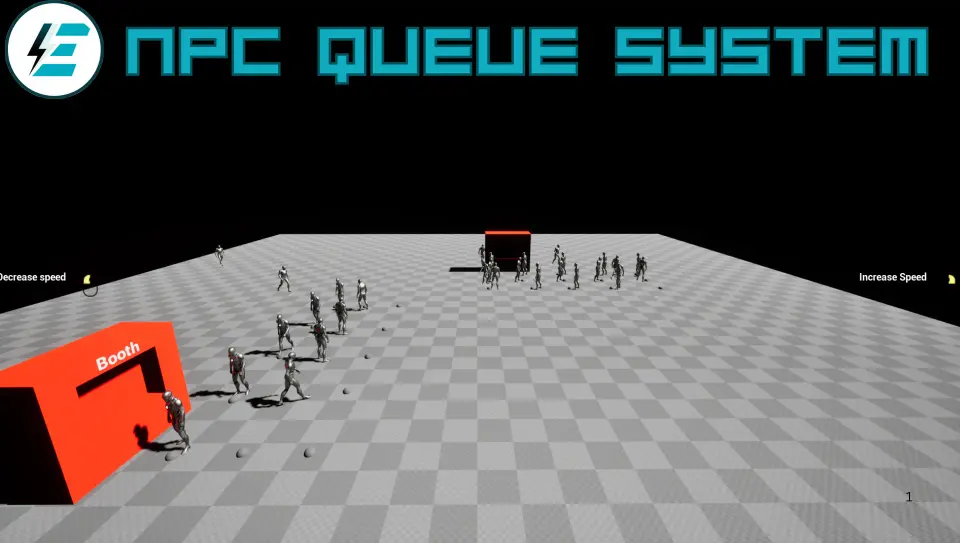
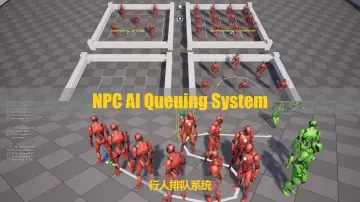
Organizing moving characters into orderly lines presents distinct spatial challenges in interactive environments. The NPC Queue system addresses this by utilizing splines as the foundational framework for queue geometry. Instead of forcing rigid, coordinate-bound paths, the blueprint setup allows developers to lay out lines directly in the level viewport by shaping spline curves to fit counters, ticket booths, theme park attractions, or transport hubs.
Using splines makes altering the footprint of a waiting line straightforward. Designers can bend, extend, or compress paths around architectural obstacles such as walls, stanchions, and service desks without breaking character awareness. AI agents assigned to the queue follow the spline trajectory naturally, maintaining consistent directional orientation as they advance through the designated path toward their destination.
Customizable Queue Entry: Start-Only versus Free-Entry
Crowd flow demands varied line rules depending on the simulated scenario. The system incorporates two explicit entry configurations to govern how AI pedestrians approach and join an active line:
Start-Only Mode: Characters must approach and join the line strictly at its designated beginning point. This mode models strict, orderly environments such as security checkpoints, single-file ticket turnstiles, or structured bank queues where cutting into the middle of the formation is prohibited.
Free-Entry Mode: Characters are permitted to slot into available spaces at any position along the line. This configuration suits casual gathering points, food markets, or dynamic crowd scenarios where pedestrians fill gaps as they appear along the spline.
Switching between these entry methods enables tailored behavior across different zones of a game. A store entrance can enforce single-point access to prevent crowding at the front, while a broad counter area can allow incoming NPCs to slip into gaps along the perimeter as spots open up.
Dynamic Queue Behavior and Departure Logic
Static lines rarely reflect realistic human movement. To handle variability within simulation loops, the system features dynamic queue behavior that lets AI agents make decisions while waiting. Characters advance along the spline step by step as preceding agents move forward, but they are not locked into remaining in line indefinitely.
NPCs possess the ability to leave the queue randomly at any point along the spline path. This mechanism simulates impatience, changing priorities, or distraction, preventing the line from behaving like a rigid conveyor belt. Alternatively, characters can follow standard queue discipline, holding their positions until they successfully reach the head of the line to complete their intended interaction. Because agents follow the spline naturally, departures and positional updates occur fluidly along the track without breaking navigation flow.
Managing Multiple Queues in Crowd and Tycoon Environments
Complex simulations often require several service points operating simultaneously. The system includes native support for multiple queues running in the same scene, allowing distinct spline paths to operate side by side without interference. This capability is directly applicable to two primary game production contexts:
In tycoon and management games, player progression often hinges on customer throughput. Having multiple independent lines allows developers to bind separate queues to individual cash registers, ride entrances, or service windows. As lines fill up or stall, the underlying queue logic keeps track of agent counts and position states across every active spline.
In broad pedestrian and crowd simulations, multiple queues help break massive groups into believable, localized interactions. Street vendors, bus stops, and building checkpoints can each run self-contained queue loops. Because characters can join or peel away dynamically, the surrounding environment maintains the illusion of an active, thinking crowd that responds to wait times and line availability.
Integration Workflow with Documentation Guidance
Designed around Blueprint architecture, the package incorporates the core logic needed to govern AI character registration, spline path advancement, and line departures. The included documentation provides reference steps to assist with integrating the logic into custom character blueprints and project level designs. By providing spline creation tools, distinct entry modes, dynamic dropout mechanics, and multi-line support, the system gives simulation projects a functional foundation for believable line management.
 Gameplay Features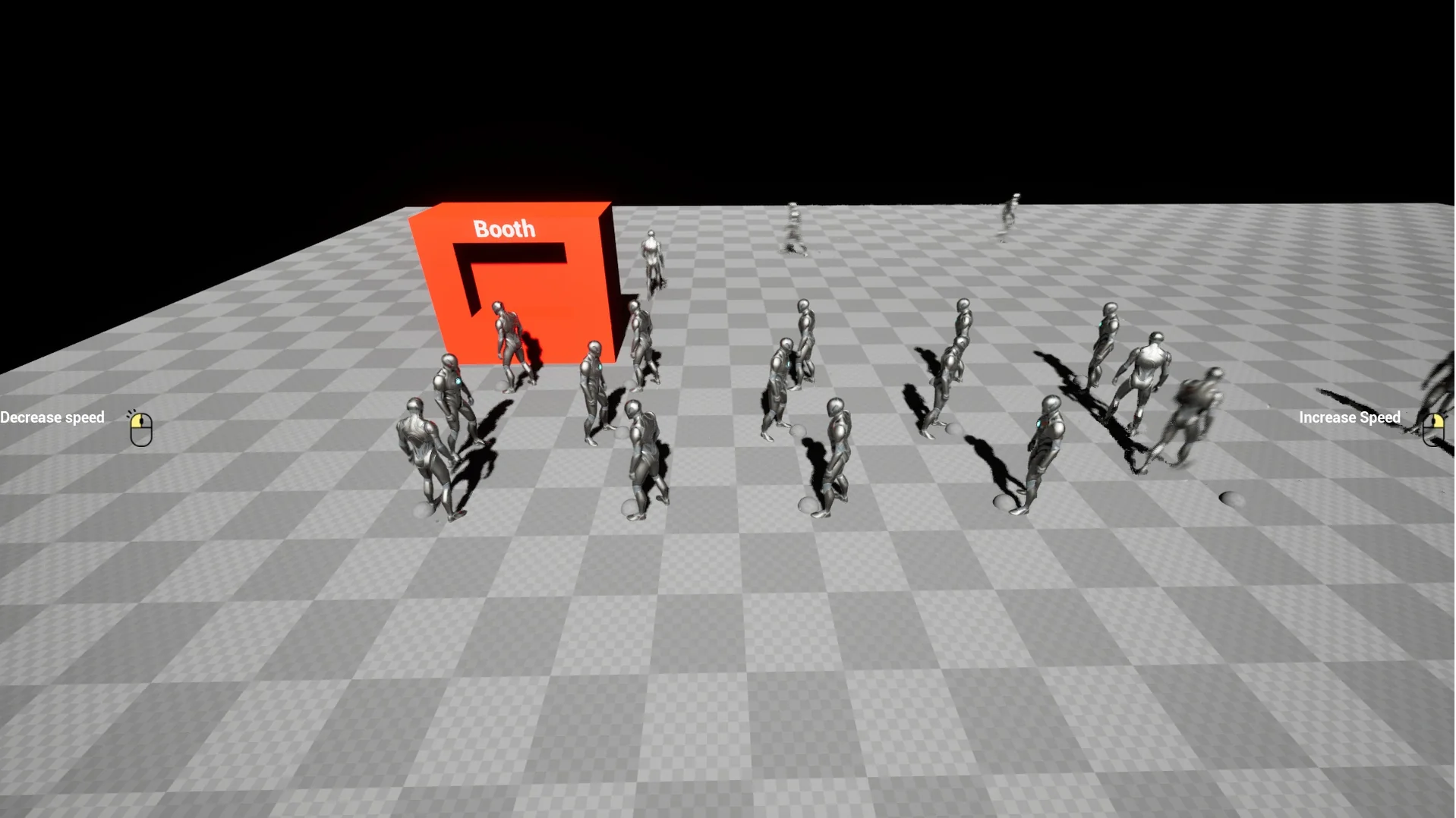
 Gameplay Features
 Gameplay Features
 Gameplay Features