"c68a05d5e51405b3"{"id":"1001105","slug":"modular-limb-damage-system","title":"Modular Limb Damage System","category":"Gameplay Features","engine":"5.7","assetVersion":"Asset Version: 1.0","engineVersion":"Engine Version: 5.7","tag":"Gameplay Features","accent":"blue","visual":"mech","summary":"C++-driven Unreal Engine 5 plugin for runtime limb damage with bone-based damage, per-limb health, partial/full destruction, physics-driven detachment, and repl","platform":"Unreal Engine","publishedAt":"2026-09-07T05:41:59.387Z","updatedAt":"2026-09-07T05:41:59.387Z","sourceNotes":[],"fileContents":[],"compatibility":["Unreal Engine","Asset Version: 1.0","Engine Version: 5.7"],"featuredImage":{"alt":"Modular Limb Damage System","src":"/wp-content/uploads/published/2026/09/3f6190758daa-041a1d38-6d71-4125-b85c-f2635d7c5f8e-96e662065b.webp"},"hasDownloadLink":true,"downloads":1,"terms":[{"taxonomy":"category","slug":"gameplay-features-tools-and-plugins","name":"Gameplay Features"}],"galleryImages":[{"src":"/wp-content/uploads/published/2026/09/8fda023fa353-fe45059b-c082-4b3c-ba2f-d99f80aff184-46de5f37ac.webp","alt":"Modular Limb Damage System"},{"src":"/wp-content/uploads/published/2026/09/ac9ed6cdb9e4-7ab4a261-f1b9-4221-b01e-7ebf6e9d6dba-1d338a7d1d.webp","alt":"Modular Limb Damage System"},{"src":"/wp-content/uploads/published/2026/09/9ce99090f7f6-af9925cf-52db-4f52-8464-4561e72408cf-3c2207769d.webp","alt":"Modular Limb Damage System"}],"accessPanel":{"kind":"resource","title":"Download this resource","eyebrow":"Free Download","message":"Log in or create a free account to start your download.","fileName":"5.7.7z","safetyNote":"Resources are manually reviewed before listing to improve quality and reduce obvious risks.","actionLabel":"Download Free","resourceType":"Resource archive"},"contentHtml":"\u003cp\u003eRuntime limb loss is one of those mechanics that feels great in a game until it has to survive contact with the animation system. Modular Limb Damage System (MLDS) keeps the implementation path short: the core is written in C++, the components are exposed to Blueprint, and the system produces runtime limb damage with configurable break and destroy events plus physics-driven limb detachment. The goal is to let a character lose a limb or take damage to a specific bone without chasing gameplay logic across every layer of the project.\u003c/p\u003e \u003ch2\u003eBone-based limb damage and per-limb health\u003c/h2\u003e\n\u003cp\u003eDamage in MLDS is bone-based. You can apply damage to an individual bone, or you can target a whole limb hierarchy, with the plugin handling automatic traversal of that hierarchy. This matters in practice because it removes the need to hard-code break states for every individual body part. A hit that connects with an upper arm can resolve against the same hierarchical rules as a hit on the forearm, with the system deciding which bones are affected and how the damage flows through connected segments.\u003c/p\u003e\n\u003cp\u003eEach limb carries its own configurable health value, so a developer can tune a shoulder differently from a hand or set a leg to come off more easily than an arm. The system supports both partial and full limb destruction. A limb can remain connected after taking enough damage or it can be destroyed outright if the applied damage exceeds its threshold. Break events and destroy events are configurable, making it possible to trigger different feedback depending on how severe the hit is.\u003c/p\u003e \u003ch2\u003eRuntime dismemberment and detached limb actors\u003c/h2\u003e\n\u003cp\u003eDismemberment in MLDS does not have to be a non-interactive effect. The plugin can detach limbs dynamically while the game is running, and it automatically traverses the bone hierarchy to decide what remains connected. A clean separation is maintained between the intact mesh on the character and the mesh that becomes the detached limb actor. That split prevents the usual side effects where a partially removed limb leaves corrupted geometry behind on the character.\u003c/p\u003e\n\u003cp\u003eThe detached limb actor is a distinct piece of the system, so once a limb is removed it is no longer part of the character's mesh. Because the core logic runs in C++, the hierarchy traversal and detachment decisions stay efficient even during moments with multiple simultaneous hits. The same traversal ensures that partial destruction is handled consistently: some bones may still be connected while other portions of the limb have already broken away.\u003c/p\u003e \u003ch2\u003eA component split instead of a monolithic system\u003c/h2\u003e\n\u003cp\u003eMLDS is intentionally not a single monolithic gameplay module. The feature set comes in a few independent pieces: a limb mesh component, a limb damage component, and a detached limb actor. Optional editor helpers can assist during authoring, but they are not required for every setup. A project can take only the limb damage component and pair it with the limb mesh component, or it can skip the detached limb actor when full separation is unnecessary.\u003c/p\u003e\n\u003cp\u003eThis modular shape carries over to the Blueprint side. The core logic is written in C++, but the plugin exposes Blueprint-friendly components and events. Gameplay designers can hook into those events and components without writing C++, while the heavier hierarchical and replication work stays in a compiled layer. Because the pieces are separated naturally, MLDS can be combined with other plugins or integrated into an existing character setup without forcing a rewrite of core gameplay or animation logic.\u003c/p\u003e \u003ch2\u003eServer-authoritative logic for replicated detachment\u003c/h2\u003e\n\u003cp\u003eMultiplayer projects need damage systems that do not rely on each client making its own call. MLDS is built for networked games from the ground up. The logic is server-authoritative, so the server is the deciding authority for when a limb breaks or detaches. Limb detachment is replication-safe, meaning the split between intact and detached meshes is not a visual trick that each machine has to guess at.\u003c/p\u003e\n\u003cp\u003eA server-confirmed break or destroy event can then be replicated to clients in a way that lines up with the rest of the networked simulation. This makes the system particularly useful for shooters and melee games where players need to see the same outcome at the same time. The server-authoritative approach also keeps bone hierarchy traversal consistent, preventing cases where the server sees a limb as detached while a client still sees it attached.\u003c/p\u003e \u003ch2\u003eFits across shooters, melee, horror, and simulation work\u003c/h2\u003e\n\u003cp\u003eThe damage mechanics in MLDS line up with several genres. Shooters benefit from limb-specific weak points, melee games can use dismemberment as a direct result of weapon impact, and horror or gore systems gain a non-scripted way to tear apart characters. The same tooling can be used in simulation-heavy projects where damage has to be systemic and repeatable, or in research and study projects that focus on how skeletal meshes handle runtime destruction.\u003c/p\u003e\n\u003cp\u003eBecause MLDS is modular, teams can adopt only the pieces that fit their current need. A project that already has a custom damage system could use just the limb mesh component and detached limb actor, while a project starting fresh can lean on both the limb damage component and the optional editor helpers. The use of per-limb health and configurable break and destroy events keeps the system flexible enough to be reused across different gameplay settings.\u003c/p\u003e \u003ch2\u003eSupport and production angle\u003c/h2\u003e\n\u003cp\u003eThe plugin is built to be integrated, not to force a new architecture on a project. Its C++ core and Blueprint-accessible components make it possible to extend or adjust during production, and the modular pieces let development teams grow into the system over time. For any setup questions, the developer runs a Discord support channel where implementers can raise specific issues while wiring limb damage into their combat or gameplay code.\u003c/p\u003e\n\n\u003ch2\u003eMore From The Same Workflow\u003c/h2\u003e\n\u003cul\u003e\n\u003cli\u003e\u003ca href=\"https://3dcghub.com/instance-damage-system/\" title=\"Instance Damage System\"\u003eInstance Damage System\u003c/a\u003e\u003c/li\u003e\n\u003cli\u003e\u003ca href=\"https://3dcghub.com/flex-pool-actor-pooling-system/\" title=\"Flex Pool - Actor Pooling System\"\u003eFlex Pool - Actor Pooling System\u003c/a\u003e\u003c/li\u003e\n\u003cli\u003e\u003ca href=\"https://3dcghub.com/generic-movement-system-a-powerful-movement-control-and-locomotion-system/\" title=\"Generic Movement System - A powerful movement control and locomotion system\"\u003eGeneric Movement System - A powerful movement control and locomotion system\u003c/a\u003e\u003c/li\u003e\n\u003cli\u003e\u003ca href=\"https://3dcghub.com/event-queue/\" title=\"Event Queue\"\u003eEvent Queue\u003c/a\u003e\u003c/li\u003e\n\u003cli\u003e\u003ca href=\"https://3dcghub.com/tempered-glass-destructible-glass-system/\" title=\"Tempered Glass – Destructible Glass System\"\u003eTempered Glass – Destructible Glass System\u003c/a\u003e\u003c/li\u003e\n\u003c/ul\u003e","contentTextLength":6124,"navigation":{"current":870,"total":3860,"previous":{"id":"1001106","slug":"modular-sci-fi-quarry-environment","title":"Modular Sci-Fi Quarry Environment","category":"Sci-Fi","platform":"Unreal Engine","updatedAt":"2026-09-07T05:54:31.086Z"},"next":{"id":"1001103","slug":"metro-maintenance-station-pack","title":"Metro Maintenance Station Pack","category":"Industrial Buildings","platform":"Unreal Engine","updatedAt":"2026-09-07T05:38:04.497Z"}},"relatedResources":[{"id":"15027","slug":"instance-damage-system","title":"Instance Damage System","category":"Gameplay Features","engine":"5.3","assetVersion":"Engine version: 5.3","engineVersion":"5.1","tag":"Gameplay Features","accent":"blue","visual":"luts","summary":"The Instance Damage System provides a powerful solution for managing and destroying instanced static meshes in large environments. It features advanced networking, object pooling, and seamless World Partition support.","platform":"Unreal Engine","publishedAt":"2026-03-12T07:31:44.000Z","updatedAt":"2026-04-19T15:45:36.000Z","sourceNotes":[],"fileContents":[],"compatibility":["Unreal Engine","Engine version: 5.3"],"featuredImage":{"alt":"Instance Damage System","src":"https://3dcghub.com/wp-content/uploads/2026/03/8f410e85-6ba6-4752-ac1e-be0e965d9564.webp"},"hasDownloadLink":true,"downloads":0},{"id":"15092","slug":"tile-based-minimap","title":"Tile Based Minimap","category":"Gameplay Features","engine":"5.3 - 5.5","assetVersion":"Asset Version: 1.2.2 - 2.1.1","engineVersion":"Engine Version: 5.3 - 5.5","tag":"Gameplay Features","accent":"blue","visual":"mech","summary":"The Tile Based Minimap system provides a robust solution for creating tiled in-game maps using pre-rendered level images. It features GPS-style routing, multi-grid support, and full Blueprint extensibility.","platform":"Unreal Engine","publishedAt":"2026-03-12T07:51:23.000Z","updatedAt":"2026-10-08T12:57:55.645Z","sourceNotes":[],"fileContents":[],"compatibility":["Unreal Engine","Asset Version: 1.2.2 - 2.1.1","Engine Version: 5.3 - 5.5"],"featuredImage":{"alt":"Tile Based Minimap","src":"https://3dcghub.com/wp-content/uploads/2026/03/768cc7d5-0ca5-439b-b02a-f4807a2c39bd.webp"},"hasDownloadLink":true,"downloads":4},{"id":"14999","slug":"customizable-interaction-plugin","title":"Customizable Interaction Plugin","category":"Gameplay Features","engine":"5.2 - 5.7","assetVersion":"Asset Version:1.0.1 - 2.0.4","engineVersion":"Engine version: 5.2 - 5.7","tag":"Gameplay Features","accent":"blue","visual":"character","summary":"The Customizable Interaction Plugin is a high-performance C++ tool designed for easy implementation. It features various interaction modes, detection settings, and full network replication.","platform":"Unreal Engine","publishedAt":"2026-03-12T07:22:15.000Z","updatedAt":"2026-09-30T04:21:56.258Z","sourceNotes":[],"fileContents":[],"compatibility":["Unreal Engine","Asset Version:1.0.1 - 2.0.4","Engine version: 5.2 - 5.7"],"featuredImage":{"alt":"Customizable Interaction Plugin","src":"https://3dcghub.com/wp-content/uploads/2026/03/61633308-c75d-4c5d-99bd-54efe2e0d535.webp"},"hasDownloadLink":true,"downloads":3}]}
Gameplay Features
Modular Limb Damage System
C++-driven Unreal Engine 5 plugin for runtime limb damage with bone-based damage, per-limb health, partial/full destruction, physics-driven detachment, and repl
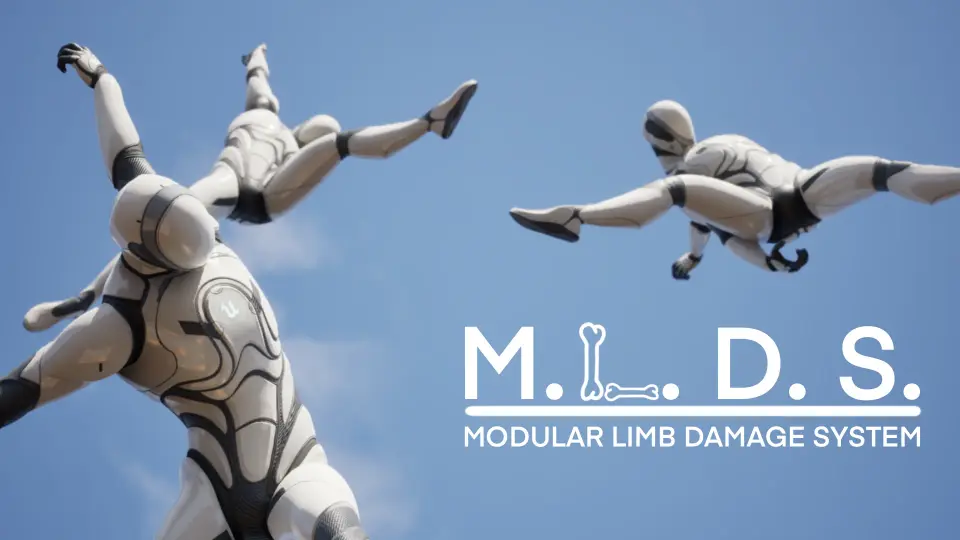
Runtime limb loss is one of those mechanics that feels great in a game until it has to survive contact with the animation system. Modular Limb Damage System (MLDS) keeps the implementation path short: the core is written in C++, the components are exposed to Blueprint, and the system produces runtime limb damage with configurable break and destroy events plus physics-driven limb detachment. The goal is to let a character lose a limb or take damage to a specific bone without chasing gameplay logic across every layer of the project.
Bone-based limb damage and per-limb health
Damage in MLDS is bone-based. You can apply damage to an individual bone, or you can target a whole limb hierarchy, with the plugin handling automatic traversal of that hierarchy. This matters in practice because it removes the need to hard-code break states for every individual body part. A hit that connects with an upper arm can resolve against the same hierarchical rules as a hit on the forearm, with the system deciding which bones are affected and how the damage flows through connected segments.
Each limb carries its own configurable health value, so a developer can tune a shoulder differently from a hand or set a leg to come off more easily than an arm. The system supports both partial and full limb destruction. A limb can remain connected after taking enough damage or it can be destroyed outright if the applied damage exceeds its threshold. Break events and destroy events are configurable, making it possible to trigger different feedback depending on how severe the hit is.
Runtime dismemberment and detached limb actors
Dismemberment in MLDS does not have to be a non-interactive effect. The plugin can detach limbs dynamically while the game is running, and it automatically traverses the bone hierarchy to decide what remains connected. A clean separation is maintained between the intact mesh on the character and the mesh that becomes the detached limb actor. That split prevents the usual side effects where a partially removed limb leaves corrupted geometry behind on the character.
The detached limb actor is a distinct piece of the system, so once a limb is removed it is no longer part of the character's mesh. Because the core logic runs in C++, the hierarchy traversal and detachment decisions stay efficient even during moments with multiple simultaneous hits. The same traversal ensures that partial destruction is handled consistently: some bones may still be connected while other portions of the limb have already broken away.
A component split instead of a monolithic system
MLDS is intentionally not a single monolithic gameplay module. The feature set comes in a few independent pieces: a limb mesh component, a limb damage component, and a detached limb actor. Optional editor helpers can assist during authoring, but they are not required for every setup. A project can take only the limb damage component and pair it with the limb mesh component, or it can skip the detached limb actor when full separation is unnecessary.
This modular shape carries over to the Blueprint side. The core logic is written in C++, but the plugin exposes Blueprint-friendly components and events. Gameplay designers can hook into those events and components without writing C++, while the heavier hierarchical and replication work stays in a compiled layer. Because the pieces are separated naturally, MLDS can be combined with other plugins or integrated into an existing character setup without forcing a rewrite of core gameplay or animation logic.
Server-authoritative logic for replicated detachment
Multiplayer projects need damage systems that do not rely on each client making its own call. MLDS is built for networked games from the ground up. The logic is server-authoritative, so the server is the deciding authority for when a limb breaks or detaches. Limb detachment is replication-safe, meaning the split between intact and detached meshes is not a visual trick that each machine has to guess at.
A server-confirmed break or destroy event can then be replicated to clients in a way that lines up with the rest of the networked simulation. This makes the system particularly useful for shooters and melee games where players need to see the same outcome at the same time. The server-authoritative approach also keeps bone hierarchy traversal consistent, preventing cases where the server sees a limb as detached while a client still sees it attached.
Fits across shooters, melee, horror, and simulation work
The damage mechanics in MLDS line up with several genres. Shooters benefit from limb-specific weak points, melee games can use dismemberment as a direct result of weapon impact, and horror or gore systems gain a non-scripted way to tear apart characters. The same tooling can be used in simulation-heavy projects where damage has to be systemic and repeatable, or in research and study projects that focus on how skeletal meshes handle runtime destruction.
Because MLDS is modular, teams can adopt only the pieces that fit their current need. A project that already has a custom damage system could use just the limb mesh component and detached limb actor, while a project starting fresh can lean on both the limb damage component and the optional editor helpers. The use of per-limb health and configurable break and destroy events keeps the system flexible enough to be reused across different gameplay settings.
Support and production angle
The plugin is built to be integrated, not to force a new architecture on a project. Its C++ core and Blueprint-accessible components make it possible to extend or adjust during production, and the modular pieces let development teams grow into the system over time. For any setup questions, the developer runs a Discord support channel where implementers can raise specific issues while wiring limb damage into their combat or gameplay code.
 Gameplay Features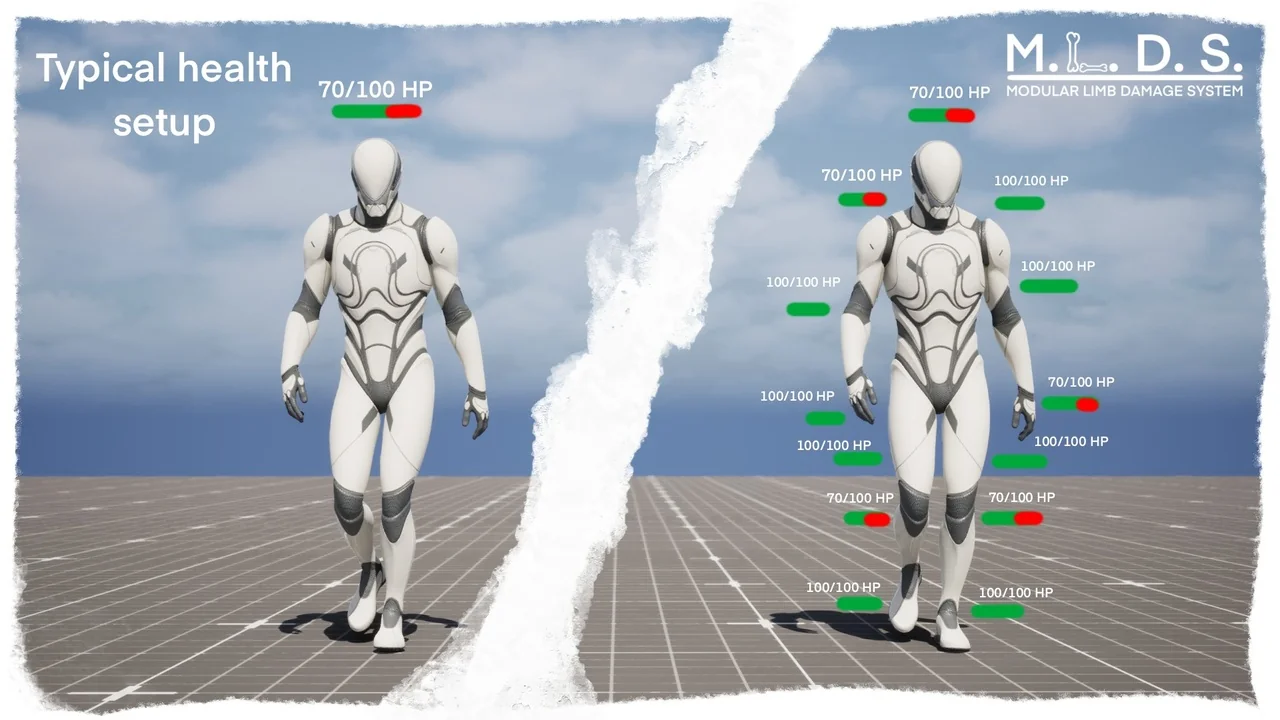
 Gameplay Features
 Gameplay Features
 Gameplay Features