"7066dd76da796369"{"id":"15027","slug":"instance-damage-system","title":"Instance Damage System","category":"Gameplay Features","engine":"5.3","assetVersion":"Engine version: 5.3","engineVersion":"5.1","tag":"Gameplay Features","accent":"blue","visual":"luts","summary":"The Instance Damage System provides a powerful solution for managing and destroying instanced static meshes in large environments. It features advanced networking, object pooling, and seamless World Partition support.","platform":"Unreal Engine","publishedAt":"2026-03-12T07:31:44.000Z","updatedAt":"2026-04-19T15:45:36.000Z","sourceNotes":[],"fileContents":[],"compatibility":["Unreal Engine","Engine version: 5.3"],"featuredImage":{"alt":"Instance Damage System","src":"https://3dcghub.com/wp-content/uploads/2026/03/8f410e85-6ba6-4752-ac1e-be0e965d9564.webp"},"hasDownloadLink":true,"downloads":0,"terms":[{"taxonomy":"category","slug":"gameplay-features-tools-and-plugins","name":"Gameplay Features"},{"taxonomy":"post_tag","slug":"environment","name":"Environment"},{"taxonomy":"post_tag","slug":"game-systems","name":"Game Systems"},{"taxonomy":"post_tag","slug":"plugins","name":"Plugins"},{"taxonomy":"post_tag","slug":"prop","name":"Prop"},{"taxonomy":"post_tag","slug":"tools","name":"Tools"},{"taxonomy":"post_tag","slug":"unreal-engine-5","name":"Unreal Engine 5"}],"galleryImages":[{"src":"https://3dcghub.com/wp-content/uploads/2026/03/c6ef2d10b9c2_0d36f4b8-fc52-41cb-8bd5-92b34c877159.webp","alt":"Instance Damage System"},{"src":"https://3dcghub.com/wp-content/uploads/2026/03/0cdd73d15485_9edadf73-28a2-4440-b10f-826ddbc4f1fb.webp","alt":"Instance Damage System"},{"src":"https://3dcghub.com/wp-content/uploads/2026/03/72e87526453c_e9265d2d-2fc2-49a1-be76-5e759e4e7e49.webp","alt":"Instance Damage System"},{"src":"https://3dcghub.com/wp-content/uploads/2026/03/24f47d1e169e_1bc6abe2-0b54-45bd-9727-eafbbecb0a0e.webp","alt":"Instance Damage System"},{"src":"https://3dcghub.com/wp-content/uploads/2026/03/213b00f225d3_38a1b0ea-67c9-41de-b248-f761571e68fa.webp","alt":"Instance Damage System"},{"src":"https://3dcghub.com/wp-content/uploads/2026/03/670285168521_57e8532b-fa8f-4ad5-a174-299a34238d0d.webp","alt":"Instance Damage System"},{"src":"https://3dcghub.com/wp-content/uploads/2026/03/1b420fe8da87_765a457a-0e6b-49c1-ba4d-e61f007eefca.webp","alt":"Instance Damage System"},{"src":"https://3dcghub.com/wp-content/uploads/2026/03/6f9dee64ba5d_17be5725-5aa2-4e81-b0ea-668cf638b8ae.webp","alt":"Instance Damage System"}],"accessPanel":{"kind":"resource","title":"Access this resource","eyebrow":"Free Download","message":"Log in or create a free account to start your download.","fileName":"Instance Damage System 5.3.7z","safetyNote":"All resources are 100% manually reviewed to eliminate all risks.","actionLabel":"Download Free","resourceType":"Resource archive"},"contentHtml":"\u003ch2\u003eAdvanced Interaction with Instanced Meshes\u003c/h2\u003e\n\u003cp\u003eThe Instance Damage System provides a robust solution for interacting with instanced static meshes (ISMCs) in an open-world environment. Furthermore, this system is ideal for developers creating GTA-style destruction or resource collection games. It manages props efficiently through a proxy system. Specifically, the creator designed it to register static mesh components as proxies, allowing for high-performance interaction with large numbers of objects.\u003c/p\u003e\n\n\u003ch2\u003eKey Features for Destruction and Respawning\u003c/h2\u003e\n\u003cp\u003eA primary benefit of the Instance Damage System is its ability to swap static instances with destructible actors. When an object takes damage, the system hides the original instance and spawns a destructible version in its place. Additionally, the system supports object pooling to reuse spawned objects efficiently. However, note that pooling is currently disabled for Chaos-based geometry collections in the example project.\u003c/p\u003e\n\n\u003cp\u003eTo maintain a living world, the system includes logic for respawning props over time. These respawns are calculated based on the distance to the player. Moreover, the system supports World Partition. This allows for visibility management even when proxies are not currently present in the level. Consequently, the world remains consistent and optimized.\u003c/p\u003e\n\n\u003ch2\u003eNetworking and Customization\u003c/h2\u003e\n\u003cp\u003eThe Instance Damage System is built with multiplayer functionality in mind. It offers three distinct network replication modes to suit different project needs:\u003c/p\u003e\n\u003cul\u003e\n\u003cli\u003e\u003cstrong\u003eClient Authoritative:\u003c/strong\u003e Clients spawn destructibles while the server handles damage detection and updates other clients.\u003c/li\u003e\n\u003cli\u003e\u003cstrong\u003eClient Replicated:\u003c/strong\u003e Clients spawn destructibles as a direct result of server replication.\u003c/li\u003e\n\u003cli\u003e\u003cstrong\u003eServer:\u003c/strong\u003e Destructible actors themselves are responsible for the replication process.\u003c/li\u003e\n\u003c/ul\u003e\n\n\u003cp\u003eDevelopers can also define custom data for each damage asset, such as experience points or currency rewards. Furthermore, the setup is simplified through data tables and is fully exposed to Blueprints. For advanced users, the C++ subsystem is extendable. This allows for custom virtual functions and new feature overrides to fit specific gameplay requirements.\u003c/p\u003e\n\n\u003ch2\u003ePractical Examples and Integration\u003c/h2\u003e\n\u003cp\u003eThe developer included an example project featuring several minigames built around the system. These include a Chaos minigame inspired by Mayhem activities and a destruction minigame involving random mesh targets. Additionally, there is a Wanted Level example where players earn stars based on the amount of damage caused. These examples demonstrate how easily the system integrates with existing gameplay logic.\u003c/p\u003e\n\n\u003cp\u003eThe clearest takeaway is that the Instance Damage System is a comprehensive tool for handling large-scale prop interaction. It balances performance with deep functionality. Whether you are building a resource gathering system or a chaotic urban sandbox, this tool provides the necessary framework for persistent and reactive environments.\u003c/p\u003e\n\n\u003ch2\u003eMore From The Same Workflow\u003c/h2\u003e\n\u003cul\u003e\n\u003cli\u003e\u003ca href=\"https://3dcghub.com/extile-plus-ultimate-non-tiling-material-toolkit-for-unreal-engine-environments/\" title=\"EXTILE PLUS -Ultimate Non-Tiling Material Toolkit for Unreal Engine Environments\"\u003eEXTILE PLUS -Ultimate Non-Tiling Material Toolkit for Unreal Engine Environments\u003c/a\u003e\u003c/li\u003e\n\u003cli\u003e\u003ca href=\"https://3dcghub.com/ultimate-template-unrealengine-2d-dialogue-inventory-system-save/\" title=\"ULTIMATE Template UnrealEngine || 2D + Dialogue + Inventory system + Save | |\"\u003eULTIMATE Template UnrealEngine || 2D + Dialogue + Inventory system + Save | |\u003c/a\u003e\u003c/li\u003e\n\u003cli\u003e\u003ca href=\"https://3dcghub.com/zxing-for-unreal/\" title=\"ZXing For Unreal\"\u003eZXing For Unreal\u003c/a\u003e\u003c/li\u003e\n\u003cli\u003e\u003ca href=\"https://3dcghub.com/daz-to-unreal/\" title=\"Daz To Unreal\"\u003eDaz To Unreal\u003c/a\u003e\u003c/li\u003e\n\u003cli\u003e\u003ca href=\"https://3dcghub.com/blueprint-generator-ai-kibibyte-labs-engine-assistant/\" title=\"Blueprint Generator Ai – Kibibyte Labs (Engine Assistant)\"\u003eBlueprint Generator Ai – Kibibyte Labs (Engine Assistant)\u003c/a\u003e\u003c/li\u003e\n\u003c/ul\u003e\n\n\u003ch2\u003eAsset Gallery\u003c/h2\u003e","contentTextLength":3263,"navigation":{"current":3425,"total":4016,"previous":{"id":"14989","slug":"component-timeline","title":"Component Timeline","category":"Gameplay Features","platform":"Unreal Engine","updatedAt":"2026-04-19T15:45:37.000Z"},"next":{"id":"15117","slug":"weapon-shooting-system-pro","title":"Weapon Shooting System Pro","category":"Gameplay Features","platform":"Unreal Engine","updatedAt":"2026-04-19T15:45:35.000Z"}},"relatedResources":[{"id":"15005","slug":"fire-chat-pro-groups-pms-proximity-and-world-chat-with-adjustable-range","title":"Fire Chat PRO – Groups, PMs, Proximity and World Chat with adjustable range","category":"Gameplay Features","engine":"5.3 - 5.7","assetVersion":"Engine version: 5.3 - 5.7","engineVersion":"Asset Version:1.0 - 1.3","tag":"Gameplay Features","accent":"blue","visual":"animation","summary":"Enhance your multiplayer project with Fire Chat PRO. This system offers unlimited channels, private messaging, and adjustable proximity chat for Unreal Engine developers.","platform":"Unreal Engine","publishedAt":"2026-03-12T07:22:05.000Z","updatedAt":"2026-04-19T15:45:37.000Z","sourceNotes":[],"fileContents":[],"compatibility":["Unreal Engine","Engine version: 5.3 - 5.7","Asset Version: 1.0 - 1.3"],"featuredImage":{"alt":"Fire Chat PRO – Groups, PMs, Proximity and World Chat with adjustable range","src":"https://3dcghub.com/wp-content/uploads/2026/03/8f314fa1-b51f-4e57-aeb3-ffbe08760427.webp"},"hasDownloadLink":true,"downloads":0},{"id":"15012","slug":"flex-partition-optimization-system","title":"Flex Partition - Optimization System","category":"Gameplay Features","engine":"5.5","assetVersion":"Engine version: 5.5","engineVersion":"Asset Version:1.7","tag":"Gameplay Features","accent":"blue","visual":"luts","summary":"Flex Partition - Optimization System offers a sophisticated way to manage runtime and procedural actors using spatial hash grids. It prevents frame spikes through rate-limited streaming while maintaining actor states during activation cycles.","platform":"Unreal Engine","publishedAt":"2026-03-12T07:25:29.000Z","updatedAt":"2026-04-19T15:45:37.000Z","sourceNotes":[],"fileContents":[],"compatibility":["Unreal Engine","Engine version: 5.5","Asset Version: 1.7"],"featuredImage":{"alt":"Flex Partition - Optimization System","src":"https://3dcghub.com/wp-content/uploads/2026/03/df6dfa1a-d220-474e-a529-dd86fc919bf8.webp"},"hasDownloadLink":true,"downloads":0},{"id":"15092","slug":"tile-based-minimap","title":"Tile Based Minimap","category":"Gameplay Features","engine":"5.3 - 5.5","assetVersion":"Asset Version: 1.2.2 - 2.1.1","engineVersion":"Engine Version: 5.3 - 5.5","tag":"Gameplay Features","accent":"blue","visual":"mech","summary":"The Tile Based Minimap system provides a robust solution for creating tiled in-game maps using pre-rendered level images. It features GPS-style routing, multi-grid support, and full Blueprint extensibility.","platform":"Unreal Engine","publishedAt":"2026-03-12T07:51:23.000Z","updatedAt":"2026-10-08T12:57:55.645Z","sourceNotes":[],"fileContents":[],"compatibility":["Unreal Engine","Asset Version: 1.2.2 - 2.1.1","Engine Version: 5.3 - 5.5"],"featuredImage":{"alt":"Tile Based Minimap","src":"https://3dcghub.com/wp-content/uploads/2026/03/768cc7d5-0ca5-439b-b02a-f4807a2c39bd.webp"},"hasDownloadLink":true,"downloads":5}]}
Gameplay Features
Instance Damage System
The Instance Damage System provides a powerful solution for managing and destroying instanced static meshes in large environments. It features advanced networking, object pooling, and seamless World Partition support.
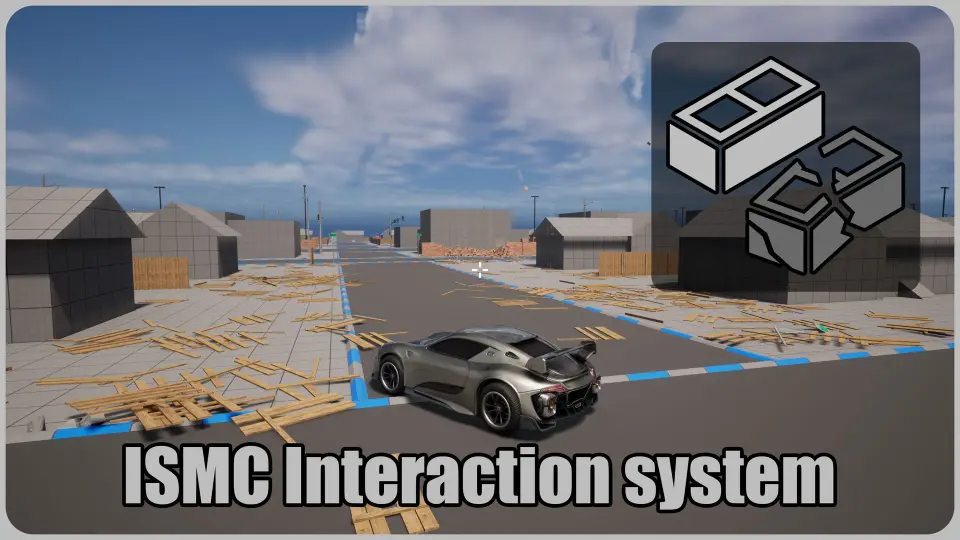
The Instance Damage System provides a robust solution for interacting with instanced static meshes (ISMCs) in an open-world environment. Furthermore, this system is ideal for developers creating GTA-style destruction or resource collection games. It manages props efficiently through a proxy system. Specifically, the creator designed it to register static mesh components as proxies, allowing for high-performance interaction with large numbers of objects.
Key Features for Destruction and Respawning
A primary benefit of the Instance Damage System is its ability to swap static instances with destructible actors. When an object takes damage, the system hides the original instance and spawns a destructible version in its place. Additionally, the system supports object pooling to reuse spawned objects efficiently. However, note that pooling is currently disabled for Chaos-based geometry collections in the example project.
To maintain a living world, the system includes logic for respawning props over time. These respawns are calculated based on the distance to the player. Moreover, the system supports World Partition. This allows for visibility management even when proxies are not currently present in the level. Consequently, the world remains consistent and optimized.
Networking and Customization
The Instance Damage System is built with multiplayer functionality in mind. It offers three distinct network replication modes to suit different project needs:
Client Authoritative: Clients spawn destructibles while the server handles damage detection and updates other clients.
Client Replicated: Clients spawn destructibles as a direct result of server replication.
Server: Destructible actors themselves are responsible for the replication process.
Developers can also define custom data for each damage asset, such as experience points or currency rewards. Furthermore, the setup is simplified through data tables and is fully exposed to Blueprints. For advanced users, the C++ subsystem is extendable. This allows for custom virtual functions and new feature overrides to fit specific gameplay requirements.
Practical Examples and Integration
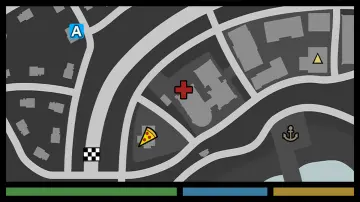
The developer included an example project featuring several minigames built around the system. These include a Chaos minigame inspired by Mayhem activities and a destruction minigame involving random mesh targets. Additionally, there is a Wanted Level example where players earn stars based on the amount of damage caused. These examples demonstrate how easily the system integrates with existing gameplay logic.
The clearest takeaway is that the Instance Damage System is a comprehensive tool for handling large-scale prop interaction. It balances performance with deep functionality. Whether you are building a resource gathering system or a chaotic urban sandbox, this tool provides the necessary framework for persistent and reactive environments.
 Gameplay Features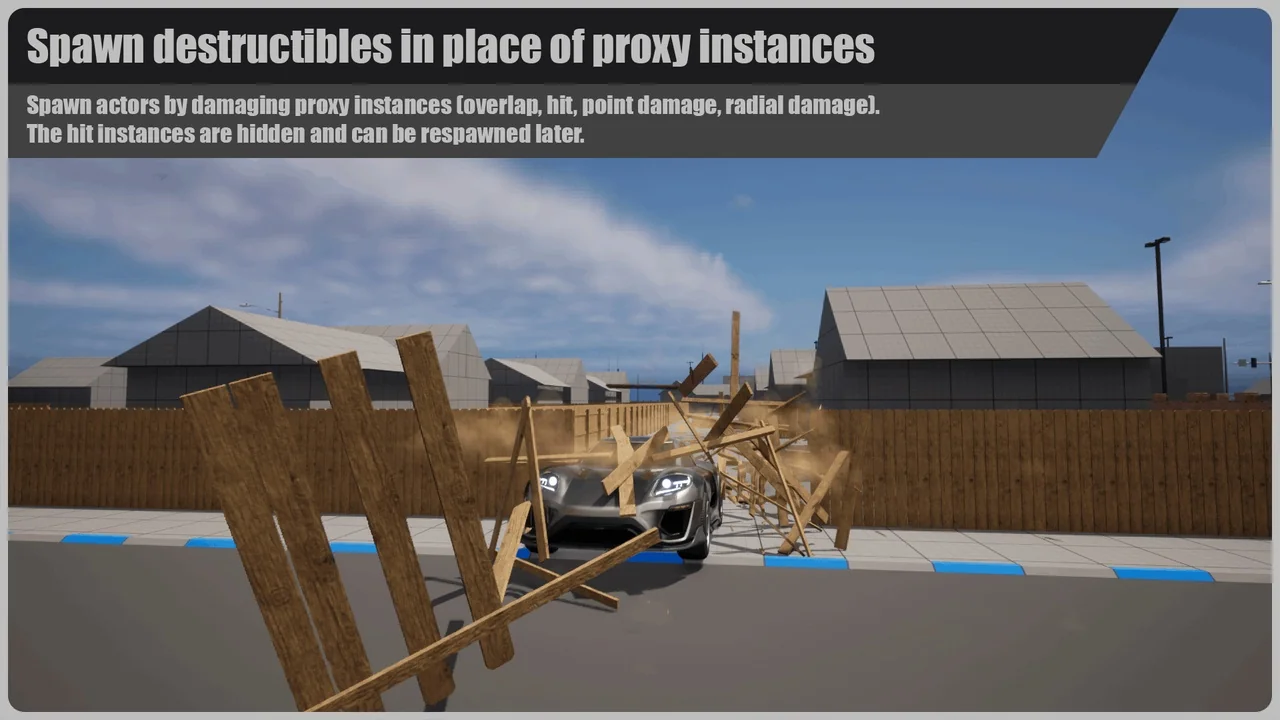
 Gameplay Features
 Gameplay Features
 Gameplay Features