"7b46a695175d8694"{"id":"1001534","slug":"mini-market-environment","title":"Mini Market Environment","category":"Cities","engine":"4.26+,5.0+","assetVersion":"","engineVersion":"Engine Version: 4.26+,5.0+","tag":"Cities","accent":"blue","visual":"city","summary":"Explore the Mini Market Environment featuring over 120 optimized game-ready props, gas station assets, PBR shaders, IES lighting, and indoor spaces.","platform":"Unreal Engine","publishedAt":"2026-10-09T17:27:19.818Z","updatedAt":"2026-10-09T17:27:19.818Z","sourceNotes":[],"fileContents":[],"compatibility":["Unreal Engine","Engine Version: 4.26+,5.0+"],"featuredImage":{"alt":"Mini Market Environment","src":"/wp-content/uploads/published/2026/10/e82a81188ca9-65856884-717d-404b-a19a-ec2a1862d057-e6bdf53317.webp"},"hasDownloadLink":true,"downloads":0,"terms":[{"taxonomy":"category","slug":"cities","name":"Cities"}],"galleryImages":[{"src":"/wp-content/uploads/published/2026/10/e357ee43c541-785526a7-628b-4f5d-b81e-4f5a8b9c8dd4-aad0ab73af.webp","alt":"Mini Market Environment"},{"src":"/wp-content/uploads/published/2026/10/fdd446531710-ed1b297c-7fa9-4f07-935f-10857037aaa1-ef12987a9e.webp","alt":"Mini Market Environment"},{"src":"/wp-content/uploads/published/2026/10/b78277e26276-b7892f3b-360a-40a9-8aab-8a30de5cac98-6a4c18d93c.webp","alt":"Mini Market Environment"},{"src":"/wp-content/uploads/published/2026/10/72d1ed45f497-5c11845e-65af-49eb-bd44-0f45d4bc4555-42355a9129.webp","alt":"Mini Market Environment"},{"src":"/wp-content/uploads/published/2026/10/72d82e7e49f8-12ce8f71-92a1-4341-9bc1-da2cec5aee37-bb92f5e8bc.webp","alt":"Mini Market Environment"},{"src":"/wp-content/uploads/published/2026/10/82cde2cc3a35-be9e8c66-4a28-4614-8306-a7e3bf5d8afe-d1319b6565.webp","alt":"Mini Market Environment"},{"src":"/wp-content/uploads/published/2026/10/cce7d65ea4ee-22bcf3fd-c9b1-4dc4-be3b-5fcc9903042c-6c7d24a3c5.webp","alt":"Mini Market Environment"},{"src":"/wp-content/uploads/published/2026/10/f13d8622d3cc-e63746e6-c4ac-4167-b164-0bd9475d8a30-e9fdf7abee.webp","alt":"Mini Market Environment"},{"src":"/wp-content/uploads/published/2026/10/5e70bb98dde4-c29bb5b2-dffb-49bf-80bf-c30a557b7ad1-142c250dde.webp","alt":"Mini Market Environment"},{"src":"/wp-content/uploads/published/2026/10/f046dbce1527-7c3763da-15e3-4c27-b604-49f58f7bb3ea-41a28ab9a4.webp","alt":"Mini Market Environment"}],"accessPanel":{"kind":"resource","title":"Download this resource","eyebrow":"Free Download","message":"Log in or create a free account to start your download.","fileName":"Mini Market Environment.7z","safetyNote":"Resources are manually reviewed before listing to improve quality and reduce obvious risks.","actionLabel":"Download Free","resourceType":"Resource archive"},"contentHtml":"\u003ch2\u003eDeploying the Mini Market Environment and Interior Spaces\u003c/h2\u003e\u003cp\u003eIntegrating a contemporary commercial setting into a game pipeline requires cohesive visual scaling, optimized geometry, and modular utility across both public and service zones. Mini Market Environment establishes this layout directly through a combined interior and exterior framework. Rather than restricting the play space to customer-facing aisles, the environment accounts for realistic structural workflows by including a dedicated technical room alongside a fully realized toilet room.\u003c/p\u003e\u003cp\u003eThese distinct sub-areas expand how a commercial building functions in a playable level. The main retail floor handles customer interaction zones, shelf arrangements, and checkout areas, while the technical room supports the unseen mechanical footprint of a working mini market. Including dedicated toilet room assets ensures seamless continuity for indoor exploration, stealth scenarios, or narrative encounters where players step away from primary retail aisles into service corridors. Because all assets are prepared specifically as optimized and game-ready models, loading these distinct interior sectors into an active scene avoids excessive performance overhead.\u003c/p\u003e\u003ch2\u003eExterior Forecourt and Gas Station Props Setup\u003c/h2\u003e\u003cp\u003eBeyond the retail doors, the environment bridges commercial retail with roadside vehicle services. The inclusion of specialized exterior infrastructure grounds the building in a modern transportation setting. Outdoor assets span essential refueling and transit hardware designed to populate an active forecourt.\u003c/p\u003e\u003cp\u003eSpecific exterior assets included in the collection comprise:\u003c/p\u003e\u003cul\u003e\u003cli\u003eGas pump units for standard fueling lanes\u003c/li\u003e\u003cli\u003eCar charging stations reflecting modern electric vehicle infrastructure\u003c/li\u003e\u003cli\u003eFunctional vehicle assets to park or position across the lot\u003c/li\u003e\u003cli\u003eExterior building elements and ventilation props mounted to walls or rooflines\u003c/li\u003e\u003c/ul\u003e\u003cp\u003ePlacing ventilation props across the exterior architecture establishes realistic silhouettes for the building envelope. Coupled with the gas pump islands and electric car charging stations, the exterior forecourt provides full context for roadside stops, suburban intersections, or standalone highway stations.\u003c/p\u003e\u003ch2\u003eStocking the Shelves with Market Props, Goods, and Perishables\u003c/h2\u003e\u003cp\u003ePopulating retail shelves demands significant asset variety to prevent obvious visual repetition across aisles. Mini Market Environment supplies over 120 objects that distribute across retail racks, storage bins, and floor displays. The asset selection spans dry goods, packaged products, and perishable foodstuffs required to convey an active grocery operation.\u003c/p\u003e\u003cp\u003eItem distribution within the market area incorporates:\u003c/p\u003e\u003cul\u003e\u003cli\u003eAssorted market props such as shelving units, counters, and general store fixtures\u003c/li\u003e\u003cli\u003ePackaged retail goods and individual product displays\u003c/li\u003e\u003cli\u003eIndividual bottles categorized across beverage racks and cold storage cases\u003c/li\u003e\u003cli\u003eFresh fruit models for produce stands and grocery displays\u003c/li\u003e\u003cli\u003eTechnical utility items and structural pieces suited for storage nooks\u003c/li\u003e\u003c/ul\u003e\u003cp\u003eThese pieces allow developers to stage dense commercial scenes ranging from fully stocked, active convenience stores to picked-over, abandoned grocery shelves. The variety of goods and loose bottles means individual aisles can carry distinct thematic identities without relying on identical prop clusters.\u003c/p\u003e\u003ch2\u003eSurface Material Pipeline with PBR Shaders and Decals\u003c/h2\u003e\u003cp\u003eSurface authenticity across the mini market relies on physically based rendering to handle diverse material types under changing illumination. Every asset across the collection utilizes PBR shaders, ensuring accurate interaction with direct sunlight on the asphalt as well as artificial fluorescent tubes indoors.\u003c/p\u003e\u003cp\u003eReflective plastics on bottles, matte surfaces on fresh fruit, painted metal on car charging stations, and industrial coatings on gas pumps react predictably across viewing angles. Complementing the core PBR material passes are custom decals. Decals add wear, functional markings, commercial signage accents, and localized surface breakup without increasing vertex density. Placing decals on walls, flooring, and forecourt pavement breaks up repetitive tiling, grounding pristine props into a weathered, believable world.\u003c/p\u003e\u003ch2\u003eConfiguring Illumination with IES Profiles and Lightmap Levels\u003c/h2\u003e\u003cp\u003eLighting in commercial properties features harsh fluorescent troffers, directional spotlighting over produce displays, focused safety lights in technical rooms, and wide floodlights over exterior gas islands. Mini Market Environment incorporates IES light profiles to replicate real-world photometric light emission patterns directly inside the engine.\u003c/p\u003e\u003cp\u003eUsing IES profiles ensures that light falloff, beam angles, and fixture hot spots mirror genuine retail lighting fixtures rather than simple mathematical point sources. To support optimized runtime performance on static architecture, the collection features a configured lightmap level setup. Baked lightmaps capture secondary bounce lighting throughout tightly enclosed spaces like the toilet room and technical room, delivering clean shadows and realistic ambient occlusion while keeping frame rates stable during gameplay.\u003c/p\u003e\u003ch2\u003eTechnical Room Organization and Asset Optimization\u003c/h2\u003e\u003cp\u003eManaging over 120 objects inside an interactive level requires disciplined asset optimization. The items within the Mini Market Environment are developed as next gen, game-ready assets engineered to maintain high visual fidelity without compromising frame budgets. Polygon counts, texture allocations, and material assignments are calibrated to ensure models can be placed in dense configurations throughout the grocery aisles and outdoor lots.\u003c/p\u003e\u003cp\u003eThe technical room elements—such as wall-mounted conduits, machinery housings, and ventilation props—enable level designers to flesh out utility corners that are often neglected in generic store kits. The environment also maintains compatibility with the Rome Empire Character Pack, permitting character asset integration within modern engine workflows.\u003c/p\u003e\u003ch2\u003eTarget Implementations for Retail and Roadside Levels\u003c/h2\u003e\u003cp\u003eThe flexibility of the included 120-plus assets makes Mini Market Environment suitable for a broad spectrum of real-time applications:\u003c/p\u003e\u003cul\u003e\u003cli\u003eSurvival horror titles requiring tight indoor spaces, unlit technical backrooms, and dimly lit service restrooms\u003c/li\u003e\u003cli\u003eUrban open-world games needing roadside gas stations and enterable mini markets for resource gathering\u003c/li\u003e\u003cli\u003eAction set-pieces situated around forecourt cover points, vehicles, gas pumps, and storefront windows\u003c/li\u003e\u003cli\u003eSimulation projects depicting everyday convenience store transactions, electric vehicle charging, or grocery inventory tasks\u003c/li\u003e\u003c/ul\u003e\u003cp\u003eBecause the pack spans structural rooms, detailed shelf inventory, exterior refueling props, and complete lighting profiles, developers can construct a cohesive roadside commercial complex without having to source separate kits for indoor goods, outdoor fuel points, and back-office utility rooms.\u003c/p\u003e\n\n\u003ch2\u003eExplore Similar Assets\u003c/h2\u003e\n\u003cul\u003e\n\u003cli\u003e\u003ca href=\"https://3dcghub.com/weapons-series-japan-weapons-mini-pack/\" title=\"Weapons Series - Japan Weapons - Mini Pack\"\u003eWeapons Series - Japan Weapons - Mini Pack\u003c/a\u003e\u003c/li\u003e\n\u003cli\u003e\u003ca href=\"https://3dcghub.com/nature-materials-ice/\" title=\"Nature Materials Ice\"\u003eNature Materials Ice\u003c/a\u003e\u003c/li\u003e\n\u003cli\u003e\u003ca href=\"https://3dcghub.com/postsoviet-city-pack/\" title=\"PostSoviet City Pack\"\u003ePostSoviet City Pack\u003c/a\u003e\u003c/li\u003e\n\u003cli\u003e\u003ca href=\"https://3dcghub.com/paradise-motel-modular-pack/\" title=\"Paradise Motel - Modular Pack\"\u003eParadise Motel - Modular Pack\u003c/a\u003e\u003c/li\u003e\n\u003cli\u003e\u003ca href=\"https://3dcghub.com/desert-environment/\" title=\"Desert Environment\"\u003eDesert Environment\u003c/a\u003e\u003c/li\u003e\n\u003c/ul\u003e","contentTextLength":7105,"navigation":{"current":10,"total":3481,"previous":{"id":"1001535","slug":"modular-interiors-and-explorer-props","title":"Modular Interiors and Explorer Props","category":"Interior","platform":"Unreal Engine","updatedAt":"2026-10-09T17:28:19.616Z"},"next":{"id":"1001533","slug":"medieval-stronghold-architecture","title":"Medieval Stronghold Architecture","category":"Fantasy","platform":"Unreal Engine","updatedAt":"2026-10-09T17:26:18.770Z"}},"relatedResources":[{"id":"5489","slug":"weapons-series-japan-weapons-mini-pack","title":"Weapons Series - Japan Weapons - Mini Pack","category":"Weapons \u0026 Combat","engine":"4.26+,5.0+","assetVersion":"Engine version: 4.26+,5.0+","engineVersion":"4.15","tag":"Weapons \u0026 Combat","accent":"blue","visual":"luts","summary":"Enhance your game with 14 realistic Japanese weapons. This pack includes katanas, shurikens, and more, featuring PBR textures and optimized materials.","platform":"Unreal Engine","publishedAt":"2026-02-15T15:32:33.000Z","updatedAt":"2026-04-19T15:56:56.000Z","sourceNotes":[],"fileContents":[],"compatibility":["Unreal Engine","Engine version: 4.26+,5.0+"],"featuredImage":{"alt":"Weapons Series - Japan Weapons - Mini Pack","src":"https://3dcghub.com/wp-content/uploads/2026/02/e6e9d393-4e66-4fb7-8371-6548fc81da52.webp"},"hasDownloadLink":true,"downloads":0},{"id":"1001355","slug":"nature-materials-ice","title":"Nature Materials Ice","category":"Cities","engine":"4.15+,5.0+","assetVersion":"","engineVersion":"Engine Version: 4.15+,5.0+","tag":"Cities","accent":"blue","visual":"luts","summary":"Examine the technical parameters, depth clouds, bump offset, and distance blending features available in the Nature Materials Ice shader system.","platform":"Unreal Engine","publishedAt":"2026-10-04T10:24:11.372Z","updatedAt":"2026-10-04T10:24:11.372Z","sourceNotes":[],"fileContents":[],"compatibility":["Unreal Engine","Engine Version: 4.15+,5.0+"],"featuredImage":{"alt":"Nature Materials Ice","src":"/wp-content/uploads/published/2026/10/180cc8364e7b-d9c98a66-c1d3-4d80-9a44-5ae55aa4ac0d-a2f5b5eb7d.webp"},"hasDownloadLink":true,"downloads":0},{"id":"1001413","slug":"postsoviet-city-pack","title":"PostSoviet City Pack","category":"Cities","engine":"4.26+,5.0+","assetVersion":"","engineVersion":"Engine Version: 4.26+,5.0+","tag":"Cities","accent":"blue","visual":"city","summary":"Construct authentic post-Soviet city environments using modular building segments, materials for fake interiors, roads, playgrounds, and utility mains.","platform":"Unreal Engine","publishedAt":"2026-10-05T06:21:00.890Z","updatedAt":"2026-10-05T06:21:00.890Z","sourceNotes":[],"fileContents":[],"compatibility":["Unreal Engine","Engine Version: 4.26+,5.0+"],"featuredImage":{"alt":"PostSoviet City Pack","src":"/wp-content/uploads/published/2026/10/638a9faee0c2-e2ee2726-9118-4949-9f85-7f90e6a51a7b-b1934f9667.webp"},"hasDownloadLink":true,"downloads":1}]}
Cities
Mini Market Environment
Explore the Mini Market Environment featuring over 120 optimized game-ready props, gas station assets, PBR shaders, IES lighting, and indoor spaces.
Category:Unreal Engine,CitiesPlatform: Unreal EngineEngine Version: 4.26+,5.0+Published: Oct 9, 2026
Cities
Resource overview
Deploying the Mini Market Environment and Interior Spaces
Integrating a contemporary commercial setting into a game pipeline requires cohesive visual scaling, optimized geometry, and modular utility across both public and service zones. Mini Market Environment establishes this layout directly through a combined interior and exterior framework. Rather than restricting the play space to customer-facing aisles, the environment accounts for realistic structural workflows by including a dedicated technical room alongside a fully realized toilet room.
These distinct sub-areas expand how a commercial building functions in a playable level. The main retail floor handles customer interaction zones, shelf arrangements, and checkout areas, while the technical room supports the unseen mechanical footprint of a working mini market. Including dedicated toilet room assets ensures seamless continuity for indoor exploration, stealth scenarios, or narrative encounters where players step away from primary retail aisles into service corridors. Because all assets are prepared specifically as optimized and game-ready models, loading these distinct interior sectors into an active scene avoids excessive performance overhead.
Exterior Forecourt and Gas Station Props Setup
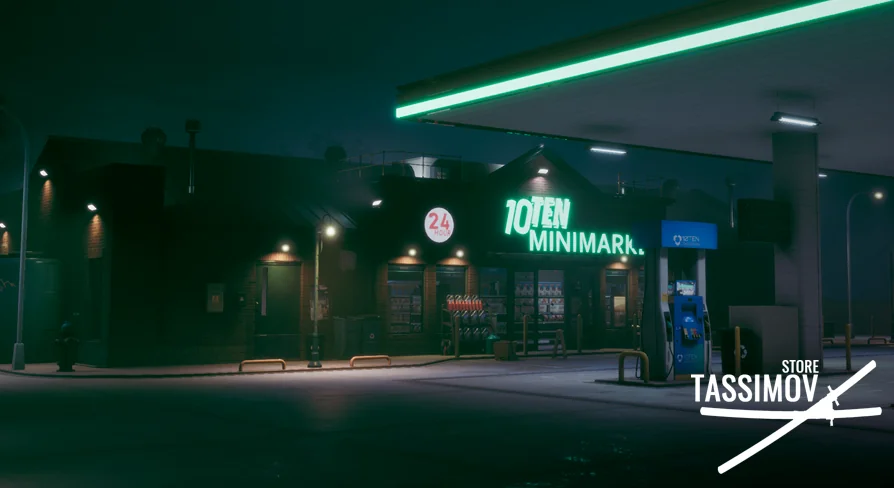
Beyond the retail doors, the environment bridges commercial retail with roadside vehicle services. The inclusion of specialized exterior infrastructure grounds the building in a modern transportation setting. Outdoor assets span essential refueling and transit hardware designed to populate an active forecourt.
Specific exterior assets included in the collection comprise:
Gas pump units for standard fueling lanes
Car charging stations reflecting modern electric vehicle infrastructure
Functional vehicle assets to park or position across the lot
Exterior building elements and ventilation props mounted to walls or rooflines
Placing ventilation props across the exterior architecture establishes realistic silhouettes for the building envelope. Coupled with the gas pump islands and electric car charging stations, the exterior forecourt provides full context for roadside stops, suburban intersections, or standalone highway stations.
Stocking the Shelves with Market Props, Goods, and Perishables
Populating retail shelves demands significant asset variety to prevent obvious visual repetition across aisles. Mini Market Environment supplies over 120 objects that distribute across retail racks, storage bins, and floor displays. The asset selection spans dry goods, packaged products, and perishable foodstuffs required to convey an active grocery operation.
Item distribution within the market area incorporates:
Assorted market props such as shelving units, counters, and general store fixtures
Packaged retail goods and individual product displays
Individual bottles categorized across beverage racks and cold storage cases
Fresh fruit models for produce stands and grocery displays
Technical utility items and structural pieces suited for storage nooks
These pieces allow developers to stage dense commercial scenes ranging from fully stocked, active convenience stores to picked-over, abandoned grocery shelves. The variety of goods and loose bottles means individual aisles can carry distinct thematic identities without relying on identical prop clusters.
Surface Material Pipeline with PBR Shaders and Decals
Surface authenticity across the mini market relies on physically based rendering to handle diverse material types under changing illumination. Every asset across the collection utilizes PBR shaders, ensuring accurate interaction with direct sunlight on the asphalt as well as artificial fluorescent tubes indoors.
Reflective plastics on bottles, matte surfaces on fresh fruit, painted metal on car charging stations, and industrial coatings on gas pumps react predictably across viewing angles. Complementing the core PBR material passes are custom decals. Decals add wear, functional markings, commercial signage accents, and localized surface breakup without increasing vertex density. Placing decals on walls, flooring, and forecourt pavement breaks up repetitive tiling, grounding pristine props into a weathered, believable world.
Configuring Illumination with IES Profiles and Lightmap Levels
Lighting in commercial properties features harsh fluorescent troffers, directional spotlighting over produce displays, focused safety lights in technical rooms, and wide floodlights over exterior gas islands. Mini Market Environment incorporates IES light profiles to replicate real-world photometric light emission patterns directly inside the engine.
Using IES profiles ensures that light falloff, beam angles, and fixture hot spots mirror genuine retail lighting fixtures rather than simple mathematical point sources. To support optimized runtime performance on static architecture, the collection features a configured lightmap level setup. Baked lightmaps capture secondary bounce lighting throughout tightly enclosed spaces like the toilet room and technical room, delivering clean shadows and realistic ambient occlusion while keeping frame rates stable during gameplay.
Technical Room Organization and Asset Optimization
Managing over 120 objects inside an interactive level requires disciplined asset optimization. The items within the Mini Market Environment are developed as next gen, game-ready assets engineered to maintain high visual fidelity without compromising frame budgets. Polygon counts, texture allocations, and material assignments are calibrated to ensure models can be placed in dense configurations throughout the grocery aisles and outdoor lots.
The technical room elements—such as wall-mounted conduits, machinery housings, and ventilation props—enable level designers to flesh out utility corners that are often neglected in generic store kits. The environment also maintains compatibility with the Rome Empire Character Pack, permitting character asset integration within modern engine workflows.
Target Implementations for Retail and Roadside Levels
The flexibility of the included 120-plus assets makes Mini Market Environment suitable for a broad spectrum of real-time applications:
Survival horror titles requiring tight indoor spaces, unlit technical backrooms, and dimly lit service restrooms
Urban open-world games needing roadside gas stations and enterable mini markets for resource gathering
Action set-pieces situated around forecourt cover points, vehicles, gas pumps, and storefront windows
Simulation projects depicting everyday convenience store transactions, electric vehicle charging, or grocery inventory tasks
Because the pack spans structural rooms, detailed shelf inventory, exterior refueling props, and complete lighting profiles, developers can construct a cohesive roadside commercial complex without having to source separate kits for indoor goods, outdoor fuel points, and back-office utility rooms.
 Cities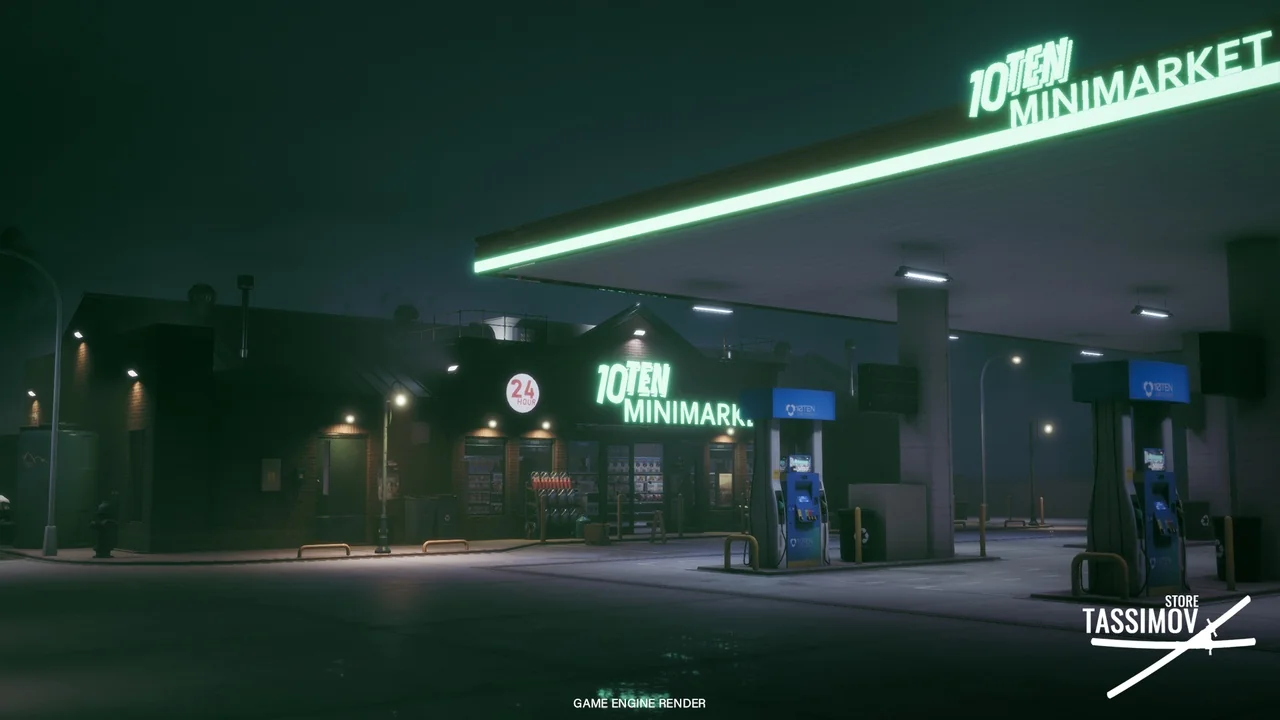
 Weapons & Combat
 Cities
 Cities