"5da73d49ff33a5b1"{"id":"1002392","slug":"medieval-girl","title":"Medieval Girl","category":"Humans","engine":"4.19+,5.0+","assetVersion":"","engineVersion":"Engine Version: 4.19+,5.0+","tag":"Humans","accent":"blue","visual":"mech","summary":"Examine the technical layout, modular setup, Epic Skeleton rigging, and ARKit blendshapes of the Medieval Girl 3D character asset.","platform":"Unreal Engine","indexPolicy":"index","publishedAt":"2026-11-10T04:17:58.165Z","updatedAt":"2026-11-10T04:17:58.165Z","sourceNotes":[],"fileContents":[],"compatibility":["Unreal Engine","Engine Version: 4.19+,5.0+"],"featuredImage":{"alt":"Medieval Girl","src":"/wp-content/uploads/published/2026/11/9e82bc2e09b3-9e7c2e43-aad9-4bb1-add2-43e8145276a3-3b60630b4d.webp"},"hasDownloadLink":true,"downloads":0,"terms":[{"taxonomy":"category","slug":"humans","name":"Humans"}],"galleryImages":[{"src":"/wp-content/uploads/published/2026/11/f5918b0305e9-9a71b2e1-060b-470f-be88-709b14cb742e-1ed1f04dc9.webp","alt":"Medieval Girl"},{"src":"/wp-content/uploads/published/2026/11/e92a82c0666d-d85df156-cf96-4b30-9321-623b526591e3-cd84473902.webp","alt":"Medieval Girl"},{"src":"/wp-content/uploads/published/2026/11/49060b93df23-45076036-3eb0-4880-8def-7d01b5f09752-540a1db981.webp","alt":"Medieval Girl"},{"src":"/wp-content/uploads/published/2026/11/013c9b28235c-c8a7a339-15e3-4ed2-b559-bd1cda9cb8fb-e41769cd21.webp","alt":"Medieval Girl"},{"src":"/wp-content/uploads/published/2026/11/240accae7370-1cbdcf47-2de4-461b-ba82-f8317d5f19e5-2b8d28d8b0.webp","alt":"Medieval Girl"},{"src":"/wp-content/uploads/published/2026/11/64220a4ea69b-6013d320-720c-4450-ad48-ae3784875785-f94084760a.webp","alt":"Medieval Girl"},{"src":"/wp-content/uploads/published/2026/11/c9ec3116dd52-bc114688-05af-4f89-b8d6-80777ac4b8c4-ab1591766c.webp","alt":"Medieval Girl"},{"src":"/wp-content/uploads/published/2026/11/e662fb6fceef-1213e060-adab-4a31-a054-8ea4e8cb3670-bf99b2900d.webp","alt":"Medieval Girl"},{"src":"/wp-content/uploads/published/2026/11/a697bb197ad7-e2f924fe-d458-4d30-af1c-4cbd9df33dc8-f529ff1ba4.webp","alt":"Medieval Girl"},{"src":"/wp-content/uploads/published/2026/11/31567fcaec1d-b42ebb09-5837-45d2-96db-6f193083df95-abdc114d48.webp","alt":"Medieval Girl"}],"accessPanel":{"kind":"resource","title":"Get this resource","eyebrow":"Free resource","message":"Download this resource in your browser.","fileName":"Content.7z","safetyNote":"Resources are manually reviewed before listing to improve quality and reduce obvious risks.","actionLabel":"Get this resource","resourceType":"Resource archive","versions":[]},"contentHtml":"\u003cp\u003eDivided into modular garment components, anatomical geometry, and specialized hair strands, Medieval Girl provides a fantasy warrior setup configured for real-time rendering. The core package centers on a female knight character displaying realistic and stylized Asian facial characteristics, delivered with separate meshes that can be detached, mixed, or hidden depending on rendering requirements. At base level (LOD 0), the geometry registers approximately 50,237 faces, 70,458 triangles, and 50,504 vertices. This density targets primary character applications where costume layering and silhouette definition must hold up under close-range camera passes.\u003c/p\u003e \u003cp\u003eThe mesh structure divides clothing and anatomy into interchangeable units. Outer wardrobe components are split between top garments and bottom pieces, allowing technical artists to strip away layers or exchange parts for alternative costuming. Because store publishing guidelines require strict handling of character forms, the underlying base body geometry is cut and censored beneath the clothing layers. Any props or weaponry shown in demonstrative promotional renders are excluded from the actual asset files, keeping the package strictly focused on the character's direct anatomical and sartorial assets.\u003c/p\u003e \u003ch2\u003eModular Anatomy and Mesh Assembly of the Medieval Girl\u003c/h2\u003e \u003cp\u003eModularity dictates the structural design of the geometry. Rather than delivering a single, collapsed mesh where boots, tunic, trousers, and skin share continuous topology, the character uses isolated modular pieces. You can isolate the head, retain the torso garments, or discard the lower clothing sections without compromising edge loops on surrounding panels. This decoupling simplifies clipping prevention, since sub-meshes occluded by heavier exterior layers can be toggled off inside an engine viewport or through rendering components.\u003c/p\u003e \u003cp\u003eThe base mesh shares historical design continuity with the Roxy rigged female base character platform, maintaining proportions suitable for knight and warrior archetypes. Because the asset maintains distinct mesh boundaries between the head, body, top, bottom, and hair elements, character customization screens can swap individual clothing slots directly. The mesh budget balances surface detail with runtime performance, distributing the 70,458 triangles primarily across visible folds, silhouette-defining armor contours, and strand-based hair cards to prevent faceted silhouettes during dynamic character movement.\u003c/p\u003e \u003ch2\u003eSkeleton Extensions and Rigging Architecture in Medieval Girl\u003c/h2\u003e \u003cp\u003eThe underlying deformation structure is mapped directly to the Epic Skeleton standard used throughout Unreal Engine. Utilizing this bone hierarchy ensures that standard animation libraries, locomotion systems, and combat animation cycles can be retargeted directly to the character without manual remapping of primary limbs. The core spine, pelvis, and limb chains preserve default orientations, minimizing joint twist artifacts when pulling animations from existing motion libraries.\u003c/p\u003e \u003cp\u003eBeyond standard humanoid bones, the skeleton incorporates dedicated secondary deformers to handle movement for non-rigid anatomical features and hair cards. These custom additions include:\u003c/p\u003e\n\u003cul\u003e \u003cli\u003eLeft and right breast bones (\u003ccode\u003eBreast_l\u003c/code\u003e And \u003ccode\u003eBreast_r\u003c/code\u003e) for secondary movement.\u003c/li\u003e \u003cli\u003eIndividual eye joints (\u003ccode\u003eEye_l\u003c/code\u003e And \u003ccode\u003eEye_r\u003c/code\u003e) allowing precise sightline adjustment independent of blendshape deformation.\u003c/li\u003e \u003cli\u003eSymmetrical front hair chains (\u003ccode\u003eHair_front_01_l\u003c/code\u003e Through \u003ccode\u003eHair_front_03_l\u003c/code\u003e, alongside matching right-side counterparts).\u003c/li\u003e \u003cli\u003eA central posterior hair chain (\u003ccode\u003eHair_back_mid_01\u003c/code\u003e Through \u003ccode\u003eHair_back_mid_03\u003c/code\u003e) built to handle running movement, wind effects, or procedural physics simulation.\u003c/li\u003e\n\u003c/ul\u003e \u003cp\u003eThese supplementary bones exist alongside the standard Epic hierarchy, allowing animators to drive hair and eye motions using procedural dynamic nodes, spring controllers, or hand-keyed sequences while maintaining retargeting compatibility on the main skeletal body.\u003c/p\u003e \u003ch2\u003eApple Blendshapes, ARKit, and Face Motion Capture\u003c/h2\u003e \u003cp\u003eFacial deformation avoids joint-only limitations by incorporating a comprehensive suite of morph targets mapped to the Apple ARKit standard. These blendshapes encompass the micro-movements required by modern facial performance systems, covering precise lip shapes, brow movements, cheek raises, and eyelid twitches. Because the shapes match standard ARKit naming conventions, the asset can be connected directly to live-streaming capture devices and iOS facial tracking inputs for real-time virtual production or streaming setups.\u003c/p\u003e \u003cp\u003eThe facial rig serves two distinct functional pipelines: live capture and scripted conversational dialogue. In cinematic sequences, dialogue animators can drive phonemes and emotional shifts through standard engine facial curves without hand-crafting complex deformer clusters. The integration of separate meshes and materials for teeth, tongue, eyes, and eyelashes ensures that wide facial openings and expressive morphing maintain correct depth and occlusion, avoiding surface clipping around the oral cavity or eyelids during extreme expressions.\u003c/p\u003e \u003ch2\u003e4K Texture Sets and Material Instance Customization\u003c/h2\u003e \u003cp\u003eSurface properties rely on a metallic-roughness PBR workflow, delivered across seven dedicated texture sets at 4K resolution. These groups separate the character into logical material domains:\u003c/p\u003e\n\u003cul\u003e \u003cli\u003eHead\u003c/li\u003e \u003cli\u003eBody\u003c/li\u003e \u003cli\u003eTop\u003c/li\u003e \u003cli\u003eBottom\u003c/li\u003e \u003cli\u003eHair\u003c/li\u003e \u003cli\u003eEyes\u003c/li\u003e \u003cli\u003eLashes and Teeth\u003c/li\u003e\n\u003c/ul\u003e \u003cp\u003eEach set supplies high-resolution maps covering albedo, normal, metallic, roughness, and opacity. The presence of discrete opacity maps governs strand transparency across the hair cards and eyelash geometry, creating natural transitions without heavy polygonal density. Normal maps capture micro-surface variations, including fabric weaves in the medieval attire, skin grain across the face, and edge bevels along leather straps.\u003c/p\u003e \u003cp\u003eTo enable rapid aesthetic variations without requiring external texture painting programs, the Unreal Engine 4 setup utilizes pre-configured Material Instances backed by included MatID masks. The MatID channels identify discrete sub-elements of the clothing and gear, allowing developers to isolate collars, trim, leather panels, or cloth accents within the shader graph. By altering color parameters directly inside material instances, wardrobe palettes can be recolored on the fly while retaining the underlying roughness and normal map detail.\u003c/p\u003e \u003ch2\u003ePipeline Placement and Engine Setup\u003c/h2\u003e \u003cp\u003eIntegrating the character into an interactive project requires establishing technical logic on the user end. The asset provides the visual and skeletal groundwork—skeletal meshes, textures, materials, and morph targets—but deliberately omits Blueprints. Developers must supply their own Character Blueprints, state machines, and input mechanics to tie the model into interactive player controllers or AI behavior trees. The retargeting-ready Epic Skeleton ensures that assigning a standard locomotion state machine requires only standard retargeting steps in Unreal Engine.\u003c/p\u003e \u003cp\u003eThe combination of ARKit facial shapes, modular mesh segments, and standard skeleton architecture fits the model for dialogue-heavy fantasy adventures, third-person action titles, or digital host streaming avatars. Because the asset delivers 4K texture data, isolated secondary bones for dynamic hair, and comprehensive facial morphs, it handles close-up cinematic framing as cleanly as dynamic gameplay traversal, provided that project teams supply the overarching execution logic.\u003c/p\u003e\n\n\u003ch2\u003eMore From The Same Workflow\u003c/h2\u003e\n\u003cul\u003e\n\u003cli\u003e\u003ca href=\"https://3dcghub.com/anime-girl-cleric/\" rel=\"noopener noreferrer\"\u003eAnime Girl Cleric\u003c/a\u003e\u003c/li\u003e\n\u003cli\u003e\u003ca href=\"https://3dcghub.com/winsome-girl/\" rel=\"noopener noreferrer\"\u003eWinsome Girl\u003c/a\u003e\u003c/li\u003e\n\u003cli\u003e\u003ca href=\"https://3dcghub.com/xiao-jue-asian-girl/\" rel=\"noopener noreferrer\"\u003eXiao Jue - Asian Girl\u003c/a\u003e\u003c/li\u003e\n\u003cli\u003e\u003ca href=\"https://3dcghub.com/assassin-girl-modular/\" rel=\"noopener noreferrer\"\u003eAssassin Girl Modular\u003c/a\u003e\u003c/li\u003e\n\u003cli\u003e\u003ca href=\"https://3dcghub.com/survivor-girl-1-modular/\" rel=\"noopener noreferrer\"\u003eSurvivor Girl 1 (Modular)\u003c/a\u003e\u003c/li\u003e\n\u003c/ul\u003e","contentTextLength":7588,"navigation":{"current":28,"total":4340,"previous":{"id":"1002393","slug":"novice-girl","title":"Novice Girl","category":"Characters \u0026 Creatures","platform":"Unreal Engine","updatedAt":"2026-11-10T04:18:53.597Z"},"next":{"id":"1002391","slug":"mechanic-girl","title":"Mechanic Girl","category":"Humans","platform":"Unreal Engine","updatedAt":"2026-11-10T04:16:59.332Z"}},"relatedResources":[{"id":"1002406","slug":"death-archer-girl-morgana","title":"Death Archer Girl Morgana","category":"Humans","engine":"4.24+,5.0+","assetVersion":"","engineVersion":"Engine Version: 4.24+,5.0+","tag":"Humans","accent":"blue","visual":"mech","summary":"Death Archer Girl Morgana is a modular, fully rigged UE5 character with 52 ARKit blendshapes, MatID color swaps, 4K textures and a bow for dark fantasy scenes.","platform":"Unreal Engine","indexPolicy":"index","publishedAt":"2026-11-10T12:02:23.586Z","updatedAt":"2026-11-10T12:02:23.586Z","sourceNotes":[],"fileContents":[],"compatibility":["Unreal Engine","Engine Version: 4.24+,5.0+"],"featuredImage":{"alt":"Death Archer Girl Morgana","src":"/wp-content/uploads/published/2026/11/ea8636dbb6df-2816da73-8314-4654-b908-7327f7cfd95e-bbd131ee7b.webp"},"hasDownloadLink":true,"downloads":0},{"id":"1002405","slug":"samurai-girl-tomoe","title":"Samurai Girl Tomoe","category":"Humans","engine":"4.19+,5.0+","assetVersion":"","engineVersion":"Engine Version: 4.19+,5.0+","tag":"Humans","accent":"blue","visual":"mech","summary":"Modular 3D warrior character Samurai Girl Tomoe featuring 52 ARKit blendshapes, 4K packed textures, and an Epic Skeleton rig for action games.","platform":"Unreal Engine","indexPolicy":"index","publishedAt":"2026-11-10T07:07:18.175Z","updatedAt":"2026-11-10T07:07:18.175Z","sourceNotes":[],"fileContents":[],"compatibility":["Unreal Engine","Engine Version: 4.19+,5.0+"],"featuredImage":{"alt":"Samurai Girl Tomoe","src":"/wp-content/uploads/published/2026/11/5c46690700c0-95be6877-7081-4ad3-b57c-fd636373f3cb-40e5943225.webp"},"hasDownloadLink":true,"downloads":0},{"id":"1002403","slug":"customizable-school-girls","title":"Customizable School Girls","category":"Humans","engine":"4.19+,5.0+","assetVersion":"","engineVersion":"Engine Version: 4.19+,5.0+","tag":"Humans","accent":"blue","visual":"mech","summary":"Explore Customizable School Girls, a modular 3D character featuring 4K PBR textures, Live Link blendshapes, cloth simulation, and Epic Skeleton rigging.","platform":"Unreal Engine","indexPolicy":"index","publishedAt":"2026-11-10T05:14:18.764Z","updatedAt":"2026-11-10T05:14:18.764Z","sourceNotes":[],"fileContents":[],"compatibility":["Unreal Engine","Engine Version: 4.19+,5.0+"],"featuredImage":{"alt":"Customizable School Girls","src":"/wp-content/uploads/published/2026/11/e27de06de645-c3c2e3d3-1425-47ac-a056-100d6670b067-63cb3abe64.webp"},"hasDownloadLink":true,"downloads":0}]}
Humans
Medieval Girl
Examine the technical layout, modular setup, Epic Skeleton rigging, and ARKit blendshapes of the Medieval Girl 3D character asset.
Category:Unreal Engine,HumansPlatform: Unreal EngineEngine Version: 4.19+,5.0+Published: Nov 10, 2026
Humans
Resource overview
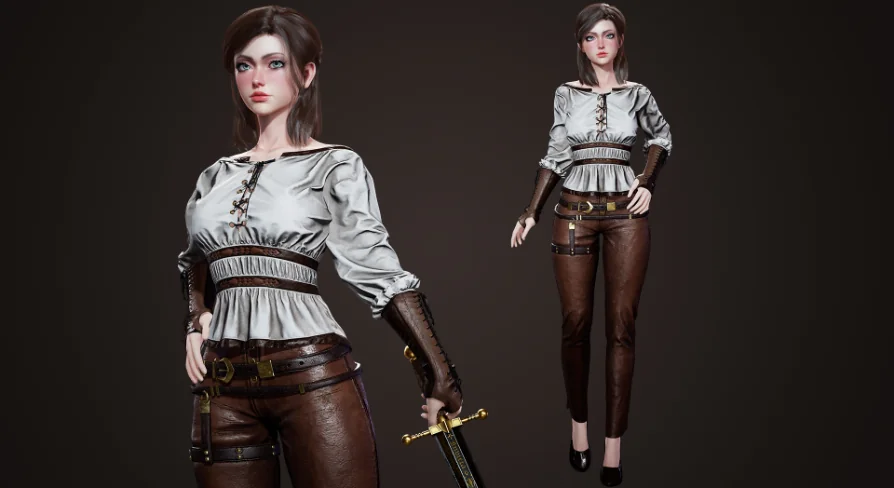
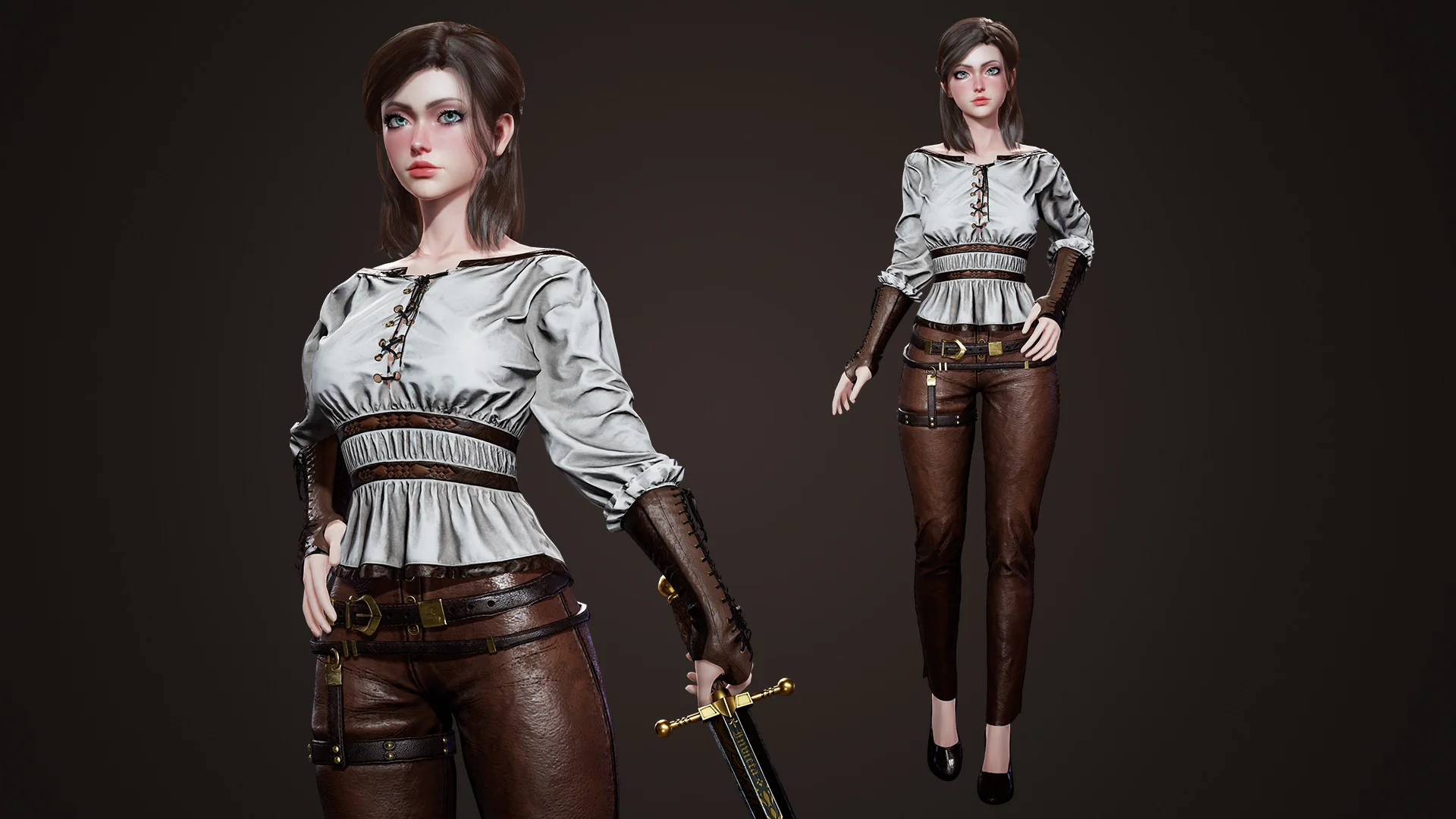
Divided into modular garment components, anatomical geometry, and specialized hair strands, Medieval Girl provides a fantasy warrior setup configured for real-time rendering. The core package centers on a female knight character displaying realistic and stylized Asian facial characteristics, delivered with separate meshes that can be detached, mixed, or hidden depending on rendering requirements. At base level (LOD 0), the geometry registers approximately 50,237 faces, 70,458 triangles, and 50,504 vertices. This density targets primary character applications where costume layering and silhouette definition must hold up under close-range camera passes.
The mesh structure divides clothing and anatomy into interchangeable units. Outer wardrobe components are split between top garments and bottom pieces, allowing technical artists to strip away layers or exchange parts for alternative costuming. Because store publishing guidelines require strict handling of character forms, the underlying base body geometry is cut and censored beneath the clothing layers. Any props or weaponry shown in demonstrative promotional renders are excluded from the actual asset files, keeping the package strictly focused on the character's direct anatomical and sartorial assets.
Modular Anatomy and Mesh Assembly of the Medieval Girl
Modularity dictates the structural design of the geometry. Rather than delivering a single, collapsed mesh where boots, tunic, trousers, and skin share continuous topology, the character uses isolated modular pieces. You can isolate the head, retain the torso garments, or discard the lower clothing sections without compromising edge loops on surrounding panels. This decoupling simplifies clipping prevention, since sub-meshes occluded by heavier exterior layers can be toggled off inside an engine viewport or through rendering components.
The base mesh shares historical design continuity with the Roxy rigged female base character platform, maintaining proportions suitable for knight and warrior archetypes. Because the asset maintains distinct mesh boundaries between the head, body, top, bottom, and hair elements, character customization screens can swap individual clothing slots directly. The mesh budget balances surface detail with runtime performance, distributing the 70,458 triangles primarily across visible folds, silhouette-defining armor contours, and strand-based hair cards to prevent faceted silhouettes during dynamic character movement.
Skeleton Extensions and Rigging Architecture in Medieval Girl
The underlying deformation structure is mapped directly to the Epic Skeleton standard used throughout Unreal Engine. Utilizing this bone hierarchy ensures that standard animation libraries, locomotion systems, and combat animation cycles can be retargeted directly to the character without manual remapping of primary limbs. The core spine, pelvis, and limb chains preserve default orientations, minimizing joint twist artifacts when pulling animations from existing motion libraries.
Beyond standard humanoid bones, the skeleton incorporates dedicated secondary deformers to handle movement for non-rigid anatomical features and hair cards. These custom additions include:
Left and right breast bones (Breast_l And Breast_r) for secondary movement.
Individual eye joints (Eye_l And Eye_r) allowing precise sightline adjustment independent of blendshape deformation.
Symmetrical front hair chains (Hair_front_01_l Through Hair_front_03_l, alongside matching right-side counterparts).
A central posterior hair chain (Hair_back_mid_01 Through Hair_back_mid_03) built to handle running movement, wind effects, or procedural physics simulation.
These supplementary bones exist alongside the standard Epic hierarchy, allowing animators to drive hair and eye motions using procedural dynamic nodes, spring controllers, or hand-keyed sequences while maintaining retargeting compatibility on the main skeletal body.
Apple Blendshapes, ARKit, and Face Motion Capture
Facial deformation avoids joint-only limitations by incorporating a comprehensive suite of morph targets mapped to the Apple ARKit standard. These blendshapes encompass the micro-movements required by modern facial performance systems, covering precise lip shapes, brow movements, cheek raises, and eyelid twitches. Because the shapes match standard ARKit naming conventions, the asset can be connected directly to live-streaming capture devices and iOS facial tracking inputs for real-time virtual production or streaming setups.
The facial rig serves two distinct functional pipelines: live capture and scripted conversational dialogue. In cinematic sequences, dialogue animators can drive phonemes and emotional shifts through standard engine facial curves without hand-crafting complex deformer clusters. The integration of separate meshes and materials for teeth, tongue, eyes, and eyelashes ensures that wide facial openings and expressive morphing maintain correct depth and occlusion, avoiding surface clipping around the oral cavity or eyelids during extreme expressions.
4K Texture Sets and Material Instance Customization
Surface properties rely on a metallic-roughness PBR workflow, delivered across seven dedicated texture sets at 4K resolution. These groups separate the character into logical material domains:
Head
Body
Top
Bottom
Hair
Eyes
Lashes and Teeth
Each set supplies high-resolution maps covering albedo, normal, metallic, roughness, and opacity. The presence of discrete opacity maps governs strand transparency across the hair cards and eyelash geometry, creating natural transitions without heavy polygonal density. Normal maps capture micro-surface variations, including fabric weaves in the medieval attire, skin grain across the face, and edge bevels along leather straps.
To enable rapid aesthetic variations without requiring external texture painting programs, the Unreal Engine 4 setup utilizes pre-configured Material Instances backed by included MatID masks. The MatID channels identify discrete sub-elements of the clothing and gear, allowing developers to isolate collars, trim, leather panels, or cloth accents within the shader graph. By altering color parameters directly inside material instances, wardrobe palettes can be recolored on the fly while retaining the underlying roughness and normal map detail.
Pipeline Placement and Engine Setup
Integrating the character into an interactive project requires establishing technical logic on the user end. The asset provides the visual and skeletal groundwork—skeletal meshes, textures, materials, and morph targets—but deliberately omits Blueprints. Developers must supply their own Character Blueprints, state machines, and input mechanics to tie the model into interactive player controllers or AI behavior trees. The retargeting-ready Epic Skeleton ensures that assigning a standard locomotion state machine requires only standard retargeting steps in Unreal Engine.
The combination of ARKit facial shapes, modular mesh segments, and standard skeleton architecture fits the model for dialogue-heavy fantasy adventures, third-person action titles, or digital host streaming avatars. Because the asset delivers 4K texture data, isolated secondary bones for dynamic hair, and comprehensive facial morphs, it handles close-up cinematic framing as cleanly as dynamic gameplay traversal, provided that project teams supply the overarching execution logic.
 Humans
 Humans
 Humans
 Humans