"ae2217ad8e73450c"{"id":"1003039","slug":"ladders-and-ledges-animset","title":"Ladders and Ledges Animset","category":"Variety","engine":"4.19+,5.0+","assetVersion":"","engineVersion":"Engine Version: 4.19+,5.0+","tag":"Variety","accent":"blue","visual":"mech","summary":"A comprehensive breakdown of the Ladders and Ledges Animset, featuring over 130 motion capture animations for vertical navigation, climbing, and locomotion.","platform":"Unreal Engine","indexPolicy":"index","publishedAt":"2026-11-25T16:59:14.332Z","updatedAt":"2026-11-25T16:59:14.332Z","sourceNotes":[],"fileContents":[],"compatibility":["Unreal Engine","Engine Version: 4.19+,5.0+"],"featuredImage":{"alt":"Ladders and Ledges Animset","src":"/wp-content/uploads/published/2026/11/52a8d97f5da2-3fe86dab-c1aa-4dea-b20b-d604ae4c9189-31b3720840.webp"},"hasDownloadLink":true,"downloads":0,"terms":[{"taxonomy":"category","slug":"variety-animations","name":"Variety"}],"galleryImages":[{"src":"/wp-content/uploads/published/2026/11/180dd5ef8e9b-470210cb-013a-4022-94d4-f0653f05c330-74460ddd98.webp","alt":"Ladders and Ledges Animset"},{"src":"/wp-content/uploads/published/2026/11/4aa5c6d51d79-b648aace-6d74-4c73-b2b6-974476d9b663-6ae8406a3f.webp","alt":"Ladders and Ledges Animset"},{"src":"/wp-content/uploads/published/2026/11/f4e880a00b55-cc15e1e0-1f89-4422-806f-2bad4d778354-1fed723adc.webp","alt":"Ladders and Ledges Animset"},{"src":"/wp-content/uploads/published/2026/11/05b46901d511-c128e035-fb97-4330-84d1-0989ace3b276-b82fd4c652.webp","alt":"Ladders and Ledges Animset"},{"src":"/wp-content/uploads/published/2026/11/db50122f6b88-0df73244-3b37-46ba-9037-95250c20db96-592e69fc55.webp","alt":"Ladders and Ledges Animset"},{"src":"/wp-content/uploads/published/2026/11/c7619f79846c-bd402324-f0f3-40b5-9674-a190154fb04b-b2cd84a233.webp","alt":"Ladders and Ledges Animset"},{"src":"/wp-content/uploads/published/2026/11/fc1d7a7aa3ec-4831f5c7-433f-4965-8f43-b0aae2b7c99c-6f1eb49d2e.webp","alt":"Ladders and Ledges Animset"}],"accessPanel":{"kind":"resource","title":"Get this resource","safetyNote":"Resources are manually reviewed before listing to improve quality and reduce obvious risks.","fileName":"Content.7z","resourceType":"Resource archive","versions":[]},"contentHtml":"\u003cp\u003eOver 130 motion capture animations comprise the Ladders and Ledges Animset, focusing on vertical traversal, structure clambering, ground locomotion, and physical environment interaction. Character mobility in games often breaks down when shifting from flat terrain to vertical assets like rungs and wall edges. This collection provides the intermediary steps, directional shifts, and momentum changes needed to bridge horizontal movement with vertical obstacle navigation.\u003c/p\u003e \u003ch2\u003eMotion Capture Mechanics in the Ladders and Ledges Animset\u003c/h2\u003e\n\u003cp\u003eOptical or inertial tracking data provides the physical weight present throughout the collection. Motion capture captures the minute shifts in balance, foot placement, and hand adjustment that define realistic human climbing. Because vertical navigation places substantial physical resistance on a character, standard interpolated rotations often look weightless. The animations in this set maintain the center-of-mass shifts that occur when a character reaches for an elevated rung or shifts lateral position against a flat vertical plane.\u003c/p\u003e\n\u003cp\u003eA key focus within the collection is the universal handling of character gaits. The data is designed and suitable for the gaits of both male and female characters. Rather than forcing stylized or exaggerated movements that restrict use to a single character archetype, the captures emphasize clean, direct, and biomechanically neutral trajectories. This makes the data set adaptable across varying character proportions, skeletal rigs, and silhouette designs without causing immediate motion artifacts or unnatural hip sway during climbing cycles.\u003c/p\u003e \u003ch2\u003eLadder Traversal, Mounting, and Mid-Air Transitions\u003c/h2\u003e\n\u003cp\u003eMoving across rungs requires distinct states beyond simple vertical loops. Characters need logical entries, exits, and reactive transitions to navigate ladders without snapping between ground and climb states. The set contains continuous ascending and descending movements that reflect fluid, uninterrupted climbing speed. Hand and foot coordination follows an alternating cadence, avoiding mechanical or rigid frame pacing.\u003c/p\u003e\n\u003cp\u003eEntry and exit logic is handled via explicit mount and unmount cycles built for both the top and the bottom of the ladder:\u003c/p\u003e\n\u003cul\u003e\n\u003cli\u003eMounting from the bottom positions the character securely onto the first rungs before full ascension begins.\u003c/li\u003e\n\u003cli\u003eUnmounting at the bottom allows the character to step down, plant their feet, and resume standard footing on the floor.\u003c/li\u003e\n\u003cli\u003eMounting from the top controls the deliberate backward step and weight transfer required to lower the body from a high platform onto the ladder.\u003c/li\u003e\n\u003cli\u003eUnmounting at the top carries the character up over the final rungs, lifting the body cleanly onto the upper floor surface.\u003c/li\u003e\n\u003c/ul\u003e\n\u003cp\u003eDynamic movement around ladders is not confined to slow, methodical mounting. Characters can initiate jumps directly toward a ladder, grab the rungs mid-air, and arrest their downward momentum. The set also supports leaps away from a ladder, facilitating fast dismounts or evasion maneuvers. In scenarios where a character falls from an elevated hazard or drops from an overhead position, landing animations specifically tuned for catching or hitting ladders allow characters to stick the impact without resetting into generic ground impact poses.\u003c/p\u003e \u003ch2\u003eFull 360-Degree Vertical Wall and Ledges Navigation\u003c/h2\u003e\n\u003cp\u003eBeyond isolated rungs, vertical spaces frequently require characters to traverse flat facades and sheer drops. The Ladders and Ledges Animset incorporates a 360-degree range of motion across eight discrete directional paths along vertical walls. This includes standard upward, downward, leftward, and rightward locomotion, alongside four diagonal pathways: moving up-left, up-right, down-left, and down-right across the vertical surface.\u003c/p\u003e\n\u003cp\u003eDiagonal navigation accounts for the asymmetrical reach required when a climber pulls themselves diagonally across a wall. Instead of relying on blended directional matrices that slide hands unnaturally across flat surfaces, the captured sequences track the torso shifts, cross-hand reaches, and coordinated foot shuffles necessary to navigate diagonal vectors. This ensures that when a character traverses sideways and upward simultaneously, the limbs maintain a grounded sense of grip and leverage.\u003c/p\u003e\n\u003cp\u003eWall navigation is complemented by structural transition sequences. Characters can mount vertical walls from lower ground positions, latching onto edges or handholds to begin their ascent. Once they reach the crest of a wall, dedicated climb-off animations pull the body up and over the upper ledge, depositing the character onto their feet at the top surface. These boundary animations prevent abrupt cutoffs between climbing states and standing idle states.\u003c/p\u003e \u003ch2\u003eGround Locomotion, Air States, and Box Interaction\u003c/h2\u003e\n\u003cp\u003eThe collection extends beyond elevated rungs and wall holds by supplying ground-level actions that integrate with vertical paths. Standard ground locomotion and jumping animations are present within the set, establishing continuity between approaching an obstacle, leaping toward it, and resuming ground movement on the opposite side. This continuity minimizes stylistic gaps between standard run cycles and specialized climbing actions.\u003c/p\u003e\n\u003cp\u003eAir traversal includes multiple jumping, falling, and landing variations. Differences in jump velocity and fall height require varied landing responses, from soft absorptions to heavier impacts where the character must steady their balance before standing. These falling states accommodate both clean drops and unexpected slips from high ledges, allowing developers to implement varying levels of physical consequence for missed ledge grabs.\u003c/p\u003e\n\u003cp\u003eEnvironmental puzzle solving and physical interactions are supported by object manipulation sequences. The library includes animations for grabbing and pulling boxes. These actions mirror the physical tension seen in the climbing clips, tracking hand placement, arm pull, and foot braces against the floor as the character bears the weight of an external object. Including object manipulation alongside ledge climbing supports interactive level designs where movable obstacles and dynamic climb paths are directly linked.\u003c/p\u003e \u003ch2\u003eTechnical Breadth of the Traversal Set\u003c/h2\u003e\n\u003cp\u003eBecause the Ladders and Ledges Animset packages more than 130 discrete clips, developers can build multi-layered state machines without reusing identical frames for distinct actions. The coverage encompasses rapid jumps to ladders, controlled unmounts from top decks, omnidirectional diagonal climbing against sheer vertical surfaces, and ground-level cargo handling. Combining standard locomotion with climbing mechanics provides the base animation data needed to construct cohesive vertical traversal systems across both male and female character setups.\u003c/p\u003e\n\n\u003ch2\u003eMore From The Same Workflow\u003c/h2\u003e\n\u003cul\u003e\n\u003cli\u003e\u003ca href=\"https://3dcghub.com/open-world-animset/\" rel=\"noopener noreferrer\"\u003eOpen World Animset\u003c/a\u003e\u003c/li\u003e\n\u003cli\u003e\u003ca href=\"https://3dcghub.com/idle-animset-pack/\" rel=\"noopener noreferrer\"\u003eIdle Animset Pack\u003c/a\u003e\u003c/li\u003e\n\u003cli\u003e\u003ca href=\"https://3dcghub.com/action-adventure-ledge-climbing-animation-pack/\" rel=\"noopener noreferrer\"\u003eAction Adventure Ledge Climbing Animation Pack\u003c/a\u003e\u003c/li\u003e\n\u003cli\u003e\u003ca href=\"https://3dcghub.com/old-man-animset/\" rel=\"noopener noreferrer\"\u003eOld Man Animset\u003c/a\u003e\u003c/li\u003e\n\u003cli\u003e\u003ca href=\"https://3dcghub.com/sci-fi-worker-animset/\" rel=\"noopener noreferrer\"\u003eSci-fi Worker Animset\u003c/a\u003e\u003c/li\u003e\n\u003c/ul\u003e","contentTextLength":6916,"navigation":{"current":5,"total":4964,"previous":{"id":"1003040","slug":"mc-skydive-animation-pack","title":"MC Skydive Animation Pack","category":"Variety","platform":"Unreal Engine","updatedAt":"2026-11-25T17:10:17.168Z"},"next":{"id":"1003038","slug":"japanese-sword-action","title":"Japanese sword action","category":"Variety","platform":"Unreal Engine","updatedAt":"2026-11-25T16:58:36.992Z"}},"relatedResources":[{"id":"1003043","slug":"movement-animset-pro","title":"Movement Animset Pro","category":"Variety","engine":"4.23+,5.0+","assetVersion":"","engineVersion":"Engine Version: 4.23+,5.0+","tag":"Variety","accent":"blue","visual":"mech","summary":"Explore Movement Animset Pro, an unarmed third-person motion capture library with over 180 animations covering locomotion, transitions, climbing, and melee.","platform":"Unreal Engine","indexPolicy":"index","publishedAt":"2026-11-25T17:59:16.705Z","updatedAt":"2026-11-25T17:59:16.705Z","sourceNotes":[],"fileContents":[],"compatibility":["Unreal Engine","Engine Version: 4.23+,5.0+"],"featuredImage":{"alt":"Movement Animset Pro","src":"/wp-content/uploads/published/2026/11/dec6e6e5678d-0066b976-79d2-4adc-b080-00325daf1bf5-b63d80de8d.webp"},"hasDownloadLink":true,"downloads":0},{"id":"1001583","slug":"open-world-animset","title":"Open World Animset","category":"Variety","engine":"4.8+,5.0+","assetVersion":"","engineVersion":"Engine Version: 4.8+,5.0+","tag":"Variety","accent":"blue","visual":"mech","summary":"Over 500 motion capture animations for humanoid character movement, traversal, cover mechanics, firearm handling, and melee combat.","platform":"Unreal Engine","indexPolicy":"index","publishedAt":"2026-10-10T08:55:24.492Z","updatedAt":"2026-10-10T08:55:24.492Z","sourceNotes":[],"fileContents":[],"compatibility":["Unreal Engine","Engine Version: 4.8+,5.0+"],"featuredImage":{"alt":"Open World Animset","src":"/wp-content/uploads/published/2026/10/5316a1357041-5e3578f2-c647-450e-a63b-ea83d2aa1e89-94597b32fa.webp"},"fileSizeBytes":129240752,"hasDownloadLink":true,"downloads":2},{"id":"1002321","slug":"idle-animset-pack","title":"Idle Animset Pack","category":"Variety","engine":"4.23+,5.0+","assetVersion":"","engineVersion":"Engine Version: 4.23+,5.0+","tag":"Variety","accent":"blue","visual":"mech","summary":"Idle Animset Pack holds 36 character idle animations, split into 25 base idles and 11 mirror animations, suited to survival, fishing, and simulation games.","platform":"Unreal Engine","indexPolicy":"index","publishedAt":"2026-11-06T06:22:51.144Z","updatedAt":"2026-11-06T06:22:51.144Z","sourceNotes":[],"fileContents":[],"compatibility":["Unreal Engine","Engine Version: 4.23+,5.0+"],"featuredImage":{"alt":"Idle Animset Pack","src":"/wp-content/uploads/published/2026/11/48405b9eacf8-8380692b-cd0d-4232-bf32-845ba0545a30-5800898379.webp"},"fileSizeBytes":13749598,"hasDownloadLink":true,"downloads":0}]}[{"id":4225,"sourceId":4225,"taxonomyId":4225,"taxonomy":"category","slug":"asset-library","name":"Asset Library","parentId":null,"count":4817,"hasChildren":true,"href":"/","seoTitle":"Free Game Assets Library | 3DCGHUB","seoDescription":"Browse free Unreal Engine, Unity, Blender assets and game development tutorials on 3DCGHUB with previews, compatibility notes, and secure downloads.","sitemapEnabled":true,"children":[{"id":4227,"sourceId":4227,"taxonomyId":4227,"taxonomy":"category","slug":"blender-add-ons-plugins","name":"Blender Add-ons \u0026 Plugins","parentId":4225,"count":10,"hasChildren":false,"href":"/category/blender-add-ons-plugins/","seoTitle":"Free Blender Add-ons \u0026 Plugins | 3DCGHUB","seoDescription":"Browse free Blender Add-ons \u0026 Plugins tools for Blender on 3DCGHUB: curated downloads with preview images, compatibility notes and secure download access.","sitemapEnabled":true},{"id":514,"sourceId":514,"taxonomyId":514,"taxonomy":"category","slug":"unity-2","name":"Unity","parentId":4225,"count":453,"hasChildren":true,"href":"/category/unity-2/","seoTitle":"Free Unity Assets | 3DCGHUB","seoDescription":"Browse free Unity resources on 3DCGHUB: curated downloads with preview images, compatibility notes and secure download access.","sitemapEnabled":true,"children":[{"id":523,"sourceId":523,"taxonomyId":523,"taxonomy":"category","slug":"2d","name":"2D","parentId":514,"count":1,"hasChildren":true,"href":"/category/2d/","seoTitle":"Free Unity 2D | 3DCGHUB","seoDescription":"Browse free 2D assets for Unity on 3DCGHUB: curated downloads with preview images, compatibility notes and secure download access.","sitemapEnabled":true},{"id":515,"sourceId":515,"taxonomyId":515,"taxonomy":"category","slug":"3d-unity-2","name":"3D","parentId":514,"count":162,"hasChildren":true,"href":"/category/3d-unity-2/","seoTitle":"Free Unity 3D Assets | 3DCGHUB","seoDescription":"Browse free 3D assets for Unity on 3DCGHUB: curated downloads with preview images, compatibility notes and secure download access.","sitemapEnabled":true},{"id":565,"sourceId":565,"taxonomyId":565,"taxonomy":"category","slug":"add-ons","name":"Add-Ons","parentId":514,"count":2,"hasChildren":false,"href":"/category/add-ons/","seoTitle":"Free Unity Add-Ons | 3DCGHUB","seoDescription":"Browse free Add-Ons assets for Unity on 3DCGHUB: curated downloads with preview images, compatibility notes and secure download access.","sitemapEnabled":true},{"id":529,"sourceId":529,"taxonomyId":529,"taxonomy":"category","slug":"audio-unity-2","name":"Audio","parentId":514,"count":1,"hasChildren":true,"href":"/category/audio-unity-2/","seoTitle":"Free Unity Audio | 3DCGHUB","seoDescription":"Browse free Audio for Unity on 3DCGHUB: curated downloads with preview images, compatibility notes and secure download access.","sitemapEnabled":true},{"id":557,"sourceId":557,"taxonomyId":557,"taxonomy":"category","slug":"templates","name":"Templates","parentId":514,"count":36,"hasChildren":true,"href":"/category/templates/","seoTitle":"Free Unity Templates | 3DCGHUB","seoDescription":"Browse free Unity project templates on 3DCGHUB. Starter kits with previews, compatibility notes, and secure download access.","sitemapEnabled":true},{"id":533,"sourceId":533,"taxonomyId":533,"taxonomy":"category","slug":"tools-unity-2","name":"Tools","parentId":514,"count":0,"hasChildren":true,"href":"/category/tools-unity-2/","sitemapEnabled":true},{"id":554,"sourceId":554,"taxonomyId":554,"taxonomy":"category","slug":"vfx-unity-2","name":"VFX","parentId":514,"count":4,"hasChildren":true,"href":"/category/vfx-unity-2/","seoTitle":"Free Unity VFX | 3DCGHUB","seoDescription":"Browse free VFX for Unity on 3DCGHUB: curated downloads with preview images, compatibility notes and secure download access.","sitemapEnabled":true}]},{"id":511,"sourceId":511,"taxonomyId":511,"taxonomy":"category","slug":"unreal-engine-2","name":"Unreal Engine","parentId":4225,"count":4355,"hasChildren":true,"href":"/category/unreal-engine-2/","seoTitle":"Free Unreal Engine Assets | 3DCGHUB","seoDescription":"Browse free Unreal Engine resources on 3DCGHUB: curated downloads with preview images, compatibility notes and secure download access.","sitemapEnabled":true,"children":[{"id":54,"sourceId":54,"taxonomyId":54,"taxonomy":"category","slug":"3d","name":"3D","parentId":511,"count":2441,"hasChildren":true,"href":"/category/3d/","seoTitle":"Free Unreal Engine 3D | 3DCGHUB","seoDescription":"Browse free 3D assets for Unreal Engine on 3DCGHUB: curated downloads with preview images, compatibility notes and secure download access.","sitemapEnabled":true},{"id":441,"sourceId":441,"taxonomyId":441,"taxonomy":"category","slug":"animations","name":"Animations","parentId":511,"count":269,"hasChildren":true,"href":"/category/animations/","seoTitle":"Free Unreal Engine Animations | 3DCGHUB","seoDescription":"Browse free Animations for Unreal Engine on 3DCGHUB: curated downloads with preview images, compatibility notes and secure download access.","sitemapEnabled":true},{"id":446,"sourceId":446,"taxonomyId":446,"taxonomy":"category","slug":"audio","name":"Audio","parentId":511,"count":63,"hasChildren":true,"href":"/category/audio/","seoTitle":"Free Unreal Engine Audio Resources | 3DCGHUB","seoDescription":"Browse free Unreal Engine audio resources including sound effects, voices, dialogue, and ambient sounds. Curated free downloads on 3DCGHUB.","sitemapEnabled":true},{"id":466,"sourceId":466,"taxonomyId":466,"taxonomy":"category","slug":"game-systems","name":"Game Systems","parentId":511,"count":381,"hasChildren":true,"href":"/category/game-systems/","seoTitle":"Free Unreal Engine Game Systems | 3DCGHUB","seoDescription":"Browse free Game Systems tools for Unreal Engine on 3DCGHUB: curated downloads with preview images, compatibility notes and secure download access.","sitemapEnabled":true},{"id":478,"sourceId":478,"taxonomyId":478,"taxonomy":"category","slug":"game-templates","name":"Game Templates","parentId":511,"count":155,"hasChildren":true,"href":"/category/game-templates/","seoTitle":"Free Unreal Engine Game Templates | 3DCGHUB","seoDescription":"Browse free Game Templates for Unreal Engine on 3DCGHUB: curated downloads with preview images, compatibility notes and secure download access.","sitemapEnabled":true},{"id":432,"sourceId":432,"taxonomyId":432,"taxonomy":"category","slug":"hdri","name":"HDRI","parentId":511,"count":6,"hasChildren":true,"href":"/category/hdri/","seoTitle":"Free Unreal Engine HDRI | 3DCGHUB","seoDescription":"Browse free Unreal Engine HDRI skies and lighting maps on 3DCGHUB. Environment lighting with previews and secure downloads.","sitemapEnabled":true},{"id":228,"sourceId":228,"taxonomyId":228,"taxonomy":"category","slug":"material-and-textures","name":"Material \u0026 Textures","parentId":511,"count":172,"hasChildren":true,"href":"/category/material-and-textures/","seoTitle":"Free Unreal Engine Material \u0026 Textures | 3DCGHUB","seoDescription":"Browse free Material \u0026 Textures for Unreal Engine on 3DCGHUB: curated downloads with preview images, compatibility notes and secure download access.","sitemapEnabled":true},{"id":298,"sourceId":298,"taxonomyId":298,"taxonomy":"category","slug":"sprites-and-flipbooks","name":"Sprites \u0026 Flipbooks","parentId":511,"count":18,"hasChildren":true,"href":"/category/sprites-and-flipbooks/","seoTitle":"Free Unreal Engine Sprites \u0026 Flipbooks | 3DCGHUB","seoDescription":"Browse free Sprites \u0026 Flipbooks assets for Unreal Engine on 3DCGHUB: curated downloads with preview images, compatibility notes and secure download access.","sitemapEnabled":true},{"id":489,"sourceId":489,"taxonomyId":489,"taxonomy":"category","slug":"tools-and-plugins","name":"Tools \u0026 Plugins","parentId":511,"count":390,"hasChildren":true,"href":"/category/tools-and-plugins/","seoTitle":"Free Unreal Engine Tools \u0026 Plugins | 3DCGHUB","seoDescription":"Browse free Tools \u0026 Plugins for Unreal Engine on 3DCGHUB: curated downloads with preview images, compatibility notes and secure download access.","sitemapEnabled":true},{"id":459,"sourceId":459,"taxonomyId":459,"taxonomy":"category","slug":"ui","name":"UI","parentId":511,"count":47,"hasChildren":true,"href":"/category/ui/","seoTitle":"Free Unreal Engine UI | 3DCGHUB","seoDescription":"Browse free UI for Unreal Engine on 3DCGHUB: curated downloads with preview images, compatibility notes and secure download access.","sitemapEnabled":true},{"id":450,"sourceId":450,"taxonomyId":450,"taxonomy":"category","slug":"vfx","name":"VFX","parentId":511,"count":413,"hasChildren":true,"href":"/category/vfx/","seoTitle":"Free Unreal Engine VFX | 3DCGHUB","seoDescription":"Browse free VFX for Unreal Engine on 3DCGHUB: curated downloads with preview images, compatibility notes and secure download access.","sitemapEnabled":true}]}]},{"id":4222,"sourceId":4222,"taxonomyId":4222,"taxonomy":"category","slug":"tutorial-library","name":"Tutorial Library","parentId":null,"count":117,"hasChildren":false,"href":"/tutorials/","seoTitle":"Free Game Development Tutorial Library | 3DCGHUB","seoDescription":"Browse free game development tutorials for Unreal Engine, Unity, Blender, and more on 3DCGHUB with practical workflows and secure downloads.","sitemapEnabled":true}]
Resource screenshots
1 / 7
Asset drops
Daily Asset Drops
Follow 3DCGHUB on Telegram for daily Unreal, Unity & Blender drops and curated CC0 releases.
Resources are manually reviewed before listing to improve quality and reduce obvious risks.
Reviewed archive
Variety
Ladders and Ledges Animset
A comprehensive breakdown of the Ladders and Ledges Animset, featuring over 130 motion capture animations for vertical navigation, climbing, and locomotion.
Over 130 motion capture animations comprise the Ladders and Ledges Animset, focusing on vertical traversal, structure clambering, ground locomotion, and physical environment interaction. Character mobility in games often breaks down when shifting from flat terrain to vertical assets like rungs and wall edges. This collection provides the intermediary steps, directional shifts, and momentum changes needed to bridge horizontal movement with vertical obstacle navigation.
Motion Capture Mechanics in the Ladders and Ledges Animset
Optical or inertial tracking data provides the physical weight present throughout the collection. Motion capture captures the minute shifts in balance, foot placement, and hand adjustment that define realistic human climbing. Because vertical navigation places substantial physical resistance on a character, standard interpolated rotations often look weightless. The animations in this set maintain the center-of-mass shifts that occur when a character reaches for an elevated rung or shifts lateral position against a flat vertical plane.
A key focus within the collection is the universal handling of character gaits. The data is designed and suitable for the gaits of both male and female characters. Rather than forcing stylized or exaggerated movements that restrict use to a single character archetype, the captures emphasize clean, direct, and biomechanically neutral trajectories. This makes the data set adaptable across varying character proportions, skeletal rigs, and silhouette designs without causing immediate motion artifacts or unnatural hip sway during climbing cycles.
Ladder Traversal, Mounting, and Mid-Air Transitions
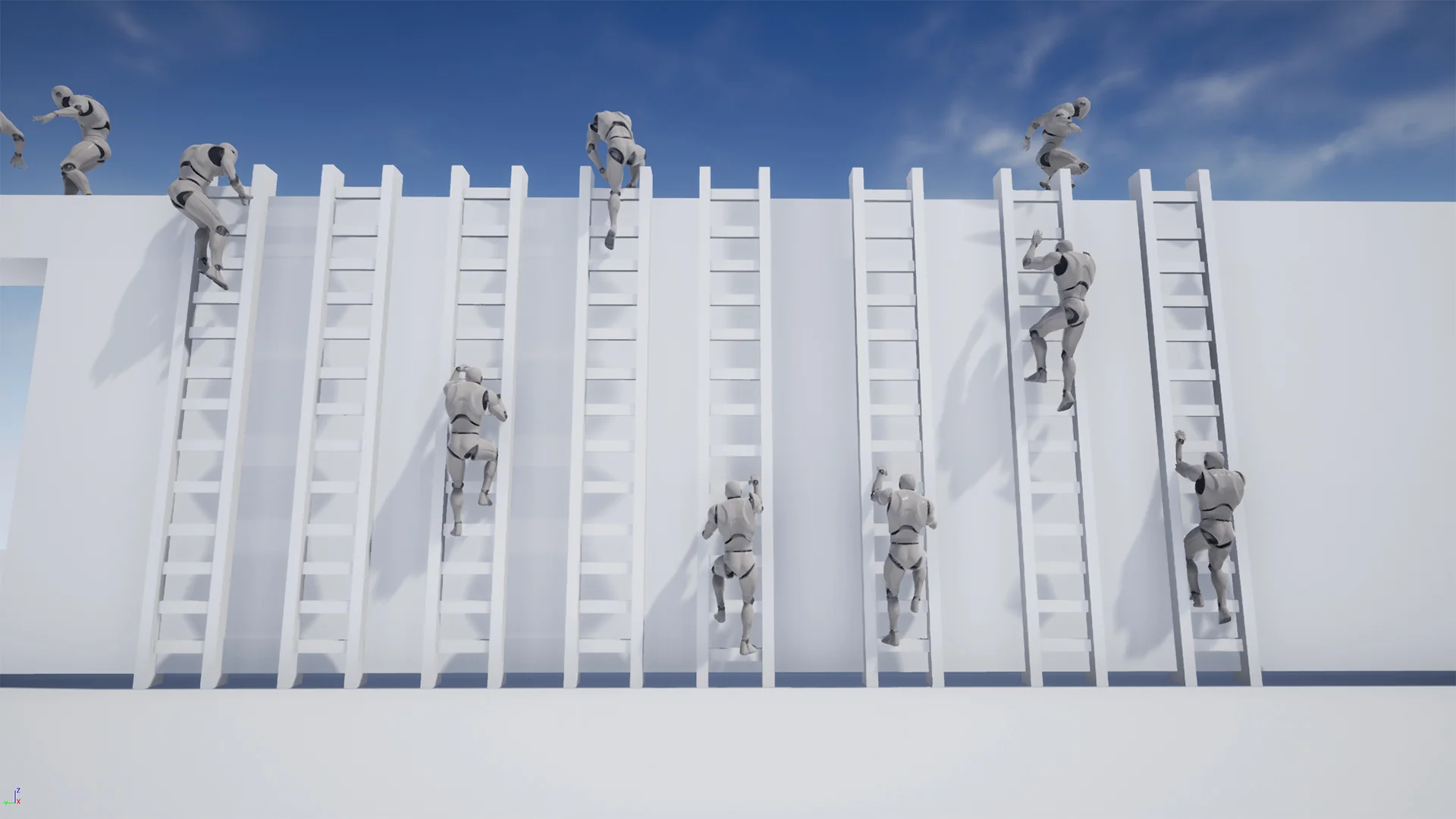
Moving across rungs requires distinct states beyond simple vertical loops. Characters need logical entries, exits, and reactive transitions to navigate ladders without snapping between ground and climb states. The set contains continuous ascending and descending movements that reflect fluid, uninterrupted climbing speed. Hand and foot coordination follows an alternating cadence, avoiding mechanical or rigid frame pacing.
Entry and exit logic is handled via explicit mount and unmount cycles built for both the top and the bottom of the ladder:
Mounting from the bottom positions the character securely onto the first rungs before full ascension begins.
Unmounting at the bottom allows the character to step down, plant their feet, and resume standard footing on the floor.
Mounting from the top controls the deliberate backward step and weight transfer required to lower the body from a high platform onto the ladder.
Unmounting at the top carries the character up over the final rungs, lifting the body cleanly onto the upper floor surface.
Dynamic movement around ladders is not confined to slow, methodical mounting. Characters can initiate jumps directly toward a ladder, grab the rungs mid-air, and arrest their downward momentum. The set also supports leaps away from a ladder, facilitating fast dismounts or evasion maneuvers. In scenarios where a character falls from an elevated hazard or drops from an overhead position, landing animations specifically tuned for catching or hitting ladders allow characters to stick the impact without resetting into generic ground impact poses.
Full 360-Degree Vertical Wall and Ledges Navigation
Beyond isolated rungs, vertical spaces frequently require characters to traverse flat facades and sheer drops. The Ladders and Ledges Animset incorporates a 360-degree range of motion across eight discrete directional paths along vertical walls. This includes standard upward, downward, leftward, and rightward locomotion, alongside four diagonal pathways: moving up-left, up-right, down-left, and down-right across the vertical surface.
Diagonal navigation accounts for the asymmetrical reach required when a climber pulls themselves diagonally across a wall. Instead of relying on blended directional matrices that slide hands unnaturally across flat surfaces, the captured sequences track the torso shifts, cross-hand reaches, and coordinated foot shuffles necessary to navigate diagonal vectors. This ensures that when a character traverses sideways and upward simultaneously, the limbs maintain a grounded sense of grip and leverage.
Wall navigation is complemented by structural transition sequences. Characters can mount vertical walls from lower ground positions, latching onto edges or handholds to begin their ascent. Once they reach the crest of a wall, dedicated climb-off animations pull the body up and over the upper ledge, depositing the character onto their feet at the top surface. These boundary animations prevent abrupt cutoffs between climbing states and standing idle states.
Ground Locomotion, Air States, and Box Interaction
The collection extends beyond elevated rungs and wall holds by supplying ground-level actions that integrate with vertical paths. Standard ground locomotion and jumping animations are present within the set, establishing continuity between approaching an obstacle, leaping toward it, and resuming ground movement on the opposite side. This continuity minimizes stylistic gaps between standard run cycles and specialized climbing actions.
Air traversal includes multiple jumping, falling, and landing variations. Differences in jump velocity and fall height require varied landing responses, from soft absorptions to heavier impacts where the character must steady their balance before standing. These falling states accommodate both clean drops and unexpected slips from high ledges, allowing developers to implement varying levels of physical consequence for missed ledge grabs.
Environmental puzzle solving and physical interactions are supported by object manipulation sequences. The library includes animations for grabbing and pulling boxes. These actions mirror the physical tension seen in the climbing clips, tracking hand placement, arm pull, and foot braces against the floor as the character bears the weight of an external object. Including object manipulation alongside ledge climbing supports interactive level designs where movable obstacles and dynamic climb paths are directly linked.
Technical Breadth of the Traversal Set
Because the Ladders and Ledges Animset packages more than 130 discrete clips, developers can build multi-layered state machines without reusing identical frames for distinct actions. The coverage encompasses rapid jumps to ladders, controlled unmounts from top decks, omnidirectional diagonal climbing against sheer vertical surfaces, and ground-level cargo handling. Combining standard locomotion with climbing mechanics provides the base animation data needed to construct cohesive vertical traversal systems across both male and female character setups.
 Variety
 Variety
 Variety