"6c6413bef81af556"{"id":"1000784","slug":"action-adventure-ledge-climbing-animation-pack","title":"Action Adventure Ledge Climbing Animation Pack","category":"Variety","engine":"4.26+,5.0+","assetVersion":"","engineVersion":"Engine Version: 4.26+,5.0+","tag":"Variety","accent":"blue","visual":"animation","summary":"153 motion-captured climbing animations for Unreal Engine. Includes root motion and in-place FBX files compatible with UE4 and UE5 skeletons.","platform":"Unreal Engine","publishedAt":"2026-07-30T11:47:10.437Z","updatedAt":"2026-07-30T11:47:10.437Z","sourceNotes":[],"fileContents":[],"compatibility":["Unreal Engine","Engine Version: 4.26+,5.0+"],"featuredImage":{"alt":"Action Adventure Ledge Climbing Animation Pack","src":"/wp-content/uploads/published/2026/07/0b4927bb0369-4fb2802d-5df8-4c1e-b596-2a967d4d648a-6486670beb.webp"},"hasDownloadLink":true,"downloads":0,"terms":[{"taxonomy":"category","slug":"variety-animations","name":"Variety"}],"galleryImages":[{"src":"/wp-content/uploads/published/2026/07/8a971f43642f-6edb57e5-4d91-4700-86f6-86f41e1d9866-e271047a56.webp","alt":"Action Adventure Ledge Climbing Animation Pack"},{"src":"/wp-content/uploads/published/2026/07/b42c3208c340-58ccbc12-4d57-4efd-8878-787ef2bb4578-daa3836483.webp","alt":"Action Adventure Ledge Climbing Animation Pack"},{"src":"/wp-content/uploads/published/2026/07/5438542b85dd-7ad7af00-6a42-4aee-969f-be827e7ef431-decf684c53.webp","alt":"Action Adventure Ledge Climbing Animation Pack"},{"src":"/wp-content/uploads/published/2026/07/6d1bd14e38dc-895b0cc1-d8d2-4417-800b-afb4083b7c1f-2e334c7462.webp","alt":"Action Adventure Ledge Climbing Animation Pack"},{"src":"/wp-content/uploads/published/2026/07/88df86209e03-31a856c7-3d1d-4375-9781-8f399a4c2ac9-deaa55df47.webp","alt":"Action Adventure Ledge Climbing Animation Pack"}],"accessPanel":{"kind":"resource","title":"Download this resource","eyebrow":"Free Download","message":"Log in or create a free account to start your download.","fileName":"Content.7z","safetyNote":"Resources are manually reviewed before listing to improve quality and reduce obvious risks.","actionLabel":"Download Free","resourceType":"Resource archive"},"contentHtml":"\u003cp\u003eWhen a character pulls onto a ledge or shifts weight across a narrow hold, the difference between believable motion and stiff approximation is measured in frames. The \u003cem\u003eAction Adventure Ledge Climbing Animation Pack\u003c/em\u003e roots itself in that narrow margin, delivering 153 motion-captured climbing animations that carry the micro-adjustments of real human movement into an Unreal Engine project. Every clip comes from full performance capture rather than hand-keyed approximation, which means shoulder rolls, grip checks, and foot repositioning read with the kind of imperfection that sells a scene.\u003c/p\u003e\n\n\u003cp\u003eThe pack is structured through the UE4 and UE5 Skeletons, so clips slot into existing Unreal mannequin rigs without requiring a retargeting detour. Both Root Motion and in-place versions are included, giving developers control over whether displacement is driven by the animation or by gameplay logic. FBX files also sit inside the package, so the same motion can be pulled into external DCC tools or downstream pipelines without locking the work inside a single engine version.\u003c/p\u003e\n\n\u003ch2\u003eMotion Capture Foundation for Ledge and Wall Traversal\u003c/h2\u003e\n\u003cp\u003eThe 153 clips cover the vocabulary of action-adventure climbing. Ledge pulls, mantle-ups, hangs, traverses, and drop sequences form the core, while the broader tag set—\u003cem\u003eBoulder\u003c/em\u003e, \u003cem\u003eClimb\u003c/em\u003e, and \u003cem\u003eWall\u003c/em\u003e—points toward rugged vertical traversal rather than stylized parkour. Because the data is fully motion-captured, weight transfer happens naturally across frames. A character peeling off a wall carries the same delayed hip-drop a real climber would show when a foothold fails.\u003c/p\u003e\n\n\u003cp\u003eRoot Motion variants let the animation drive the character capsule through space, which is useful when you need precise foot planting on static meshes or authored traversal routes. In-place variants strip the displacement, handing control to Blueprints or gameplay code. That split matters in action-adventure titles where the player can interrupt a climb, jump off a wall, or re-aim mid-hang. The same hang idle can run as a stationary pose while a state machine decides what happens next.\u003c/p\u003e\n\n\u003ch3\u003eCorner and Campus State Expansion in Update V3\u003c/h3\u003e\n\u003cp\u003eThe September 2024 update (V3) added corner animations that enable clean turning transitions without sliding. In climb systems, sliding feet or sliding hands during a corner peel is a common artifact that breaks immersion. By introducing corner-specific clips, the pack lets a character round a bend on a ledge with planted contact points, preserving the tactile weight of the hold.\u003c/p\u003e\n\n\u003cp\u003eV3 also added transitions to the campus state, the phase where a climber skips footholds and moves hand-over-hand with momentum. Linking a standard ledge traverse into a campus burst requires a clip where the character shifts cadence, engages the shoulders, and abandons foot contact. That transition now sits in the library, so flow between grounded traverse and dynamic campus moves can be assembled from matching capture data rather than cross-faded improvisation.\u003c/p\u003e\n\n\u003ch3\u003eCross-Structure Transitions Added in Update V2\u003c/h3\u003e\n\u003cp\u003eThe June 2024 update (V2) broadened the transition coverage to several adjacent climb contexts. New transition animations connect the base ledge work to campus climb, ladder, cable cross, and pole. Each of these represents a distinct spatial scenario, and bridging them with authored animation clips eliminates the awkward blended moment when a character switches from one interactive prop type to another.\u003c/p\u003e\n\n\u003cp\u003eA ladder, a cable, and a pole each demand different grip geometry. Ladder hands sit on rungs, cable hangs follow a single tension line, and pole work often involves a wrapped grip. By threading transitions from the ledge set into these structures, developers can script sequences where a character pulls onto a ledge, sidles toward a cable, and crosses it without leaving the motion library. The capture provenance of those transitions preserves realistic body mechanics across each change.\u003c/p\u003e\n\n\u003ch2\u003eStructuring a Climb System with the Included Variants\u003c/h2\u003e\n\u003cp\u003eBecause both Root Motion and in-place versions ship together, level designers and animators can operate on different layers of the same problem. Root Motion clips lock the character to the geometry for cinematic moments where exact placement matters, then in-place clips can take over when the player resumes control. This duality also supports AI companions or scripted NPCs where movement data may need to be decoupled from NavMesh-driven locomotion.\u003c/p\u003e\n\n\u003cp\u003eThe FBX inclusion is part of that flexibility. A developer could pull the FBX files into a DCC tool, bake corrections, or generate custom animation variants—saving time when resolving minor residual artifacts from the capture session, such as finger contact drift or heel slide on uneven surfaces, without waiting on a pack-level update.\u003c/p\u003e\n\n\u003ch2\u003ePipeline Fit and Iterative Growth Pattern\u003c/h2\u003e\n\u003cp\u003eThis pack is an updated re-release of an earlier Action Adventure Ledge Climbing pack on the Unreal Engine Marketplace. The developer has rebranded under a formal studio and consolidated the content under this refreshed listing. The update history—V2 in June 2024 and V3 in September 2024—shows a trajectory of expanding the transition surface between climb sub-states rather than only adding isolated clips. Those two updates specifically target connectivity: campus transitions, ladder links, cable cross handoff, pole entry, and non-sliding corner turns. Each addition plugs a seam in a typical climb graph.\u003c/p\u003e\n\n\u003cp\u003eFor teams assembling a climbing character controller, the practical value sits in those seams. A raw set of idle, pull, and hang clips would still leave transitions as a manual synthesis problem. By closing the gaps between campus, corner, ladder, cable, and pole states within the library itself, the pack reduces the amount of glue animation a developer must author to make traversal feel continuous. The motion-captured origin of every clip keeps the loop weight changes and grip mechanics consistent, which is often the first thing players notice when a climb system feels real.\u003c/p\u003e\n\n\u003ch2\u003eContinue Browsing Similar Packs\u003c/h2\u003e\n\u003cul\u003e\n\u003cli\u003e\u003ca href=\"https://3dcghub.com/adventures-of-climbing-poles-and-moving-heavy-objects/\" title=\"Adventures of climbing poles and moving heavy objects\"\u003eAdventures of climbing poles and moving heavy objects\u003c/a\u003e\u003c/li\u003e\n\u003cli\u003e\u003ca href=\"https://3dcghub.com/city-sim-animation-pack/\" title=\"CiTY SIM ANIMATION PACK\"\u003eCiTY SIM ANIMATION PACK\u003c/a\u003e\u003c/li\u003e\n\u003cli\u003e\u003ca href=\"https://3dcghub.com/interaction-animations-interactive-animated-pack/\" title=\"Interaction Animations | Interactive Animated Pack\"\u003eInteraction Animations | Interactive Animated Pack\u003c/a\u003e\u003c/li\u003e\n\u003cli\u003e\u003ca href=\"https://3dcghub.com/military-animation-pack-i-unarmed/\" title=\"Military Animation Pack I (Unarmed)\"\u003eMilitary Animation Pack I (Unarmed)\u003c/a\u003e\u003c/li\u003e\n\u003cli\u003e\u003ca href=\"https://3dcghub.com/storage-units-set/\" title=\"Storage Units Set\"\u003eStorage Units Set\u003c/a\u003e\u003c/li\u003e\n\u003c/ul\u003e","contentTextLength":6228,"navigation":{"current":440,"total":3140,"previous":{"id":"1000785","slug":"advanced-crafting-system-plugin","title":"Advanced Crafting System - Plugin","category":"Network \u0026 Multiplayer","platform":"Unreal Engine","updatedAt":"2026-07-30T11:54:43.085Z"},"next":{"id":"1000783","slug":"92-animations-for-warrior","title":"92 Animations For Warrior","category":"Combat","platform":"Unreal Engine","updatedAt":"2026-07-30T11:37:20.237Z"}},"relatedResources":[{"id":"6225","slug":"adventures-of-climbing-poles-and-moving-heavy-objects","title":"Adventures of climbing poles and moving heavy objects","category":"Variety","engine":"4.26+,5.0+","assetVersion":"Engine version: 4.26+,5.0+","engineVersion":"4.16","tag":"Variety","accent":"blue","visual":"animation","summary":"Enhance your project with 43 high-quality animations for climbing poles and moving heavy objects in Unreal Engine. Includes Blueprints and ready-to-use assets.","platform":"Unreal Engine","publishedAt":"2026-02-19T14:09:38.000Z","updatedAt":"2026-04-19T15:56:28.000Z","sourceNotes":[],"fileContents":[],"compatibility":["Unreal Engine","Engine version: 4.26+,5.0+"],"featuredImage":{"alt":"Adventures of climbing poles and moving heavy objects","src":"https://3dcghub.com/wp-content/uploads/2026/02/23afd805-97b2-4eff-94db-5c5186ffc1b7.webp"},"hasDownloadLink":true,"downloads":1},{"id":"27483","slug":"city-sim-animation-pack","title":"CiTY SIM ANIMATION PACK","category":"Variety","engine":"4.27,5.0+","assetVersion":"Engine version: 4.27,5.0+","engineVersion":"","tag":"Variety","accent":"blue","visual":"animation","summary":"This animation library focuses on everyday city behavior: walking, running, sitting, sleeping, bar interaction, and emotes, along with role-based emergency actions. It also includes male and female movement sets that fit citizen and service-character scenes.","platform":"Unreal Engine","publishedAt":"2026-04-26T06:01:51.000Z","updatedAt":"2026-04-26T06:01:52.000Z","sourceNotes":[],"fileContents":[],"compatibility":["Unreal Engine","Engine version: 4.27,5.0+"],"featuredImage":{"alt":"CiTY SIM ANIMATION PACK","src":"https://3dcghub.com/wp-content/uploads/2026/04/89cb54dc9b3e_225b779a-c1f6-4171-b9ea-1efe1f14d322.webp"},"hasDownloadLink":true,"downloads":0},{"id":"6353","slug":"interaction-animations-interactive-animated-pack","title":"Interaction Animations | Interactive Animated Pack","category":"Variety","engine":"5.0+","assetVersion":"Engine version: 5.0+","engineVersion":"5.0","tag":"Variety","accent":"blue","visual":"animation","summary":"Enhance your game's immersion with 71 high-quality interaction animations. Includes root-motion character and object actions for doors, chests, and generators.","platform":"Unreal Engine","publishedAt":"2026-02-19T14:51:28.000Z","updatedAt":"2026-04-19T15:56:26.000Z","sourceNotes":[],"fileContents":[],"compatibility":["Unreal Engine","Engine version: 5.0+"],"featuredImage":{"alt":"Interaction Animations | Interactive Animated Pack","src":"https://3dcghub.com/wp-content/uploads/2026/02/57389028-3464-421a-88ab-db685d4dac45.webp"},"hasDownloadLink":true,"downloads":2}]}
Variety
Action Adventure Ledge Climbing Animation Pack
153 motion-captured climbing animations for Unreal Engine. Includes root motion and in-place FBX files compatible with UE4 and UE5 skeletons.
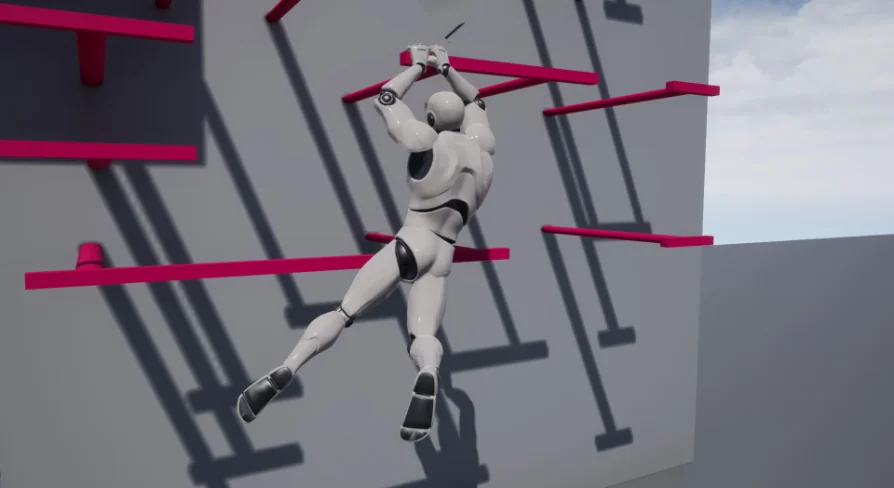
When a character pulls onto a ledge or shifts weight across a narrow hold, the difference between believable motion and stiff approximation is measured in frames. The Action Adventure Ledge Climbing Animation Pack roots itself in that narrow margin, delivering 153 motion-captured climbing animations that carry the micro-adjustments of real human movement into an Unreal Engine project. Every clip comes from full performance capture rather than hand-keyed approximation, which means shoulder rolls, grip checks, and foot repositioning read with the kind of imperfection that sells a scene.
The pack is structured through the UE4 and UE5 Skeletons, so clips slot into existing Unreal mannequin rigs without requiring a retargeting detour. Both Root Motion and in-place versions are included, giving developers control over whether displacement is driven by the animation or by gameplay logic. FBX files also sit inside the package, so the same motion can be pulled into external DCC tools or downstream pipelines without locking the work inside a single engine version.
Motion Capture Foundation for Ledge and Wall Traversal
The 153 clips cover the vocabulary of action-adventure climbing. Ledge pulls, mantle-ups, hangs, traverses, and drop sequences form the core, while the broader tag set—Boulder, Climb, and Wall—points toward rugged vertical traversal rather than stylized parkour. Because the data is fully motion-captured, weight transfer happens naturally across frames. A character peeling off a wall carries the same delayed hip-drop a real climber would show when a foothold fails.
Root Motion variants let the animation drive the character capsule through space, which is useful when you need precise foot planting on static meshes or authored traversal routes. In-place variants strip the displacement, handing control to Blueprints or gameplay code. That split matters in action-adventure titles where the player can interrupt a climb, jump off a wall, or re-aim mid-hang. The same hang idle can run as a stationary pose while a state machine decides what happens next.
Corner and Campus State Expansion in Update V3
The September 2024 update (V3) added corner animations that enable clean turning transitions without sliding. In climb systems, sliding feet or sliding hands during a corner peel is a common artifact that breaks immersion. By introducing corner-specific clips, the pack lets a character round a bend on a ledge with planted contact points, preserving the tactile weight of the hold.
V3 also added transitions to the campus state, the phase where a climber skips footholds and moves hand-over-hand with momentum. Linking a standard ledge traverse into a campus burst requires a clip where the character shifts cadence, engages the shoulders, and abandons foot contact. That transition now sits in the library, so flow between grounded traverse and dynamic campus moves can be assembled from matching capture data rather than cross-faded improvisation.
Cross-Structure Transitions Added in Update V2
The June 2024 update (V2) broadened the transition coverage to several adjacent climb contexts. New transition animations connect the base ledge work to campus climb, ladder, cable cross, and pole. Each of these represents a distinct spatial scenario, and bridging them with authored animation clips eliminates the awkward blended moment when a character switches from one interactive prop type to another.
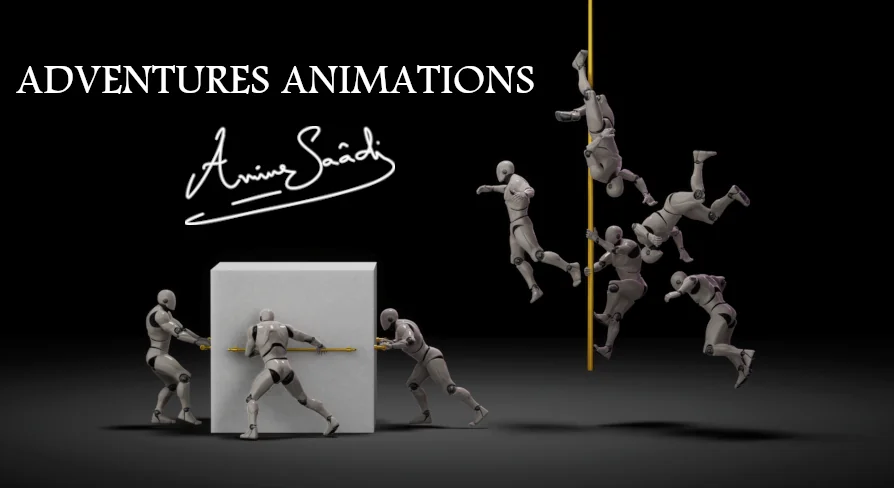
A ladder, a cable, and a pole each demand different grip geometry. Ladder hands sit on rungs, cable hangs follow a single tension line, and pole work often involves a wrapped grip. By threading transitions from the ledge set into these structures, developers can script sequences where a character pulls onto a ledge, sidles toward a cable, and crosses it without leaving the motion library. The capture provenance of those transitions preserves realistic body mechanics across each change.
Structuring a Climb System with the Included Variants
Because both Root Motion and in-place versions ship together, level designers and animators can operate on different layers of the same problem. Root Motion clips lock the character to the geometry for cinematic moments where exact placement matters, then in-place clips can take over when the player resumes control. This duality also supports AI companions or scripted NPCs where movement data may need to be decoupled from NavMesh-driven locomotion.
The FBX inclusion is part of that flexibility. A developer could pull the FBX files into a DCC tool, bake corrections, or generate custom animation variants—saving time when resolving minor residual artifacts from the capture session, such as finger contact drift or heel slide on uneven surfaces, without waiting on a pack-level update.
Pipeline Fit and Iterative Growth Pattern
This pack is an updated re-release of an earlier Action Adventure Ledge Climbing pack on the Unreal Engine Marketplace. The developer has rebranded under a formal studio and consolidated the content under this refreshed listing. The update history—V2 in June 2024 and V3 in September 2024—shows a trajectory of expanding the transition surface between climb sub-states rather than only adding isolated clips. Those two updates specifically target connectivity: campus transitions, ladder links, cable cross handoff, pole entry, and non-sliding corner turns. Each addition plugs a seam in a typical climb graph.
For teams assembling a climbing character controller, the practical value sits in those seams. A raw set of idle, pull, and hang clips would still leave transitions as a manual synthesis problem. By closing the gaps between campus, corner, ladder, cable, and pole states within the library itself, the pack reduces the amount of glue animation a developer must author to make traversal feel continuous. The motion-captured origin of every clip keeps the loop weight changes and grip mechanics consistent, which is often the first thing players notice when a climb system feels real.
 Variety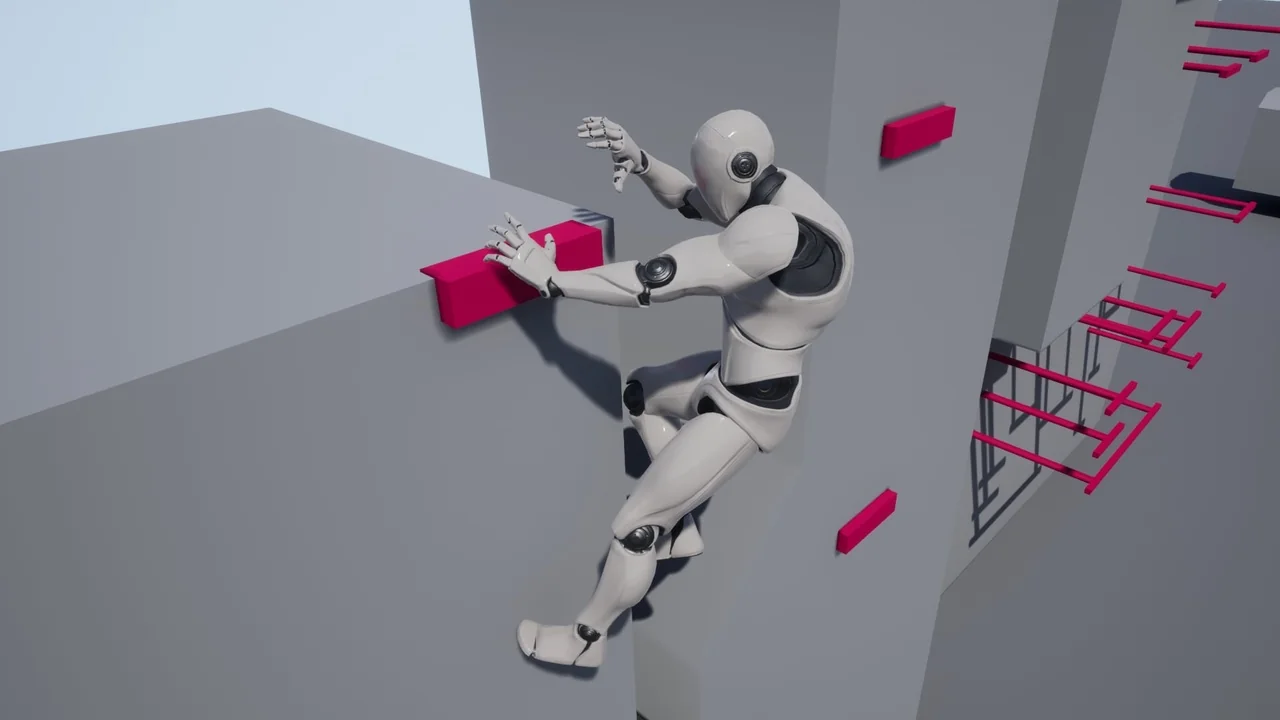
 Variety
 Variety
 Variety