"ae2217ad8e73450c"{"id":"1003038","slug":"japanese-sword-action","title":"Japanese sword action","category":"Variety","engine":"4.21+,5.0+","assetVersion":"","engineVersion":"Engine Version: 4.21+,5.0+","tag":"Variety","accent":"blue","visual":"mech","summary":"Explore the Japanese sword action animation library featuring 315 motions, foundational strike sets, drawing and scabbard mechanics, and an included sword model","platform":"Unreal Engine","indexPolicy":"index","publishedAt":"2026-11-25T16:58:36.992Z","updatedAt":"2026-11-25T16:58:36.992Z","sourceNotes":[],"fileContents":[],"compatibility":["Unreal Engine","Engine Version: 4.21+,5.0+"],"featuredImage":{"alt":"Japanese sword action","src":"/wp-content/uploads/published/2026/11/b9d25ca8ec31-42e05437-5aa4-4724-88bf-b628431f41ba-bb3d6fb292.webp"},"hasDownloadLink":true,"downloads":0,"terms":[{"taxonomy":"category","slug":"variety-animations","name":"Variety"}],"galleryImages":[{"src":"/wp-content/uploads/published/2026/11/6b7c5c05e4f9-8a822d0e-ffbf-4a7f-a819-7c76f594c961-7a4b01b67f.webp","alt":"Japanese sword action"},{"src":"/wp-content/uploads/published/2026/11/5044ef1f6c69-5d04d528-8238-4b0d-a46a-00f26bea5afc-88f91070a2.webp","alt":"Japanese sword action"},{"src":"/wp-content/uploads/published/2026/11/d4a203fb7664-f75906ca-9810-43bf-a00b-87c80fd7a6d5-03b9cecfbe.webp","alt":"Japanese sword action"},{"src":"/wp-content/uploads/published/2026/11/a85e809815ea-7f8e363a-ab92-4db9-9691-a50feaf31573-2d4cf45412.webp","alt":"Japanese sword action"},{"src":"/wp-content/uploads/published/2026/11/ea6fbc5766f0-49583f85-8bc9-44af-b431-eac1fd505814-62e083ec09.webp","alt":"Japanese sword action"},{"src":"/wp-content/uploads/published/2026/11/a8bbb84cef85-e80b2353-1bcf-47c4-9868-7028dd19d3cf-63e4238a5b.webp","alt":"Japanese sword action"},{"src":"/wp-content/uploads/published/2026/11/aae8f26d7de3-85fb348a-8804-488c-a9b7-9a79ce4a6a52-7d7c4b3fe7.webp","alt":"Japanese sword action"}],"accessPanel":{"kind":"resource","title":"Get this resource","safetyNote":"Resources are manually reviewed before listing to improve quality and reduce obvious risks.","fileName":"Content.7z","resourceType":"Resource archive","versions":[]},"contentHtml":"\u003ch2\u003eStaging Sword Combat Encounters and Dynamic Flow\u003c/h2\u003e\n\u003cp\u003eMelee action scenes demand an acute balance between visual authenticity and fluid movement. In character-driven swordplay, combat pacing falls flat when strikes appear disjointed, repetitive, or mechanically disconnected from the lower body. Japanese sword action addresses this challenge directly by providing a dedicated library anchored in the physical behavior and handling of Japanese swords. Totaling 315 individual actions, the collection provides a deep kinetic vocabulary that supports intricate martial encounters, defensive responses, and aggressive strike chains.\u003c/p\u003e\n\u003cp\u003eRather than presenting a handful of standalone swings, the 315 animations map out how a practitioner shifts weight, pivots through space, and manages weapon momentum. A broad animation set of this size enables projects to build extensive combat systems where characters can execute distinct attacks based on their active stance, facing direction, or current tactical scenario. By treating the blade as an extension of full-body momentum, the assets offer the variety necessary to animate complex encounters without relying on repeated loops or generic slashes.\u003c/p\u003e \u003ch2\u003eThe Core 32 Basic Techniques in Japanese Sword Action\u003c/h2\u003e\n\u003cp\u003eAt the center of the library sits a designated collection of 32 basic technique variations. These foundational movements are organized across eight primary attack classifications: kara, kesa, nagi, kage, skkz, tuki, ksuk, and gduk. Each of these classifications represents a distinct mechanical approach to swinging, thrusting, or deflecting with a traditional blade.\u003c/p\u003e\n\u003cp\u003eThe strike classifications correspond to essential lines of attack seen in traditional swordsmanship. Actions labeled kesa capture diagonal descending cuts, shearing downward across the centerline from shoulder to hip. The nagi set delivers broad horizontal sweeps, cleaving along lateral planes to maintain perimeter control or clear multiple adversaries. Direct center-line thrusts are encapsulated within the tuki sequences, offering linear forward-driving penetrations that trade broad coverage for focused reach. The remaining categories—kara, kage, skkz, ksuk, and gduk—round out the primary set, providing high, low, counter-cutting, and reactive blade behaviors that ensure every vector of attack is accounted for across the core roster.\u003c/p\u003e \u003ch2\u003eDirectional Stances and Mechanical Footwork Variations\u003c/h2\u003e\n\u003cp\u003eAttacks rarely happen in isolation from foot placement. A strike thrown from the lead foot feels and functions completely differently than a strike driven from the trailing leg or executed while repositioning laterally. Japanese sword action embeds this reality through clear directional and positional variations across its basic techniques.\u003c/p\u003e\n\u003cp\u003eThe primary strikes feature designated stance variations, split across distinct positional profiles:\u003c/p\u003e\n\u003cul\u003e \u003cli\u003e\u003cstrong\u003eKara, kesa, nagi, kage, skkz, and tuki:\u003c/strong\u003e Configured across four distinct variations comprising RF, LF, RJ, and LJ. These notations distinguish cuts executed from a forward right stance (RF) or forward left stance (LF), alongside jumping, repositioning, or evasive foot variations (RJ and LJ).\u003c/li\u003e \u003cli\u003e\u003cstrong\u003eKsuk and gduk:\u003c/strong\u003e Configured across defensive, transitional, and directional variations including RB, LB, R, and L. These cover rearward right-foot retreats (RB), rearward left-foot steps (LB), and lateral steps across right (R) and left (L) vectors.\u003c/li\u003e\n\u003c/ul\u003e\n\u003cp\u003eThese variations remove the need to force-blend an unnatural strike across an incompatible lower-body stance. When an attack originates from the right side, an RF animation ensures the hips and knees are properly braced to support that kinetic chain. Conversely, executing a cut from a left forward lead (LF) correctly reorients the torso, shoulder line, and trailing foot. When navigating evasions or repositioning during a duel, the dedicated RB, LB, R, and L motions provide dedicated directional footing for ksuk and gduk, eliminating unnatural foot sliding and maintaining solid physical grounding.\u003c/p\u003e \u003ch2\u003eDrawing, Sheathing, and Connecting Motion Sequences\u003c/h2\u003e\n\u003cp\u003eMartial arts using Japanese swords are defined just as much by what happens before and after a strike as by the blow itself. The collection accounts for these framing gestures by including specific animations for drawing the sword from its scabbard and maneuvering to return the blade once the engagement ends.\u003c/p\u003e\n\u003cp\u003eThe unsheathing actions capture the focused draw of the blade, enabling combatants to initiate encounters seamlessly from a rested or holstered posture. Equally critical are the re-sheathing motions, which provide the deliberate hand-eye coordination required to guide the tip back into the scabbard mouth without clipping or awkward hand shifts. Having dedicated animations for both sides of the sword-drawing cycle allows characters to enter and leave battle states cleanly.\u003c/p\u003e\n\u003cp\u003eBeyond opening and closing gestures, the library incorporates connecting motions. These transitional clips serve as structural connective tissue between individual techniques, enabling animators and gameplay programmers to blend one strike directly into another. By using motion to connect techniques and techniques, developers can construct seamless continuous combinations. Instead of a character resetting to an idle stance between every strike, the connecting frames maintain combat momentum, flowing smoothly from a kesa diagonal cut into a nagi lateral sweep or a tuki thrust.\u003c/p\u003e \u003ch2\u003eIncluded Sword Model and Production Utility\u003c/h2\u003e\n\u003cp\u003eAlongside the 315 animations, the package comes complete with a dedicated sword model. Providing the weapon model directly with the motion set streamlines integration, as the weapon's dimensions, pivot expectations, and hand placements align with the motion data out of the box.\u003c/p\u003e\n\u003cp\u003eThe inclusion of the sword model proves especially useful during early choreography passes and animation state-tree assembly. Developers can immediately evaluate grip registration, draw sequences, and sheath docking mechanics without needing to first track down, scale, or calibrate a third-party blade mesh. The asset serves as an immediate, functional reference to verify that the sword travels accurately through every strike arc, scabbard draw, and connecting motion sequence.\u003c/p\u003e \u003ch2\u003eTarget Implementations for Combat Choreography\u003c/h2\u003e\n\u003cp\u003eJapanese sword action offers practical utility for developers constructing complex melee systems, action-adventure titles, and cinematic fight scenes. Studios building combo-heavy fighting systems benefit directly from the pairing of directional strike variants and modular connecting motions, which allow them to assemble branching attack trees rooted in consistent footwork.\u003c/p\u003e\n\u003cp\u003eAnimators framing linear narrative sequences or cinematic fight cutscenes can leverage the large library of 315 actions to stage extended duels without visual stagnation. The clear division between drawing mechanics, foundational strikes, directional repositioning, and disciplined sheathing covers the full lifecycle of an encounter. For creators tasked with bringing deliberate, fluid Japanese swordplay into their interactive scenes, this focused asset collection provides the essential building blocks needed to craft compelling, high-speed martial arts sequences.\u003c/p\u003e\n\n\u003ch2\u003eRelated Resources Worth Checking\u003c/h2\u003e\n\u003cul\u003e\n\u003cli\u003e\u003ca href=\"https://3dcghub.com/action-adventure-ledge-climbing-animation-pack/\" rel=\"noopener noreferrer\"\u003eAction Adventure Ledge Climbing Animation Pack\u003c/a\u003e\u003c/li\u003e\n\u003cli\u003e\u003ca href=\"https://3dcghub.com/one-handed-sword-animset-pro/\" rel=\"noopener noreferrer\"\u003eOne Handed Sword Animset Pro\u003c/a\u003e\u003c/li\u003e\n\u003cli\u003e\u003ca href=\"https://3dcghub.com/dual-swords/\" rel=\"noopener noreferrer\"\u003eDual Swords\u003c/a\u003e\u003c/li\u003e\n\u003cli\u003e\u003ca href=\"https://3dcghub.com/great-dualblade-animset/\" rel=\"noopener noreferrer\"\u003eGreat DualBlade AnimSet\u003c/a\u003e\u003c/li\u003e\n\u003cli\u003e\u003ca href=\"https://3dcghub.com/insane-aircombo-animset/\" rel=\"noopener noreferrer\"\u003eInsane Aircombo AnimSet\u003c/a\u003e\u003c/li\u003e\n\u003c/ul\u003e","contentTextLength":7385,"navigation":{"current":6,"total":4964,"previous":{"id":"1003039","slug":"ladders-and-ledges-animset","title":"Ladders and Ledges Animset","category":"Variety","platform":"Unreal Engine","updatedAt":"2026-11-25T16:59:14.332Z"},"next":{"id":"1003037","slug":"hostage-set","title":"Hostage Set","category":"Gestures","platform":"Unreal Engine","updatedAt":"2026-11-25T16:41:59.342Z"}},"relatedResources":[{"id":"1000784","slug":"action-adventure-ledge-climbing-animation-pack","title":"Action Adventure Ledge Climbing Animation Pack","category":"Variety","engine":"4.26+,5.0+","assetVersion":"","engineVersion":"Engine Version: 4.26+,5.0+","tag":"Variety","accent":"blue","visual":"animation","summary":"153 motion-captured climbing animations for Unreal Engine. Includes root motion and in-place FBX files compatible with UE4 and UE5 skeletons.","platform":"Unreal Engine","indexPolicy":"index","publishedAt":"2026-07-30T11:47:10.437Z","updatedAt":"2026-07-30T11:47:10.437Z","sourceNotes":[],"fileContents":[],"compatibility":["Unreal Engine","Engine Version: 4.26+,5.0+"],"featuredImage":{"alt":"Action Adventure Ledge Climbing Animation Pack","src":"/wp-content/uploads/published/2026/07/0b4927bb0369-4fb2802d-5df8-4c1e-b596-2a967d4d648a-6486670beb.webp"},"fileSizeBytes":17193452,"hasDownloadLink":true,"downloads":3},{"id":"5828","slug":"one-handed-sword-animset-pro","title":"One Handed Sword Animset Pro","category":"Combat","engine":"4.26+,5.0+","assetVersion":"Engine version: 4.26+,5.0+","engineVersion":"4.16","tag":"Combat","accent":"blue","visual":"animation","summary":"Elevate your game with the One Handed Sword Animset Pro. Featuring 110 handcrafted animations, this pack is perfect for stylish action RPGs and fantasy combat.","platform":"Unreal Engine","indexPolicy":"noindex","publishedAt":"2026-02-18T15:21:52.000Z","updatedAt":"2026-04-19T15:56:39.000Z","sourceNotes":[],"fileContents":[],"compatibility":["Unreal Engine","Engine version: 4.26+,5.0+"],"featuredImage":{"alt":"One Handed Sword Animset Pro","src":"https://3dcghub.com/wp-content/uploads/2026/02/70bc78ff-6d5c-43da-b2a6-41d5ffb3d162.webp"},"fileSizeBytes":337509869,"hasDownloadLink":true,"downloads":9},{"id":"5611","slug":"dual-swords","title":"Dual Swords","category":"Combat","engine":"4.26+,5.0+","assetVersion":"Engine version: 4.26+,5.0+","engineVersion":"4.16","tag":"Combat","accent":"blue","visual":"animation","summary":"Enhance your action game with this professional Dual Sword animation pack. Featuring over 80 handcrafted animations for fluid, stylized fantasy combat.","platform":"Unreal Engine","indexPolicy":"noindex","publishedAt":"2026-02-17T16:11:32.000Z","updatedAt":"2026-04-19T15:56:43.000Z","sourceNotes":[],"fileContents":[],"compatibility":["Unreal Engine","Engine version: 4.26+,5.0+"],"featuredImage":{"alt":"Dual Swords","src":"https://3dcghub.com/wp-content/uploads/2026/02/ad6df0f7-34dc-4a50-a367-d7023af02c1a.webp"},"fileSizeBytes":198922668,"hasDownloadLink":true,"downloads":4}]}[{"id":4225,"sourceId":4225,"taxonomyId":4225,"taxonomy":"category","slug":"asset-library","name":"Asset Library","parentId":null,"count":4817,"hasChildren":true,"href":"/","seoTitle":"Free Game Assets Library | 3DCGHUB","seoDescription":"Browse free Unreal Engine, Unity, Blender assets and game development tutorials on 3DCGHUB with previews, compatibility notes, and secure downloads.","sitemapEnabled":true,"children":[{"id":4227,"sourceId":4227,"taxonomyId":4227,"taxonomy":"category","slug":"blender-add-ons-plugins","name":"Blender Add-ons \u0026 Plugins","parentId":4225,"count":10,"hasChildren":false,"href":"/category/blender-add-ons-plugins/","seoTitle":"Free Blender Add-ons \u0026 Plugins | 3DCGHUB","seoDescription":"Browse free Blender Add-ons \u0026 Plugins tools for Blender on 3DCGHUB: curated downloads with preview images, compatibility notes and secure download access.","sitemapEnabled":true},{"id":514,"sourceId":514,"taxonomyId":514,"taxonomy":"category","slug":"unity-2","name":"Unity","parentId":4225,"count":453,"hasChildren":true,"href":"/category/unity-2/","seoTitle":"Free Unity Assets | 3DCGHUB","seoDescription":"Browse free Unity resources on 3DCGHUB: curated downloads with preview images, compatibility notes and secure download access.","sitemapEnabled":true,"children":[{"id":523,"sourceId":523,"taxonomyId":523,"taxonomy":"category","slug":"2d","name":"2D","parentId":514,"count":1,"hasChildren":true,"href":"/category/2d/","seoTitle":"Free Unity 2D | 3DCGHUB","seoDescription":"Browse free 2D assets for Unity on 3DCGHUB: curated downloads with preview images, compatibility notes and secure download access.","sitemapEnabled":true},{"id":515,"sourceId":515,"taxonomyId":515,"taxonomy":"category","slug":"3d-unity-2","name":"3D","parentId":514,"count":162,"hasChildren":true,"href":"/category/3d-unity-2/","seoTitle":"Free Unity 3D Assets | 3DCGHUB","seoDescription":"Browse free 3D assets for Unity on 3DCGHUB: curated downloads with preview images, compatibility notes and secure download access.","sitemapEnabled":true},{"id":565,"sourceId":565,"taxonomyId":565,"taxonomy":"category","slug":"add-ons","name":"Add-Ons","parentId":514,"count":2,"hasChildren":false,"href":"/category/add-ons/","seoTitle":"Free Unity Add-Ons | 3DCGHUB","seoDescription":"Browse free Add-Ons assets for Unity on 3DCGHUB: curated downloads with preview images, compatibility notes and secure download access.","sitemapEnabled":true},{"id":529,"sourceId":529,"taxonomyId":529,"taxonomy":"category","slug":"audio-unity-2","name":"Audio","parentId":514,"count":1,"hasChildren":true,"href":"/category/audio-unity-2/","seoTitle":"Free Unity Audio | 3DCGHUB","seoDescription":"Browse free Audio for Unity on 3DCGHUB: curated downloads with preview images, compatibility notes and secure download access.","sitemapEnabled":true},{"id":557,"sourceId":557,"taxonomyId":557,"taxonomy":"category","slug":"templates","name":"Templates","parentId":514,"count":36,"hasChildren":true,"href":"/category/templates/","seoTitle":"Free Unity Templates | 3DCGHUB","seoDescription":"Browse free Unity project templates on 3DCGHUB. Starter kits with previews, compatibility notes, and secure download access.","sitemapEnabled":true},{"id":533,"sourceId":533,"taxonomyId":533,"taxonomy":"category","slug":"tools-unity-2","name":"Tools","parentId":514,"count":0,"hasChildren":true,"href":"/category/tools-unity-2/","sitemapEnabled":true},{"id":554,"sourceId":554,"taxonomyId":554,"taxonomy":"category","slug":"vfx-unity-2","name":"VFX","parentId":514,"count":4,"hasChildren":true,"href":"/category/vfx-unity-2/","seoTitle":"Free Unity VFX | 3DCGHUB","seoDescription":"Browse free VFX for Unity on 3DCGHUB: curated downloads with preview images, compatibility notes and secure download access.","sitemapEnabled":true}]},{"id":511,"sourceId":511,"taxonomyId":511,"taxonomy":"category","slug":"unreal-engine-2","name":"Unreal Engine","parentId":4225,"count":4355,"hasChildren":true,"href":"/category/unreal-engine-2/","seoTitle":"Free Unreal Engine Assets | 3DCGHUB","seoDescription":"Browse free Unreal Engine resources on 3DCGHUB: curated downloads with preview images, compatibility notes and secure download access.","sitemapEnabled":true,"children":[{"id":54,"sourceId":54,"taxonomyId":54,"taxonomy":"category","slug":"3d","name":"3D","parentId":511,"count":2441,"hasChildren":true,"href":"/category/3d/","seoTitle":"Free Unreal Engine 3D | 3DCGHUB","seoDescription":"Browse free 3D assets for Unreal Engine on 3DCGHUB: curated downloads with preview images, compatibility notes and secure download access.","sitemapEnabled":true},{"id":441,"sourceId":441,"taxonomyId":441,"taxonomy":"category","slug":"animations","name":"Animations","parentId":511,"count":269,"hasChildren":true,"href":"/category/animations/","seoTitle":"Free Unreal Engine Animations | 3DCGHUB","seoDescription":"Browse free Animations for Unreal Engine on 3DCGHUB: curated downloads with preview images, compatibility notes and secure download access.","sitemapEnabled":true},{"id":446,"sourceId":446,"taxonomyId":446,"taxonomy":"category","slug":"audio","name":"Audio","parentId":511,"count":63,"hasChildren":true,"href":"/category/audio/","seoTitle":"Free Unreal Engine Audio Resources | 3DCGHUB","seoDescription":"Browse free Unreal Engine audio resources including sound effects, voices, dialogue, and ambient sounds. Curated free downloads on 3DCGHUB.","sitemapEnabled":true},{"id":466,"sourceId":466,"taxonomyId":466,"taxonomy":"category","slug":"game-systems","name":"Game Systems","parentId":511,"count":381,"hasChildren":true,"href":"/category/game-systems/","seoTitle":"Free Unreal Engine Game Systems | 3DCGHUB","seoDescription":"Browse free Game Systems tools for Unreal Engine on 3DCGHUB: curated downloads with preview images, compatibility notes and secure download access.","sitemapEnabled":true},{"id":478,"sourceId":478,"taxonomyId":478,"taxonomy":"category","slug":"game-templates","name":"Game Templates","parentId":511,"count":155,"hasChildren":true,"href":"/category/game-templates/","seoTitle":"Free Unreal Engine Game Templates | 3DCGHUB","seoDescription":"Browse free Game Templates for Unreal Engine on 3DCGHUB: curated downloads with preview images, compatibility notes and secure download access.","sitemapEnabled":true},{"id":432,"sourceId":432,"taxonomyId":432,"taxonomy":"category","slug":"hdri","name":"HDRI","parentId":511,"count":6,"hasChildren":true,"href":"/category/hdri/","seoTitle":"Free Unreal Engine HDRI | 3DCGHUB","seoDescription":"Browse free Unreal Engine HDRI skies and lighting maps on 3DCGHUB. Environment lighting with previews and secure downloads.","sitemapEnabled":true},{"id":228,"sourceId":228,"taxonomyId":228,"taxonomy":"category","slug":"material-and-textures","name":"Material \u0026 Textures","parentId":511,"count":172,"hasChildren":true,"href":"/category/material-and-textures/","seoTitle":"Free Unreal Engine Material \u0026 Textures | 3DCGHUB","seoDescription":"Browse free Material \u0026 Textures for Unreal Engine on 3DCGHUB: curated downloads with preview images, compatibility notes and secure download access.","sitemapEnabled":true},{"id":298,"sourceId":298,"taxonomyId":298,"taxonomy":"category","slug":"sprites-and-flipbooks","name":"Sprites \u0026 Flipbooks","parentId":511,"count":18,"hasChildren":true,"href":"/category/sprites-and-flipbooks/","seoTitle":"Free Unreal Engine Sprites \u0026 Flipbooks | 3DCGHUB","seoDescription":"Browse free Sprites \u0026 Flipbooks assets for Unreal Engine on 3DCGHUB: curated downloads with preview images, compatibility notes and secure download access.","sitemapEnabled":true},{"id":489,"sourceId":489,"taxonomyId":489,"taxonomy":"category","slug":"tools-and-plugins","name":"Tools \u0026 Plugins","parentId":511,"count":390,"hasChildren":true,"href":"/category/tools-and-plugins/","seoTitle":"Free Unreal Engine Tools \u0026 Plugins | 3DCGHUB","seoDescription":"Browse free Tools \u0026 Plugins for Unreal Engine on 3DCGHUB: curated downloads with preview images, compatibility notes and secure download access.","sitemapEnabled":true},{"id":459,"sourceId":459,"taxonomyId":459,"taxonomy":"category","slug":"ui","name":"UI","parentId":511,"count":47,"hasChildren":true,"href":"/category/ui/","seoTitle":"Free Unreal Engine UI | 3DCGHUB","seoDescription":"Browse free UI for Unreal Engine on 3DCGHUB: curated downloads with preview images, compatibility notes and secure download access.","sitemapEnabled":true},{"id":450,"sourceId":450,"taxonomyId":450,"taxonomy":"category","slug":"vfx","name":"VFX","parentId":511,"count":413,"hasChildren":true,"href":"/category/vfx/","seoTitle":"Free Unreal Engine VFX | 3DCGHUB","seoDescription":"Browse free VFX for Unreal Engine on 3DCGHUB: curated downloads with preview images, compatibility notes and secure download access.","sitemapEnabled":true}]}]},{"id":4222,"sourceId":4222,"taxonomyId":4222,"taxonomy":"category","slug":"tutorial-library","name":"Tutorial Library","parentId":null,"count":117,"hasChildren":false,"href":"/tutorials/","seoTitle":"Free Game Development Tutorial Library | 3DCGHUB","seoDescription":"Browse free game development tutorials for Unreal Engine, Unity, Blender, and more on 3DCGHUB with practical workflows and secure downloads.","sitemapEnabled":true}]
Resource screenshots
1 / 7
Asset drops
Daily Asset Drops
Follow 3DCGHUB on Telegram for daily Unreal, Unity & Blender drops and curated CC0 releases.
Resources are manually reviewed before listing to improve quality and reduce obvious risks.
Reviewed archive
Variety
Japanese sword action
Explore the Japanese sword action animation library featuring 315 motions, foundational strike sets, drawing and scabbard mechanics, and an included sword model
Melee action scenes demand an acute balance between visual authenticity and fluid movement. In character-driven swordplay, combat pacing falls flat when strikes appear disjointed, repetitive, or mechanically disconnected from the lower body. Japanese sword action addresses this challenge directly by providing a dedicated library anchored in the physical behavior and handling of Japanese swords. Totaling 315 individual actions, the collection provides a deep kinetic vocabulary that supports intricate martial encounters, defensive responses, and aggressive strike chains.
Rather than presenting a handful of standalone swings, the 315 animations map out how a practitioner shifts weight, pivots through space, and manages weapon momentum. A broad animation set of this size enables projects to build extensive combat systems where characters can execute distinct attacks based on their active stance, facing direction, or current tactical scenario. By treating the blade as an extension of full-body momentum, the assets offer the variety necessary to animate complex encounters without relying on repeated loops or generic slashes.
The Core 32 Basic Techniques in Japanese Sword Action
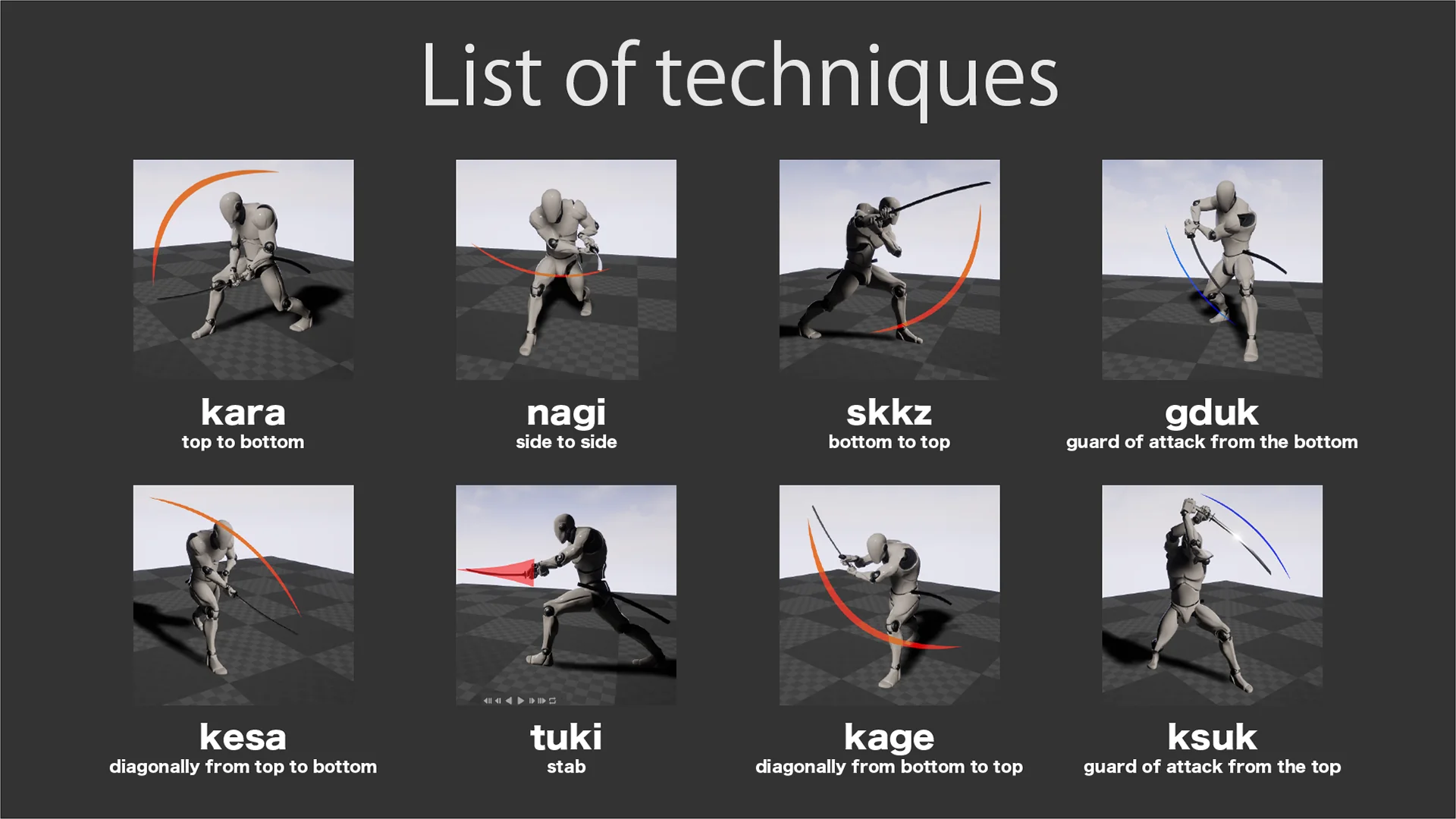
At the center of the library sits a designated collection of 32 basic technique variations. These foundational movements are organized across eight primary attack classifications: kara, kesa, nagi, kage, skkz, tuki, ksuk, and gduk. Each of these classifications represents a distinct mechanical approach to swinging, thrusting, or deflecting with a traditional blade.
The strike classifications correspond to essential lines of attack seen in traditional swordsmanship. Actions labeled kesa capture diagonal descending cuts, shearing downward across the centerline from shoulder to hip. The nagi set delivers broad horizontal sweeps, cleaving along lateral planes to maintain perimeter control or clear multiple adversaries. Direct center-line thrusts are encapsulated within the tuki sequences, offering linear forward-driving penetrations that trade broad coverage for focused reach. The remaining categories—kara, kage, skkz, ksuk, and gduk—round out the primary set, providing high, low, counter-cutting, and reactive blade behaviors that ensure every vector of attack is accounted for across the core roster.
Directional Stances and Mechanical Footwork Variations
Attacks rarely happen in isolation from foot placement. A strike thrown from the lead foot feels and functions completely differently than a strike driven from the trailing leg or executed while repositioning laterally. Japanese sword action embeds this reality through clear directional and positional variations across its basic techniques.
The primary strikes feature designated stance variations, split across distinct positional profiles:
Kara, kesa, nagi, kage, skkz, and tuki: Configured across four distinct variations comprising RF, LF, RJ, and LJ. These notations distinguish cuts executed from a forward right stance (RF) or forward left stance (LF), alongside jumping, repositioning, or evasive foot variations (RJ and LJ).
Ksuk and gduk: Configured across defensive, transitional, and directional variations including RB, LB, R, and L. These cover rearward right-foot retreats (RB), rearward left-foot steps (LB), and lateral steps across right (R) and left (L) vectors.
These variations remove the need to force-blend an unnatural strike across an incompatible lower-body stance. When an attack originates from the right side, an RF animation ensures the hips and knees are properly braced to support that kinetic chain. Conversely, executing a cut from a left forward lead (LF) correctly reorients the torso, shoulder line, and trailing foot. When navigating evasions or repositioning during a duel, the dedicated RB, LB, R, and L motions provide dedicated directional footing for ksuk and gduk, eliminating unnatural foot sliding and maintaining solid physical grounding.
Drawing, Sheathing, and Connecting Motion Sequences
Martial arts using Japanese swords are defined just as much by what happens before and after a strike as by the blow itself. The collection accounts for these framing gestures by including specific animations for drawing the sword from its scabbard and maneuvering to return the blade once the engagement ends.
The unsheathing actions capture the focused draw of the blade, enabling combatants to initiate encounters seamlessly from a rested or holstered posture. Equally critical are the re-sheathing motions, which provide the deliberate hand-eye coordination required to guide the tip back into the scabbard mouth without clipping or awkward hand shifts. Having dedicated animations for both sides of the sword-drawing cycle allows characters to enter and leave battle states cleanly.
Beyond opening and closing gestures, the library incorporates connecting motions. These transitional clips serve as structural connective tissue between individual techniques, enabling animators and gameplay programmers to blend one strike directly into another. By using motion to connect techniques and techniques, developers can construct seamless continuous combinations. Instead of a character resetting to an idle stance between every strike, the connecting frames maintain combat momentum, flowing smoothly from a kesa diagonal cut into a nagi lateral sweep or a tuki thrust.
Included Sword Model and Production Utility
Alongside the 315 animations, the package comes complete with a dedicated sword model. Providing the weapon model directly with the motion set streamlines integration, as the weapon's dimensions, pivot expectations, and hand placements align with the motion data out of the box.
The inclusion of the sword model proves especially useful during early choreography passes and animation state-tree assembly. Developers can immediately evaluate grip registration, draw sequences, and sheath docking mechanics without needing to first track down, scale, or calibrate a third-party blade mesh. The asset serves as an immediate, functional reference to verify that the sword travels accurately through every strike arc, scabbard draw, and connecting motion sequence.
Target Implementations for Combat Choreography
Japanese sword action offers practical utility for developers constructing complex melee systems, action-adventure titles, and cinematic fight scenes. Studios building combo-heavy fighting systems benefit directly from the pairing of directional strike variants and modular connecting motions, which allow them to assemble branching attack trees rooted in consistent footwork.
Animators framing linear narrative sequences or cinematic fight cutscenes can leverage the large library of 315 actions to stage extended duels without visual stagnation. The clear division between drawing mechanics, foundational strikes, directional repositioning, and disciplined sheathing covers the full lifecycle of an encounter. For creators tasked with bringing deliberate, fluid Japanese swordplay into their interactive scenes, this focused asset collection provides the essential building blocks needed to craft compelling, high-speed martial arts sequences.
 Variety
 Combat
 Combat