"ae2217ad8e73450c"{"id":"1003037","slug":"hostage-set","title":"Hostage Set","category":"Gestures","engine":"4.24+,5.0+","assetVersion":"","engineVersion":"Engine Version: 4.24+,5.0+","tag":"Gestures","accent":"blue","visual":"mech","summary":"Explore the Hostage Set animation pack featuring paired grabs, pistol executions, handcuffed states, aim spaces, and sitting transition animations.","platform":"Unreal Engine","indexPolicy":"index","publishedAt":"2026-11-25T16:41:59.342Z","updatedAt":"2026-11-25T16:41:59.342Z","sourceNotes":[],"fileContents":[],"compatibility":["Unreal Engine","Engine Version: 4.24+,5.0+"],"featuredImage":{"alt":"Hostage Set","src":"/wp-content/uploads/published/2026/11/83ad76bfefb4-7d4f020f-80a9-4178-90ec-c8974bd146af-b0a4f7b6a8.webp"},"hasDownloadLink":true,"downloads":1,"terms":[{"taxonomy":"category","slug":"gestures","name":"Gestures"}],"galleryImages":[{"src":"/wp-content/uploads/published/2026/11/1d438fa92cda-dfc94ace-6520-4aa7-a2a3-c07b37f1186d-0fcb5d26e4.webp","alt":"Hostage Set"},{"src":"/wp-content/uploads/published/2026/11/aac4237b2662-238ec1a7-e110-4cc8-bdcc-a95dbfdca89d-92d5d50cb1.webp","alt":"Hostage Set"},{"src":"/wp-content/uploads/published/2026/11/455d8546f5f8-b2251972-0be2-41e4-bd76-33a137870694-5d5e9908d7.webp","alt":"Hostage Set"},{"src":"/wp-content/uploads/published/2026/11/56aad13ce4e2-ef759813-1b94-4bdd-b82c-af61db685a7b-e2e4f3d1de.webp","alt":"Hostage Set"},{"src":"/wp-content/uploads/published/2026/11/b467163c7ec8-0a4c099c-decd-4b42-ae0d-fe927abe7952-4e92d2000b.webp","alt":"Hostage Set"},{"src":"/wp-content/uploads/published/2026/11/d8f8858e1089-50f82cbe-1fa6-4017-b88a-eb2eac05ddfb-3b34a85f02.webp","alt":"Hostage Set"},{"src":"/wp-content/uploads/published/2026/11/af46f2662496-1fe28025-3180-4d43-8d59-d1e1883615a2-02208c0981.webp","alt":"Hostage Set"}],"accessPanel":{"kind":"resource","title":"Get this resource","safetyNote":"Resources are manually reviewed before listing to improve quality and reduce obvious risks.","fileName":"Content.7z","resourceType":"Resource archive","versions":[]},"contentHtml":"\u003cp\u003eHigh-stakes tactical set pieces in games frequently hinge on tension-filled encounters: an armed assailant seizing an unarmed bystander, an operative taking cover behind a captive, or a tense standoff resolving through negotiation or sudden violence. Choreographing these interactions requires distinct motion data that accurately matches the spatial relationship between two characters. The Hostage Set delivers an animation library dedicated directly to these synchronized hostage scenarios, delivering paired grabs, captive states, standing weapon idles, and transition movements built to support tense narrative moments and dynamic combat situations.\u003c/p\u003e \u003ch2\u003eStandoff Mechanics and the Hostage Set Framework\u003c/h2\u003e\n\u003cp\u003eInteractive hostage mechanics rely heavily on strict spatial alignment. When a captor grabs a hostage, both character rigs must synchronize their positions, orientations, and limbs so the captor's arm correctly wraps around the captive's neck or torso while holding a weapon. The core library of the Hostage Set establishes this baseline with 45 base animations expanded by 39 additional animations across multiple updates, bringing the complete collection to 84 individual animation assets.\u003c/p\u003e \u003cp\u003eAt the center of this framework are 22 pistol hostage grab animations. These grab sequences account for the primary paired interaction where an armed assailant controls an unwilling subject. Because grabs in real-time environments often require multiple approaches or varying states of captive struggle, having twenty-two distinct grab animations allows technical animators to stage varied takedowns or capture moments rather than repeating a single uniform hold. The grab sequences integrate the firearm directly into the posture, keeping one hand tasked with weapon control while the other manages the hostage.\u003c/p\u003e \u003ch2\u003eSynchronized Captor Grabs and Execution Sequences\u003c/h2\u003e\n\u003cp\u003eBeyond the initial capture, confrontations reach critical branch points where lethal force takes place. The package features two dedicated pistol hostage execution animations, cleanly split into one attacker motion and one victim motion. In production, synchronized paired actions require that the attacker's trigger pull, muzzle alignment, and recoil pattern line up precisely with the victim's physical reaction and fall.\u003c/p\u003e \u003cp\u003eBecause the execution pair is split into distinct tracks for attacker and victim, teams can align the two characters at a shared sync point or root marker before initiating playback. This paired split ensures that collision boxes, ragdoll blend weights, and camera systems can trigger smoothly at the exact frame of weapon discharge without desynchronizing the physical interaction between the two participants.\u003c/p\u003e \u003ch2\u003eAim Spaces and Armed Hostage Idles\u003c/h2\u003e\n\u003cp\u003eHolding a captive is rarely a static event; armed assailants must track threats, sweep rooms, or respond to approaching player characters. To address dynamic targeting while maintaining a grip on a captive, the Hostage Set incorporates 20 aim space animations. Aim spaces allow an animation graph to blend additive pitch and yaw offsets across a base pose. By layering these 20 aim space variations over the standing captor poses, developers can let AI characters or player-controlled captors point and adjust their pistol aiming across horizontal and vertical arcs while maintaining their physical hold on the hostage model.\u003c/p\u003e \u003cp\u003eWhen the captor is stationary and not tracking active targets, five pistol standing idles provide natural breathing, shifting weight, and baseline posture variations. These standing idles preserve the tension of the scene without introducing sudden movements that could break alignment with adjacent cinematic triggers or captive positioning.\u003c/p\u003e \u003ch2\u003eCaptive States: Handcuffs, Surrender, and Ground Transitions\u003c/h2\u003e\n\u003cp\u003eA hostage scenario involves extended periods where captives are secured, subdued, or awaiting rescue away from the immediate grip of an assailant. The asset package addresses these non-combatant states through an extensive suite of dedicated poses and transitional movements:\u003c/p\u003e \u003cul\u003e \u003cli\u003e\u003cstrong\u003eSurrender and Compliance:\u003c/strong\u003e Four hostage hands-up animations accommodate the initial phase of capture, providing clear body language for compliant or frightened characters before physical restraint occurs.\u003c/li\u003e \u003cli\u003e\u003cstrong\u003eRestrained Movement:\u003c/strong\u003e Twenty-two hostage handcuffed animations provide exhaustive coverage for secured victims. This broad count supports various idle states, nervous shifts, and restrained movement options necessary when managing captive NPCs across prolonged scenes.\u003c/li\u003e \u003cli\u003e\u003cstrong\u003eGround and Sitting Transitions:\u003c/strong\u003e Ten animations cover sitting on the floor, laying on the floor, and the transitions moving between these states. These motions permit scenes where captives are forced down, ordered to remain seated against walls, or knocked to the floor during a breach.\u003c/li\u003e\n\u003c/ul\u003e \u003cp\u003eThese grounded and seated motions give directors the assets needed to populate banks, offices, or compound interiors with believable captive groups without leaving every NPC frozen in an identical standing loop.\u003c/p\u003e \u003ch2\u003eRoot Motion Variants and Orientation Management\u003c/h2\u003e\n\u003cp\u003eMovement management in synchronized character setups presents specific technical demands, particularly regarding root orientation. Update iterations to the package introduced nine root motion variants that specifically feature the root facing the front across both root motion and non-root motion modes. In standard character controllers, mismatch between actor forward vectors and animation root bones can lead to foot sliding, capsule misalignment, or sudden 180-degree snapping when blending back into generic locomotion states.\u003c/p\u003e \u003cp\u003eBy offering front-facing root configurations in both playback styles, animators have direct flexibility in how motion is propagated through their game engine. Teams driving character displacement purely through code or character capsule physics can rely on the in-place, non-root motion versions. Conversely, productions that rely on bone-driven translation and rotation to maintain perfect foot-locking during struggle sequences can deploy the root motion variants directly.\u003c/p\u003e \u003ch2\u003eImplementation Scope and Pipeline Boundaries\u003c/h2\u003e\n\u003cp\u003eIntegrating the Hostage Set requires a clear understanding of what is included within the package boundary. The package delivers raw motion data: grab cycles, idles, captive states, aim spaces, and transition sets. Blueprints for gameplay systems, weapon firing logic, interaction triggers, and user interfaces are not included, as the pack operates strictly as an animation asset resource. Developers must implement their own interaction logic, sync components, and input mapping to tie the captor and captive skeletons together.\u003c/p\u003e \u003cp\u003eAlso, the character meshes shown in preview materials are promotional assets and are not included in the library. All animation data is intended to be retargeted or assigned directly to production-ready character rigs within your engine environment. Combat designers, technical animators, and narrative teams building tactical shooters, stealth titles, or crime dramas will find the pack focused entirely on solving the complex spatial pairing of captor and captive, leaving gameplay architecture fully customizable to the host project's systems.\u003c/p\u003e\n\n\u003ch2\u003eContinue Browsing Similar Packs\u003c/h2\u003e\n\u003cul\u003e\n\u003cli\u003e\u003ca href=\"https://3dcghub.com/loot-anim-set/\" rel=\"noopener noreferrer\"\u003eLoot Anim Set\u003c/a\u003e\u003c/li\u003e\n\u003cli\u003e\u003ca href=\"https://3dcghub.com/small-boat-anim-set/\" rel=\"noopener noreferrer\"\u003eSmall Boat Anim Set\u003c/a\u003e\u003c/li\u003e\n\u003cli\u003e\u003ca href=\"https://3dcghub.com/trying-on-clothes-animation/\" rel=\"noopener noreferrer\"\u003eTrying On Clothes Animation\u003c/a\u003e\u003c/li\u003e\n\u003cli\u003e\u003ca href=\"https://3dcghub.com/trumpet-and-sax-animations/\" rel=\"noopener noreferrer\"\u003eTrumpet \u0026amp; Sax | Animations\u003c/a\u003e\u003c/li\u003e\n\u003cli\u003e\u003ca href=\"https://3dcghub.com/shopkeeper-merchant-animation-set/\" rel=\"noopener noreferrer\"\u003eShopkeeper Merchant Animation Set\u003c/a\u003e\u003c/li\u003e\n\u003c/ul\u003e","contentTextLength":7343,"navigation":{"current":7,"total":4964,"previous":{"id":"1003038","slug":"japanese-sword-action","title":"Japanese sword action","category":"Variety","platform":"Unreal Engine","updatedAt":"2026-11-25T16:58:36.992Z"},"next":{"id":"1003036","slug":"hammer-animation-pack","title":"Hammer Animation Pack","category":"Combat","platform":"Unreal Engine","updatedAt":"2026-11-25T16:40:12.269Z"}},"relatedResources":[{"id":"6050","slug":"loot-anim-set","title":"Loot Anim Set","category":"Gestures","engine":"4.24+,5.0+","assetVersion":"","engineVersion":"Engine Version: 4.24+,5.0+","tag":"Gestures","accent":"blue","visual":"animation","summary":"Boost your game's immersion with the Loot Anim Set. Featuring over 80 professional animations for chests, corpses, and backpacks for Unreal Engine projects.","platform":"Unreal Engine","indexPolicy":"noindex","publishedAt":"2026-02-18T16:37:44.000Z","updatedAt":"2026-11-24T15:25:39.939Z","sourceNotes":[],"fileContents":[],"compatibility":["Unreal Engine","Engine Version: 4.24+,5.0+"],"featuredImage":{"alt":"Loot Anim Set","src":"https://3dcghub.com/wp-content/uploads/2026/02/e8d93312-3a66-4151-8b6a-1632ad0fbd88.webp"},"hasDownloadLink":true,"downloads":7},{"id":"1002203","slug":"small-boat-anim-set","title":"Small Boat Anim Set","category":"Gestures","engine":"4.24+,5.0+","assetVersion":"","engineVersion":"Engine Version: 4.24+,5.0+","tag":"Gestures","accent":"blue","visual":"mech","summary":"Explore the Small Boat Anim Set, featuring 26 rowboat animations covering paddle strokes, idle poses, enters, and exits for character navigation.","platform":"Unreal Engine","indexPolicy":"index","publishedAt":"2026-10-29T14:46:41.373Z","updatedAt":"2026-10-29T14:46:41.373Z","sourceNotes":[],"fileContents":[],"compatibility":["Unreal Engine","Engine Version: 4.24+,5.0+"],"featuredImage":{"alt":"Small Boat Anim Set","src":"/wp-content/uploads/published/2026/10/29ddbb0e85c9-ad0e392b-2f4f-443d-890c-922f2d8bfbca-6b6a98d10c.webp"},"fileSizeBytes":13702991,"hasDownloadLink":true,"downloads":0},{"id":"1001022","slug":"trying-on-clothes-animation","title":"Trying On Clothes Animation","category":"Gestures","engine":"5.3+","assetVersion":"","engineVersion":"Engine Version: 5.3+","tag":"Gestures","accent":"blue","visual":"animation","summary":"Animation set for character trying on clothes, covering the change and reactions. For inventory and waiting states. Supports UE4 and UE5 skeletons.","platform":"Unreal Engine","indexPolicy":"index","publishedAt":"2026-08-23T05:22:16.582Z","updatedAt":"2026-08-23T05:22:16.582Z","sourceNotes":[],"fileContents":[],"compatibility":["Unreal Engine","Engine Version: 5.3+"],"featuredImage":{"alt":"Trying On Clothes Animation","src":"/wp-content/uploads/published/2026/08/119917fd5dcb-8f53430a-5e90-4c6f-a3d8-5bd609592900-0901f0ffbc.webp"},"fileSizeBytes":145890837,"hasDownloadLink":true,"downloads":2}]}[{"id":4225,"sourceId":4225,"taxonomyId":4225,"taxonomy":"category","slug":"asset-library","name":"Asset Library","parentId":null,"count":4817,"hasChildren":true,"href":"/","seoTitle":"Free Game Assets Library | 3DCGHUB","seoDescription":"Browse free Unreal Engine, Unity, Blender assets and game development tutorials on 3DCGHUB with previews, compatibility notes, and secure downloads.","sitemapEnabled":true,"children":[{"id":4227,"sourceId":4227,"taxonomyId":4227,"taxonomy":"category","slug":"blender-add-ons-plugins","name":"Blender Add-ons \u0026 Plugins","parentId":4225,"count":10,"hasChildren":false,"href":"/category/blender-add-ons-plugins/","seoTitle":"Free Blender Add-ons \u0026 Plugins | 3DCGHUB","seoDescription":"Browse free Blender Add-ons \u0026 Plugins tools for Blender on 3DCGHUB: curated downloads with preview images, compatibility notes and secure download access.","sitemapEnabled":true},{"id":514,"sourceId":514,"taxonomyId":514,"taxonomy":"category","slug":"unity-2","name":"Unity","parentId":4225,"count":453,"hasChildren":true,"href":"/category/unity-2/","seoTitle":"Free Unity Assets | 3DCGHUB","seoDescription":"Browse free Unity resources on 3DCGHUB: curated downloads with preview images, compatibility notes and secure download access.","sitemapEnabled":true,"children":[{"id":523,"sourceId":523,"taxonomyId":523,"taxonomy":"category","slug":"2d","name":"2D","parentId":514,"count":1,"hasChildren":true,"href":"/category/2d/","seoTitle":"Free Unity 2D | 3DCGHUB","seoDescription":"Browse free 2D assets for Unity on 3DCGHUB: curated downloads with preview images, compatibility notes and secure download access.","sitemapEnabled":true},{"id":515,"sourceId":515,"taxonomyId":515,"taxonomy":"category","slug":"3d-unity-2","name":"3D","parentId":514,"count":162,"hasChildren":true,"href":"/category/3d-unity-2/","seoTitle":"Free Unity 3D Assets | 3DCGHUB","seoDescription":"Browse free 3D assets for Unity on 3DCGHUB: curated downloads with preview images, compatibility notes and secure download access.","sitemapEnabled":true},{"id":565,"sourceId":565,"taxonomyId":565,"taxonomy":"category","slug":"add-ons","name":"Add-Ons","parentId":514,"count":2,"hasChildren":false,"href":"/category/add-ons/","seoTitle":"Free Unity Add-Ons | 3DCGHUB","seoDescription":"Browse free Add-Ons assets for Unity on 3DCGHUB: curated downloads with preview images, compatibility notes and secure download access.","sitemapEnabled":true},{"id":529,"sourceId":529,"taxonomyId":529,"taxonomy":"category","slug":"audio-unity-2","name":"Audio","parentId":514,"count":1,"hasChildren":true,"href":"/category/audio-unity-2/","seoTitle":"Free Unity Audio | 3DCGHUB","seoDescription":"Browse free Audio for Unity on 3DCGHUB: curated downloads with preview images, compatibility notes and secure download access.","sitemapEnabled":true},{"id":557,"sourceId":557,"taxonomyId":557,"taxonomy":"category","slug":"templates","name":"Templates","parentId":514,"count":36,"hasChildren":true,"href":"/category/templates/","seoTitle":"Free Unity Templates | 3DCGHUB","seoDescription":"Browse free Unity project templates on 3DCGHUB. Starter kits with previews, compatibility notes, and secure download access.","sitemapEnabled":true},{"id":533,"sourceId":533,"taxonomyId":533,"taxonomy":"category","slug":"tools-unity-2","name":"Tools","parentId":514,"count":0,"hasChildren":true,"href":"/category/tools-unity-2/","sitemapEnabled":true},{"id":554,"sourceId":554,"taxonomyId":554,"taxonomy":"category","slug":"vfx-unity-2","name":"VFX","parentId":514,"count":4,"hasChildren":true,"href":"/category/vfx-unity-2/","seoTitle":"Free Unity VFX | 3DCGHUB","seoDescription":"Browse free VFX for Unity on 3DCGHUB: curated downloads with preview images, compatibility notes and secure download access.","sitemapEnabled":true}]},{"id":511,"sourceId":511,"taxonomyId":511,"taxonomy":"category","slug":"unreal-engine-2","name":"Unreal Engine","parentId":4225,"count":4355,"hasChildren":true,"href":"/category/unreal-engine-2/","seoTitle":"Free Unreal Engine Assets | 3DCGHUB","seoDescription":"Browse free Unreal Engine resources on 3DCGHUB: curated downloads with preview images, compatibility notes and secure download access.","sitemapEnabled":true,"children":[{"id":54,"sourceId":54,"taxonomyId":54,"taxonomy":"category","slug":"3d","name":"3D","parentId":511,"count":2441,"hasChildren":true,"href":"/category/3d/","seoTitle":"Free Unreal Engine 3D | 3DCGHUB","seoDescription":"Browse free 3D assets for Unreal Engine on 3DCGHUB: curated downloads with preview images, compatibility notes and secure download access.","sitemapEnabled":true},{"id":441,"sourceId":441,"taxonomyId":441,"taxonomy":"category","slug":"animations","name":"Animations","parentId":511,"count":269,"hasChildren":true,"href":"/category/animations/","seoTitle":"Free Unreal Engine Animations | 3DCGHUB","seoDescription":"Browse free Animations for Unreal Engine on 3DCGHUB: curated downloads with preview images, compatibility notes and secure download access.","sitemapEnabled":true},{"id":446,"sourceId":446,"taxonomyId":446,"taxonomy":"category","slug":"audio","name":"Audio","parentId":511,"count":63,"hasChildren":true,"href":"/category/audio/","seoTitle":"Free Unreal Engine Audio Resources | 3DCGHUB","seoDescription":"Browse free Unreal Engine audio resources including sound effects, voices, dialogue, and ambient sounds. Curated free downloads on 3DCGHUB.","sitemapEnabled":true},{"id":466,"sourceId":466,"taxonomyId":466,"taxonomy":"category","slug":"game-systems","name":"Game Systems","parentId":511,"count":381,"hasChildren":true,"href":"/category/game-systems/","seoTitle":"Free Unreal Engine Game Systems | 3DCGHUB","seoDescription":"Browse free Game Systems tools for Unreal Engine on 3DCGHUB: curated downloads with preview images, compatibility notes and secure download access.","sitemapEnabled":true},{"id":478,"sourceId":478,"taxonomyId":478,"taxonomy":"category","slug":"game-templates","name":"Game Templates","parentId":511,"count":155,"hasChildren":true,"href":"/category/game-templates/","seoTitle":"Free Unreal Engine Game Templates | 3DCGHUB","seoDescription":"Browse free Game Templates for Unreal Engine on 3DCGHUB: curated downloads with preview images, compatibility notes and secure download access.","sitemapEnabled":true},{"id":432,"sourceId":432,"taxonomyId":432,"taxonomy":"category","slug":"hdri","name":"HDRI","parentId":511,"count":6,"hasChildren":true,"href":"/category/hdri/","seoTitle":"Free Unreal Engine HDRI | 3DCGHUB","seoDescription":"Browse free Unreal Engine HDRI skies and lighting maps on 3DCGHUB. Environment lighting with previews and secure downloads.","sitemapEnabled":true},{"id":228,"sourceId":228,"taxonomyId":228,"taxonomy":"category","slug":"material-and-textures","name":"Material \u0026 Textures","parentId":511,"count":172,"hasChildren":true,"href":"/category/material-and-textures/","seoTitle":"Free Unreal Engine Material \u0026 Textures | 3DCGHUB","seoDescription":"Browse free Material \u0026 Textures for Unreal Engine on 3DCGHUB: curated downloads with preview images, compatibility notes and secure download access.","sitemapEnabled":true},{"id":298,"sourceId":298,"taxonomyId":298,"taxonomy":"category","slug":"sprites-and-flipbooks","name":"Sprites \u0026 Flipbooks","parentId":511,"count":18,"hasChildren":true,"href":"/category/sprites-and-flipbooks/","seoTitle":"Free Unreal Engine Sprites \u0026 Flipbooks | 3DCGHUB","seoDescription":"Browse free Sprites \u0026 Flipbooks assets for Unreal Engine on 3DCGHUB: curated downloads with preview images, compatibility notes and secure download access.","sitemapEnabled":true},{"id":489,"sourceId":489,"taxonomyId":489,"taxonomy":"category","slug":"tools-and-plugins","name":"Tools \u0026 Plugins","parentId":511,"count":390,"hasChildren":true,"href":"/category/tools-and-plugins/","seoTitle":"Free Unreal Engine Tools \u0026 Plugins | 3DCGHUB","seoDescription":"Browse free Tools \u0026 Plugins for Unreal Engine on 3DCGHUB: curated downloads with preview images, compatibility notes and secure download access.","sitemapEnabled":true},{"id":459,"sourceId":459,"taxonomyId":459,"taxonomy":"category","slug":"ui","name":"UI","parentId":511,"count":47,"hasChildren":true,"href":"/category/ui/","seoTitle":"Free Unreal Engine UI | 3DCGHUB","seoDescription":"Browse free UI for Unreal Engine on 3DCGHUB: curated downloads with preview images, compatibility notes and secure download access.","sitemapEnabled":true},{"id":450,"sourceId":450,"taxonomyId":450,"taxonomy":"category","slug":"vfx","name":"VFX","parentId":511,"count":413,"hasChildren":true,"href":"/category/vfx/","seoTitle":"Free Unreal Engine VFX | 3DCGHUB","seoDescription":"Browse free VFX for Unreal Engine on 3DCGHUB: curated downloads with preview images, compatibility notes and secure download access.","sitemapEnabled":true}]}]},{"id":4222,"sourceId":4222,"taxonomyId":4222,"taxonomy":"category","slug":"tutorial-library","name":"Tutorial Library","parentId":null,"count":117,"hasChildren":false,"href":"/tutorials/","seoTitle":"Free Game Development Tutorial Library | 3DCGHUB","seoDescription":"Browse free game development tutorials for Unreal Engine, Unity, Blender, and more on 3DCGHUB with practical workflows and secure downloads.","sitemapEnabled":true}]
Resource screenshots
1 / 7
Asset drops
Daily Asset Drops
Follow 3DCGHUB on Telegram for daily Unreal, Unity & Blender drops and curated CC0 releases.
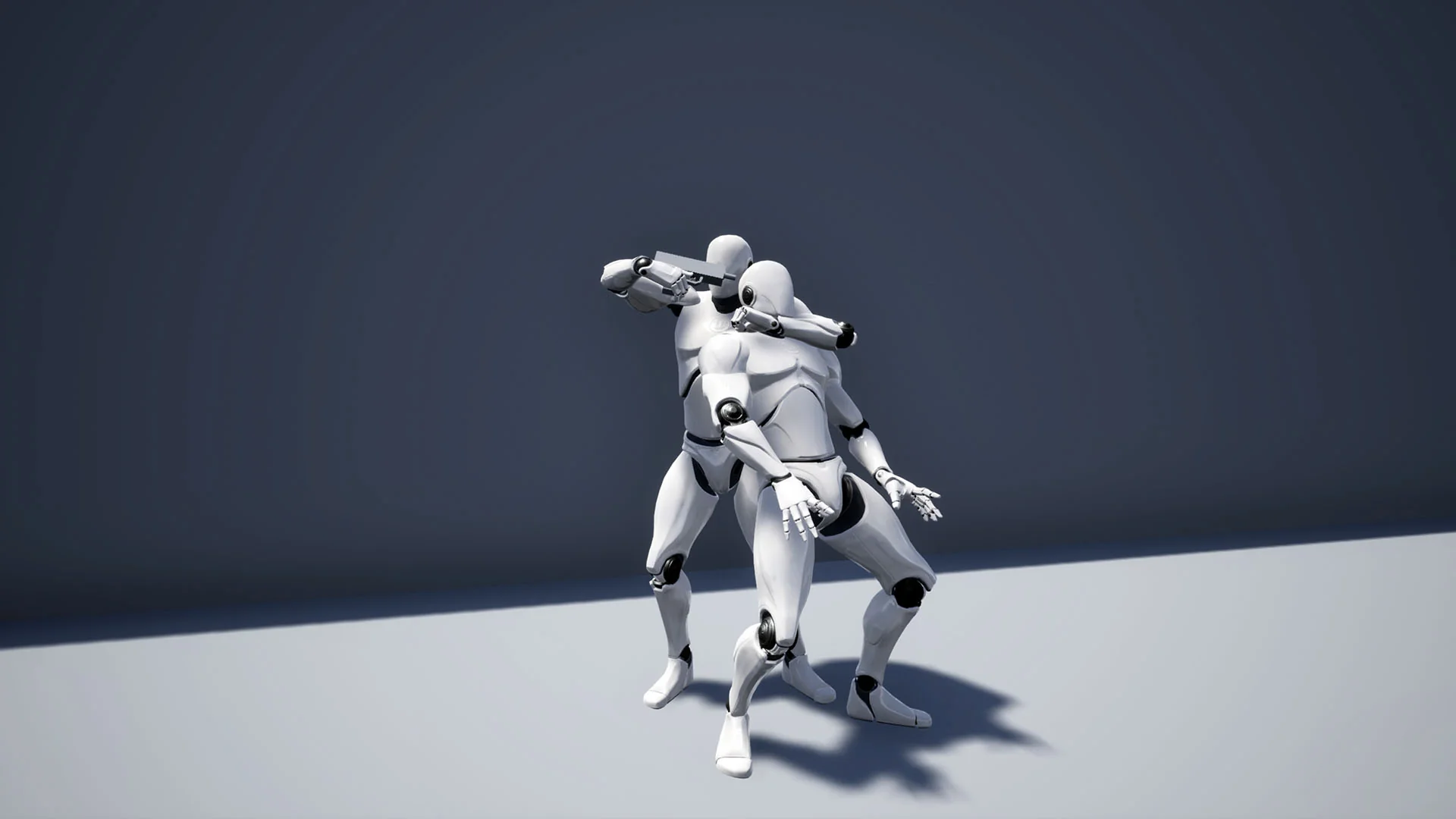
High-stakes tactical set pieces in games frequently hinge on tension-filled encounters: an armed assailant seizing an unarmed bystander, an operative taking cover behind a captive, or a tense standoff resolving through negotiation or sudden violence. Choreographing these interactions requires distinct motion data that accurately matches the spatial relationship between two characters. The Hostage Set delivers an animation library dedicated directly to these synchronized hostage scenarios, delivering paired grabs, captive states, standing weapon idles, and transition movements built to support tense narrative moments and dynamic combat situations.
Standoff Mechanics and the Hostage Set Framework
Interactive hostage mechanics rely heavily on strict spatial alignment. When a captor grabs a hostage, both character rigs must synchronize their positions, orientations, and limbs so the captor's arm correctly wraps around the captive's neck or torso while holding a weapon. The core library of the Hostage Set establishes this baseline with 45 base animations expanded by 39 additional animations across multiple updates, bringing the complete collection to 84 individual animation assets.
At the center of this framework are 22 pistol hostage grab animations. These grab sequences account for the primary paired interaction where an armed assailant controls an unwilling subject. Because grabs in real-time environments often require multiple approaches or varying states of captive struggle, having twenty-two distinct grab animations allows technical animators to stage varied takedowns or capture moments rather than repeating a single uniform hold. The grab sequences integrate the firearm directly into the posture, keeping one hand tasked with weapon control while the other manages the hostage.
Synchronized Captor Grabs and Execution Sequences
Beyond the initial capture, confrontations reach critical branch points where lethal force takes place. The package features two dedicated pistol hostage execution animations, cleanly split into one attacker motion and one victim motion. In production, synchronized paired actions require that the attacker's trigger pull, muzzle alignment, and recoil pattern line up precisely with the victim's physical reaction and fall.
Because the execution pair is split into distinct tracks for attacker and victim, teams can align the two characters at a shared sync point or root marker before initiating playback. This paired split ensures that collision boxes, ragdoll blend weights, and camera systems can trigger smoothly at the exact frame of weapon discharge without desynchronizing the physical interaction between the two participants.
Aim Spaces and Armed Hostage Idles
Holding a captive is rarely a static event; armed assailants must track threats, sweep rooms, or respond to approaching player characters. To address dynamic targeting while maintaining a grip on a captive, the Hostage Set incorporates 20 aim space animations. Aim spaces allow an animation graph to blend additive pitch and yaw offsets across a base pose. By layering these 20 aim space variations over the standing captor poses, developers can let AI characters or player-controlled captors point and adjust their pistol aiming across horizontal and vertical arcs while maintaining their physical hold on the hostage model.
When the captor is stationary and not tracking active targets, five pistol standing idles provide natural breathing, shifting weight, and baseline posture variations. These standing idles preserve the tension of the scene without introducing sudden movements that could break alignment with adjacent cinematic triggers or captive positioning.
Captive States: Handcuffs, Surrender, and Ground Transitions
A hostage scenario involves extended periods where captives are secured, subdued, or awaiting rescue away from the immediate grip of an assailant. The asset package addresses these non-combatant states through an extensive suite of dedicated poses and transitional movements:
Surrender and Compliance: Four hostage hands-up animations accommodate the initial phase of capture, providing clear body language for compliant or frightened characters before physical restraint occurs.
Restrained Movement: Twenty-two hostage handcuffed animations provide exhaustive coverage for secured victims. This broad count supports various idle states, nervous shifts, and restrained movement options necessary when managing captive NPCs across prolonged scenes.
Ground and Sitting Transitions: Ten animations cover sitting on the floor, laying on the floor, and the transitions moving between these states. These motions permit scenes where captives are forced down, ordered to remain seated against walls, or knocked to the floor during a breach.
These grounded and seated motions give directors the assets needed to populate banks, offices, or compound interiors with believable captive groups without leaving every NPC frozen in an identical standing loop.
Root Motion Variants and Orientation Management
Movement management in synchronized character setups presents specific technical demands, particularly regarding root orientation. Update iterations to the package introduced nine root motion variants that specifically feature the root facing the front across both root motion and non-root motion modes. In standard character controllers, mismatch between actor forward vectors and animation root bones can lead to foot sliding, capsule misalignment, or sudden 180-degree snapping when blending back into generic locomotion states.
By offering front-facing root configurations in both playback styles, animators have direct flexibility in how motion is propagated through their game engine. Teams driving character displacement purely through code or character capsule physics can rely on the in-place, non-root motion versions. Conversely, productions that rely on bone-driven translation and rotation to maintain perfect foot-locking during struggle sequences can deploy the root motion variants directly.
Implementation Scope and Pipeline Boundaries
Integrating the Hostage Set requires a clear understanding of what is included within the package boundary. The package delivers raw motion data: grab cycles, idles, captive states, aim spaces, and transition sets. Blueprints for gameplay systems, weapon firing logic, interaction triggers, and user interfaces are not included, as the pack operates strictly as an animation asset resource. Developers must implement their own interaction logic, sync components, and input mapping to tie the captor and captive skeletons together.
Also, the character meshes shown in preview materials are promotional assets and are not included in the library. All animation data is intended to be retargeted or assigned directly to production-ready character rigs within your engine environment. Combat designers, technical animators, and narrative teams building tactical shooters, stealth titles, or crime dramas will find the pack focused entirely on solving the complex spatial pairing of captor and captive, leaving gameplay architecture fully customizable to the host project's systems.
 Gestures
 Gestures
 Gestures