"ae2217ad8e73450c"{"id":"1003043","slug":"movement-animset-pro","title":"Movement Animset Pro","category":"Variety","engine":"4.23+,5.0+","assetVersion":"","engineVersion":"Engine Version: 4.23+,5.0+","tag":"Variety","accent":"blue","visual":"mech","summary":"Explore Movement Animset Pro, an unarmed third-person motion capture library with over 180 animations covering locomotion, transitions, climbing, and melee.","platform":"Unreal Engine","indexPolicy":"index","publishedAt":"2026-11-25T17:59:16.705Z","updatedAt":"2026-11-25T17:59:16.705Z","sourceNotes":[],"fileContents":[],"compatibility":["Unreal Engine","Engine Version: 4.23+,5.0+"],"featuredImage":{"alt":"Movement Animset Pro","src":"/wp-content/uploads/published/2026/11/dec6e6e5678d-0066b976-79d2-4adc-b080-00325daf1bf5-b63d80de8d.webp"},"hasDownloadLink":true,"downloads":0,"terms":[{"taxonomy":"category","slug":"variety-animations","name":"Variety"}],"galleryImages":[{"src":"/wp-content/uploads/published/2026/11/0fbe78cad0e2-1a8ff2b3-ee84-4e80-9dfb-85db996b81ca-e5b7257817.webp","alt":"Movement Animset Pro"}],"accessPanel":{"kind":"resource","title":"Get this resource","safetyNote":"Resources are manually reviewed before listing to improve quality and reduce obvious risks.","fileName":"Content.7z","resourceType":"Resource archive","versions":[]},"contentHtml":"\u003ch2\u003eMovement Animset Pro Implementation Architecture\u003c/h2\u003e\u003cp\u003eMovement Animset Pro provides a foundation of over 180 motion capture animations specifically created for unarmed third-person perspective (TPP) character setups. Unlike gameplay templates that bundle pre-configured physics code, player inputs, and camera components, this package focuses purely on kinematic animation data. It does not contain an internal character controller. For technical animators and gameplay programmers, this architectural separation provides full control over how movement logic, state transitions, and skeletal updates are mapped onto custom character rigs.\u003c/p\u003e\u003cp\u003eIntegrating an unarmed locomotion set without a bundled controller requires establishing baseline movement logic within the game engine. Developers configure standard locomotion variables, such as forward speed, directional velocity, acceleration curves, and ground-contact booleans, to drive custom state machines, blend spaces, and animation graphs. Because the assets represent authentic motion capture of an adult male moving in casual scenarios, the motion data carries realistic human weight, natural physical momentum, and accurate footfalls without requiring manual keyframe correction for basic balance shifts.\u003c/p\u003e\u003ch2\u003eLocomotion States and Movement Animset Pro Transitions\u003c/h2\u003e\u003cp\u003eA primary challenge in third-person character animation is smoothing the shift between stationary stances and continuous locomotion loops. Movement Animset Pro resolves this by pairing standard walking and running cycles with an extensive set of transition animations. The walking and running sets span multiple speeds, matched with dedicated start animations, abrupt stop clips, and pivot turns. When a player commands a direction from a standstill, the engine can trigger a realistic start animation that shifts the character's weight before blending smoothly into a continuous walk or run loop. Similarly, sudden halts or directional reversals play dedicated deceleration and pivot frames to prevent unnatural snapping between poses.\u003c/p\u003e\u003cp\u003eGround traversal extends into dedicated sneaking and crouching states. Stealth gameplay requires restrained pacing, a lowered center of gravity, and deliberate footfalls. The library includes sneaking locomotion cycles alongside crouch-walking and crouched idle poses. Bridging these stances are dedicated entry and recovery transitions. Moving from an upright idle into a crouch drives a transition clip that compresses the character's posture fluidly, preventing sudden visual pops in the spine or pelvis. When the character stands back up, the recovery animation returns the skeleton smoothly to an upright standing idle.\u003c/p\u003e\u003ch2\u003eClimbing, Jumping, and Dynamic Traversal States\u003c/h2\u003e\u003cp\u003eTo support dynamic level designs, the library incorporates traversal assets covering jumping, climbing, and sliding. Jumping animations are partitioned into distinct operational phases not just one baked clip. By splitting the jump sequence into a takeoff phase, an airborne apex, a downward falling loop, and landing impact recoveries, gameplay systems can synchronize visual output with physics sweeps and collision checks. When a character leaps off an elevated ledge, the falling loop plays continuously until ground collision triggers the appropriate landing animation to absorb downward momentum.\u003c/p\u003e\u003cp\u003eFor low-obstacle navigation and evasion mechanics, the animation set includes running slides. Sliding allows a character running at speed to drop low to the ground, carry forward velocity underneath obstacles, and either transition into a crouch or return to a sprint. When navigating vertical geometry, climbing clips supply the kinematic data required to clear low barriers, vault obstacles, or pull the character's body weight onto elevated ledges. These climbing motions establish distinct physical contact phases for environmental mantling, bridging horizontal ground movement with vertical navigation.\u003c/p\u003e\u003ch2\u003eUnarmed Combat and Object Interactions in Movement Animset Pro\u003c/h2\u003e\u003cp\u003eCharacters in third-person games frequently require physical actions beyond passive traversal. Movement Animset Pro addresses basic physical conflict through motion-captured fist-fighting animations. The melee clips depict authentic striking mechanics, including punches, swings, and combat stances suited for street or casual physical confrontations. Because these animations capture true human biomechanics, the strikes emphasize realistic torso rotation, shoulder engagement, and natural follow-through recovery frames, maintaining visual consistency with the realistic tone of the core locomotion set.\u003c/p\u003e\u003cp\u003eDevelopers can integrate these unarmed combat clips into attack montages or layered animation slots. For responsive control, fist strikes can be isolated to upper-body animation layers, allowing characters to throw punches while the lower body continues through walking or running cycles. Alternatively, full-body root motion combat animations can be executed when an attack requires the character to step forward into the strike with full physical commitment. Alongside combat, the library delivers object interaction animations. These clips capture characters reaching out, touching physical elements, operating levers or switches, inspecting items, and opening doors, ensuring natural hand placement and torso alignment when manipulating world objects.\u003c/p\u003e\u003ch2\u003eAnimation Pipeline and Update 1.5 Content\u003c/h2\u003e\u003cp\u003eMaintaining animation consistency across production milestones is essential for project continuity. The library was expanded through the release of Update 1.5, which added supplementary motion-captured animations to widen the baseline collection of over 180 clips. Whether working with the original set or incorporating the additions from Update 1.5, technical artists must establish consistent skeleton retargeting rules. Mapping the assets onto custom rigs while preserving proper retargeting chains ensures that the realistic male motion capture maintains proper foot placement, spine alignment, and arm extension.\u003c/p\u003e\u003cp\u003eFoot sliding is a common challenge when implementing motion capture assets into gameplay engines. Because Movement Animset Pro reflects authentic human locomotion, in-engine capsule speeds must correspond to the captured physical stride distance. Developers can either utilize root motion tracks to drive pawn displacement directly from the animation data to eliminate foot sliding, or calibrate in-game movement speeds to match the exact stride cadence of the walk, run, and sneak cycles. By providing a decoupled asset library spanning locomotion loops, transitions, sliding, climbing, fist melee, and object interactions, Movement Animset Pro supplies the core kinematic building blocks needed for responsive third-person character animation systems.\u003c/p\u003e\n\n\u003ch2\u003eRelated Resources Worth Checking\u003c/h2\u003e\n\u003cul\u003e\n\u003cli\u003e\u003ca href=\"https://3dcghub.com/open-world-animset/\" rel=\"noopener noreferrer\"\u003eOpen World Animset\u003c/a\u003e\u003c/li\u003e\n\u003cli\u003e\u003ca href=\"https://3dcghub.com/ladders-and-ledges-animset/\" rel=\"noopener noreferrer\"\u003eLadders and Ledges Animset\u003c/a\u003e\u003c/li\u003e\n\u003cli\u003e\u003ca href=\"https://3dcghub.com/idle-animset-pack/\" rel=\"noopener noreferrer\"\u003eIdle Animset Pack\u003c/a\u003e\u003c/li\u003e\n\u003cli\u003e\u003ca href=\"https://3dcghub.com/female-movement-animset-pro/\" rel=\"noopener noreferrer\"\u003eFemale Movement Animset Pro\u003c/a\u003e\u003c/li\u003e\n\u003cli\u003e\u003ca href=\"https://3dcghub.com/old-man-animset/\" rel=\"noopener noreferrer\"\u003eOld Man Animset\u003c/a\u003e\u003c/li\u003e\n\u003c/ul\u003e","contentTextLength":6909,"navigation":{"current":1,"total":4964,"next":{"id":"1003042","slug":"mocap-pirates-animation-library","title":"Mocap - Pirates Animation Library","category":"Variety","platform":"Unreal Engine","updatedAt":"2026-11-25T17:58:29.381Z"}},"relatedResources":[{"id":"1001583","slug":"open-world-animset","title":"Open World Animset","category":"Variety","engine":"4.8+,5.0+","assetVersion":"","engineVersion":"Engine Version: 4.8+,5.0+","tag":"Variety","accent":"blue","visual":"mech","summary":"Over 500 motion capture animations for humanoid character movement, traversal, cover mechanics, firearm handling, and melee combat.","platform":"Unreal Engine","indexPolicy":"index","publishedAt":"2026-10-10T08:55:24.492Z","updatedAt":"2026-10-10T08:55:24.492Z","sourceNotes":[],"fileContents":[],"compatibility":["Unreal Engine","Engine Version: 4.8+,5.0+"],"featuredImage":{"alt":"Open World Animset","src":"/wp-content/uploads/published/2026/10/5316a1357041-5e3578f2-c647-450e-a63b-ea83d2aa1e89-94597b32fa.webp"},"fileSizeBytes":129240752,"hasDownloadLink":true,"downloads":2},{"id":"1003039","slug":"ladders-and-ledges-animset","title":"Ladders and Ledges Animset","category":"Variety","engine":"4.19+,5.0+","assetVersion":"","engineVersion":"Engine Version: 4.19+,5.0+","tag":"Variety","accent":"blue","visual":"mech","summary":"A comprehensive breakdown of the Ladders and Ledges Animset, featuring over 130 motion capture animations for vertical navigation, climbing, and locomotion.","platform":"Unreal Engine","indexPolicy":"index","publishedAt":"2026-11-25T16:59:14.332Z","updatedAt":"2026-11-25T16:59:14.332Z","sourceNotes":[],"fileContents":[],"compatibility":["Unreal Engine","Engine Version: 4.19+,5.0+"],"featuredImage":{"alt":"Ladders and Ledges Animset","src":"/wp-content/uploads/published/2026/11/52a8d97f5da2-3fe86dab-c1aa-4dea-b20b-d604ae4c9189-31b3720840.webp"},"hasDownloadLink":true,"downloads":0},{"id":"1002321","slug":"idle-animset-pack","title":"Idle Animset Pack","category":"Variety","engine":"4.23+,5.0+","assetVersion":"","engineVersion":"Engine Version: 4.23+,5.0+","tag":"Variety","accent":"blue","visual":"mech","summary":"Idle Animset Pack holds 36 character idle animations, split into 25 base idles and 11 mirror animations, suited to survival, fishing, and simulation games.","platform":"Unreal Engine","indexPolicy":"index","publishedAt":"2026-11-06T06:22:51.144Z","updatedAt":"2026-11-06T06:22:51.144Z","sourceNotes":[],"fileContents":[],"compatibility":["Unreal Engine","Engine Version: 4.23+,5.0+"],"featuredImage":{"alt":"Idle Animset Pack","src":"/wp-content/uploads/published/2026/11/48405b9eacf8-8380692b-cd0d-4232-bf32-845ba0545a30-5800898379.webp"},"fileSizeBytes":13749598,"hasDownloadLink":true,"downloads":0}]}[{"id":4225,"sourceId":4225,"taxonomyId":4225,"taxonomy":"category","slug":"asset-library","name":"Asset Library","parentId":null,"count":4817,"hasChildren":true,"href":"/","seoTitle":"Free Game Assets Library | 3DCGHUB","seoDescription":"Browse free Unreal Engine, Unity, Blender assets and game development tutorials on 3DCGHUB with previews, compatibility notes, and secure downloads.","sitemapEnabled":true,"children":[{"id":4227,"sourceId":4227,"taxonomyId":4227,"taxonomy":"category","slug":"blender-add-ons-plugins","name":"Blender Add-ons \u0026 Plugins","parentId":4225,"count":10,"hasChildren":false,"href":"/category/blender-add-ons-plugins/","seoTitle":"Free Blender Add-ons \u0026 Plugins | 3DCGHUB","seoDescription":"Browse free Blender Add-ons \u0026 Plugins tools for Blender on 3DCGHUB: curated downloads with preview images, compatibility notes and secure download access.","sitemapEnabled":true},{"id":514,"sourceId":514,"taxonomyId":514,"taxonomy":"category","slug":"unity-2","name":"Unity","parentId":4225,"count":453,"hasChildren":true,"href":"/category/unity-2/","seoTitle":"Free Unity Assets | 3DCGHUB","seoDescription":"Browse free Unity resources on 3DCGHUB: curated downloads with preview images, compatibility notes and secure download access.","sitemapEnabled":true,"children":[{"id":523,"sourceId":523,"taxonomyId":523,"taxonomy":"category","slug":"2d","name":"2D","parentId":514,"count":1,"hasChildren":true,"href":"/category/2d/","seoTitle":"Free Unity 2D | 3DCGHUB","seoDescription":"Browse free 2D assets for Unity on 3DCGHUB: curated downloads with preview images, compatibility notes and secure download access.","sitemapEnabled":true},{"id":515,"sourceId":515,"taxonomyId":515,"taxonomy":"category","slug":"3d-unity-2","name":"3D","parentId":514,"count":162,"hasChildren":true,"href":"/category/3d-unity-2/","seoTitle":"Free Unity 3D Assets | 3DCGHUB","seoDescription":"Browse free 3D assets for Unity on 3DCGHUB: curated downloads with preview images, compatibility notes and secure download access.","sitemapEnabled":true},{"id":565,"sourceId":565,"taxonomyId":565,"taxonomy":"category","slug":"add-ons","name":"Add-Ons","parentId":514,"count":2,"hasChildren":false,"href":"/category/add-ons/","seoTitle":"Free Unity Add-Ons | 3DCGHUB","seoDescription":"Browse free Add-Ons assets for Unity on 3DCGHUB: curated downloads with preview images, compatibility notes and secure download access.","sitemapEnabled":true},{"id":529,"sourceId":529,"taxonomyId":529,"taxonomy":"category","slug":"audio-unity-2","name":"Audio","parentId":514,"count":1,"hasChildren":true,"href":"/category/audio-unity-2/","seoTitle":"Free Unity Audio | 3DCGHUB","seoDescription":"Browse free Audio for Unity on 3DCGHUB: curated downloads with preview images, compatibility notes and secure download access.","sitemapEnabled":true},{"id":557,"sourceId":557,"taxonomyId":557,"taxonomy":"category","slug":"templates","name":"Templates","parentId":514,"count":36,"hasChildren":true,"href":"/category/templates/","seoTitle":"Free Unity Templates | 3DCGHUB","seoDescription":"Browse free Unity project templates on 3DCGHUB. Starter kits with previews, compatibility notes, and secure download access.","sitemapEnabled":true},{"id":533,"sourceId":533,"taxonomyId":533,"taxonomy":"category","slug":"tools-unity-2","name":"Tools","parentId":514,"count":0,"hasChildren":true,"href":"/category/tools-unity-2/","sitemapEnabled":true},{"id":554,"sourceId":554,"taxonomyId":554,"taxonomy":"category","slug":"vfx-unity-2","name":"VFX","parentId":514,"count":4,"hasChildren":true,"href":"/category/vfx-unity-2/","seoTitle":"Free Unity VFX | 3DCGHUB","seoDescription":"Browse free VFX for Unity on 3DCGHUB: curated downloads with preview images, compatibility notes and secure download access.","sitemapEnabled":true}]},{"id":511,"sourceId":511,"taxonomyId":511,"taxonomy":"category","slug":"unreal-engine-2","name":"Unreal Engine","parentId":4225,"count":4355,"hasChildren":true,"href":"/category/unreal-engine-2/","seoTitle":"Free Unreal Engine Assets | 3DCGHUB","seoDescription":"Browse free Unreal Engine resources on 3DCGHUB: curated downloads with preview images, compatibility notes and secure download access.","sitemapEnabled":true,"children":[{"id":54,"sourceId":54,"taxonomyId":54,"taxonomy":"category","slug":"3d","name":"3D","parentId":511,"count":2441,"hasChildren":true,"href":"/category/3d/","seoTitle":"Free Unreal Engine 3D | 3DCGHUB","seoDescription":"Browse free 3D assets for Unreal Engine on 3DCGHUB: curated downloads with preview images, compatibility notes and secure download access.","sitemapEnabled":true},{"id":441,"sourceId":441,"taxonomyId":441,"taxonomy":"category","slug":"animations","name":"Animations","parentId":511,"count":269,"hasChildren":true,"href":"/category/animations/","seoTitle":"Free Unreal Engine Animations | 3DCGHUB","seoDescription":"Browse free Animations for Unreal Engine on 3DCGHUB: curated downloads with preview images, compatibility notes and secure download access.","sitemapEnabled":true},{"id":446,"sourceId":446,"taxonomyId":446,"taxonomy":"category","slug":"audio","name":"Audio","parentId":511,"count":63,"hasChildren":true,"href":"/category/audio/","seoTitle":"Free Unreal Engine Audio Resources | 3DCGHUB","seoDescription":"Browse free Unreal Engine audio resources including sound effects, voices, dialogue, and ambient sounds. Curated free downloads on 3DCGHUB.","sitemapEnabled":true},{"id":466,"sourceId":466,"taxonomyId":466,"taxonomy":"category","slug":"game-systems","name":"Game Systems","parentId":511,"count":381,"hasChildren":true,"href":"/category/game-systems/","seoTitle":"Free Unreal Engine Game Systems | 3DCGHUB","seoDescription":"Browse free Game Systems tools for Unreal Engine on 3DCGHUB: curated downloads with preview images, compatibility notes and secure download access.","sitemapEnabled":true},{"id":478,"sourceId":478,"taxonomyId":478,"taxonomy":"category","slug":"game-templates","name":"Game Templates","parentId":511,"count":155,"hasChildren":true,"href":"/category/game-templates/","seoTitle":"Free Unreal Engine Game Templates | 3DCGHUB","seoDescription":"Browse free Game Templates for Unreal Engine on 3DCGHUB: curated downloads with preview images, compatibility notes and secure download access.","sitemapEnabled":true},{"id":432,"sourceId":432,"taxonomyId":432,"taxonomy":"category","slug":"hdri","name":"HDRI","parentId":511,"count":6,"hasChildren":true,"href":"/category/hdri/","seoTitle":"Free Unreal Engine HDRI | 3DCGHUB","seoDescription":"Browse free Unreal Engine HDRI skies and lighting maps on 3DCGHUB. Environment lighting with previews and secure downloads.","sitemapEnabled":true},{"id":228,"sourceId":228,"taxonomyId":228,"taxonomy":"category","slug":"material-and-textures","name":"Material \u0026 Textures","parentId":511,"count":172,"hasChildren":true,"href":"/category/material-and-textures/","seoTitle":"Free Unreal Engine Material \u0026 Textures | 3DCGHUB","seoDescription":"Browse free Material \u0026 Textures for Unreal Engine on 3DCGHUB: curated downloads with preview images, compatibility notes and secure download access.","sitemapEnabled":true},{"id":298,"sourceId":298,"taxonomyId":298,"taxonomy":"category","slug":"sprites-and-flipbooks","name":"Sprites \u0026 Flipbooks","parentId":511,"count":18,"hasChildren":true,"href":"/category/sprites-and-flipbooks/","seoTitle":"Free Unreal Engine Sprites \u0026 Flipbooks | 3DCGHUB","seoDescription":"Browse free Sprites \u0026 Flipbooks assets for Unreal Engine on 3DCGHUB: curated downloads with preview images, compatibility notes and secure download access.","sitemapEnabled":true},{"id":489,"sourceId":489,"taxonomyId":489,"taxonomy":"category","slug":"tools-and-plugins","name":"Tools \u0026 Plugins","parentId":511,"count":390,"hasChildren":true,"href":"/category/tools-and-plugins/","seoTitle":"Free Unreal Engine Tools \u0026 Plugins | 3DCGHUB","seoDescription":"Browse free Tools \u0026 Plugins for Unreal Engine on 3DCGHUB: curated downloads with preview images, compatibility notes and secure download access.","sitemapEnabled":true},{"id":459,"sourceId":459,"taxonomyId":459,"taxonomy":"category","slug":"ui","name":"UI","parentId":511,"count":47,"hasChildren":true,"href":"/category/ui/","seoTitle":"Free Unreal Engine UI | 3DCGHUB","seoDescription":"Browse free UI for Unreal Engine on 3DCGHUB: curated downloads with preview images, compatibility notes and secure download access.","sitemapEnabled":true},{"id":450,"sourceId":450,"taxonomyId":450,"taxonomy":"category","slug":"vfx","name":"VFX","parentId":511,"count":413,"hasChildren":true,"href":"/category/vfx/","seoTitle":"Free Unreal Engine VFX | 3DCGHUB","seoDescription":"Browse free VFX for Unreal Engine on 3DCGHUB: curated downloads with preview images, compatibility notes and secure download access.","sitemapEnabled":true}]}]},{"id":4222,"sourceId":4222,"taxonomyId":4222,"taxonomy":"category","slug":"tutorial-library","name":"Tutorial Library","parentId":null,"count":117,"hasChildren":false,"href":"/tutorials/","seoTitle":"Free Game Development Tutorial Library | 3DCGHUB","seoDescription":"Browse free game development tutorials for Unreal Engine, Unity, Blender, and more on 3DCGHUB with practical workflows and secure downloads.","sitemapEnabled":true}]
Resource screenshots
1 / 1
Asset drops
Daily Asset Drops
Follow 3DCGHUB on Telegram for daily Unreal, Unity & Blender drops and curated CC0 releases.
Resources are manually reviewed before listing to improve quality and reduce obvious risks.
Reviewed archive
Variety
Movement Animset Pro
Explore Movement Animset Pro, an unarmed third-person motion capture library with over 180 animations covering locomotion, transitions, climbing, and melee.
Movement Animset Pro provides a foundation of over 180 motion capture animations specifically created for unarmed third-person perspective (TPP) character setups. Unlike gameplay templates that bundle pre-configured physics code, player inputs, and camera components, this package focuses purely on kinematic animation data. It does not contain an internal character controller. For technical animators and gameplay programmers, this architectural separation provides full control over how movement logic, state transitions, and skeletal updates are mapped onto custom character rigs.
Integrating an unarmed locomotion set without a bundled controller requires establishing baseline movement logic within the game engine. Developers configure standard locomotion variables, such as forward speed, directional velocity, acceleration curves, and ground-contact booleans, to drive custom state machines, blend spaces, and animation graphs. Because the assets represent authentic motion capture of an adult male moving in casual scenarios, the motion data carries realistic human weight, natural physical momentum, and accurate footfalls without requiring manual keyframe correction for basic balance shifts.
Locomotion States and Movement Animset Pro Transitions
A primary challenge in third-person character animation is smoothing the shift between stationary stances and continuous locomotion loops. Movement Animset Pro resolves this by pairing standard walking and running cycles with an extensive set of transition animations. The walking and running sets span multiple speeds, matched with dedicated start animations, abrupt stop clips, and pivot turns. When a player commands a direction from a standstill, the engine can trigger a realistic start animation that shifts the character's weight before blending smoothly into a continuous walk or run loop. Similarly, sudden halts or directional reversals play dedicated deceleration and pivot frames to prevent unnatural snapping between poses.
Ground traversal extends into dedicated sneaking and crouching states. Stealth gameplay requires restrained pacing, a lowered center of gravity, and deliberate footfalls. The library includes sneaking locomotion cycles alongside crouch-walking and crouched idle poses. Bridging these stances are dedicated entry and recovery transitions. Moving from an upright idle into a crouch drives a transition clip that compresses the character's posture fluidly, preventing sudden visual pops in the spine or pelvis. When the character stands back up, the recovery animation returns the skeleton smoothly to an upright standing idle.
Climbing, Jumping, and Dynamic Traversal States
To support dynamic level designs, the library incorporates traversal assets covering jumping, climbing, and sliding. Jumping animations are partitioned into distinct operational phases not just one baked clip. By splitting the jump sequence into a takeoff phase, an airborne apex, a downward falling loop, and landing impact recoveries, gameplay systems can synchronize visual output with physics sweeps and collision checks. When a character leaps off an elevated ledge, the falling loop plays continuously until ground collision triggers the appropriate landing animation to absorb downward momentum.
For low-obstacle navigation and evasion mechanics, the animation set includes running slides. Sliding allows a character running at speed to drop low to the ground, carry forward velocity underneath obstacles, and either transition into a crouch or return to a sprint. When navigating vertical geometry, climbing clips supply the kinematic data required to clear low barriers, vault obstacles, or pull the character's body weight onto elevated ledges. These climbing motions establish distinct physical contact phases for environmental mantling, bridging horizontal ground movement with vertical navigation.
Unarmed Combat and Object Interactions in Movement Animset Pro
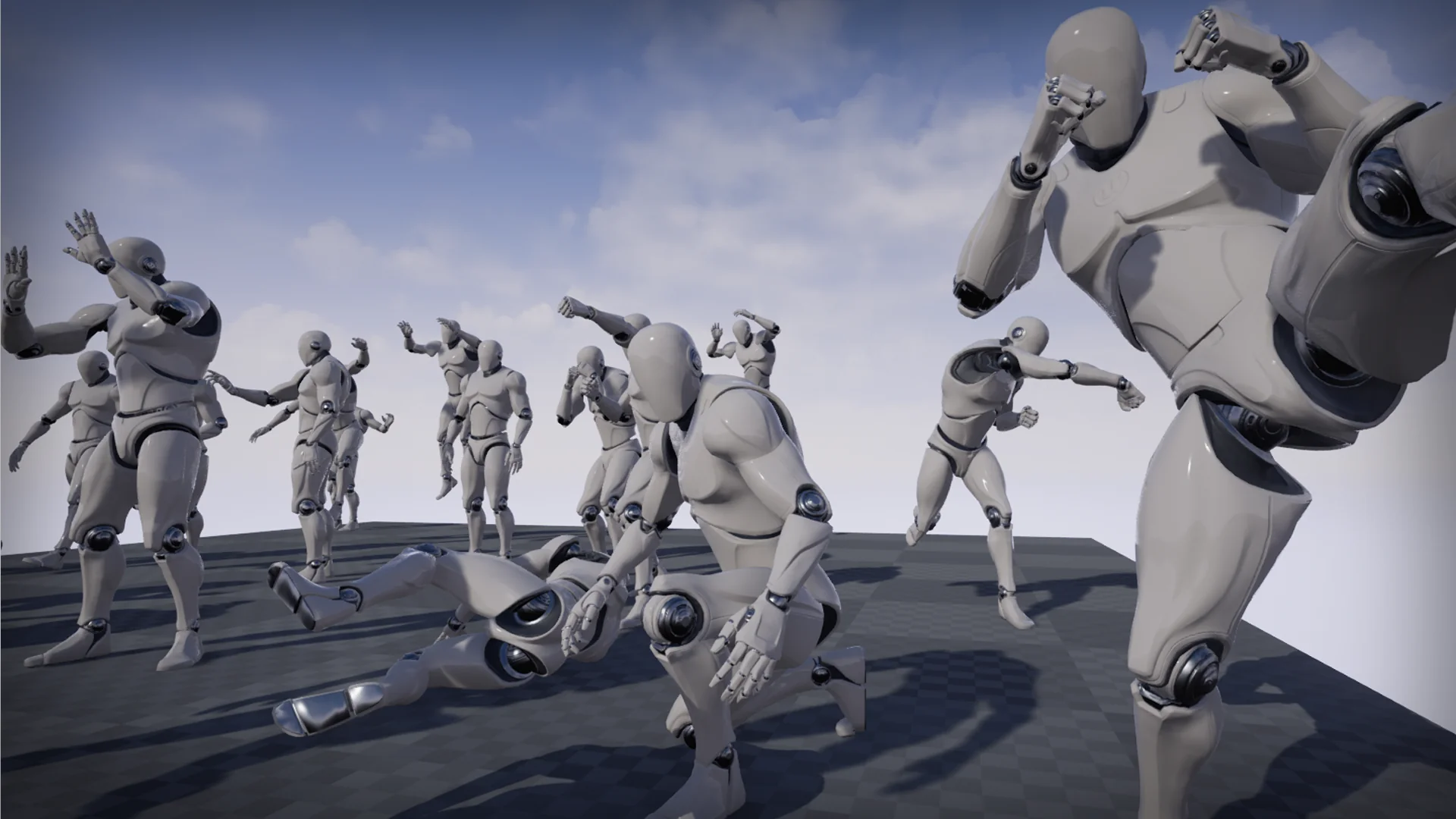
Characters in third-person games frequently require physical actions beyond passive traversal. Movement Animset Pro addresses basic physical conflict through motion-captured fist-fighting animations. The melee clips depict authentic striking mechanics, including punches, swings, and combat stances suited for street or casual physical confrontations. Because these animations capture true human biomechanics, the strikes emphasize realistic torso rotation, shoulder engagement, and natural follow-through recovery frames, maintaining visual consistency with the realistic tone of the core locomotion set.
Developers can integrate these unarmed combat clips into attack montages or layered animation slots. For responsive control, fist strikes can be isolated to upper-body animation layers, allowing characters to throw punches while the lower body continues through walking or running cycles. Alternatively, full-body root motion combat animations can be executed when an attack requires the character to step forward into the strike with full physical commitment. Alongside combat, the library delivers object interaction animations. These clips capture characters reaching out, touching physical elements, operating levers or switches, inspecting items, and opening doors, ensuring natural hand placement and torso alignment when manipulating world objects.
Animation Pipeline and Update 1.5 Content
Maintaining animation consistency across production milestones is essential for project continuity. The library was expanded through the release of Update 1.5, which added supplementary motion-captured animations to widen the baseline collection of over 180 clips. Whether working with the original set or incorporating the additions from Update 1.5, technical artists must establish consistent skeleton retargeting rules. Mapping the assets onto custom rigs while preserving proper retargeting chains ensures that the realistic male motion capture maintains proper foot placement, spine alignment, and arm extension.
Foot sliding is a common challenge when implementing motion capture assets into gameplay engines. Because Movement Animset Pro reflects authentic human locomotion, in-engine capsule speeds must correspond to the captured physical stride distance. Developers can either utilize root motion tracks to drive pawn displacement directly from the animation data to eliminate foot sliding, or calibrate in-game movement speeds to match the exact stride cadence of the walk, run, and sneak cycles. By providing a decoupled asset library spanning locomotion loops, transitions, sliding, climbing, fist melee, and object interactions, Movement Animset Pro supplies the core kinematic building blocks needed for responsive third-person character animation systems.
 Variety
 Variety
 Variety