"ae2217ad8e73450c"{"id":"1003042","slug":"mocap-pirates-animation-library","title":"Mocap - Pirates Animation Library","category":"Variety","engine":"5.1+","assetVersion":"","engineVersion":"Engine Version: 5.1+","tag":"Variety","accent":"blue","visual":"animation","summary":"A detailed look at the Mocap - Pirates Animation Library, featuring 63 cinematic body and finger animations tailored for Unreal Engine 5 projects.","platform":"Unreal Engine","indexPolicy":"index","publishedAt":"2026-11-25T17:58:29.381Z","updatedAt":"2026-11-25T17:58:29.381Z","sourceNotes":[],"fileContents":[],"compatibility":["Unreal Engine","Engine Version: 5.1+"],"featuredImage":{"alt":"Mocap - Pirates Animation Library","src":"/wp-content/uploads/published/2026/11/65c7ed721437-d03196a7-d49a-4421-ac86-897ee5e8bdd1-89d6841618.webp"},"hasDownloadLink":true,"downloads":0,"terms":[{"taxonomy":"category","slug":"variety-animations","name":"Variety"}],"galleryImages":[{"src":"/wp-content/uploads/published/2026/11/34ce06326253-8b12c0fc-4d00-44fc-a021-c64167b4227e-266d99848e.webp","alt":"Mocap - Pirates Animation Library"},{"src":"/wp-content/uploads/published/2026/11/5b3f0053245f-c7f54fa0-6c0d-42b2-9d8a-3d34a66e5c09-f848d04789.webp","alt":"Mocap - Pirates Animation Library"},{"src":"/wp-content/uploads/published/2026/11/e053b6f25ed5-6071f5a3-1c33-436d-ad81-03e2126ea6d5-0454cc4a98.webp","alt":"Mocap - Pirates Animation Library"},{"src":"/wp-content/uploads/published/2026/11/55487c9d1574-6ea494e3-0ecf-492a-9a9d-bd3471460f68-fc184b0445.webp","alt":"Mocap - Pirates Animation Library"},{"src":"/wp-content/uploads/published/2026/11/995563d4fea8-7d0cc5c5-5674-41fe-b70b-998afd7b51c5-706c73837d.webp","alt":"Mocap - Pirates Animation Library"},{"src":"/wp-content/uploads/published/2026/11/a7b3ab478380-d14fe0c5-c984-4a38-ae52-dfcd42720f3f-ae79a61a0c.webp","alt":"Mocap - Pirates Animation Library"}],"accessPanel":{"kind":"resource","title":"Get this resource","safetyNote":"Resources are manually reviewed before listing to improve quality and reduce obvious risks.","fileName":"Content.7z","resourceType":"Resource archive","versions":[]},"contentHtml":"\u003cp\u003eThe Mocap - Pirates Animation Library provides a dedicated set of 63 motion capture performances encompassing full-body movement and articulated finger data. Configured specifically for Unreal Engine 5 skeletons, the asset collection centers on the physical routines, shipboard hazards, and chaotic skirmishes typical of age-of-sail maritime narratives. The performances are delivered with polished motion capture fidelity, incorporating in-place setups, root motion formats, and looping variations suited for sequential shot building.\u003c/p\u003e \u003ch2\u003eShipboard Duties in the Pirates Animation Library\u003c/h2\u003e\n\u003cp\u003eSeafaring scenes demand a specific physical vocabulary dictated by rigging, deck maintenance, and manual navigation. A major segment of this motion library concentrates on the operational realities of historical sailing vessels. Crew members are captured performing labor-intensive actions such as scrubbing timber decks on hands and knees, pulling heavy ropes, cutting fouled rigging under pressure, and manually rotating winches to manage ship mechanisms.\u003c/p\u003e \u003cp\u003eVerticality is a core reality aboard tall ships, and the pack addresses this with distinct climbing animations. Performers demonstrate the hand-over-hand cadence of scaling rope ladders as well as ascending raw vertical ropes. Upper-deck management is further covered through coordinated sail-hoisting captures, where the motion carries realistic resistance and weight. For lookout setups, multiple idle variants establish maritime atmosphere: lookouts scan the horizon through brass spyglasses, steady themselves within rope netting, and point outward upon spotting distant land.\u003c/p\u003e \u003cp\u003eHelmsmanship and navigation routines extend these functional behaviors. The library provides dedicated takes of sailors gripping and turning the ship's wheel, studying unfolded treasure maps, and taking accurate navigational measurements using a handheld compass. These captures emphasize nuanced finger posing and posture adjustments, ensuring close-up camera angles remain grounded when characters manipulate navigational charts and instruments.\u003c/p\u003e \u003ch2\u003eCombat and Boarding Mocap Sequences\u003c/h2\u003e\n\u003cp\u003eWhen maritime encounters escalate into hostility, the library shifts toward cutlass duels, boarding maneuvers, and artillery management. Ranged and melee encounters feature full motion tracking, accounting for the unrefined, aggressive fighting styles associated with privateers and corsairs. The pack supplies specific performances for drawing cutlasses, engaging in multi-stroke sword duels, delivering precise thrusts, and defensively parrying strikes with knives. Characters can also be seen sheathing weapons or running across the deck with blades bared, keeping tension high during chaotic breaches.\u003c/p\u003e \u003cp\u003eArtillery operations are divided into distinct stages. Crew characters are animated loading heavy cannon shot down the barrel and coordinating the ignition sequence to fire broadsides. Handheld firearm animations reflect the mechanics of flintlock and matchlock combat, featuring targeted firearm aiming and firing cycles alongside close-quarters intimidation maneuvers where characters brandish swords and pistols directly into an opponent's face.\u003c/p\u003e \u003cp\u003eBoarding actions introduce heightened stunts and kinetic transfers. Captures include swinging across open air suspended by ropes to breach opposing decks, hurling boarding grappling hooks to draw ships together, and casting harpoons with full-body momentum. When close-quarters combat degrades into unorganized brawls, the performances include improvised tavern-style violence, such as smashing glass rum bottles across an adversary's head or leaping from gunwales to execute boarding assaults.\u003c/p\u003e \u003ch2\u003eMaritime Misfortune, Captivity, and Camp Sequences\u003c/h2\u003e\n\u003cp\u003eHistorical buccaneering narratives frequently revolve around discipline, defeat, mutiny, and survival. The collection accounts for these grim turns of fortune through targeted physical interactions. Several takes represent captivity and punishment, including a prisoner tied immobiler to a wooden mast, an officer lashing a captive with a whip, and an injured captive reacting to whip strikes across the back. In dueling contexts, physical trauma is addressed with explicit hit reactions, such as a sword puncture to the abdomen.\u003c/p\u003e \u003cp\u003eLife outside of combat includes downtime, intoxication, and bodily distress. Performances capture crewmen guzzling from rum bottles, resting supine in suspended canvas hammocks, and sprawling across deck planks in drunken stupors. The rougher physical toll of sea travel appears in animations depicting sea-sickness, with characters retching overboard, or ringing the ship's alarm bell frantically in response to collisions, ramming maneuvers, or sudden ambush.\u003c/p\u003e \u003cp\u003eSubmersion and disaster scenarios account for crew members thrown or driven into the sea. Characters jump over the rail, plunge holding onto ship lines, swim against ocean surges, drift while clinging desperately to floating timber planks, and sink lifelessly as drowned corpses. For shore landings and plunder sequences, the performances pivot toward recovery and exploration: characters dig coastal sands with shovels, throw casting nets into shallows, haul water buckets from rowboats, row small landing crafts, open heavy chest lids, and wave white surrender flags when overwhelmed.\u003c/p\u003e \u003ch2\u003eCinematic Framing Over Gameplay State Machines\u003c/h2\u003e\n\u003cp\u003eThe library is explicitly structured for cinematic timelines, cutscenes, and pre-visualized narrative sequences rather than complex gameplay state machines. While individual tracks supply root motion and clean looping cycles that technical animators can repurpose, the acting choices, physical cadence, and pacing of each capture are optimized to serve linear visual storytelling in Unreal Engine's Sequencer.\u003c/p\u003e \u003cp\u003eLocomotion variations reflect character-driven storytelling rather than standard tactical strafing. The collection features specific walking profiles that immediately establish character backstory, including a distinct peg-leg limp, an anxious walk while balancing along a plank before jumping, and purposeful traverses carrying cargo boxes, sacks slung over shoulders, flickering candles, or burning torches. The integration of complete finger tracking across these actions guarantees that secondary interactions—holding handles, gripping torch timber, or feeling the edge of a sword—hold up under close cinematic scrutiny on modern character rigs, including MetaHuman workflows.\u003c/p\u003e\n\n\u003ch2\u003eExplore Similar Assets\u003c/h2\u003e\n\u003cul\u003e\n\u003cli\u003e\u003ca href=\"https://3dcghub.com/mocap-wizard-academy-animation-library/\" rel=\"noopener noreferrer\"\u003eMocap - Wizard Academy Animation Library\u003c/a\u003e\u003c/li\u003e\n\u003cli\u003e\u003ca href=\"https://3dcghub.com/female-mocap-animation-pack-vol-1/\" rel=\"noopener noreferrer\"\u003eFemale Mocap Animation Pack Vol.1\u003c/a\u003e\u003c/li\u003e\n\u003cli\u003e\u003ca href=\"https://3dcghub.com/mocap-western-animation-library/\" rel=\"noopener noreferrer\"\u003eMocap - Western Animation Library\u003c/a\u003e\u003c/li\u003e\n\u003cli\u003e\u003ca href=\"https://3dcghub.com/dance-mocap-collection/\" rel=\"noopener noreferrer\"\u003eDance MoCap Collection\u003c/a\u003e\u003c/li\u003e\n\u003cli\u003e\u003ca href=\"https://3dcghub.com/party-dance-npc-animation-pack/\" rel=\"noopener noreferrer\"\u003eParty Dance NPC Animation Pack\u003c/a\u003e\u003c/li\u003e\n\u003c/ul\u003e","contentTextLength":6612,"navigation":{"current":2,"total":4964,"previous":{"id":"1003043","slug":"movement-animset-pro","title":"Movement Animset Pro","category":"Variety","platform":"Unreal Engine","updatedAt":"2026-11-25T17:59:16.705Z"},"next":{"id":"1003041","slug":"mobility-pro-mocap-pack","title":"Mobility Pro - MoCap Pack","category":"Locomotion / Gaits","platform":"Unreal Engine","updatedAt":"2026-11-25T17:55:41.107Z"}},"relatedResources":[{"id":"1001744","slug":"mocap-wizard-academy-animation-library","title":"Mocap - Wizard Academy Animation Library","category":"Variety","engine":"5.1+","assetVersion":"","engineVersion":"Engine Version: 5.1+","tag":"Variety","accent":"blue","visual":"animation","summary":"Explore the Mocap - Wizard Academy Animation Library, featuring 61 cinematic body and finger mocap clips for UE5 skeletons, spells, and rituals.","platform":"Unreal Engine","indexPolicy":"index","publishedAt":"2026-10-20T02:50:02.754Z","updatedAt":"2026-10-20T02:50:02.754Z","sourceNotes":[],"fileContents":[],"compatibility":["Unreal Engine","Engine Version: 5.1+"],"featuredImage":{"alt":"Mocap - Wizard Academy Animation Library","src":"/wp-content/uploads/published/2026/10/a0fa4c046cc3-a2a6f810-c572-4044-86ea-9395ee387d8f-ed02f7b58f.webp"},"fileSizeBytes":312697006,"hasDownloadLink":true,"downloads":1},{"id":"1001393","slug":"female-mocap-animation-pack-vol-1","title":"Female Mocap Animation Pack Vol.1","category":"Variety","engine":"5.0+","assetVersion":"","engineVersion":"Engine Version: 5.0+","tag":"Variety","accent":"blue","visual":"animation","summary":"Female Mocap Animation Pack Vol.1 provides motion-captured female animations built on the default Epic Skeleton in looped and segmented formats.","platform":"Unreal Engine","indexPolicy":"index","publishedAt":"2026-10-04T17:16:36.132Z","updatedAt":"2026-10-04T17:16:36.132Z","sourceNotes":[],"fileContents":[],"compatibility":["Unreal Engine","Engine Version: 5.0+"],"featuredImage":{"alt":"Female Mocap Animation Pack Vol.1","src":"/wp-content/uploads/published/2026/10/c2839484756e-3e4c488f-fd2b-48e5-adbc-19b9252c784e-114b6b1274.webp"},"fileSizeBytes":41521163,"hasDownloadLink":true,"downloads":1},{"id":"1000955","slug":"mocap-western-animation-library","title":"Mocap - Western Animation Library","category":"Variety","engine":"5.1+","assetVersion":"","engineVersion":"Engine Version: 5.1+","tag":"Variety","accent":"blue","visual":"animation","summary":"90 western motion capture animations with body and finger data for Unreal Engine 5 cinematics, covering duels, saloon life, deaths, and horse work with loops an","platform":"Unreal Engine","indexPolicy":"index","publishedAt":"2026-08-14T14:51:46.206Z","updatedAt":"2026-08-14T14:51:46.206Z","sourceNotes":[],"fileContents":[],"compatibility":["Unreal Engine","Engine Version: 5.1+"],"featuredImage":{"alt":"Mocap - Western Animation Library","src":"/wp-content/uploads/published/2026/08/2a3ed0777334-d8974bda-65fd-4e05-8e7f-c6281c2c4175-a0cb0ab85a.webp"},"fileSizeBytes":317126776,"hasDownloadLink":true,"downloads":1}]}[{"id":4225,"sourceId":4225,"taxonomyId":4225,"taxonomy":"category","slug":"asset-library","name":"Asset Library","parentId":null,"count":4817,"hasChildren":true,"href":"/","seoTitle":"Free Game Assets Library | 3DCGHUB","seoDescription":"Browse free Unreal Engine, Unity, Blender assets and game development tutorials on 3DCGHUB with previews, compatibility notes, and secure downloads.","sitemapEnabled":true,"children":[{"id":4227,"sourceId":4227,"taxonomyId":4227,"taxonomy":"category","slug":"blender-add-ons-plugins","name":"Blender Add-ons \u0026 Plugins","parentId":4225,"count":10,"hasChildren":false,"href":"/category/blender-add-ons-plugins/","seoTitle":"Free Blender Add-ons \u0026 Plugins | 3DCGHUB","seoDescription":"Browse free Blender Add-ons \u0026 Plugins tools for Blender on 3DCGHUB: curated downloads with preview images, compatibility notes and secure download access.","sitemapEnabled":true},{"id":514,"sourceId":514,"taxonomyId":514,"taxonomy":"category","slug":"unity-2","name":"Unity","parentId":4225,"count":453,"hasChildren":true,"href":"/category/unity-2/","seoTitle":"Free Unity Assets | 3DCGHUB","seoDescription":"Browse free Unity resources on 3DCGHUB: curated downloads with preview images, compatibility notes and secure download access.","sitemapEnabled":true,"children":[{"id":523,"sourceId":523,"taxonomyId":523,"taxonomy":"category","slug":"2d","name":"2D","parentId":514,"count":1,"hasChildren":true,"href":"/category/2d/","seoTitle":"Free Unity 2D | 3DCGHUB","seoDescription":"Browse free 2D assets for Unity on 3DCGHUB: curated downloads with preview images, compatibility notes and secure download access.","sitemapEnabled":true},{"id":515,"sourceId":515,"taxonomyId":515,"taxonomy":"category","slug":"3d-unity-2","name":"3D","parentId":514,"count":162,"hasChildren":true,"href":"/category/3d-unity-2/","seoTitle":"Free Unity 3D Assets | 3DCGHUB","seoDescription":"Browse free 3D assets for Unity on 3DCGHUB: curated downloads with preview images, compatibility notes and secure download access.","sitemapEnabled":true},{"id":565,"sourceId":565,"taxonomyId":565,"taxonomy":"category","slug":"add-ons","name":"Add-Ons","parentId":514,"count":2,"hasChildren":false,"href":"/category/add-ons/","seoTitle":"Free Unity Add-Ons | 3DCGHUB","seoDescription":"Browse free Add-Ons assets for Unity on 3DCGHUB: curated downloads with preview images, compatibility notes and secure download access.","sitemapEnabled":true},{"id":529,"sourceId":529,"taxonomyId":529,"taxonomy":"category","slug":"audio-unity-2","name":"Audio","parentId":514,"count":1,"hasChildren":true,"href":"/category/audio-unity-2/","seoTitle":"Free Unity Audio | 3DCGHUB","seoDescription":"Browse free Audio for Unity on 3DCGHUB: curated downloads with preview images, compatibility notes and secure download access.","sitemapEnabled":true},{"id":557,"sourceId":557,"taxonomyId":557,"taxonomy":"category","slug":"templates","name":"Templates","parentId":514,"count":36,"hasChildren":true,"href":"/category/templates/","seoTitle":"Free Unity Templates | 3DCGHUB","seoDescription":"Browse free Unity project templates on 3DCGHUB. Starter kits with previews, compatibility notes, and secure download access.","sitemapEnabled":true},{"id":533,"sourceId":533,"taxonomyId":533,"taxonomy":"category","slug":"tools-unity-2","name":"Tools","parentId":514,"count":0,"hasChildren":true,"href":"/category/tools-unity-2/","sitemapEnabled":true},{"id":554,"sourceId":554,"taxonomyId":554,"taxonomy":"category","slug":"vfx-unity-2","name":"VFX","parentId":514,"count":4,"hasChildren":true,"href":"/category/vfx-unity-2/","seoTitle":"Free Unity VFX | 3DCGHUB","seoDescription":"Browse free VFX for Unity on 3DCGHUB: curated downloads with preview images, compatibility notes and secure download access.","sitemapEnabled":true}]},{"id":511,"sourceId":511,"taxonomyId":511,"taxonomy":"category","slug":"unreal-engine-2","name":"Unreal Engine","parentId":4225,"count":4355,"hasChildren":true,"href":"/category/unreal-engine-2/","seoTitle":"Free Unreal Engine Assets | 3DCGHUB","seoDescription":"Browse free Unreal Engine resources on 3DCGHUB: curated downloads with preview images, compatibility notes and secure download access.","sitemapEnabled":true,"children":[{"id":54,"sourceId":54,"taxonomyId":54,"taxonomy":"category","slug":"3d","name":"3D","parentId":511,"count":2441,"hasChildren":true,"href":"/category/3d/","seoTitle":"Free Unreal Engine 3D | 3DCGHUB","seoDescription":"Browse free 3D assets for Unreal Engine on 3DCGHUB: curated downloads with preview images, compatibility notes and secure download access.","sitemapEnabled":true},{"id":441,"sourceId":441,"taxonomyId":441,"taxonomy":"category","slug":"animations","name":"Animations","parentId":511,"count":269,"hasChildren":true,"href":"/category/animations/","seoTitle":"Free Unreal Engine Animations | 3DCGHUB","seoDescription":"Browse free Animations for Unreal Engine on 3DCGHUB: curated downloads with preview images, compatibility notes and secure download access.","sitemapEnabled":true},{"id":446,"sourceId":446,"taxonomyId":446,"taxonomy":"category","slug":"audio","name":"Audio","parentId":511,"count":63,"hasChildren":true,"href":"/category/audio/","seoTitle":"Free Unreal Engine Audio Resources | 3DCGHUB","seoDescription":"Browse free Unreal Engine audio resources including sound effects, voices, dialogue, and ambient sounds. Curated free downloads on 3DCGHUB.","sitemapEnabled":true},{"id":466,"sourceId":466,"taxonomyId":466,"taxonomy":"category","slug":"game-systems","name":"Game Systems","parentId":511,"count":381,"hasChildren":true,"href":"/category/game-systems/","seoTitle":"Free Unreal Engine Game Systems | 3DCGHUB","seoDescription":"Browse free Game Systems tools for Unreal Engine on 3DCGHUB: curated downloads with preview images, compatibility notes and secure download access.","sitemapEnabled":true},{"id":478,"sourceId":478,"taxonomyId":478,"taxonomy":"category","slug":"game-templates","name":"Game Templates","parentId":511,"count":155,"hasChildren":true,"href":"/category/game-templates/","seoTitle":"Free Unreal Engine Game Templates | 3DCGHUB","seoDescription":"Browse free Game Templates for Unreal Engine on 3DCGHUB: curated downloads with preview images, compatibility notes and secure download access.","sitemapEnabled":true},{"id":432,"sourceId":432,"taxonomyId":432,"taxonomy":"category","slug":"hdri","name":"HDRI","parentId":511,"count":6,"hasChildren":true,"href":"/category/hdri/","seoTitle":"Free Unreal Engine HDRI | 3DCGHUB","seoDescription":"Browse free Unreal Engine HDRI skies and lighting maps on 3DCGHUB. Environment lighting with previews and secure downloads.","sitemapEnabled":true},{"id":228,"sourceId":228,"taxonomyId":228,"taxonomy":"category","slug":"material-and-textures","name":"Material \u0026 Textures","parentId":511,"count":172,"hasChildren":true,"href":"/category/material-and-textures/","seoTitle":"Free Unreal Engine Material \u0026 Textures | 3DCGHUB","seoDescription":"Browse free Material \u0026 Textures for Unreal Engine on 3DCGHUB: curated downloads with preview images, compatibility notes and secure download access.","sitemapEnabled":true},{"id":298,"sourceId":298,"taxonomyId":298,"taxonomy":"category","slug":"sprites-and-flipbooks","name":"Sprites \u0026 Flipbooks","parentId":511,"count":18,"hasChildren":true,"href":"/category/sprites-and-flipbooks/","seoTitle":"Free Unreal Engine Sprites \u0026 Flipbooks | 3DCGHUB","seoDescription":"Browse free Sprites \u0026 Flipbooks assets for Unreal Engine on 3DCGHUB: curated downloads with preview images, compatibility notes and secure download access.","sitemapEnabled":true},{"id":489,"sourceId":489,"taxonomyId":489,"taxonomy":"category","slug":"tools-and-plugins","name":"Tools \u0026 Plugins","parentId":511,"count":390,"hasChildren":true,"href":"/category/tools-and-plugins/","seoTitle":"Free Unreal Engine Tools \u0026 Plugins | 3DCGHUB","seoDescription":"Browse free Tools \u0026 Plugins for Unreal Engine on 3DCGHUB: curated downloads with preview images, compatibility notes and secure download access.","sitemapEnabled":true},{"id":459,"sourceId":459,"taxonomyId":459,"taxonomy":"category","slug":"ui","name":"UI","parentId":511,"count":47,"hasChildren":true,"href":"/category/ui/","seoTitle":"Free Unreal Engine UI | 3DCGHUB","seoDescription":"Browse free UI for Unreal Engine on 3DCGHUB: curated downloads with preview images, compatibility notes and secure download access.","sitemapEnabled":true},{"id":450,"sourceId":450,"taxonomyId":450,"taxonomy":"category","slug":"vfx","name":"VFX","parentId":511,"count":413,"hasChildren":true,"href":"/category/vfx/","seoTitle":"Free Unreal Engine VFX | 3DCGHUB","seoDescription":"Browse free VFX for Unreal Engine on 3DCGHUB: curated downloads with preview images, compatibility notes and secure download access.","sitemapEnabled":true}]}]},{"id":4222,"sourceId":4222,"taxonomyId":4222,"taxonomy":"category","slug":"tutorial-library","name":"Tutorial Library","parentId":null,"count":117,"hasChildren":false,"href":"/tutorials/","seoTitle":"Free Game Development Tutorial Library | 3DCGHUB","seoDescription":"Browse free game development tutorials for Unreal Engine, Unity, Blender, and more on 3DCGHUB with practical workflows and secure downloads.","sitemapEnabled":true}]
Resource screenshots
1 / 6
Asset drops
Daily Asset Drops
Follow 3DCGHUB on Telegram for daily Unreal, Unity & Blender drops and curated CC0 releases.
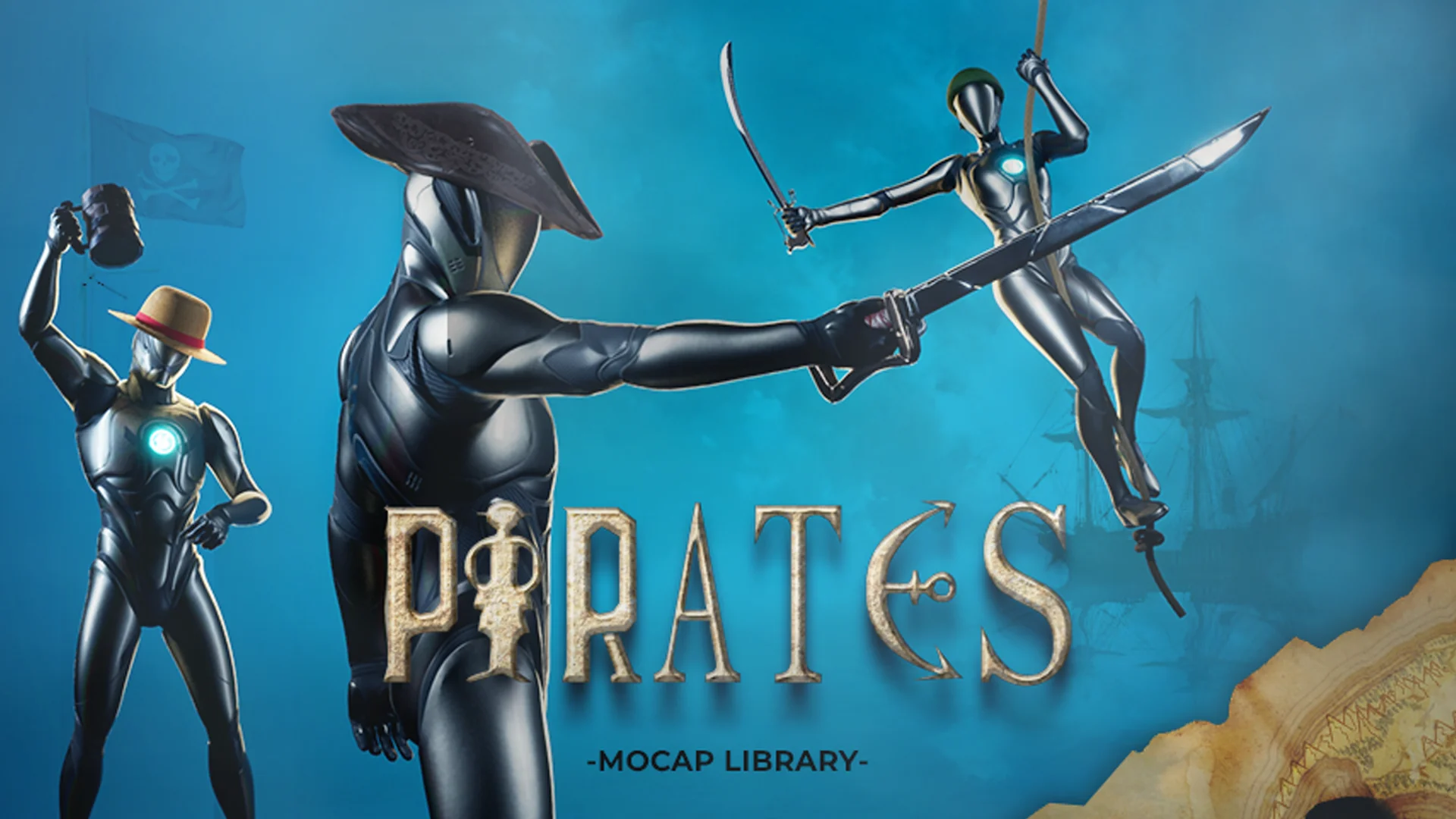
The Mocap - Pirates Animation Library provides a dedicated set of 63 motion capture performances encompassing full-body movement and articulated finger data. Configured specifically for Unreal Engine 5 skeletons, the asset collection centers on the physical routines, shipboard hazards, and chaotic skirmishes typical of age-of-sail maritime narratives. The performances are delivered with polished motion capture fidelity, incorporating in-place setups, root motion formats, and looping variations suited for sequential shot building.
Shipboard Duties in the Pirates Animation Library
Seafaring scenes demand a specific physical vocabulary dictated by rigging, deck maintenance, and manual navigation. A major segment of this motion library concentrates on the operational realities of historical sailing vessels. Crew members are captured performing labor-intensive actions such as scrubbing timber decks on hands and knees, pulling heavy ropes, cutting fouled rigging under pressure, and manually rotating winches to manage ship mechanisms.
Verticality is a core reality aboard tall ships, and the pack addresses this with distinct climbing animations. Performers demonstrate the hand-over-hand cadence of scaling rope ladders as well as ascending raw vertical ropes. Upper-deck management is further covered through coordinated sail-hoisting captures, where the motion carries realistic resistance and weight. For lookout setups, multiple idle variants establish maritime atmosphere: lookouts scan the horizon through brass spyglasses, steady themselves within rope netting, and point outward upon spotting distant land.
Helmsmanship and navigation routines extend these functional behaviors. The library provides dedicated takes of sailors gripping and turning the ship's wheel, studying unfolded treasure maps, and taking accurate navigational measurements using a handheld compass. These captures emphasize nuanced finger posing and posture adjustments, ensuring close-up camera angles remain grounded when characters manipulate navigational charts and instruments.
Combat and Boarding Mocap Sequences
When maritime encounters escalate into hostility, the library shifts toward cutlass duels, boarding maneuvers, and artillery management. Ranged and melee encounters feature full motion tracking, accounting for the unrefined, aggressive fighting styles associated with privateers and corsairs. The pack supplies specific performances for drawing cutlasses, engaging in multi-stroke sword duels, delivering precise thrusts, and defensively parrying strikes with knives. Characters can also be seen sheathing weapons or running across the deck with blades bared, keeping tension high during chaotic breaches.
Artillery operations are divided into distinct stages. Crew characters are animated loading heavy cannon shot down the barrel and coordinating the ignition sequence to fire broadsides. Handheld firearm animations reflect the mechanics of flintlock and matchlock combat, featuring targeted firearm aiming and firing cycles alongside close-quarters intimidation maneuvers where characters brandish swords and pistols directly into an opponent's face.
Boarding actions introduce heightened stunts and kinetic transfers. Captures include swinging across open air suspended by ropes to breach opposing decks, hurling boarding grappling hooks to draw ships together, and casting harpoons with full-body momentum. When close-quarters combat degrades into unorganized brawls, the performances include improvised tavern-style violence, such as smashing glass rum bottles across an adversary's head or leaping from gunwales to execute boarding assaults.
Maritime Misfortune, Captivity, and Camp Sequences
Historical buccaneering narratives frequently revolve around discipline, defeat, mutiny, and survival. The collection accounts for these grim turns of fortune through targeted physical interactions. Several takes represent captivity and punishment, including a prisoner tied immobiler to a wooden mast, an officer lashing a captive with a whip, and an injured captive reacting to whip strikes across the back. In dueling contexts, physical trauma is addressed with explicit hit reactions, such as a sword puncture to the abdomen.
Life outside of combat includes downtime, intoxication, and bodily distress. Performances capture crewmen guzzling from rum bottles, resting supine in suspended canvas hammocks, and sprawling across deck planks in drunken stupors. The rougher physical toll of sea travel appears in animations depicting sea-sickness, with characters retching overboard, or ringing the ship's alarm bell frantically in response to collisions, ramming maneuvers, or sudden ambush.
Submersion and disaster scenarios account for crew members thrown or driven into the sea. Characters jump over the rail, plunge holding onto ship lines, swim against ocean surges, drift while clinging desperately to floating timber planks, and sink lifelessly as drowned corpses. For shore landings and plunder sequences, the performances pivot toward recovery and exploration: characters dig coastal sands with shovels, throw casting nets into shallows, haul water buckets from rowboats, row small landing crafts, open heavy chest lids, and wave white surrender flags when overwhelmed.
Cinematic Framing Over Gameplay State Machines
The library is explicitly structured for cinematic timelines, cutscenes, and pre-visualized narrative sequences rather than complex gameplay state machines. While individual tracks supply root motion and clean looping cycles that technical animators can repurpose, the acting choices, physical cadence, and pacing of each capture are optimized to serve linear visual storytelling in Unreal Engine's Sequencer.
Locomotion variations reflect character-driven storytelling rather than standard tactical strafing. The collection features specific walking profiles that immediately establish character backstory, including a distinct peg-leg limp, an anxious walk while balancing along a plank before jumping, and purposeful traverses carrying cargo boxes, sacks slung over shoulders, flickering candles, or burning torches. The integration of complete finger tracking across these actions guarantees that secondary interactions—holding handles, gripping torch timber, or feeling the edge of a sword—hold up under close cinematic scrutiny on modern character rigs, including MetaHuman workflows.
 Variety
 Variety
 Variety