"ae2217ad8e73450c"{"id":"1003041","slug":"mobility-pro-mocap-pack","title":"Mobility Pro - MoCap Pack","category":"Locomotion / Gaits","engine":"4.9+,5.0+","assetVersion":"","engineVersion":"Engine Version: 4.9+,5.0+","tag":"Locomotion / Gaits","accent":"blue","visual":"animation","summary":"Examine the Mobility Pro MoCap Pack for Unreal Engine, featuring over 223 locomotion animations, root motion, and custom speed curve data.","platform":"Unreal Engine","indexPolicy":"index","publishedAt":"2026-11-25T17:55:41.107Z","updatedAt":"2026-11-25T17:55:41.107Z","sourceNotes":[],"fileContents":[],"compatibility":["Unreal Engine","Engine Version: 4.9+,5.0+"],"featuredImage":{"alt":"Mobility Pro - MoCap Pack","src":"/wp-content/uploads/published/2026/11/e4f42c31847b-3f165c9a-8487-470b-918d-3d960a70d581-525d225d01.webp"},"hasDownloadLink":true,"downloads":0,"terms":[{"taxonomy":"category","slug":"locomotion-gaits","name":"Locomotion / Gaits"}],"galleryImages":[{"src":"/wp-content/uploads/published/2026/11/8b2aa57965b8-9f786188-f80b-42a6-b60e-9a63673d1dd3-9d1f842036.webp","alt":"Mobility Pro - MoCap Pack"},{"src":"/wp-content/uploads/published/2026/11/434b8f1abedd-faa39c51-79dc-4ba8-8827-37d7e9f9b428-7d20883892.webp","alt":"Mobility Pro - MoCap Pack"},{"src":"/wp-content/uploads/published/2026/11/5eaddb5d1f1e-795f1199-530d-4afb-84ee-31d19ab2db3e-f35e31e5eb.webp","alt":"Mobility Pro - MoCap Pack"}],"accessPanel":{"kind":"resource","title":"Get this resource","safetyNote":"Resources are manually reviewed before listing to improve quality and reduce obvious risks.","fileName":"Content.7z","resourceType":"Resource archive","versions":[]},"contentHtml":"\u003ch2\u003eLocomotion Library in the Mobility Pro MoCap Pack\u003c/h2\u003e\n\u003cp\u003eCharacter locomotion forms the foundation of player engagement in third-person action games and open-world environments. When character inputs fail to translate into clean shifts of weight, precise directional changes, or grounded footfalls, immersion breaks instantly. The Mobility Pro MoCap Pack addresses these baseline movement demands by assembling a comprehensive suite of more than 223 motion-captured character animations. Built explicitly for Unreal Engine, the collection serves projects ranging from solo indie productions to larger animation studios and professional teams constructing character controllers, combat frameworks, and AI-driven navigation behaviors.\u003c/p\u003e\n\u003cp\u003eSupplied on the standard UE4 Skeleton inside a native Unreal Project file alongside raw source.FBX assets, the data is configured to integrate immediately into Unreal Engine's native animation architecture. Rather than forcing a singular technical implementation, every movement set is authored with both Root Motion and In-Place options. This split allows technical designers to drive velocity through animation root translation directly or govern displacement entirely through a programmatic character movement component, depending on network synchronization requirements or gameplay preferences.\u003c/p\u003e \u003ch2\u003eMovement States, Directional Control, and Transitions\u003c/h2\u003e\n\u003cp\u003eNavigating dynamic environments requires an extensive palette of continuous locomotion states. Within this collection, movement is structured across multiple tiers of momentum, including walking, jogging, running, and full sprinting. Each phase is not restricted to standard forward strides; instead, characters can traverse forward, backward, laterally, and diagonally. For evasive maneuvers or spatial repositioning during encounters, the set includes dedicated backpedaling cycles and circular movement arcs, giving characters realistic pathways when maneuvering around obstacles or tracking adversaries.\u003c/p\u003e\n\u003cp\u003eStationary character behavior is equally fleshed out. Rather than relying on a static repeating pose, the pack contains several idle poses, subtle physical fidgets, baseline standing cycles, and conversational gestures that bring ambient life to non-playable characters and waiting player avatars. Fluidity between these still states and active locomotion relies on carefully pose-matched transition animations. Characters can move into and out of standing, walking, jogging, running, or crouching states without sudden pops or unnatural blending artifacts, preserving continuous physical momentum across speed variations.\u003c/p\u003e\n\u003cp\u003eStealth mechanics and low-profile navigation are handled through dedicated crouch locomotion. The system accounts for crouch idles, directional crouch walks, and crouch turns. In the V-2.7B revision, crouch walks were lowered specifically to match the crouch idle height, ensuring that entering or exiting crouch movement maintains consistent pelvic elevation. This eliminates vertical snapping between sneaking postures and stationary cover stances.\u003c/p\u003e \u003ch2\u003eDynamic Jumps, Turns, and Targeting Offsets\u003c/h2\u003e\n\u003cp\u003eTraversing vertical obstacles and rapidly changing headings require specialized animation clips that account for human body mechanics. The pack handles orientation adjustments through turn animations calibrated for standing, walking, jogging, crouching, and running states. These rotational sequences are divided into discrete angles—specifically 45-degree, 90-degree, 135-degree, and 180-degree changes. For situations requiring heading retention while repositioning, full strafing animation suites enable sideways and diagonal strides without turning the torso away from the focal point. Turn-in-place looping animations are also implemented for standing and crouching states to resolve rotational alignment while remaining rooted to a single spot.\u003c/p\u003e\n\u003cp\u003eVerticality is supported through comprehensive jump and split jump mechanics. Rather than relying on single generic leaping clips, the assets provide segmented sequences covering the initial take-off, sustained in-air suspension loops, and weight-settling landings. These sequences are authored across multiple entry momentum levels, allowing characters to leap from a standstill, a standard walk, a steady jog, or a full run. Realism is further expanded through distinct left-foot and right-foot take-off variations, reflecting how an athlete naturally drives upward off whichever foot carries current forward pressure.\u003c/p\u003e\n\u003cp\u003eTo support shooter combat and interaction targeting, the package incorporates aiming animations, aim offsets, and look offsets. These allow characters to tilt their head or adjust weapon aim across vertical and horizontal fields while standing, crouching, or actively moving across the terrain. When engagements turn lethal, directional death sequences cover impacts and collapses falling forward, backward, to the left, and to the right, supplying dramatic physical conclusions to in-game failures or defeated enemies.\u003c/p\u003e \u003ch2\u003eMobility Pro Skeleton Delivery and Controller Integration\u003c/h2\u003e\n\u003cp\u003eTechnical implementation is structured around real-world production pipelines. Because sliding feet undermine visual credibility, the animations include custom attributes containing continuous speed and rotation data curves. This data pipeline allows gameplay systems to evaluate true skeletal momentum and drive synchronized foot planting, mirroring the technical workflows adopted by major development studios.\u003c/p\u003e\n\u003cp\u003eWhile structured around the UE4 Skeleton for broad backward compatibility, the animations are optimized for retargeting directly onto Unreal Engine 5's Manny character. Customized IK-Retargeters assist this workflow by ensuring correct bone alignment and clean blend operations across different skeletal proportions. Developers looking to verify handling without building a controller from scratch can also utilize the included demo Blueprint Controller produced by 3 Prong Gaming. Developed by Motus Digital—a team with more than thirty years of industry experience across hundreds of video game titles—the pack balances motion capture fidelity with the functional demands of real-time character movement.\u003c/p\u003e\n\n\u003ch2\u003eExplore Similar Assets\u003c/h2\u003e\n\u003cul\u003e\n\u003cli\u003e\u003ca href=\"https://3dcghub.com/female-movement-animset-pro/\" rel=\"noopener noreferrer\"\u003eFemale Movement Animset Pro\u003c/a\u003e\u003c/li\u003e\n\u003cli\u003e\u003ca href=\"https://3dcghub.com/climbing-ladder-pro-mocap-animation-pack/\" rel=\"noopener noreferrer\"\u003eClimbing Ladder Pro - MoCap Animation Pack\u003c/a\u003e\u003c/li\u003e\n\u003cli\u003e\u003ca href=\"https://3dcghub.com/26-zombie-animations-starter-pack-with-blueprints/\" rel=\"noopener noreferrer\"\u003e26 Zombie Animations Starter Pack With Blueprints\u003c/a\u003e\u003c/li\u003e\n\u003cli\u003e\u003ca href=\"https://3dcghub.com/mocap-online-free-animation-pack-unreal-3d-character-animations-for-fab-market/\" rel=\"noopener noreferrer\"\u003eMoCap Online Free Animation Pack | UNREAL 3D Character Animations for FAB Market\u003c/a\u003e\u003c/li\u003e\n\u003cli\u003e\u003ca href=\"https://3dcghub.com/actorcore-sample-motions/\" rel=\"noopener noreferrer\"\u003eActorCore Sample Motions\u003c/a\u003e\u003c/li\u003e\n\u003c/ul\u003e","contentTextLength":6424,"navigation":{"current":3,"total":4964,"previous":{"id":"1003042","slug":"mocap-pirates-animation-library","title":"Mocap - Pirates Animation Library","category":"Variety","platform":"Unreal Engine","updatedAt":"2026-11-25T17:58:29.381Z"},"next":{"id":"1003040","slug":"mc-skydive-animation-pack","title":"MC Skydive Animation Pack","category":"Variety","platform":"Unreal Engine","updatedAt":"2026-11-25T17:10:17.168Z"}},"relatedResources":[{"id":"1002302","slug":"female-movement-animset-pro","title":"Female Movement Animset Pro","category":"Locomotion / Gaits","engine":"4.26+,5.0+","assetVersion":"","engineVersion":"Engine Version: 4.26+,5.0+","tag":"Locomotion / Gaits","accent":"blue","visual":"animation","summary":"Female Movement Animset Pro packs 180 mocap clips, FBX source files, and a game character model for seamless third-person female locomotion.","platform":"Unreal Engine","indexPolicy":"index","publishedAt":"2026-11-05T10:03:37.017Z","updatedAt":"2026-11-05T10:03:37.017Z","sourceNotes":[],"fileContents":[],"compatibility":["Unreal Engine","Engine Version: 4.26+,5.0+"],"featuredImage":{"alt":"Female Movement Animset Pro","src":"/wp-content/uploads/published/2026/11/478cf9783bf2-b87a9a86-bc56-4917-b149-a15bb653a672-de68413cac.webp"},"fileSizeBytes":1700498240,"hasDownloadLink":true,"downloads":1},{"id":"6116","slug":"climbing-ladder-pro-mocap-animation-pack","title":"Climbing Ladder Pro - MoCap Animation Pack","category":"Locomotion / Gaits","engine":"4.26+,5.0+","assetVersion":"Engine version: 4.26+,5.0+","engineVersion":"4.24","tag":"Locomotion / Gaits","accent":"blue","visual":"animation","summary":"Boost your project with 198 professional ladder animations. This MoCap pack supports multiple industry standards and offers seamless Unreal Engine integration.","platform":"Unreal Engine","indexPolicy":"noindex","publishedAt":"2026-02-18T16:54:53.000Z","updatedAt":"2026-04-19T15:56:31.000Z","sourceNotes":[],"fileContents":[],"compatibility":["Unreal Engine","Engine version: 4.26+,5.0+"],"featuredImage":{"alt":"Climbing Ladder Pro - MoCap Animation Pack","src":"https://3dcghub.com/wp-content/uploads/2026/02/b57e5a58-f4fc-4f71-ab2b-5eecda8ec117.webp"},"fileSizeBytes":76806239,"hasDownloadLink":true,"downloads":2},{"id":"6091","slug":"26-zombie-animations-starter-pack-with-blueprints","title":"26 Zombie Animations Starter Pack With Blueprints","category":"Locomotion / Gaits","engine":"4.27,5.0+","assetVersion":"Engine version: 4.27,5.0+","engineVersion":"4.27","tag":"Locomotion / Gaits","accent":"blue","visual":"animation","summary":"Enhance your horror game with 26 professional MOCAP zombie animations. Includes AI blueprints for chasing and roaming to speed up your development process.","platform":"Unreal Engine","indexPolicy":"noindex","publishedAt":"2026-02-18T16:49:41.000Z","updatedAt":"2026-04-19T15:56:31.000Z","sourceNotes":[],"fileContents":[],"compatibility":["Unreal Engine","Engine version: 4.27,5.0+"],"featuredImage":{"alt":"26 Zombie Animations Starter Pack With Blueprints","src":"https://3dcghub.com/wp-content/uploads/2026/02/04e05fcb-8faf-4558-9329-87677d4b4b19.webp"},"fileSizeBytes":271530458,"hasDownloadLink":true,"downloads":1}]}[{"id":4225,"sourceId":4225,"taxonomyId":4225,"taxonomy":"category","slug":"asset-library","name":"Asset Library","parentId":null,"count":4817,"hasChildren":true,"href":"/","seoTitle":"Free Game Assets Library | 3DCGHUB","seoDescription":"Browse free Unreal Engine, Unity, Blender assets and game development tutorials on 3DCGHUB with previews, compatibility notes, and secure downloads.","sitemapEnabled":true,"children":[{"id":4227,"sourceId":4227,"taxonomyId":4227,"taxonomy":"category","slug":"blender-add-ons-plugins","name":"Blender Add-ons \u0026 Plugins","parentId":4225,"count":10,"hasChildren":false,"href":"/category/blender-add-ons-plugins/","seoTitle":"Free Blender Add-ons \u0026 Plugins | 3DCGHUB","seoDescription":"Browse free Blender Add-ons \u0026 Plugins tools for Blender on 3DCGHUB: curated downloads with preview images, compatibility notes and secure download access.","sitemapEnabled":true},{"id":514,"sourceId":514,"taxonomyId":514,"taxonomy":"category","slug":"unity-2","name":"Unity","parentId":4225,"count":453,"hasChildren":true,"href":"/category/unity-2/","seoTitle":"Free Unity Assets | 3DCGHUB","seoDescription":"Browse free Unity resources on 3DCGHUB: curated downloads with preview images, compatibility notes and secure download access.","sitemapEnabled":true,"children":[{"id":523,"sourceId":523,"taxonomyId":523,"taxonomy":"category","slug":"2d","name":"2D","parentId":514,"count":1,"hasChildren":true,"href":"/category/2d/","seoTitle":"Free Unity 2D | 3DCGHUB","seoDescription":"Browse free 2D assets for Unity on 3DCGHUB: curated downloads with preview images, compatibility notes and secure download access.","sitemapEnabled":true},{"id":515,"sourceId":515,"taxonomyId":515,"taxonomy":"category","slug":"3d-unity-2","name":"3D","parentId":514,"count":162,"hasChildren":true,"href":"/category/3d-unity-2/","seoTitle":"Free Unity 3D Assets | 3DCGHUB","seoDescription":"Browse free 3D assets for Unity on 3DCGHUB: curated downloads with preview images, compatibility notes and secure download access.","sitemapEnabled":true},{"id":565,"sourceId":565,"taxonomyId":565,"taxonomy":"category","slug":"add-ons","name":"Add-Ons","parentId":514,"count":2,"hasChildren":false,"href":"/category/add-ons/","seoTitle":"Free Unity Add-Ons | 3DCGHUB","seoDescription":"Browse free Add-Ons assets for Unity on 3DCGHUB: curated downloads with preview images, compatibility notes and secure download access.","sitemapEnabled":true},{"id":529,"sourceId":529,"taxonomyId":529,"taxonomy":"category","slug":"audio-unity-2","name":"Audio","parentId":514,"count":1,"hasChildren":true,"href":"/category/audio-unity-2/","seoTitle":"Free Unity Audio | 3DCGHUB","seoDescription":"Browse free Audio for Unity on 3DCGHUB: curated downloads with preview images, compatibility notes and secure download access.","sitemapEnabled":true},{"id":557,"sourceId":557,"taxonomyId":557,"taxonomy":"category","slug":"templates","name":"Templates","parentId":514,"count":36,"hasChildren":true,"href":"/category/templates/","seoTitle":"Free Unity Templates | 3DCGHUB","seoDescription":"Browse free Unity project templates on 3DCGHUB. Starter kits with previews, compatibility notes, and secure download access.","sitemapEnabled":true},{"id":533,"sourceId":533,"taxonomyId":533,"taxonomy":"category","slug":"tools-unity-2","name":"Tools","parentId":514,"count":0,"hasChildren":true,"href":"/category/tools-unity-2/","sitemapEnabled":true},{"id":554,"sourceId":554,"taxonomyId":554,"taxonomy":"category","slug":"vfx-unity-2","name":"VFX","parentId":514,"count":4,"hasChildren":true,"href":"/category/vfx-unity-2/","seoTitle":"Free Unity VFX | 3DCGHUB","seoDescription":"Browse free VFX for Unity on 3DCGHUB: curated downloads with preview images, compatibility notes and secure download access.","sitemapEnabled":true}]},{"id":511,"sourceId":511,"taxonomyId":511,"taxonomy":"category","slug":"unreal-engine-2","name":"Unreal Engine","parentId":4225,"count":4355,"hasChildren":true,"href":"/category/unreal-engine-2/","seoTitle":"Free Unreal Engine Assets | 3DCGHUB","seoDescription":"Browse free Unreal Engine resources on 3DCGHUB: curated downloads with preview images, compatibility notes and secure download access.","sitemapEnabled":true,"children":[{"id":54,"sourceId":54,"taxonomyId":54,"taxonomy":"category","slug":"3d","name":"3D","parentId":511,"count":2441,"hasChildren":true,"href":"/category/3d/","seoTitle":"Free Unreal Engine 3D | 3DCGHUB","seoDescription":"Browse free 3D assets for Unreal Engine on 3DCGHUB: curated downloads with preview images, compatibility notes and secure download access.","sitemapEnabled":true},{"id":441,"sourceId":441,"taxonomyId":441,"taxonomy":"category","slug":"animations","name":"Animations","parentId":511,"count":269,"hasChildren":true,"href":"/category/animations/","seoTitle":"Free Unreal Engine Animations | 3DCGHUB","seoDescription":"Browse free Animations for Unreal Engine on 3DCGHUB: curated downloads with preview images, compatibility notes and secure download access.","sitemapEnabled":true},{"id":446,"sourceId":446,"taxonomyId":446,"taxonomy":"category","slug":"audio","name":"Audio","parentId":511,"count":63,"hasChildren":true,"href":"/category/audio/","seoTitle":"Free Unreal Engine Audio Resources | 3DCGHUB","seoDescription":"Browse free Unreal Engine audio resources including sound effects, voices, dialogue, and ambient sounds. Curated free downloads on 3DCGHUB.","sitemapEnabled":true},{"id":466,"sourceId":466,"taxonomyId":466,"taxonomy":"category","slug":"game-systems","name":"Game Systems","parentId":511,"count":381,"hasChildren":true,"href":"/category/game-systems/","seoTitle":"Free Unreal Engine Game Systems | 3DCGHUB","seoDescription":"Browse free Game Systems tools for Unreal Engine on 3DCGHUB: curated downloads with preview images, compatibility notes and secure download access.","sitemapEnabled":true},{"id":478,"sourceId":478,"taxonomyId":478,"taxonomy":"category","slug":"game-templates","name":"Game Templates","parentId":511,"count":155,"hasChildren":true,"href":"/category/game-templates/","seoTitle":"Free Unreal Engine Game Templates | 3DCGHUB","seoDescription":"Browse free Game Templates for Unreal Engine on 3DCGHUB: curated downloads with preview images, compatibility notes and secure download access.","sitemapEnabled":true},{"id":432,"sourceId":432,"taxonomyId":432,"taxonomy":"category","slug":"hdri","name":"HDRI","parentId":511,"count":6,"hasChildren":true,"href":"/category/hdri/","seoTitle":"Free Unreal Engine HDRI | 3DCGHUB","seoDescription":"Browse free Unreal Engine HDRI skies and lighting maps on 3DCGHUB. Environment lighting with previews and secure downloads.","sitemapEnabled":true},{"id":228,"sourceId":228,"taxonomyId":228,"taxonomy":"category","slug":"material-and-textures","name":"Material \u0026 Textures","parentId":511,"count":172,"hasChildren":true,"href":"/category/material-and-textures/","seoTitle":"Free Unreal Engine Material \u0026 Textures | 3DCGHUB","seoDescription":"Browse free Material \u0026 Textures for Unreal Engine on 3DCGHUB: curated downloads with preview images, compatibility notes and secure download access.","sitemapEnabled":true},{"id":298,"sourceId":298,"taxonomyId":298,"taxonomy":"category","slug":"sprites-and-flipbooks","name":"Sprites \u0026 Flipbooks","parentId":511,"count":18,"hasChildren":true,"href":"/category/sprites-and-flipbooks/","seoTitle":"Free Unreal Engine Sprites \u0026 Flipbooks | 3DCGHUB","seoDescription":"Browse free Sprites \u0026 Flipbooks assets for Unreal Engine on 3DCGHUB: curated downloads with preview images, compatibility notes and secure download access.","sitemapEnabled":true},{"id":489,"sourceId":489,"taxonomyId":489,"taxonomy":"category","slug":"tools-and-plugins","name":"Tools \u0026 Plugins","parentId":511,"count":390,"hasChildren":true,"href":"/category/tools-and-plugins/","seoTitle":"Free Unreal Engine Tools \u0026 Plugins | 3DCGHUB","seoDescription":"Browse free Tools \u0026 Plugins for Unreal Engine on 3DCGHUB: curated downloads with preview images, compatibility notes and secure download access.","sitemapEnabled":true},{"id":459,"sourceId":459,"taxonomyId":459,"taxonomy":"category","slug":"ui","name":"UI","parentId":511,"count":47,"hasChildren":true,"href":"/category/ui/","seoTitle":"Free Unreal Engine UI | 3DCGHUB","seoDescription":"Browse free UI for Unreal Engine on 3DCGHUB: curated downloads with preview images, compatibility notes and secure download access.","sitemapEnabled":true},{"id":450,"sourceId":450,"taxonomyId":450,"taxonomy":"category","slug":"vfx","name":"VFX","parentId":511,"count":413,"hasChildren":true,"href":"/category/vfx/","seoTitle":"Free Unreal Engine VFX | 3DCGHUB","seoDescription":"Browse free VFX for Unreal Engine on 3DCGHUB: curated downloads with preview images, compatibility notes and secure download access.","sitemapEnabled":true}]}]},{"id":4222,"sourceId":4222,"taxonomyId":4222,"taxonomy":"category","slug":"tutorial-library","name":"Tutorial Library","parentId":null,"count":117,"hasChildren":false,"href":"/tutorials/","seoTitle":"Free Game Development Tutorial Library | 3DCGHUB","seoDescription":"Browse free game development tutorials for Unreal Engine, Unity, Blender, and more on 3DCGHUB with practical workflows and secure downloads.","sitemapEnabled":true}]
Resource screenshots
1 / 3
Asset drops
Daily Asset Drops
Follow 3DCGHUB on Telegram for daily Unreal, Unity & Blender drops and curated CC0 releases.
Character locomotion forms the foundation of player engagement in third-person action games and open-world environments. When character inputs fail to translate into clean shifts of weight, precise directional changes, or grounded footfalls, immersion breaks instantly. The Mobility Pro MoCap Pack addresses these baseline movement demands by assembling a comprehensive suite of more than 223 motion-captured character animations. Built explicitly for Unreal Engine, the collection serves projects ranging from solo indie productions to larger animation studios and professional teams constructing character controllers, combat frameworks, and AI-driven navigation behaviors.
Supplied on the standard UE4 Skeleton inside a native Unreal Project file alongside raw source.FBX assets, the data is configured to integrate immediately into Unreal Engine's native animation architecture. Rather than forcing a singular technical implementation, every movement set is authored with both Root Motion and In-Place options. This split allows technical designers to drive velocity through animation root translation directly or govern displacement entirely through a programmatic character movement component, depending on network synchronization requirements or gameplay preferences.
Movement States, Directional Control, and Transitions
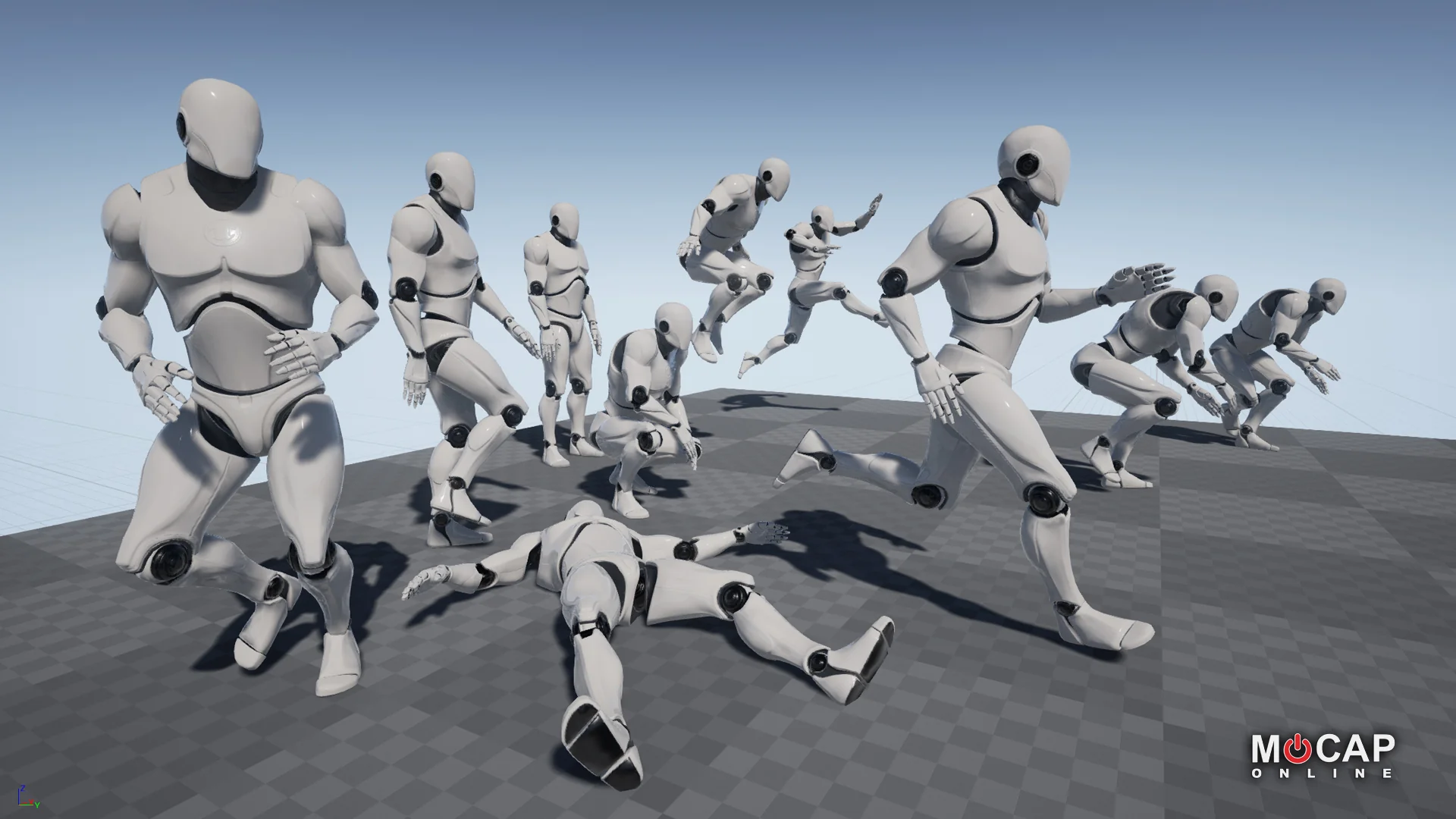
Navigating dynamic environments requires an extensive palette of continuous locomotion states. Within this collection, movement is structured across multiple tiers of momentum, including walking, jogging, running, and full sprinting. Each phase is not restricted to standard forward strides; instead, characters can traverse forward, backward, laterally, and diagonally. For evasive maneuvers or spatial repositioning during encounters, the set includes dedicated backpedaling cycles and circular movement arcs, giving characters realistic pathways when maneuvering around obstacles or tracking adversaries.
Stationary character behavior is equally fleshed out. Rather than relying on a static repeating pose, the pack contains several idle poses, subtle physical fidgets, baseline standing cycles, and conversational gestures that bring ambient life to non-playable characters and waiting player avatars. Fluidity between these still states and active locomotion relies on carefully pose-matched transition animations. Characters can move into and out of standing, walking, jogging, running, or crouching states without sudden pops or unnatural blending artifacts, preserving continuous physical momentum across speed variations.
Stealth mechanics and low-profile navigation are handled through dedicated crouch locomotion. The system accounts for crouch idles, directional crouch walks, and crouch turns. In the V-2.7B revision, crouch walks were lowered specifically to match the crouch idle height, ensuring that entering or exiting crouch movement maintains consistent pelvic elevation. This eliminates vertical snapping between sneaking postures and stationary cover stances.
Dynamic Jumps, Turns, and Targeting Offsets
Traversing vertical obstacles and rapidly changing headings require specialized animation clips that account for human body mechanics. The pack handles orientation adjustments through turn animations calibrated for standing, walking, jogging, crouching, and running states. These rotational sequences are divided into discrete angles—specifically 45-degree, 90-degree, 135-degree, and 180-degree changes. For situations requiring heading retention while repositioning, full strafing animation suites enable sideways and diagonal strides without turning the torso away from the focal point. Turn-in-place looping animations are also implemented for standing and crouching states to resolve rotational alignment while remaining rooted to a single spot.
Verticality is supported through comprehensive jump and split jump mechanics. Rather than relying on single generic leaping clips, the assets provide segmented sequences covering the initial take-off, sustained in-air suspension loops, and weight-settling landings. These sequences are authored across multiple entry momentum levels, allowing characters to leap from a standstill, a standard walk, a steady jog, or a full run. Realism is further expanded through distinct left-foot and right-foot take-off variations, reflecting how an athlete naturally drives upward off whichever foot carries current forward pressure.
To support shooter combat and interaction targeting, the package incorporates aiming animations, aim offsets, and look offsets. These allow characters to tilt their head or adjust weapon aim across vertical and horizontal fields while standing, crouching, or actively moving across the terrain. When engagements turn lethal, directional death sequences cover impacts and collapses falling forward, backward, to the left, and to the right, supplying dramatic physical conclusions to in-game failures or defeated enemies.
Mobility Pro Skeleton Delivery and Controller Integration
Technical implementation is structured around real-world production pipelines. Because sliding feet undermine visual credibility, the animations include custom attributes containing continuous speed and rotation data curves. This data pipeline allows gameplay systems to evaluate true skeletal momentum and drive synchronized foot planting, mirroring the technical workflows adopted by major development studios.
While structured around the UE4 Skeleton for broad backward compatibility, the animations are optimized for retargeting directly onto Unreal Engine 5's Manny character. Customized IK-Retargeters assist this workflow by ensuring correct bone alignment and clean blend operations across different skeletal proportions. Developers looking to verify handling without building a controller from scratch can also utilize the included demo Blueprint Controller produced by 3 Prong Gaming. Developed by Motus Digital—a team with more than thirty years of industry experience across hundreds of video game titles—the pack balances motion capture fidelity with the functional demands of real-time character movement.
 Locomotion / Gaits
 Locomotion / Gaits
 Locomotion / Gaits