"6c6413bef81af556"{"id":"1001174","slug":"actorcore-sample-motions","title":"ActorCore Sample Motions","category":"Locomotion / Gaits","engine":"5.0+","assetVersion":"","engineVersion":"Engine Version: 5.0+","tag":"Locomotion / Gaits","accent":"blue","visual":"animation","summary":"ActorCore Sample Motions provides mocap animation clips with stance transitions, in-place walking, and Unreal Engine 5.3 retargeting support.","platform":"Unreal Engine","publishedAt":"2026-09-17T03:43:25.472Z","updatedAt":"2026-09-17T03:43:25.472Z","sourceNotes":[],"fileContents":[],"compatibility":["Unreal Engine","Engine Version: 5.0+"],"featuredImage":{"alt":"ActorCore Sample Motions","src":"/wp-content/uploads/published/2026/09/c1360890ea18-c74d8e52-c8fb-4503-ad0c-2511bd3d78a5-e9797e5341.webp"},"hasDownloadLink":true,"downloads":0,"terms":[{"taxonomy":"category","slug":"locomotion-gaits","name":"Locomotion / Gaits"}],"galleryImages":[{"src":"/wp-content/uploads/published/2026/09/7dc2bd41fc4a-d70e345e-f51f-4cef-95d7-345d56eb3489-5d69709d6a.webp","alt":"ActorCore Sample Motions"},{"src":"/wp-content/uploads/published/2026/09/1713b26f1881-91526118-48e7-4a75-8f0b-f09904489de1-063c8bae45.webp","alt":"ActorCore Sample Motions"},{"src":"/wp-content/uploads/published/2026/09/b2373ae6a16d-994fe0f2-39d3-4f72-932f-92e42bad3382-12e52bdc01.webp","alt":"ActorCore Sample Motions"},{"src":"/wp-content/uploads/published/2026/09/3ea83a41b2c6-5e2d4492-e1db-41e1-a78f-3c32decf6299-281ab6dd26.webp","alt":"ActorCore Sample Motions"},{"src":"/wp-content/uploads/published/2026/09/2e3d51b656b5-d2e4e66c-a951-4ffb-b896-78c4cec8774d-7c27e53787.webp","alt":"ActorCore Sample Motions"}],"accessPanel":{"kind":"resource","title":"Download this resource","eyebrow":"Free Download","message":"Log in or create a free account to start your download.","fileName":"Content.7z","safetyNote":"Resources are manually reviewed before listing to improve quality and reduce obvious risks.","actionLabel":"Download Free","resourceType":"Resource archive"},"contentHtml":"\u003cp\u003eA character standing in an office environment shifts weight, settles into a chair, engages in conversation, and rises back up without abrupt visual snapping. In real-time character animation, the natural link between stationary postures and active locomotion defines how believable a virtual human appears on screen. ActorCore Sample Motions addresses these baseline interaction requirements through motion-captured performances shaped by a unified stance logic.\u003c/p\u003e \u003ch2\u003ePrimary and Secondary Stance Modes for Controlled Blending\u003c/h2\u003e\n\u003cp\u003eCharacters in interactive environments frequently need to shift from passive rest into active gesture or dialog without breaking physical momentum. The motion collection operates on a specially designed motion system that manages smooth transitions between primary and secondary stance modes. Rather than forcing animation clips to jump abruptly between disjointed poses, this architecture supplies connective posture changes that maintain continuity across joint rotations and root orientation.\u003c/p\u003e \u003cp\u003eThis stance framework directly serves interactive character controllers where input events trigger state changes mid-frame. When an avatar moves from an idle posture to an engaged conversational gesture, the intermediate stance mechanics preserve weight balance. The same mechanic applies to sit-and-stand dynamics. In workplace, training, and architectural scenes, characters must move cleanly between resting on furniture and walking through spaces. The package supplies distinct transition clips—specifically Male Stand to Sit and Female Stand to Sit—to resolve the mechanical difficulty of transferring root weight down to seating surfaces and returning cleanly to a balanced upright posture.\u003c/p\u003e \u003ch2\u003eEvaluating the ActorCore Sample Motions Library\u003c/h2\u003e\n\u003cp\u003eThe collection spans a structured range of gestures, locomotion cycles, and specialized performance clips intended for daily, corporate, and stylized animation setups. Everyday interaction forms the backbone of the clip manifest, providing foundational body language for neutral and conversational setups:\u003c/p\u003e \u003cul\u003e \u003cli\u003e\u003cstrong\u003eStationary and Conversational Clips:\u003c/strong\u003e Male Idle, Male Idle 2, Girl Idle, Stand Talk, Male Sit Talk, and Female Sit Talk provide foundational dialogue and rest states for seated or standing encounters.\u003c/li\u003e \u003cli\u003e\u003cstrong\u003eState Changes:\u003c/strong\u003e Male Stand to Sit and Female Stand to Sit resolve vertical displacement and weight distribution when transitioning between chairs and open ground.\u003c/li\u003e \u003cli\u003e\u003cstrong\u003eLocomotion Sequences:\u003c/strong\u003e Male Walk (In-place Motion), Male Walk Relaxed (In-place Motion), Female Walk Relaxed (In-place Motion), and Walk While Thinking provide steady, repeatable traversing passes.\u003c/li\u003e \u003cli\u003e\u003cstrong\u003eExpressive and Dynamic Routines:\u003c/strong\u003e Aerobic Dance, Air Dance, Dance Graceful, Catwalk (In-place Motion), Change Pose, and Magic Spell Cast extend beyond ordinary conversation into performance routines and gameplay actions.\u003c/li\u003e\n\u003c/ul\u003e \u003cp\u003eThe distinction between regular traversal and in-place motion is particularly critical for real-time game development. The inclusion of in-place clips such as Male Walk Relaxed, Female Walk Relaxed, and Catwalk allows game character controllers to move the character capsule independently through code while the animation clip handles skeletal articulation. This prevents foot sliding and avoids collisions with environment geometry that can occur when root motion drives world transforms directly.\u003c/p\u003e \u003cp\u003eClips like Walk While Thinking incorporate subtle asymmetric upper-body postures into regular movement cycles, breaking the mechanical symmetry often seen in standard walk loops. At the more expressive end of the spectrum, performance motions like Dance Graceful, Aerobic Dance, Air Dance, and Magic Spell Cast demonstrate how the underlying motion-capture data preserves rapid limb acceleration, torso twisting, and expressive timing without requiring manual keyframe clean-up.\u003c/p\u003e \u003ch2\u003eUnreal Engine 5.3 Support and Retargeting Workflows\u003c/h2\u003e\n\u003cp\u003eThe package has been updated for Unreal Engine 5.3, providing immediate access to the modern animation toolsets within the engine. To help animators map these performances to project-specific skeletons, tutorials and dedicated documentation outline the retargeting pipeline in Unreal Engine 5. This workflow lets users take the motion-captured data and remap joint hierarchies to custom meshes, ensuring character proportions remain intact without distorting limb lengths or producing unnatural joint bending.\u003c/p\u003e \u003cp\u003eBeyond native Unreal integration, the assets work alongside standard FBX file export formats. This export compatibility ensures the motion clips can be transferred cleanly into all major 3D tools for secondary animation layers, keyframe polishing, or cinematic layout. Compatibility extends to Character Creator assets, including the Kevin character profile, streamlining the transfer of these sample motions onto fully rigged digital humans without requiring bespoke rig reconstruction.\u003c/p\u003e \u003ch2\u003eDeploying Motions in Crowd Scenes and Interactive Environments\u003c/h2\u003e\n\u003cp\u003eCharacter density often dictates how animation data must be deployed within a scene. Large architectural designs, office simulations, and urban backdrops require ambient populations to communicate realism, but animating every background actor individually is resource-prohibitive. The lightweight characters standard in the ActorCore ecosystem are fully rigged for facial, body, and lip-sync animations, structured specifically for long to middle camera ranges.\u003c/p\u003e \u003cp\u003ePairing these lightweight crowd characters with the included sample clips provides an efficient method to populate background zones in media entertainment, film, training, and business simulations. Because the motions encompass seated dialogue, standing conversation, and walking variations, background populations can be staged naturally across office cubicles, reception areas, and open walkways. Middle-distance placement allows the high-quality mocap data to show fluid physical cadence while preserving engine performance for foreground action.\u003c/p\u003e \u003ch2\u003eProduction Utility Across Diverse Project Types\u003c/h2\u003e\n\u003cp\u003eProduction teams across interactive entertainment, architectural visualization, and corporate training benefit from having access to balanced motion-capture assets that solve the most time-consuming baseline behaviors. Creating believable standing idles, natural seated discussions, and smooth posture transitions from scratch requires hours of manual tracking and clean-up. ActorCore Sample Motions supplies a validated baseline of motion capture that handles common human physical interactions, ready for retargeting in modern real-time pipelines.\u003c/p\u003e\n\n\u003ch2\u003eExplore Similar Assets\u003c/h2\u003e\n\u003cul\u003e\n\u003cli\u003e\u003ca href=\"https://3dcghub.com/balance-component-53-animations-blueprints/\" title=\"Balance Component : 53 Animations + Blueprints\"\u003eBalance Component : 53 Animations + Blueprints\u003c/a\u003e\u003c/li\u003e\n\u003cli\u003e\u003ca href=\"https://3dcghub.com/use-phone/\" title=\"Use Phone\"\u003eUse Phone\u003c/a\u003e\u003c/li\u003e\n\u003cli\u003e\u003ca href=\"https://3dcghub.com/stairs-set/\" title=\"Stairs Set\"\u003eStairs Set\u003c/a\u003e\u003c/li\u003e\n\u003cli\u003e\u003ca href=\"https://3dcghub.com/toon-movement-animation-set/\" title=\"Toon Movement Animation Set\"\u003eToon Movement Animation Set\u003c/a\u003e\u003c/li\u003e\n\u003cli\u003e\u003ca href=\"https://3dcghub.com/roll-and-dash-animation/\" title=\"Roll and Dash Animation\"\u003eRoll and Dash Animation\u003c/a\u003e\u003c/li\u003e\n\u003c/ul\u003e","contentTextLength":6691,"navigation":{"current":23,"total":3140,"previous":{"id":"1001175","slug":"zombie-movement-and-modular-interaction-animations","title":"Zombie Movement and Modular Interaction Animations","category":"Locomotion / Gaits","platform":"Unreal Engine","updatedAt":"2026-09-17T03:47:54.048Z"},"next":{"id":"1001173","slug":"pistol-starter-mocap-pack","title":"Pistol Starter - MoCap Pack","category":"Combat","platform":"Unreal Engine","updatedAt":"2026-09-17T03:39:51.564Z"}},"relatedResources":[{"id":"1001050","slug":"balance-component-53-animations-blueprints","title":"Balance Component : 53 Animations + Blueprints","category":"Locomotion / Gaits","engine":"5.1+","assetVersion":"","engineVersion":"Engine Version: 5.1+","tag":"Locomotion / Gaits","accent":"blue","visual":"animation","summary":"53 balance animations and commented Blueprints for edge-following movement. Includes in-place locomotion, idle, jumps, root motion, and 20 bonus audio files.","platform":"Unreal Engine","publishedAt":"2026-08-30T13:06:44.987Z","updatedAt":"2026-08-30T13:06:44.987Z","sourceNotes":[],"fileContents":[],"compatibility":["Unreal Engine","Engine Version: 5.1+"],"featuredImage":{"alt":"Balance Component : 53 Animations + Blueprints","src":"/wp-content/uploads/published/2026/08/5982fe84cdb2-cdaf80ce-5f3c-462c-bf10-dcb88b61589c-f58c9dcf53.webp"},"hasDownloadLink":true,"downloads":1},{"id":"1001182","slug":"mocap-online-free-animation-pack-unreal-3d-character-animations-for-fab-market","title":"MoCap Online Free Animation Pack | UNREAL 3D Character Animations for FAB Market","category":"Locomotion / Gaits","engine":"5.0+","assetVersion":"","engineVersion":"Engine Version: 5.0+","tag":"Locomotion / Gaits","accent":"blue","visual":"animation","summary":"Explore the MoCap Online Free Animation Pack for Unreal Engine 5, featuring professional motion capture clips for locomotion, conversations, and NPCs.","platform":"Unreal Engine","publishedAt":"2026-09-17T05:23:01.662Z","updatedAt":"2026-09-17T05:23:01.662Z","sourceNotes":[],"fileContents":[],"compatibility":["Unreal Engine","Engine Version: 5.0+"],"featuredImage":{"alt":"MoCap Online Free Animation Pack | UNREAL 3D Character Animations for FAB Market","src":"/wp-content/uploads/published/2026/09/5216d9364a3f-cc20dd84-8631-4125-b427-52d974da7142-45ccece027.webp"},"hasDownloadLink":true,"downloads":0},{"id":"1001175","slug":"zombie-movement-and-modular-interaction-animations","title":"Zombie Movement and Modular Interaction Animations","category":"Locomotion / Gaits","engine":"5.0+","assetVersion":"","engineVersion":"Engine Version: 5.0+","tag":"Locomotion / Gaits","accent":"blue","visual":"animation","summary":"Explore Zombie Movement and Modular Interaction Animations, featuring 34 motion clips with wounded locomotion, paired grab sequences, and crawl attacks.","platform":"Unreal Engine","publishedAt":"2026-09-17T03:47:54.048Z","updatedAt":"2026-09-17T03:47:54.048Z","sourceNotes":[],"fileContents":[],"compatibility":["Unreal Engine","Engine Version: 5.0+"],"featuredImage":{"alt":"Zombie Movement and Modular Interaction Animations","src":"/wp-content/uploads/published/2026/09/13eb6b01a562-5c1e2ffa-4ec9-4fab-ae0a-72c010372724-88412b8dd5.webp"},"hasDownloadLink":true,"downloads":0}]}
Locomotion / Gaits
ActorCore Sample Motions
ActorCore Sample Motions provides mocap animation clips with stance transitions, in-place walking, and Unreal Engine 5.3 retargeting support.
A character standing in an office environment shifts weight, settles into a chair, engages in conversation, and rises back up without abrupt visual snapping. In real-time character animation, the natural link between stationary postures and active locomotion defines how believable a virtual human appears on screen. ActorCore Sample Motions addresses these baseline interaction requirements through motion-captured performances shaped by a unified stance logic.
Primary and Secondary Stance Modes for Controlled Blending
Characters in interactive environments frequently need to shift from passive rest into active gesture or dialog without breaking physical momentum. The motion collection operates on a specially designed motion system that manages smooth transitions between primary and secondary stance modes. Rather than forcing animation clips to jump abruptly between disjointed poses, this architecture supplies connective posture changes that maintain continuity across joint rotations and root orientation.
This stance framework directly serves interactive character controllers where input events trigger state changes mid-frame. When an avatar moves from an idle posture to an engaged conversational gesture, the intermediate stance mechanics preserve weight balance. The same mechanic applies to sit-and-stand dynamics. In workplace, training, and architectural scenes, characters must move cleanly between resting on furniture and walking through spaces. The package supplies distinct transition clips—specifically Male Stand to Sit and Female Stand to Sit—to resolve the mechanical difficulty of transferring root weight down to seating surfaces and returning cleanly to a balanced upright posture.
Evaluating the ActorCore Sample Motions Library
The collection spans a structured range of gestures, locomotion cycles, and specialized performance clips intended for daily, corporate, and stylized animation setups. Everyday interaction forms the backbone of the clip manifest, providing foundational body language for neutral and conversational setups:
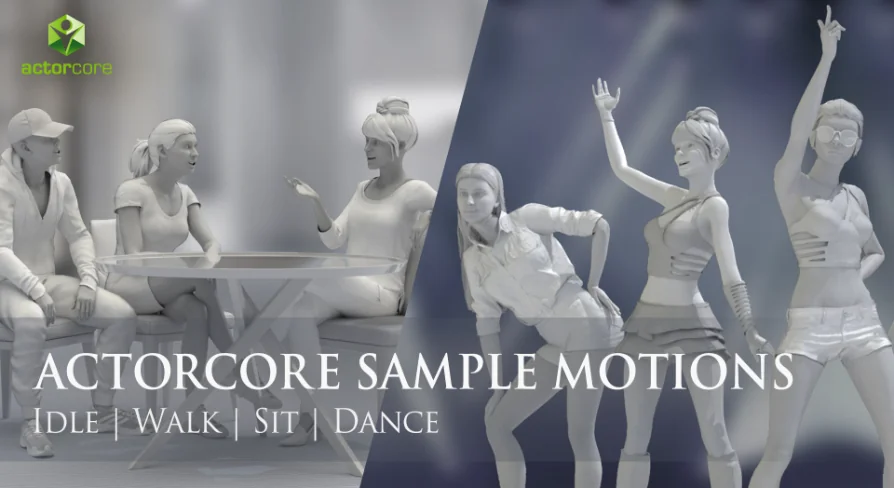
Stationary and Conversational Clips: Male Idle, Male Idle 2, Girl Idle, Stand Talk, Male Sit Talk, and Female Sit Talk provide foundational dialogue and rest states for seated or standing encounters.
State Changes: Male Stand to Sit and Female Stand to Sit resolve vertical displacement and weight distribution when transitioning between chairs and open ground.
Locomotion Sequences: Male Walk (In-place Motion), Male Walk Relaxed (In-place Motion), Female Walk Relaxed (In-place Motion), and Walk While Thinking provide steady, repeatable traversing passes.
Expressive and Dynamic Routines: Aerobic Dance, Air Dance, Dance Graceful, Catwalk (In-place Motion), Change Pose, and Magic Spell Cast extend beyond ordinary conversation into performance routines and gameplay actions.
The distinction between regular traversal and in-place motion is particularly critical for real-time game development. The inclusion of in-place clips such as Male Walk Relaxed, Female Walk Relaxed, and Catwalk allows game character controllers to move the character capsule independently through code while the animation clip handles skeletal articulation. This prevents foot sliding and avoids collisions with environment geometry that can occur when root motion drives world transforms directly.
Clips like Walk While Thinking incorporate subtle asymmetric upper-body postures into regular movement cycles, breaking the mechanical symmetry often seen in standard walk loops. At the more expressive end of the spectrum, performance motions like Dance Graceful, Aerobic Dance, Air Dance, and Magic Spell Cast demonstrate how the underlying motion-capture data preserves rapid limb acceleration, torso twisting, and expressive timing without requiring manual keyframe clean-up.
Unreal Engine 5.3 Support and Retargeting Workflows
The package has been updated for Unreal Engine 5.3, providing immediate access to the modern animation toolsets within the engine. To help animators map these performances to project-specific skeletons, tutorials and dedicated documentation outline the retargeting pipeline in Unreal Engine 5. This workflow lets users take the motion-captured data and remap joint hierarchies to custom meshes, ensuring character proportions remain intact without distorting limb lengths or producing unnatural joint bending.
Beyond native Unreal integration, the assets work alongside standard FBX file export formats. This export compatibility ensures the motion clips can be transferred cleanly into all major 3D tools for secondary animation layers, keyframe polishing, or cinematic layout. Compatibility extends to Character Creator assets, including the Kevin character profile, streamlining the transfer of these sample motions onto fully rigged digital humans without requiring bespoke rig reconstruction.
Deploying Motions in Crowd Scenes and Interactive Environments
Character density often dictates how animation data must be deployed within a scene. Large architectural designs, office simulations, and urban backdrops require ambient populations to communicate realism, but animating every background actor individually is resource-prohibitive. The lightweight characters standard in the ActorCore ecosystem are fully rigged for facial, body, and lip-sync animations, structured specifically for long to middle camera ranges.
Pairing these lightweight crowd characters with the included sample clips provides an efficient method to populate background zones in media entertainment, film, training, and business simulations. Because the motions encompass seated dialogue, standing conversation, and walking variations, background populations can be staged naturally across office cubicles, reception areas, and open walkways. Middle-distance placement allows the high-quality mocap data to show fluid physical cadence while preserving engine performance for foreground action.
Production Utility Across Diverse Project Types
Production teams across interactive entertainment, architectural visualization, and corporate training benefit from having access to balanced motion-capture assets that solve the most time-consuming baseline behaviors. Creating believable standing idles, natural seated discussions, and smooth posture transitions from scratch requires hours of manual tracking and clean-up. ActorCore Sample Motions supplies a validated baseline of motion capture that handles common human physical interactions, ready for retargeting in modern real-time pipelines.
 Locomotion / Gaits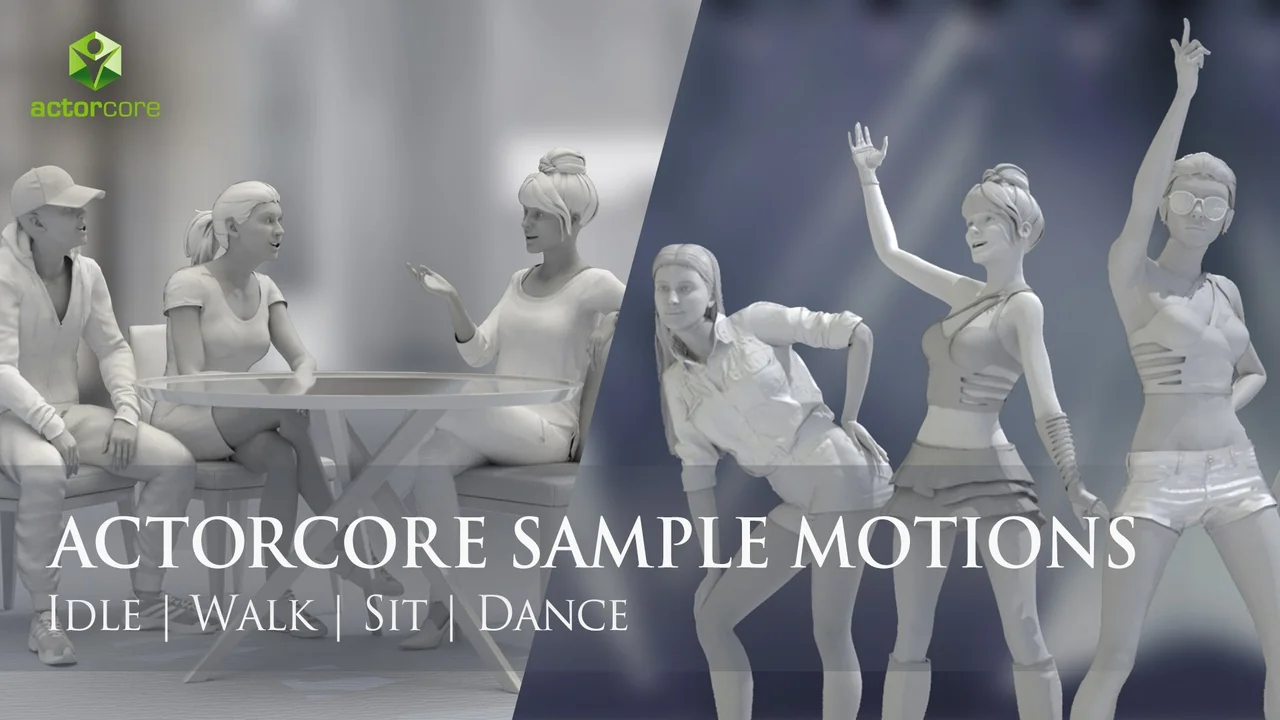
 Locomotion / Gaits
 Locomotion / Gaits
 Locomotion / Gaits