"7b46a695175d8694"{"id":"1001527","slug":"k-pop-series-lola","title":"K-POP SERIES - Lola","category":"Humans","engine":"4.19+,5.0+","assetVersion":"","engineVersion":"Engine Version: 4.19+,5.0+","tag":"Humans","accent":"blue","visual":"mech","summary":"Technical analysis of K-POP SERIES - Lola, covering its modular outfits, UE4 Mannequin rig, 52 Apple blendshapes, and 4K material workflows.","platform":"Unreal Engine","publishedAt":"2026-10-09T17:21:56.867Z","updatedAt":"2026-10-09T17:21:56.867Z","sourceNotes":[],"fileContents":[],"compatibility":["Unreal Engine","Engine Version: 4.19+,5.0+"],"featuredImage":{"alt":"K-POP SERIES - Lola","src":"/wp-content/uploads/published/2026/10/8a4dd198ce9f-f2179811-3c98-4ed9-a8ba-72459a50bb62-2e408d7d87.webp"},"hasDownloadLink":true,"downloads":0,"terms":[{"taxonomy":"category","slug":"humans","name":"Humans"}],"galleryImages":[{"src":"/wp-content/uploads/published/2026/10/4d577239f16f-ff07bedb-0936-4c45-9ad8-5901f8dc2ae2-26e5893ffe.webp","alt":"K-POP SERIES - Lola"},{"src":"/wp-content/uploads/published/2026/10/1d90253b0951-fa47f26b-8fca-4d38-9512-8c97ba9e17e5-4359640f25.webp","alt":"K-POP SERIES - Lola"},{"src":"/wp-content/uploads/published/2026/10/85da8d4a75a6-666c1af2-7ee3-4a50-a4e4-b07ade120864-d3d49c4a73.webp","alt":"K-POP SERIES - Lola"},{"src":"/wp-content/uploads/published/2026/10/8770e2f40d69-0d28ace6-b902-4669-9926-a6850df6828d-447b02ea7b.webp","alt":"K-POP SERIES - Lola"},{"src":"/wp-content/uploads/published/2026/10/c5b98c76b4fc-97a2ed97-d96e-4584-96bc-95f5ca4e5d7f-8349e357d9.webp","alt":"K-POP SERIES - Lola"},{"src":"/wp-content/uploads/published/2026/10/8d77b7fa5889-8addfdfe-2a4b-493f-b08d-bfc90ab7f080-5212e7422e.webp","alt":"K-POP SERIES - Lola"},{"src":"/wp-content/uploads/published/2026/10/29a3b0bd63db-6bf17aae-0083-4199-a4fb-81bf675a9964-1240a3d1be.webp","alt":"K-POP SERIES - Lola"},{"src":"/wp-content/uploads/published/2026/10/c5ededefbfc2-7fe1e8b4-0a58-46f1-9bbd-944e56cf8a78-e5468c00ba.webp","alt":"K-POP SERIES - Lola"},{"src":"/wp-content/uploads/published/2026/10/f0c6b18ec648-a37d4363-5faa-4dc4-b5ea-74de2d7cf6c3-2555a11b62.webp","alt":"K-POP SERIES - Lola"},{"src":"/wp-content/uploads/published/2026/10/f598863e9b70-e4968dbd-17cc-4d05-a978-47230558ea03-c5c60db8e3.webp","alt":"K-POP SERIES - Lola"}],"accessPanel":{"kind":"resource","title":"Download this resource","eyebrow":"Free Download","message":"Log in or create a free account to start your download.","fileName":"K-POP SERIES - Lola.7z","safetyNote":"Resources are manually reviewed before listing to improve quality and reduce obvious risks.","actionLabel":"Download Free","resourceType":"Resource archive"},"contentHtml":"\u003ch2\u003eModular Mesh Assembly and Outfit Variations in Lola\u003c/h2\u003e\u003cp\u003eK-POP SERIES - Lola is shaped by a fully modular geometry layout that divides the character into swappable garment groups and separated anatomical sections. The character includes three primary wardrobe configurations: Performance, Casual, and Lingerie. To eliminate cloth penetration without forcing aggressive weighting compromises, the underlying body mesh is sliced into discrete components. Sub-mesh segments obscured beneath pants, tops, or footwear can be deactivated entirely at runtime, preventing geometry clipping while directly reducing the active polycount during rendering.\u003c/p\u003e\u003cp\u003eThe package contains a full-body base underneath the clothing layers, textured with censored surface details. The mesh does not include modeled anatomical adult components, dedicated morph targets, or specialized rigging for adult features; these areas are handled exclusively through flat base texturing. Detaching or hiding outer clothing exposes the underlying anatomy directly, allowing users to assemble custom combinations or transition between the included costumes. For systems utilizing Unreal Engine's Master Pose Component or Leader Pose Component workflows, the separated meshes are prepared to track the underlying skeleton synchronously.\u003c/p\u003e\u003ch2\u003ePolygon Budgets Across Performance, Casual, and Lingerie Outfits\u003c/h2\u003e\u003cp\u003eLola is authored as a low-poly real-time asset without a native Level of Detail (LOD) chain. Because LOD transitions are not authored out of the box, production budgets require direct evaluation of the base triangle allocations across each configuration.\u003c/p\u003e\u003cul\u003e\u003cli\u003e\u003cstrong\u003ePerformance Outfit:\u003c/strong\u003e 37,939 faces, 72,090 triangles, and 40,666 vertices. This configuration represents the most complex geometry profile, accommodating intricate stage clothing geometry, multilayered accessories, and stylized performance accents.\u003c/li\u003e\u003cli\u003e\u003cstrong\u003eCasual Outfit:\u003c/strong\u003e 32,957 faces, 62,441 triangles, and 35,859 vertices. Tailored for everyday scene requirements, this setup reduces geometric density across the torso and limbs while maintaining silhouette clarity.\u003c/li\u003e\u003cli\u003e\u003cstrong\u003eLingerie Outfit:\u003c/strong\u003e 30,921 faces, 58,694 triangles, and 33,445 vertices. As the most lightweight preset, this setup retains core anatomical definition and base footwear while minimizing polygon load.\u003c/li\u003e\u003c/ul\u003e\u003cp\u003eBecause the character omits automated LOD generation, deployment in crowded real-time environments relies on engine-side reduction passes or distance culling to preserve frame times across multiple instances.\u003c/p\u003e\u003ch2\u003eUE4 Mannequin Rigging and Animation Set Integration\u003c/h2\u003e\u003cp\u003eThe internal rig is built upon the standard Unreal Engine 4 Mannequin hierarchy. Authored in Autodesk Maya without proprietary plugins or integrated visual animation controls, the core joint chain leaves all standard Epic Skeleton bone transforms intact. Retargeting standard locomotion libraries requires minimal manual axis adjustment, allowing stock third-person character animations to link directly to the skeletal asset.\u003c/p\u003e\u003cp\u003eIn addition to the standard humanoid hierarchy, extra accessory bones are included to facilitate secondary motion. These supplementary joints are left unconstrained so dynamic bone plugins, such as KawaiiPhysics, can drive physics simulation on hair strands, straps, and accessories. The baseline project files include standard third-person animation clips to test initial joint deformation. The skeletal structure has been validated against diverse animation systems, including Advanced Locomotion System v4 (ALSv4), Lyra Starter Game sets, Valley of the Ancient interaction data, Female Interactions Animations, Mocap Library packages, ARLS with Horse Animsets, Succubus AnimSets, and Close Combat: Swordsman data.\u003c/p\u003e\u003ch2\u003e52 Apple Blendshapes and Anatomical Morphs\u003c/h2\u003e\u003cp\u003eFacial animation relies on a set of 52 calibrated Apple blendshapes configured for real-time capture and tracking systems. Designed to interface directly with Live Link Face within Unreal Engine 5, these morph targets translate standard facial motion tracking for VTuber production, VRChat integration, MMD pipelines, and software suites such as FaceWare. The target deformations cover isolated eye tracking, brow tension, jaw translation, and subtle lip articulators necessary for streaming and cinematic dialogue.\u003c/p\u003e\u003cp\u003eBeyond facial performance capture, the mesh incorporates persistent body morph targets that deform both the character base and the overlaying clothing pieces simultaneously:\u003c/p\u003e\u003cul\u003e\u003cli\u003eBust and glute volume adjustment morphs for proportion tailoring.\u003c/li\u003e\u003cli\u003eEar morphology switches to transition between standard human anatomy and elongated elf ears.\u003c/li\u003e\u003cli\u003eNail length scaling targets for stylized or exaggerated hands.\u003c/li\u003e\u003c/ul\u003e\u003cp\u003eBecause these morphs deform the modular clothing assets alongside the base skin, costume geometry matches adjusted silhouettes without causing mesh tearing across seams.\u003c/p\u003e\u003ch2\u003e4K Texture Sets and Material ID Color Management\u003c/h2\u003e\u003cp\u003eSurface shading relies on nine individual texture sets covering the Body, Head, Lingerie, Performance, Casual, Teeth, Hair, Eyes, and Lashes. All map sets are supplied at 4K resolution and formatted using channel packing to consolidate memory footprint inside real-time renderers. The core map layout incorporates BaseColor, Normal, Roughness, Metallic, Ambient Occlusion, Material ID (MatID), Opacity, and Emissive channels.\u003c/p\u003e\u003cp\u003eThe material architecture uses dedicated MatID masks to segment distinct regions within a single UV layout. By linking these masks to the provided Material Instances in Unreal Engine, developers can shift individual color values for the skin, eyes, hair, and specific garment panels without repainting the base diffuse maps or re-exporting external assets. This structure permits extensive palette alterations—such as switching hair tints or modifying fabric designs—directly within the engine's material editor.\u003c/p\u003e\u003ch2\u003eImplementation in Unreal Engine Projects\u003c/h2\u003e\u003cp\u003eThe package is configured natively for Unreal Engine 4.19 and later releases, extending forward into Unreal Engine 5 environments. Physics assets are not configured natively in the project files; secondary dynamic calculations require assigning dynamic parameters manually or applying runtime helpers like KawaiiPhysics to the extra skeleton chains. Hair assets are prepared for real-time wind simulation using engine-side wind directional forces.\u003c/p\u003e\u003cp\u003eWhile interactive game logic Blueprints are excluded from the setup, the structural asset files provide raw.fbx geometry that translates into external DCC applications, including Blender, Cinema 4D, and 3ds Max. The modular asset hierarchy, standard bone assignments, and isolated texture channels deliver a functional base model ready to plug into custom character controllers and performance capture setups.\u003c/p\u003e\n\n\u003ch2\u003eMore From The Same Workflow\u003c/h2\u003e\n\u003cul\u003e\n\u003cli\u003e\u003ca href=\"https://3dcghub.com/tempest-ninja-shadows-series-stealth/\" title=\"Tempest Ninja - Shadows Series Stealth\"\u003eTempest Ninja - Shadows Series Stealth\u003c/a\u003e\u003c/li\u003e\n\u003cli\u003e\u003ca href=\"https://3dcghub.com/cosmo-cat-girl/\" title=\"Cosmo Cat Girl\"\u003eCosmo Cat Girl\u003c/a\u003e\u003c/li\u003e\n\u003cli\u003e\u003ca href=\"https://3dcghub.com/succubus-lucia/\" title=\"Succubus Lucia\"\u003eSuccubus Lucia\u003c/a\u003e\u003c/li\u003e\n\u003cli\u003e\u003ca href=\"https://3dcghub.com/xiao-jue-asian-girl/\" title=\"Xiao Jue - Asian Girl\"\u003eXiao Jue - Asian Girl\u003c/a\u003e\u003c/li\u003e\n\u003cli\u003e\u003ca href=\"https://3dcghub.com/assassin-girl-modular/\" title=\"Assassin Girl Modular\"\u003eAssassin Girl Modular\u003c/a\u003e\u003c/li\u003e\n\u003c/ul\u003e","contentTextLength":6825,"navigation":{"current":17,"total":3481,"previous":{"id":"1001528","slug":"k-pop-series-mina","title":"K-POP SERIES - Mina","category":"Humans","platform":"Unreal Engine","updatedAt":"2026-10-09T17:22:33.205Z"},"next":{"id":"1001526","slug":"japanese-modular-pagoda","title":"Japanese Modular Pagoda","category":"Temple","platform":"Unreal Engine","updatedAt":"2026-10-09T17:20:51.839Z"}},"relatedResources":[{"id":"1001528","slug":"k-pop-series-mina","title":"K-POP SERIES - Mina","category":"Humans","engine":"4.24+,5.0+","assetVersion":"","engineVersion":"Engine Version: 4.24+,5.0+","tag":"Humans","accent":"blue","visual":"mech","summary":"Modular stylized character Mina features 4K PBR textures, 52 ARKit blendshapes, multiple outfits, and an extended UE4 Epic Skeleton hierarchy.","platform":"Unreal Engine","publishedAt":"2026-10-09T17:22:33.205Z","updatedAt":"2026-10-09T17:22:33.205Z","sourceNotes":[],"fileContents":[],"compatibility":["Unreal Engine","Engine Version: 4.24+,5.0+"],"featuredImage":{"alt":"K-POP SERIES - Mina","src":"/wp-content/uploads/published/2026/10/3e40e7c5797d-c0473200-f6c1-420c-9084-9cc53ab02863-ce249513ef.webp"},"hasDownloadLink":true,"downloads":0},{"id":"27826","slug":"tempest-ninja-shadows-series-stealth","title":"Tempest Ninja - Shadows Series Stealth","category":"Humans","engine":"4.26+,5.0+","assetVersion":"Engine version: 4.26+,5.0+","engineVersion":"","tag":"Humans","accent":"blue","visual":"character","summary":"Tempest Ninja focuses on a ready-to-use stealth character setup for Unreal Engine skeleton workflows. The pack combines a rigged ninja, weapon props, material variation, textures, and a set of 28 ninja animations.","platform":"Unreal Engine","publishedAt":"2026-04-29T09:04:38.000Z","updatedAt":"2026-04-29T09:04:39.000Z","sourceNotes":[],"fileContents":[],"compatibility":["Unreal Engine","Engine version: 4.26+,5.0+"],"featuredImage":{"alt":"Tempest Ninja - Shadows Series Stealth","src":"https://3dcghub.com/wp-content/uploads/2026/04/a806b020e7e8_6006e1ca-2464-4e77-bfdd-907e5c41d32b.webp"},"hasDownloadLink":true,"downloads":0},{"id":"1000456","slug":"cosmo-cat-girl","title":"Cosmo Cat Girl","category":"Humans","engine":"4.26+,5.0+","assetVersion":"","engineVersion":"Engine Version: 4.26+,5.0+","tag":"Humans","accent":"blue","visual":"mech","summary":"Cosmo Cat Girl is a fully rigged, low-poly Unreal Engine character with 52 Apple Blendshapes, modular outfits, 4K textures, and an Epic Skeleton-based rig teste","platform":"Unreal Engine","publishedAt":"2026-07-11T02:04:42.672Z","updatedAt":"2026-07-11T02:04:42.672Z","sourceNotes":[],"fileContents":[],"compatibility":["Unreal Engine","Engine Version: 4.26+,5.0+"],"featuredImage":{"alt":"Cosmo Cat Girl","src":"/wp-content/uploads/published/2026/07/416ece716fa2-c7bb1ab6-22a2-41ed-931e-059b35548a5a-5ab5a47aa7.webp"},"hasDownloadLink":true,"downloads":0}]}
Humans
K-POP SERIES - Lola
Technical analysis of K-POP SERIES - Lola, covering its modular outfits, UE4 Mannequin rig, 52 Apple blendshapes, and 4K material workflows.
Category:Unreal Engine,HumansPlatform: Unreal EngineEngine Version: 4.19+,5.0+Published: Oct 9, 2026
Humans
Resource overview
Modular Mesh Assembly and Outfit Variations in Lola
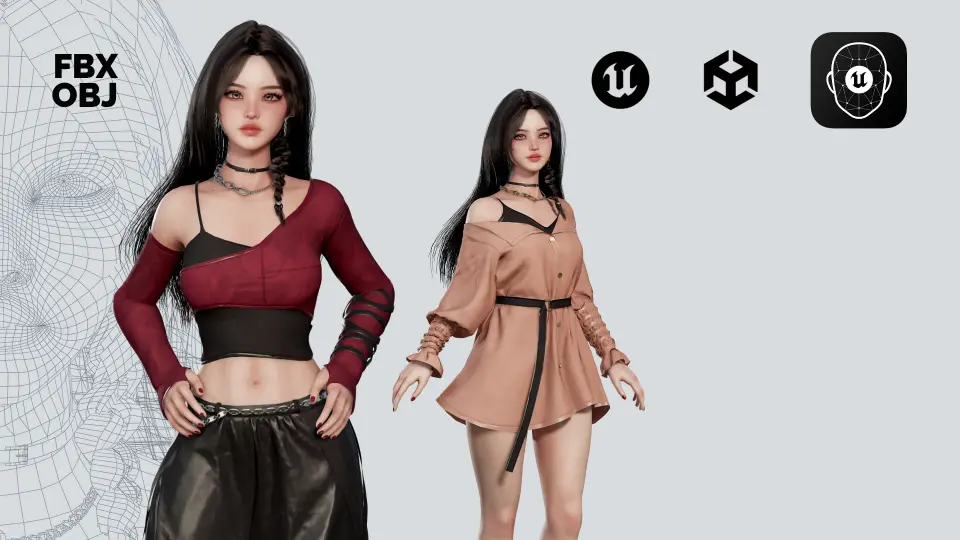
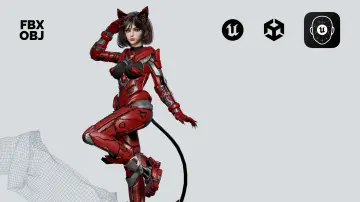
K-POP SERIES - Lola is shaped by a fully modular geometry layout that divides the character into swappable garment groups and separated anatomical sections. The character includes three primary wardrobe configurations: Performance, Casual, and Lingerie. To eliminate cloth penetration without forcing aggressive weighting compromises, the underlying body mesh is sliced into discrete components. Sub-mesh segments obscured beneath pants, tops, or footwear can be deactivated entirely at runtime, preventing geometry clipping while directly reducing the active polycount during rendering.
The package contains a full-body base underneath the clothing layers, textured with censored surface details. The mesh does not include modeled anatomical adult components, dedicated morph targets, or specialized rigging for adult features; these areas are handled exclusively through flat base texturing. Detaching or hiding outer clothing exposes the underlying anatomy directly, allowing users to assemble custom combinations or transition between the included costumes. For systems utilizing Unreal Engine's Master Pose Component or Leader Pose Component workflows, the separated meshes are prepared to track the underlying skeleton synchronously.
Polygon Budgets Across Performance, Casual, and Lingerie Outfits
Lola is authored as a low-poly real-time asset without a native Level of Detail (LOD) chain. Because LOD transitions are not authored out of the box, production budgets require direct evaluation of the base triangle allocations across each configuration.
Performance Outfit: 37,939 faces, 72,090 triangles, and 40,666 vertices. This configuration represents the most complex geometry profile, accommodating intricate stage clothing geometry, multilayered accessories, and stylized performance accents.
Casual Outfit: 32,957 faces, 62,441 triangles, and 35,859 vertices. Tailored for everyday scene requirements, this setup reduces geometric density across the torso and limbs while maintaining silhouette clarity.
Lingerie Outfit: 30,921 faces, 58,694 triangles, and 33,445 vertices. As the most lightweight preset, this setup retains core anatomical definition and base footwear while minimizing polygon load.
Because the character omits automated LOD generation, deployment in crowded real-time environments relies on engine-side reduction passes or distance culling to preserve frame times across multiple instances.
UE4 Mannequin Rigging and Animation Set Integration
The internal rig is built upon the standard Unreal Engine 4 Mannequin hierarchy. Authored in Autodesk Maya without proprietary plugins or integrated visual animation controls, the core joint chain leaves all standard Epic Skeleton bone transforms intact. Retargeting standard locomotion libraries requires minimal manual axis adjustment, allowing stock third-person character animations to link directly to the skeletal asset.
In addition to the standard humanoid hierarchy, extra accessory bones are included to facilitate secondary motion. These supplementary joints are left unconstrained so dynamic bone plugins, such as KawaiiPhysics, can drive physics simulation on hair strands, straps, and accessories. The baseline project files include standard third-person animation clips to test initial joint deformation. The skeletal structure has been validated against diverse animation systems, including Advanced Locomotion System v4 (ALSv4), Lyra Starter Game sets, Valley of the Ancient interaction data, Female Interactions Animations, Mocap Library packages, ARLS with Horse Animsets, Succubus AnimSets, and Close Combat: Swordsman data.
52 Apple Blendshapes and Anatomical Morphs
Facial animation relies on a set of 52 calibrated Apple blendshapes configured for real-time capture and tracking systems. Designed to interface directly with Live Link Face within Unreal Engine 5, these morph targets translate standard facial motion tracking for VTuber production, VRChat integration, MMD pipelines, and software suites such as FaceWare. The target deformations cover isolated eye tracking, brow tension, jaw translation, and subtle lip articulators necessary for streaming and cinematic dialogue.
Beyond facial performance capture, the mesh incorporates persistent body morph targets that deform both the character base and the overlaying clothing pieces simultaneously:
Bust and glute volume adjustment morphs for proportion tailoring.
Ear morphology switches to transition between standard human anatomy and elongated elf ears.
Nail length scaling targets for stylized or exaggerated hands.
Because these morphs deform the modular clothing assets alongside the base skin, costume geometry matches adjusted silhouettes without causing mesh tearing across seams.
4K Texture Sets and Material ID Color Management
Surface shading relies on nine individual texture sets covering the Body, Head, Lingerie, Performance, Casual, Teeth, Hair, Eyes, and Lashes. All map sets are supplied at 4K resolution and formatted using channel packing to consolidate memory footprint inside real-time renderers. The core map layout incorporates BaseColor, Normal, Roughness, Metallic, Ambient Occlusion, Material ID (MatID), Opacity, and Emissive channels.
The material architecture uses dedicated MatID masks to segment distinct regions within a single UV layout. By linking these masks to the provided Material Instances in Unreal Engine, developers can shift individual color values for the skin, eyes, hair, and specific garment panels without repainting the base diffuse maps or re-exporting external assets. This structure permits extensive palette alterations—such as switching hair tints or modifying fabric designs—directly within the engine's material editor.
Implementation in Unreal Engine Projects
The package is configured natively for Unreal Engine 4.19 and later releases, extending forward into Unreal Engine 5 environments. Physics assets are not configured natively in the project files; secondary dynamic calculations require assigning dynamic parameters manually or applying runtime helpers like KawaiiPhysics to the extra skeleton chains. Hair assets are prepared for real-time wind simulation using engine-side wind directional forces.
While interactive game logic Blueprints are excluded from the setup, the structural asset files provide raw.fbx geometry that translates into external DCC applications, including Blender, Cinema 4D, and 3ds Max. The modular asset hierarchy, standard bone assignments, and isolated texture channels deliver a functional base model ready to plug into custom character controllers and performance capture setups.
 Humans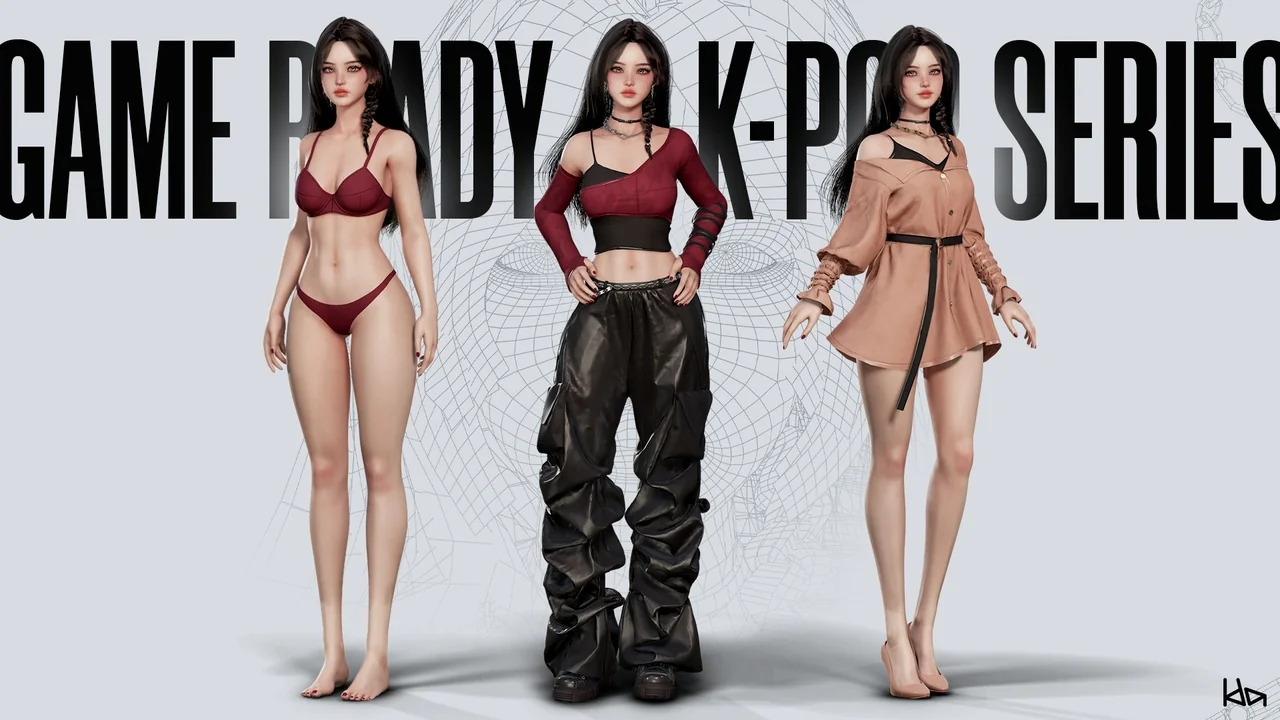
 Humans
 Humans
 Humans