"5da73d49ff33a5b1"{"id":"1002388","slug":"k-pop-series-ryu","title":"K-POP SERIES - Ryu","category":"Humans","engine":"4.24+,5.0+","assetVersion":"","engineVersion":"Engine Version: 4.24+,5.0+","tag":"Humans","accent":"blue","visual":"mech","summary":"Explore K-POP SERIES - Ryu, a modular low-poly female 3D character featuring 52 Apple blendshapes, UE4 mannequin skeleton compatibility, and 4K PBR textures.","platform":"Unreal Engine","indexPolicy":"index","publishedAt":"2026-11-10T04:05:52.610Z","updatedAt":"2026-11-10T04:05:52.610Z","sourceNotes":[],"fileContents":[],"compatibility":["Unreal Engine","Engine Version: 4.24+,5.0+"],"featuredImage":{"alt":"K-POP SERIES - Ryu","src":"/wp-content/uploads/published/2026/11/b5c8a1b59d0a-620abc61-4cf5-48bf-9fb2-3f5d4bf12f01-34709fe5a7.webp"},"hasDownloadLink":true,"downloads":0,"terms":[{"taxonomy":"category","slug":"humans","name":"Humans"}],"galleryImages":[{"src":"/wp-content/uploads/published/2026/11/a9a200d28c41-5e6793ce-403c-413b-83f0-20b6e053dd8e-7c315e354d.webp","alt":"K-POP SERIES - Ryu"},{"src":"/wp-content/uploads/published/2026/11/a9c6c7eb108c-d7820647-f84e-4454-a8fd-911adf17f8c0-c0dd84d6c7.webp","alt":"K-POP SERIES - Ryu"},{"src":"/wp-content/uploads/published/2026/11/ef3c92a77f9f-11951543-26ca-40d8-acb2-f5fd69f64488-20bb4ad5a0.webp","alt":"K-POP SERIES - Ryu"},{"src":"/wp-content/uploads/published/2026/11/674aaf3f8f1c-d65c28ae-def0-4277-b6c1-d4ec6ddbc3ed-eba9ef8701.webp","alt":"K-POP SERIES - Ryu"},{"src":"/wp-content/uploads/published/2026/11/783119a67834-f3d1817c-8808-4342-8599-bc235d0a03b5-2b82c26a8b.webp","alt":"K-POP SERIES - Ryu"},{"src":"/wp-content/uploads/published/2026/11/6762beb91d2d-fbdc109b-f838-4097-89ae-b21944923bc3-d08012166d.webp","alt":"K-POP SERIES - Ryu"},{"src":"/wp-content/uploads/published/2026/11/81d064ac4f09-00351715-f8b4-4f3e-ba87-37c3fcf010ce-4ccec9bd4a.webp","alt":"K-POP SERIES - Ryu"},{"src":"/wp-content/uploads/published/2026/11/c82f82a8c04f-bf40b2b7-0e28-483d-a84d-1bf702aea186-9fa035dfc9.webp","alt":"K-POP SERIES - Ryu"},{"src":"/wp-content/uploads/published/2026/11/7f16dbd6195b-f05c383f-8e38-4ac7-bd3a-595ad8e01a8f-b9a868ef18.webp","alt":"K-POP SERIES - Ryu"},{"src":"/wp-content/uploads/published/2026/11/66b3f61eb20d-a4943d7e-1a2a-4457-81c2-d5d36b7772e5-6ffed99974.webp","alt":"K-POP SERIES - Ryu"}],"accessPanel":{"kind":"resource","title":"Get this resource","eyebrow":"Free resource","message":"Download this resource in your browser.","fileName":"K-POP SERIES - Ryu.7z","safetyNote":"Resources are manually reviewed before listing to improve quality and reduce obvious risks.","actionLabel":"Get this resource","resourceType":"Resource archive","versions":[]},"contentHtml":"\u003ch2\u003eInteractive Staging and Live Performance Scenarios for Ryu\u003c/h2\u003e\u003cp\u003eModern interactive productions often demand stylized realism balanced against strict technical constraints. Whether staging choreographed musical sequences, developing narrative cutscenes, or configuring third-person action games, digital avatars must blend visual fidelity with immediate skeletal responsiveness. K-POP SERIES - Ryu addresses these environments by offering a contemporary character model tailored for pop-idol staging, broadcast motion capture, and dynamic game environments.\u003c/p\u003e\u003cp\u003eThe character is structured to slide into various scene contexts, shifting between casual everyday attire, formal stage performance costumes, and private interior spaces. Because visual projects often require diverse wardrobe changes without remodeling the core base, Ryu supplies multiple fully resolved clothing variations alongside a completely unclad mesh base. This structural flexibility allows developers to employ the asset across diverse staging scenarios without breaking visual continuity across scenes.\u003c/p\u003e\u003ch2\u003eModular Wardrobe and Mesh Partitioning Mechanics\u003c/h2\u003e\u003cp\u003eCharacter modularity in real-time engines regularly creates geometry intersections where tight-fitting clothing collides with underlying skin meshes. To eliminate this issue, the underlying body geometry is partitioned into individual sectional cuts. Whenever outerwear or footwear covers underlying anatomy, the corresponding body segments can be hidden or toggled off entirely within the engine hierarchy. This workflow completely removes mesh penetration artifacts while simultaneously trimming active triangle budgets.\u003c/p\u003e\u003cp\u003eRyu is delivered across four primary geometric configurations, each balanced for real-time rendering pipelines without an automatic Level of Detail (LOD) generation system:\u003c/p\u003e\u003cul\u003e\u003cli\u003e\u003cstrong\u003eRyu Casual:\u003c/strong\u003e 34,676 faces, 66,190 triangles, and 37,034 vertices.\u003c/li\u003e\u003cli\u003e\u003cstrong\u003eRyu Performance:\u003c/strong\u003e 34,460 faces, 65,886 triangles, and 37,074 vertices.\u003c/li\u003e\u003cli\u003e\u003cstrong\u003eRyu Lingerie:\u003c/strong\u003e 28,723 faces, 54,368 triangles, and 30,281 vertices.\u003c/li\u003e\u003cli\u003e\u003cstrong\u003eRyu Nude:\u003c/strong\u003e 27,589 faces, 52,120 triangles, and 29,004 vertices.\u003c/li\u003e\u003c/ul\u003e\u003cp\u003eThe nude base representation includes a censored body texture map. Anatomical adult parts are not modeled as dimensional geometry and do not possess independent skeletal joints or morph deformation targets. Outfits remain cross-compatible with the Roxy female base character standard, enabling wardrobe interchangeability across similarly mapped characters. Furthermore, individual mesh components are pre-separated to facilitate integration with Master Pose Component and Leader Pose Component pipelines within Unreal Engine.\u003c/p\u003e\u003ch2\u003eRig Architecture and Animation Testing for Ryu\u003c/h2\u003e\u003cp\u003eSkeletal setup governs how rapidly a character integrates into preexisting movement mechanics. The skeletal hierarchy for Ryu is built upon the Epic Games Unreal Engine 4 Mannequin standard. The core bone hierarchy remains unaltered, ensuring standard locomotion blends, retargeting profiles, and animation blueprints transfer directly without manual bone reassignment or axis correction. The primary rig was authored in Autodesk Maya without proprietary plugins, maintaining a clean structure devoid of non-standard animation control rigs.\u003c/p\u003e\u003cp\u003eTo support dynamic costuming and facial elements, the base skeleton incorporates targeted secondary bones. These include dedicated joints for both eyes (\u003ccode\u003eEye_l\u003c/code\u003e, \u003ccode\u003eEye_r\u003c/code\u003e), chest nodes (\u003ccode\u003eBreast_l\u003c/code\u003e, \u003ccode\u003eBreast_r\u003c/code\u003e), earrings (\u003ccode\u003eEarring_l\u003c/code\u003e, \u003ccode\u003eEarring_r\u003c/code\u003e), and complex hair chains across the crown and fringe (\u003ccode\u003eHair_front_01-03_l\u003c/code\u003e, \u003ccode\u003eHair_back_01_l/r\u003c/code\u003e, \u003ccode\u003eHair_back_01-03_mid\u003c/code\u003e). Specialized clothing joints manage dynamic fabric motion, including \u003ccode\u003ePerf_belt_01\u003c/code\u003e, multi-tiered stage skirt bones (\u003ccode\u003ePerf_skirt_01-05_01-04\u003c/code\u003e), casual skirt controllers (\u003ccode\u003eCasual_skirt_back/side/front_01-03_l/r\u003c/code\u003e), and corrective skirt stability joints (\u003ccode\u003eCasual_skirt_fix_bone_front/back_01-02\u003c/code\u003e).\u003c/p\u003e\u003cp\u003ePhysical secondary simulation is not baked directly into the base assets; dynamic chain simulation is intended to run through external physics solvers, specifically the KawaiiPhysics plugin. The rig has been verified across an extensive assortment of real-time locomotion packages, including the Advanced Locomotion System v4 (ALSv4), standard third-person game templates, Female Interactions Animations, general Mocap Library data, ARLS with Horse Animset, Succubus AnimSet, Close Combat: Swordsman, the Lyra Starter Game, and the Valley of the Ancient sample environment.\u003c/p\u003e\u003ch2\u003eFacial Capture and Morph Target Implementation\u003c/h2\u003e\u003cp\u003eLive broadcasting, virtual YouTuber setups, and modern cinematic games depend heavily on expressive facial deformation. Ryu incorporates a fully calibrated set of 52 Apple blendshapes driven via morph targets. These facial shapes conform to standard ARKit specifications, making the asset natively compatible with the Live Link Face application in Unreal Engine 5.\u003c/p\u003e\u003cp\u003eBecause the blendshape profile adheres to universal tracking inputs, the model handles real-time facial capture through platforms like FaceWare, MikuMikuDance (MMD), and standard VTuber streaming interfaces. The deformation targets cover broad emotional responses alongside subtle micro-expressions, including brow compression, eyelid adjustments, cheek movement, and precise lip synchronization. In engine projects, facial movement is driven through standard morph curves rather than bone-based facial joints.\u003c/p\u003e\u003ch2\u003eMaterial ID Channels and 4K Shading Pipeline\u003c/h2\u003e\u003cp\u003eSurface definition relies on eight distinct 4K texture sets categorized across functional regions: Body, Head, Clothes, Shoes, Teeth, Hair, Eyes, and Eyelashes. Textures are authored within a standard PBR workflow and channel-packed to maintain video memory efficiency. Map allocations provide Base Color, Normal, Roughness, Metallic, Ambient Occlusion, Opacity, and Emissive channels.\u003c/p\u003e\u003cp\u003eA critical component of the surface pipeline is the inclusion of dedicated Material ID (MatID) maps across the skin, eye meshes, hair strands, and outfit components. These ID masks isolate individual sub-regions within a single texture sheet. Working in tandem with the included Unreal Engine Material Instances, artists can alter base colors, hair highlights, iris shades, and fabric trims dynamically within the engine viewport without re-exporting bitmap data from digital content creation software. In addition, the hair setup includes dedicated wind simulation parameters to introduce environmental motion during gameplay.\u003c/p\u003e\u003ch2\u003eProduction Deployment Considerations\u003c/h2\u003e\u003cp\u003eRyu is built for projects operating on Unreal Engine 4.19 and higher, carrying native project assets, third-person standard animations, and configured material instances. The package does not contain pre-assembled actor Blueprints, meaning technical designers must incorporate the modular skeletal meshes into their own gameplay actors, state machines, and physics component chains.\u003c/p\u003e\u003cp\u003eWhile the skeleton and morph configurations originated within Maya, the raw geometry and deformation sets can be imported into third-party suites such as Blender, Cinema 4D, or 3ds Max through standard exchange formats. Technical artists migrating across software environments should verify that target applications parse the native Maya skin cluster weights and morph target hierarchies correctly upon import. This asset serves technical artists, independent game developers, and real-time VTuber creators requiring a production-tested character mesh that balances low-poly performance with extensive real-time capture features.\u003c/p\u003e\n\n\u003ch2\u003eContinue Browsing Similar Packs\u003c/h2\u003e\n\u003cul\u003e\n\u003cli\u003e\u003ca href=\"https://3dcghub.com/k-pop-series-sun/\" rel=\"noopener noreferrer\"\u003eK-POP SERIES - Sun\u003c/a\u003e\u003c/li\u003e\n\u003cli\u003e\u003ca href=\"https://3dcghub.com/k-pop-series-mina/\" rel=\"noopener noreferrer\"\u003eK-POP SERIES - Mina\u003c/a\u003e\u003c/li\u003e\n\u003cli\u003e\u003ca href=\"https://3dcghub.com/k-pop-series-lola/\" rel=\"noopener noreferrer\"\u003eK-POP SERIES - Lola\u003c/a\u003e\u003c/li\u003e\n\u003cli\u003e\u003ca href=\"https://3dcghub.com/tempest-ninja-shadows-series-stealth/\" rel=\"noopener noreferrer\"\u003eTempest Ninja - Shadows Series Stealth\u003c/a\u003e\u003c/li\u003e\n\u003cli\u003e\u003ca href=\"https://3dcghub.com/succubus-lucia/\" rel=\"noopener noreferrer\"\u003eSuccubus Lucia\u003c/a\u003e\u003c/li\u003e\n\u003c/ul\u003e","contentTextLength":7596,"navigation":{"current":32,"total":4340,"previous":{"id":"1002389","slug":"lady-biker","title":"Lady Biker","category":"Characters \u0026 Creatures","platform":"Unreal Engine","updatedAt":"2026-11-10T04:06:44.585Z"},"next":{"id":"1002387","slug":"gladiator-warrior","title":"Gladiator Warrior","category":"Characters \u0026 Creatures","platform":"Unreal Engine","updatedAt":"2026-11-10T04:05:01.420Z"}},"relatedResources":[{"id":"1001813","slug":"k-pop-series-sun","title":"K-POP SERIES - Sun","category":"Humans","engine":"4.19+,5.0+","assetVersion":"","engineVersion":"Engine Version: 4.19+,5.0+","tag":"Humans","accent":"blue","visual":"mech","summary":"Explore the K-POP SERIES - Sun 3D character featuring 3 modular outfits, 52 Apple Blendshapes, 4K packed textures, and a UE4 Mannequin compatible rig.","platform":"Unreal Engine","indexPolicy":"index","publishedAt":"2026-10-21T08:07:28.503Z","updatedAt":"2026-10-21T08:07:28.503Z","sourceNotes":[],"fileContents":[],"compatibility":["Unreal Engine","Engine Version: 4.19+,5.0+"],"featuredImage":{"alt":"K-POP SERIES - Sun","src":"/wp-content/uploads/published/2026/10/83ca5751ce7a-5a057e83-5982-45c2-912b-4df36281063c-669168bb3d.webp"},"hasDownloadLink":true,"downloads":2},{"id":"1001528","slug":"k-pop-series-mina","title":"K-POP SERIES - Mina","category":"Humans","engine":"4.24+,5.0+","assetVersion":"","engineVersion":"Engine Version: 4.24+,5.0+","tag":"Humans","accent":"blue","visual":"mech","summary":"Modular stylized character Mina features 4K PBR textures, 52 ARKit blendshapes, multiple outfits, and an extended UE4 Epic Skeleton hierarchy.","platform":"Unreal Engine","indexPolicy":"index","publishedAt":"2026-10-09T17:22:33.205Z","updatedAt":"2026-10-09T17:22:33.205Z","sourceNotes":[],"fileContents":[],"compatibility":["Unreal Engine","Engine Version: 4.24+,5.0+"],"featuredImage":{"alt":"K-POP SERIES - Mina","src":"/wp-content/uploads/published/2026/10/3e40e7c5797d-c0473200-f6c1-420c-9084-9cc53ab02863-ce249513ef.webp"},"hasDownloadLink":true,"downloads":0},{"id":"1001527","slug":"k-pop-series-lola","title":"K-POP SERIES - Lola","category":"Humans","engine":"4.19+,5.0+","assetVersion":"","engineVersion":"Engine Version: 4.19+,5.0+","tag":"Humans","accent":"blue","visual":"mech","summary":"Technical analysis of K-POP SERIES - Lola, covering its modular outfits, UE4 Mannequin rig, 52 Apple blendshapes, and 4K material workflows.","platform":"Unreal Engine","indexPolicy":"index","publishedAt":"2026-10-09T17:21:56.867Z","updatedAt":"2026-10-09T17:21:56.867Z","sourceNotes":[],"fileContents":[],"compatibility":["Unreal Engine","Engine Version: 4.19+,5.0+"],"featuredImage":{"alt":"K-POP SERIES - Lola","src":"/wp-content/uploads/published/2026/10/8a4dd198ce9f-f2179811-3c98-4ed9-a8ba-72459a50bb62-2e408d7d87.webp"},"hasDownloadLink":true,"downloads":2}]}
Humans
K-POP SERIES - Ryu
Explore K-POP SERIES - Ryu, a modular low-poly female 3D character featuring 52 Apple blendshapes, UE4 mannequin skeleton compatibility, and 4K PBR textures.
Category:Unreal Engine,HumansPlatform: Unreal EngineEngine Version: 4.24+,5.0+Published: Nov 10, 2026
Humans
Resource overview
Interactive Staging and Live Performance Scenarios for Ryu
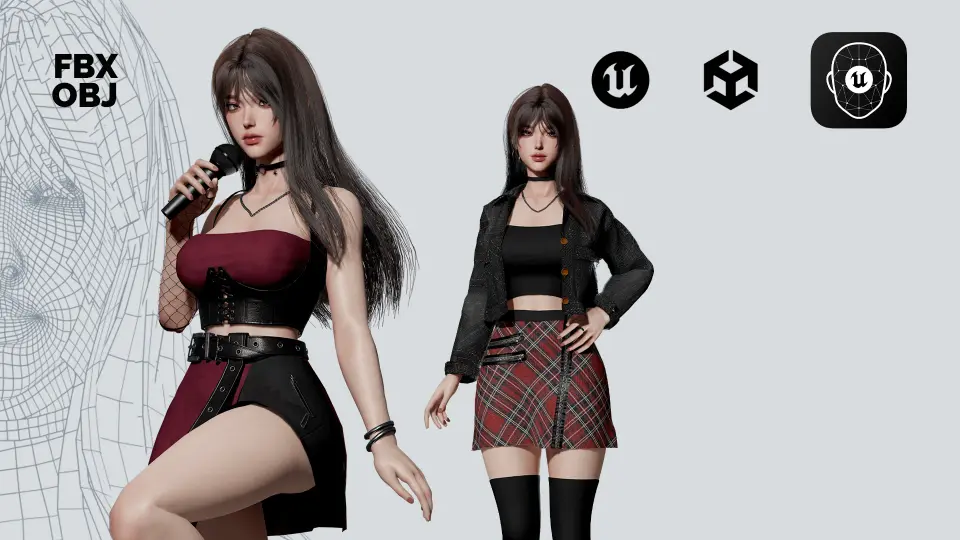
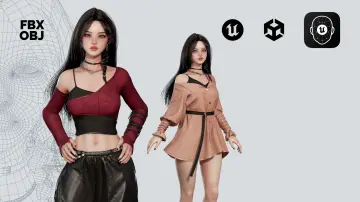
Modern interactive productions often demand stylized realism balanced against strict technical constraints. Whether staging choreographed musical sequences, developing narrative cutscenes, or configuring third-person action games, digital avatars must blend visual fidelity with immediate skeletal responsiveness. K-POP SERIES - Ryu addresses these environments by offering a contemporary character model tailored for pop-idol staging, broadcast motion capture, and dynamic game environments.
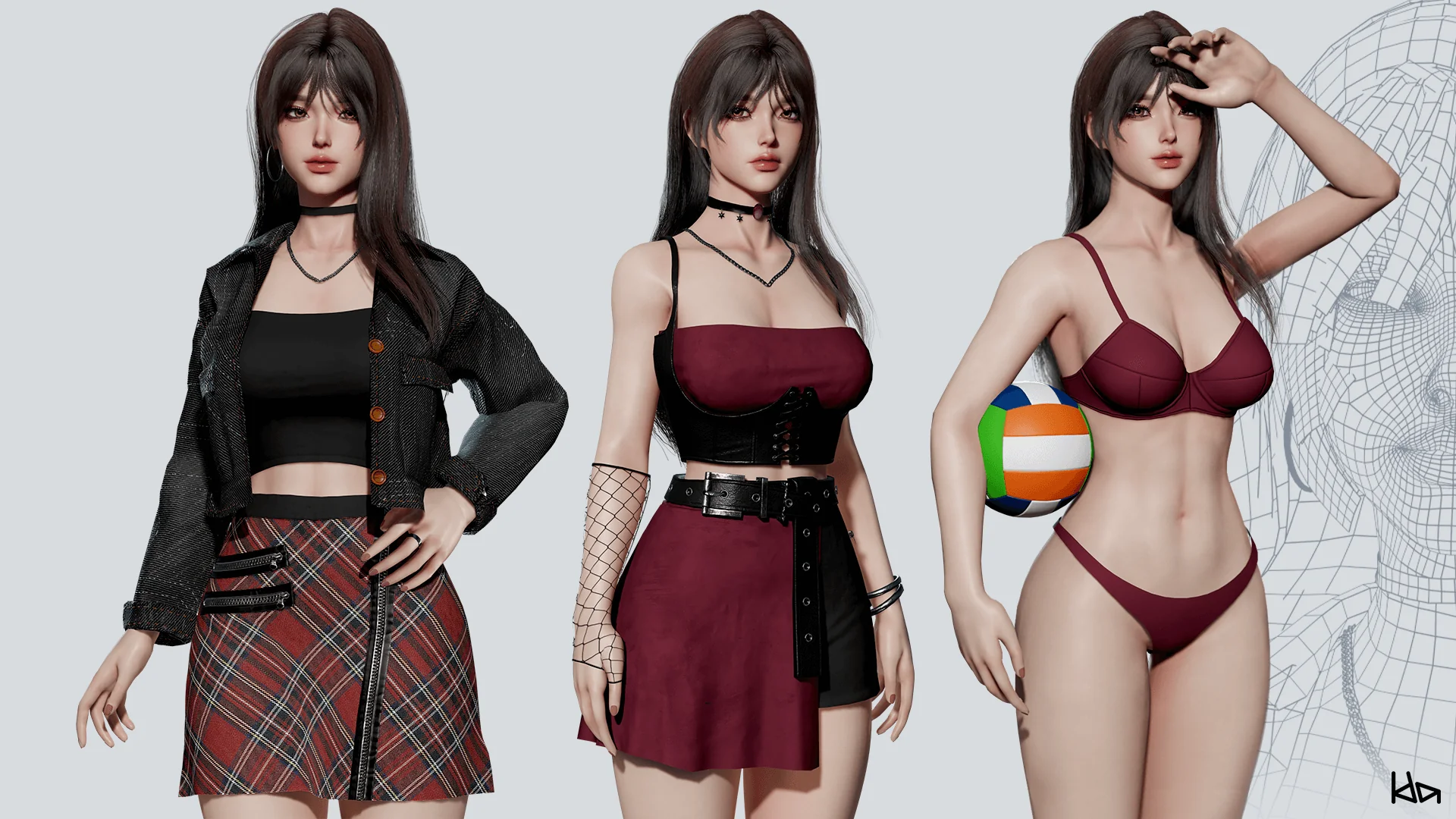
The character is structured to slide into various scene contexts, shifting between casual everyday attire, formal stage performance costumes, and private interior spaces. Because visual projects often require diverse wardrobe changes without remodeling the core base, Ryu supplies multiple fully resolved clothing variations alongside a completely unclad mesh base. This structural flexibility allows developers to employ the asset across diverse staging scenarios without breaking visual continuity across scenes.
Modular Wardrobe and Mesh Partitioning Mechanics
Character modularity in real-time engines regularly creates geometry intersections where tight-fitting clothing collides with underlying skin meshes. To eliminate this issue, the underlying body geometry is partitioned into individual sectional cuts. Whenever outerwear or footwear covers underlying anatomy, the corresponding body segments can be hidden or toggled off entirely within the engine hierarchy. This workflow completely removes mesh penetration artifacts while simultaneously trimming active triangle budgets.
Ryu is delivered across four primary geometric configurations, each balanced for real-time rendering pipelines without an automatic Level of Detail (LOD) generation system:
Ryu Casual: 34,676 faces, 66,190 triangles, and 37,034 vertices.
Ryu Performance: 34,460 faces, 65,886 triangles, and 37,074 vertices.
Ryu Lingerie: 28,723 faces, 54,368 triangles, and 30,281 vertices.
Ryu Nude: 27,589 faces, 52,120 triangles, and 29,004 vertices.
The nude base representation includes a censored body texture map. Anatomical adult parts are not modeled as dimensional geometry and do not possess independent skeletal joints or morph deformation targets. Outfits remain cross-compatible with the Roxy female base character standard, enabling wardrobe interchangeability across similarly mapped characters. Furthermore, individual mesh components are pre-separated to facilitate integration with Master Pose Component and Leader Pose Component pipelines within Unreal Engine.
Rig Architecture and Animation Testing for Ryu
Skeletal setup governs how rapidly a character integrates into preexisting movement mechanics. The skeletal hierarchy for Ryu is built upon the Epic Games Unreal Engine 4 Mannequin standard. The core bone hierarchy remains unaltered, ensuring standard locomotion blends, retargeting profiles, and animation blueprints transfer directly without manual bone reassignment or axis correction. The primary rig was authored in Autodesk Maya without proprietary plugins, maintaining a clean structure devoid of non-standard animation control rigs.
To support dynamic costuming and facial elements, the base skeleton incorporates targeted secondary bones. These include dedicated joints for both eyes (Eye_l, Eye_r), chest nodes (Breast_l, Breast_r), earrings (Earring_l, Earring_r), and complex hair chains across the crown and fringe (Hair_front_01-03_l, Hair_back_01_l/r, Hair_back_01-03_mid). Specialized clothing joints manage dynamic fabric motion, including Perf_belt_01, multi-tiered stage skirt bones (Perf_skirt_01-05_01-04), casual skirt controllers (Casual_skirt_back/side/front_01-03_l/r), and corrective skirt stability joints (Casual_skirt_fix_bone_front/back_01-02).
Physical secondary simulation is not baked directly into the base assets; dynamic chain simulation is intended to run through external physics solvers, specifically the KawaiiPhysics plugin. The rig has been verified across an extensive assortment of real-time locomotion packages, including the Advanced Locomotion System v4 (ALSv4), standard third-person game templates, Female Interactions Animations, general Mocap Library data, ARLS with Horse Animset, Succubus AnimSet, Close Combat: Swordsman, the Lyra Starter Game, and the Valley of the Ancient sample environment.
Facial Capture and Morph Target Implementation
Live broadcasting, virtual YouTuber setups, and modern cinematic games depend heavily on expressive facial deformation. Ryu incorporates a fully calibrated set of 52 Apple blendshapes driven via morph targets. These facial shapes conform to standard ARKit specifications, making the asset natively compatible with the Live Link Face application in Unreal Engine 5.
Because the blendshape profile adheres to universal tracking inputs, the model handles real-time facial capture through platforms like FaceWare, MikuMikuDance (MMD), and standard VTuber streaming interfaces. The deformation targets cover broad emotional responses alongside subtle micro-expressions, including brow compression, eyelid adjustments, cheek movement, and precise lip synchronization. In engine projects, facial movement is driven through standard morph curves rather than bone-based facial joints.
Material ID Channels and 4K Shading Pipeline
Surface definition relies on eight distinct 4K texture sets categorized across functional regions: Body, Head, Clothes, Shoes, Teeth, Hair, Eyes, and Eyelashes. Textures are authored within a standard PBR workflow and channel-packed to maintain video memory efficiency. Map allocations provide Base Color, Normal, Roughness, Metallic, Ambient Occlusion, Opacity, and Emissive channels.
A critical component of the surface pipeline is the inclusion of dedicated Material ID (MatID) maps across the skin, eye meshes, hair strands, and outfit components. These ID masks isolate individual sub-regions within a single texture sheet. Working in tandem with the included Unreal Engine Material Instances, artists can alter base colors, hair highlights, iris shades, and fabric trims dynamically within the engine viewport without re-exporting bitmap data from digital content creation software. In addition, the hair setup includes dedicated wind simulation parameters to introduce environmental motion during gameplay.
Production Deployment Considerations
Ryu is built for projects operating on Unreal Engine 4.19 and higher, carrying native project assets, third-person standard animations, and configured material instances. The package does not contain pre-assembled actor Blueprints, meaning technical designers must incorporate the modular skeletal meshes into their own gameplay actors, state machines, and physics component chains.
While the skeleton and morph configurations originated within Maya, the raw geometry and deformation sets can be imported into third-party suites such as Blender, Cinema 4D, or 3ds Max through standard exchange formats. Technical artists migrating across software environments should verify that target applications parse the native Maya skin cluster weights and morph target hierarchies correctly upon import. This asset serves technical artists, independent game developers, and real-time VTuber creators requiring a production-tested character mesh that balances low-poly performance with extensive real-time capture features.
 Humans
 Humans
 Humans
 Humans