"f813c18d2170b1f6"{"id":"1000069","slug":"introduction-to-materials-in-unreal-engine-5","title":"Introduction to Materials in Unreal Engine 5","category":"Unreal Engine","engine":"File Content: video + English subtitles","assetVersion":"Video Language : English","engineVersion":"File Content: video + English subtitles","tag":"Unreal Engine","accent":"blue","visual":"luts","summary":"A beginner Unreal Engine 5 course focused on Material Editor nodes, environment art workflows, a Rock Master Material, and updated UE 5.5 tools.","platform":"Unreal Engine","publishedAt":"2026-05-30T14:13:42.533Z","updatedAt":"2026-05-30T15:32:26.149Z","sourceNotes":[],"fileContents":[],"compatibility":["Unreal Engine","Video Language: English","File Content: video + English subtitles"],"featuredImage":{"alt":"Introduction to Materials in Unreal Engine 5","src":"/wp-content/uploads/published/2026/05/f0c3743d114a-6379897-279e-2-b47aa1a210.webp"},"hasDownloadLink":true,"downloads":1,"terms":[{"taxonomy":"category","slug":"tutoriallibrary-unrealengine","name":"Unreal Engine"}],"galleryImages":[],"accessPanel":{"kind":"resource","title":"Access this resource","eyebrow":"Free Download","message":"Log in or create a free account to start your download.","fileName":"1 - Introduction to Materials in Unreal Engine 5.7z","safetyNote":"Resources are manually reviewed before listing to improve quality and reduce obvious risks.","actionLabel":"Download Free","resourceType":"Resource archive"},"contentHtml":"\u003cp\u003eMaterials are often where an environment starts to feel convincing. Surface response, visual cohesion, and reusable shading choices all come together in the Material Editor, and that is the area this beginner course centers on. \u003cstrong\u003eIntroduction to Materials in Unreal Engine 5\u003c/strong\u003e Teaches learners how to create materials in Unreal Engine 5 with the perspective of a professional environment artist, keeping the focus on practical understanding rather than abstract theory.\u003c/p\u003e \u003cp\u003eThe course is aimed at beginner game developers who want to grow toward environment art work. That audience matters, because the training is not framed as a broad survey of every corner of Unreal Engine. It stays close to a specific creative task: learning how materials work, how key nodes inside the Material Editor affect results, and how those decisions support environment art in production.\u003c/p\u003e \u003ch2\u003eMaterial behavior in Unreal Engine 5 scenes\u003c/h2\u003e\n\u003cp\u003eFor artists and developers, materials do more than add color to an object. They define how surfaces read in context, how repeated assets stay visually consistent, and how an environment can be shaped with a controlled set of shader decisions. This course approaches that process directly by teaching material creation in Unreal Engine 5 through an environment artist mindset.\u003c/p\u003e \u003cp\u003eThat makes it especially relevant for anyone building scenes where surface quality carries much of the final impression. A beginner developer who wants to move closer to environment art can use this kind of training to understand how material choices influence the identity of rocks, ground pieces, or other world elements. The course does not present materials as isolated technical exercises. It connects them to the way an artist would work inside a larger scene.\u003c/p\u003e \u003cp\u003eBecause the stated goal is to create materials like a professional environment artist, the course naturally supports a more creative use of Unreal Engine 5. Instead of treating the editor as a set of disconnected controls, it encourages learners to see the Material Editor as part of scene building. That shift is important for beginners. It helps them think in terms of reusable visual language, not just one-off results.\u003c/p\u003e \u003ch2\u003eThe most important nodes inside the Material Editor\u003c/h2\u003e\n\u003cp\u003eA central part of the course is getting to know the most important nodes inside the Material Editor in Unreal Engine 5. For someone at a beginner level, that focus creates a manageable entry point. The Material Editor can seem dense at first, but concentrating on the nodes that matter most gives learners a clearer path into material construction.\u003c/p\u003e \u003cp\u003eThis part of the training is useful not only because it introduces tools, but because it establishes how those tools are read and combined. Understanding important nodes means understanding the building blocks behind material behavior. That foundation can help a learner move from simply placing assets in a scene to shaping the look of those assets with intent.\u003c/p\u003e \u003cp\u003eFor environment-focused work, node knowledge becomes especially valuable when consistency matters. A scene often depends on repeated material logic across multiple objects. Learning the most important nodes gives beginners a way to build that consistency from the start. It also supports experimentation, since confidence with core nodes makes iteration more practical.\u003c/p\u003e \u003cp\u003eThe course keeps this within Unreal Engine 5 rather than drifting into a general shading discussion. That makes the learning more immediately usable for anyone already working in the engine or planning to build scenes there. The emphasis stays on how the Material Editor functions inside that workflow.\u003c/p\u003e \u003ch2\u003eCreating a Rock Master Material\u003c/h2\u003e\n\u003cp\u003eOne of the clearest practical outcomes in the course is the creation of a \u003cstrong\u003eRock Master Material\u003c/strong\u003e For use in projects. This is a strong anchor for beginners because it turns material learning into a concrete result. Rather than stopping at isolated node demonstrations, the course leads toward a reusable material asset with a recognizable environment art application.\u003c/p\u003e \u003cp\u003eRock surfaces are a natural fit for environment-focused material study. They appear frequently in outdoor scenes, natural set dressing, and broader world building. A master material in that context gives learners something more flexible than a single finished look. It introduces the idea that a material can serve as a project-level tool, not just a one-time setup.\u003c/p\u003e \u003cp\u003eFrom a creative standpoint, a Rock Master Material is useful because it speaks directly to production habits in environment art. Reusability matters when scenes need cohesion. A master material can help establish that cohesion by giving artists a structured starting point for rock surfaces across multiple uses. In a beginner course, this kind of exercise helps bridge the gap between learning interface elements and producing work that feels closer to actual scene development.\u003c/p\u003e \u003cp\u003eThe project angle also helps learners understand why material decisions matter. A rock material is not just a technical exercise in node connections. It is part of how a landscape, ruin, canyon, or natural setting gains visual character. By centering one of the course outcomes on a Rock Master Material, the training stays tied to a recognizable environment art need.\u003c/p\u003e \u003ch2\u003eUpdated tools in Unreal Engine 5.5\u003c/h2\u003e\n\u003cp\u003eThe course also includes updated tools in \u003cstrong\u003eUnreal Engine 5.5\u003c/strong\u003e. That detail gives the training a current practical edge for learners entering the engine now. Materials are one of the areas where familiarity with the present toolset can shape how comfortably a beginner works, especially when following modern workflows rather than older habits.\u003c/p\u003e \u003cp\u003eFor a new developer or aspiring environment artist, this matters because early learning tends to set long-term patterns. Working with updated Unreal Engine 5.5 tools means the course is not just introducing material concepts in the abstract. It is connecting those concepts to the version of the engine identified in the course content.\u003c/p\u003e \u003cp\u003eThis also strengthens the course’s value as a starting point for people who want to understand current material workflows without first sorting through older methods. The emphasis remains tightly focused: materials, key nodes, environment art understanding, and a practical master material outcome. The mention of updated tools supports that focus instead of pulling attention away from it.\u003c/p\u003e \u003ch2\u003eWho Introduction to Materials in Unreal Engine 5 fits best\u003c/h2\u003e\n\u003cp\u003eThe intended audience is beginner game developers who aspire to become environment artists in the field. That positioning gives the course a clear identity. It is not framed for advanced technical artists, and it is not presented as a broad game development program. It is a beginner-level entry into material creation with a specific artistic direction.\u003c/p\u003e \u003cp\u003eThat direction makes the course useful for learners who want their technical growth to support visual world building. Someone moving from basic engine familiarity toward environment-focused work can use this training to start understanding how surface creation fits into that path. The attention to important Material Editor nodes, practical environment art understanding, and the Rock Master Material project all point toward the same goal.\u003c/p\u003e \u003cp\u003eThe course workload is 3 hours and 1 minute, which places it in a compact format. That scale suits a focused beginner course. It is long enough to move beyond a very brief introduction, while still staying concentrated on a single topic area. The curriculum is identified under the same title, \u003cstrong\u003eIntroduction to Materials in Unreal Engine 5\u003c/strong\u003e, reinforcing that this is a tightly scoped learning experience rather than a sprawling multi-topic package.\u003c/p\u003e \u003cp\u003ePublished on May 27, 2025 and taught by the developer, the course presents a direct path for beginners who want to make materials with an environment art mindset. The strongest takeaway is simple: it gives new Unreal Engine 5 users a practical route into the Material Editor, ending with a Rock Master Material they can use in their projects.\u003c/p\u003e\n\n\u003ch2\u003eExplore Similar Assets\u003c/h2\u003e\n\u003cul\u003e\n\u003cli\u003e\u003ca href=\"https://3dcghub.com/embergen-volumetric-unreal-engine-5/\" title=\"EmberGen Volumetric \u0026amp; Unreal Engine 5\"\u003eEmberGen Volumetric \u0026amp; Unreal Engine 5\u003c/a\u003e\u003c/li\u003e\n\u003cli\u003e\u003ca href=\"https://3dcghub.com/niagara-beginners-to-advanced-in-unreal-engine-5/\" title=\"Niagara Beginners to advanced in Unreal Engine 5\"\u003eNiagara Beginners to advanced in Unreal Engine 5\u003c/a\u003e\u003c/li\u003e\n\u003cli\u003e\u003ca href=\"https://3dcghub.com/3d-pool-in-ue5-c-aaa-quality-beginner-to-advance/\" title=\"3D pool in UE5 C++ AAA Quality (Beginner to Advance)\"\u003e3D pool in UE5 C++ AAA Quality (Beginner to Advance)\u003c/a\u003e\u003c/li\u003e\n\u003cli\u003e\u003ca href=\"https://3dcghub.com/unreal-engine-5-one-course-solution-for-niagara-vfx/\" title=\"Unreal Engine 5: One Course Solution For Niagara VFX\"\u003eUnreal Engine 5: One Course Solution For Niagara VFX\u003c/a\u003e\u003c/li\u003e\n\u003cli\u003e\u003ca href=\"https://3dcghub.com/unreal-engine-5-one-course-solution-for-material/\" title=\"Unreal Engine 5: One Course Solution For Material\"\u003eUnreal Engine 5: One Course Solution For Material\u003c/a\u003e\u003c/li\u003e\n\u003c/ul\u003e","contentTextLength":8246,"navigation":{"current":1727,"total":3651,"previous":{"id":"8299","slug":"stylized-summer-forest","title":"Stylized Summer Forest","category":"Forest \u0026 Jungle","platform":"Unreal Engine","updatedAt":"2026-05-31T12:48:26.238Z"},"next":{"id":"1000067","slug":"industrial-vol-4-electricity-hydro-and-water-treatment","title":"Industrial VOL.4 - Electricity, Hydro, and Water Treatment","category":"Buildings \u0026 Architecture","platform":"Unreal Engine","updatedAt":"2026-05-29T13:50:53.215Z"}},"relatedResources":[{"id":"1000181","slug":"unreal-engine-5-blender-environment-design-for-beginners","title":"Unreal Engine 5 + Blender Environment Design For Beginners","category":"Unreal Engine","engine":"File Content: video + English subtitles","assetVersion":"Video Language: English","engineVersion":"File Content: video + English subtitles","tag":"Unreal Engine","accent":"blue","visual":"city","summary":"A beginner course focused on creating a factory interior with Blender and Unreal Engine 5, covering modular modeling, materials, lighting, and level assembly.","platform":"Unreal Engine","publishedAt":"2026-06-21T04:53:10.052Z","updatedAt":"2026-10-03T14:08:40.296Z","sourceNotes":[],"fileContents":[],"compatibility":["Blender","Video Language: English","File Content: video + English subtitles"],"featuredImage":{"alt":"Unreal Engine 5 + Blender Environment Design For Beginners","src":"/wp-content/uploads/published/2026/06/629c97a3fbc5-6468489-877c-9382f24713.webp"},"hasDownloadLink":true,"downloads":0},{"id":"1000791","slug":"unreal-engine-5-chaos-destruction-complete-course","title":"Unreal Engine 5 - Chaos Destruction Complete Course!","category":"Unreal Engine","engine":"File Content: video + English subtitles","assetVersion":"Video Language: English","engineVersion":"File Content: video + English subtitles","tag":"Unreal Engine","accent":"blue","visual":"mech","summary":"A complete UE5 Chaos Destruction course covering fracturing, clusters, fields, Niagara VFX, and FPS shooter mechanics. 5h 29m of training for all levels.","platform":"Unreal Engine","publishedAt":"2026-07-30T12:53:39.502Z","updatedAt":"2026-07-30T12:53:39.502Z","sourceNotes":[],"fileContents":[],"compatibility":["Unreal Engine","Video Language: English","File Content: video + English subtitles"],"featuredImage":{"alt":"Unreal Engine 5 - Chaos Destruction Complete Course!","src":"/wp-content/uploads/published/2026/07/b1ccb61cc408-6517179-31bb-3-f9563adc43.webp"},"hasDownloadLink":true,"downloads":4},{"id":"1000741","slug":"real-time-automotive-rendering-1001","title":"Real-Time Automotive Rendering 1001","category":"Unreal Engine","engine":"File Content: video + English subtitles","assetVersion":"Video Language: English","engineVersion":"File Content: video + English subtitles","tag":"Unreal Engine","accent":"blue","visual":"mech","summary":"A beginner-friendly Unreal Engine course covering automotive cinematic creation: asset prep in Maya, shader setup, exterior and studio lighting, and camera rend","platform":"Unreal Engine","publishedAt":"2026-07-27T11:52:00.768Z","updatedAt":"2026-07-27T11:52:00.768Z","sourceNotes":[],"fileContents":[],"compatibility":["Unreal Engine","Video Language: English","File Content: video + English subtitles"],"featuredImage":{"alt":"Real-Time Automotive Rendering 1001","src":"/wp-content/uploads/published/2026/07/e10d685964d4-rtat1001-0002-porsche-shot-chateu-1-0005-2048x811-da382017e6.webp"},"hasDownloadLink":true,"downloads":1}]}
Unreal Engine
Introduction to Materials in Unreal Engine 5
A beginner Unreal Engine 5 course focused on Material Editor nodes, environment art workflows, a Rock Master Material, and updated UE 5.5 tools.
Category:Unreal EnginePlatform: Unreal EngineVideo Language: EnglishFile Content: video + English subtitlesPublished: May 30, 2026
Unreal Engine
Resource overview
Materials are often where an environment starts to feel convincing. Surface response, visual cohesion, and reusable shading choices all come together in the Material Editor, and that is the area this beginner course centers on. Introduction to Materials in Unreal Engine 5 Teaches learners how to create materials in Unreal Engine 5 with the perspective of a professional environment artist, keeping the focus on practical understanding rather than abstract theory.
The course is aimed at beginner game developers who want to grow toward environment art work. That audience matters, because the training is not framed as a broad survey of every corner of Unreal Engine. It stays close to a specific creative task: learning how materials work, how key nodes inside the Material Editor affect results, and how those decisions support environment art in production.
Material behavior in Unreal Engine 5 scenes
For artists and developers, materials do more than add color to an object. They define how surfaces read in context, how repeated assets stay visually consistent, and how an environment can be shaped with a controlled set of shader decisions. This course approaches that process directly by teaching material creation in Unreal Engine 5 through an environment artist mindset.
That makes it especially relevant for anyone building scenes where surface quality carries much of the final impression. A beginner developer who wants to move closer to environment art can use this kind of training to understand how material choices influence the identity of rocks, ground pieces, or other world elements. The course does not present materials as isolated technical exercises. It connects them to the way an artist would work inside a larger scene.
Because the stated goal is to create materials like a professional environment artist, the course naturally supports a more creative use of Unreal Engine 5. Instead of treating the editor as a set of disconnected controls, it encourages learners to see the Material Editor as part of scene building. That shift is important for beginners. It helps them think in terms of reusable visual language, not just one-off results.
The most important nodes inside the Material Editor
A central part of the course is getting to know the most important nodes inside the Material Editor in Unreal Engine 5. For someone at a beginner level, that focus creates a manageable entry point. The Material Editor can seem dense at first, but concentrating on the nodes that matter most gives learners a clearer path into material construction.
This part of the training is useful not only because it introduces tools, but because it establishes how those tools are read and combined. Understanding important nodes means understanding the building blocks behind material behavior. That foundation can help a learner move from simply placing assets in a scene to shaping the look of those assets with intent.
For environment-focused work, node knowledge becomes especially valuable when consistency matters. A scene often depends on repeated material logic across multiple objects. Learning the most important nodes gives beginners a way to build that consistency from the start. It also supports experimentation, since confidence with core nodes makes iteration more practical.
The course keeps this within Unreal Engine 5 rather than drifting into a general shading discussion. That makes the learning more immediately usable for anyone already working in the engine or planning to build scenes there. The emphasis stays on how the Material Editor functions inside that workflow.
Creating a Rock Master Material
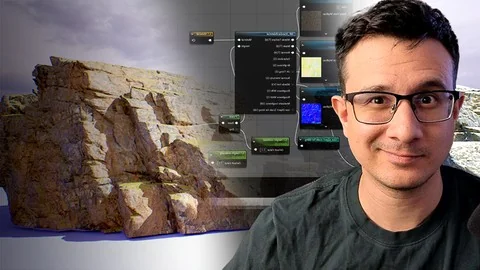
One of the clearest practical outcomes in the course is the creation of a Rock Master Material For use in projects. This is a strong anchor for beginners because it turns material learning into a concrete result. Rather than stopping at isolated node demonstrations, the course leads toward a reusable material asset with a recognizable environment art application.
Rock surfaces are a natural fit for environment-focused material study. They appear frequently in outdoor scenes, natural set dressing, and broader world building. A master material in that context gives learners something more flexible than a single finished look. It introduces the idea that a material can serve as a project-level tool, not just a one-time setup.
From a creative standpoint, a Rock Master Material is useful because it speaks directly to production habits in environment art. Reusability matters when scenes need cohesion. A master material can help establish that cohesion by giving artists a structured starting point for rock surfaces across multiple uses. In a beginner course, this kind of exercise helps bridge the gap between learning interface elements and producing work that feels closer to actual scene development.
The project angle also helps learners understand why material decisions matter. A rock material is not just a technical exercise in node connections. It is part of how a landscape, ruin, canyon, or natural setting gains visual character. By centering one of the course outcomes on a Rock Master Material, the training stays tied to a recognizable environment art need.
Updated tools in Unreal Engine 5.5
The course also includes updated tools in Unreal Engine 5.5. That detail gives the training a current practical edge for learners entering the engine now. Materials are one of the areas where familiarity with the present toolset can shape how comfortably a beginner works, especially when following modern workflows rather than older habits.
For a new developer or aspiring environment artist, this matters because early learning tends to set long-term patterns. Working with updated Unreal Engine 5.5 tools means the course is not just introducing material concepts in the abstract. It is connecting those concepts to the version of the engine identified in the course content.
This also strengthens the course’s value as a starting point for people who want to understand current material workflows without first sorting through older methods. The emphasis remains tightly focused: materials, key nodes, environment art understanding, and a practical master material outcome. The mention of updated tools supports that focus instead of pulling attention away from it.
Who Introduction to Materials in Unreal Engine 5 fits best
The intended audience is beginner game developers who aspire to become environment artists in the field. That positioning gives the course a clear identity. It is not framed for advanced technical artists, and it is not presented as a broad game development program. It is a beginner-level entry into material creation with a specific artistic direction.
That direction makes the course useful for learners who want their technical growth to support visual world building. Someone moving from basic engine familiarity toward environment-focused work can use this training to start understanding how surface creation fits into that path. The attention to important Material Editor nodes, practical environment art understanding, and the Rock Master Material project all point toward the same goal.
The course workload is 3 hours and 1 minute, which places it in a compact format. That scale suits a focused beginner course. It is long enough to move beyond a very brief introduction, while still staying concentrated on a single topic area. The curriculum is identified under the same title, Introduction to Materials in Unreal Engine 5, reinforcing that this is a tightly scoped learning experience rather than a sprawling multi-topic package.
Published on May 27, 2025 and taught by the developer, the course presents a direct path for beginners who want to make materials with an environment art mindset. The strongest takeaway is simple: it gives new Unreal Engine 5 users a practical route into the Material Editor, ending with a Rock Master Material they can use in their projects.
 Unreal Engine
 Unreal Engine
 Unreal Engine
 Unreal Engine