"e9c335e082208b17"{"id":"1002882","slug":"global-event-handler","title":"Global Event Handler","category":"Engine Tools","engine":"4.27","assetVersion":"Asset Version: 1.0","engineVersion":"Engine Version: 4.27","tag":"Engine Tools","accent":"blue","visual":"mech","summary":"Decouple Unreal Engine Blueprints with Global Event Handler. Utilize an Event Aggregator pattern and Game Instance Subsystem for clean cross-level messaging.","platform":"Unreal Engine","indexPolicy":"index","publishedAt":"2026-11-21T01:46:41.164Z","updatedAt":"2026-11-21T01:46:41.164Z","sourceNotes":[],"fileContents":[],"compatibility":["Unreal Engine","Asset Version: 1.0","Engine Version: 4.27"],"featuredImage":{"alt":"Global Event Handler","src":"/wp-content/uploads/published/2026/11/3475d0c9e296-2652f3a7-fc92-49e5-94f8-0e9b9420a608-4919b4e688.webp"},"fileSizeBytes":12102202,"hasDownloadLink":true,"downloads":0,"terms":[{"taxonomy":"category","slug":"engine-tools-tools-and-plugins","name":"Engine Tools"}],"galleryImages":[{"src":"/wp-content/uploads/published/2026/11/417ba43005ef-4e8695ce-1018-453d-8f70-45a86a093fe6-3c9f3d004f.webp","alt":"Global Event Handler"},{"src":"/wp-content/uploads/published/2026/11/a20694fd9b3b-17e361c7-8e4a-4743-b484-94dea2f95c60-a45132ca60.webp","alt":"Global Event Handler"},{"src":"/wp-content/uploads/published/2026/11/d8334533ebfd-05a4d98d-829a-41a6-8184-d3b5c377604e-0535bdec72.webp","alt":"Global Event Handler"},{"src":"/wp-content/uploads/published/2026/11/594d2b9364cf-42826d34-e044-4be5-b30a-4d39affba925-d2b53ee9f3.webp","alt":"Global Event Handler"},{"src":"/wp-content/uploads/published/2026/11/ad7baa75c8f5-67e2f9ef-2999-47ec-8d51-f596518d3e5c-725c0d7126.webp","alt":"Global Event Handler"},{"src":"/wp-content/uploads/published/2026/11/71427571bc9c-db99081e-f2d6-4f9a-a03d-10d4a35564b8-15dd878561.webp","alt":"Global Event Handler"}],"contentHtml":"\u003ch2\u003eEliminating Casting Dependencies with the Global Event Pattern\u003c/h2\u003e\u003cp\u003eIn standard Unreal Engine Blueprint scripting, establishing communication between separate actors often leads developers down the path of direct class casting. When an interactive actor, user interface element, or trigger zone needs to trigger logic on another object, casting directly to that target Blueprint provides an immediate solution. However, this convenience introduces hard references within the project architecture. The engine treats every casted class as a direct dependency of the calling asset. As development progresses, these localized references expand into complicated dependency webs where individual gameplay mechanics become inextricably tied to one another.\u003c/p\u003e\u003cp\u003eThe structural drawbacks of tight coupling become glaringly evident whenever an asset needs to be migrated to another project, cleaned up, or restructured. Attempting to export an isolated gameplay element often pulls along dozens of unrelated Blueprints, game modes, animations, and sound assets simply because a single casting node created a chain of reference. To counteract this issue, the Global Event Handler brings the Event Aggregator pattern—a proven implementation of the Observer pattern popularized in WPF development frameworks like Prism—directly into the Unreal Engine ecosystem. Rather than requiring actors to seek out, reference, and cast to specific target classes, the event aggregator acts as a centralized broker. Senders broadcast events into the global system without retaining any knowledge of who receives them, and listeners bind logic to those events without needing references to the invoking classes.\u003c/p\u003e\u003ch2\u003eGame Instance Subsystem Mechanics in the Global Event Handler\u003c/h2\u003e\u003cp\u003eMany decoupled messaging solutions in Unreal Engine rely on custom actor components, specialized interface layers, or manager actors placed manually inside a persistent level. The Global Event Handler avoids these setup requirements by constructing its architecture entirely upon a Game Instance Subsystem. Because Game Instance Subsystems initialize automatically alongside the game instance and persist throughout the entire lifecycle of the game session, the event broker is operational from the moment the project launches without requiring level-specific actor placement or initialization scripts.\u003c/p\u003e\u003cp\u003eBy building the global event infrastructure directly into a subsystem, the workflow dispenses with the need to implement Blueprint Interfaces across every actor that intends to listen for signals. Instead, the interaction paradigm matches the native Call and Bind model already familiar from Unreal Engine 4's built-in Event Dispatchers. Where standard Event Dispatchers are restricted to the local context of the specific actor or component hosting them, this implementation operates on a global scale. Broadcasters trigger events globally through subsystem nodes, and listening Blueprints bind custom events or functions directly to the broadcast channel. This maintains the ergonomic feel of standard visual scripting while removing the localized boundaries and reference requirements of conventional dispatchers.\u003c/p\u003e\u003ch2\u003eCross-Sublevel Messaging via Global Event Dispatching\u003c/h2\u003e\u003cp\u003eLevel streaming setups present persistent communication hurdles when relying on standard Blueprint referencing methods. When gameplay takes place across multiple streaming levels or sublevels that load and unload dynamically, establishing direct actor-to-actor links becomes complex. An actor residing in one sublevel cannot easily query or reference an actor located in a separate, asynchronously loaded sublevel without resorting to persistent-level orchestrators, search-by-tag iterations, or fragile world-context lookups.\u003c/p\u003e\u003cp\u003eThe Global Event Handler resolves the friction of cross-level communication by operating above individual streaming levels. Because the underlying Game Instance Subsystem sits outside the transient world boundaries of individual streaming maps, events dispatched from an actor in one sublevel broadcast seamlessly to subscribers located in entirely different sublevels. As long as both actors are active in their respective loaded sublevels and have registered their bindings, communication executes instantly. Broadcasters do not need to query whether a target actor exists in the current world partition or monitor streaming states, streamlining workflows for open environments, segmented dungeons, and modular level design architectures.\u003c/p\u003e\u003ch2\u003eStructuring Arbitrary Data Inside UObject Payloads for the Handler\u003c/h2\u003e\u003cp\u003eSimple notification signals are often insufficient for gameplay logic; events usually require supporting data to describe what transpired. The Global Event Handler accommodates complex data delivery by providing full support for UObject payloads. When an event is triggered, the calling Blueprint can instantiate or provide any standard UObject containing arbitrary variables, data structures, arrays, and properties to accompany the broadcast.\u003c/p\u003e\u003cp\u003eAdopting UObject payloads establishes a clean and adaptable data pipeline. Rather than generating specialized event channels or custom function signatures for every combination of parameters, a single unified event channel can transmit a self-contained payload object. When the event fires, the receiving Blueprints read the passed UObject, extract the relevant fields, and run their localized operations. If feature requirements evolve later in production and additional data parameters must be transmitted alongside the event, developers can update the payload object itself. The core event binding signature remains unchanged, avoiding widespread node breaks or cascading modifications across existing project Blueprints.\u003c/p\u003e\u003ch2\u003eAchieving Modular Blueprints and Solid Architecture through Decoupled Events\u003c/h2\u003e\u003cp\u003eApplying solid software architecture patterns to game development improves both team productivity and long-term asset maintenance. When Blueprints remain decoupled, individual game mechanics can be constructed, updated, and verified in total isolation. In an environment dominated by direct class casting, testing a single interactive mechanic—such as a chest that grants loot, updates quest status, and triggers audio cues—often requires loading the entire gameplay ecosystem so that every casted target class resolves successfully.\u003c/p\u003e\u003cp\u003eBy structuring communication through the Global Event Handler, the chest actor simply calls the global event, packages its UObject payload, and finishes its execution. The quest manager, inventory system, and audio controllers bind to that event independently. During development, developers can isolate and test the chest actor in a standalone test map without loading the quest system or inventory framework. Similarly, downstream systems can be verified independently by manually firing test events through the subsystem. This separation of concerns preserves modularity, keeps migration paths clean, and prevents unwanted cross-dependencies from destabilizing complex Unreal Engine projects.\u003c/p\u003e\n\n\u003ch2\u003eRelated Resources Worth Checking\u003c/h2\u003e\n\u003cul\u003e\n\u003cli\u003e\u003ca href=\"https://3dcghub.com/dlc-in-blueprints/\" rel=\"noopener noreferrer\"\u003eDLC in Blueprints\u003c/a\u003e\u003c/li\u003e\n\u003cli\u003e\u003ca href=\"https://3dcghub.com/insta-deform-component/\" rel=\"noopener noreferrer\"\u003eInsta Deform Component\u003c/a\u003e\u003c/li\u003e\n\u003cli\u003e\u003ca href=\"https://3dcghub.com/global-search-pro/\" rel=\"noopener noreferrer\"\u003eGlobal Search Pro\u003c/a\u003e\u003c/li\u003e\n\u003cli\u003e\u003ca href=\"https://3dcghub.com/unicode-handler/\" rel=\"noopener noreferrer\"\u003eUnicode Handler\u003c/a\u003e\u003c/li\u003e\n\u003cli\u003e\u003ca href=\"https://3dcghub.com/clarus-viewer-base/\" rel=\"noopener noreferrer\"\u003eClarus Viewer Base\u003c/a\u003e\u003c/li\u003e\n\u003c/ul\u003e","contentTextLength":7150,"navigation":{"current":53,"total":4839,"previous":{"id":"1002883","slug":"le-socket-connection","title":"LE Socket Connection","category":"Engine Tools","platform":"Unreal Engine","updatedAt":"2026-11-21T01:51:11.356Z"},"next":{"id":"1002881","slug":"content-pack-generator","title":"Content Pack Generator","category":"Engine Tools","platform":"Unreal Engine","updatedAt":"2026-11-21T01:43:25.890Z"}},"relatedResources":[{"id":"1000587","slug":"dlc-in-blueprints","title":"DLC in Blueprints","category":"Engine Tools","engine":"4.25 - 5.7","assetVersion":"Asset Version: 1.0 - 3.2","engineVersion":"Engine Version: 4.25 - 5.7","tag":"Engine Tools","accent":"blue","visual":"mech","summary":"A Blueprint-native node library exposing Steam and Epic Games Store commerce APIs as event-driven nodes for DLC, microtransactions, and content unlocks in Unrea","platform":"Unreal Engine","indexPolicy":"index","publishedAt":"2026-07-17T00:14:24.763Z","updatedAt":"2026-09-30T05:45:19.996Z","sourceNotes":[],"fileContents":[],"compatibility":["Unreal Engine","Asset Version: 1.0 - 3.2","Engine Version: 4.25 - 5.7"],"featuredImage":{"alt":"DLC in Blueprints","src":"/wp-content/uploads/published/2026/07/f29eff68126f-5bc8d78a-e0cb-4c93-8b50-3d38b175418f-e6ec42f6e0.webp"},"fileSizeBytes":148604052,"hasDownloadLink":true,"downloads":0},{"id":"1001267","slug":"insta-deform-component","title":"Insta Deform Component","category":"Engine Tools","engine":"4.26 - 5.6","assetVersion":"Asset Version: 1.2","engineVersion":"Engine Version: 4.26 - 5.6","tag":"Engine Tools","accent":"blue","visual":"mech","summary":"Add instant, fully replicated visual deformation to vehicles and skeletal meshes in Unreal Engine with fast hit-event setup and stress-tested performance.","platform":"Unreal Engine","indexPolicy":"index","publishedAt":"2026-09-30T05:49:51.218Z","updatedAt":"2026-09-30T05:49:51.218Z","sourceNotes":[],"fileContents":[],"compatibility":["Unreal Engine","Asset Version: 1.2","Engine Version: 4.26 - 5.6"],"featuredImage":{"alt":"Insta Deform Component","src":"/wp-content/uploads/published/2026/09/c662b5d1a286-0d9734bc-bb9e-47eb-a1d4-b828a06d5463-7ed02f8e45.webp"},"fileSizeBytes":241040169,"hasDownloadLink":true,"downloads":1},{"id":"27726","slug":"world-spawner-global-spawning-system","title":"World Spawner - Global Spawning System","category":"Engine Tools","engine":"5.0 - 5.3","assetVersion":"Asset Version: 1.9","engineVersion":"Engine Version: 5.0 - 5.3","tag":"Engine Tools","accent":"blue","visual":"character","summary":"World Spawner centers on three connected systems: fast population, optimization, and path and waypoint control. It targets projects that need large-scale spawning of NPCs, loot, and items while keeping movement, persistence, and performance management in th...","platform":"Unreal Engine","indexPolicy":"index","publishedAt":"2026-04-28T16:02:07.000Z","updatedAt":"2026-11-21T20:55:12.077Z","sourceNotes":[],"fileContents":[],"compatibility":["Unreal Engine","Asset Version: 1.9","Engine Version: 5.0 - 5.3"],"featuredImage":{"alt":"World Spawner - Global Spawning System","src":"https://3dcghub.com/wp-content/uploads/2026/04/3d28a92bdd03_7520a099-82c4-46c0-93bf-585380c35f1e.webp"},"fileSizeBytes":199771854,"hasDownloadLink":true,"downloads":0}]}
Resource screenshots
1 / 6
Join our channel
Follow 3DCGHUB on Telegram for new resource drops, migration updates, and community notices.
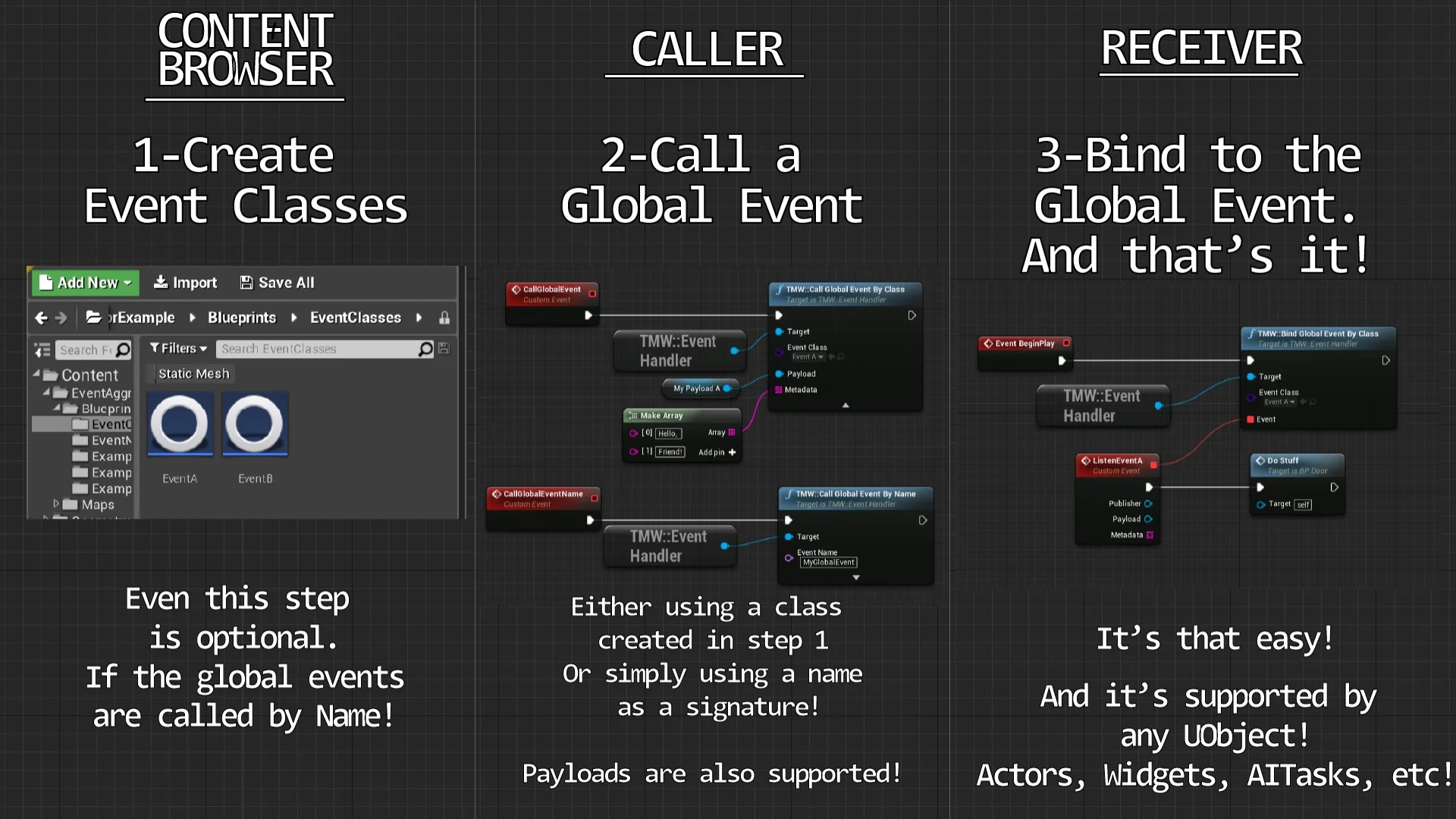
Decouple Unreal Engine Blueprints with Global Event Handler. Utilize an Event Aggregator pattern and Game Instance Subsystem for clean cross-level messaging.
Eliminating Casting Dependencies with the Global Event Pattern
In standard Unreal Engine Blueprint scripting, establishing communication between separate actors often leads developers down the path of direct class casting. When an interactive actor, user interface element, or trigger zone needs to trigger logic on another object, casting directly to that target Blueprint provides an immediate solution. However, this convenience introduces hard references within the project architecture. The engine treats every casted class as a direct dependency of the calling asset. As development progresses, these localized references expand into complicated dependency webs where individual gameplay mechanics become inextricably tied to one another.
The structural drawbacks of tight coupling become glaringly evident whenever an asset needs to be migrated to another project, cleaned up, or restructured. Attempting to export an isolated gameplay element often pulls along dozens of unrelated Blueprints, game modes, animations, and sound assets simply because a single casting node created a chain of reference. To counteract this issue, the Global Event Handler brings the Event Aggregator pattern—a proven implementation of the Observer pattern popularized in WPF development frameworks like Prism—directly into the Unreal Engine ecosystem. Rather than requiring actors to seek out, reference, and cast to specific target classes, the event aggregator acts as a centralized broker. Senders broadcast events into the global system without retaining any knowledge of who receives them, and listeners bind logic to those events without needing references to the invoking classes.
Game Instance Subsystem Mechanics in the Global Event Handler
Many decoupled messaging solutions in Unreal Engine rely on custom actor components, specialized interface layers, or manager actors placed manually inside a persistent level. The Global Event Handler avoids these setup requirements by constructing its architecture entirely upon a Game Instance Subsystem. Because Game Instance Subsystems initialize automatically alongside the game instance and persist throughout the entire lifecycle of the game session, the event broker is operational from the moment the project launches without requiring level-specific actor placement or initialization scripts.
By building the global event infrastructure directly into a subsystem, the workflow dispenses with the need to implement Blueprint Interfaces across every actor that intends to listen for signals. Instead, the interaction paradigm matches the native Call and Bind model already familiar from Unreal Engine 4's built-in Event Dispatchers. Where standard Event Dispatchers are restricted to the local context of the specific actor or component hosting them, this implementation operates on a global scale. Broadcasters trigger events globally through subsystem nodes, and listening Blueprints bind custom events or functions directly to the broadcast channel. This maintains the ergonomic feel of standard visual scripting while removing the localized boundaries and reference requirements of conventional dispatchers.
Cross-Sublevel Messaging via Global Event Dispatching
Level streaming setups present persistent communication hurdles when relying on standard Blueprint referencing methods. When gameplay takes place across multiple streaming levels or sublevels that load and unload dynamically, establishing direct actor-to-actor links becomes complex. An actor residing in one sublevel cannot easily query or reference an actor located in a separate, asynchronously loaded sublevel without resorting to persistent-level orchestrators, search-by-tag iterations, or fragile world-context lookups.
The Global Event Handler resolves the friction of cross-level communication by operating above individual streaming levels. Because the underlying Game Instance Subsystem sits outside the transient world boundaries of individual streaming maps, events dispatched from an actor in one sublevel broadcast seamlessly to subscribers located in entirely different sublevels. As long as both actors are active in their respective loaded sublevels and have registered their bindings, communication executes instantly. Broadcasters do not need to query whether a target actor exists in the current world partition or monitor streaming states, streamlining workflows for open environments, segmented dungeons, and modular level design architectures.
Structuring Arbitrary Data Inside UObject Payloads for the Handler
Simple notification signals are often insufficient for gameplay logic; events usually require supporting data to describe what transpired. The Global Event Handler accommodates complex data delivery by providing full support for UObject payloads. When an event is triggered, the calling Blueprint can instantiate or provide any standard UObject containing arbitrary variables, data structures, arrays, and properties to accompany the broadcast.
Adopting UObject payloads establishes a clean and adaptable data pipeline. Rather than generating specialized event channels or custom function signatures for every combination of parameters, a single unified event channel can transmit a self-contained payload object. When the event fires, the receiving Blueprints read the passed UObject, extract the relevant fields, and run their localized operations. If feature requirements evolve later in production and additional data parameters must be transmitted alongside the event, developers can update the payload object itself. The core event binding signature remains unchanged, avoiding widespread node breaks or cascading modifications across existing project Blueprints.
Achieving Modular Blueprints and Solid Architecture through Decoupled Events
Applying solid software architecture patterns to game development improves both team productivity and long-term asset maintenance. When Blueprints remain decoupled, individual game mechanics can be constructed, updated, and verified in total isolation. In an environment dominated by direct class casting, testing a single interactive mechanic—such as a chest that grants loot, updates quest status, and triggers audio cues—often requires loading the entire gameplay ecosystem so that every casted target class resolves successfully.
By structuring communication through the Global Event Handler, the chest actor simply calls the global event, packages its UObject payload, and finishes its execution. The quest manager, inventory system, and audio controllers bind to that event independently. During development, developers can isolate and test the chest actor in a standalone test map without loading the quest system or inventory framework. Similarly, downstream systems can be verified independently by manually firing test events through the subsystem. This separation of concerns preserves modularity, keeps migration paths clean, and prevents unwanted cross-dependencies from destabilizing complex Unreal Engine projects.
 Engine Tools
 Engine Tools
 Engine Tools