"e9c335e082208b17"{"id":"1002883","slug":"le-socket-connection","title":"LE Socket Connection","category":"Engine Tools","engine":"4.26","assetVersion":"Asset Version: 4.26.0 r0","engineVersion":"Engine Version: 4.26","tag":"Engine Tools","accent":"blue","visual":"mech","summary":"Explore the LE Socket Connection plugin for Unreal Engine, enabling direct Blueprint interaction with Java socket servers, matchmaking, and account systems.","platform":"Unreal Engine","indexPolicy":"index","publishedAt":"2026-11-21T01:51:11.356Z","updatedAt":"2026-11-21T01:51:11.356Z","sourceNotes":[],"fileContents":[],"compatibility":["Unreal Engine","Asset Version: 4.26.0 r0","Engine Version: 4.26"],"featuredImage":{"alt":"LE Socket Connection","src":"/wp-content/uploads/published/2026/11/faee85b5f044-c1971186-00d0-47db-88b2-2b5a5a685949-58f4f1a55c.webp"},"fileSizeBytes":23797844,"hasDownloadLink":true,"downloads":0,"terms":[{"taxonomy":"category","slug":"engine-tools-tools-and-plugins","name":"Engine Tools"}],"galleryImages":[{"src":"/wp-content/uploads/published/2026/11/44ba2e11004f-3a1525a0-1f45-4b95-bb95-587c7826d7dc-cad1dc92f0.webp","alt":"LE Socket Connection"},{"src":"/wp-content/uploads/published/2026/11/8093572c919b-5ab07e13-277a-4af0-a8e1-fe8f9285693e-e6bcba9abd.webp","alt":"LE Socket Connection"},{"src":"/wp-content/uploads/published/2026/11/86b2ae6874a6-49ef6baf-1eb3-4bf9-84d6-fd511d63e133-c5fed12c0c.webp","alt":"LE Socket Connection"},{"src":"/wp-content/uploads/published/2026/11/c55579d5f607-878ef333-fce7-45c0-9028-809141c26992-3ebfeaacef.webp","alt":"LE Socket Connection"},{"src":"/wp-content/uploads/published/2026/11/e334197c6d12-4a6f5068-ad66-41a4-824e-9d3fb2137772-7ebf7e4a92.webp","alt":"LE Socket Connection"},{"src":"/wp-content/uploads/published/2026/11/deb12e2af002-0275a33d-a668-4b7e-af8f-b4a43f1065aa-072d0a8eb0.webp","alt":"LE Socket Connection"},{"src":"/wp-content/uploads/published/2026/11/337adb185b0f-1f387045-cc06-49db-a6e6-cefb13f48eaf-f622aa5257.webp","alt":"LE Socket Connection"},{"src":"/wp-content/uploads/published/2026/11/f2ac3116fd37-f223c7c7-79b2-4d44-a0a6-7dee5a12f4c2-16306b1f51.webp","alt":"LE Socket Connection"},{"src":"/wp-content/uploads/published/2026/11/ed075d5ff3fb-5a8dfe74-5146-45d5-93e2-d68cc67f5e94-c7196ec380.webp","alt":"LE Socket Connection"},{"src":"/wp-content/uploads/published/2026/11/696472c3e82f-1a4942e0-bfa2-4d93-aed8-a4315955faee-a8fe5043fd.webp","alt":"LE Socket Connection"}],"contentHtml":"\u003cp\u003eEstablishing a persistent connection between a game client and an external network service often requires bespoke communication layers. In many interactive projects, low-level socket handling is locked behind native engine code, leaving visual scripting setups without a straightforward way to pass network packets. LE Socket Connection addresses this specific structural gap by giving developers direct Blueprint access to connect to and interact with remote socket servers without forcing developers into native C++ scripting.\u003c/p\u003e \u003ch2\u003eBridging Unreal Blueprints with LE Socket Connection\u003c/h2\u003e\n\u003cp\u003eWithin a standard project architecture, client-side game logic often needs to communicate asynchronously with external systems that sit outside the primary gameplay loop. Visual scripting nodes provided by this plugin establish the connection pipeline directly within the Blueprint graph. Instead of relying strictly on engine-level replication or web-based polling mechanisms, the toolset opens up socket-level communication where persistent streams can be opened, monitored, and maintained.\u003c/p\u003e \u003cp\u003eBy exposing socket actions directly to Blueprints, logic governing server interactions can live right alongside UI events, character controllers, or game state listeners. When an interaction occurs on the client, nodes handle the dispatch of outbound messages and receive responses from the listening host. This setup provides visual scripting developers with direct control over network sockets, enabling them to construct responsive, real-time client interfaces that react immediately to network events.\u003c/p\u003e \u003ch2\u003eJava Backend Integration and Dedicated Socket Server Roles\u003c/h2\u003e\n\u003cp\u003eThe core design of this networking tool is oriented toward environments running servers programmed in Java. External infrastructure often relies on enterprise languages like Java to manage databases, player sessions, and server routing. Rather than attempting to serve as a generic, unguided networking socket, the plugin is tailored to coordinate with these external Java environments to ensure clean interoperability between the game client and backend architecture.\u003c/p\u003e \u003cp\u003eTwo primary architectural implementations highlight this design focus: account servers and matchmaking servers.\u003c/p\u003e \u003cul\u003e \u003cli\u003e\u003cstrong\u003eAccount Servers:\u003c/strong\u003e An account server requires secure, consistent sessions where authentication checks, player identity verification, and persistent profile data pass back and forth between the client and database. Implementing socket communication directly in Blueprints allows login forms, credential validation, and user profile queries to process seamlessly during the title screen or front-end menu phases.\u003c/li\u003e \u003cli\u003e\u003cstrong\u003eMatchmaking Servers:\u003c/strong\u003e Matchmaking environments depend on low-latency, persistent client tracking to register queue requests, monitor lobby capacity, and deliver match assignments. Using visual nodes to maintain an active socket to a Java matchmaking service allows the game client to update matchmaking statuses continuously, notify players when a match is found, and negotiate handoffs to specific play sessions.\u003c/li\u003e\n\u003c/ul\u003e \u003cp\u003eSeparating these backend responsibilities from dedicated Unreal game servers preserves performance. Offloading player matchmaking and account verification to an independent Java environment keeps the core game instance free to manage simulation physics, actor lifecycles, and direct gameplay replication.\u003c/p\u003e \u003ch2\u003eAlgorithmic Parity Across the Java Connection Pipeline\u003c/h2\u003e\n\u003cp\u003eNetwork communication breaks down when the client and server do not share the exact same rules for handling incoming and outgoing data. In socket environments, discrepancies in how packets are assembled, framed, or deciphered can lead to corrupted payloads or dropped connections. To solve this coordination challenge, the underlying network algorithm has been matched across both sides of the pipeline.\u003c/p\u003e \u003cp\u003eThe network algorithm utilized by the Blueprint plugin has also been directly implemented within a standalone Java library. Because this Java library is free and open source, backend engineers have transparent access to the precise algorithmic logic governing client packets. This parity eliminates guesswork when building the receiving Java application. The server can decode payloads using the exact data formatting, validation routines, and streaming structures that the client-side Blueprint nodes produce.\u003c/p\u003e \u003cp\u003eHaving full access to the open-source Java implementation also enables backend developers to extend or embed the network routines within existing microservice frameworks. Whether integrating into enterprise Java platforms, containerized backend services, or lightweight standalone servers, the open codebase provides the foundational protocol logic necessary to maintain lockstep communication with the Unreal Engine client.\u003c/p\u003e \u003ch2\u003eByte Serialization via the LE Extended Standard Library\u003c/h2\u003e\n\u003cp\u003eRaw socket communication operates purely in bytes, whereas game logic in Blueprints primarily operates with high-level data types such as strings, booleans, integers, and text. Bridging this data transformation layer requires utility tools capable of converting incoming and outgoing streams accurately.\u003c/p\u003e \u003cp\u003eTo handle these conversions, the plugin works in combination with the LE Extended Standard Library, an auxiliary free plugin. This companion library provides the dedicated translation nodes needed to convert raw bytes into strings and transform strings back into byte arrays. When constructing an outbound packet, Blueprint logic routes strings or structured text into byte-conversion nodes, creating the raw payload expected by the socket layer.\u003c/p\u003e \u003cp\u003eWhen the Java server returns a message down the socket, the process works in reverse. The raw bytes delivered to the client are passed through the conversion utilities to reconstruct readable text strings. Once converted back to standard strings, visual scripts can parse commands, extract session identifiers, read matchmaking tokens, or update player UI elements without requiring low-level memory operations inside the engine.\u003c/p\u003e \u003ch2\u003eImplementation Considerations for Networked Pipelines\u003c/h2\u003e\n\u003cp\u003eAdopting this socket workflow establishes a clean division of labor within online titles. By relying on an open-source Java foundation, studios can develop client-side game clients and server-side management platforms in parallel. Programmers working in Java can optimize the backend services independently, knowing that the network algorithm remains identical to the one operating inside the game client's Blueprint nodes.\u003c/p\u003e \u003cp\u003eThis setup is particularly relevant for projects that require external authentication loops, persistent inventory verification, or scalable multi-server lobbies outside the traditional gameplay server boundaries. The combination of native Blueprint accessibility, an open Java network library, and byte-to-string transformation tools provides a complete, structured pipeline for bi-directional communication between Unreal Engine and dedicated Java server environments.\u003c/p\u003e\n\n\u003ch2\u003eExplore Similar Assets\u003c/h2\u003e\n\u003cul\u003e\n\u003cli\u003e\u003ca href=\"https://3dcghub.com/web-socket-client/\" rel=\"noopener noreferrer\"\u003eWeb Socket Client\u003c/a\u003e\u003c/li\u003e\n\u003cli\u003e\u003ca href=\"https://3dcghub.com/modular-snap-system/\" rel=\"noopener noreferrer\"\u003eModular Snap System\u003c/a\u003e\u003c/li\u003e\n\u003cli\u003e\u003ca href=\"https://3dcghub.com/udp-socket-server-and-client/\" rel=\"noopener noreferrer\"\u003eUDP Socket Server And Client\u003c/a\u003e\u003c/li\u003e\n\u003cli\u003e\u003ca href=\"https://3dcghub.com/le-http-request/\" rel=\"noopener noreferrer\"\u003eLE Http Request\u003c/a\u003e\u003c/li\u003e\n\u003cli\u003e\u003ca href=\"https://3dcghub.com/blend-file-importer/\" rel=\"noopener noreferrer\"\u003eBlend File Importer\u003c/a\u003e\u003c/li\u003e\n\u003c/ul\u003e","contentTextLength":7053,"navigation":{"current":52,"total":4839,"previous":{"id":"1002884","slug":"pak-loader-plugin","title":"Pak Loader Plugin","category":"Engine Tools","platform":"Unreal Engine","updatedAt":"2026-11-21T01:51:42.694Z"},"next":{"id":"1002882","slug":"global-event-handler","title":"Global Event Handler","category":"Engine Tools","platform":"Unreal Engine","updatedAt":"2026-11-21T01:46:41.164Z"}},"relatedResources":[{"id":"14819","slug":"web-socket-client","title":"Web Socket Client","category":"Engine Tools","engine":"4.26 - 5.8","assetVersion":"Asset Version:1.0","engineVersion":"Engine version: 4.26 - 5.8","tag":"Engine Tools","accent":"blue","visual":"mech","summary":"The Web Socket Client is a powerful tool designed for developers who need to integrate real-time web communication into their projects. It offers direct Blueprint access to manage connections and server messages efficiently.","platform":"Unreal Engine","indexPolicy":"noindex","publishedAt":"2026-03-11T19:28:46.000Z","updatedAt":"2026-09-30T03:51:54.722Z","sourceNotes":[],"fileContents":[],"compatibility":["Unreal Engine","Asset Version:1.0","Engine version: 4.26 - 5.8"],"featuredImage":{"alt":"Web Socket Client","src":"https://3dcghub.com/wp-content/uploads/2026/03/1a5d3f40-1afd-4e96-a5d6-c29f47d562bd.webp"},"fileSizeBytes":147685122,"hasDownloadLink":true,"downloads":0},{"id":"14695","slug":"udp-socket-server-and-client","title":"UDP Socket Server And Client","category":"Engine Tools","engine":"4.26 - 5.8","assetVersion":"Asset Version:1.1 - 2.0","engineVersion":"Engine version: 4.26 - 5.8","tag":"Engine Tools","accent":"blue","visual":"city","summary":"UDP Socket Server And Client is an Unreal Engine plugin for Blueprint-facing UDP data communication, combining server and client components for sending and receiving messages.","platform":"Unreal Engine","indexPolicy":"noindex","publishedAt":"2026-03-11T19:00:59.000Z","updatedAt":"2026-09-30T03:08:35.970Z","sourceNotes":[],"fileContents":[],"compatibility":["Unreal Engine","Asset Version:1.1 - 2.0","Engine version: 4.26 - 5.8"],"featuredImage":{"alt":"UDP Socket Server And Client","src":"https://3dcghub.com/wp-content/uploads/2026/03/476d920b-e32b-4bbc-b437-2a91aca5e181.webp"},"fileSizeBytes":109174423,"hasDownloadLink":true,"downloads":1},{"id":"14215","slug":"modular-snap-system","title":"Modular Snap System","category":"Engine Tools","engine":"4.26 - 5.8","assetVersion":"Asset Version: 1.5.1 - 1.5.3","engineVersion":"Engine version: 4.26 - 5.8","tag":"Engine Tools","accent":"blue","visual":"animation","summary":"Simplify your level design workflow with the Modular Snap System. This Editor Plugin uses a socket-to-socket concept to align meshes, splines, and actors instantly without manual grid adjustments.","platform":"Unreal Engine","indexPolicy":"noindex","publishedAt":"2026-03-11T16:17:51.000Z","updatedAt":"2026-10-21T17:02:25.901Z","sourceNotes":[],"fileContents":[],"compatibility":["Unreal Engine","Asset Version: 1.5.1 - 1.5.3","Engine version: 4.26 - 5.8"],"featuredImage":{"alt":"Modular Snap System","src":"https://3dcghub.com/wp-content/uploads/2026/03/70a3c32f-f27e-4e90-93ea-0cadd2355ae2.webp"},"fileSizeBytes":93382478,"hasDownloadLink":true,"downloads":1}]}
Resource screenshots
1 / 10
Join our channel
Follow 3DCGHUB on Telegram for new resource drops, migration updates, and community notices.
Explore the LE Socket Connection plugin for Unreal Engine, enabling direct Blueprint interaction with Java socket servers, matchmaking, and account systems.
Establishing a persistent connection between a game client and an external network service often requires bespoke communication layers. In many interactive projects, low-level socket handling is locked behind native engine code, leaving visual scripting setups without a straightforward way to pass network packets. LE Socket Connection addresses this specific structural gap by giving developers direct Blueprint access to connect to and interact with remote socket servers without forcing developers into native C++ scripting.
Bridging Unreal Blueprints with LE Socket Connection
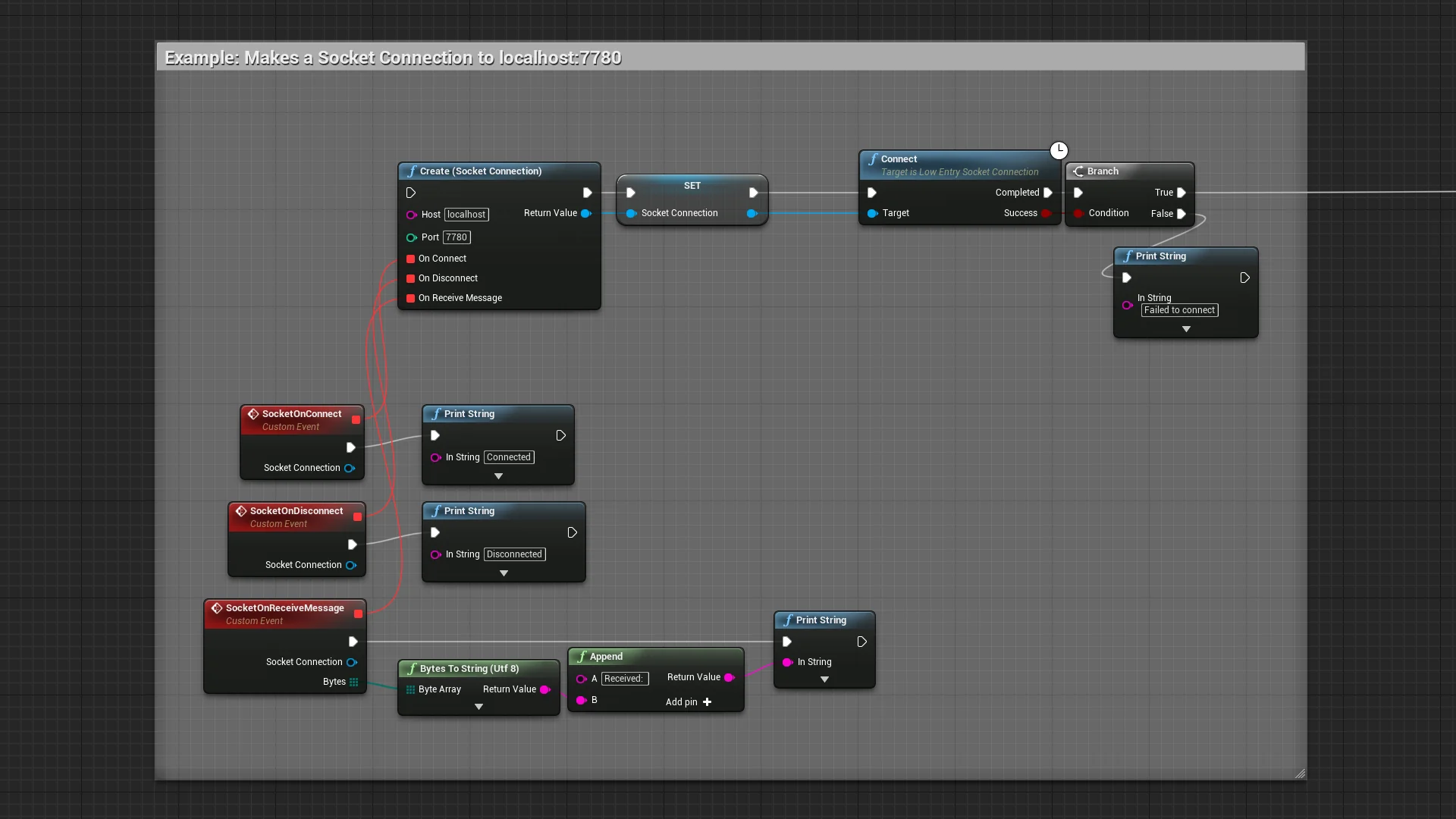
Within a standard project architecture, client-side game logic often needs to communicate asynchronously with external systems that sit outside the primary gameplay loop. Visual scripting nodes provided by this plugin establish the connection pipeline directly within the Blueprint graph. Instead of relying strictly on engine-level replication or web-based polling mechanisms, the toolset opens up socket-level communication where persistent streams can be opened, monitored, and maintained.
By exposing socket actions directly to Blueprints, logic governing server interactions can live right alongside UI events, character controllers, or game state listeners. When an interaction occurs on the client, nodes handle the dispatch of outbound messages and receive responses from the listening host. This setup provides visual scripting developers with direct control over network sockets, enabling them to construct responsive, real-time client interfaces that react immediately to network events.
Java Backend Integration and Dedicated Socket Server Roles
The core design of this networking tool is oriented toward environments running servers programmed in Java. External infrastructure often relies on enterprise languages like Java to manage databases, player sessions, and server routing. Rather than attempting to serve as a generic, unguided networking socket, the plugin is tailored to coordinate with these external Java environments to ensure clean interoperability between the game client and backend architecture.
Two primary architectural implementations highlight this design focus: account servers and matchmaking servers.
Account Servers: An account server requires secure, consistent sessions where authentication checks, player identity verification, and persistent profile data pass back and forth between the client and database. Implementing socket communication directly in Blueprints allows login forms, credential validation, and user profile queries to process seamlessly during the title screen or front-end menu phases.
Matchmaking Servers: Matchmaking environments depend on low-latency, persistent client tracking to register queue requests, monitor lobby capacity, and deliver match assignments. Using visual nodes to maintain an active socket to a Java matchmaking service allows the game client to update matchmaking statuses continuously, notify players when a match is found, and negotiate handoffs to specific play sessions.
Separating these backend responsibilities from dedicated Unreal game servers preserves performance. Offloading player matchmaking and account verification to an independent Java environment keeps the core game instance free to manage simulation physics, actor lifecycles, and direct gameplay replication.
Algorithmic Parity Across the Java Connection Pipeline
Network communication breaks down when the client and server do not share the exact same rules for handling incoming and outgoing data. In socket environments, discrepancies in how packets are assembled, framed, or deciphered can lead to corrupted payloads or dropped connections. To solve this coordination challenge, the underlying network algorithm has been matched across both sides of the pipeline.
The network algorithm utilized by the Blueprint plugin has also been directly implemented within a standalone Java library. Because this Java library is free and open source, backend engineers have transparent access to the precise algorithmic logic governing client packets. This parity eliminates guesswork when building the receiving Java application. The server can decode payloads using the exact data formatting, validation routines, and streaming structures that the client-side Blueprint nodes produce.
Having full access to the open-source Java implementation also enables backend developers to extend or embed the network routines within existing microservice frameworks. Whether integrating into enterprise Java platforms, containerized backend services, or lightweight standalone servers, the open codebase provides the foundational protocol logic necessary to maintain lockstep communication with the Unreal Engine client.
Byte Serialization via the LE Extended Standard Library
Raw socket communication operates purely in bytes, whereas game logic in Blueprints primarily operates with high-level data types such as strings, booleans, integers, and text. Bridging this data transformation layer requires utility tools capable of converting incoming and outgoing streams accurately.
To handle these conversions, the plugin works in combination with the LE Extended Standard Library, an auxiliary free plugin. This companion library provides the dedicated translation nodes needed to convert raw bytes into strings and transform strings back into byte arrays. When constructing an outbound packet, Blueprint logic routes strings or structured text into byte-conversion nodes, creating the raw payload expected by the socket layer.
When the Java server returns a message down the socket, the process works in reverse. The raw bytes delivered to the client are passed through the conversion utilities to reconstruct readable text strings. Once converted back to standard strings, visual scripts can parse commands, extract session identifiers, read matchmaking tokens, or update player UI elements without requiring low-level memory operations inside the engine.
Implementation Considerations for Networked Pipelines
Adopting this socket workflow establishes a clean division of labor within online titles. By relying on an open-source Java foundation, studios can develop client-side game clients and server-side management platforms in parallel. Programmers working in Java can optimize the backend services independently, knowing that the network algorithm remains identical to the one operating inside the game client's Blueprint nodes.
This setup is particularly relevant for projects that require external authentication loops, persistent inventory verification, or scalable multi-server lobbies outside the traditional gameplay server boundaries. The combination of native Blueprint accessibility, an open Java network library, and byte-to-string transformation tools provides a complete, structured pipeline for bi-directional communication between Unreal Engine and dedicated Java server environments.
 Engine Tools
 Engine Tools
 Engine Tools