"ae2217ad8e73450c"{"id":"1002994","slug":"automatic-sliding-doors","title":"Automatic Sliding Doors","category":"Buildings \u0026 Architecture","engine":"4.23+,5.0+","assetVersion":"","engineVersion":"Engine Version: 4.23+,5.0+","tag":"Buildings","accent":"blue","visual":"mech","summary":"Explore the setup of Automatic Sliding Doors, featuring 12 interactive blueprints, shared 4K texture atlases, custom audio, and PBR material workflows.","platform":"Unreal Engine","indexPolicy":"index","publishedAt":"2026-11-25T15:56:40.011Z","updatedAt":"2026-11-25T15:56:40.011Z","sourceNotes":[],"fileContents":[],"compatibility":["Unreal Engine","Engine Version: 4.23+,5.0+"],"featuredImage":{"alt":"Automatic Sliding Doors","src":"/wp-content/uploads/published/2026/11/bd5c806f2afc-f7b476cc-8f67-4db4-a7a2-9daa0f9051d5-42f9daf280.webp"},"hasDownloadLink":true,"downloads":0,"terms":[{"taxonomy":"category","slug":"buildings-and-architecture","name":"Buildings \u0026 Architecture"}],"galleryImages":[{"src":"/wp-content/uploads/published/2026/11/5d98ecf72974-c7577091-ad3b-4881-a3b0-03e62ab7aadb-9eb6621665.webp","alt":"Automatic Sliding Doors"},{"src":"/wp-content/uploads/published/2026/11/4844837718d8-34918fd9-95e4-44b7-a9fd-452de7215fa1-a9e96794f2.webp","alt":"Automatic Sliding Doors"},{"src":"/wp-content/uploads/published/2026/11/0893b6395c3f-240fcd26-5ead-4eed-b5cb-1a04388bedba-1390f014fe.webp","alt":"Automatic Sliding Doors"},{"src":"/wp-content/uploads/published/2026/11/9a1bc71fb5e0-9f9c2384-81ef-454d-acc7-e5e29d10f2ce-4f20040b5c.webp","alt":"Automatic Sliding Doors"},{"src":"/wp-content/uploads/published/2026/11/b9063c536fa9-209bd16d-c748-4d62-afb7-8b30c905af84-d773836620.webp","alt":"Automatic Sliding Doors"},{"src":"/wp-content/uploads/published/2026/11/ae14db227a19-0320566f-2f91-4029-9ab1-e7c9fc5a4342-1e8aa99e37.webp","alt":"Automatic Sliding Doors"},{"src":"/wp-content/uploads/published/2026/11/0f73c60d842b-12af51a0-c2af-4033-a0ee-3bd48b23adfc-d1a757acf5.webp","alt":"Automatic Sliding Doors"}],"accessPanel":{"kind":"resource","title":"Get this resource","safetyNote":"Resources are manually reviewed before listing to improve quality and reduce obvious risks.","fileName":"Content.7z","resourceType":"Resource archive","versions":[]},"contentHtml":"\u003ch2\u003eConstructing Modern Retail Thresholds with Automatic Sliding Doors\u003c/h2\u003e\u003cp\u003eModern commercial architecture relies heavily on fluid, hands-free transitions. In supermarkets, department stores, transit centers, and corporate facilities, automated entryways dictate the flow of foot traffic and set the visual tone for the interior space. The Automatic Sliding Doors collection targets these specific architectural requirements by providing twelve distinct blueprint variations configured for realistic commercial and retail layouts. Rather than treating an entrance as a static mesh cutout, the package supplies functional, responsive doorway assemblies that handle the transition between exterior facades and interior store floors smoothly.\u003c/p\u003e\u003cp\u003eAchieving believable immersion in realistic storefronts requires both mechanical responsiveness and visual consistency. Whether dressing a modern grocery store entrance, an urban commercial pharmacy, or an office lobby vestibule, having twelve separate blueprint configurations allows environmental variation across a project without breaking stylistic unity. The assets are structured to solve the common issues found in interactive architectural set pieces, delivering immediate functionality out of the box while maintaining strict rendering efficiencies.\u003c/p\u003e\u003ch2\u003eDetection Logic and Trigger Volumes in Automatic Sliding Doors\u003c/h2\u003e\u003cp\u003eThe core mechanical behavior of each door is driven by an integrated cube trigger volume positioned directly around the door frames. This detection zone monitors world actors, triggering the opening sequence the moment an entity crosses the perimeter. Unlike rudimentary door scripts that restrict activation strictly to a player pawn, these blueprints are wired to respond to both the player and dynamic physics objects. When a physics-driven prop or a character enters the bounds of the cube trigger, the mechanism activates, sliding the panels apart and keeping them fully retracted for the entire duration of the intrusion.\u003c/p\u003e\u003cp\u003eOnce the player or physics asset fully clears the trigger boundaries, the system initiates the closing cycle. This continuous volume check prevents the visual clipping and unnatural entrapment that occurs when doors cycle on fixed, unyielding timers while an actor is still standing within the frame. By accounting for physics objects alongside standard character models, the setup naturally accommodates gameplay scenarios involving movable props, physics-enabled carts, or debris carried through an entryway. The physical behavior mirrors real-world automated sensor arches, creating an intuitive spatial response that functions without requiring custom scripting passes for basic traversal.\u003c/p\u003e\u003ch2\u003eCollision Design and Synchronized Audio Assets\u003c/h2\u003e\u003cp\u003ePhysical boundaries and auditory feedback are configured directly within the individual blueprints. Every single one of the twelve doors features custom collision geometry crafted specifically to match its frame proportions and moving glass panels. Custom collision ensures that characters, camera sweeps, and physics props interact cleanly with both the stationary outer jambs and the active sliding panels, preventing pass-through glitches or invisible wall anomalies during both the static closed state and the active transit phase.\u003c/p\u003e\u003cp\u003eAuditory feedback is handled alongside physical movement. Each blueprint incorporates dedicated sound effects tailored to the motion profile of the doors, playing distinct audio cues during the opening and closing cycles. Mechanical hums, rail friction, and pneumatic or motorized stops are tied directly to the state machine governing panel displacement. Having custom audio linked to the open and close triggers avoids the flat, silent movement common in raw mechanical props, giving the entranceways the tactile presence expected in commercial retail spaces.\u003c/p\u003e\u003ch2\u003eShared 4K Atlas Architecture and Masked Decals\u003c/h2\u003e\u003cp\u003eHigh visual fidelity in architectural visualization and environment art often comes at the expense of excessive draw calls and texture memory bloat. The Automatic Sliding Doors package resolves this performance bottleneck through an intentional texture atlas strategy. Rather than allocating individual texture sets to every door variation, all twelve blueprints share a single massive 4096x4096 texture atlas dedicated to the structural metal frames, alongside a second 4096x4096 texture atlas assigned to the glass windows.\u003c/p\u003e\u003cp\u003eConsolidating the visual data into two unified 4K atlases yields several distinct rendering advantages:\u003c/p\u003e\u003cul\u003e\u003cli\u003e\u003cstrong\u003eTexture Reuse:\u003c/strong\u003e Twelve separate structural configurations read from the same frame atlas, dramatically curbing overall video memory consumption across dense commercial scenes.\u003c/li\u003e\u003cli\u003e\u003cstrong\u003eDraw Call Reduction:\u003c/strong\u003e Instanced and repeated placements of various door types share the same underlying material instances, streamlining scene rendering.\u003c/li\u003e\u003cli\u003e\u003cstrong\u003eCrisp Edge Fidelity:\u003c/strong\u003e The 4096x4096 resolution provides adequate pixel density across large surface areas, preserving sharp metallic bevels and subtle glass imperfections up close.\u003c/li\u003e\u003c/ul\u003e\u003cp\u003eSurface signage and safety warnings are implemented using alpha-masked square decals rather than being baked directly into the master glass atlas. This separation preserves the clean, high-resolution transparency of the window panes while allowing realistic warning stickers, branding placements, and operational signage to sit atop the glass surfaces. Alpha masking prevents texture blurring along the sticker borders, giving small-scale regulatory decals crisp definition even when inspected at point-blank range by a first-person camera.\u003c/p\u003e\u003ch2\u003ePhysically Based Rendering Across Commercial Storefronts\u003c/h2\u003e\u003cp\u003eSurface responses across the metal framing and transparent panels rely on complete Physically Based Rendering workflows. The materials are configured with dedicated texture maps for albedo, opacity, metalness, roughness, and normals. The frame atlas balances the matte and semi-reflective characteristics typical of powder-coated or brushed architectural metals, ensuring that changes in ambient lighting, directional sun angles, and artificial storefront neon produce accurate specular reflections and micro-surface scattering.\u003c/p\u003e\u003cp\u003eThe glass material leverages its dedicated opacity, roughness, and normal maps to maintain balance between optical clarity and physical presence. In real commercial environments, automated glass doors exhibit mild smudging, subtle surface waviness, and controlled reflectivity that prevents them from appearing as invisible voids. Because the normal and roughness channels operate in tandem with the opacity mask, the panels pick up realistic environment highlights without obscuring the interior showroom or retail display positioned directly behind the threshold.\u003c/p\u003e\u003cp\u003eIntegrating these entranceways into an existing level pipeline requires minimal setup. Because collision profiles, sound cues, trigger volumes, and PBR materials are packaged within ready-to-place blueprints, the assets function immediately upon placement in a level. Creators building shopping malls, urban grocery stores, transit stations, or corporate centers can deploy varied entrances across wide facades while maintaining consistent performance standards and cohesive material response throughout the entire scene.\u003c/p\u003e\n\n\u003ch2\u003eRelated Resources Worth Checking\u003c/h2\u003e\n\u003cul\u003e\n\u003cli\u003e\u003ca href=\"https://3dcghub.com/crazy-insane-door-pack/\" rel=\"noopener noreferrer\"\u003eCrazy Insane Door Pack\u003c/a\u003e\u003c/li\u003e\n\u003cli\u003e\u003ca href=\"https://3dcghub.com/japanese-street/\" rel=\"noopener noreferrer\"\u003eJapanese Street\u003c/a\u003e\u003c/li\u003e\n\u003cli\u003e\u003ca href=\"https://3dcghub.com/abandoned-unfinished-building/\" rel=\"noopener noreferrer\"\u003eAbandoned unfinished building\u003c/a\u003e\u003c/li\u003e\n\u003cli\u003e\u003ca href=\"https://3dcghub.com/houseplant-pack-interior-and-exterior-plants/\" rel=\"noopener noreferrer\"\u003eHouseplant Pack - Interior and Exterior Plants\u003c/a\u003e\u003c/li\u003e\n\u003cli\u003e\u003ca href=\"https://3dcghub.com/wind-turbine/\" rel=\"noopener noreferrer\"\u003eWind Turbine\u003c/a\u003e\u003c/li\u003e\n\u003c/ul\u003e","contentTextLength":7381,"navigation":{"current":50,"total":4964,"previous":{"id":"1002995","slug":"barbed-wire-spline-tool","title":"Barbed Wire Spline Tool","category":"Weapons \u0026 Combat","platform":"Unreal Engine","updatedAt":"2026-11-25T15:57:42.858Z"},"next":{"id":"1002993","slug":"automatic-coral-generator","title":"Automatic Coral Generator","category":"Procedural Systems","platform":"Unreal Engine","updatedAt":"2026-11-25T15:55:50.854Z"}},"relatedResources":[{"id":"1001339","slug":"crazy-insane-door-pack","title":"Crazy Insane Door Pack","category":"Buildings \u0026 Architecture","engine":"4.7+,5.0+","assetVersion":"","engineVersion":"Engine Version: 4.7+,5.0+","tag":"Buildings","accent":"blue","visual":"mech","summary":"Explore the Crazy Insane Door Pack, featuring 2,342 modular door assets, 8 dimensional groups, 4K wood textures, and vertex painting workflows.","platform":"Unreal Engine","indexPolicy":"index","publishedAt":"2026-10-04T10:03:59.144Z","updatedAt":"2026-10-04T10:03:59.144Z","sourceNotes":[],"fileContents":[],"compatibility":["Unreal Engine","Engine Version: 4.7+,5.0+"],"featuredImage":{"alt":"Crazy Insane Door Pack","src":"/wp-content/uploads/published/2026/10/41bc567faf07-4356fbd9-f5ce-4c8d-a7fc-6119e35afcb2-a198cc7346.webp"},"fileSizeBytes":1097883154,"hasDownloadLink":true,"downloads":2},{"id":"1000228","slug":"japanese-street","title":"Japanese Street","category":"Buildings \u0026 Architecture","engine":"4.26+,5.0+","assetVersion":"","engineVersion":"Engine Version: 4.26+,5.0+","tag":"Buildings","accent":"blue","visual":"mech","summary":"Construct dense urban layouts with the Japanese Street asset, featuring modular cozy houses, material swapping, and functional interior door systems.","platform":"Unreal Engine","indexPolicy":"index","publishedAt":"2026-06-27T18:42:28.315Z","updatedAt":"2026-06-27T18:42:28.315Z","sourceNotes":[],"fileContents":[],"compatibility":["Unreal Engine","Engine Version: 4.26+,5.0+"],"featuredImage":{"alt":"Japanese Street","src":"/wp-content/uploads/published/2026/06/3de2d3bd432a-b89297f6-a639-4d09-9015-f7c5f39252c0-ee5d879f21.webp"},"fileSizeBytes":1030767413,"hasDownloadLink":true,"downloads":9},{"id":"1002287","slug":"abandoned-unfinished-building","title":"Abandoned unfinished building","category":"Buildings \u0026 Architecture","engine":"4.20+,5.0+","assetVersion":"","engineVersion":"Engine Version: 4.20+,5.0+","tag":"Buildings","accent":"blue","visual":"mech","summary":"A 3D scan of an abandoned unfinished building in Slovakia, built from 298 DJI Mini 4 Pro photos with a 7×8K texture set for decayed concrete scenes.","platform":"Unreal Engine","indexPolicy":"index","publishedAt":"2026-11-04T05:17:48.029Z","updatedAt":"2026-11-04T05:17:48.029Z","sourceNotes":[],"fileContents":[],"compatibility":["Unreal Engine","Engine Version: 4.20+,5.0+"],"featuredImage":{"alt":"Abandoned unfinished building","src":"/wp-content/uploads/published/2026/11/7b4e1ecf8e4e-fb06454b-39b4-46d8-8990-1ee69f261862-c361f577cf.webp"},"fileSizeBytes":1196457692,"hasDownloadLink":true,"downloads":0}]}[{"id":4225,"sourceId":4225,"taxonomyId":4225,"taxonomy":"category","slug":"asset-library","name":"Asset Library","parentId":null,"count":4817,"hasChildren":true,"href":"/","seoTitle":"Free Game Assets Library | 3DCGHUB","seoDescription":"Browse free Unreal Engine, Unity, Blender assets and game development tutorials on 3DCGHUB with previews, compatibility notes, and secure downloads.","sitemapEnabled":true,"children":[{"id":4227,"sourceId":4227,"taxonomyId":4227,"taxonomy":"category","slug":"blender-add-ons-plugins","name":"Blender Add-ons \u0026 Plugins","parentId":4225,"count":10,"hasChildren":false,"href":"/category/blender-add-ons-plugins/","seoTitle":"Free Blender Add-ons \u0026 Plugins | 3DCGHUB","seoDescription":"Browse free Blender Add-ons \u0026 Plugins tools for Blender on 3DCGHUB: curated downloads with preview images, compatibility notes and secure download access.","sitemapEnabled":true},{"id":514,"sourceId":514,"taxonomyId":514,"taxonomy":"category","slug":"unity-2","name":"Unity","parentId":4225,"count":453,"hasChildren":true,"href":"/category/unity-2/","seoTitle":"Free Unity Assets | 3DCGHUB","seoDescription":"Browse free Unity resources on 3DCGHUB: curated downloads with preview images, compatibility notes and secure download access.","sitemapEnabled":true,"children":[{"id":523,"sourceId":523,"taxonomyId":523,"taxonomy":"category","slug":"2d","name":"2D","parentId":514,"count":1,"hasChildren":true,"href":"/category/2d/","seoTitle":"Free Unity 2D | 3DCGHUB","seoDescription":"Browse free 2D assets for Unity on 3DCGHUB: curated downloads with preview images, compatibility notes and secure download access.","sitemapEnabled":true},{"id":515,"sourceId":515,"taxonomyId":515,"taxonomy":"category","slug":"3d-unity-2","name":"3D","parentId":514,"count":162,"hasChildren":true,"href":"/category/3d-unity-2/","seoTitle":"Free Unity 3D Assets | 3DCGHUB","seoDescription":"Browse free 3D assets for Unity on 3DCGHUB: curated downloads with preview images, compatibility notes and secure download access.","sitemapEnabled":true},{"id":565,"sourceId":565,"taxonomyId":565,"taxonomy":"category","slug":"add-ons","name":"Add-Ons","parentId":514,"count":2,"hasChildren":false,"href":"/category/add-ons/","seoTitle":"Free Unity Add-Ons | 3DCGHUB","seoDescription":"Browse free Add-Ons assets for Unity on 3DCGHUB: curated downloads with preview images, compatibility notes and secure download access.","sitemapEnabled":true},{"id":529,"sourceId":529,"taxonomyId":529,"taxonomy":"category","slug":"audio-unity-2","name":"Audio","parentId":514,"count":1,"hasChildren":true,"href":"/category/audio-unity-2/","seoTitle":"Free Unity Audio | 3DCGHUB","seoDescription":"Browse free Audio for Unity on 3DCGHUB: curated downloads with preview images, compatibility notes and secure download access.","sitemapEnabled":true},{"id":557,"sourceId":557,"taxonomyId":557,"taxonomy":"category","slug":"templates","name":"Templates","parentId":514,"count":36,"hasChildren":true,"href":"/category/templates/","seoTitle":"Free Unity Templates | 3DCGHUB","seoDescription":"Browse free Unity project templates on 3DCGHUB. Starter kits with previews, compatibility notes, and secure download access.","sitemapEnabled":true},{"id":533,"sourceId":533,"taxonomyId":533,"taxonomy":"category","slug":"tools-unity-2","name":"Tools","parentId":514,"count":0,"hasChildren":true,"href":"/category/tools-unity-2/","sitemapEnabled":true},{"id":554,"sourceId":554,"taxonomyId":554,"taxonomy":"category","slug":"vfx-unity-2","name":"VFX","parentId":514,"count":4,"hasChildren":true,"href":"/category/vfx-unity-2/","seoTitle":"Free Unity VFX | 3DCGHUB","seoDescription":"Browse free VFX for Unity on 3DCGHUB: curated downloads with preview images, compatibility notes and secure download access.","sitemapEnabled":true}]},{"id":511,"sourceId":511,"taxonomyId":511,"taxonomy":"category","slug":"unreal-engine-2","name":"Unreal Engine","parentId":4225,"count":4355,"hasChildren":true,"href":"/category/unreal-engine-2/","seoTitle":"Free Unreal Engine Assets | 3DCGHUB","seoDescription":"Browse free Unreal Engine resources on 3DCGHUB: curated downloads with preview images, compatibility notes and secure download access.","sitemapEnabled":true,"children":[{"id":54,"sourceId":54,"taxonomyId":54,"taxonomy":"category","slug":"3d","name":"3D","parentId":511,"count":2441,"hasChildren":true,"href":"/category/3d/","seoTitle":"Free Unreal Engine 3D | 3DCGHUB","seoDescription":"Browse free 3D assets for Unreal Engine on 3DCGHUB: curated downloads with preview images, compatibility notes and secure download access.","sitemapEnabled":true},{"id":441,"sourceId":441,"taxonomyId":441,"taxonomy":"category","slug":"animations","name":"Animations","parentId":511,"count":269,"hasChildren":true,"href":"/category/animations/","seoTitle":"Free Unreal Engine Animations | 3DCGHUB","seoDescription":"Browse free Animations for Unreal Engine on 3DCGHUB: curated downloads with preview images, compatibility notes and secure download access.","sitemapEnabled":true},{"id":446,"sourceId":446,"taxonomyId":446,"taxonomy":"category","slug":"audio","name":"Audio","parentId":511,"count":63,"hasChildren":true,"href":"/category/audio/","seoTitle":"Free Unreal Engine Audio Resources | 3DCGHUB","seoDescription":"Browse free Unreal Engine audio resources including sound effects, voices, dialogue, and ambient sounds. Curated free downloads on 3DCGHUB.","sitemapEnabled":true},{"id":466,"sourceId":466,"taxonomyId":466,"taxonomy":"category","slug":"game-systems","name":"Game Systems","parentId":511,"count":381,"hasChildren":true,"href":"/category/game-systems/","seoTitle":"Free Unreal Engine Game Systems | 3DCGHUB","seoDescription":"Browse free Game Systems tools for Unreal Engine on 3DCGHUB: curated downloads with preview images, compatibility notes and secure download access.","sitemapEnabled":true},{"id":478,"sourceId":478,"taxonomyId":478,"taxonomy":"category","slug":"game-templates","name":"Game Templates","parentId":511,"count":155,"hasChildren":true,"href":"/category/game-templates/","seoTitle":"Free Unreal Engine Game Templates | 3DCGHUB","seoDescription":"Browse free Game Templates for Unreal Engine on 3DCGHUB: curated downloads with preview images, compatibility notes and secure download access.","sitemapEnabled":true},{"id":432,"sourceId":432,"taxonomyId":432,"taxonomy":"category","slug":"hdri","name":"HDRI","parentId":511,"count":6,"hasChildren":true,"href":"/category/hdri/","seoTitle":"Free Unreal Engine HDRI | 3DCGHUB","seoDescription":"Browse free Unreal Engine HDRI skies and lighting maps on 3DCGHUB. Environment lighting with previews and secure downloads.","sitemapEnabled":true},{"id":228,"sourceId":228,"taxonomyId":228,"taxonomy":"category","slug":"material-and-textures","name":"Material \u0026 Textures","parentId":511,"count":172,"hasChildren":true,"href":"/category/material-and-textures/","seoTitle":"Free Unreal Engine Material \u0026 Textures | 3DCGHUB","seoDescription":"Browse free Material \u0026 Textures for Unreal Engine on 3DCGHUB: curated downloads with preview images, compatibility notes and secure download access.","sitemapEnabled":true},{"id":298,"sourceId":298,"taxonomyId":298,"taxonomy":"category","slug":"sprites-and-flipbooks","name":"Sprites \u0026 Flipbooks","parentId":511,"count":18,"hasChildren":true,"href":"/category/sprites-and-flipbooks/","seoTitle":"Free Unreal Engine Sprites \u0026 Flipbooks | 3DCGHUB","seoDescription":"Browse free Sprites \u0026 Flipbooks assets for Unreal Engine on 3DCGHUB: curated downloads with preview images, compatibility notes and secure download access.","sitemapEnabled":true},{"id":489,"sourceId":489,"taxonomyId":489,"taxonomy":"category","slug":"tools-and-plugins","name":"Tools \u0026 Plugins","parentId":511,"count":390,"hasChildren":true,"href":"/category/tools-and-plugins/","seoTitle":"Free Unreal Engine Tools \u0026 Plugins | 3DCGHUB","seoDescription":"Browse free Tools \u0026 Plugins for Unreal Engine on 3DCGHUB: curated downloads with preview images, compatibility notes and secure download access.","sitemapEnabled":true},{"id":459,"sourceId":459,"taxonomyId":459,"taxonomy":"category","slug":"ui","name":"UI","parentId":511,"count":47,"hasChildren":true,"href":"/category/ui/","seoTitle":"Free Unreal Engine UI | 3DCGHUB","seoDescription":"Browse free UI for Unreal Engine on 3DCGHUB: curated downloads with preview images, compatibility notes and secure download access.","sitemapEnabled":true},{"id":450,"sourceId":450,"taxonomyId":450,"taxonomy":"category","slug":"vfx","name":"VFX","parentId":511,"count":413,"hasChildren":true,"href":"/category/vfx/","seoTitle":"Free Unreal Engine VFX | 3DCGHUB","seoDescription":"Browse free VFX for Unreal Engine on 3DCGHUB: curated downloads with preview images, compatibility notes and secure download access.","sitemapEnabled":true}]}]},{"id":4222,"sourceId":4222,"taxonomyId":4222,"taxonomy":"category","slug":"tutorial-library","name":"Tutorial Library","parentId":null,"count":117,"hasChildren":false,"href":"/tutorials/","seoTitle":"Free Game Development Tutorial Library | 3DCGHUB","seoDescription":"Browse free game development tutorials for Unreal Engine, Unity, Blender, and more on 3DCGHUB with practical workflows and secure downloads.","sitemapEnabled":true}]
Resource screenshots
1 / 7
Asset drops
Daily Asset Drops
Follow 3DCGHUB on Telegram for daily Unreal, Unity & Blender drops and curated CC0 releases.
Constructing Modern Retail Thresholds with Automatic Sliding Doors
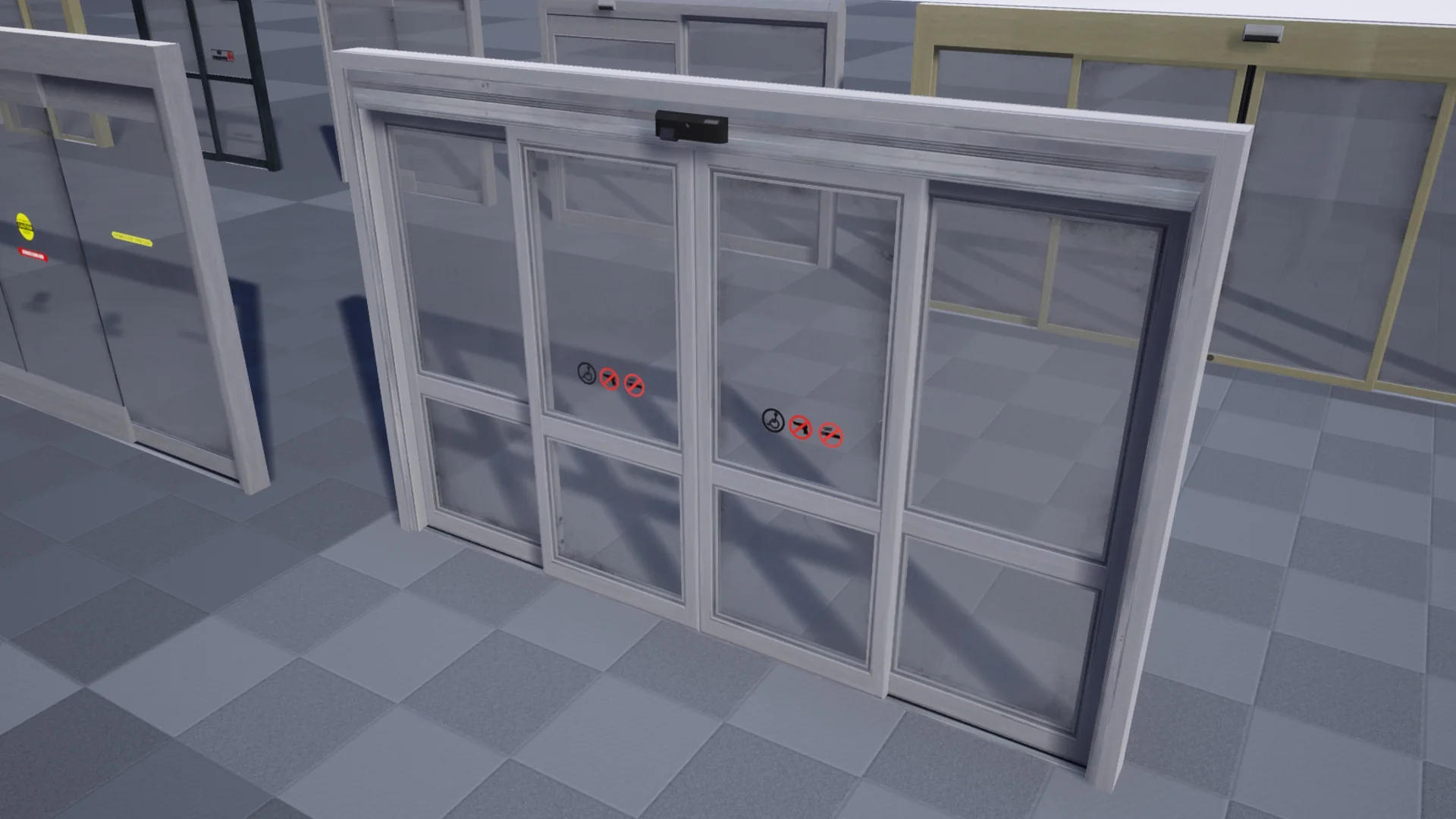
Modern commercial architecture relies heavily on fluid, hands-free transitions. In supermarkets, department stores, transit centers, and corporate facilities, automated entryways dictate the flow of foot traffic and set the visual tone for the interior space. The Automatic Sliding Doors collection targets these specific architectural requirements by providing twelve distinct blueprint variations configured for realistic commercial and retail layouts. Rather than treating an entrance as a static mesh cutout, the package supplies functional, responsive doorway assemblies that handle the transition between exterior facades and interior store floors smoothly.
Achieving believable immersion in realistic storefronts requires both mechanical responsiveness and visual consistency. Whether dressing a modern grocery store entrance, an urban commercial pharmacy, or an office lobby vestibule, having twelve separate blueprint configurations allows environmental variation across a project without breaking stylistic unity. The assets are structured to solve the common issues found in interactive architectural set pieces, delivering immediate functionality out of the box while maintaining strict rendering efficiencies.
Detection Logic and Trigger Volumes in Automatic Sliding Doors
The core mechanical behavior of each door is driven by an integrated cube trigger volume positioned directly around the door frames. This detection zone monitors world actors, triggering the opening sequence the moment an entity crosses the perimeter. Unlike rudimentary door scripts that restrict activation strictly to a player pawn, these blueprints are wired to respond to both the player and dynamic physics objects. When a physics-driven prop or a character enters the bounds of the cube trigger, the mechanism activates, sliding the panels apart and keeping them fully retracted for the entire duration of the intrusion.
Once the player or physics asset fully clears the trigger boundaries, the system initiates the closing cycle. This continuous volume check prevents the visual clipping and unnatural entrapment that occurs when doors cycle on fixed, unyielding timers while an actor is still standing within the frame. By accounting for physics objects alongside standard character models, the setup naturally accommodates gameplay scenarios involving movable props, physics-enabled carts, or debris carried through an entryway. The physical behavior mirrors real-world automated sensor arches, creating an intuitive spatial response that functions without requiring custom scripting passes for basic traversal.
Collision Design and Synchronized Audio Assets
Physical boundaries and auditory feedback are configured directly within the individual blueprints. Every single one of the twelve doors features custom collision geometry crafted specifically to match its frame proportions and moving glass panels. Custom collision ensures that characters, camera sweeps, and physics props interact cleanly with both the stationary outer jambs and the active sliding panels, preventing pass-through glitches or invisible wall anomalies during both the static closed state and the active transit phase.
Auditory feedback is handled alongside physical movement. Each blueprint incorporates dedicated sound effects tailored to the motion profile of the doors, playing distinct audio cues during the opening and closing cycles. Mechanical hums, rail friction, and pneumatic or motorized stops are tied directly to the state machine governing panel displacement. Having custom audio linked to the open and close triggers avoids the flat, silent movement common in raw mechanical props, giving the entranceways the tactile presence expected in commercial retail spaces.
Shared 4K Atlas Architecture and Masked Decals
High visual fidelity in architectural visualization and environment art often comes at the expense of excessive draw calls and texture memory bloat. The Automatic Sliding Doors package resolves this performance bottleneck through an intentional texture atlas strategy. Rather than allocating individual texture sets to every door variation, all twelve blueprints share a single massive 4096x4096 texture atlas dedicated to the structural metal frames, alongside a second 4096x4096 texture atlas assigned to the glass windows.
Consolidating the visual data into two unified 4K atlases yields several distinct rendering advantages:
Texture Reuse: Twelve separate structural configurations read from the same frame atlas, dramatically curbing overall video memory consumption across dense commercial scenes.
Draw Call Reduction: Instanced and repeated placements of various door types share the same underlying material instances, streamlining scene rendering.
Crisp Edge Fidelity: The 4096x4096 resolution provides adequate pixel density across large surface areas, preserving sharp metallic bevels and subtle glass imperfections up close.
Surface signage and safety warnings are implemented using alpha-masked square decals rather than being baked directly into the master glass atlas. This separation preserves the clean, high-resolution transparency of the window panes while allowing realistic warning stickers, branding placements, and operational signage to sit atop the glass surfaces. Alpha masking prevents texture blurring along the sticker borders, giving small-scale regulatory decals crisp definition even when inspected at point-blank range by a first-person camera.
Physically Based Rendering Across Commercial Storefronts
Surface responses across the metal framing and transparent panels rely on complete Physically Based Rendering workflows. The materials are configured with dedicated texture maps for albedo, opacity, metalness, roughness, and normals. The frame atlas balances the matte and semi-reflective characteristics typical of powder-coated or brushed architectural metals, ensuring that changes in ambient lighting, directional sun angles, and artificial storefront neon produce accurate specular reflections and micro-surface scattering.
The glass material leverages its dedicated opacity, roughness, and normal maps to maintain balance between optical clarity and physical presence. In real commercial environments, automated glass doors exhibit mild smudging, subtle surface waviness, and controlled reflectivity that prevents them from appearing as invisible voids. Because the normal and roughness channels operate in tandem with the opacity mask, the panels pick up realistic environment highlights without obscuring the interior showroom or retail display positioned directly behind the threshold.
Integrating these entranceways into an existing level pipeline requires minimal setup. Because collision profiles, sound cues, trigger volumes, and PBR materials are packaged within ready-to-place blueprints, the assets function immediately upon placement in a level. Creators building shopping malls, urban grocery stores, transit stations, or corporate centers can deploy varied entrances across wide facades while maintaining consistent performance standards and cohesive material response throughout the entire scene.
 Buildings
 Buildings
 Buildings