"efaa631e936fd3ee"{"id":"1002269","slug":"wind-turbine","title":"Wind Turbine","category":"Buildings \u0026 Architecture","engine":"4.26+,5.0+","assetVersion":"","engineVersion":"Engine Version: 4.26+,5.0+","tag":"Buildings","accent":"blue","visual":"mech","summary":"Examine the customizable Wind Turbine blueprint, featuring adjustable dimensions, offshore bases, dynamic rotor rotation, and custom material wear.","platform":"Unreal Engine","publishedAt":"2026-10-29T16:29:29.827Z","updatedAt":"2026-10-29T16:29:29.827Z","sourceNotes":[],"fileContents":[],"compatibility":["Unreal Engine","Engine Version: 4.26+,5.0+"],"featuredImage":{"alt":"Wind Turbine","src":"/wp-content/uploads/published/2026/10/eff5446b4a77-9dd44366-c1fd-4f5c-b4a1-ad4ce9be5110-de5c1b6f91.webp"},"hasDownloadLink":true,"downloads":0,"terms":[{"taxonomy":"category","slug":"buildings-and-architecture","name":"Buildings \u0026 Architecture"}],"galleryImages":[{"src":"/wp-content/uploads/published/2026/10/e0661abfe25b-4cee34a0-d0db-403e-b4a3-f597171c38c2-bf96ee6d17.webp","alt":"Wind Turbine"},{"src":"/wp-content/uploads/published/2026/10/0a5f45846f4d-92c7ecad-5712-4a60-a233-5bd12a2c0f6e-6cb3e1b89e.webp","alt":"Wind Turbine"},{"src":"/wp-content/uploads/published/2026/10/4b5bcdcbf355-563657a5-8041-4000-8dc9-c3c1da63c29c-985bbaeadb.webp","alt":"Wind Turbine"},{"src":"/wp-content/uploads/published/2026/10/485900cdca29-75141946-18ad-4ad9-b8ea-a9a05cfe77a5-18d6b56bf1.webp","alt":"Wind Turbine"},{"src":"/wp-content/uploads/published/2026/10/de9489e705bb-ffde1ce3-1ec1-4ec0-8cd1-866c88b203f2-733110b9e2.webp","alt":"Wind Turbine"},{"src":"/wp-content/uploads/published/2026/10/532d93d5ff4e-8c3aab25-b9a3-4d5c-85c1-b55b1e7c7eee-e7bc96e5c1.webp","alt":"Wind Turbine"},{"src":"/wp-content/uploads/published/2026/10/85c2fe5f3f95-893acdcb-2f41-4a8b-9b7f-104a39370d11-5896614c58.webp","alt":"Wind Turbine"},{"src":"/wp-content/uploads/published/2026/10/227dd839ed86-266ffcb5-bc71-4741-b3c5-f2c8af1eea45-2f086da2ac.webp","alt":"Wind Turbine"},{"src":"/wp-content/uploads/published/2026/10/88abfc325800-1d5a6783-8421-4093-8c89-248929a33239-d68587b7c3.webp","alt":"Wind Turbine"}],"accessPanel":{"kind":"resource","title":"Download this resource","eyebrow":"Free Download","message":"Log in or create a free account to start your download.","fileName":"Wind Turbine.7z","safetyNote":"Resources are manually reviewed before listing to improve quality and reduce obvious risks.","actionLabel":"Download Free","resourceType":"Resource archive"},"contentHtml":"\u003cp\u003eA solitary wind turbine standing against a distant ridgeline requires a completely different visual footprint than an offshore array churning above open water. Instead of locking the structure to a rigid set of static proportions, this modern Wind Turbine operates as a fully configurable blueprint designed to adapt to diverse terrain profiles, camera distances, and environmental conditions. It bridges the gap between distant background scenery and detailed foreground hero props, providing immediate control over mechanical movement, physical scale, and surface weathering.\u003c/p\u003e \u003ch2\u003eConfiguring Height and Rotor Diameter Across Varied Landscapes\u003c/h2\u003e\n\u003cp\u003eScale is the defining characteristic of modern renewable energy infrastructure, where structural proportions vary widely based on real-world engineering standards and geographic placement. The blueprint accommodates these differences by allowing manual adjustment of both vertical elevation and blade reach. Creators can set the tower height anywhere between 50 meters and 150 meters, measured directly from the center of the rotor hub down to ground level. The default setting sits at an even 100 meters, which aligns with standard modern onshore industrial installations.\u003c/p\u003e \u003cp\u003eBlade span operates independently of tower height. The rotor diameter can be tuned from 60 meters up to 130 meters, making it possible to configure compact regional windmills or massive industrial-grade installations. Adjusting these values inside the blueprint automatically maintains structural coherence across the model, allowing artists to match surrounding terrain scale, align with realistic engineering proportions, or create hyper-scaled structures for stylized industrial horizons without exporting new skeletal or static mesh iterations.\u003c/p\u003e \u003ch2\u003eRotor Rotation, Nacelle Orientation, and Synchronized Anemometer Motion\u003c/h2\u003e\n\u003cp\u003eStatic industrial props often feel sterile when placed in open-air environments. This setup relies on integrated rotational mechanics to simulate active electricity generation. The main rotor rotation speed is directly modifiable, giving developers control over how rapidly the blades cut through the air. In a project containing dozens of identical turbines, perfectly synchronized blades instantly break visual immersion. To resolve this, the blueprint includes built-in random speed variation. When multiple instances are scattered across a vista, the rotors automatically stagger their rotational velocities, creating a natural, asynchronous movement pattern across the entire wind farm.\u003c/p\u003e \u003cp\u003eWind direction rarely remains uniform across different level layouts. The nacelle houses the main mechanical components at the top of the tower and can be turned on its vertical yaw axis to accurately face whatever prevailing wind heading a scene demands. Positioned at the rear of the nacelle, the small anemometer automatically spins in direct proportion to the main rotor speed. If the main blades are configured to spin at high velocity, the anemometer matches that kinetic energy with faster rotation, maintaining physical consistency across all moving parts without requiring custom animation graphs or manual keyframing.\u003c/p\u003e \u003ch2\u003eBlueprint Switching Between Onshore Sites and Offshore Water Bases\u003c/h2\u003e\n\u003cp\u003eWind installations exist in two fundamentally distinct environments: inland plains and open marine waters. Rather than requiring two separate assets, the blueprint integrates an onshore foundation and a dedicated offshore marine base that can be toggled through a single setting. The offshore base structure was introduced to provide an engineered underwater platform suitable for lakes, shallow coastlines, and deep oceanic deployments.\u003c/p\u003e \u003cp\u003eWhen set to the onshore configuration, the turbine anchors directly into dirt, rock, or concrete terrain profiles. Switching to the offshore variant introduces the specialized heavy foundation geometry designed to emerge from water planes. This flexibility makes it straightforward to design projects that transition from coastal highway networks to open-sea energy installations, using the same unified asset architecture across both geographic contexts.\u003c/p\u003e \u003ch2\u003eSurface Wear, Dynamic Materials, and Alpha Channel Logo Customization\u003c/h2\u003e\n\u003cp\u003eRealistic environment art depends heavily on realistic surface wear. The asset uses dynamic materials and physical-based rendering (PBR) workflows to govern the condition of the exterior shell. Through material controls, the turbine can be dialed from pristine, factory-fresh paint to heavily weathered, dirty, and rust-stained surfaces, as well as intermediate stages of oxidation and grime. This allows level designers to visually convey the age of the installation, contrasting newly constructed greenfield energy sites with neglected, decaying industrial complexes.\u003c/p\u003e \u003cp\u003eBranding customization is handled natively through user texture inputs. The asset allows developers to apply their own corporate or regional logos to the exterior casing by supplying a custom texture map containing an alpha channel. The alpha channel isolates the graphic mark from its background, projecting the branding cleanly onto the housing while preserving underlying paint roughness, metallic values, and weathering layers.\u003c/p\u003e \u003ch2\u003eAcoustic Feedback, Lightmap UVs, and Performance Optimization\u003c/h2\u003e\n\u003cp\u003eVisual presence is complemented by dedicated auditory feedback. The asset includes turbine audio, supplying the low-frequency mechanical whoosh and hum generated by revolving industrial blades. Having integrated audio tied to the prop simplifies environment design, ensuring that close-up inspections by the player or camera are rewarded with appropriate acoustic feedback without manual audio cue placement across large layouts.\u003c/p\u003e \u003cp\u003eLong-term maintenance of the asset has resolved structural and rendering quirks across successive revisions. Corrected lightmap UV channels prevent lighting seams and baking artifacts when relying on precomputed static illumination. Furthermore, ongoing performance passes, including support for Nanite workflows and geometry optimizations, keep draw overhead restrained. Whether populating a single background asset visible along a roadway or instancing hundreds of units across rolling hills, the blueprint maintains predictable rendering costs across complex real-time scenes.\u003c/p\u003e\n\n\u003ch2\u003eContinue Browsing Similar Packs\u003c/h2\u003e\n\u003cul\u003e\n\u003cli\u003e\u003ca href=\"https://3dcghub.com/tropical-house-plants/\" title=\"Tropical House Plants\"\u003eTropical House Plants\u003c/a\u003e\u003c/li\u003e\n\u003cli\u003e\u003ca href=\"https://3dcghub.com/r2-realistic-house-pack/\" title=\"R2 - REALISTIC HOUSE PACK\"\u003eR2 - REALISTIC HOUSE PACK\u003c/a\u003e\u003c/li\u003e\n\u003cli\u003e\u003ca href=\"https://3dcghub.com/crazy-insane-door-pack/\" title=\"Crazy Insane Door Pack\"\u003eCrazy Insane Door Pack\u003c/a\u003e\u003c/li\u003e\n\u003cli\u003e\u003ca href=\"https://3dcghub.com/houseplant-pack-interior-and-exterior-plants/\" title=\"Houseplant Pack - Interior and Exterior Plants\"\u003eHouseplant Pack - Interior and Exterior Plants\u003c/a\u003e\u003c/li\u003e\n\u003cli\u003e\u003ca href=\"https://3dcghub.com/ventilation-system-pack/\" title=\"Ventilation System pack\"\u003eVentilation System pack\u003c/a\u003e\u003c/li\u003e\n\u003c/ul\u003e","contentTextLength":6434,"navigation":{"current":16,"total":4209,"previous":{"id":"1002270","slug":"winsome-girl","title":"Winsome Girl","category":"Humans","platform":"Unreal Engine","updatedAt":"2026-10-29T16:29:50.361Z"},"next":{"id":"1002268","slug":"wildman","title":"Wildman","category":"Characters \u0026 Creatures","platform":"Unreal Engine","updatedAt":"2026-10-29T16:29:01.463Z"}},"relatedResources":[{"id":"1402","slug":"tropical-house-plants","title":"Tropical House Plants","category":"Buildings \u0026 Architecture","engine":"4.26+,5.0+","assetVersion":"Engine version: 4.26+,5.0+","engineVersion":"4.19","tag":"Buildings","accent":"blue","visual":"animation","summary":"Upgrade your 3D scenes with 30 realistic tropical house plants. This pack includes 10 pots, customizable materials, and dynamic wind features for high realism.","platform":"Unreal Engine","publishedAt":"2026-02-06T18:13:16.000Z","updatedAt":"2026-04-19T15:58:10.000Z","sourceNotes":[],"fileContents":[],"compatibility":["Unreal Engine","Engine version: 4.26+,5.0+"],"featuredImage":{"alt":"Tropical House Plants","src":"https://3dcghub.com/wp-content/uploads/2026/02/0ea321b2-736e-4434-aff3-03d0c20ef87b.png"},"hasDownloadLink":true,"downloads":1},{"id":"1341","slug":"r2-realistic-house-pack","title":"R2 - REALISTIC HOUSE PACK","category":"Buildings \u0026 Architecture","engine":"4.26+,5.0+","assetVersion":"Engine version: 4.26+,5.0+","engineVersion":"4.24","tag":"Buildings","accent":"blue","visual":"mech","summary":"Master architectural visualization with the R2 Realistic House Pack for Unreal Engine. Explore optimized models, PBR materials, and advanced wind systems.","platform":"Unreal Engine","publishedAt":"2026-02-06T17:56:43.000Z","updatedAt":"2026-04-19T15:58:11.000Z","sourceNotes":[],"fileContents":[],"compatibility":["Unreal Engine","Engine version: 4.26+,5.0+"],"featuredImage":{"alt":"R2 - REALISTIC HOUSE PACK","src":"https://3dcghub.com/wp-content/uploads/2026/02/5d5de34b-ae59-4295-a0b6-fcaf703bb23c.png"},"hasDownloadLink":true,"downloads":0},{"id":"1001339","slug":"crazy-insane-door-pack","title":"Crazy Insane Door Pack","category":"Buildings \u0026 Architecture","engine":"4.7+,5.0+","assetVersion":"","engineVersion":"Engine Version: 4.7+,5.0+","tag":"Buildings","accent":"blue","visual":"mech","summary":"Explore the Crazy Insane Door Pack, featuring 2,342 modular door assets, 8 dimensional groups, 4K wood textures, and vertex painting workflows.","platform":"Unreal Engine","publishedAt":"2026-10-04T10:03:59.144Z","updatedAt":"2026-10-04T10:03:59.144Z","sourceNotes":[],"fileContents":[],"compatibility":["Unreal Engine","Engine Version: 4.7+,5.0+"],"featuredImage":{"alt":"Crazy Insane Door Pack","src":"/wp-content/uploads/published/2026/10/41bc567faf07-4356fbd9-f5ce-4c8d-a7fc-6119e35afcb2-a198cc7346.webp"},"hasDownloadLink":true,"downloads":2}]}
Buildings
Wind Turbine
Examine the customizable Wind Turbine blueprint, featuring adjustable dimensions, offshore bases, dynamic rotor rotation, and custom material wear.
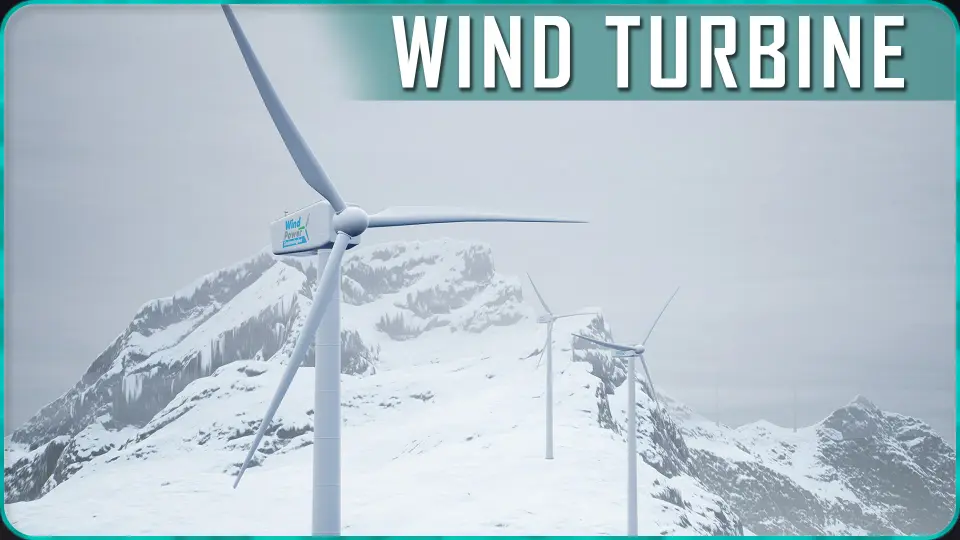
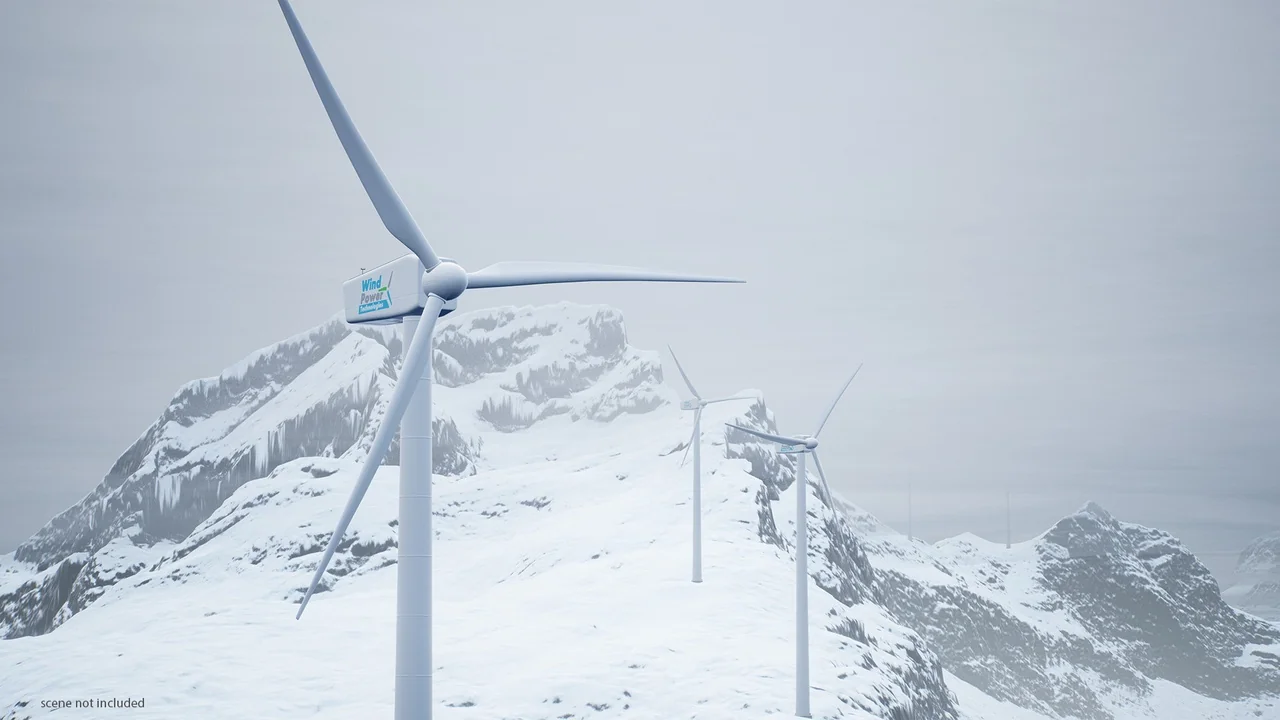
A solitary wind turbine standing against a distant ridgeline requires a completely different visual footprint than an offshore array churning above open water. Instead of locking the structure to a rigid set of static proportions, this modern Wind Turbine operates as a fully configurable blueprint designed to adapt to diverse terrain profiles, camera distances, and environmental conditions. It bridges the gap between distant background scenery and detailed foreground hero props, providing immediate control over mechanical movement, physical scale, and surface weathering.
Configuring Height and Rotor Diameter Across Varied Landscapes
Scale is the defining characteristic of modern renewable energy infrastructure, where structural proportions vary widely based on real-world engineering standards and geographic placement. The blueprint accommodates these differences by allowing manual adjustment of both vertical elevation and blade reach. Creators can set the tower height anywhere between 50 meters and 150 meters, measured directly from the center of the rotor hub down to ground level. The default setting sits at an even 100 meters, which aligns with standard modern onshore industrial installations.
Blade span operates independently of tower height. The rotor diameter can be tuned from 60 meters up to 130 meters, making it possible to configure compact regional windmills or massive industrial-grade installations. Adjusting these values inside the blueprint automatically maintains structural coherence across the model, allowing artists to match surrounding terrain scale, align with realistic engineering proportions, or create hyper-scaled structures for stylized industrial horizons without exporting new skeletal or static mesh iterations.
Rotor Rotation, Nacelle Orientation, and Synchronized Anemometer Motion
Static industrial props often feel sterile when placed in open-air environments. This setup relies on integrated rotational mechanics to simulate active electricity generation. The main rotor rotation speed is directly modifiable, giving developers control over how rapidly the blades cut through the air. In a project containing dozens of identical turbines, perfectly synchronized blades instantly break visual immersion. To resolve this, the blueprint includes built-in random speed variation. When multiple instances are scattered across a vista, the rotors automatically stagger their rotational velocities, creating a natural, asynchronous movement pattern across the entire wind farm.
Wind direction rarely remains uniform across different level layouts. The nacelle houses the main mechanical components at the top of the tower and can be turned on its vertical yaw axis to accurately face whatever prevailing wind heading a scene demands. Positioned at the rear of the nacelle, the small anemometer automatically spins in direct proportion to the main rotor speed. If the main blades are configured to spin at high velocity, the anemometer matches that kinetic energy with faster rotation, maintaining physical consistency across all moving parts without requiring custom animation graphs or manual keyframing.
Blueprint Switching Between Onshore Sites and Offshore Water Bases
Wind installations exist in two fundamentally distinct environments: inland plains and open marine waters. Rather than requiring two separate assets, the blueprint integrates an onshore foundation and a dedicated offshore marine base that can be toggled through a single setting. The offshore base structure was introduced to provide an engineered underwater platform suitable for lakes, shallow coastlines, and deep oceanic deployments.
When set to the onshore configuration, the turbine anchors directly into dirt, rock, or concrete terrain profiles. Switching to the offshore variant introduces the specialized heavy foundation geometry designed to emerge from water planes. This flexibility makes it straightforward to design projects that transition from coastal highway networks to open-sea energy installations, using the same unified asset architecture across both geographic contexts.
Surface Wear, Dynamic Materials, and Alpha Channel Logo Customization
Realistic environment art depends heavily on realistic surface wear. The asset uses dynamic materials and physical-based rendering (PBR) workflows to govern the condition of the exterior shell. Through material controls, the turbine can be dialed from pristine, factory-fresh paint to heavily weathered, dirty, and rust-stained surfaces, as well as intermediate stages of oxidation and grime. This allows level designers to visually convey the age of the installation, contrasting newly constructed greenfield energy sites with neglected, decaying industrial complexes.
Branding customization is handled natively through user texture inputs. The asset allows developers to apply their own corporate or regional logos to the exterior casing by supplying a custom texture map containing an alpha channel. The alpha channel isolates the graphic mark from its background, projecting the branding cleanly onto the housing while preserving underlying paint roughness, metallic values, and weathering layers.
Acoustic Feedback, Lightmap UVs, and Performance Optimization
Visual presence is complemented by dedicated auditory feedback. The asset includes turbine audio, supplying the low-frequency mechanical whoosh and hum generated by revolving industrial blades. Having integrated audio tied to the prop simplifies environment design, ensuring that close-up inspections by the player or camera are rewarded with appropriate acoustic feedback without manual audio cue placement across large layouts.
Long-term maintenance of the asset has resolved structural and rendering quirks across successive revisions. Corrected lightmap UV channels prevent lighting seams and baking artifacts when relying on precomputed static illumination. Furthermore, ongoing performance passes, including support for Nanite workflows and geometry optimizations, keep draw overhead restrained. Whether populating a single background asset visible along a roadway or instancing hundreds of units across rolling hills, the blueprint maintains predictable rendering costs across complex real-time scenes.
 Buildings
 Buildings
 Buildings
 Buildings