"efaa631e936fd3ee"{"id":"1002255","slug":"ventilation-system-pack","title":"Ventilation System pack","category":"Buildings \u0026 Architecture","engine":"4.24+,5.0+","assetVersion":"","engineVersion":"Engine Version: 4.24+,5.0+","tag":"Buildings","accent":"blue","visual":"mech","summary":"Deploy realistic industrial ductwork with the Ventilation System pack, featuring 32 unique rigged meshes, custom LODs, colliders, 4K textures, and audio.","platform":"Unreal Engine","publishedAt":"2026-10-29T16:14:58.883Z","updatedAt":"2026-10-29T16:14:58.883Z","sourceNotes":[],"fileContents":[],"compatibility":["Unreal Engine","Engine Version: 4.24+,5.0+"],"featuredImage":{"alt":"Ventilation System pack","src":"/wp-content/uploads/published/2026/10/56007ed1655d-fb1debfc-e7c2-4c3b-95e8-e29388f65101-85cda2718f.webp"},"hasDownloadLink":true,"downloads":0,"terms":[{"taxonomy":"category","slug":"buildings-and-architecture","name":"Buildings \u0026 Architecture"}],"galleryImages":[{"src":"/wp-content/uploads/published/2026/10/a8f1f4fef3c4-fd28a7e6-7b4a-4e24-bbed-489d794e99df-66d3b03c78.webp","alt":"Ventilation System pack"},{"src":"/wp-content/uploads/published/2026/10/253889e78992-0b655362-e370-423b-8550-ef3b91231eee-65eb17e85e.webp","alt":"Ventilation System pack"},{"src":"/wp-content/uploads/published/2026/10/e47ffb0ba85c-8816e2f7-8728-45d5-ae19-4b39960858d6-6c6955c0b8.webp","alt":"Ventilation System pack"},{"src":"/wp-content/uploads/published/2026/10/e6d6808534ec-9849d989-2a08-4955-afc0-8a10ba284b61-799dd6e8d3.webp","alt":"Ventilation System pack"},{"src":"/wp-content/uploads/published/2026/10/4f14165948ed-ef373f66-e5d8-4617-aa12-ef62e60e0d35-b37839c53c.webp","alt":"Ventilation System pack"}],"accessPanel":{"kind":"resource","title":"Download this resource","eyebrow":"Free Download","message":"Log in or create a free account to start your download.","fileName":"Content.7z","safetyNote":"Resources are manually reviewed before listing to improve quality and reduce obvious risks.","actionLabel":"Download Free","resourceType":"Resource archive"},"contentHtml":"\u003ch2\u003eIntegrating 32 Unique Meshes into Custom Industrial Layouts\u003c/h2\u003e\n\u003cp\u003eAssembling an industrial environment begins with establishing duct pathways, air intake channels, and exhaust machinery throughout architectural volumes. The Ventilation System pack delivers 32 unique meshes designed to serve as modular components for these air-handling setups. Full, pre-assembled demo scenes are deliberately excluded, leaving the placement, routing, and structural composition entirely open to the needs of the surrounding level architecture. Designers can snap together linear duct runs, position wall exhaust ports, and establish floor-standing cooler units directly within custom map boundaries.\u003c/p\u003e\n\u003cp\u003eBecause the collection targets realistic industrial facilities, each asset carries distinct mechanical features appropriate for factories, research complexes, utility tunnels, and survival horror environments. The components function as modular units, permitting flexible branching paths that weave across ceilings or penetrate interior walls. Implementing these pieces involves selecting the appropriate intake or exhaust piece, snapping connector segments along service corridors, and anchoring primary cooler enclosures where heavy equipment naturally belongs.\u003c/p\u003e \u003ch2\u003eRig and Animation Controls for Ventilation and Fan Systems\u003c/h2\u003e\n\u003cp\u003eStatic ductwork provides spatial framing, but active airflow equipment requires believable mechanical motion. The Ventilation System pack addresses this by incorporating skeletal rigs and embedded animations directly into the relevant machinery. Instead of relying on external vertex deformation or makeshift rotation scripts, mechanical components such as rotating fan blades and motorized cooler assemblies are rigged for immediate playback.\u003c/p\u003e\n\u003cp\u003eThis rigging structure allows dynamic mechanical movement to be triggered through standard animation workflows. In industrial backdrops or tense horror corridors, spinning fan impellers cast moving shadows and introduce continuous mechanical movement into otherwise dormant utility spaces. The presence of internal animation data ensures that fans rotate on accurate mechanical pivots without wobbling or mesh clipping, maintaining realistic operation across cooling units and ventilation shafts.\u003c/p\u003e \u003ch2\u003eManually Made LODs and Collision Implementation\u003c/h2\u003e\n\u003cp\u003eOptimizing dense geometric assets in scenes packed with pipes, vents, and machinery requires tight control over polygon counts at varying distances. The 32 meshes in this collection include manually made LODs rather than automated decimations. Hand-crafted level-of-detail steps prevent the collapsing of critical silhouette lines, ensuring that cylindrical duct segments, grates, and outer motor housings preserve their intended mechanical contours even when viewed from down a long utility corridor.\u003c/p\u003e\n\u003cp\u003eCollision meshes are similarly authored by hand rather than generated through generic bounding boxes. Custom colliders conform closely to the functional surfaces of each prop, preventing invisible barriers around duct openings, fan housings, and exterior frames. This precision ensures that characters, projectiles, and physics-driven objects interact accurately with open grates, recessed fan enclosures, and hanging ductwork without snagging on oversized collision primitives.\u003c/p\u003e \u003ch2\u003e4096x4096 Texture Management and Material Handling\u003c/h2\u003e\n\u003cp\u003eClose inspection of industrial props demands clean surface definitions, surface wear, and realistic material separation. The asset set ships with 4096x4096 texture maps paired with dedicated materials. At this 4K resolution, metal panel seams, bolt heads, cooling grates, and surface degradation retain distinct clarity during close-up player interaction or cutscene framing.\u003c/p\u003e\n\u003cp\u003ePipelines with strict memory budgets retain full flexibility to downscale or reformat these assets to match platform requirements. If an optimization pass demands a lighter memory footprint, the 4096x4096 textures can be reduced to lower resolutions such as 2048x2048 or 1024x1024 without breaking material connections. The textures can also be converted to JPEG formats when disk storage or streaming bandwidth takes priority over uncompressed source fidelity. This adaptability allows the pack to serve both high-fidelity hero placements and lower-overhead background sets.\u003c/p\u003e \u003ch2\u003eAudio Integration and Server Pack Deployment\u003c/h2\u003e\n\u003cp\u003eMechanical machinery relies heavily on sound to ground its presence within a scene. Alongside visual assets and materials, the package includes dedicated sounds intended to support the animated machinery. Pairing these audio clips with the animated fan units and cooler meshes introduces low-frequency hums, air circulation tones, and active motor resonance, instantly turning silent industrial geometry into a functional ventilation plant.\u003c/p\u003e\n\u003cp\u003eBuilt with server pack compatibility, the collection is structured for reliable multi-user and network-driven runtime environments. The assets contain clean dependencies that allow them to load, replicate, and render consistently without relying on missing project-level references or nested map packages. Whether used to populate an abandoned manufacturing plant, an underground lab, or a hazardous industrial chamber, the Ventilation System pack provides the fundamental physical, visual, and acoustic pieces necessary to build complete environmental air systems from the ground up.\u003c/p\u003e\n\n\u003ch2\u003eRelated Resources Worth Checking\u003c/h2\u003e\n\u003cul\u003e\n\u003cli\u003e\u003ca href=\"https://3dcghub.com/crazy-insane-door-pack/\" title=\"Crazy Insane Door Pack\"\u003eCrazy Insane Door Pack\u003c/a\u003e\u003c/li\u003e\n\u003cli\u003e\u003ca href=\"https://3dcghub.com/houseplant-pack-interior-and-exterior-plants/\" title=\"Houseplant Pack - Interior and Exterior Plants\"\u003eHouseplant Pack - Interior and Exterior Plants\u003c/a\u003e\u003c/li\u003e\n\u003cli\u003e\u003ca href=\"https://3dcghub.com/sci-fi-shrine-props-vol-1/\" title=\"Sci-Fi Shrine Props VOL 1\"\u003eSci-Fi Shrine Props VOL 1\u003c/a\u003e\u003c/li\u003e\n\u003cli\u003e\u003ca href=\"https://3dcghub.com/metro-station-modular-pack/\" title=\"Metro Station Modular Pack\"\u003eMetro Station Modular Pack\u003c/a\u003e\u003c/li\u003e\n\u003cli\u003e\u003ca href=\"https://3dcghub.com/construction-site-modular-kit/\" title=\"Construction site modular kit\"\u003eConstruction site modular kit\u003c/a\u003e\u003c/li\u003e\n\u003c/ul\u003e","contentTextLength":5531,"navigation":{"current":30,"total":4209,"previous":{"id":"1002256","slug":"vertical-third","title":"Vertical Third","category":"Action-Adventure","platform":"Unreal Engine","updatedAt":"2026-10-29T16:17:06.791Z"},"next":{"id":"1002254","slug":"velociraptor-mech","title":"Velociraptor Mech","category":"Creatures \u0026 Monsters","platform":"Unreal Engine","updatedAt":"2026-10-29T16:13:27.610Z"}},"relatedResources":[{"id":"1001339","slug":"crazy-insane-door-pack","title":"Crazy Insane Door Pack","category":"Buildings \u0026 Architecture","engine":"4.7+,5.0+","assetVersion":"","engineVersion":"Engine Version: 4.7+,5.0+","tag":"Buildings","accent":"blue","visual":"mech","summary":"Explore the Crazy Insane Door Pack, featuring 2,342 modular door assets, 8 dimensional groups, 4K wood textures, and vertex painting workflows.","platform":"Unreal Engine","publishedAt":"2026-10-04T10:03:59.144Z","updatedAt":"2026-10-04T10:03:59.144Z","sourceNotes":[],"fileContents":[],"compatibility":["Unreal Engine","Engine Version: 4.7+,5.0+"],"featuredImage":{"alt":"Crazy Insane Door Pack","src":"/wp-content/uploads/published/2026/10/41bc567faf07-4356fbd9-f5ce-4c8d-a7fc-6119e35afcb2-a198cc7346.webp"},"hasDownloadLink":true,"downloads":2},{"id":"1001638","slug":"houseplant-pack-interior-and-exterior-plants","title":"Houseplant Pack - Interior and Exterior Plants","category":"Buildings \u0026 Architecture","engine":"4.19+,5.0+","assetVersion":"","engineVersion":"Engine Version: 4.19+,5.0+","tag":"Buildings","accent":"blue","visual":"mech","summary":"Add realistic foliage to UE4 scenes with the Houseplant Pack, featuring 11 plant species, customizable planters, stands, and flexible material parameters.","platform":"Unreal Engine","publishedAt":"2026-10-13T02:19:57.667Z","updatedAt":"2026-10-13T02:19:57.667Z","sourceNotes":[],"fileContents":[],"compatibility":["Unreal Engine","Engine Version: 4.19+,5.0+"],"featuredImage":{"alt":"Houseplant Pack - Interior and Exterior Plants","src":"/wp-content/uploads/published/2026/10/afeec071ba8c-977c02e4-2144-4d75-bd32-8f0e94c306f9-03c30a7766.webp"},"hasDownloadLink":true,"downloads":1},{"id":"1002269","slug":"wind-turbine","title":"Wind Turbine","category":"Buildings \u0026 Architecture","engine":"4.26+,5.0+","assetVersion":"","engineVersion":"Engine Version: 4.26+,5.0+","tag":"Buildings","accent":"blue","visual":"mech","summary":"Examine the customizable Wind Turbine blueprint, featuring adjustable dimensions, offshore bases, dynamic rotor rotation, and custom material wear.","platform":"Unreal Engine","publishedAt":"2026-10-29T16:29:29.827Z","updatedAt":"2026-10-29T16:29:29.827Z","sourceNotes":[],"fileContents":[],"compatibility":["Unreal Engine","Engine Version: 4.26+,5.0+"],"featuredImage":{"alt":"Wind Turbine","src":"/wp-content/uploads/published/2026/10/eff5446b4a77-9dd44366-c1fd-4f5c-b4a1-ad4ce9be5110-de5c1b6f91.webp"},"hasDownloadLink":true,"downloads":0}]}
Buildings
Ventilation System pack
Deploy realistic industrial ductwork with the Ventilation System pack, featuring 32 unique rigged meshes, custom LODs, colliders, 4K textures, and audio.
Integrating 32 Unique Meshes into Custom Industrial Layouts
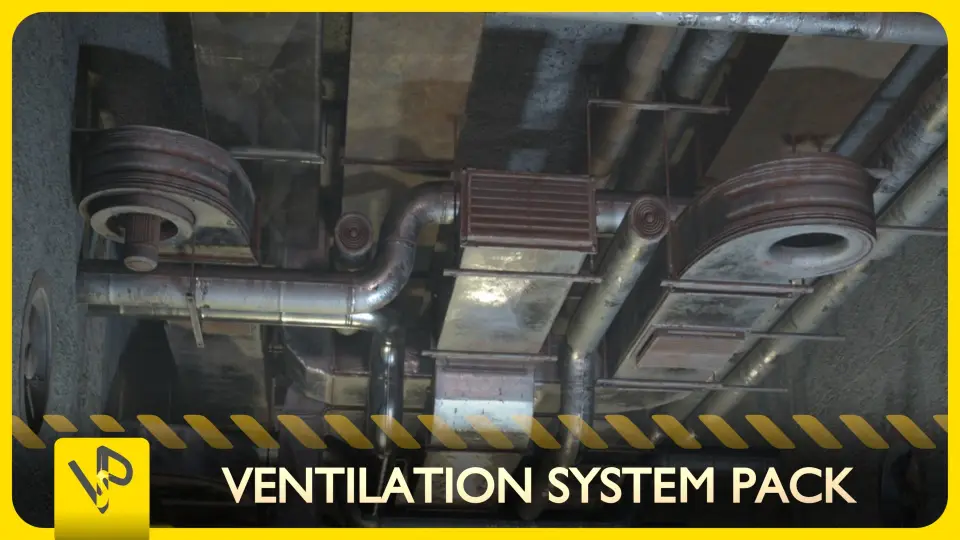
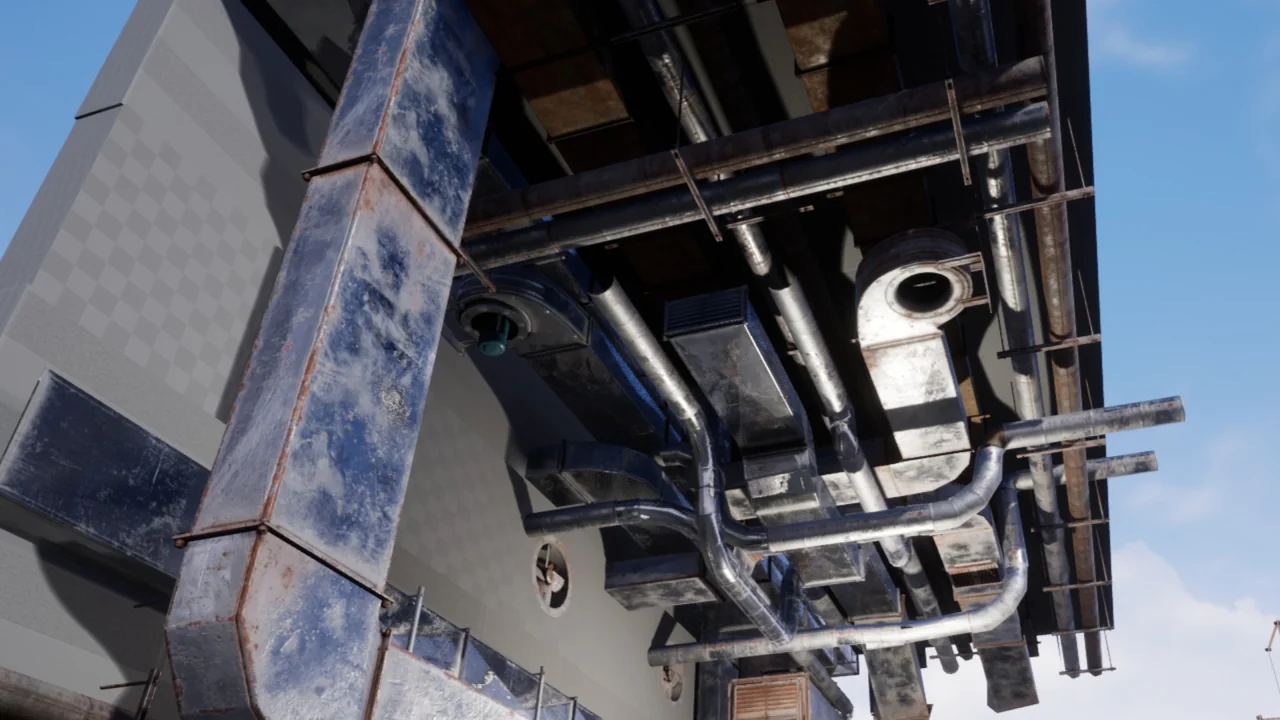
Assembling an industrial environment begins with establishing duct pathways, air intake channels, and exhaust machinery throughout architectural volumes. The Ventilation System pack delivers 32 unique meshes designed to serve as modular components for these air-handling setups. Full, pre-assembled demo scenes are deliberately excluded, leaving the placement, routing, and structural composition entirely open to the needs of the surrounding level architecture. Designers can snap together linear duct runs, position wall exhaust ports, and establish floor-standing cooler units directly within custom map boundaries.
Because the collection targets realistic industrial facilities, each asset carries distinct mechanical features appropriate for factories, research complexes, utility tunnels, and survival horror environments. The components function as modular units, permitting flexible branching paths that weave across ceilings or penetrate interior walls. Implementing these pieces involves selecting the appropriate intake or exhaust piece, snapping connector segments along service corridors, and anchoring primary cooler enclosures where heavy equipment naturally belongs.
Rig and Animation Controls for Ventilation and Fan Systems
Static ductwork provides spatial framing, but active airflow equipment requires believable mechanical motion. The Ventilation System pack addresses this by incorporating skeletal rigs and embedded animations directly into the relevant machinery. Instead of relying on external vertex deformation or makeshift rotation scripts, mechanical components such as rotating fan blades and motorized cooler assemblies are rigged for immediate playback.
This rigging structure allows dynamic mechanical movement to be triggered through standard animation workflows. In industrial backdrops or tense horror corridors, spinning fan impellers cast moving shadows and introduce continuous mechanical movement into otherwise dormant utility spaces. The presence of internal animation data ensures that fans rotate on accurate mechanical pivots without wobbling or mesh clipping, maintaining realistic operation across cooling units and ventilation shafts.
Manually Made LODs and Collision Implementation
Optimizing dense geometric assets in scenes packed with pipes, vents, and machinery requires tight control over polygon counts at varying distances. The 32 meshes in this collection include manually made LODs rather than automated decimations. Hand-crafted level-of-detail steps prevent the collapsing of critical silhouette lines, ensuring that cylindrical duct segments, grates, and outer motor housings preserve their intended mechanical contours even when viewed from down a long utility corridor.
Collision meshes are similarly authored by hand rather than generated through generic bounding boxes. Custom colliders conform closely to the functional surfaces of each prop, preventing invisible barriers around duct openings, fan housings, and exterior frames. This precision ensures that characters, projectiles, and physics-driven objects interact accurately with open grates, recessed fan enclosures, and hanging ductwork without snagging on oversized collision primitives.
4096x4096 Texture Management and Material Handling
Close inspection of industrial props demands clean surface definitions, surface wear, and realistic material separation. The asset set ships with 4096x4096 texture maps paired with dedicated materials. At this 4K resolution, metal panel seams, bolt heads, cooling grates, and surface degradation retain distinct clarity during close-up player interaction or cutscene framing.
Pipelines with strict memory budgets retain full flexibility to downscale or reformat these assets to match platform requirements. If an optimization pass demands a lighter memory footprint, the 4096x4096 textures can be reduced to lower resolutions such as 2048x2048 or 1024x1024 without breaking material connections. The textures can also be converted to JPEG formats when disk storage or streaming bandwidth takes priority over uncompressed source fidelity. This adaptability allows the pack to serve both high-fidelity hero placements and lower-overhead background sets.
Audio Integration and Server Pack Deployment
Mechanical machinery relies heavily on sound to ground its presence within a scene. Alongside visual assets and materials, the package includes dedicated sounds intended to support the animated machinery. Pairing these audio clips with the animated fan units and cooler meshes introduces low-frequency hums, air circulation tones, and active motor resonance, instantly turning silent industrial geometry into a functional ventilation plant.
Built with server pack compatibility, the collection is structured for reliable multi-user and network-driven runtime environments. The assets contain clean dependencies that allow them to load, replicate, and render consistently without relying on missing project-level references or nested map packages. Whether used to populate an abandoned manufacturing plant, an underground lab, or a hazardous industrial chamber, the Ventilation System pack provides the fundamental physical, visual, and acoustic pieces necessary to build complete environmental air systems from the ground up.
 Buildings
 Buildings
 Buildings
 Buildings