"6f9bd6df1f44a86f"{"id":"1002287","slug":"abandoned-unfinished-building","title":"Abandoned unfinished building","category":"Buildings \u0026 Architecture","engine":"4.20+,5.0+","assetVersion":"","engineVersion":"Engine Version: 4.20+,5.0+","tag":"Buildings","accent":"blue","visual":"mech","summary":"A 3D scan of an abandoned unfinished building in Slovakia, built from 298 DJI Mini 4 Pro photos with a 7×8K texture set for decayed concrete scenes.","platform":"Unreal Engine","indexPolicy":"index","publishedAt":"2026-11-04T05:17:48.029Z","updatedAt":"2026-11-04T05:17:48.029Z","sourceNotes":[],"fileContents":[],"compatibility":["Unreal Engine","Engine Version: 4.20+,5.0+"],"featuredImage":{"alt":"Abandoned unfinished building","src":"/wp-content/uploads/published/2026/11/7b4e1ecf8e4e-fb06454b-39b4-46d8-8990-1ee69f261862-c361f577cf.webp"},"hasDownloadLink":true,"downloads":0,"terms":[{"taxonomy":"category","slug":"buildings-and-architecture","name":"Buildings \u0026 Architecture"}],"galleryImages":[{"src":"/wp-content/uploads/published/2026/11/7c2116206d62-3ea52a32-e7ab-44cc-9d6d-054f381e60de-2a278c809b.webp","alt":"Abandoned unfinished building"}],"accessPanel":{"kind":"resource","title":"Download this resource","eyebrow":"Free Download","message":"Log in or create a free account to start your download.","fileName":"Content.7z","safetyNote":"Resources are manually reviewed before listing to improve quality and reduce obvious risks.","actionLabel":"Download Free","resourceType":"Resource archive"},"contentHtml":"\u003cp\u003eBlocking out an abandoned building is quick. Making it look like a place that has stood open to the elements is not. The gap is usually surface data: the concrete, brick, and reinforced-concrete breakup that a clean model does not carry. This 3D scan of an abandoned unfinished building supplies that layer from a real site, with 298 drone photos behind the reconstruction and a 7×8K texture set.\u003c/p\u003e \u003ch2\u003eInside the 298-photo scan of an abandoned unfinished building\u003c/h2\u003e\n\u003cp\u003eThe asset is a 3D scan, not a hand-modeled stand-in. Its source is 298 photos taken with a DJI Mini 4 Pro. That photo count is the first concrete number to note: it points to a drone-based capture built from a dense set of frames rather than a handful of stills.\u003c/p\u003e\n\u003cp\u003eThe subject is an abandoned unfinished building, and the unfinished state matters as much as the abandonment. The structure is caught before completion, so it can sit in a stalled construction site, a decayed urban block, or a scene where building work stopped and the weather moved in. The location is Slovakia, which gives the architecture a specific regional anchor rather than a generic ruin silhouette.\u003c/p\u003e \u003ch2\u003eConcrete, brick, and the 7×8K texture set\u003c/h2\u003e\n\u003cp\u003eThe texture set is recorded as 7×8K. Seven 8K textures are the resolution figure to plan around when the camera moves close to the building's concrete and brick surfaces. The tag set names Reinforced, Reinforcedconcrete, Concrete, Brick, and Block, so the structure is not a single-material shell. It carries the material mix that makes an unfinished building read as construction rather than a solid mass.\u003c/p\u003e\n\u003cp\u003eCondition tags fill in the rest: Decay, Damaged, Dirty. Those are the states the surface is meant to show, and they sit alongside the material tags. War and Communist place the building in a visual territory that runs from conflict-damaged architecture to post-communist concrete blocks. The dry winter season is part of that same record, not a decorative note.\u003c/p\u003e \u003ch2\u003eSlovakia, dry winter, and the site's seasonal state\u003c/h2\u003e\n\u003cp\u003eThe building was captured in Slovakia during a dry winter season. That seasonal detail fixes the surface state: this is not a high-summer overgrowth scene or a wet-weather capture. The building arrives with a dry, cold-season read that can anchor a scene set in a comparable climate.\u003c/p\u003e\n\u003cp\u003eFor a project set elsewhere, the same dry surface still works as a base for decayed concrete and brick. The seasonal context does not lock the asset to one story; it gives the environment artist a clear starting condition. A scene can add its own weather, lighting, and surrounding damage without fighting a surface that was recorded under different conditions.\u003c/p\u003e \u003ch2\u003eWhere an unfinished concrete block fits in a production\u003c/h2\u003e\n\u003cp\u003eThe tag set runs from Decay, Abandoned, Damaged, and Dirty through Reinforced, War, Communist, Concrete, Block, Building, Brick, Unfinished, Reinforcedconcrete, and Architecture. Read together, those words point to environments where architecture has outlived its intended use. A post-conflict street, a stalled construction site, a decaying urban block, or a communist-era concrete structure are all natural scene types for this building.\u003c/p\u003e\n\u003cp\u003eIt can serve as the main structure in an exploration scene or as one building inside a larger abandoned district. Because the building is unfinished, it does not have to read as a collapsed ruin. It can be the site caught mid-construction, with the decay and dirt tags doing the work of time and exposure. That makes it useful for scenes about interrupted development, war damage, or long-term neglect.\u003c/p\u003e \u003ch2\u003eWorking with the 298-photo capture and 8K surfaces\u003c/h2\u003e\n\u003cp\u003ePlan around the texture count first. Seven 8K textures are the part of the asset most likely to shape how close the camera can get and how much surface detail the scene can hold. If the building is meant to be inspected up close, the 7×8K set is the reason to keep the concrete and brick in the foreground. If it sits farther back, the silhouette and the material tags still carry the read.\u003c/p\u003e\n\u003cp\u003eThe 298-photo source count is provenance as much as a number. It shows the scan came from a drone pass over the building, not from a small set of ground-level stills. The DJI Mini 4 Pro capture and the Slovakia location are part of the same record, and they give the asset a specific origin that can be matched to a scene's setting.\u003c/p\u003e \u003ch2\u003eThe production pass this building scan suits\u003c/h2\u003e\n\u003cp\u003eEnvironment artists building decayed urban scenes are the clearest fit. Level designers who need an unfinished concrete block with real surface decay can lay out a scene around its footprint. Teams working on conflict-damaged or post-communist settings get a building that already carries the visual tags for those themes.\u003c/p\u003e\n\u003cp\u003eThe scan belongs in the environment art pass after layout, where the structure's silhouette is set and the surfaces need to carry the site's history. Its 298-photo capture, 7×8K texture set, Slovakia location, and dry winter state are the details that decide where it lands in a production.\u003c/p\u003e\n\n\u003ch2\u003eRelated Resources Worth Checking\u003c/h2\u003e\n\u003cul\u003e\n\u003cli\u003e\u003ca href=\"https://3dcghub.com/apocalyptic-office-props-vol1/\" rel=\"noopener noreferrer\"\u003eApocalyptic Office Props Vol1\u003c/a\u003e\u003c/li\u003e\n\u003cli\u003e\u003ca href=\"https://3dcghub.com/crazy-insane-door-pack/\" rel=\"noopener noreferrer\"\u003eCrazy Insane Door Pack\u003c/a\u003e\u003c/li\u003e\n\u003cli\u003e\u003ca href=\"https://3dcghub.com/houseplant-pack-interior-and-exterior-plants/\" rel=\"noopener noreferrer\"\u003eHouseplant Pack - Interior and Exterior Plants\u003c/a\u003e\u003c/li\u003e\n\u003cli\u003e\u003ca href=\"https://3dcghub.com/wind-turbine/\" rel=\"noopener noreferrer\"\u003eWind Turbine\u003c/a\u003e\u003c/li\u003e\n\u003cli\u003e\u003ca href=\"https://3dcghub.com/ventilation-system-pack/\" rel=\"noopener noreferrer\"\u003eVentilation System pack\u003c/a\u003e\u003c/li\u003e\n\u003c/ul\u003e","contentTextLength":5141,"navigation":{"current":9,"total":4218,"previous":{"id":"1002288","slug":"advanced-attachment-bundle","title":"Advanced Attachment Bundle","category":"Weapons \u0026 Combat","platform":"Unreal Engine","updatedAt":"2026-11-04T05:18:09.932Z"},"next":{"id":"1002286","slug":"12-burning-wood-materials-animated","title":"12 Burning Wood Materials Animated","category":"Damage \u0026 Grunge","platform":"Unreal Engine","updatedAt":"2026-11-04T05:17:15.249Z"}},"relatedResources":[{"id":"1001790","slug":"apocalyptic-office-props-vol1","title":"Apocalyptic Office Props Vol1","category":"Buildings \u0026 Architecture","engine":"5.3+","assetVersion":"","engineVersion":"Engine Version: 5.3+","tag":"Buildings","accent":"blue","visual":"mech","summary":"Apocalyptic Office Props Vol1 brings realistic hospital and office assets into Unreal Engine 5.4 for post-apocalyptic and abandoned interior environments.","platform":"Unreal Engine","indexPolicy":"index","publishedAt":"2026-10-21T07:42:48.211Z","updatedAt":"2026-10-21T07:42:48.211Z","sourceNotes":[],"fileContents":[],"compatibility":["Unreal Engine","Engine Version: 5.3+"],"featuredImage":{"alt":"Apocalyptic Office Props Vol1","src":"/wp-content/uploads/published/2026/10/9319306b06ba-7da03850-c648-4a18-b50f-ddfdaa2f7a9a-82644ff2d2.webp"},"hasDownloadLink":true,"downloads":2},{"id":"1001339","slug":"crazy-insane-door-pack","title":"Crazy Insane Door Pack","category":"Buildings \u0026 Architecture","engine":"4.7+,5.0+","assetVersion":"","engineVersion":"Engine Version: 4.7+,5.0+","tag":"Buildings","accent":"blue","visual":"mech","summary":"Explore the Crazy Insane Door Pack, featuring 2,342 modular door assets, 8 dimensional groups, 4K wood textures, and vertex painting workflows.","platform":"Unreal Engine","indexPolicy":"index","publishedAt":"2026-10-04T10:03:59.144Z","updatedAt":"2026-10-04T10:03:59.144Z","sourceNotes":[],"fileContents":[],"compatibility":["Unreal Engine","Engine Version: 4.7+,5.0+"],"featuredImage":{"alt":"Crazy Insane Door Pack","src":"/wp-content/uploads/published/2026/10/41bc567faf07-4356fbd9-f5ce-4c8d-a7fc-6119e35afcb2-a198cc7346.webp"},"hasDownloadLink":true,"downloads":2},{"id":"1001638","slug":"houseplant-pack-interior-and-exterior-plants","title":"Houseplant Pack - Interior and Exterior Plants","category":"Buildings \u0026 Architecture","engine":"4.19+,5.0+","assetVersion":"","engineVersion":"Engine Version: 4.19+,5.0+","tag":"Buildings","accent":"blue","visual":"mech","summary":"Add realistic foliage to UE4 scenes with the Houseplant Pack, featuring 11 plant species, customizable planters, stands, and flexible material parameters.","platform":"Unreal Engine","indexPolicy":"index","publishedAt":"2026-10-13T02:19:57.667Z","updatedAt":"2026-10-13T02:19:57.667Z","sourceNotes":[],"fileContents":[],"compatibility":["Unreal Engine","Engine Version: 4.19+,5.0+"],"featuredImage":{"alt":"Houseplant Pack - Interior and Exterior Plants","src":"/wp-content/uploads/published/2026/10/afeec071ba8c-977c02e4-2144-4d75-bd32-8f0e94c306f9-03c30a7766.webp"},"hasDownloadLink":true,"downloads":1}]}
Buildings
Abandoned unfinished building
A 3D scan of an abandoned unfinished building in Slovakia, built from 298 DJI Mini 4 Pro photos with a 7×8K texture set for decayed concrete scenes.
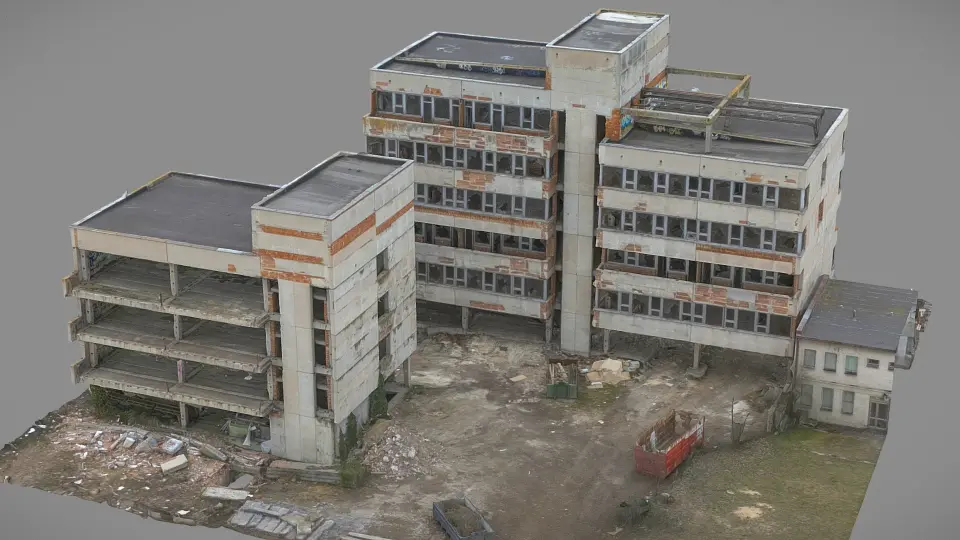
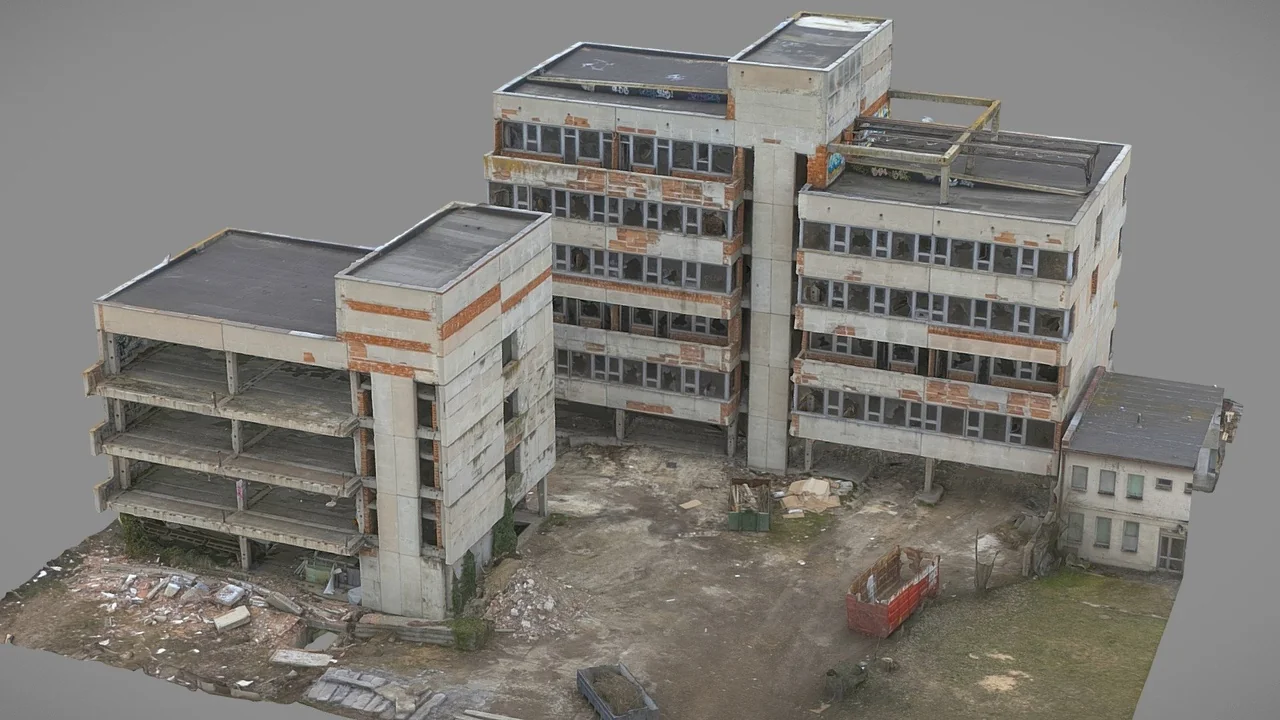
Blocking out an abandoned building is quick. Making it look like a place that has stood open to the elements is not. The gap is usually surface data: the concrete, brick, and reinforced-concrete breakup that a clean model does not carry. This 3D scan of an abandoned unfinished building supplies that layer from a real site, with 298 drone photos behind the reconstruction and a 7×8K texture set.
Inside the 298-photo scan of an abandoned unfinished building
The asset is a 3D scan, not a hand-modeled stand-in. Its source is 298 photos taken with a DJI Mini 4 Pro. That photo count is the first concrete number to note: it points to a drone-based capture built from a dense set of frames rather than a handful of stills.
The subject is an abandoned unfinished building, and the unfinished state matters as much as the abandonment. The structure is caught before completion, so it can sit in a stalled construction site, a decayed urban block, or a scene where building work stopped and the weather moved in. The location is Slovakia, which gives the architecture a specific regional anchor rather than a generic ruin silhouette.
Concrete, brick, and the 7×8K texture set
The texture set is recorded as 7×8K. Seven 8K textures are the resolution figure to plan around when the camera moves close to the building's concrete and brick surfaces. The tag set names Reinforced, Reinforcedconcrete, Concrete, Brick, and Block, so the structure is not a single-material shell. It carries the material mix that makes an unfinished building read as construction rather than a solid mass.
Condition tags fill in the rest: Decay, Damaged, Dirty. Those are the states the surface is meant to show, and they sit alongside the material tags. War and Communist place the building in a visual territory that runs from conflict-damaged architecture to post-communist concrete blocks. The dry winter season is part of that same record, not a decorative note.
Slovakia, dry winter, and the site's seasonal state
The building was captured in Slovakia during a dry winter season. That seasonal detail fixes the surface state: this is not a high-summer overgrowth scene or a wet-weather capture. The building arrives with a dry, cold-season read that can anchor a scene set in a comparable climate.
For a project set elsewhere, the same dry surface still works as a base for decayed concrete and brick. The seasonal context does not lock the asset to one story; it gives the environment artist a clear starting condition. A scene can add its own weather, lighting, and surrounding damage without fighting a surface that was recorded under different conditions.
Where an unfinished concrete block fits in a production
The tag set runs from Decay, Abandoned, Damaged, and Dirty through Reinforced, War, Communist, Concrete, Block, Building, Brick, Unfinished, Reinforcedconcrete, and Architecture. Read together, those words point to environments where architecture has outlived its intended use. A post-conflict street, a stalled construction site, a decaying urban block, or a communist-era concrete structure are all natural scene types for this building.
It can serve as the main structure in an exploration scene or as one building inside a larger abandoned district. Because the building is unfinished, it does not have to read as a collapsed ruin. It can be the site caught mid-construction, with the decay and dirt tags doing the work of time and exposure. That makes it useful for scenes about interrupted development, war damage, or long-term neglect.
Working with the 298-photo capture and 8K surfaces
Plan around the texture count first. Seven 8K textures are the part of the asset most likely to shape how close the camera can get and how much surface detail the scene can hold. If the building is meant to be inspected up close, the 7×8K set is the reason to keep the concrete and brick in the foreground. If it sits farther back, the silhouette and the material tags still carry the read.
The 298-photo source count is provenance as much as a number. It shows the scan came from a drone pass over the building, not from a small set of ground-level stills. The DJI Mini 4 Pro capture and the Slovakia location are part of the same record, and they give the asset a specific origin that can be matched to a scene's setting.
The production pass this building scan suits
Environment artists building decayed urban scenes are the clearest fit. Level designers who need an unfinished concrete block with real surface decay can lay out a scene around its footprint. Teams working on conflict-damaged or post-communist settings get a building that already carries the visual tags for those themes.
The scan belongs in the environment art pass after layout, where the structure's silhouette is set and the surfaces need to carry the site's history. Its 298-photo capture, 7×8K texture set, Slovakia location, and dry winter state are the details that decide where it lands in a production.
 Buildings
 Buildings
 Buildings
 Buildings