"6f9bd6df1f44a86f"{"id":"1002286","slug":"12-burning-wood-materials-animated","title":"12 Burning Wood Materials Animated","category":"Damage \u0026 Grunge","engine":"4.25+,5.0+","assetVersion":"","engineVersion":"Engine Version: 4.25+,5.0+","tag":"Damage \u0026 Grunge","accent":"blue","visual":"luts","summary":"12 animated burning wood materials with 4096x4096 maps, RMA and emissive channels, three masters and twelve instances for fire, war, and horror scenes.","platform":"Unreal Engine","indexPolicy":"index","publishedAt":"2026-11-04T05:17:15.249Z","updatedAt":"2026-11-04T05:17:15.249Z","sourceNotes":[],"fileContents":[],"compatibility":["Unreal Engine","Engine Version: 4.25+,5.0+"],"featuredImage":{"alt":"12 Burning Wood Materials Animated","src":"/wp-content/uploads/published/2026/11/6613573f1f32-f28ced6a-8ff1-4038-86f3-47d1f87710fd-2870253b43.webp"},"hasDownloadLink":true,"downloads":0,"terms":[{"taxonomy":"category","slug":"damage-and-grunge","name":"Damage \u0026 Grunge"}],"galleryImages":[{"src":"/wp-content/uploads/published/2026/11/e48218d989e7-2418c156-5af7-445d-9ca6-7851e283caaa-4c4470dc15.webp","alt":"12 Burning Wood Materials Animated"},{"src":"/wp-content/uploads/published/2026/11/15312f69a442-a1981179-863c-4029-889d-cd0e6ee5188d-a7cded3925.webp","alt":"12 Burning Wood Materials Animated"},{"src":"/wp-content/uploads/published/2026/11/485bdff2c769-eff551bc-afbf-4950-9a73-dffdd593493d-fe47d08a3c.webp","alt":"12 Burning Wood Materials Animated"},{"src":"/wp-content/uploads/published/2026/11/3f9d779a1c9e-900f6223-3cec-46c4-81df-33697dca4a8b-2c4b53ba0c.webp","alt":"12 Burning Wood Materials Animated"},{"src":"/wp-content/uploads/published/2026/11/a26731ddd21a-d52aebfb-ddd5-4526-918c-17339b5299ac-572beba0c6.webp","alt":"12 Burning Wood Materials Animated"}],"accessPanel":{"kind":"resource","title":"Download this resource","eyebrow":"Free Download","message":"Log in or create a free account to start your download.","fileName":"Content.7z","safetyNote":"Resources are manually reviewed before listing to improve quality and reduce obvious risks.","actionLabel":"Download Free","resourceType":"Resource archive"},"contentHtml":"\u003ch2\u003eTwelve wood surfaces, all of them moving\u003c/h2\u003e\n\u003cp\u003eThe package holds twelve unique materials, and every one of them is animated. That is the first thing to understand about it: these are not static textures of charred planks waiting for a shader to bring them to life. The burn already lives inside the material, so a wooden floor, beam, or doorframe carries moving fire detail the moment it is applied.\u003c/p\u003e\n\u003cp\u003eEach material draws on 4096x4096 texture maps. The channel set covers Diffuse, Normal, Displacement, RMA (Roughness, Metalness, Ambient Occlusion), and Emissive. Five distinct map types per material, sixty textures in total.\u003c/p\u003e\n\u003cp\u003eThe texture themes lean hard in one direction. Tags on the package place it among Post-apocalyptic, Zombie, Horror, War, and Medieval scenes, alongside Fantasy. Burning wood sits naturally in all of those: a collapsed village, a raided keep, a corridor that has already been lost.\u003c/p\u003e \u003ch2\u003eThree masters, twelve instances, and what the masters control\u003c/h2\u003e\n\u003cp\u003eThe set is split into three master materials and twelve material instances. Each master covers four of the twelve looks, and the instances expose the tuning without touching the graph underneath.\u003c/p\u003e\n\u003cp\u003eWhat the master material setup actually gives you control over is stated plainly: burning, displacement, and emissive intensity. Those three controls map directly onto the channels in the texture set.\u003c/p\u003e\n\u003cul\u003e\n\u003cli\u003e\u003cstrong\u003eBurning\u003c/strong\u003e Governs the animated fire behavior driven through the diffuse and emissive maps.\u003c/li\u003e\n\u003cli\u003e\u003cstrong\u003eDisplacement\u003c/strong\u003e Works with the displacement map to push the surface outward, so charred edges and split grain read as relief rather than painted-on shadow.\u003c/li\u003e\n\u003cli\u003e\u003cstrong\u003eEmissive intensity\u003c/strong\u003e Scales how strongly the emissive map glows, letting the same instance serve a smoldering ember or a fully lit blaze.\u003c/li\u003e\n\u003c/ul\u003e\n\u003cp\u003eBecause the twelve looks are instances rather than separate materials, a project can standardize on the three masters and adjust per-surface. The RMA packing keeps roughness, metalness, and ambient occlusion in a single map, which is the practical reason the channel count stays manageable at this resolution.\u003c/p\u003e \u003ch3\u003eWhy 4096x4096 matters for burning wood\u003c/h3\u003e\n\u003cp\u003eFire detail on wood is fine-grained. Char lines, glowing cracks, and the transition from intact grain to carbon all happen at a small scale, and those are exactly the features that blur first when resolution drops. At 4096x4096 across diffuse, normal, displacement, RMA, and emissive, the material keeps that detail available for surfaces the camera gets close to. The cost is texture memory, and sixty maps at that size is a real budget line — worth knowing before the whole set is dropped into a scene at once.\u003c/p\u003e \u003ch3\u003eWhere the animated burn fits in a workflow\u003c/h3\u003e\n\u003cp\u003eThe animated aspect changes how these materials get used. Static burning wood usually needs a separate particle system, a flipbook, or a shader layered on top to avoid looking dead. Here the animation is part of the material, so a wall, floor, or prop can sit in the scene and read as actively burning without extra setup.\u003c/p\u003e\n\u003cp\u003eThat makes the set useful in two broad situations. The first is environment dressing: a medieval street after a raid, a bunker corridor in a zombie or horror context, an apocalyptic ruin where the fire never went out. The second is set-piece work, where a single burning surface needs to hold attention while the camera moves past it. In both cases the emissive intensity control lets the same instance be dialed down to a faint glow or pushed up for a bright, obvious flame source.\u003c/p\u003e\n\u003cp\u003eThe war and fantasy angles are served by the same twelve looks. A burning wooden floor in a besieged castle and a burning wooden floor in a fantasy dungeon are the same material problem, and the set covers it once.\u003c/p\u003e \u003ch2\u003eWorking with displacement on wooden surfaces\u003c/h2\u003e\n\u003cp\u003eThe displacement channel deserves separate attention because wood is one of the surfaces where it pays off most. Grain runs in one direction, planks split along their length, and burned wood loses material unevenly — edges crumble while the center of a plank survives. Feeding the displacement map through the master's displacement control lets those losses show as actual surface variation rather than a flat normal-map impression.\u003c/p\u003e\n\u003cp\u003eWhere the surface is a background element seen at distance, the displacement can be eased back and the normal map left to carry the read. Where it is close to camera, pushing displacement forward gives the char its weight. The same twelve instances handle both cases because the control lives on the master.\u003c/p\u003e \u003ch2\u003eMaterial counts to plan around\u003c/h2\u003e\n\u003cp\u003eThe numbers are straightforward and worth restating as a planning reference: three master materials, twelve material instances, sixty textures, all at 4096x4096. Twelve unique materials in total, each animated, each with the full Diffuse, Normal, Displacement, RMA, and Emissive set.\u003c/p\u003e\n\u003cp\u003eSixty textures at 4K is the figure that shapes how the package gets loaded. A scene using a handful of the twelve instances will not carry the full weight; a scene using all twelve at once will. Since the instances sit on shared masters, the shader cost stays consistent across the set even as the texture count climbs.\u003c/p\u003e \u003ch2\u003eWhat the set is built to handle\u003c/h2\u003e\n\u003cp\u003eA wooden surface that is already on fire, at close range, in a scene that needs the fire to move. That is the case these twelve materials are set up for, and the master controls for burning, displacement, and emissive intensity are the three levers that keep it adjustable across medieval, war, horror, zombie, apocalyptic, and fantasy settings. Bring the RMA packing and the 4K maps into the budget early, pick the instances that match the surfaces in view, and the burn behavior is already in place.\u003c/p\u003e\n\n\u003ch2\u003eExplore Similar Assets\u003c/h2\u003e\n\u003cul\u003e\n\u003cli\u003e\u003ca href=\"https://3dcghub.com/blood/\" rel=\"noopener noreferrer\"\u003eBlood\u003c/a\u003e\u003c/li\u003e\n\u003cli\u003e\u003ca href=\"https://3dcghub.com/mud-material-pack-4/\" rel=\"noopener noreferrer\"\u003eMud Material Pack 4\u003c/a\u003e\u003c/li\u003e\n\u003cli\u003e\u003ca href=\"https://3dcghub.com/horror-and-decay-vol-5-urban-surfaces/\" rel=\"noopener noreferrer\"\u003eHorror and Decay VOL.5 - Urban Surfaces\u003c/a\u003e\u003c/li\u003e\n\u003cli\u003e\u003ca href=\"https://3dcghub.com/battle-damaged-decals-1/\" rel=\"noopener noreferrer\"\u003eBattle Damaged Decals 1\u003c/a\u003e\u003c/li\u003e\n\u003cli\u003e\u003ca href=\"https://3dcghub.com/bullet-impact-decals-vol-3-wood/\" rel=\"noopener noreferrer\"\u003eBullet Impact Decals Vol. 3 - Wood\u003c/a\u003e\u003c/li\u003e\n\u003c/ul\u003e","contentTextLength":5765,"navigation":{"current":10,"total":4218,"previous":{"id":"1002287","slug":"abandoned-unfinished-building","title":"Abandoned unfinished building","category":"Buildings \u0026 Architecture","platform":"Unreal Engine","updatedAt":"2026-11-04T05:17:48.029Z"},"next":{"id":"1000109","slug":"undercity-wonderland-bundle","title":"UnderCity + WonderLand Bundle","category":"Industrial","platform":"Unreal Engine","updatedAt":"2026-10-31T11:02:59.627Z"}},"relatedResources":[{"id":"1001722","slug":"blood","title":"Blood","category":"Damage \u0026 Grunge","engine":"4.26+,5.0+","assetVersion":"","engineVersion":"Engine Version: 4.26+,5.0+","tag":"Damage \u0026 Grunge","accent":"blue","visual":"mech","summary":"Over 120 horror decals deliver 4K and 2K blood smears, demonic symbols, and text with a performance-first single-texture setup and Decal Blueprint control.","platform":"Unreal Engine","indexPolicy":"index","publishedAt":"2026-10-19T16:20:31.409Z","updatedAt":"2026-10-19T16:20:31.409Z","sourceNotes":[],"fileContents":[],"compatibility":["Unreal Engine","Engine Version: 4.26+,5.0+"],"featuredImage":{"alt":"Blood","src":"/wp-content/uploads/published/2026/10/c8e02bd2344b-ac47f0d8-8e82-4163-b6b7-d83fe1867fbb-065bd8a46c.webp"},"hasDownloadLink":true,"downloads":1},{"id":"1002122","slug":"mud-material-pack-4","title":"Mud Material Pack 4","category":"Damage \u0026 Grunge","engine":"4.26+,5.0+","assetVersion":"","engineVersion":"Engine Version: 4.26+,5.0+","tag":"Damage \u0026 Grunge","accent":"blue","visual":"luts","summary":"Explore Mud Material Pack 4, featuring 7 unique 4K realistic mud and water materials with color tint, tiling, and normal map detail level controls.","platform":"Unreal Engine","indexPolicy":"index","publishedAt":"2026-10-29T09:03:23.830Z","updatedAt":"2026-10-29T09:03:23.830Z","sourceNotes":[],"fileContents":[],"compatibility":["Unreal Engine","Engine Version: 4.26+,5.0+"],"featuredImage":{"alt":"Mud Material Pack 4","src":"/wp-content/uploads/published/2026/10/bd1f34bd308b-31116ce6-7209-407e-bc5d-ccdd06b935d4-951db9de04.webp"},"hasDownloadLink":true,"downloads":0},{"id":"28275","slug":"horror-and-decay-vol-5-urban-surfaces","title":"Horror and Decay VOL.5 - Urban Surfaces","category":"Damage \u0026 Grunge","engine":"4.26+,5.0+","assetVersion":"Engine version: 4.26+,5.0+","engineVersion":"","tag":"Damage \u0026 Grunge","accent":"blue","visual":"luts","summary":"Horror and Decay VOL.5 - Urban Surfaces focuses on the messy, broken side of city environments. Its tileable texture sets, master material setup, and vertex paint blending make it useful for building grimy roads, walls, dirt, mud, and cracked concrete with...","platform":"Unreal Engine","indexPolicy":"index","publishedAt":"2026-05-06T15:45:04.000Z","updatedAt":"2026-05-06T15:45:05.000Z","sourceNotes":[],"fileContents":[],"compatibility":["Unreal Engine","Engine version: 4.26+,5.0+"],"featuredImage":{"alt":"Horror and Decay VOL.5 - Urban Surfaces","src":"https://3dcghub.com/wp-content/uploads/2026/05/9037e3dd3b26_a62630b0-0965-4e52-b1eb-593d490fe082.webp"},"hasDownloadLink":true,"downloads":0}]}
Damage & Grunge
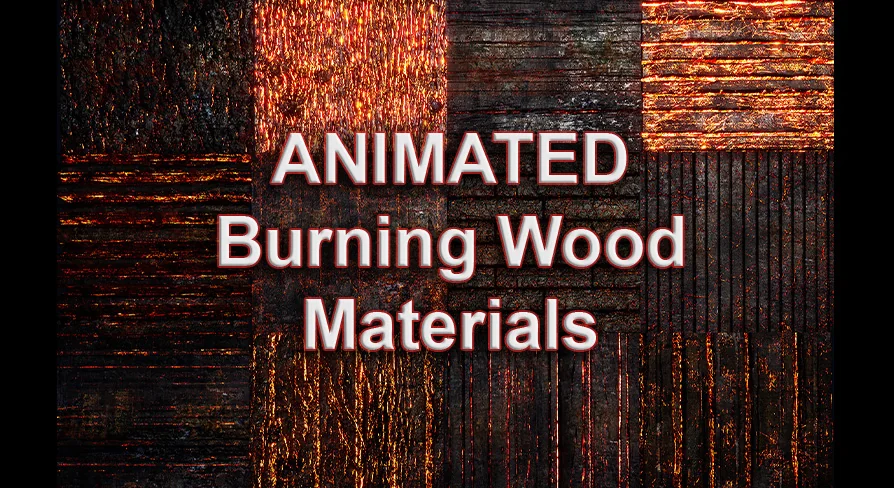
12 Burning Wood Materials Animated
12 animated burning wood materials with 4096x4096 maps, RMA and emissive channels, three masters and twelve instances for fire, war, and horror scenes.
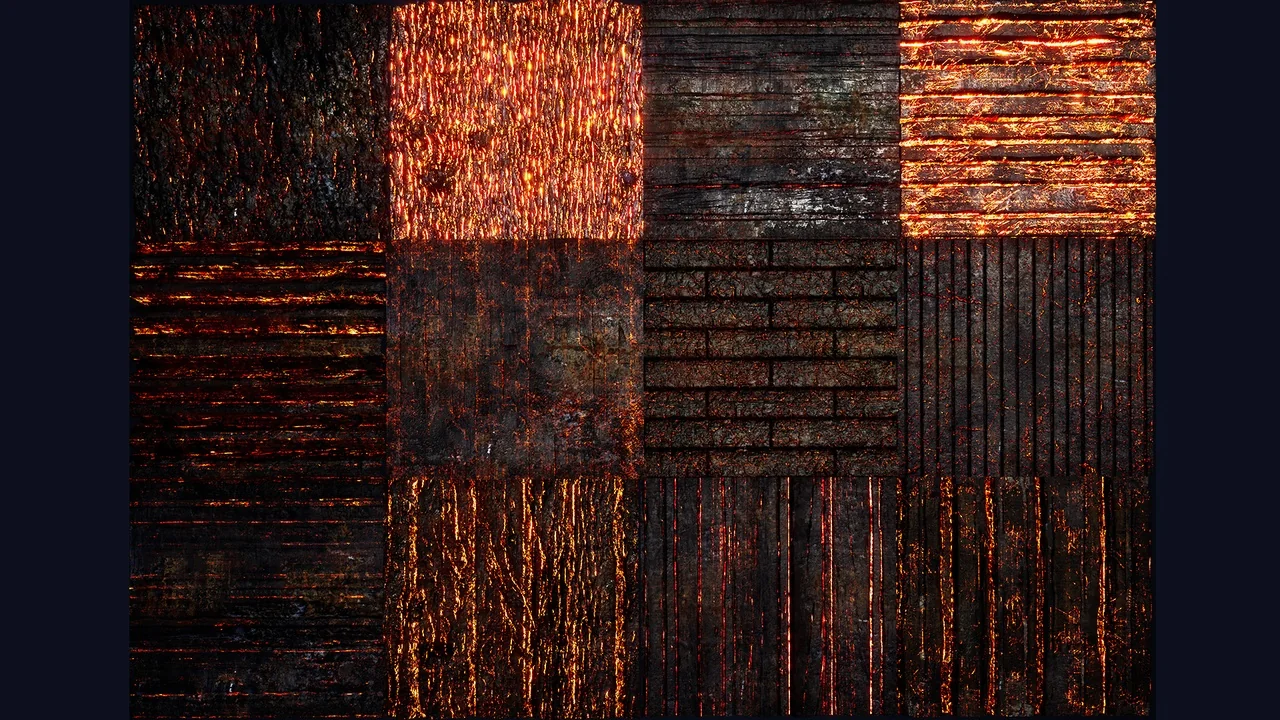
The package holds twelve unique materials, and every one of them is animated. That is the first thing to understand about it: these are not static textures of charred planks waiting for a shader to bring them to life. The burn already lives inside the material, so a wooden floor, beam, or doorframe carries moving fire detail the moment it is applied.
Each material draws on 4096x4096 texture maps. The channel set covers Diffuse, Normal, Displacement, RMA (Roughness, Metalness, Ambient Occlusion), and Emissive. Five distinct map types per material, sixty textures in total.
The texture themes lean hard in one direction. Tags on the package place it among Post-apocalyptic, Zombie, Horror, War, and Medieval scenes, alongside Fantasy. Burning wood sits naturally in all of those: a collapsed village, a raided keep, a corridor that has already been lost.
Three masters, twelve instances, and what the masters control
The set is split into three master materials and twelve material instances. Each master covers four of the twelve looks, and the instances expose the tuning without touching the graph underneath.
What the master material setup actually gives you control over is stated plainly: burning, displacement, and emissive intensity. Those three controls map directly onto the channels in the texture set.
Burning Governs the animated fire behavior driven through the diffuse and emissive maps.
Displacement Works with the displacement map to push the surface outward, so charred edges and split grain read as relief rather than painted-on shadow.
Emissive intensity Scales how strongly the emissive map glows, letting the same instance serve a smoldering ember or a fully lit blaze.
Because the twelve looks are instances rather than separate materials, a project can standardize on the three masters and adjust per-surface. The RMA packing keeps roughness, metalness, and ambient occlusion in a single map, which is the practical reason the channel count stays manageable at this resolution.
Why 4096x4096 matters for burning wood
Fire detail on wood is fine-grained. Char lines, glowing cracks, and the transition from intact grain to carbon all happen at a small scale, and those are exactly the features that blur first when resolution drops. At 4096x4096 across diffuse, normal, displacement, RMA, and emissive, the material keeps that detail available for surfaces the camera gets close to. The cost is texture memory, and sixty maps at that size is a real budget line — worth knowing before the whole set is dropped into a scene at once.
Where the animated burn fits in a workflow
The animated aspect changes how these materials get used. Static burning wood usually needs a separate particle system, a flipbook, or a shader layered on top to avoid looking dead. Here the animation is part of the material, so a wall, floor, or prop can sit in the scene and read as actively burning without extra setup.
That makes the set useful in two broad situations. The first is environment dressing: a medieval street after a raid, a bunker corridor in a zombie or horror context, an apocalyptic ruin where the fire never went out. The second is set-piece work, where a single burning surface needs to hold attention while the camera moves past it. In both cases the emissive intensity control lets the same instance be dialed down to a faint glow or pushed up for a bright, obvious flame source.
The war and fantasy angles are served by the same twelve looks. A burning wooden floor in a besieged castle and a burning wooden floor in a fantasy dungeon are the same material problem, and the set covers it once.
Working with displacement on wooden surfaces
The displacement channel deserves separate attention because wood is one of the surfaces where it pays off most. Grain runs in one direction, planks split along their length, and burned wood loses material unevenly — edges crumble while the center of a plank survives. Feeding the displacement map through the master's displacement control lets those losses show as actual surface variation rather than a flat normal-map impression.
Where the surface is a background element seen at distance, the displacement can be eased back and the normal map left to carry the read. Where it is close to camera, pushing displacement forward gives the char its weight. The same twelve instances handle both cases because the control lives on the master.
Material counts to plan around
The numbers are straightforward and worth restating as a planning reference: three master materials, twelve material instances, sixty textures, all at 4096x4096. Twelve unique materials in total, each animated, each with the full Diffuse, Normal, Displacement, RMA, and Emissive set.
Sixty textures at 4K is the figure that shapes how the package gets loaded. A scene using a handful of the twelve instances will not carry the full weight; a scene using all twelve at once will. Since the instances sit on shared masters, the shader cost stays consistent across the set even as the texture count climbs.
What the set is built to handle
A wooden surface that is already on fire, at close range, in a scene that needs the fire to move. That is the case these twelve materials are set up for, and the master controls for burning, displacement, and emissive intensity are the three levers that keep it adjustable across medieval, war, horror, zombie, apocalyptic, and fantasy settings. Bring the RMA packing and the 4K maps into the budget early, pick the instances that match the surfaces in view, and the burn behavior is already in place.
 Damage & Grunge
 Damage & Grunge
 Damage & Grunge
 Damage & Grunge