"8652e693bd7bbc55"{"id":"1002986","slug":"amt-asymmetrical-multiplayer-template-4-vs-1","title":"AMT (Asymmetrical Multiplayer Template, 4 vs 1)","category":"Action-Adventure","engine":"4.26+,5.0+","assetVersion":"","engineVersion":"Engine Version: 4.26+,5.0+","tag":"Action-Adventure","accent":"blue","visual":"mech","summary":"Explore the systems, objective loops, networking, and UI modules powering the AMT (Asymmetrical Multiplayer Template, 4 vs 1) Blueprint project.","platform":"Unreal Engine","indexPolicy":"index","publishedAt":"2026-11-25T09:49:46.615Z","updatedAt":"2026-11-25T09:49:46.615Z","sourceNotes":[],"fileContents":[],"compatibility":["Unreal Engine","Engine Version: 4.26+,5.0+"],"featuredImage":{"alt":"AMT (Asymmetrical Multiplayer Template, 4 vs 1)","src":"/wp-content/uploads/published/2026/11/465c01857547-6012a320-7e92-43bd-bb94-fd5f19c3203c-d103d5f8a1.webp"},"hasDownloadLink":true,"downloads":0,"terms":[{"taxonomy":"category","slug":"action-adventure","name":"Action-Adventure"}],"galleryImages":[{"src":"/wp-content/uploads/published/2026/11/604504505a07-045b1a56-32de-4bad-ba85-0bdcda7ed5f3-fd3b08d401.webp","alt":"AMT (Asymmetrical Multiplayer Template, 4 vs 1)"},{"src":"/wp-content/uploads/published/2026/11/3884bba551a9-663df6f3-e8bb-490a-bf82-533cdc51eec3-f09e0cad7b.webp","alt":"AMT (Asymmetrical Multiplayer Template, 4 vs 1)"},{"src":"/wp-content/uploads/published/2026/11/a6f8b84b18ce-54fd418d-e045-4481-b193-cf6041512cb9-e677a01172.webp","alt":"AMT (Asymmetrical Multiplayer Template, 4 vs 1)"},{"src":"/wp-content/uploads/published/2026/11/5c0f06b0afd1-b24e2261-703f-4699-9bf5-b3b0885f392f-e6d2989ae2.webp","alt":"AMT (Asymmetrical Multiplayer Template, 4 vs 1)"},{"src":"/wp-content/uploads/published/2026/11/5d98fd49280c-a696ccfc-0f48-4143-b8ab-dddc00101727-6ce7b589b9.webp","alt":"AMT (Asymmetrical Multiplayer Template, 4 vs 1)"}],"accessPanel":{"kind":"resource","title":"Get this resource","safetyNote":"Resources are manually reviewed before listing to improve quality and reduce obvious risks.","fileName":"AMT (Asymmetrical Multiplayer Template, 4 vs 1).7z","resourceType":"Resource archive","versions":[]},"contentHtml":"\u003cp\u003eA multiplayer match in this framework brings together two uneven sides, combining network replication, objective tracking, character roles, and visual interface systems. The core structure supplies a complete baseline for four cooperative players facing off against a single solitary monster. Constructed entirely in Blueprints, the project lays down the server-client coordination, session management, and round logic required to run online matches across distinct network hosting environments.\u003c/p\u003e \u003ch2\u003eCore Systems in the AMT Asymmetrical Framework\u003c/h2\u003e\n\u003cp\u003eThe gameplay foundation establishes an uneven confrontation where each team operates under distinct play styles and win criteria. On one side, four players navigate the game space with an emphasis on evasion and task completion. Surviving against the solitary threat requires active stealth, map navigation, and team distribution. Players must actively hide from the monster while scouting and interacting with mechanical objectives scattered across the environment.\u003c/p\u003e \u003cp\u003eProgress for the survivor group is measured by repairing generators. A minimum of three generators must be fully repaired before the final exit gate becomes accessible. This rule requires players to coordinate their efforts, either grouping up to complete single generators faster or splitting across multiple locations to divide the monster's attention. Once the three-generator threshold is reached, the exit gate can be opened, shifting the round into an escape phase where players must navigate to the unlocked threshold. For the player side to claim victory, at least one player must successfully escape through the open gates.\u003c/p\u003e \u003cp\u003eThe monster role functions under completely opposing incentives. Operating alone, the monster acts as an active disruptor and lethal predator. Its immediate tactical goal is preventing the player team from repairing the required three generators. Should the players manage to power the circuit, the monster's focus shifts immediately to gate defense, actively preventing players from reaching and passing through the extraction boundary. The definitive victory condition for the monster requires eliminating all four players before any can cross the threshold to safety.\u003c/p\u003e \u003ch2\u003eTemplate Architecture and Server Configuration\u003c/h2\u003e\n\u003cp\u003eNetwork synchronization forms the backbone of the framework, providing out-of-the-box compatibility with both listen servers and dedicated server deployments. Listen server functionality enables individual clients to host sessions directly on their local machines, allowing immediate testing, small group play, and peer-to-peer matchmaking without external server hardware. For more formal online environments, dedicated server support allows headless server builds to manage game state authority, player positioning, and round resolution independently of any player client.\u003c/p\u003e \u003cp\u003eUnderlying this network layer is an extendable and flexible Blueprint architecture. Because the project avoids rigid hardcoding, technical designers can dissect and branch logic modules with minimal friction. Task interactions, such as generator repair timers, gate unlocking progress, and health or damage calculations, are isolated into clear, readable sequences. Modifying parameters—such as increasing the required generator count, adjusting the threshold of surviving players required for victory, or changing the monster's interaction range—can be accomplished without destabilizing the broader replication flow.\u003c/p\u003e \u003cp\u003eThis structural clarity extends to event dispatching and role assignments. The logic cleanly separates survivor behaviors from monster systems, ensuring that authority checks and client-side predictions run through coherent execution paths. By maintaining modular Blueprints, the framework simplifies the process of plugging in custom character models, unique creature capabilities, audio triggers, and tailored gameplay events.\u003c/p\u003e \u003ch2\u003eUser Interface and In-Match Feedback Modules\u003c/h2\u003e\n\u003cp\u003eThe template provides a comprehensive suite of interface widgets covering both out-of-match administrative flow and mid-match player tracking. The menu loop begins at the Main Menu, branching into a dedicated Host Game screen for session setup, a Server Browser menu for discovering active public or private games, a Game Settings menu for configuring client preferences, and an FAQ screen to display instructions or rules directly to users.\u003c/p\u003e \u003cp\u003eInside the active match, situational awareness is maintained through several specialized HUD components:\u003c/p\u003e\n\u003cul\u003e \u003cli\u003e\u003cstrong\u003ePlayer HUD:\u003c/strong\u003e Displays immediate status indicators, objective targets, and essential gameplay feedback for active participants.\u003c/li\u003e \u003cli\u003e\u003cstrong\u003eObserver HUD:\u003c/strong\u003e Engages when a player is knocked out of play, switching the interface to spectator tracking so eliminated participants remain engaged with the match progression.\u003c/li\u003e \u003cli\u003e\u003cstrong\u003eHelp Widget:\u003c/strong\u003e Delivers on-demand explanations of objectives, controls, and active role goals directly to players during gameplay.\u003c/li\u003e \u003cli\u003e\u003cstrong\u003eGame Chat:\u003c/strong\u003e Facilitates real-time text communication across the lobby and match, allowing team coordination or social banter.\u003c/li\u003e \u003cli\u003e\u003cstrong\u003eKill Feed:\u003c/strong\u003e Generates real-time notifications of player eliminations, broadcasting critical status shifts immediately to all clients.\u003c/li\u003e \u003cli\u003e\u003cstrong\u003eScoreboard:\u003c/strong\u003e Summarizes current performance metrics and player statuses across both the survivor team and the monster.\u003c/li\u003e\n\u003c/ul\u003e \u003cp\u003eThese real-time visual modules ensure that both sides maintain full context of match progression. Survivors can glance at their interface to verify how many generators remain uncompleted, while the monster can monitor active alerts and track down remaining survivors as the match reaches high-intensity gate-defense sequences.\u003c/p\u003e \u003ch2\u003eSession Flow and Match Resolution Logic\u003c/h2\u003e\n\u003cp\u003eEvery match is structured around discrete phases that transition seamlessly from initial staging to final evaluation. The game starts with the assembly phase, moves into the cat-and-mouse generator repair cycle, escalates into the gate escape phase, and resolves when win conditions are verified by the server authority. Once the game rules detect that either all survivors have been eliminated or at least one player has cleared the gate, the game triggers the Round Finish event.\u003c/p\u003e \u003cp\u003eThe Round Finish interface reports individual and team outcomes, detailing which faction achieved their operational objectives. Following round resolution, the Match Finish screen provides comprehensive performance breakdowns, transitioning the session gracefully back toward lobby menus or subsequent rounds. This loop handles cleanup, unbinds match-specific listeners, and ensures server stability across consecutive gameplay cycles.\u003c/p\u003e \u003cp\u003eWith built-in support for online survival horror dynamics, social deduction styles, and asymmetrical competition, the framework supplies developers with a completely functional foundation for multiplayer hide-and-hunt gameplay.\u003c/p\u003e\n\n\u003ch2\u003eMore From The Same Workflow\u003c/h2\u003e\n\u003cul\u003e\n\u003cli\u003e\u003ca href=\"https://3dcghub.com/advanced-asymmetrical-multiplayer-template/\" rel=\"noopener noreferrer\"\u003eAdvanced Asymmetrical Multiplayer Template\u003c/a\u003e\u003c/li\u003e\n\u003cli\u003e\u003ca href=\"https://3dcghub.com/asymmetric-multiplayer-horror/\" rel=\"noopener noreferrer\"\u003eAsymmetric Multiplayer Horror\u003c/a\u003e\u003c/li\u003e\n\u003cli\u003e\u003ca href=\"https://3dcghub.com/multiplayer-mission-system-v2/\" rel=\"noopener noreferrer\"\u003eMultiplayer Mission System V2\u003c/a\u003e\u003c/li\u003e\n\u003cli\u003e\u003ca href=\"https://3dcghub.com/multiplayer-topdown-kit/\" rel=\"noopener noreferrer\"\u003eMultiplayer TopDown Kit\u003c/a\u003e\u003c/li\u003e\n\u003cli\u003e\u003ca href=\"https://3dcghub.com/n00dlobby/\" rel=\"noopener noreferrer\"\u003en00dLobby\u003c/a\u003e\u003c/li\u003e\n\u003c/ul\u003e","contentTextLength":6960,"navigation":{"current":5,"total":4911,"previous":{"id":"1002987","slug":"angled-lower-thirds","title":"Angled Lower Thirds","category":"Widgets \u0026 Controls","platform":"Unreal Engine","updatedAt":"2026-11-25T09:50:32.950Z"},"next":{"id":"1002985","slug":"air-strike","title":"Air Strike","category":"Gameplay Features","platform":"Unreal Engine","updatedAt":"2026-11-25T09:49:14.550Z"}},"relatedResources":[{"id":"1002574","slug":"advanced-asymmetrical-multiplayer-template","title":"Advanced Asymmetrical Multiplayer Template","category":"Action-Adventure","engine":"5.0+","assetVersion":"","engineVersion":"Engine Version: 5.0+","tag":"Action-Adventure","accent":"blue","visual":"mech","summary":"Explore the Advanced Asymmetrical Multiplayer Template, offering a 4 vs 1 survival horror framework, custom perspectives, and Blueprint networking.","platform":"Unreal Engine","indexPolicy":"index","publishedAt":"2026-11-13T20:13:09.696Z","updatedAt":"2026-11-13T20:13:09.696Z","sourceNotes":[],"fileContents":[],"compatibility":["Unreal Engine","Engine Version: 5.0+"],"featuredImage":{"alt":"Advanced Asymmetrical Multiplayer Template","src":"/wp-content/uploads/published/2026/11/0ee25474a0b8-3617e541-bae5-451b-8057-c9ae9698bff4-2480d8ee2f.webp"},"fileSizeBytes":529829261,"hasDownloadLink":true,"downloads":0},{"id":"1000977","slug":"asymmetric-multiplayer-horror","title":"Asymmetric Multiplayer Horror","category":"Action-Adventure","engine":"5.0+","assetVersion":"","engineVersion":"Engine Version: 5.0+","tag":"Action-Adventure","accent":"blue","visual":"mech","summary":"Blueprint template for asymmetric multiplayer horror with 4 vs 1 play, AI or player monsters, first/third person views, and a Cursed Forest demo.","platform":"Unreal Engine","indexPolicy":"index","publishedAt":"2026-08-17T17:19:51.833Z","updatedAt":"2026-08-17T17:19:51.833Z","sourceNotes":[],"fileContents":[],"compatibility":["Unreal Engine","Engine Version: 5.0+"],"featuredImage":{"alt":"Asymmetric Multiplayer Horror","src":"/wp-content/uploads/published/2026/08/d3e8d4559426-f968b340-50b9-4a59-9fa7-7cdea14f055c-e0904bd06f.webp"},"fileSizeBytes":646912915,"hasDownloadLink":true,"downloads":1},{"id":"1002927","slug":"multiplayer-mission-system-v2","title":"Multiplayer Mission System V2","category":"Action-Adventure","engine":"4.26+,5.0+","assetVersion":"","engineVersion":"Engine Version: 4.26+,5.0+","tag":"Action-Adventure","accent":"blue","visual":"mech","summary":"Explore the networking architecture, dynamic objective markers, quest log widgets, and leveling integration of Multiplayer Mission System V2.","platform":"Unreal Engine","indexPolicy":"index","publishedAt":"2026-11-21T22:55:07.738Z","updatedAt":"2026-11-21T22:55:07.738Z","sourceNotes":[],"fileContents":[],"compatibility":["Unreal Engine","Engine Version: 4.26+,5.0+"],"featuredImage":{"alt":"Multiplayer Mission System V2","src":"/wp-content/uploads/published/2026/11/e35d7e453147-af49587a-1b56-4e7e-8bea-9e0a619504f4-3835674d1c.webp"},"fileSizeBytes":16542868,"hasDownloadLink":true,"downloads":1}]}[{"id":4225,"sourceId":4225,"taxonomyId":4225,"taxonomy":"category","slug":"asset-library","name":"Asset Library","parentId":null,"count":4765,"hasChildren":true,"href":"/","seoTitle":"Free Game Assets Library | 3DCGHUB","seoDescription":"Browse free Unreal Engine, Unity, Blender assets and game development tutorials on 3DCGHUB with previews, compatibility notes, and secure downloads.","sitemapEnabled":true,"children":[{"id":4227,"sourceId":4227,"taxonomyId":4227,"taxonomy":"category","slug":"blender-add-ons-plugins","name":"Blender Add-ons \u0026 Plugins","parentId":4225,"count":10,"hasChildren":false,"href":"/category/blender-add-ons-plugins/","seoTitle":"Free Blender Add-ons \u0026 Plugins | 3DCGHUB","seoDescription":"Browse free Blender Add-ons \u0026 Plugins tools for Blender on 3DCGHUB: curated downloads with preview images, compatibility notes and secure download access.","sitemapEnabled":true},{"id":514,"sourceId":514,"taxonomyId":514,"taxonomy":"category","slug":"unity-2","name":"Unity","parentId":4225,"count":453,"hasChildren":true,"href":"/category/unity-2/","seoTitle":"Free Unity Assets | 3DCGHUB","seoDescription":"Browse free Unity resources on 3DCGHUB: curated downloads with preview images, compatibility notes and secure download access.","sitemapEnabled":true,"children":[{"id":523,"sourceId":523,"taxonomyId":523,"taxonomy":"category","slug":"2d","name":"2D","parentId":514,"count":1,"hasChildren":true,"href":"/category/2d/","seoTitle":"Free Unity 2D | 3DCGHUB","seoDescription":"Browse free 2D assets for Unity on 3DCGHUB: curated downloads with preview images, compatibility notes and secure download access.","sitemapEnabled":true},{"id":515,"sourceId":515,"taxonomyId":515,"taxonomy":"category","slug":"3d-unity-2","name":"3D","parentId":514,"count":162,"hasChildren":true,"href":"/category/3d-unity-2/","seoTitle":"Free Unity 3D Assets | 3DCGHUB","seoDescription":"Browse free 3D assets for Unity on 3DCGHUB: curated downloads with preview images, compatibility notes and secure download access.","sitemapEnabled":true},{"id":565,"sourceId":565,"taxonomyId":565,"taxonomy":"category","slug":"add-ons","name":"Add-Ons","parentId":514,"count":2,"hasChildren":false,"href":"/category/add-ons/","seoTitle":"Free Unity Add-Ons | 3DCGHUB","seoDescription":"Browse free Add-Ons assets for Unity on 3DCGHUB: curated downloads with preview images, compatibility notes and secure download access.","sitemapEnabled":true},{"id":529,"sourceId":529,"taxonomyId":529,"taxonomy":"category","slug":"audio-unity-2","name":"Audio","parentId":514,"count":1,"hasChildren":true,"href":"/category/audio-unity-2/","seoTitle":"Free Unity Audio | 3DCGHUB","seoDescription":"Browse free Audio for Unity on 3DCGHUB: curated downloads with preview images, compatibility notes and secure download access.","sitemapEnabled":true},{"id":557,"sourceId":557,"taxonomyId":557,"taxonomy":"category","slug":"templates","name":"Templates","parentId":514,"count":36,"hasChildren":true,"href":"/category/templates/","seoTitle":"Free Unity Templates | 3DCGHUB","seoDescription":"Browse free Unity project templates on 3DCGHUB. Starter kits with previews, compatibility notes, and secure download access.","sitemapEnabled":true},{"id":533,"sourceId":533,"taxonomyId":533,"taxonomy":"category","slug":"tools-unity-2","name":"Tools","parentId":514,"count":0,"hasChildren":true,"href":"/category/tools-unity-2/","sitemapEnabled":true},{"id":554,"sourceId":554,"taxonomyId":554,"taxonomy":"category","slug":"vfx-unity-2","name":"VFX","parentId":514,"count":4,"hasChildren":true,"href":"/category/vfx-unity-2/","seoTitle":"Free Unity VFX | 3DCGHUB","seoDescription":"Browse free VFX for Unity on 3DCGHUB: curated downloads with preview images, compatibility notes and secure download access.","sitemapEnabled":true}]},{"id":511,"sourceId":511,"taxonomyId":511,"taxonomy":"category","slug":"unreal-engine-2","name":"Unreal Engine","parentId":4225,"count":4303,"hasChildren":true,"href":"/category/unreal-engine-2/","seoTitle":"Free Unreal Engine Assets | 3DCGHUB","seoDescription":"Browse free Unreal Engine resources on 3DCGHUB: curated downloads with preview images, compatibility notes and secure download access.","sitemapEnabled":true,"children":[{"id":54,"sourceId":54,"taxonomyId":54,"taxonomy":"category","slug":"3d","name":"3D","parentId":511,"count":2434,"hasChildren":true,"href":"/category/3d/","seoTitle":"Free Unreal Engine 3D | 3DCGHUB","seoDescription":"Browse free 3D assets for Unreal Engine on 3DCGHUB: curated downloads with preview images, compatibility notes and secure download access.","sitemapEnabled":true},{"id":441,"sourceId":441,"taxonomyId":441,"taxonomy":"category","slug":"animations","name":"Animations","parentId":511,"count":245,"hasChildren":true,"href":"/category/animations/","seoTitle":"Free Unreal Engine Animations | 3DCGHUB","seoDescription":"Browse free Animations for Unreal Engine on 3DCGHUB: curated downloads with preview images, compatibility notes and secure download access.","sitemapEnabled":true},{"id":446,"sourceId":446,"taxonomyId":446,"taxonomy":"category","slug":"audio","name":"Audio","parentId":511,"count":63,"hasChildren":true,"href":"/category/audio/","seoTitle":"Free Unreal Engine Audio Resources | 3DCGHUB","seoDescription":"Browse free Unreal Engine audio resources including sound effects, voices, dialogue, and ambient sounds. Curated free downloads on 3DCGHUB.","sitemapEnabled":true},{"id":466,"sourceId":466,"taxonomyId":466,"taxonomy":"category","slug":"game-systems","name":"Game Systems","parentId":511,"count":366,"hasChildren":true,"href":"/category/game-systems/","seoTitle":"Free Unreal Engine Game Systems | 3DCGHUB","seoDescription":"Browse free Game Systems tools for Unreal Engine on 3DCGHUB: curated downloads with preview images, compatibility notes and secure download access.","sitemapEnabled":true},{"id":478,"sourceId":478,"taxonomyId":478,"taxonomy":"category","slug":"game-templates","name":"Game Templates","parentId":511,"count":151,"hasChildren":true,"href":"/category/game-templates/","seoTitle":"Free Unreal Engine Game Templates | 3DCGHUB","seoDescription":"Browse free Game Templates for Unreal Engine on 3DCGHUB: curated downloads with preview images, compatibility notes and secure download access.","sitemapEnabled":true},{"id":432,"sourceId":432,"taxonomyId":432,"taxonomy":"category","slug":"hdri","name":"HDRI","parentId":511,"count":6,"hasChildren":true,"href":"/category/hdri/","seoTitle":"Free Unreal Engine HDRI | 3DCGHUB","seoDescription":"Browse free Unreal Engine HDRI skies and lighting maps on 3DCGHUB. Environment lighting with previews and secure downloads.","sitemapEnabled":true},{"id":228,"sourceId":228,"taxonomyId":228,"taxonomy":"category","slug":"material-and-textures","name":"Material \u0026 Textures","parentId":511,"count":172,"hasChildren":true,"href":"/category/material-and-textures/","seoTitle":"Free Unreal Engine Material \u0026 Textures | 3DCGHUB","seoDescription":"Browse free Material \u0026 Textures for Unreal Engine on 3DCGHUB: curated downloads with preview images, compatibility notes and secure download access.","sitemapEnabled":true},{"id":298,"sourceId":298,"taxonomyId":298,"taxonomy":"category","slug":"sprites-and-flipbooks","name":"Sprites \u0026 Flipbooks","parentId":511,"count":18,"hasChildren":true,"href":"/category/sprites-and-flipbooks/","seoTitle":"Free Unreal Engine Sprites \u0026 Flipbooks | 3DCGHUB","seoDescription":"Browse free Sprites \u0026 Flipbooks assets for Unreal Engine on 3DCGHUB: curated downloads with preview images, compatibility notes and secure download access.","sitemapEnabled":true},{"id":489,"sourceId":489,"taxonomyId":489,"taxonomy":"category","slug":"tools-and-plugins","name":"Tools \u0026 Plugins","parentId":511,"count":390,"hasChildren":true,"href":"/category/tools-and-plugins/","seoTitle":"Free Unreal Engine Tools \u0026 Plugins | 3DCGHUB","seoDescription":"Browse free Tools \u0026 Plugins for Unreal Engine on 3DCGHUB: curated downloads with preview images, compatibility notes and secure download access.","sitemapEnabled":true},{"id":459,"sourceId":459,"taxonomyId":459,"taxonomy":"category","slug":"ui","name":"UI","parentId":511,"count":45,"hasChildren":true,"href":"/category/ui/","seoTitle":"Free Unreal Engine UI | 3DCGHUB","seoDescription":"Browse free UI for Unreal Engine on 3DCGHUB: curated downloads with preview images, compatibility notes and secure download access.","sitemapEnabled":true},{"id":450,"sourceId":450,"taxonomyId":450,"taxonomy":"category","slug":"vfx","name":"VFX","parentId":511,"count":413,"hasChildren":true,"href":"/category/vfx/","seoTitle":"Free Unreal Engine VFX | 3DCGHUB","seoDescription":"Browse free VFX for Unreal Engine on 3DCGHUB: curated downloads with preview images, compatibility notes and secure download access.","sitemapEnabled":true}]}]},{"id":4222,"sourceId":4222,"taxonomyId":4222,"taxonomy":"category","slug":"tutorial-library","name":"Tutorial Library","parentId":null,"count":117,"hasChildren":false,"href":"/tutorials/","seoTitle":"Free Game Development Tutorial Library | 3DCGHUB","seoDescription":"Browse free game development tutorials for Unreal Engine, Unity, Blender, and more on 3DCGHUB with practical workflows and secure downloads.","sitemapEnabled":true}]
Resource screenshots
1 / 5
Asset drops
Daily Asset Drops
Follow 3DCGHUB on Telegram for daily Unreal, Unity & Blender drops and curated CC0 releases.
A multiplayer match in this framework brings together two uneven sides, combining network replication, objective tracking, character roles, and visual interface systems. The core structure supplies a complete baseline for four cooperative players facing off against a single solitary monster. Constructed entirely in Blueprints, the project lays down the server-client coordination, session management, and round logic required to run online matches across distinct network hosting environments.
Core Systems in the AMT Asymmetrical Framework
The gameplay foundation establishes an uneven confrontation where each team operates under distinct play styles and win criteria. On one side, four players navigate the game space with an emphasis on evasion and task completion. Surviving against the solitary threat requires active stealth, map navigation, and team distribution. Players must actively hide from the monster while scouting and interacting with mechanical objectives scattered across the environment.
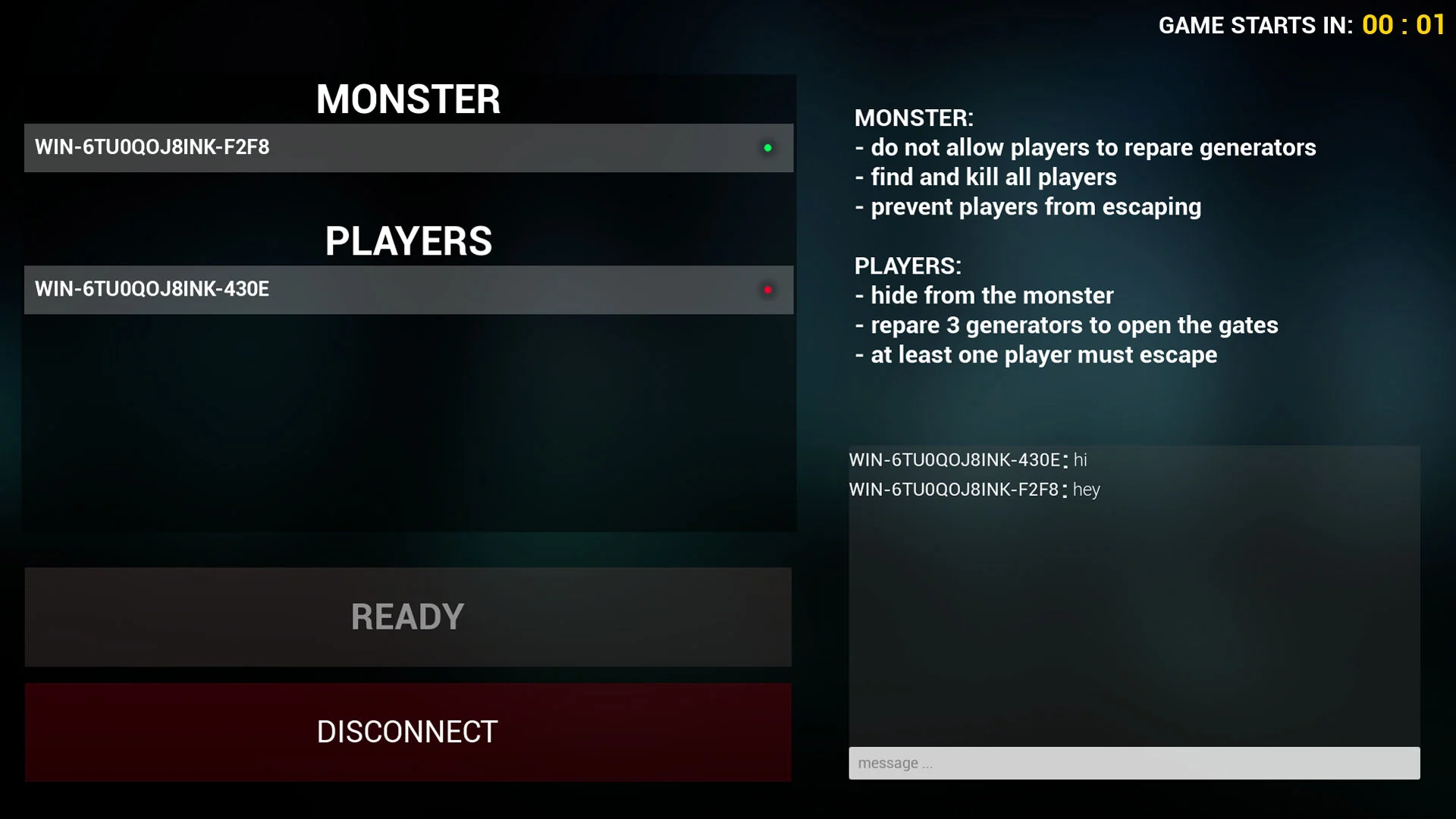
Progress for the survivor group is measured by repairing generators. A minimum of three generators must be fully repaired before the final exit gate becomes accessible. This rule requires players to coordinate their efforts, either grouping up to complete single generators faster or splitting across multiple locations to divide the monster's attention. Once the three-generator threshold is reached, the exit gate can be opened, shifting the round into an escape phase where players must navigate to the unlocked threshold. For the player side to claim victory, at least one player must successfully escape through the open gates.
The monster role functions under completely opposing incentives. Operating alone, the monster acts as an active disruptor and lethal predator. Its immediate tactical goal is preventing the player team from repairing the required three generators. Should the players manage to power the circuit, the monster's focus shifts immediately to gate defense, actively preventing players from reaching and passing through the extraction boundary. The definitive victory condition for the monster requires eliminating all four players before any can cross the threshold to safety.
Template Architecture and Server Configuration
Network synchronization forms the backbone of the framework, providing out-of-the-box compatibility with both listen servers and dedicated server deployments. Listen server functionality enables individual clients to host sessions directly on their local machines, allowing immediate testing, small group play, and peer-to-peer matchmaking without external server hardware. For more formal online environments, dedicated server support allows headless server builds to manage game state authority, player positioning, and round resolution independently of any player client.
Underlying this network layer is an extendable and flexible Blueprint architecture. Because the project avoids rigid hardcoding, technical designers can dissect and branch logic modules with minimal friction. Task interactions, such as generator repair timers, gate unlocking progress, and health or damage calculations, are isolated into clear, readable sequences. Modifying parameters—such as increasing the required generator count, adjusting the threshold of surviving players required for victory, or changing the monster's interaction range—can be accomplished without destabilizing the broader replication flow.
This structural clarity extends to event dispatching and role assignments. The logic cleanly separates survivor behaviors from monster systems, ensuring that authority checks and client-side predictions run through coherent execution paths. By maintaining modular Blueprints, the framework simplifies the process of plugging in custom character models, unique creature capabilities, audio triggers, and tailored gameplay events.
User Interface and In-Match Feedback Modules
The template provides a comprehensive suite of interface widgets covering both out-of-match administrative flow and mid-match player tracking. The menu loop begins at the Main Menu, branching into a dedicated Host Game screen for session setup, a Server Browser menu for discovering active public or private games, a Game Settings menu for configuring client preferences, and an FAQ screen to display instructions or rules directly to users.
Inside the active match, situational awareness is maintained through several specialized HUD components:
Player HUD: Displays immediate status indicators, objective targets, and essential gameplay feedback for active participants.
Observer HUD: Engages when a player is knocked out of play, switching the interface to spectator tracking so eliminated participants remain engaged with the match progression.
Help Widget: Delivers on-demand explanations of objectives, controls, and active role goals directly to players during gameplay.
Game Chat: Facilitates real-time text communication across the lobby and match, allowing team coordination or social banter.
Kill Feed: Generates real-time notifications of player eliminations, broadcasting critical status shifts immediately to all clients.
Scoreboard: Summarizes current performance metrics and player statuses across both the survivor team and the monster.
These real-time visual modules ensure that both sides maintain full context of match progression. Survivors can glance at their interface to verify how many generators remain uncompleted, while the monster can monitor active alerts and track down remaining survivors as the match reaches high-intensity gate-defense sequences.
Session Flow and Match Resolution Logic
Every match is structured around discrete phases that transition seamlessly from initial staging to final evaluation. The game starts with the assembly phase, moves into the cat-and-mouse generator repair cycle, escalates into the gate escape phase, and resolves when win conditions are verified by the server authority. Once the game rules detect that either all survivors have been eliminated or at least one player has cleared the gate, the game triggers the Round Finish event.
The Round Finish interface reports individual and team outcomes, detailing which faction achieved their operational objectives. Following round resolution, the Match Finish screen provides comprehensive performance breakdowns, transitioning the session gracefully back toward lobby menus or subsequent rounds. This loop handles cleanup, unbinds match-specific listeners, and ensures server stability across consecutive gameplay cycles.
With built-in support for online survival horror dynamics, social deduction styles, and asymmetrical competition, the framework supplies developers with a completely functional foundation for multiplayer hide-and-hunt gameplay.
 Action-Adventure
 Action-Adventure
 Action-Adventure