"8652e693bd7bbc55"{"id":"1002971","slug":"abandoned-hatchback-car","title":"Abandoned Hatchback Car","category":"Cars \u0026 Trucks","engine":"4.18+,5.0+","assetVersion":"","engineVersion":"Engine Version: 4.18+,5.0+","tag":"Cars \u0026 Trucks","accent":"blue","visual":"mech","summary":"A customizable, modular abandoned hatchback with PBR materials, rusty and grunge detail, built for post-apocalyptic, industrial, and simulation scenes as a wrec","platform":"Unreal Engine","indexPolicy":"index","publishedAt":"2026-11-25T08:45:38.112Z","updatedAt":"2026-11-25T08:45:38.112Z","sourceNotes":[],"fileContents":[],"compatibility":["Unreal Engine","Engine Version: 4.18+,5.0+"],"featuredImage":{"alt":"Abandoned Hatchback Car","src":"/wp-content/uploads/published/2026/11/e10edaab39e4-dd9440b3-f0e8-41b5-b4c5-e8190c4d6950-486831e840.webp"},"hasDownloadLink":true,"downloads":0,"terms":[{"taxonomy":"category","slug":"cars-and-trucks","name":"Cars \u0026 Trucks"}],"galleryImages":[{"src":"/wp-content/uploads/published/2026/11/d384485629bb-ee629aac-67d2-4d57-ba5f-7546246fbf69-73a6fe5133.webp","alt":"Abandoned Hatchback Car"},{"src":"/wp-content/uploads/published/2026/11/305f75137b94-2b1a0079-251f-40db-ba04-2588d22d6970-9a51719dd4.webp","alt":"Abandoned Hatchback Car"},{"src":"/wp-content/uploads/published/2026/11/e77a0a184401-dcc69388-6332-4a6a-ae6d-083456324728-8a373730b2.webp","alt":"Abandoned Hatchback Car"},{"src":"/wp-content/uploads/published/2026/11/c33d49bcb414-72f91318-a7a7-4f67-ad79-c3572fdc83b5-e1c84e953a.webp","alt":"Abandoned Hatchback Car"},{"src":"/wp-content/uploads/published/2026/11/fc4e22d108c0-d9696ca5-3de1-4e2b-8f9b-321ed69194a4-d94b43c527.webp","alt":"Abandoned Hatchback Car"},{"src":"/wp-content/uploads/published/2026/11/2962c994c912-7807a418-4f0b-437b-8c1f-611bc89368ab-615a69a2c7.webp","alt":"Abandoned Hatchback Car"},{"src":"/wp-content/uploads/published/2026/11/0e4e353e687f-862b3c8f-19cd-466d-85d6-128a3b317e40-e7e680589a.webp","alt":"Abandoned Hatchback Car"}],"accessPanel":{"kind":"resource","title":"Get this resource","safetyNote":"Resources are manually reviewed before listing to improve quality and reduce obvious risks.","fileName":"Content.7z","resourceType":"Resource archive","versions":[]},"contentHtml":"\u003cp\u003ePark a dead hatchback at the edge of a street and the scene shifts. The eye lands on it before it lands on anything else — rust along the sills, glass gone or clouded, a silhouette that still reads as a car somebody used to drive. The Abandoned Hatchback Car is built for that beat. It is an abandoned vehicle carrying many customization options, so the wreck you place does not have to be the only wreck the asset can produce.\u003c/p\u003e \u003ch2\u003eHow the Abandoned Hatchback Car Reads in a Scene\u003c/h2\u003e\n\u003cp\u003eHatchbacks age in a particular way. They are small, upright, and domestic, which makes them convincing as everyday objects left behind — the kind of car that sits outside a shuttered shop or half off a kerb rather than the kind that belongs in a showroom or a chase sequence. Placing one turns an empty street into a street where something happened.\u003c/p\u003e\n\u003cp\u003eThat is the practical role this asset fills: it is scene dressing with a recognizable body type. A hatchback in a destroyed state tells a story about ordinary life interrupted, which is exactly the register that post-apocalyptic and industrial environments need. A sports car reads as aspiration; a hatchback reads as errands. When the errands stop, the environment starts working.\u003c/p\u003e\n\u003cp\u003eBecause the model is realistically proportioned and finished, it holds up close to camera as well as at distance. That matters when a scene calls for the player or the viewer to walk past a wreck rather than glance at it from a rooftop.\u003c/p\u003e \u003ch2\u003eCustomization and Modularity on the Hatchback\u003c/h2\u003e\n\u003cp\u003eThe customization is the part worth dwelling on. A single fixed wreck commits a project to one silhouette, one damage pattern, one color story, and repeating it across a block of buildings produces the tell-tale copy-paste look. A modular vehicle sidesteps that. Parts can be combined differently from instance to instance, so the same hatchback body can populate several positions in a scene without reading as the same object duplicated.\u003c/p\u003e\n\u003cp\u003eFor layout work, this changes how a scene gets blocked out. Rather than hunting for four distinct abandoned cars, a level or environment artist can assemble variation from one modular set. Streets, parking bays, driveways, and roadside shoulders can each hold something slightly different while staying inside the same recognizable vehicle family.\u003c/p\u003e\n\u003ch3\u003eBlueprint in the Vehicle Setup\u003c/h3\u003e\n\u003cp\u003eBlueprint appears among the asset's tags, which points to engine-side logic sitting alongside the art — a scriptable setup rather than a static mesh with nothing behind it. For teams working in an engine where vehicle logic and mesh assembly are handled together, that is a meaningful practical difference: the wreck is not purely a decorative prop, and its parts are organized in a way that supports being handled programmatically.\u003c/p\u003e \u003ch2\u003eRust, Grunge, and the PBR Finish\u003c/h2\u003e\n\u003cp\u003eThe surface treatment is where the abandoned read is won or lost. The tag set here is dense and consistent: rusty, destroyed, grunge, old, retro, realistic, PBR. Those are not decorative labels — they describe a material approach built on physically based shading, so the metal, the corrosion, and the dirt sit in the same lighting response as the rest of a scene. A rusty hatchback lit by a low sun or a single streetlamp needs believable roughness breakup; PBR materials give the lighting something to work with.\u003c/p\u003e\n\u003cp\u003eThere is an interesting tension in the tags as well. Modern and retro both appear, alongside old and industrial. That combination suggests a vehicle that can be read as contemporary-but-neglected or as genuinely dated, which widens the number of environments it can sit in without looking anachronistic. Grunge and destroyed cover everything from surface-level neglect to structural damage.\u003c/p\u003e \u003ch2\u003eWhere the Hatchback Sits Alongside Other Vehicles\u003c/h2\u003e\n\u003cp\u003eThis asset does not exist alone. A drivable hatchback and a broader customizable abandoned car belong to the same family of vehicle resources, which opens up an obvious production pattern: use one version for the car the player drives and the other for the cars the world left behind. Continuity between a working vehicle and the wrecks around it makes a setting feel like one place rather than a collection of unrelated props.\u003c/p\u003e\n\u003cp\u003eThe surrounding catalog reinforces that. Background cars, city buses, trains, and city traffic tools all address the same problem — populating streets with believable vehicles at different distances and different levels of interaction. An abandoned hatchback is the stationary, story-carrying end of that spectrum.\u003c/p\u003e \u003ch2\u003eSimulation and Automotive Contexts\u003c/h2\u003e\n\u003cp\u003eSimulation is one of the listed tags, and it is a useful signal for how far the asset reaches beyond pure set dressing. Simulation environments need clutter that behaves and renders predictably, including vehicles that are not part of the driving experience — the broken-down car at the roadside, the abandoned one in the lot. A realistic, PBR-shaded hatchback fits that requirement without pulling attention away from the systems being simulated.\u003c/p\u003e\n\u003cp\u003ePost-apocalyptic work is the other clear home for it, and industrial scenes make a third: yards, depots, and loading areas where a neglected car is simply part of the environment rather than a plot point. In all three, the vehicle is doing the same job — filling space with something specific instead of something generic.\u003c/p\u003e \u003ch2\u003eThe Practical Takeaway for a Team\u003c/h2\u003e\n\u003cp\u003eThe strongest argument for this asset is that it refuses to be a single prop. A modular, customizable abandoned hatchback gives environment artists variation from one source, PBR materials give lighting something honest to work with, and the rusty, destroyed, grunge treatment means the wreck looks the part at close range. If a project already includes a drivable hatchback, adding the abandoned version keeps the world consistent; if it does not, the wreck alone still carries a street corner. Either way, the asset earns its place by being reusable rather than repeatable.\u003c/p\u003e\n\n\u003ch2\u003eExplore Similar Assets\u003c/h2\u003e\n\u003cul\u003e\n\u003cli\u003e\u003ca href=\"https://3dcghub.com/hatchback-car-driveable-animated-realistic-hatchback-car-driveable-vehicle/\" rel=\"noopener noreferrer\"\u003eHatchBack Car Driveable / Animated / Realistic (HatchBack Car Driveable Vehicle)\u003c/a\u003e\u003c/li\u003e\n\u003cli\u003e\u003ca href=\"https://3dcghub.com/postapo-car-wrecks-vol-01/\" rel=\"noopener noreferrer\"\u003ePostApo Car Wrecks vol. 01\u003c/a\u003e\u003c/li\u003e\n\u003cli\u003e\u003ca href=\"https://3dcghub.com/abandoned-service-garage-vol-4-vehicles-and-service-machines/\" rel=\"noopener noreferrer\"\u003eAbandoned Service Garage - VOL.4 - Vehicles and Service Machines\u003c/a\u003e\u003c/li\u003e\n\u003cli\u003e\u003ca href=\"https://3dcghub.com/vehicles-vol-9-future-cars-low-poly/\" rel=\"noopener noreferrer\"\u003eVehicles VOL.9- Future Cars (Low Poly)\u003c/a\u003e\u003c/li\u003e\n\u003cli\u003e\u003ca href=\"https://3dcghub.com/sport-car-aunardi-multiplayer-ue5/\" rel=\"noopener noreferrer\"\u003e🏆 Sport Car Aunardi 🚥 Multiplayer 🚥 UE5\u003c/a\u003e\u003c/li\u003e\n\u003c/ul\u003e","contentTextLength":6169,"navigation":{"current":20,"total":4911,"previous":{"id":"1002972","slug":"action-rpg-inventory-system","title":"Action RPG Inventory System","category":"Network \u0026 Multiplayer","platform":"Unreal Engine","updatedAt":"2026-11-25T08:46:19.961Z"},"next":{"id":"1002970","slug":"3d-radar","title":"3D Radar","category":"Gameplay Features","platform":"Unreal Engine","updatedAt":"2026-11-25T08:44:46.149Z"}},"relatedResources":[{"id":"1002048","slug":"hatchback-car-driveable-animated-realistic-hatchback-car-driveable-vehicle","title":"HatchBack Car Driveable / Animated / Realistic (HatchBack Car Driveable Vehicle)","category":"Cars \u0026 Trucks","engine":"5.0+","assetVersion":"","engineVersion":"Engine Version: 5.0+","tag":"Cars \u0026 Trucks","accent":"blue","visual":"mech","summary":"Driveable and customizable hatchback vehicle package featuring separated meshes, interactive door controls, customizable material parameters, and ULAT support.","platform":"Unreal Engine","indexPolicy":"index","publishedAt":"2026-10-26T15:04:27.811Z","updatedAt":"2026-10-26T15:04:27.811Z","sourceNotes":[],"fileContents":[],"compatibility":["Unreal Engine","Engine Version: 5.0+"],"featuredImage":{"alt":"HatchBack Car Driveable / Animated / Realistic (HatchBack Car Driveable Vehicle)","src":"/wp-content/uploads/published/2026/10/03471613c350-d50f04e7-569f-4720-8475-e7eee2d8e2e6-a82e58e275.webp"},"fileSizeBytes":240536183,"hasDownloadLink":true,"downloads":1},{"id":"5063","slug":"postapo-car-wrecks-vol-01","title":"PostApo Car Wrecks vol. 01","category":"Cars \u0026 Trucks","engine":"4.26+,5.0+","assetVersion":"Engine version: 4.26+,5.0+","engineVersion":"4.20","tag":"Cars \u0026 Trucks","accent":"blue","visual":"mech","summary":"Enhance your game world with these 5 high-quality abandoned car wrecks. Perfect for post-apocalyptic environments, featuring low-poly designs and custom materia","platform":"Unreal Engine","indexPolicy":"noindex","publishedAt":"2026-02-14T17:32:20.000Z","updatedAt":"2026-04-19T15:57:01.000Z","sourceNotes":[],"fileContents":[],"compatibility":["Unreal Engine","Engine version: 4.26+,5.0+"],"featuredImage":{"alt":"PostApo Car Wrecks vol. 01","src":"https://3dcghub.com/wp-content/uploads/2026/02/c2dd9816-fbe8-4235-b393-80d1a00b65c0.webp"},"fileSizeBytes":720385845,"hasDownloadLink":true,"downloads":0},{"id":"1000417","slug":"abandoned-service-garage-vol-4-vehicles-and-service-machines","title":"Abandoned Service Garage - VOL.4 - Vehicles and Service Machines","category":"Cars \u0026 Trucks","engine":"4.26+,5.0+","assetVersion":"","engineVersion":"Engine Version: 4.26+,5.0+","tag":"Cars \u0026 Trucks","accent":"blue","visual":"mech","summary":"Explore the technical setup of Abandoned Service Garage - VOL.4, featuring Unreal Engine assets, vehicles, machinery, and a customized master material system.","platform":"Unreal Engine","indexPolicy":"index","publishedAt":"2026-07-08T21:45:16.576Z","updatedAt":"2026-07-08T21:45:16.576Z","sourceNotes":[],"fileContents":[],"compatibility":["Unreal Engine","Engine Version: 4.26+,5.0+"],"featuredImage":{"alt":"Abandoned Service Garage - VOL.4 - Vehicles and Service Machines","src":"/wp-content/uploads/published/2026/07/5ee6bf34b6e6-1a3b6f7e-3f8a-45fc-a351-7c7546eac482-a42bc5cdcd.webp"},"fileSizeBytes":537479158,"hasDownloadLink":true,"downloads":3}]}[{"id":4225,"sourceId":4225,"taxonomyId":4225,"taxonomy":"category","slug":"asset-library","name":"Asset Library","parentId":null,"count":4765,"hasChildren":true,"href":"/","seoTitle":"Free Game Assets Library | 3DCGHUB","seoDescription":"Browse free Unreal Engine, Unity, Blender assets and game development tutorials on 3DCGHUB with previews, compatibility notes, and secure downloads.","sitemapEnabled":true,"children":[{"id":4227,"sourceId":4227,"taxonomyId":4227,"taxonomy":"category","slug":"blender-add-ons-plugins","name":"Blender Add-ons \u0026 Plugins","parentId":4225,"count":10,"hasChildren":false,"href":"/category/blender-add-ons-plugins/","seoTitle":"Free Blender Add-ons \u0026 Plugins | 3DCGHUB","seoDescription":"Browse free Blender Add-ons \u0026 Plugins tools for Blender on 3DCGHUB: curated downloads with preview images, compatibility notes and secure download access.","sitemapEnabled":true},{"id":514,"sourceId":514,"taxonomyId":514,"taxonomy":"category","slug":"unity-2","name":"Unity","parentId":4225,"count":453,"hasChildren":true,"href":"/category/unity-2/","seoTitle":"Free Unity Assets | 3DCGHUB","seoDescription":"Browse free Unity resources on 3DCGHUB: curated downloads with preview images, compatibility notes and secure download access.","sitemapEnabled":true,"children":[{"id":523,"sourceId":523,"taxonomyId":523,"taxonomy":"category","slug":"2d","name":"2D","parentId":514,"count":1,"hasChildren":true,"href":"/category/2d/","seoTitle":"Free Unity 2D | 3DCGHUB","seoDescription":"Browse free 2D assets for Unity on 3DCGHUB: curated downloads with preview images, compatibility notes and secure download access.","sitemapEnabled":true},{"id":515,"sourceId":515,"taxonomyId":515,"taxonomy":"category","slug":"3d-unity-2","name":"3D","parentId":514,"count":162,"hasChildren":true,"href":"/category/3d-unity-2/","seoTitle":"Free Unity 3D Assets | 3DCGHUB","seoDescription":"Browse free 3D assets for Unity on 3DCGHUB: curated downloads with preview images, compatibility notes and secure download access.","sitemapEnabled":true},{"id":565,"sourceId":565,"taxonomyId":565,"taxonomy":"category","slug":"add-ons","name":"Add-Ons","parentId":514,"count":2,"hasChildren":false,"href":"/category/add-ons/","seoTitle":"Free Unity Add-Ons | 3DCGHUB","seoDescription":"Browse free Add-Ons assets for Unity on 3DCGHUB: curated downloads with preview images, compatibility notes and secure download access.","sitemapEnabled":true},{"id":529,"sourceId":529,"taxonomyId":529,"taxonomy":"category","slug":"audio-unity-2","name":"Audio","parentId":514,"count":1,"hasChildren":true,"href":"/category/audio-unity-2/","seoTitle":"Free Unity Audio | 3DCGHUB","seoDescription":"Browse free Audio for Unity on 3DCGHUB: curated downloads with preview images, compatibility notes and secure download access.","sitemapEnabled":true},{"id":557,"sourceId":557,"taxonomyId":557,"taxonomy":"category","slug":"templates","name":"Templates","parentId":514,"count":36,"hasChildren":true,"href":"/category/templates/","seoTitle":"Free Unity Templates | 3DCGHUB","seoDescription":"Browse free Unity project templates on 3DCGHUB. Starter kits with previews, compatibility notes, and secure download access.","sitemapEnabled":true},{"id":533,"sourceId":533,"taxonomyId":533,"taxonomy":"category","slug":"tools-unity-2","name":"Tools","parentId":514,"count":0,"hasChildren":true,"href":"/category/tools-unity-2/","sitemapEnabled":true},{"id":554,"sourceId":554,"taxonomyId":554,"taxonomy":"category","slug":"vfx-unity-2","name":"VFX","parentId":514,"count":4,"hasChildren":true,"href":"/category/vfx-unity-2/","seoTitle":"Free Unity VFX | 3DCGHUB","seoDescription":"Browse free VFX for Unity on 3DCGHUB: curated downloads with preview images, compatibility notes and secure download access.","sitemapEnabled":true}]},{"id":511,"sourceId":511,"taxonomyId":511,"taxonomy":"category","slug":"unreal-engine-2","name":"Unreal Engine","parentId":4225,"count":4303,"hasChildren":true,"href":"/category/unreal-engine-2/","seoTitle":"Free Unreal Engine Assets | 3DCGHUB","seoDescription":"Browse free Unreal Engine resources on 3DCGHUB: curated downloads with preview images, compatibility notes and secure download access.","sitemapEnabled":true,"children":[{"id":54,"sourceId":54,"taxonomyId":54,"taxonomy":"category","slug":"3d","name":"3D","parentId":511,"count":2434,"hasChildren":true,"href":"/category/3d/","seoTitle":"Free Unreal Engine 3D | 3DCGHUB","seoDescription":"Browse free 3D assets for Unreal Engine on 3DCGHUB: curated downloads with preview images, compatibility notes and secure download access.","sitemapEnabled":true},{"id":441,"sourceId":441,"taxonomyId":441,"taxonomy":"category","slug":"animations","name":"Animations","parentId":511,"count":245,"hasChildren":true,"href":"/category/animations/","seoTitle":"Free Unreal Engine Animations | 3DCGHUB","seoDescription":"Browse free Animations for Unreal Engine on 3DCGHUB: curated downloads with preview images, compatibility notes and secure download access.","sitemapEnabled":true},{"id":446,"sourceId":446,"taxonomyId":446,"taxonomy":"category","slug":"audio","name":"Audio","parentId":511,"count":63,"hasChildren":true,"href":"/category/audio/","seoTitle":"Free Unreal Engine Audio Resources | 3DCGHUB","seoDescription":"Browse free Unreal Engine audio resources including sound effects, voices, dialogue, and ambient sounds. Curated free downloads on 3DCGHUB.","sitemapEnabled":true},{"id":466,"sourceId":466,"taxonomyId":466,"taxonomy":"category","slug":"game-systems","name":"Game Systems","parentId":511,"count":366,"hasChildren":true,"href":"/category/game-systems/","seoTitle":"Free Unreal Engine Game Systems | 3DCGHUB","seoDescription":"Browse free Game Systems tools for Unreal Engine on 3DCGHUB: curated downloads with preview images, compatibility notes and secure download access.","sitemapEnabled":true},{"id":478,"sourceId":478,"taxonomyId":478,"taxonomy":"category","slug":"game-templates","name":"Game Templates","parentId":511,"count":151,"hasChildren":true,"href":"/category/game-templates/","seoTitle":"Free Unreal Engine Game Templates | 3DCGHUB","seoDescription":"Browse free Game Templates for Unreal Engine on 3DCGHUB: curated downloads with preview images, compatibility notes and secure download access.","sitemapEnabled":true},{"id":432,"sourceId":432,"taxonomyId":432,"taxonomy":"category","slug":"hdri","name":"HDRI","parentId":511,"count":6,"hasChildren":true,"href":"/category/hdri/","seoTitle":"Free Unreal Engine HDRI | 3DCGHUB","seoDescription":"Browse free Unreal Engine HDRI skies and lighting maps on 3DCGHUB. Environment lighting with previews and secure downloads.","sitemapEnabled":true},{"id":228,"sourceId":228,"taxonomyId":228,"taxonomy":"category","slug":"material-and-textures","name":"Material \u0026 Textures","parentId":511,"count":172,"hasChildren":true,"href":"/category/material-and-textures/","seoTitle":"Free Unreal Engine Material \u0026 Textures | 3DCGHUB","seoDescription":"Browse free Material \u0026 Textures for Unreal Engine on 3DCGHUB: curated downloads with preview images, compatibility notes and secure download access.","sitemapEnabled":true},{"id":298,"sourceId":298,"taxonomyId":298,"taxonomy":"category","slug":"sprites-and-flipbooks","name":"Sprites \u0026 Flipbooks","parentId":511,"count":18,"hasChildren":true,"href":"/category/sprites-and-flipbooks/","seoTitle":"Free Unreal Engine Sprites \u0026 Flipbooks | 3DCGHUB","seoDescription":"Browse free Sprites \u0026 Flipbooks assets for Unreal Engine on 3DCGHUB: curated downloads with preview images, compatibility notes and secure download access.","sitemapEnabled":true},{"id":489,"sourceId":489,"taxonomyId":489,"taxonomy":"category","slug":"tools-and-plugins","name":"Tools \u0026 Plugins","parentId":511,"count":390,"hasChildren":true,"href":"/category/tools-and-plugins/","seoTitle":"Free Unreal Engine Tools \u0026 Plugins | 3DCGHUB","seoDescription":"Browse free Tools \u0026 Plugins for Unreal Engine on 3DCGHUB: curated downloads with preview images, compatibility notes and secure download access.","sitemapEnabled":true},{"id":459,"sourceId":459,"taxonomyId":459,"taxonomy":"category","slug":"ui","name":"UI","parentId":511,"count":45,"hasChildren":true,"href":"/category/ui/","seoTitle":"Free Unreal Engine UI | 3DCGHUB","seoDescription":"Browse free UI for Unreal Engine on 3DCGHUB: curated downloads with preview images, compatibility notes and secure download access.","sitemapEnabled":true},{"id":450,"sourceId":450,"taxonomyId":450,"taxonomy":"category","slug":"vfx","name":"VFX","parentId":511,"count":413,"hasChildren":true,"href":"/category/vfx/","seoTitle":"Free Unreal Engine VFX | 3DCGHUB","seoDescription":"Browse free VFX for Unreal Engine on 3DCGHUB: curated downloads with preview images, compatibility notes and secure download access.","sitemapEnabled":true}]}]},{"id":4222,"sourceId":4222,"taxonomyId":4222,"taxonomy":"category","slug":"tutorial-library","name":"Tutorial Library","parentId":null,"count":117,"hasChildren":false,"href":"/tutorials/","seoTitle":"Free Game Development Tutorial Library | 3DCGHUB","seoDescription":"Browse free game development tutorials for Unreal Engine, Unity, Blender, and more on 3DCGHUB with practical workflows and secure downloads.","sitemapEnabled":true}]
Resource screenshots
1 / 7
Asset drops
Daily Asset Drops
Follow 3DCGHUB on Telegram for daily Unreal, Unity & Blender drops and curated CC0 releases.
Resources are manually reviewed before listing to improve quality and reduce obvious risks.
Reviewed archive
Cars & Trucks
Abandoned Hatchback Car
A customizable, modular abandoned hatchback with PBR materials, rusty and grunge detail, built for post-apocalyptic, industrial, and simulation scenes as a wrec
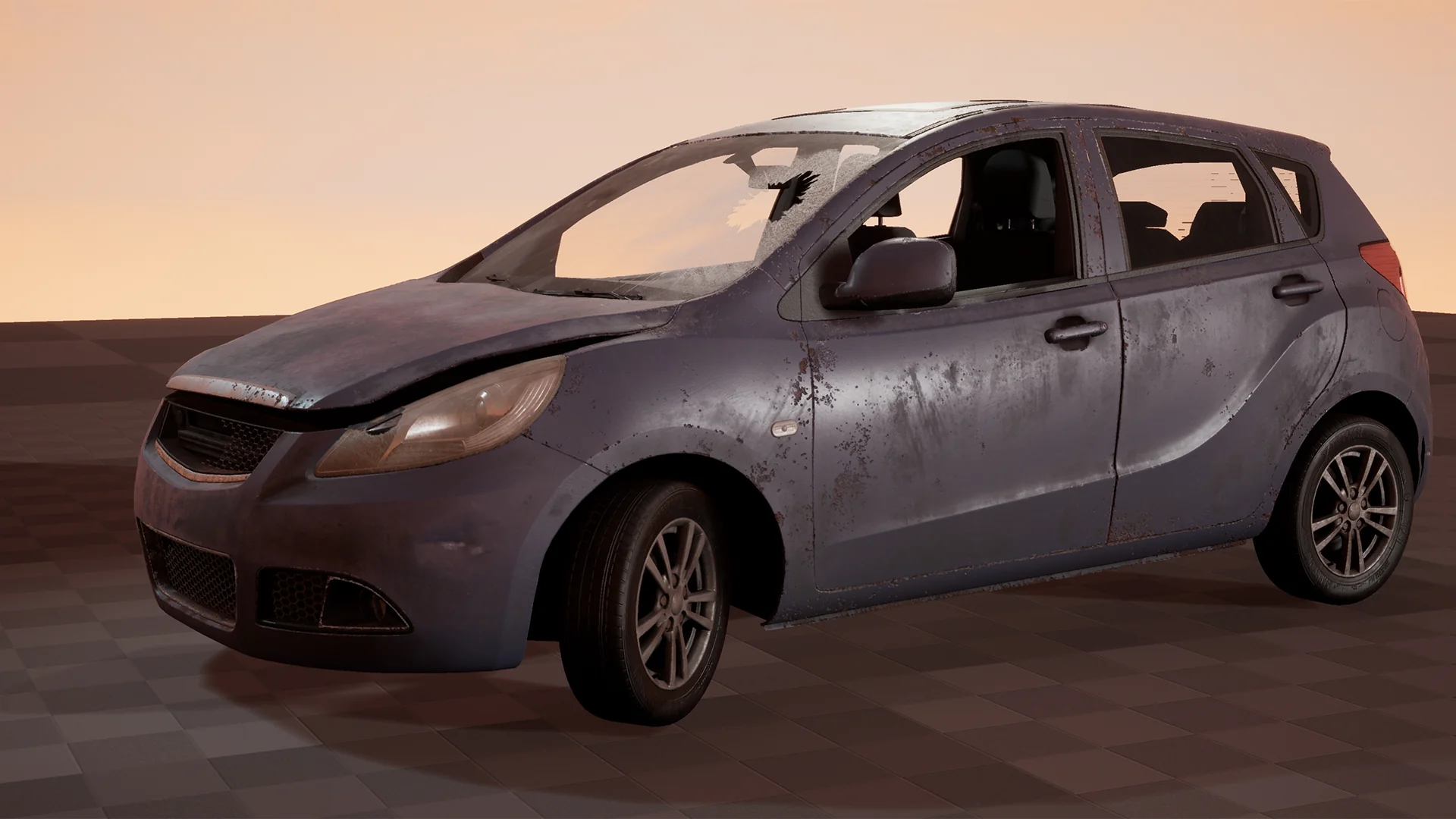
Park a dead hatchback at the edge of a street and the scene shifts. The eye lands on it before it lands on anything else — rust along the sills, glass gone or clouded, a silhouette that still reads as a car somebody used to drive. The Abandoned Hatchback Car is built for that beat. It is an abandoned vehicle carrying many customization options, so the wreck you place does not have to be the only wreck the asset can produce.
How the Abandoned Hatchback Car Reads in a Scene
Hatchbacks age in a particular way. They are small, upright, and domestic, which makes them convincing as everyday objects left behind — the kind of car that sits outside a shuttered shop or half off a kerb rather than the kind that belongs in a showroom or a chase sequence. Placing one turns an empty street into a street where something happened.
That is the practical role this asset fills: it is scene dressing with a recognizable body type. A hatchback in a destroyed state tells a story about ordinary life interrupted, which is exactly the register that post-apocalyptic and industrial environments need. A sports car reads as aspiration; a hatchback reads as errands. When the errands stop, the environment starts working.
Because the model is realistically proportioned and finished, it holds up close to camera as well as at distance. That matters when a scene calls for the player or the viewer to walk past a wreck rather than glance at it from a rooftop.
Customization and Modularity on the Hatchback
The customization is the part worth dwelling on. A single fixed wreck commits a project to one silhouette, one damage pattern, one color story, and repeating it across a block of buildings produces the tell-tale copy-paste look. A modular vehicle sidesteps that. Parts can be combined differently from instance to instance, so the same hatchback body can populate several positions in a scene without reading as the same object duplicated.
For layout work, this changes how a scene gets blocked out. Rather than hunting for four distinct abandoned cars, a level or environment artist can assemble variation from one modular set. Streets, parking bays, driveways, and roadside shoulders can each hold something slightly different while staying inside the same recognizable vehicle family.
Blueprint in the Vehicle Setup
Blueprint appears among the asset's tags, which points to engine-side logic sitting alongside the art — a scriptable setup rather than a static mesh with nothing behind it. For teams working in an engine where vehicle logic and mesh assembly are handled together, that is a meaningful practical difference: the wreck is not purely a decorative prop, and its parts are organized in a way that supports being handled programmatically.
Rust, Grunge, and the PBR Finish
The surface treatment is where the abandoned read is won or lost. The tag set here is dense and consistent: rusty, destroyed, grunge, old, retro, realistic, PBR. Those are not decorative labels — they describe a material approach built on physically based shading, so the metal, the corrosion, and the dirt sit in the same lighting response as the rest of a scene. A rusty hatchback lit by a low sun or a single streetlamp needs believable roughness breakup; PBR materials give the lighting something to work with.
There is an interesting tension in the tags as well. Modern and retro both appear, alongside old and industrial. That combination suggests a vehicle that can be read as contemporary-but-neglected or as genuinely dated, which widens the number of environments it can sit in without looking anachronistic. Grunge and destroyed cover everything from surface-level neglect to structural damage.
Where the Hatchback Sits Alongside Other Vehicles
This asset does not exist alone. A drivable hatchback and a broader customizable abandoned car belong to the same family of vehicle resources, which opens up an obvious production pattern: use one version for the car the player drives and the other for the cars the world left behind. Continuity between a working vehicle and the wrecks around it makes a setting feel like one place rather than a collection of unrelated props.
The surrounding catalog reinforces that. Background cars, city buses, trains, and city traffic tools all address the same problem — populating streets with believable vehicles at different distances and different levels of interaction. An abandoned hatchback is the stationary, story-carrying end of that spectrum.
Simulation and Automotive Contexts
Simulation is one of the listed tags, and it is a useful signal for how far the asset reaches beyond pure set dressing. Simulation environments need clutter that behaves and renders predictably, including vehicles that are not part of the driving experience — the broken-down car at the roadside, the abandoned one in the lot. A realistic, PBR-shaded hatchback fits that requirement without pulling attention away from the systems being simulated.
Post-apocalyptic work is the other clear home for it, and industrial scenes make a third: yards, depots, and loading areas where a neglected car is simply part of the environment rather than a plot point. In all three, the vehicle is doing the same job — filling space with something specific instead of something generic.
The Practical Takeaway for a Team
The strongest argument for this asset is that it refuses to be a single prop. A modular, customizable abandoned hatchback gives environment artists variation from one source, PBR materials give lighting something honest to work with, and the rusty, destroyed, grunge treatment means the wreck looks the part at close range. If a project already includes a drivable hatchback, adding the abandoned version keeps the world consistent; if it does not, the wreck alone still carries a street corner. Either way, the asset earns its place by being reusable rather than repeatable.
 Cars & Trucks
 Cars & Trucks
 Cars & Trucks