"c68a05d5e51405b3"{"id":"1000716","slug":"willow-lake-biome-environment","title":"Willow Lake Biome Environment","category":"Forest \u0026 Jungle","engine":"5.3+","assetVersion":"","engineVersion":"Engine Version: 5.3+","tag":"Forest \u0026 Jungle","accent":"blue","visual":"city","summary":"Unreal Engine lakeside biome pack with PCG foliage placement, willow trees, reflective water, wooden boardwalks, and Lumen/Nanite support.","platform":"Unreal Engine","publishedAt":"2026-07-24T12:01:30.082Z","updatedAt":"2026-07-24T12:01:30.082Z","sourceNotes":[],"fileContents":[],"compatibility":["Unreal Engine","Engine Version: 5.3+"],"featuredImage":{"alt":"Willow Lake Biome Environment","src":"/wp-content/uploads/published/2026/07/34d2104b5dd5-aa1a1dde-a3ba-42b1-974e-e5e7e0bfc434-a457b24d63.webp"},"hasDownloadLink":true,"downloads":1,"terms":[{"taxonomy":"category","slug":"forest-and-jungle","name":"Forest \u0026 Jungle"}],"galleryImages":[{"src":"/wp-content/uploads/published/2026/07/7167519b9dfa-77688e10-287b-4a50-9810-1382497fbf41-e7edce987f.webp","alt":"Willow Lake Biome Environment"},{"src":"/wp-content/uploads/published/2026/07/e1f360df8524-bf22990f-7572-4ffe-8e3b-70a92099ef8c-1b61cf544e.webp","alt":"Willow Lake Biome Environment"},{"src":"/wp-content/uploads/published/2026/07/3f2fb75fb053-52f8758c-a2e6-45e7-89cf-ccb299d3979d-c4e2174584.webp","alt":"Willow Lake Biome Environment"},{"src":"/wp-content/uploads/published/2026/07/4fd5e90bbdff-aaf80cc2-0b89-482e-a969-167d0982394c-e17e8a7041.webp","alt":"Willow Lake Biome Environment"},{"src":"/wp-content/uploads/published/2026/07/90a8a0ca213b-81cb3282-905e-443d-b338-b8c74b8f0e37-556b11543d.webp","alt":"Willow Lake Biome Environment"},{"src":"/wp-content/uploads/published/2026/07/a07f8f703f7f-e16cefc7-3a7c-407c-9554-ed8f296bfa1e-303d2ef6b3.webp","alt":"Willow Lake Biome Environment"},{"src":"/wp-content/uploads/published/2026/07/9d78c5f7cc2f-377ad5db-bb9f-434d-bc08-1aea06cbf25d-9f834b9380.webp","alt":"Willow Lake Biome Environment"},{"src":"/wp-content/uploads/published/2026/07/943098988db0-f6610d19-e965-4038-9471-798840b05427-d0d9163e66.webp","alt":"Willow Lake Biome Environment"},{"src":"/wp-content/uploads/published/2026/07/39f57100f7b3-09245854-99dc-4090-b8d9-f221eb7c813d-f14fbb2295.webp","alt":"Willow Lake Biome Environment"},{"src":"/wp-content/uploads/published/2026/07/e89c4b729265-4ef9e6c3-daea-4b1c-8353-bd6819dd824e-da3dec7136.webp","alt":"Willow Lake Biome Environment"}],"accessPanel":{"kind":"resource","title":"Download this resource","eyebrow":"Free Download","message":"Log in or create a free account to start your download.","fileName":"Content.7z","safetyNote":"Resources are manually reviewed before listing to improve quality and reduce obvious risks.","actionLabel":"Download Free","resourceType":"Resource archive"},"contentHtml":"\u003cp\u003eSome projects do not need a battlefield or a crowded city. They need a quiet shoreline where willow trees lean over still water and a wooden boardwalk traces the edge of the land. The Willow Lake Biome Environment is built for exactly those situations. Whether the goal is an exploration game that pauses on a calm lakeside vista, a relaxing cutscene framed by golden-hour light, or a world that simply needs a breath of fresh air, this pack provides the core components to assemble that scene in Unreal Engine.\u003c/p\u003e\n\n\u003ch2\u003eWhat Sits Inside the Willow Lake Biome Environment\u003c/h2\u003e\n\u003cp\u003eAt its center, the package is a lakeside scene assembly. It brings together willow trees, reeds, shrubs, and ground plants around a calm, reflective lake dotted with lily pads and water vegetation. A wooden boardwalk cuts through the greenery, giving a clear path for walkways and nature trails. Scattered rocks and tree stumps break up the shoreline, adding detail without requiring manual placement.\u003c/p\u003e\n\n\u003cp\u003eThe terrain uses natural materials with realistic blending, meaning the transition between grass, dirt, and shore does not rely on a single flat texture. The asset set is rounded out by an atmospheric lighting setup built for both daytime and golden-hour scenes. There are also birds, bugs, and breeze-ready ambiance elements included, though the creator notes that the actual sound files are left to the user to supply.\u003c/p\u003e\n\n\u003ch3\u003eVegetation Distribution Through PCG\u003c/h3\u003e\n\u003cp\u003eOne of the more production-relevant decisions in this pack is the foliage workflow. Instead of relying purely on hand-painted foliage volumes or static placement, the environment uses PCG Foliage Placement. This allows plants to spread naturally across large areas without manual brushing. The system handles the distribution of willows, reeds, shrubs, and ground plants, which matters most when the scene needs to fill a shoreline that stretches well beyond a hero prop.\u003c/p\u003e\n\n\u003cp\u003eThe foliage assets are described as optimized and ready for large-scale use. In use, this points toward a workflow where the user can block out and populate a sizable lakeside level without immediately running into performance walls from draw calls or overly dense manual placement. The PCG approach also means that iterating on coverage — adding a denser cluster of reeds near one stretch of shore, opening up a clearing near the boardwalk — becomes a parameter adjustment rather than a repaint.\u003c/p\u003e\n\n\u003ch2\u003eWhere This Lakeside Pack Fits in Production\u003c/h2\u003e\n\u003cp\u003eThe clearest fit is any scene that calls for a restrained, natural exterior. Exploration games that use lakeside landmarks as waypoints or rest points can drop this biome in as a composed environment rather than assembling one from individual tree and rock packs. Relaxing cutscenes benefit from the included daytime and golden-hour lighting setups, since the palette is already tuned to those moods. For larger worlds that need a nature respite between more intense areas, the willow lake functions as a tonal counterpoint.\u003c/p\u003e\n\n\u003cp\u003eThe wooden boardwalk is a specific structural piece worth noting. It gives the environment an implied player path, which is useful for level designers who need a read through the space. Rather than a purely decorative nature scene, the boardwalk suggests a route, and the scattered shoreline assets give that route edges and landmarks without requiring additional dressing packs.\u003c/p\u003e\n\n\u003ch3\u003ePlugin and Feature Requirements\u003c/h3\u003e\n\u003cp\u003eThis is not a drop-in pack that runs on a default empty project configuration. The following plugins and engine features \u003cstrong\u003eMUST BE ENABLED\u003c/strong\u003e for the environment to function correctly:\u003c/p\u003e\n\n\u003cul\u003e\n \u003cli\u003e\u003cstrong\u003ePCG Plugin\u003c/strong\u003e — Required for procedural foliage distribution across the landscape.\u003c/li\u003e\n \u003cli\u003e\u003cstrong\u003ePCG Geometry Script\u003c/strong\u003e — Required for procedural terrain and foliage generation logic.\u003c/li\u003e\n \u003cli\u003e\u003cstrong\u003eWater Plugin\u003c/strong\u003e — Required for the reflective lake surface, buoyancy, and water vegetation.\u003c/li\u003e\n \u003cli\u003e\u003cstrong\u003eHDRI Backdrop Plugin\u003c/strong\u003e — Required for sky and ambient lighting context.\u003c/li\u003e\n \u003cli\u003e\u003cstrong\u003eLumen\u003c/strong\u003e — Required for dynamic global illumination and realistic light bounce.\u003c/li\u003e\n \u003cli\u003e\u003cstrong\u003eNanite\u003c/strong\u003e — Enabled on select high-density meshes (requires Unreal Engine 5.0+).\u003c/li\u003e\n\u003c/ul\u003e\n\n\u003cp\u003eThese dependencies are structural, not optional — the PCG foliage, lighting, and water surfaces will not function as intended if any of these plugins are missing or disabled.\u003c/p\u003e\n\n\u003ch2\u003eUnreal Engine Dependencies and What They Mean for Your Project\u003c/h2\u003e\n\u003cp\u003eBecause the pack leans on Lumen, the intended visual result is dynamic lighting that responds to the scene's geometry and material properties. The golden-hour setup, in particular, depends on this for the warm bounce and soft shadow work that a lakeside scene relies on. The HDRI Backdrop requirement suggests the lighting context is tied to an HDRI sky rather than a purely directional light rig, which affects how the environment will look if extracted and placed into a different level.\u003c/p\u003e\n\n\u003cp\u003eThe Water Plugin component is critical to understand. The calm, reflective lake with lily pads and water vegetation is not a simple plane with a material on it. Unreal Engine's Water Plugin brings its own surface, buoyancy, and rendering systems, which means the lake is integrated into the environment through engine tooling rather than a custom shader trick. Projects that already use the Water Plugin will find this consistent with their setup. Projects that have avoided it will need to enable it.\u003c/p\u003e\n\n\u003ch3\u003eNanite Support and Performance Scope\u003c/h3\u003e\n\u003cp\u003eNanite is enabled on some meshes within the pack, not all. This is a practical distinction. The foliage and organic assets likely use Nanite where the geometry density justifies it — rocks, tree stumps, and similar shoreline detailing pieces are common candidates. The Nanite support for Unreal Engine 5.0+ sets a floor for engine version compatibility as well. Teams targeting UE5.0 and above can use the Nanite-enabled meshes as intended; teams on earlier versions cannot use that feature path.\u003c/p\u003e\n\n\u003cp\u003eThe combination of PCG foliage placement, optimized foliage assets, and Nanite on select meshes paints a picture of a pack built to cover large areas. The intent is to let users populate a full lakeside biome rather than a small garden, which is why the PCG system and optimization notes are foregrounded in the feature list.\u003c/p\u003e\n\n\u003ch2\u003eWho Benefits Most from This Environment Pack\u003c/h2\u003e\n\u003cp\u003eThis pack is strongest for developers who need a composed lakeside scene with an emphasis on natural foliage distribution and mood-correct lighting. The PCG system makes it suitable for projects that need to fill large shorelines without manual plant-by-plant work. The lighting setups make it a good starting point for daytime and golden-hour exterior scenes. The boardwalk and shoreline detailing assets provide structural read for level design. The main constraint is the dependency stack: Lumen, Nanite, PCG Plugin, HDRI Backdrop Plugin, Water Plugin, and PCG Geometry Script must all be enabled and compatible with the target Unreal Engine version. For teams already working in that UE5 feature set, the Willow Lake Biome Environment is a ready-made lakeside assembly. For teams on older engines or with these plugins disabled, the setup work falls on the user before the scene will run as intended.\u003c/p\u003e\n\n\u003ch2\u003eMore From The Same Workflow\u003c/h2\u003e\n\u003cul\u003e\n\u003cli\u003e\u003ca href=\"https://3dcghub.com/wildlands-stylized-nature-pine-forest-trees-foliage-nature-forest-biome/\" title=\"Wildlands: Stylized Nature (Pine Forest, Trees, Foliage, Nature, Forest, Biome)\"\u003eWildlands: Stylized Nature (Pine Forest, Trees, Foliage, Nature, Forest, Biome)\u003c/a\u003e\u003c/li\u003e\n\u003cli\u003e\u003ca href=\"https://3dcghub.com/red-pine-biome/\" title=\"Red Pine Biome\"\u003eRed Pine Biome\u003c/a\u003e\u003c/li\u003e\n\u003cli\u003e\u003ca href=\"https://3dcghub.com/mw-meadow-forest-trees-biome/\" title=\"MW Meadow Forest Trees Biome\"\u003eMW Meadow Forest Trees Biome\u003c/a\u003e\u003c/li\u003e\n\u003cli\u003e\u003ca href=\"https://3dcghub.com/procedural-biomes/\" title=\"Procedural Biomes\"\u003eProcedural Biomes\u003c/a\u003e\u003c/li\u003e\n\u003cli\u003e\u003ca href=\"https://3dcghub.com/mw-conifer-forest-trees-biome/\" title=\"MW Conifer Forest Trees Biome\"\u003eMW Conifer Forest Trees Biome\u003c/a\u003e\u003c/li\u003e\n\u003c/ul\u003e","contentTextLength":7269,"navigation":{"current":1287,"total":3860,"previous":{"id":"1000717","slug":"xiao-jue-asian-girl","title":"Xiao Jue - Asian Girl","category":"Humans","platform":"Unreal Engine","updatedAt":"2026-07-24T12:37:39.846Z"},"next":{"id":"1000715","slug":"western-npc-metahuman","title":"Western NPC - Metahuman","category":"Characters \u0026 Creatures","platform":"Unreal Engine","updatedAt":"2026-07-24T11:47:34.725Z"}},"relatedResources":[{"id":"1000351","slug":"wildlands-stylized-nature-pine-forest-trees-foliage-nature-forest-biome","title":"Wildlands: Stylized Nature (Pine Forest, Trees, Foliage, Nature, Forest, Biome)","category":"Forest \u0026 Jungle","engine":"5.2+","assetVersion":"","engineVersion":"Engine Version: 5.2+","tag":"Forest \u0026 Jungle","accent":"blue","visual":"mech","summary":"Implement a stylized nature ecosystem with a procedural landscape system, Nanite-ready assets, smart materials, and dynamic weather in Unreal Engine.","platform":"Unreal Engine","publishedAt":"2026-07-05T09:58:16.836Z","updatedAt":"2026-07-05T09:58:16.836Z","sourceNotes":[],"fileContents":[],"compatibility":["Unreal Engine","Engine Version: 5.2+"],"featuredImage":{"alt":"Wildlands: Stylized Nature (Pine Forest, Trees, Foliage, Nature, Forest, Biome)","src":"/wp-content/uploads/published/2026/07/f21a5fbc4225-6e5084cb-4357-4112-8e9f-2a0ff3086973-41cd4bd8e7.webp"},"hasDownloadLink":true,"downloads":1},{"id":"1001490","slug":"the-pine-environment-foliage-island-pcg-nature-river-nature-nature-biom","title":"The Pine Environment ( Foliage Island PCG Nature River Nature Nature Biom )","category":"Forest \u0026 Jungle","engine":"5.4+","assetVersion":"","engineVersion":"Engine Version: 5.4+","tag":"Forest \u0026 Jungle","accent":"blue","visual":"city","summary":"Explore The Pine Environment, featuring 53 unique meshes, procedural PCG scattering, river biomes, Nanite and Lumen support, and ULAT modular integration.","platform":"Unreal Engine","publishedAt":"2026-10-08T10:04:47.716Z","updatedAt":"2026-10-08T10:04:47.716Z","sourceNotes":[],"fileContents":[],"compatibility":["Unreal Engine","Engine Version: 5.4+"],"featuredImage":{"alt":"The Pine Environment ( Foliage Island PCG Nature River Nature Nature Biom )","src":"/wp-content/uploads/published/2026/10/3ea4f6900e86-b4efa431-bc2a-403b-8c5c-6b72af4180f0-c94ccb1b90.webp"},"hasDownloadLink":true,"downloads":2},{"id":"1001107","slug":"broadleaf-poplar-forest-pcg-biome","title":"Broadleaf Poplar Forest - PCG Biome","category":"Forest \u0026 Jungle","engine":"5.4+","assetVersion":"","engineVersion":"Engine Version: 5.4+","tag":"Forest \u0026 Jungle","accent":"blue","visual":"mech","summary":"Fully procedural PCG poplar biome for Unreal Engine: photoscanned trees, dynamic wind and foliage interaction, plus World Partition and runtime generation.","platform":"Unreal Engine","publishedAt":"2026-09-07T06:21:06.743Z","updatedAt":"2026-09-07T06:21:06.743Z","sourceNotes":[],"fileContents":[],"compatibility":["Unreal Engine","Engine Version: 5.4+"],"featuredImage":{"alt":"Broadleaf Poplar Forest - PCG Biome","src":"/wp-content/uploads/published/2026/09/62ee8e5ec890-f775a27c-8e9d-49c5-bb9a-6fd09118f806-4aeeb75b35.webp"},"hasDownloadLink":true,"downloads":4}]}
Forest & Jungle
Willow Lake Biome Environment
Unreal Engine lakeside biome pack with PCG foliage placement, willow trees, reflective water, wooden boardwalks, and Lumen/Nanite support.
Some projects do not need a battlefield or a crowded city. They need a quiet shoreline where willow trees lean over still water and a wooden boardwalk traces the edge of the land. The Willow Lake Biome Environment is built for exactly those situations. Whether the goal is an exploration game that pauses on a calm lakeside vista, a relaxing cutscene framed by golden-hour light, or a world that simply needs a breath of fresh air, this pack provides the core components to assemble that scene in Unreal Engine.
What Sits Inside the Willow Lake Biome Environment
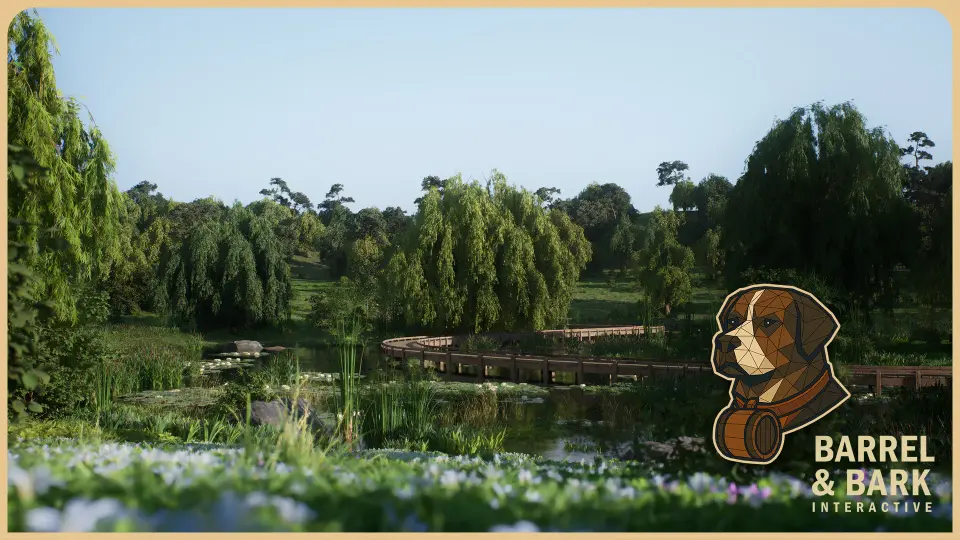
At its center, the package is a lakeside scene assembly. It brings together willow trees, reeds, shrubs, and ground plants around a calm, reflective lake dotted with lily pads and water vegetation. A wooden boardwalk cuts through the greenery, giving a clear path for walkways and nature trails. Scattered rocks and tree stumps break up the shoreline, adding detail without requiring manual placement.
The terrain uses natural materials with realistic blending, meaning the transition between grass, dirt, and shore does not rely on a single flat texture. The asset set is rounded out by an atmospheric lighting setup built for both daytime and golden-hour scenes. There are also birds, bugs, and breeze-ready ambiance elements included, though the creator notes that the actual sound files are left to the user to supply.
Vegetation Distribution Through PCG
One of the more production-relevant decisions in this pack is the foliage workflow. Instead of relying purely on hand-painted foliage volumes or static placement, the environment uses PCG Foliage Placement. This allows plants to spread naturally across large areas without manual brushing. The system handles the distribution of willows, reeds, shrubs, and ground plants, which matters most when the scene needs to fill a shoreline that stretches well beyond a hero prop.
The foliage assets are described as optimized and ready for large-scale use. In use, this points toward a workflow where the user can block out and populate a sizable lakeside level without immediately running into performance walls from draw calls or overly dense manual placement. The PCG approach also means that iterating on coverage — adding a denser cluster of reeds near one stretch of shore, opening up a clearing near the boardwalk — becomes a parameter adjustment rather than a repaint.
Where This Lakeside Pack Fits in Production
The clearest fit is any scene that calls for a restrained, natural exterior. Exploration games that use lakeside landmarks as waypoints or rest points can drop this biome in as a composed environment rather than assembling one from individual tree and rock packs. Relaxing cutscenes benefit from the included daytime and golden-hour lighting setups, since the palette is already tuned to those moods. For larger worlds that need a nature respite between more intense areas, the willow lake functions as a tonal counterpoint.
The wooden boardwalk is a specific structural piece worth noting. It gives the environment an implied player path, which is useful for level designers who need a read through the space. Rather than a purely decorative nature scene, the boardwalk suggests a route, and the scattered shoreline assets give that route edges and landmarks without requiring additional dressing packs.
Plugin and Feature Requirements
This is not a drop-in pack that runs on a default empty project configuration. The following plugins and engine features MUST BE ENABLED for the environment to function correctly:
PCG Plugin — Required for procedural foliage distribution across the landscape.
PCG Geometry Script — Required for procedural terrain and foliage generation logic.
Water Plugin — Required for the reflective lake surface, buoyancy, and water vegetation.
HDRI Backdrop Plugin — Required for sky and ambient lighting context.
Lumen — Required for dynamic global illumination and realistic light bounce.
These dependencies are structural, not optional — the PCG foliage, lighting, and water surfaces will not function as intended if any of these plugins are missing or disabled.
Unreal Engine Dependencies and What They Mean for Your Project
Because the pack leans on Lumen, the intended visual result is dynamic lighting that responds to the scene's geometry and material properties. The golden-hour setup, in particular, depends on this for the warm bounce and soft shadow work that a lakeside scene relies on. The HDRI Backdrop requirement suggests the lighting context is tied to an HDRI sky rather than a purely directional light rig, which affects how the environment will look if extracted and placed into a different level.
The Water Plugin component is critical to understand. The calm, reflective lake with lily pads and water vegetation is not a simple plane with a material on it. Unreal Engine's Water Plugin brings its own surface, buoyancy, and rendering systems, which means the lake is integrated into the environment through engine tooling rather than a custom shader trick. Projects that already use the Water Plugin will find this consistent with their setup. Projects that have avoided it will need to enable it.
Nanite Support and Performance Scope
Nanite is enabled on some meshes within the pack, not all. This is a practical distinction. The foliage and organic assets likely use Nanite where the geometry density justifies it — rocks, tree stumps, and similar shoreline detailing pieces are common candidates. The Nanite support for Unreal Engine 5.0+ sets a floor for engine version compatibility as well. Teams targeting UE5.0 and above can use the Nanite-enabled meshes as intended; teams on earlier versions cannot use that feature path.
The combination of PCG foliage placement, optimized foliage assets, and Nanite on select meshes paints a picture of a pack built to cover large areas. The intent is to let users populate a full lakeside biome rather than a small garden, which is why the PCG system and optimization notes are foregrounded in the feature list.
Who Benefits Most from This Environment Pack
This pack is strongest for developers who need a composed lakeside scene with an emphasis on natural foliage distribution and mood-correct lighting. The PCG system makes it suitable for projects that need to fill large shorelines without manual plant-by-plant work. The lighting setups make it a good starting point for daytime and golden-hour exterior scenes. The boardwalk and shoreline detailing assets provide structural read for level design. The main constraint is the dependency stack: Lumen, Nanite, PCG Plugin, HDRI Backdrop Plugin, Water Plugin, and PCG Geometry Script must all be enabled and compatible with the target Unreal Engine version. For teams already working in that UE5 feature set, the Willow Lake Biome Environment is a ready-made lakeside assembly. For teams on older engines or with these plugins disabled, the setup work falls on the user before the scene will run as intended.
 Forest & Jungle
 Forest & Jungle
 Forest & Jungle
 Forest & Jungle