"148d1066ed74e216"{"id":"1002956","slug":"utility-ai-wise-feline-ultimate-v3-npc-memory-emotions-smart-objects-gas","title":"Utility AI - Wise Feline Ultimate V3 (NPC Memory, Emotions, Smart Objects, GAS)","category":"Artificial Intelligence","engine":"5.1 - 5.6","assetVersion":"Asset Version: 1.7.0 - 2.1.0","engineVersion":"Engine Version: 5.1 - 5.6","tag":"Artificial Intelli","accent":"blue","visual":"mech","summary":"Explore Utility AI - Wise Feline Ultimate V3 for Unreal Engine, featuring dynamic utility scoring, Remembrance memory, GAS, and Smart Object integration.","platform":"Unreal Engine","indexPolicy":"index","publishedAt":"2026-11-22T07:45:59.630Z","updatedAt":"2026-11-22T07:45:59.630Z","sourceNotes":[],"fileContents":[],"compatibility":["Unreal Engine","Asset Version: 1.7.0 - 2.1.0","Engine Version: 5.1 - 5.6"],"featuredImage":{"alt":"Utility AI - Wise Feline Ultimate V3 (NPC Memory, Emotions, Smart Objects, GAS)","src":"/wp-content/uploads/published/2026/11/45b6bf8ea8f6-91c04886-97fd-407b-a273-5d6bac76c816-147f0d423b.webp"},"fileSizeBytes":8305138,"hasDownloadLink":true,"downloads":0,"terms":[{"taxonomy":"category","slug":"artificial-intelligence-tools-and-plugins","name":"Artificial Intelligence"}],"galleryImages":[{"src":"/wp-content/uploads/published/2026/11/6ddc502c5ec4-8fc76426-b8ad-465d-b49e-5f66fe97b2ab-aae42252c6.webp","alt":"Utility AI - Wise Feline Ultimate V3 (NPC Memory, Emotions, Smart Objects, GAS)"},{"src":"/wp-content/uploads/published/2026/11/f3d0492e7526-3dc7de40-8278-40f0-9772-49935556de79-10ddb270af.webp","alt":"Utility AI - Wise Feline Ultimate V3 (NPC Memory, Emotions, Smart Objects, GAS)"},{"src":"/wp-content/uploads/published/2026/11/fd1e4cff1098-4a447661-28cd-4179-b27d-02c7bbd2ba82-192f6b7b56.webp","alt":"Utility AI - Wise Feline Ultimate V3 (NPC Memory, Emotions, Smart Objects, GAS)"},{"src":"/wp-content/uploads/published/2026/11/d38d6082932b-db60cc1a-5d8f-4581-b696-94e1419da411-709f89e3e0.webp","alt":"Utility AI - Wise Feline Ultimate V3 (NPC Memory, Emotions, Smart Objects, GAS)"},{"src":"/wp-content/uploads/published/2026/11/38d860395fb0-b7a62fa8-8342-4f02-a1fa-b3b3b9140ea5-8d18bad6dd.webp","alt":"Utility AI - Wise Feline Ultimate V3 (NPC Memory, Emotions, Smart Objects, GAS)"},{"src":"/wp-content/uploads/published/2026/11/3a1d11f6151a-6de3c6b8-3bb9-4c52-a5a1-cbc3b01e8873-75a2d8146c.webp","alt":"Utility AI - Wise Feline Ultimate V3 (NPC Memory, Emotions, Smart Objects, GAS)"},{"src":"/wp-content/uploads/published/2026/11/3393eb71a460-938c8313-3504-431a-bef0-935f9c8731b5-324e2eee37.webp","alt":"Utility AI - Wise Feline Ultimate V3 (NPC Memory, Emotions, Smart Objects, GAS)"}],"accessPanel":{"kind":"resource","title":"Get this resource","safetyNote":"Resources are manually reviewed before listing to improve quality and reduce obvious risks.","fileName":"Wise Feline.7z","resourceType":"Resource archive","versions":[]},"contentHtml":"\u003ch2\u003eDynamic Decision-Making with Wise Feline Ultimate\u003c/h2\u003e\n\u003cp\u003eA villager working in the fields often faces competing demands. Finishing a daily task takes priority over a slight appetite, but as hunger grows, lunchtime eventually overrules field work. If a wolf suddenly appears on the path, both labor and meal plans need to be abandoned immediately. Wise Feline Ultimate gives Unreal Engine non-player characters a structured way to handle these shifting priorities. Instead of navigating rigid, tangled state trees, the character assigns a score to each candidate action based on its immediate perception of the world, determining whether an active task should continue or yield to an interruption.\u003c/p\u003e\n\u003cp\u003eDecision-making within this framework operates on continuous utility evaluation. Every action an agent can take is vetted against the current state of the game environment. When circumstances change—whether through rising danger, shifting survival stats, or secondary opportunities—the utility framework re-evaluates the validity of current tasks against emerging options, allowing NPCs to step away from repetitive scripts and respond fluidly to ambient events.\u003c/p\u003e \u003ch2\u003eConsiderations, Curves, and Action Scoring\u003c/h2\u003e\n\u003cp\u003eAt the center of the utility calculation are considerations. A consideration gathers raw data from the game—such as an actor's hunger level, spatial distance to an adversary, or remaining ammunition—and normalizes it. A response curve then converts that raw measurement into a definitive numerical score. By adjusting the shape of the mathematical curve, designers dictate how an NPC perceives urgency. A linear curve yields a steady rise in motivation, while an exponential curve keeps an NPC passive until a threshold is crossed, triggering sudden, decisive action.\u003c/p\u003e\n\u003cp\u003eDevelopers can assemble actions and considerations using either Blueprint or C++, combining them directly inside the behavior editor. The framework includes 17 editable presets that serve as baselines for common behaviors. Actions are modular assets that can be shared across multiple behavior definitions, and full behaviors can be dynamically added or removed from an agent at runtime. When picking what to do next, the agent can either select the absolute highest-scoring action for strict, deterministic choices or sample from the top candidates using uniform or score-weighted randomness to introduce organic variability into group behavior.\u003c/p\u003e \u003ch2\u003eDeep Diagnostics with the Decision Debugger and Memory Inspector\u003c/h2\u003e\n\u003cp\u003eComplex utility scoring can become opaque without robust diagnostic tools. Wise Feline Ultimate addresses this by letting developers pin an individual agent brain inside a dedicated decision debugger. While the game runs, the tool provides real-time visibility into which actions were weighed, which action maintained execution priority, and how each input value, response curve, and target score contributed to the outcome. When diagnosing rapid logic changes, the display can be frozen to inspect a frame without interrupting the background recording. Furthermore, decision data surrounding an action switch can be exported for post-run analysis even after a Play In Editor session has terminated.\u003c/p\u003e\n\u003cp\u003eDiagnostic support extends into Unreal Engine's native profiling suite. The system includes built-in hooks for both the Visual Logger and the Gameplay Debugger. For projects tracking social relationships and emotional states, the Memory and Emotion Inspector exposes the internal states managed by the Remembrance module, ensuring developers can verify why an agent holds a grudge, displays fear, or warms up to friendly players.\u003c/p\u003e \u003ch2\u003eLiving Village Simulation and Emotional Remembrance\u003c/h2\u003e\n\u003cp\u003eIncluded with the Ultimate package is Wise Feline Remembrance, a subsystem dedicated to tracking personal history and emotional sentiment. A past encounter can directly color an agent's future choices through four specialized considerations:\u003c/p\u003e\n\u003cul\u003e \u003cli\u003eThe general mood of the NPC across time.\u003c/li\u003e \u003cli\u003eThe specific emotional disposition held toward a distinct actor.\u003c/li\u003e \u003cli\u003eThe elapsed game time since a particular event occurred.\u003c/li\u003e \u003cli\u003eThe total count of matching events stored in the character's memory.\u003c/li\u003e\n\u003c/ul\u003e\n\u003cp\u003eThese mechanics are showcased in the Living Village sample, built as a standalone Blueprint demonstration in Unreal Engine 5.8. The sample models seven individual villagers as they balance hunger, physical fatigue, socialization, and vocational tasks. If an NPC witnesses a player stealing goods from a market stall, that witness can seek out a town guard to report the crime. Returning the stolen parcel prompts the merchant to adjust transaction pricing, yet the independent witness continues to remember the original theft. The sample demonstrates the combined power of Ultimate decision-making, spatial Influence Maps, and integration toolsets working simultaneously within an interconnected community.\u003c/p\u003e \u003ch2\u003eIntegrating Smart Objects, GAS, and Behavior Trees\u003c/h2\u003e\n\u003cp\u003eUtility architecture does not require discarding conventional Unreal Engine AI workflows. An entire existing Behavior Tree can be encapsulated and run as a single utility action. The system can read from and write to standard AI Blackboards, run and evaluate Environment Query System (EQS) queries, and command agents to navigate toward the resulting query positions.\u003c/p\u003e\n\u003cp\u003eThrough the separate, free WFIntegrations package, utility logic connects directly to Epic's modern gameplay systems. Actions can claim, navigate to, and interact with Smart Objects placed throughout a level. For titles utilizing the Gameplay Ability System (GAS), the integration allows utility actions to trigger specific Gameplay Abilities while utilizing specialized considerations that evaluate gameplay tags, check attribute values, or determine whether an ability is off cooldown and ready for activation.\u003c/p\u003e \u003ch2\u003eAI Assistant Workflow and Behavior Authoring in UE 5.8\u003c/h2\u003e\n\u003cp\u003eTo accelerate setup and balancing, the package bundles an AI assistant skill tailored for utility behavior design. The skill equips external language models with domain-specific knowledge regarding response curve design, spatial target filtering, and action lifecycle handling. Designers can query the assistant to draft specialized curves—such as balancing cautious reload tendencies against offensive pressure—or to troubleshoot logic anomalies where a sentry fails to break a patrol path when enemies enter range.\u003c/p\u003e\n\u003cp\u003eSetup is managed directly within the editor via Tools \u0026gt; Wise Feline \u0026gt; Getting Started, which installs bundled skills for development environments including Codex, Claude Code, and Gemini CLI, or configures prompts for web interfaces such as ChatGPT, Claude Cowork, and Gemini Gems. In Unreal Engine 5.8, developers can connect an assistant directly to the editor using the Model Context Protocol (MCP), enabling external agents to directly inspect, create, and refine behavior assets, considerations, actions, and evaluation curves inside the project workspace.\u003c/p\u003e\n\n\u003ch2\u003eMore From The Same Workflow\u003c/h2\u003e\n\u003cul\u003e\n\u003cli\u003e\u003ca href=\"https://3dcghub.com/world-director-npc-pro-massive-npc-simulation-with-multiplayer-and-optimization/\" rel=\"noopener noreferrer\"\u003eWorld Director NPC PRO – Massive NPC Simulation with Multiplayer \u0026amp; Optimization\u003c/a\u003e\u003c/li\u003e\n\u003cli\u003e\u003ca href=\"https://3dcghub.com/runtime-ai-chatbot-integrator-tts/\" rel=\"noopener noreferrer\"\u003eRuntime AI Chatbot Integrator (+TTS)\u003c/a\u003e\u003c/li\u003e\n\u003cli\u003e\u003ca href=\"https://3dcghub.com/ultimate-game-ready-character-and-enemy-ai/\" rel=\"noopener noreferrer\"\u003eUltimate Game Ready Character and Enemy AI\u003c/a\u003e\u003c/li\u003e\n\u003cli\u003e\u003ca href=\"https://3dcghub.com/fast-ai-plugin-multiplayer/\" rel=\"noopener noreferrer\"\u003eFast AI Plugin (Multiplayer)\u003c/a\u003e\u003c/li\u003e\n\u003cli\u003e\u003ca href=\"https://3dcghub.com/advanced-phone-system-v3-replicated/\" rel=\"noopener noreferrer\"\u003eAdvanced Phone System V3 Replicated\u003c/a\u003e\u003c/li\u003e\n\u003c/ul\u003e","contentTextLength":7167,"navigation":{"current":14,"total":4890,"previous":{"id":"14194","slug":"mission-objectives","title":"Mission \u0026 Objectives","category":"Engine Tools","platform":"Unreal Engine","updatedAt":"2026-11-22T07:52:47.616Z"},"next":{"id":"1002955","slug":"cross-platform-voice-chat-pro","title":"Cross-Platform Voice Chat Pro","category":"Network \u0026 Multiplayer","platform":"Unreal Engine","updatedAt":"2026-11-22T07:12:51.498Z"}},"relatedResources":[{"id":"1001260","slug":"world-director-npc-pro-massive-npc-simulation-with-multiplayer-and-optimization","title":"World Director NPC PRO – Massive NPC Simulation with Multiplayer \u0026 Optimization","category":"Artificial Intelligence","engine":"4.26 - 5.8","assetVersion":"Asset Version: 1.1.6 - 2.2.4","engineVersion":"Engine Version: 4.26 - 5.8","tag":"Artificial Intelli","accent":"blue","visual":"mech","summary":"Simulate thousands of persistent NPCs in Unreal Engine with World Director NPC PRO, featuring four optimization tiers, multithreaded AI, and multiplayer support","platform":"Unreal Engine","indexPolicy":"index","publishedAt":"2026-09-30T05:29:11.329Z","updatedAt":"2026-09-30T05:29:11.329Z","sourceNotes":[],"fileContents":[],"compatibility":["Unreal Engine","Asset Version: 1.1.6 - 2.2.4","Engine Version: 4.26 - 5.8"],"featuredImage":{"alt":"World Director NPC PRO – Massive NPC Simulation with Multiplayer \u0026 Optimization","src":"/wp-content/uploads/published/2026/09/d7eb47e30036-c6858b58-c55b-4e92-8af4-f18c94ce9c23-0fcfe248e5.webp"},"fileSizeBytes":319068314,"hasDownloadLink":true,"downloads":2},{"id":"13584","slug":"runtime-ai-chatbot-integrator-tts","title":"Runtime AI Chatbot Integrator (+TTS)","category":"Artificial Intelligence","engine":"5.0 - 5.7","assetVersion":"Asset Version:1.0","engineVersion":"Engine version: 5.0 - 5.7","tag":"Artificial Intelli","accent":"blue","visual":"audio","summary":"Integrate cutting-edge AI chatbots and natural-sounding speech into your Unreal Engine projects. This Blueprint-ready plugin supports top models like GPT, Claude, and Gemini.","platform":"Unreal Engine","indexPolicy":"index","publishedAt":"2026-03-11T03:43:51.000Z","updatedAt":"2026-08-03T02:06:54.252Z","sourceNotes":[],"fileContents":[],"compatibility":["Unreal Engine","Asset Version:1.0","Engine version: 5.0 - 5.7"],"featuredImage":{"alt":"Runtime AI Chatbot Integrator (+TTS)","src":"https://3dcghub.com/wp-content/uploads/2026/03/d18b3ecd-be4b-4066-80e2-af28fdc168d2.webp"},"fileSizeBytes":170876236,"hasDownloadLink":true,"downloads":2},{"id":"1001473","slug":"ultimate-game-ready-character-and-enemy-ai","title":"Ultimate Game Ready Character and Enemy AI","category":"Action-Adventure","engine":"5.4+","assetVersion":"","engineVersion":"Engine Version: 5.4+","tag":"Action-Adventure","accent":"blue","visual":"character","summary":"Explore the mechanics of Ultimate Game Ready Character and Enemy AI, featuring Behavior Tree combatants, Niagara VFX, and modular player systems.","platform":"Unreal Engine","indexPolicy":"index","publishedAt":"2026-10-08T08:24:45.975Z","updatedAt":"2026-10-08T08:24:45.975Z","sourceNotes":[],"fileContents":[],"compatibility":["Unreal Engine","Engine Version: 5.4+"],"featuredImage":{"alt":"Ultimate Game Ready Character and Enemy AI","src":"https://media.fab.com/image_previews/gallery_images/179897da-4b4e-4fd2-a0e2-f27677b2278e/daaa7fc3-a13a-4879-80a9-5bfe18feb434.png"},"fileSizeBytes":321354554,"hasDownloadLink":true,"downloads":2}]}[{"id":4225,"sourceId":4225,"taxonomyId":4225,"taxonomy":"category","slug":"asset-library","name":"Asset Library","parentId":null,"count":4744,"hasChildren":true,"href":"/","seoTitle":"Free Game Assets Library | 3DCGHUB","seoDescription":"Browse free Unreal Engine, Unity, Blender assets and game development tutorials on 3DCGHUB with previews, compatibility notes, and secure downloads.","sitemapEnabled":true,"children":[{"id":4227,"sourceId":4227,"taxonomyId":4227,"taxonomy":"category","slug":"blender-add-ons-plugins","name":"Blender Add-ons \u0026 Plugins","parentId":4225,"count":10,"hasChildren":false,"href":"/category/blender-add-ons-plugins/","seoTitle":"Free Blender Add-ons \u0026 Plugins | 3DCGHUB","seoDescription":"Browse free Blender Add-ons \u0026 Plugins tools for Blender on 3DCGHUB: curated downloads with preview images, compatibility notes and secure download access.","sitemapEnabled":true},{"id":514,"sourceId":514,"taxonomyId":514,"taxonomy":"category","slug":"unity-2","name":"Unity","parentId":4225,"count":453,"hasChildren":true,"href":"/category/unity-2/","seoTitle":"Free Unity Assets | 3DCGHUB","seoDescription":"Browse free Unity resources on 3DCGHUB: curated downloads with preview images, compatibility notes and secure download access.","sitemapEnabled":true,"children":[{"id":523,"sourceId":523,"taxonomyId":523,"taxonomy":"category","slug":"2d","name":"2D","parentId":514,"count":1,"hasChildren":true,"href":"/category/2d/","seoTitle":"Free Unity 2D | 3DCGHUB","seoDescription":"Browse free 2D assets for Unity on 3DCGHUB: curated downloads with preview images, compatibility notes and secure download access.","sitemapEnabled":true},{"id":515,"sourceId":515,"taxonomyId":515,"taxonomy":"category","slug":"3d-unity-2","name":"3D","parentId":514,"count":162,"hasChildren":true,"href":"/category/3d-unity-2/","seoTitle":"Free Unity 3D Assets | 3DCGHUB","seoDescription":"Browse free 3D assets for Unity on 3DCGHUB: curated downloads with preview images, compatibility notes and secure download access.","sitemapEnabled":true},{"id":565,"sourceId":565,"taxonomyId":565,"taxonomy":"category","slug":"add-ons","name":"Add-Ons","parentId":514,"count":2,"hasChildren":false,"href":"/category/add-ons/","seoTitle":"Free Unity Add-Ons | 3DCGHUB","seoDescription":"Browse free Add-Ons assets for Unity on 3DCGHUB: curated downloads with preview images, compatibility notes and secure download access.","sitemapEnabled":true},{"id":529,"sourceId":529,"taxonomyId":529,"taxonomy":"category","slug":"audio-unity-2","name":"Audio","parentId":514,"count":1,"hasChildren":true,"href":"/category/audio-unity-2/","seoTitle":"Free Unity Audio | 3DCGHUB","seoDescription":"Browse free Audio for Unity on 3DCGHUB: curated downloads with preview images, compatibility notes and secure download access.","sitemapEnabled":true},{"id":557,"sourceId":557,"taxonomyId":557,"taxonomy":"category","slug":"templates","name":"Templates","parentId":514,"count":36,"hasChildren":true,"href":"/category/templates/","seoTitle":"Free Unity Templates | 3DCGHUB","seoDescription":"Browse free Unity project templates on 3DCGHUB. Starter kits with previews, compatibility notes, and secure download access.","sitemapEnabled":true},{"id":533,"sourceId":533,"taxonomyId":533,"taxonomy":"category","slug":"tools-unity-2","name":"Tools","parentId":514,"count":0,"hasChildren":true,"href":"/category/tools-unity-2/","sitemapEnabled":true},{"id":554,"sourceId":554,"taxonomyId":554,"taxonomy":"category","slug":"vfx-unity-2","name":"VFX","parentId":514,"count":4,"hasChildren":true,"href":"/category/vfx-unity-2/","seoTitle":"Free Unity VFX | 3DCGHUB","seoDescription":"Browse free VFX for Unity on 3DCGHUB: curated downloads with preview images, compatibility notes and secure download access.","sitemapEnabled":true}]},{"id":511,"sourceId":511,"taxonomyId":511,"taxonomy":"category","slug":"unreal-engine-2","name":"Unreal Engine","parentId":4225,"count":4282,"hasChildren":true,"href":"/category/unreal-engine-2/","seoTitle":"Free Unreal Engine Assets | 3DCGHUB","seoDescription":"Browse free Unreal Engine resources on 3DCGHUB: curated downloads with preview images, compatibility notes and secure download access.","sitemapEnabled":true,"children":[{"id":54,"sourceId":54,"taxonomyId":54,"taxonomy":"category","slug":"3d","name":"3D","parentId":511,"count":2428,"hasChildren":true,"href":"/category/3d/","seoTitle":"Free Unreal Engine 3D | 3DCGHUB","seoDescription":"Browse free 3D assets for Unreal Engine on 3DCGHUB: curated downloads with preview images, compatibility notes and secure download access.","sitemapEnabled":true},{"id":441,"sourceId":441,"taxonomyId":441,"taxonomy":"category","slug":"animations","name":"Animations","parentId":511,"count":245,"hasChildren":true,"href":"/category/animations/","seoTitle":"Free Unreal Engine Animations | 3DCGHUB","seoDescription":"Browse free Animations for Unreal Engine on 3DCGHUB: curated downloads with preview images, compatibility notes and secure download access.","sitemapEnabled":true},{"id":446,"sourceId":446,"taxonomyId":446,"taxonomy":"category","slug":"audio","name":"Audio","parentId":511,"count":63,"hasChildren":true,"href":"/category/audio/","seoTitle":"Free Unreal Engine Audio Resources | 3DCGHUB","seoDescription":"Browse free Unreal Engine audio resources including sound effects, voices, dialogue, and ambient sounds. Curated free downloads on 3DCGHUB.","sitemapEnabled":true},{"id":466,"sourceId":466,"taxonomyId":466,"taxonomy":"category","slug":"game-systems","name":"Game Systems","parentId":511,"count":356,"hasChildren":true,"href":"/category/game-systems/","seoTitle":"Free Unreal Engine Game Systems | 3DCGHUB","seoDescription":"Browse free Game Systems tools for Unreal Engine on 3DCGHUB: curated downloads with preview images, compatibility notes and secure download access.","sitemapEnabled":true},{"id":478,"sourceId":478,"taxonomyId":478,"taxonomy":"category","slug":"game-templates","name":"Game Templates","parentId":511,"count":150,"hasChildren":true,"href":"/category/game-templates/","seoTitle":"Free Unreal Engine Game Templates | 3DCGHUB","seoDescription":"Browse free Game Templates for Unreal Engine on 3DCGHUB: curated downloads with preview images, compatibility notes and secure download access.","sitemapEnabled":true},{"id":432,"sourceId":432,"taxonomyId":432,"taxonomy":"category","slug":"hdri","name":"HDRI","parentId":511,"count":6,"hasChildren":true,"href":"/category/hdri/","seoTitle":"Free Unreal Engine HDRI | 3DCGHUB","seoDescription":"Browse free Unreal Engine HDRI skies and lighting maps on 3DCGHUB. Environment lighting with previews and secure downloads.","sitemapEnabled":true},{"id":228,"sourceId":228,"taxonomyId":228,"taxonomy":"category","slug":"material-and-textures","name":"Material \u0026 Textures","parentId":511,"count":172,"hasChildren":true,"href":"/category/material-and-textures/","seoTitle":"Free Unreal Engine Material \u0026 Textures | 3DCGHUB","seoDescription":"Browse free Material \u0026 Textures for Unreal Engine on 3DCGHUB: curated downloads with preview images, compatibility notes and secure download access.","sitemapEnabled":true},{"id":298,"sourceId":298,"taxonomyId":298,"taxonomy":"category","slug":"sprites-and-flipbooks","name":"Sprites \u0026 Flipbooks","parentId":511,"count":17,"hasChildren":true,"href":"/category/sprites-and-flipbooks/","seoTitle":"Free Unreal Engine Sprites \u0026 Flipbooks | 3DCGHUB","seoDescription":"Browse free Sprites \u0026 Flipbooks assets for Unreal Engine on 3DCGHUB: curated downloads with preview images, compatibility notes and secure download access.","sitemapEnabled":true},{"id":489,"sourceId":489,"taxonomyId":489,"taxonomy":"category","slug":"tools-and-plugins","name":"Tools \u0026 Plugins","parentId":511,"count":390,"hasChildren":true,"href":"/category/tools-and-plugins/","seoTitle":"Free Unreal Engine Tools \u0026 Plugins | 3DCGHUB","seoDescription":"Browse free Tools \u0026 Plugins for Unreal Engine on 3DCGHUB: curated downloads with preview images, compatibility notes and secure download access.","sitemapEnabled":true},{"id":459,"sourceId":459,"taxonomyId":459,"taxonomy":"category","slug":"ui","name":"UI","parentId":511,"count":43,"hasChildren":true,"href":"/category/ui/","seoTitle":"Free Unreal Engine UI | 3DCGHUB","seoDescription":"Browse free UI for Unreal Engine on 3DCGHUB: curated downloads with preview images, compatibility notes and secure download access.","sitemapEnabled":true},{"id":450,"sourceId":450,"taxonomyId":450,"taxonomy":"category","slug":"vfx","name":"VFX","parentId":511,"count":412,"hasChildren":true,"href":"/category/vfx/","seoTitle":"Free Unreal Engine VFX | 3DCGHUB","seoDescription":"Browse free VFX for Unreal Engine on 3DCGHUB: curated downloads with preview images, compatibility notes and secure download access.","sitemapEnabled":true}]}]},{"id":4222,"sourceId":4222,"taxonomyId":4222,"taxonomy":"category","slug":"tutorial-library","name":"Tutorial Library","parentId":null,"count":117,"hasChildren":false,"href":"/tutorials/","seoTitle":"Free Game Development Tutorial Library | 3DCGHUB","seoDescription":"Browse free game development tutorials for Unreal Engine, Unity, Blender, and more on 3DCGHUB with practical workflows and secure downloads.","sitemapEnabled":true}]
Resource screenshots
1 / 7
Join our channel
Follow 3DCGHUB on Telegram for new resource drops, migration updates, and community notices.
A villager working in the fields often faces competing demands. Finishing a daily task takes priority over a slight appetite, but as hunger grows, lunchtime eventually overrules field work. If a wolf suddenly appears on the path, both labor and meal plans need to be abandoned immediately. Wise Feline Ultimate gives Unreal Engine non-player characters a structured way to handle these shifting priorities. Instead of navigating rigid, tangled state trees, the character assigns a score to each candidate action based on its immediate perception of the world, determining whether an active task should continue or yield to an interruption.
Decision-making within this framework operates on continuous utility evaluation. Every action an agent can take is vetted against the current state of the game environment. When circumstances change—whether through rising danger, shifting survival stats, or secondary opportunities—the utility framework re-evaluates the validity of current tasks against emerging options, allowing NPCs to step away from repetitive scripts and respond fluidly to ambient events.
Considerations, Curves, and Action Scoring
At the center of the utility calculation are considerations. A consideration gathers raw data from the game—such as an actor's hunger level, spatial distance to an adversary, or remaining ammunition—and normalizes it. A response curve then converts that raw measurement into a definitive numerical score. By adjusting the shape of the mathematical curve, designers dictate how an NPC perceives urgency. A linear curve yields a steady rise in motivation, while an exponential curve keeps an NPC passive until a threshold is crossed, triggering sudden, decisive action.
Developers can assemble actions and considerations using either Blueprint or C++, combining them directly inside the behavior editor. The framework includes 17 editable presets that serve as baselines for common behaviors. Actions are modular assets that can be shared across multiple behavior definitions, and full behaviors can be dynamically added or removed from an agent at runtime. When picking what to do next, the agent can either select the absolute highest-scoring action for strict, deterministic choices or sample from the top candidates using uniform or score-weighted randomness to introduce organic variability into group behavior.
Deep Diagnostics with the Decision Debugger and Memory Inspector
Complex utility scoring can become opaque without robust diagnostic tools. Wise Feline Ultimate addresses this by letting developers pin an individual agent brain inside a dedicated decision debugger. While the game runs, the tool provides real-time visibility into which actions were weighed, which action maintained execution priority, and how each input value, response curve, and target score contributed to the outcome. When diagnosing rapid logic changes, the display can be frozen to inspect a frame without interrupting the background recording. Furthermore, decision data surrounding an action switch can be exported for post-run analysis even after a Play In Editor session has terminated.
Diagnostic support extends into Unreal Engine's native profiling suite. The system includes built-in hooks for both the Visual Logger and the Gameplay Debugger. For projects tracking social relationships and emotional states, the Memory and Emotion Inspector exposes the internal states managed by the Remembrance module, ensuring developers can verify why an agent holds a grudge, displays fear, or warms up to friendly players.
Living Village Simulation and Emotional Remembrance
Included with the Ultimate package is Wise Feline Remembrance, a subsystem dedicated to tracking personal history and emotional sentiment. A past encounter can directly color an agent's future choices through four specialized considerations:
The general mood of the NPC across time.
The specific emotional disposition held toward a distinct actor.
The elapsed game time since a particular event occurred.
The total count of matching events stored in the character's memory.
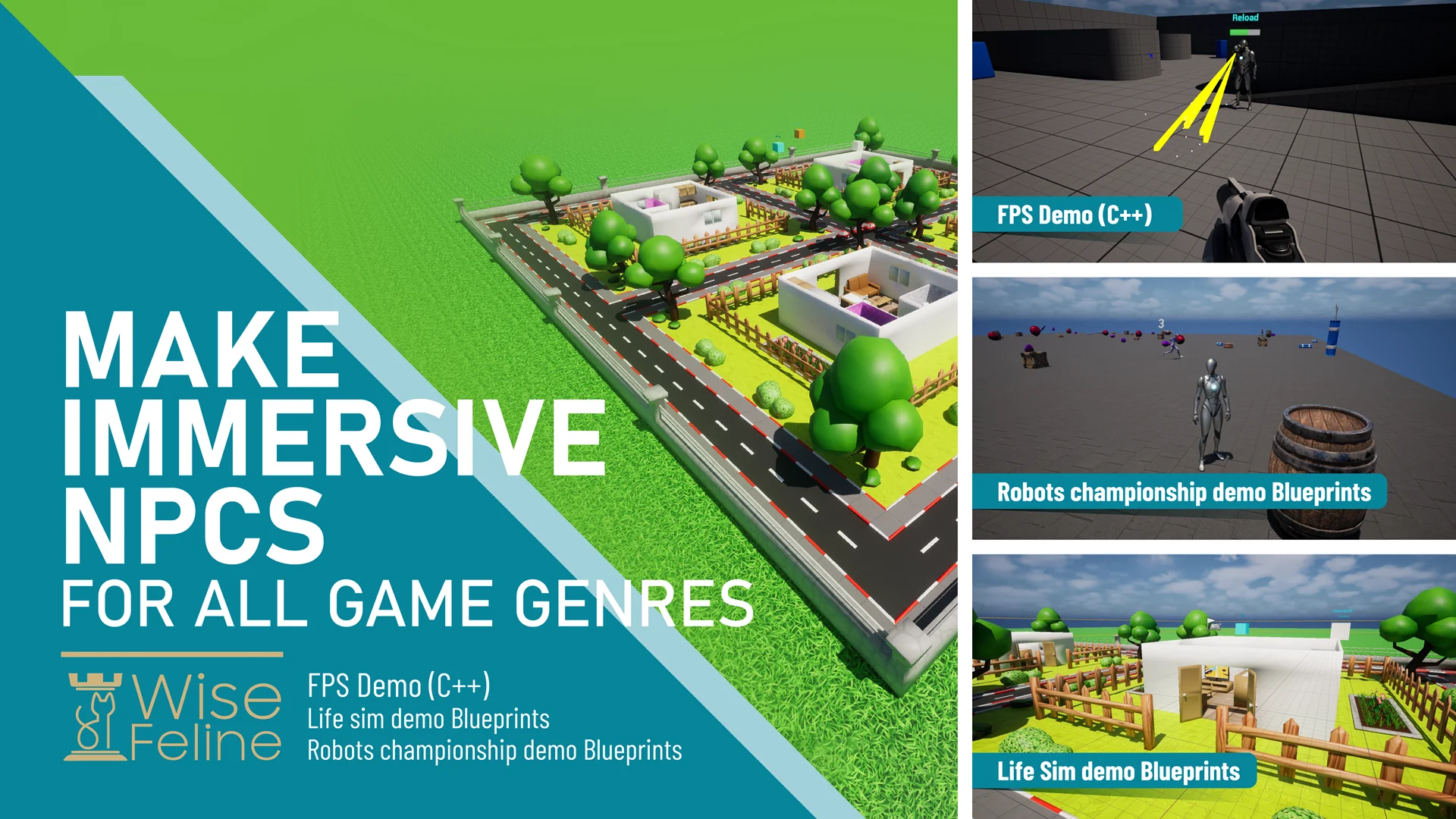
These mechanics are showcased in the Living Village sample, built as a standalone Blueprint demonstration in Unreal Engine 5.8. The sample models seven individual villagers as they balance hunger, physical fatigue, socialization, and vocational tasks. If an NPC witnesses a player stealing goods from a market stall, that witness can seek out a town guard to report the crime. Returning the stolen parcel prompts the merchant to adjust transaction pricing, yet the independent witness continues to remember the original theft. The sample demonstrates the combined power of Ultimate decision-making, spatial Influence Maps, and integration toolsets working simultaneously within an interconnected community.
Integrating Smart Objects, GAS, and Behavior Trees
Utility architecture does not require discarding conventional Unreal Engine AI workflows. An entire existing Behavior Tree can be encapsulated and run as a single utility action. The system can read from and write to standard AI Blackboards, run and evaluate Environment Query System (EQS) queries, and command agents to navigate toward the resulting query positions.
Through the separate, free WFIntegrations package, utility logic connects directly to Epic's modern gameplay systems. Actions can claim, navigate to, and interact with Smart Objects placed throughout a level. For titles utilizing the Gameplay Ability System (GAS), the integration allows utility actions to trigger specific Gameplay Abilities while utilizing specialized considerations that evaluate gameplay tags, check attribute values, or determine whether an ability is off cooldown and ready for activation.
AI Assistant Workflow and Behavior Authoring in UE 5.8
To accelerate setup and balancing, the package bundles an AI assistant skill tailored for utility behavior design. The skill equips external language models with domain-specific knowledge regarding response curve design, spatial target filtering, and action lifecycle handling. Designers can query the assistant to draft specialized curves—such as balancing cautious reload tendencies against offensive pressure—or to troubleshoot logic anomalies where a sentry fails to break a patrol path when enemies enter range.
Setup is managed directly within the editor via Tools > Wise Feline > Getting Started, which installs bundled skills for development environments including Codex, Claude Code, and Gemini CLI, or configures prompts for web interfaces such as ChatGPT, Claude Cowork, and Gemini Gems. In Unreal Engine 5.8, developers can connect an assistant directly to the editor using the Model Context Protocol (MCP), enabling external agents to directly inspect, create, and refine behavior assets, considerations, actions, and evaluation curves inside the project workspace.
 Artificial Intelli
 Artificial Intelli
 Action-Adventure