"1f00f67f9253451b"{"id":"1001260","slug":"world-director-npc-pro-massive-npc-simulation-with-multiplayer-and-optimization","title":"World Director NPC PRO – Massive NPC Simulation with Multiplayer \u0026 Optimization","category":"Artificial Intelligence","engine":"4.26 - 5.8","assetVersion":"Asset Version: 1.1.6 - 2.2.4","engineVersion":"Engine Version: 4.26 - 5.8","tag":"Artificial Intelli","accent":"blue","visual":"mech","summary":"Simulate thousands of persistent NPCs in Unreal Engine with World Director NPC PRO, featuring four optimization tiers, multithreaded AI, and multiplayer support","platform":"Unreal Engine","publishedAt":"2026-09-30T05:29:11.329Z","updatedAt":"2026-09-30T05:29:11.329Z","sourceNotes":[],"fileContents":[],"compatibility":["Unreal Engine","Asset Version: 1.1.6 - 2.2.4","Engine Version: 4.26 - 5.8"],"featuredImage":{"alt":"World Director NPC PRO – Massive NPC Simulation with Multiplayer \u0026 Optimization","src":"/wp-content/uploads/published/2026/09/d7eb47e30036-c6858b58-c55b-4e92-8af4-f18c94ce9c23-0fcfe248e5.webp"},"hasDownloadLink":true,"downloads":0,"terms":[{"taxonomy":"category","slug":"artificial-intelligence-tools-and-plugins","name":"Artificial Intelligence"}],"galleryImages":[{"src":"/wp-content/uploads/published/2026/09/60492554a9b6-290ba6b6-eb3b-44a3-9447-a3ab691d375e-b9af61f50b.webp","alt":"World Director NPC PRO – Massive NPC Simulation with Multiplayer \u0026 Optimization"},{"src":"/wp-content/uploads/published/2026/09/04cf06c0630b-803bb4d1-b5aa-4699-84b9-ce49e2f55f4b-71d7a3486c.webp","alt":"World Director NPC PRO – Massive NPC Simulation with Multiplayer \u0026 Optimization"},{"src":"/wp-content/uploads/published/2026/09/29aba6bb93e7-952c68c8-216d-4997-877b-a9d7ad4c3aae-09ec622f6e.webp","alt":"World Director NPC PRO – Massive NPC Simulation with Multiplayer \u0026 Optimization"}],"accessPanel":{"kind":"resource","title":"Download this resource","eyebrow":"Free Download","message":"Log in or create a free account to start your download.","fileName":"World Director NPC - PRO. Now with multiplayer.7z","safetyNote":"Resources are manually reviewed before listing to improve quality and reduce obvious risks.","actionLabel":"Download Free","resourceType":"Resource archive"},"contentHtml":"\u003cp\u003eWhen vast environments must feel populated by living crowds, games often face an immediate technical bottleneck: simulating thousands of distinct characters without crippling the CPU. Standard character pawns bring a heavy baseline cost, encompassing full skeletal updates, tick loops, and intricate behavior trees that quickly saturate frame budgets when multiplied across an entire city or open terrain.\u003c/p\u003e\u003cp\u003eWorld Director NPC PRO resolves this scaling issue by treating distant simulation differently from immediate, on-screen action. Rather than freezing or despawning characters once they exit view, the framework preserves pawn state—including exact location, scale, rotation, health, and progression levels—while continuing their physical progression across large territories. In synthetic benchmarking on an AMD Ryzen 2700X processor, the architecture supported upwards of 200,000 pawns running at over 120 frames per second, depending on specific project configurations and implementation specifics.\u003c/p\u003e\u003ch2\u003eFour Concurrent Optimization Levels for Massive Pawn Populations\u003c/h2\u003e\u003cp\u003eThe core mechanism behind this scalability is a tiered management model that steps down computing intensity as characters distance themselves from the camera. Instead of relying on a simple binary toggle between active and dormant, four discrete optimization tiers operate concurrently across the world:\u003c/p\u003e\u003cul\u003e\u003cli\u003e\u003cstrong\u003eLevel 1: Visual and Animation Culling.\u003c/strong\u003e When pawns drift outside the player's immediate camera frustum, rendering halts entirely. Alongside disabled meshes, the framework reduces animation evaluation and tick frequency, freeing substantial GPU and CPU cycles while leaving the character physically grounded near the player.\u003c/li\u003e\u003cli\u003e\u003cstrong\u003eLevel 2: Simplified NavMesh Wandering.\u003c/strong\u003e Distant pawns step back from full AI logic into an abstracted simulation mode. Their updated positions and movement paths continue to be calculated against the project NavMesh, accounting for dynamic obstacle avoidance. Characters wander naturally within a developer-configured movement radius without running heavy task loops.\u003c/li\u003e\u003cli\u003e\u003cstrong\u003eLevel 3: Concurrency Throttling.\u003c/strong\u003e Farther into the background, the system caps the total number of pawns permitted to walk simultaneously. While the entire population remains tracked in world space, only a regulated slice executes active steps at any given moment, smoothing frame delivery across wide map sectors.\u003c/li\u003e\u003cli\u003e\u003cstrong\u003eLevel 4: Dormant Persistence.\u003c/strong\u003e At extreme ranges, pawns halt physical displacement entirely. They do not unload from memory or reset their internal attributes. Instead, they remain stored in place, seamlessly reactivating their stepping routines as player proximity shifts outward.\u003c/li\u003e\u003c/ul\u003e\u003ch2\u003eMultithreaded Background Simulation and Simplified Navigation\u003c/h2\u003e\u003cp\u003eStandard Unreal Engine Behavior Trees offer high behavioral flexibility, but running thousands of distinct trees simultaneously will quickly overwhelm the main game thread. Under this framework, characters operating in deeper optimization tiers shed their Behavior Trees entirely. In their place, simplified, streamlined locomotion logic drives character motion in the background.\u003c/p\u003e\u003cp\u003eTo safeguard baseline frame rates, calculations for hidden and distant pawns execute across worker threads. Pathing remains visually coherent due to specialized movement rules. Developers can assign per-NPC road sets, configuring precise usage chances and search radii so that background pedestrians consistently stick to pathways and sidewalks rather than drifting haphazardly across open landscape geometry.\u003c/p\u003e\u003cp\u003eA similar rule set governs Points of Interest. Characters can be drawn toward distinct zones such as public parks, markets, or town squares. Developers configure the attraction likelihood alongside specific roam radii, allowing background crowds to gather organically at central landmarks without requiring manual trigger management or custom scripting per character.\u003c/p\u003e\u003ch2\u003eServer-Side Calculations and Editor-to-Shipping Threading\u003c/h2\u003e\u003cp\u003ePopulated worlds frequently struggle when translated into multiplayer network environments. World Director NPC PRO manages this synchronization requirement by anchoring all underlying calculations server-side. The server maintains authoritative control over pawn coordinates, active tiers, and trajectory updates, maintaining parity across connected clients without client-side divergence.\u003c/p\u003e\u003cp\u003eOperating background simulations across background threads can occasionally create instability during active editor sessions, particularly when asynchronous tasks ping navigation systems. To address engine stability during production, the plugin automatically routes NavSystem requests through the primary game thread while running in editor mode, preventing thread collision crashes during testing. When the project is compiled into a shipping build, the system shifts these operations back to dedicated worker threads to maximize performance efficiency on target hardware.\u003c/p\u003e\u003ch2\u003eStatic-Mesh Representation and State Persistence\u003c/h2\u003e\u003cp\u003eFor dense urban simulations where absolute character individuality can be traded for raw crowd scale, the plugin allows characters to swap their skeletal components for static-mesh representations. This lightweight representation mode operates exclusively in single-player setups, letting level designers fill background streets with believable pedestrian flow without the memory and processing overhead associated with full skeletal assets.\u003c/p\u003e\u003cp\u003eLong-term continuity is reinforced by a built-in state save and load pipeline. Because pawns maintain tracked variables like health status, scale, and character levels throughout their optimization transitions, this data can be written directly to disk and restored upon reloading the game world.\u003c/p\u003e\u003cp\u003eFine-tuning control extends to individual actors. While global radii determine baseline transitions through Levels 1 through 4, developers can override these distances on an individual actor or NPC basis. This makes it straightforward to give key targets wider visual simulation ranges while keeping ordinary ambient civilians on aggressive culling curves. The toolset also natively integrates with Population Control PRO, supporting layer offsets and per-actor overrides within shared world configurations.\u003c/p\u003e\u003ch2\u003eSpatial Layering Overrides and Screen-Space Realities\u003c/h2\u003e\u003cp\u003eWhile the background framework aggressively minimizes calculations for distant populations, no optimization algorithm can bypass the baseline rendering cost of clustered, visible geometry. When several hundred complex pawns converge directly within the camera viewport, the local machine must still render those triangles and process their active local scripts.\u003c/p\u003e\u003cp\u003eManaging dense scenes requires planning out spawn densities, using static mesh replacements where appropriate, and dialing in layer distance bands so characters shed complex processing the moment they drift out of focus. For technical directors and gameplay programmers building sprawling open-world scenarios or dense city simulations, this tiered execution pipeline offers a structured foundation for preserving dynamic character populations without sacrificing frame delivery.\u003c/p\u003e\n\n\u003ch2\u003eExplore Similar Assets\u003c/h2\u003e\n\u003cul\u003e\n\u003cli\u003e\u003ca href=\"https://3dcghub.com/fast-ai-plugin-multiplayer/\" title=\"Fast AI Plugin (Multiplayer)\"\u003eFast AI Plugin (Multiplayer)\u003c/a\u003e\u003c/li\u003e\n\u003cli\u003e\u003ca href=\"https://3dcghub.com/open-world-ai-multiplayer-spawn-system/\" title=\"Open World AI Multiplayer Spawn System\"\u003eOpen World AI Multiplayer Spawn System\u003c/a\u003e\u003c/li\u003e\n\u003cli\u003e\u003ca href=\"https://3dcghub.com/dynamic-ai-system/\" title=\"Dynamic AI System\"\u003eDynamic AI System\u003c/a\u003e\u003c/li\u003e\n\u003cli\u003e\u003ca href=\"https://3dcghub.com/smart-ai/\" title=\"Smart AI\"\u003eSmart AI\u003c/a\u003e\u003c/li\u003e\n\u003cli\u003e\u003ca href=\"https://3dcghub.com/thief-simulator-starter-kit/\" title=\"Thief Simulator Starter Kit\"\u003eThief Simulator Starter Kit\u003c/a\u003e\u003c/li\u003e\n\u003c/ul\u003e","contentTextLength":7240,"navigation":{"current":24,"total":3222,"previous":{"id":"1001261","slug":"upfiledialog","title":"UPFileDialog","category":"Dialog Systems","platform":"Unreal Engine","updatedAt":"2026-09-30T05:30:56.686Z"},"next":{"id":"15285","slug":"landscaping","title":"Landscaping","category":"Procedural Systems","platform":"Unreal Engine","updatedAt":"2026-09-30T05:04:36.509Z"}},"relatedResources":[{"id":"1000602","slug":"fast-ai-plugin-multiplayer","title":"Fast AI Plugin (Multiplayer)","category":"Artificial Intelligence","engine":"5.3,5.5 - 5.6","assetVersion":"Asset Version: 2.1.3 - 2.2.6","engineVersion":"Engine Version: 5.3,5.5 - 5.6","tag":"Artificial Intelli","accent":"blue","visual":"mech","summary":"C++ AI system for Unreal Engine supporting single-player and multiplayer with melee, ranged, zombie, animal, and civilian NPCs, plus pooling and optimization to","platform":"Unreal Engine","publishedAt":"2026-07-20T15:37:11.434Z","updatedAt":"2026-07-20T15:37:11.434Z","sourceNotes":[],"fileContents":[],"compatibility":["Unreal Engine","Asset Version: 2.1.3 - 2.2.6","Engine Version: 5.3,5.5 - 5.6"],"featuredImage":{"alt":"Fast AI Plugin (Multiplayer)","src":"/wp-content/uploads/published/2026/07/02f169ae5179-f5295a1f-228e-4784-8203-b58dd35d6870-7131490d73.webp"},"hasDownloadLink":true,"downloads":0},{"id":"1000922","slug":"open-world-ai-multiplayer-spawn-system","title":"Open World AI Multiplayer Spawn System","category":"Gameplay Features","engine":"4.26+,5.0+","assetVersion":"","engineVersion":"Engine Version: 4.26+,5.0+","tag":"Gameplay Features","accent":"blue","visual":"mech","summary":"A server-side Blueprint spawn system for open-world multiplayer games, with roaming, stationary, and path AI, friendly or zombie variants.","platform":"Unreal Engine","publishedAt":"2026-08-08T05:05:40.195Z","updatedAt":"2026-08-08T05:05:40.195Z","sourceNotes":[],"fileContents":[],"compatibility":["Unreal Engine","Engine Version: 4.26+,5.0+"],"featuredImage":{"alt":"Open World AI Multiplayer Spawn System","src":"/wp-content/uploads/published/2026/08/c4917032d21c-cb7e3ead-ba0b-445c-8608-4fe8a4722c7e-d50d7d81fc.webp"},"hasDownloadLink":true,"downloads":1},{"id":"11105","slug":"smart-ai","title":"Smart AI","category":"Gameplay Features","engine":"4.27,5.0+","assetVersion":"Engine version: 4.27,5.0+","engineVersion":"4.26","tag":"Gameplay Features","accent":"blue","visual":"city","summary":"Enhance your project with Smart AI, a versatile system offering 15 unique behaviors and full multiplayer support. It includes melee and ranged combat, specialized AI types, and advanced optimization tools.","platform":"Unreal Engine","publishedAt":"2026-03-03T16:56:50.000Z","updatedAt":"2026-04-19T15:49:49.000Z","sourceNotes":[],"fileContents":[],"compatibility":["Unreal Engine","Engine version: 4.27,5.0+"],"featuredImage":{"alt":"Smart AI","src":"https://3dcghub.com/wp-content/uploads/2026/03/3e6175a6-1ad0-4a6a-aa6a-a60785237185.webp"},"hasDownloadLink":true,"downloads":1}]}
Artificial Intelli
World Director NPC PRO – Massive NPC Simulation with Multiplayer & Optimization
Simulate thousands of persistent NPCs in Unreal Engine with World Director NPC PRO, featuring four optimization tiers, multithreaded AI, and multiplayer support
When vast environments must feel populated by living crowds, games often face an immediate technical bottleneck: simulating thousands of distinct characters without crippling the CPU. Standard character pawns bring a heavy baseline cost, encompassing full skeletal updates, tick loops, and intricate behavior trees that quickly saturate frame budgets when multiplied across an entire city or open terrain.
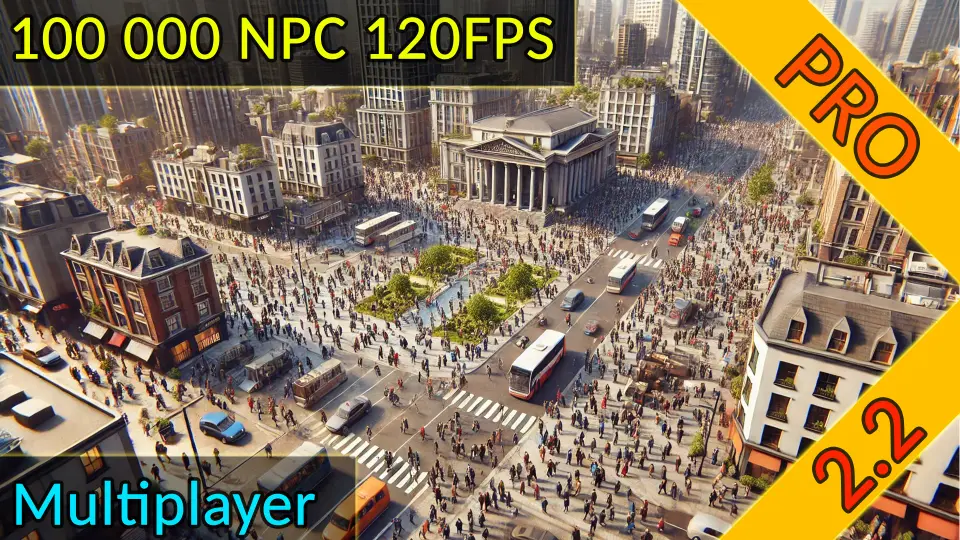
World Director NPC PRO resolves this scaling issue by treating distant simulation differently from immediate, on-screen action. Rather than freezing or despawning characters once they exit view, the framework preserves pawn state—including exact location, scale, rotation, health, and progression levels—while continuing their physical progression across large territories. In synthetic benchmarking on an AMD Ryzen 2700X processor, the architecture supported upwards of 200,000 pawns running at over 120 frames per second, depending on specific project configurations and implementation specifics.
Four Concurrent Optimization Levels for Massive Pawn Populations
The core mechanism behind this scalability is a tiered management model that steps down computing intensity as characters distance themselves from the camera. Instead of relying on a simple binary toggle between active and dormant, four discrete optimization tiers operate concurrently across the world:
Level 1: Visual and Animation Culling. When pawns drift outside the player's immediate camera frustum, rendering halts entirely. Alongside disabled meshes, the framework reduces animation evaluation and tick frequency, freeing substantial GPU and CPU cycles while leaving the character physically grounded near the player.
Level 2: Simplified NavMesh Wandering. Distant pawns step back from full AI logic into an abstracted simulation mode. Their updated positions and movement paths continue to be calculated against the project NavMesh, accounting for dynamic obstacle avoidance. Characters wander naturally within a developer-configured movement radius without running heavy task loops.
Level 3: Concurrency Throttling. Farther into the background, the system caps the total number of pawns permitted to walk simultaneously. While the entire population remains tracked in world space, only a regulated slice executes active steps at any given moment, smoothing frame delivery across wide map sectors.
Level 4: Dormant Persistence. At extreme ranges, pawns halt physical displacement entirely. They do not unload from memory or reset their internal attributes. Instead, they remain stored in place, seamlessly reactivating their stepping routines as player proximity shifts outward.
Multithreaded Background Simulation and Simplified Navigation
Standard Unreal Engine Behavior Trees offer high behavioral flexibility, but running thousands of distinct trees simultaneously will quickly overwhelm the main game thread. Under this framework, characters operating in deeper optimization tiers shed their Behavior Trees entirely. In their place, simplified, streamlined locomotion logic drives character motion in the background.
To safeguard baseline frame rates, calculations for hidden and distant pawns execute across worker threads. Pathing remains visually coherent due to specialized movement rules. Developers can assign per-NPC road sets, configuring precise usage chances and search radii so that background pedestrians consistently stick to pathways and sidewalks rather than drifting haphazardly across open landscape geometry.
A similar rule set governs Points of Interest. Characters can be drawn toward distinct zones such as public parks, markets, or town squares. Developers configure the attraction likelihood alongside specific roam radii, allowing background crowds to gather organically at central landmarks without requiring manual trigger management or custom scripting per character.
Server-Side Calculations and Editor-to-Shipping Threading
Populated worlds frequently struggle when translated into multiplayer network environments. World Director NPC PRO manages this synchronization requirement by anchoring all underlying calculations server-side. The server maintains authoritative control over pawn coordinates, active tiers, and trajectory updates, maintaining parity across connected clients without client-side divergence.
Operating background simulations across background threads can occasionally create instability during active editor sessions, particularly when asynchronous tasks ping navigation systems. To address engine stability during production, the plugin automatically routes NavSystem requests through the primary game thread while running in editor mode, preventing thread collision crashes during testing. When the project is compiled into a shipping build, the system shifts these operations back to dedicated worker threads to maximize performance efficiency on target hardware.
Static-Mesh Representation and State Persistence
For dense urban simulations where absolute character individuality can be traded for raw crowd scale, the plugin allows characters to swap their skeletal components for static-mesh representations. This lightweight representation mode operates exclusively in single-player setups, letting level designers fill background streets with believable pedestrian flow without the memory and processing overhead associated with full skeletal assets.
Long-term continuity is reinforced by a built-in state save and load pipeline. Because pawns maintain tracked variables like health status, scale, and character levels throughout their optimization transitions, this data can be written directly to disk and restored upon reloading the game world.
Fine-tuning control extends to individual actors. While global radii determine baseline transitions through Levels 1 through 4, developers can override these distances on an individual actor or NPC basis. This makes it straightforward to give key targets wider visual simulation ranges while keeping ordinary ambient civilians on aggressive culling curves. The toolset also natively integrates with Population Control PRO, supporting layer offsets and per-actor overrides within shared world configurations.
Spatial Layering Overrides and Screen-Space Realities
While the background framework aggressively minimizes calculations for distant populations, no optimization algorithm can bypass the baseline rendering cost of clustered, visible geometry. When several hundred complex pawns converge directly within the camera viewport, the local machine must still render those triangles and process their active local scripts.
Managing dense scenes requires planning out spawn densities, using static mesh replacements where appropriate, and dialing in layer distance bands so characters shed complex processing the moment they drift out of focus. For technical directors and gameplay programmers building sprawling open-world scenarios or dense city simulations, this tiered execution pipeline offers a structured foundation for preserving dynamic character populations without sacrificing frame delivery.
 Artificial Intelli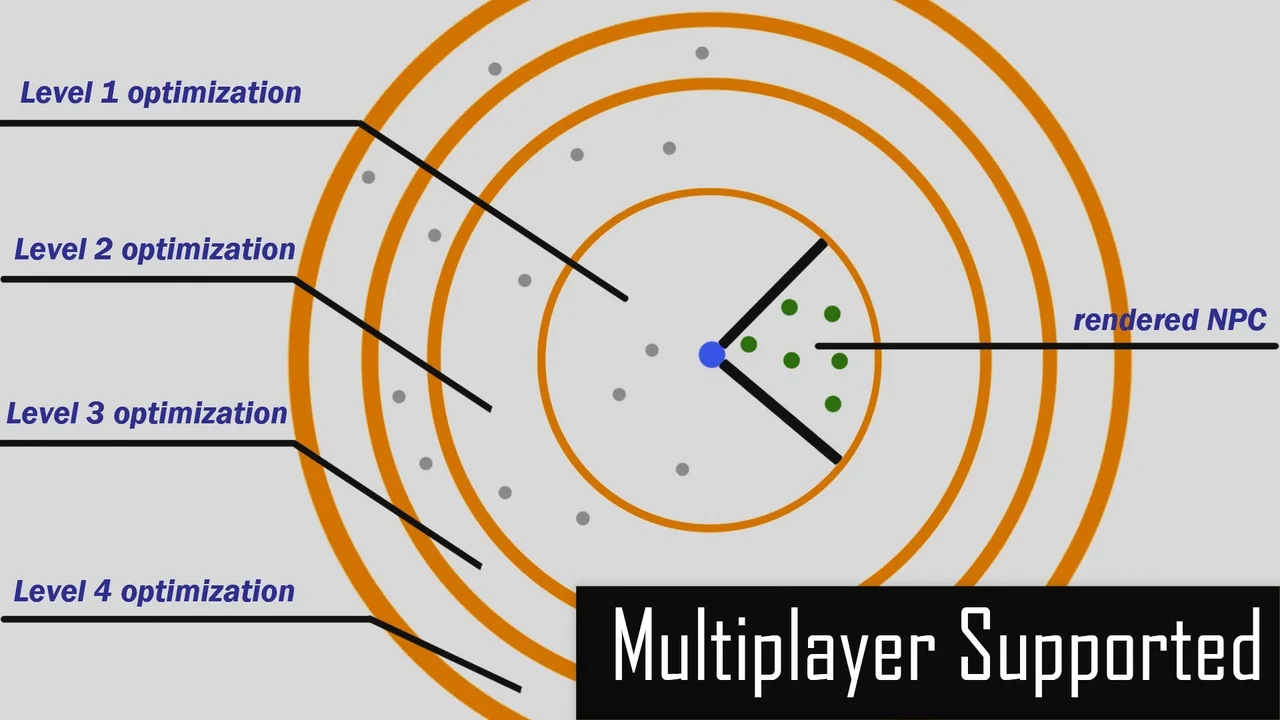
 Artificial Intelli
 Gameplay Features
 Gameplay Features