"7e6fc58c410f2894"{"id":"1000447","slug":"unreal-engine-5-realistic-automotive-rendering-masterclass","title":"Unreal Engine 5: Realistic Automotive Rendering Masterclass","category":"Unreal Engine","engine":"File Content: video + English subtitles","assetVersion":"Video Language: English","engineVersion":"File Content: video + English subtitles","tag":"Unreal Engine","accent":"blue","visual":"mech","summary":"A project-based Unreal Engine 5 course covering HDRI lighting, cameras, and rendering across four car scenes including Mustang, G Wagon, and Porsche.","platform":"Unreal Engine","publishedAt":"2026-07-11T00:27:47.295Z","updatedAt":"2026-07-11T00:27:47.295Z","sourceNotes":[],"fileContents":[],"compatibility":["Unreal Engine","Video Language: English","File Content: video + English subtitles"],"featuredImage":{"alt":"Unreal Engine 5: Realistic Automotive Rendering Masterclass","src":"/wp-content/uploads/published/2026/07/2440ee418069-6061173-a055-2-47876a9bdc.webp"},"hasDownloadLink":true,"downloads":1,"terms":[{"taxonomy":"category","slug":"tutoriallibrary-unrealengine","name":"Unreal Engine"}],"galleryImages":[],"accessPanel":{"kind":"video-resource","title":"Download this video resource","eyebrow":"Free Download","message":"Log in or create a free account to start your download.","fileName":"Unreal Engine 5 Realistic Automotive Rendering Masterclass.7z","safetyNote":"Resources are manually reviewed before listing to improve quality and reduce obvious risks.","actionLabel":"Download Free","resourceType":"Video download"},"contentHtml":"\u003ch2\u003eBuilding Car Scenes from the Ground Up in Unreal Engine 5\u003c/h2\u003e\n\u003cp\u003eCreating convincing automotive visuals in a real-time engine demands more than dropping a vehicle model into a default environment. \u003cstrong\u003eUnreal Engine 5: Realistic Automotive Rendering Masterclass\u003c/strong\u003e Addresses that gap by leading learners through the construction of four complete car scenes, each set in a distinct location that changes how lighting, camera work, and rendering decisions come together.\u003c/p\u003e\n\u003cp\u003eThe four projects break down into specific pairings of vehicle and setting. A Mustang sits in a street environment. A G Wagon appears twice, once on a hill and once in a parking lot. A Porsche rounds out the set on a race track. Each scene acts as a practical frame for learning a different configuration of environmental variables, from the ambient light of an open hillside to the reflective surfaces and tight framing of a parking lot.\u003c/p\u003e \u003ch2\u003eProject-Based Learning Across Four Distinct Environments\u003c/h2\u003e\n\u003cp\u003eEvery module in the course centers on making something visible rather than working through abstract tool demonstrations. The instructor, Nafay Sheikh, organizes the learning around completed scenes so that each new skill has an immediate application within a production-style context.\u003c/p\u003e\n\u003cp\u003eThe Mustang in a Street section places a classic performance car in an urban ground plane, requiring attention to the way street-level surfaces interact with paint reflections and surrounding light spill. The G Wagon on a Hill shifts to an outdoor elevation setting, where exposure and natural light direction become the primary variables. The G Wagon in a Parking Lot then moves the same vehicle type into a confined architectural space, demanding a separate approach to ambient reflection and ambient occlusion. The Porsche on a Race Track introduces a high-open environment where surface spread and track geometry influence camera framing decisions.\u003c/p\u003e\n\u003cp\u003eThe course begins with a general Introduction to establish the workflow before moving sequentially through each of the four scene builds. This gives learners a progression that starts with foundational setup and advances toward more complex lighting and camera relationships in the later environments.\u003c/p\u003e \u003ch2\u003eHDRI Lighting as the Foundation for Automotive Realism\u003c/h2\u003e\n\u003cp\u003eOne of the four skill pillars covers HDRI lighting through a project-based approach. Automotive rendering depends heavily on the surrounding environment reflecting off the car body, making high dynamic range imagery a primary driver of perceived realism. The course treats HDRI setup not as a standalone technique demo but as part of each vehicle environment, folding it into the scene-building process.\u003c/p\u003e\n\u003cp\u003eFor the outdoor scenes like the G Wagon on a Hill and the Porsche on a Race Track, HDRI choices define the sky tone, sun direction, and ambient fill that touch the reflective surfaces of the vehicles. For the street and parking lot scenes, the same fundamentals apply but must work alongside the artificial or constrained light sources of the built environment. Learners are expected to develop instincts for matching HDRI intensity and angle to the specific look each scene requires rather than applying a one-size-fits-all lighting template.\u003c/p\u003e \u003ch2\u003eCameras, Framing, and the Cinematic Side of Car Presentation\u003c/h2\u003e\n\u003cp\u003eCamera setup receives equal weight alongside lighting and rendering. The course teaches camera basics in Unreal Engine 5 through the same four-scene structure, letting learners practice framing and composition decisions in contexts that shift from low-angle street work to wide open track environments.\u003c/p\u003e\n\u003cp\u003eA Mustang on a street invites tighter framing and ground-level angles that emphasize stance and proximity to the road surface. The Porsche on a Race Track opens room for tracking-style compositions and wider contextual shots. The two G Wagon scenes contrast a natural exterior setting against an enclosed architectural one, pushing learners to experiment with different focal lengths and camera placements that suit each location. The vehicle and its environment determine the choices the learner practices, reinforcing how camera decisions in automotive work stay bound to the scene context rather than general cinematic principles alone.\u003c/p\u003e \u003ch2\u003eRendering Within a Real-Time Pipeline\u003c/h2\u003e\n\u003cp\u003eThe course includes a dedicated project-based focus on rendering fundamentals in Unreal Engine 5. Rendering is treated as the output stage where prior lighting and camera work get locked into a final image or animation sequence. Learners encounter the rendering workflow as part of finishing each scene rather than as a detached post-processing module.\u003c/p\u003e\n\u003cp\u003eBy running through the render stage four separate times, the course repeats the full setup-to-output cycle enough to build familiarity. Each scene offers a different visual target: street-level realism, hilly exterior naturalism, parking lot enclosure, and track-day clarity. That repetition across contrasting environments is what develops a learner's ability to judge render settings against scene intent rather than memorizing a single render preset.\u003c/p\u003e \u003ch2\u003eCourse Structure and Practical Scope\u003c/h2\u003e\n\u003cp\u003eThe total course workload is 3 hours and 16 minutes, published on July 8, 2024. The level is set to All Levels, which aligns with the project-based approach that introduces each scene from its setup phase rather than assuming prior Unreal Engine 5 proficiency.\u003c/p\u003e\n\u003cp\u003eThe curriculum flows from Introduction directly into the four scene modules. There is no separate abstract section on lighting theory or camera mechanics detached from production work; the skills taught live inside the car builds themselves. The project sequence reads as follows: Introduction, Mustang in a Street, G Wagon on a Hill, G Wagon in a Parking Lot, and Porsche on a Race Track.\u003c/p\u003e\n\u003cp\u003eThe target audience is artists who want to learn Unreal Engine 5 through hands-on scene completion. The course structure respects that intent by keeping the learning visible at each stage and grounded in outputs the learner can evaluate.\u003c/p\u003e \u003ch2\u003eWho Gets the Most From This Course\u003c/h2\u003e\n\u003cp\u003eArtists seeking a structured path through Unreal Engine 5 automotive work will find the project-based design aligned with how production tasks actually unfold. The four-scene repetition builds transferable muscle memory for lighting, camera, and rendering decisions, while the varied vehicle and setting pairings prevent the course from becoming rote practice on a single environment type.\u003c/p\u003e\n\u003cp\u003eSince the curriculum moves through the same four stages repeatedly across contrasting scenes, learners finish with experience adapting fundamentals to different automotive contexts rather than recreating one demo. That adaptability is what makes the course a practical starting point for artists building automotive portfolios or integrating car visualization into broader Unreal Engine 5 workflows.\u003c/p\u003e\n\n\u003ch2\u003eExplore Similar Assets\u003c/h2\u003e\n\u003cul\u003e\n\u003cli\u003e\u003ca href=\"https://3dcghub.com/unreal-engine-5-the-complete-automotive-cinematic-course/\" title=\"Unreal Engine 5 - The Complete Automotive Cinematic Course\"\u003eUnreal Engine 5 - The Complete Automotive Cinematic Course\u003c/a\u003e\u003c/li\u003e\n\u003cli\u003e\u003ca href=\"https://3dcghub.com/unreal-engine-5-5-the-ultimate-cinematic-masterclass/\" title=\"Unreal Engine 5.5 - The Ultimate Cinematic Masterclass\"\u003eUnreal Engine 5.5 - The Ultimate Cinematic Masterclass\u003c/a\u003e\u003c/li\u003e\n\u003cli\u003e\u003ca href=\"https://3dcghub.com/unreal-engine-5-blueprints-game-developer-masterclass/\" title=\"Unreal Engine 5 - Blueprints Game Developer Masterclass\"\u003eUnreal Engine 5 - Blueprints Game Developer Masterclass\u003c/a\u003e\u003c/li\u003e\n\u003cli\u003e\u003ca href=\"https://3dcghub.com/embergen-volumetric-unreal-engine-5/\" title=\"EmberGen Volumetric \u0026amp; Unreal Engine 5\"\u003eEmberGen Volumetric \u0026amp; Unreal Engine 5\u003c/a\u003e\u003c/li\u003e\n\u003cli\u003e\u003ca href=\"https://3dcghub.com/unreal-engine-5-create-professional-cinematics-and-trailers/\" title=\"Unreal Engine 5 - Create Professional Cinematics \u0026amp; Trailers!\"\u003eUnreal Engine 5 - Create Professional Cinematics \u0026amp; Trailers!\u003c/a\u003e\u003c/li\u003e\n\u003c/ul\u003e","contentTextLength":7092,"navigation":{"current":1311,"total":3618,"previous":{"id":"1000448","slug":"blue-gem-earth-80k","title":"Blue Gem Earth 80k","category":"Sky \u0026 Space","platform":"Unreal Engine","updatedAt":"2026-07-11T00:53:53.737Z"},"next":{"id":"1000446","slug":"vertex-animation-manager","title":"Vertex Animation Manager","category":"Animations","platform":"Unreal Engine","updatedAt":"2026-07-11T00:22:10.116Z"}},"relatedResources":[{"id":"1000741","slug":"real-time-automotive-rendering-1001","title":"Real-Time Automotive Rendering 1001","category":"Unreal Engine","engine":"File Content: video + English subtitles","assetVersion":"Video Language: English","engineVersion":"File Content: video + English subtitles","tag":"Unreal Engine","accent":"blue","visual":"mech","summary":"A beginner-friendly Unreal Engine course covering automotive cinematic creation: asset prep in Maya, shader setup, exterior and studio lighting, and camera rend","platform":"Unreal Engine","publishedAt":"2026-07-27T11:52:00.768Z","updatedAt":"2026-07-27T11:52:00.768Z","sourceNotes":[],"fileContents":[],"compatibility":["Unreal Engine","Video Language: English","File Content: video + English subtitles"],"featuredImage":{"alt":"Real-Time Automotive Rendering 1001","src":"/wp-content/uploads/published/2026/07/e10d685964d4-rtat1001-0002-porsche-shot-chateu-1-0005-2048x811-da382017e6.webp"},"hasDownloadLink":true,"downloads":1},{"id":"1000251","slug":"unreal-engine-5-the-complete-automotive-cinematic-course","title":"Unreal Engine 5 - The Complete Automotive Cinematic Course","category":"Unreal Engine","engine":"File Content: video + English subtitles","assetVersion":"Video Language: English","engineVersion":"File Content: video + English subtitles","tag":"Unreal Engine","accent":"blue","visual":"mech","summary":"A comprehensive 7.5-hour curriculum detailing the workflow for creating photo-realistic automotive cinematics using Unreal Engine 5, Sequencer, and Niagara.","platform":"Unreal Engine","publishedAt":"2026-06-30T21:27:39.957Z","updatedAt":"2026-06-30T21:27:39.957Z","sourceNotes":[],"fileContents":[],"compatibility":["Unreal Engine","Video Language: English","File Content: video + English subtitles"],"featuredImage":{"alt":"Unreal Engine 5 - The Complete Automotive Cinematic Course","src":"/wp-content/uploads/published/2026/06/41c957b5fe31-5981764-16a5-2-7db92226dc.webp"},"hasDownloadLink":true,"downloads":0},{"id":"1000746","slug":"product-rendering-in-unreal-engine-5-6-beginner-s-guide","title":"Product Rendering in Unreal Engine 5.6 | Beginner’s Guide","category":"Unreal Engine","engine":"File Content: video + English subtitles","assetVersion":"Video Language: English","engineVersion":"File Content: video + English subtitles","tag":"Unreal Engine","accent":"blue","visual":"mech","summary":"Build a product-rendering workflow in Unreal Engine 5.6 and DaVinci Resolve. Master studio lighting, reference matching, CGI integration, and color grading.","platform":"Unreal Engine","publishedAt":"2026-07-27T12:20:50.298Z","updatedAt":"2026-07-27T12:20:50.298Z","sourceNotes":[],"fileContents":[],"compatibility":["Unreal Engine","Video Language: English","File Content: video + English subtitles"],"featuredImage":{"alt":"Product Rendering in Unreal Engine 5.6 | Beginner’s Guide","src":"/wp-content/uploads/published/2026/07/28b6ff840a87-6935627-b546-2-e512e0113d.webp"},"hasDownloadLink":true,"downloads":2}]}
A project-based Unreal Engine 5 course covering HDRI lighting, cameras, and rendering across four car scenes including Mustang, G Wagon, and Porsche.
Category:Unreal EnginePlatform: Unreal EngineVideo Language: EnglishFile Content: video + English subtitlesPublished: Jul 11, 2026
Unreal Engine
Resource overview
Building Car Scenes from the Ground Up in Unreal Engine 5
Creating convincing automotive visuals in a real-time engine demands more than dropping a vehicle model into a default environment. Unreal Engine 5: Realistic Automotive Rendering Masterclass Addresses that gap by leading learners through the construction of four complete car scenes, each set in a distinct location that changes how lighting, camera work, and rendering decisions come together.
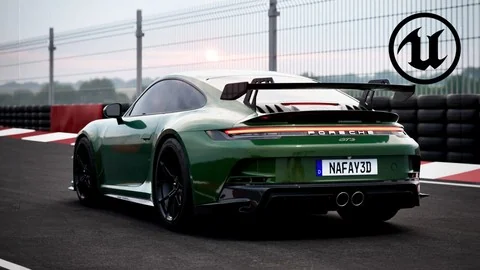
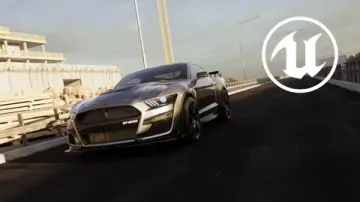
The four projects break down into specific pairings of vehicle and setting. A Mustang sits in a street environment. A G Wagon appears twice, once on a hill and once in a parking lot. A Porsche rounds out the set on a race track. Each scene acts as a practical frame for learning a different configuration of environmental variables, from the ambient light of an open hillside to the reflective surfaces and tight framing of a parking lot.
Project-Based Learning Across Four Distinct Environments
Every module in the course centers on making something visible rather than working through abstract tool demonstrations. The instructor, Nafay Sheikh, organizes the learning around completed scenes so that each new skill has an immediate application within a production-style context.
The Mustang in a Street section places a classic performance car in an urban ground plane, requiring attention to the way street-level surfaces interact with paint reflections and surrounding light spill. The G Wagon on a Hill shifts to an outdoor elevation setting, where exposure and natural light direction become the primary variables. The G Wagon in a Parking Lot then moves the same vehicle type into a confined architectural space, demanding a separate approach to ambient reflection and ambient occlusion. The Porsche on a Race Track introduces a high-open environment where surface spread and track geometry influence camera framing decisions.
The course begins with a general Introduction to establish the workflow before moving sequentially through each of the four scene builds. This gives learners a progression that starts with foundational setup and advances toward more complex lighting and camera relationships in the later environments.
HDRI Lighting as the Foundation for Automotive Realism
One of the four skill pillars covers HDRI lighting through a project-based approach. Automotive rendering depends heavily on the surrounding environment reflecting off the car body, making high dynamic range imagery a primary driver of perceived realism. The course treats HDRI setup not as a standalone technique demo but as part of each vehicle environment, folding it into the scene-building process.
For the outdoor scenes like the G Wagon on a Hill and the Porsche on a Race Track, HDRI choices define the sky tone, sun direction, and ambient fill that touch the reflective surfaces of the vehicles. For the street and parking lot scenes, the same fundamentals apply but must work alongside the artificial or constrained light sources of the built environment. Learners are expected to develop instincts for matching HDRI intensity and angle to the specific look each scene requires rather than applying a one-size-fits-all lighting template.
Cameras, Framing, and the Cinematic Side of Car Presentation
Camera setup receives equal weight alongside lighting and rendering. The course teaches camera basics in Unreal Engine 5 through the same four-scene structure, letting learners practice framing and composition decisions in contexts that shift from low-angle street work to wide open track environments.
A Mustang on a street invites tighter framing and ground-level angles that emphasize stance and proximity to the road surface. The Porsche on a Race Track opens room for tracking-style compositions and wider contextual shots. The two G Wagon scenes contrast a natural exterior setting against an enclosed architectural one, pushing learners to experiment with different focal lengths and camera placements that suit each location. The vehicle and its environment determine the choices the learner practices, reinforcing how camera decisions in automotive work stay bound to the scene context rather than general cinematic principles alone.
Rendering Within a Real-Time Pipeline
The course includes a dedicated project-based focus on rendering fundamentals in Unreal Engine 5. Rendering is treated as the output stage where prior lighting and camera work get locked into a final image or animation sequence. Learners encounter the rendering workflow as part of finishing each scene rather than as a detached post-processing module.
By running through the render stage four separate times, the course repeats the full setup-to-output cycle enough to build familiarity. Each scene offers a different visual target: street-level realism, hilly exterior naturalism, parking lot enclosure, and track-day clarity. That repetition across contrasting environments is what develops a learner's ability to judge render settings against scene intent rather than memorizing a single render preset.
Course Structure and Practical Scope
The total course workload is 3 hours and 16 minutes, published on July 8, 2024. The level is set to All Levels, which aligns with the project-based approach that introduces each scene from its setup phase rather than assuming prior Unreal Engine 5 proficiency.
The curriculum flows from Introduction directly into the four scene modules. There is no separate abstract section on lighting theory or camera mechanics detached from production work; the skills taught live inside the car builds themselves. The project sequence reads as follows: Introduction, Mustang in a Street, G Wagon on a Hill, G Wagon in a Parking Lot, and Porsche on a Race Track.
The target audience is artists who want to learn Unreal Engine 5 through hands-on scene completion. The course structure respects that intent by keeping the learning visible at each stage and grounded in outputs the learner can evaluate.
Who Gets the Most From This Course
Artists seeking a structured path through Unreal Engine 5 automotive work will find the project-based design aligned with how production tasks actually unfold. The four-scene repetition builds transferable muscle memory for lighting, camera, and rendering decisions, while the varied vehicle and setting pairings prevent the course from becoming rote practice on a single environment type.
Since the curriculum moves through the same four stages repeatedly across contrasting scenes, learners finish with experience adapting fundamentals to different automotive contexts rather than recreating one demo. That adaptability is what makes the course a practical starting point for artists building automotive portfolios or integrating car visualization into broader Unreal Engine 5 workflows.
 Unreal Engine
 Unreal Engine
 Unreal Engine
 Unreal Engine