Vertex Animation Manager
Unreal Engine plugin baking vertex animation textures in-editor, driving Static Mesh, ISM, HISM playback, and GPU Skeletal Mesh with compute shader aim-offset a
 Animations
Resource overview
When a scene needs thousands of animated characters playing simultaneously, traditional skeletal mesh evaluation quickly becomes the bottleneck. Vertex Animation Manager approaches that problem by baking skeletal motion into vertex animation textures—data textures that store per-frame vertex positions—then driving playback on the GPU without constant CPU ticking. The plugin does the baking directly inside the Unreal Engine editor, so no external tool or separate pipeline step is required to produce the VAT data.
What makes the tool practical for technical artists is that the same plugin both generates the textures and supplies the runtime components for playback. Static Meshes, Instanced Static Meshes (ISM), and Hierarchical Instanced Static Meshes (HISM) each have corresponding components. That coverage means a small squad of characters, a mid-density crowd, and a massive scattered swarm can all be served by one coherent system rather than three separate workflows.
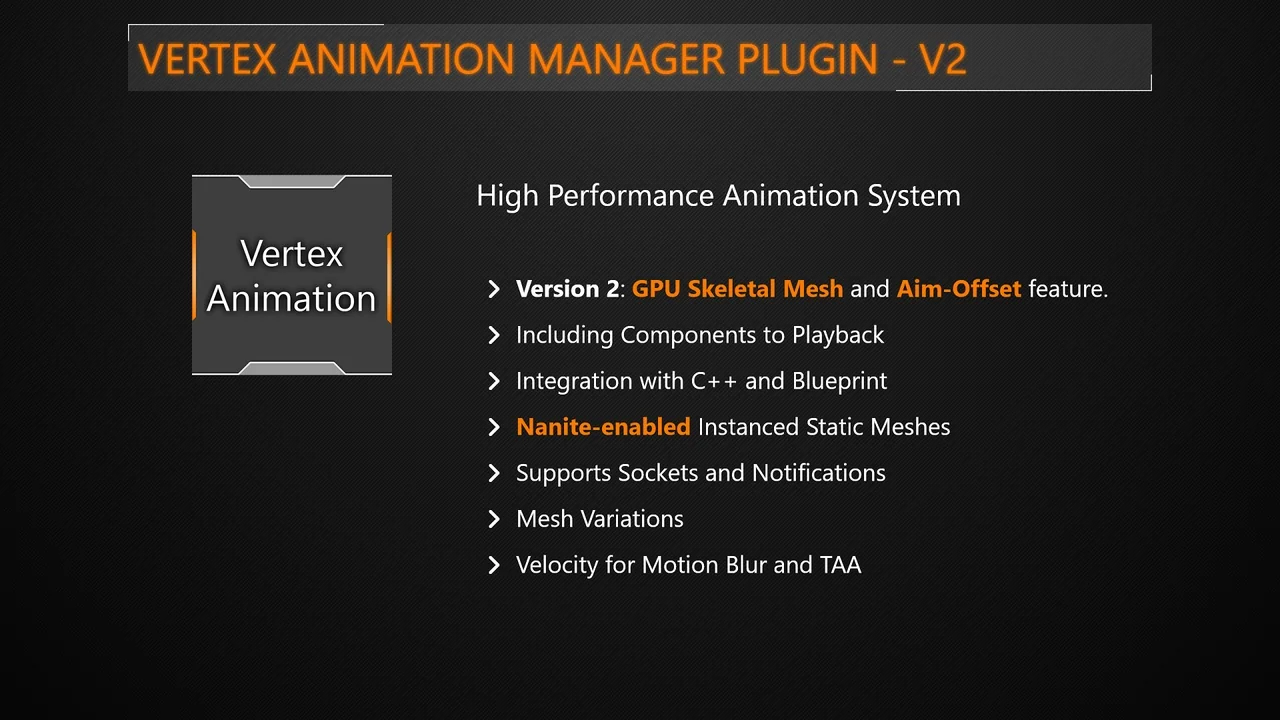
With VAMP 2, the system extends beyond VAT-only playback. An Advanced Quality mode converts meshes into GPU Skeletal Meshes using a compute shader animation system. The package then offers higher-quality rendering for transitions and per-bone weight blending, even at large scales. Procedural Aim-Offset also runs directly on the GPU through this new skeletal mesh path, which keeps aiming and orientation adjustments off the CPU.
Generating VAT Data Inside the Unreal Editor
The plugin removes the need for a standalone baking tool. Vertex animation textures are generated within the editor itself, letting artists iterate without exporting meshes to a separate application. This in-editor generation also makes it straightforward to re-bake when an animation changes, since the entire data pipeline stays inside the same project environment.
Scale capacity is a defining characteristic of the system. There are no frame limits baked into the tooling—over 500,000 frames with 100 bones can be packed into a single texture. This removes a common ceiling that forces teams to split long animations across multiple textures or sacrifice bone count. For combat sequences, long idle loops, or extended cinematic motions, that means the full sequence can live in one coherent data block.
Texture precision is also adjustable. An ultra-precision profile setting stores 32-bit float texture data for cases where lower-precision encoding would degrade subtle motion. A reduction tool handles automatic influence optimization in-editor, trimming unnecessary bone weights to keep the baking output lean without manual cleanup.
Advanced Quality and GPU Skeletal Mesh Compute Shader Workflow
The VAMP 2 update introduces Advanced Quality mode, which shifts the mesh into a GPU Skeletal Mesh driven by a compute shader animation system. This is where the plugin moves from purely texture-driven motion into GPU-based skeletal evaluation. The aim-offset feature runs through this GPU skeletal path, allowing procedural orientation adjustments to be calculated on the GPU rather than pre-baked or CPU-driven.
Quality gains are most visible in transition blending and per-bone weight weighting. Because the compute shader handles the blending on the GPU, large-scale renders—where hundreds or thousands of instances are animating simultaneously—maintain higher visual fidelity than VAT-only playback typically allows. The compute shader path is also built for extensibility, positioning the system to adopt additional GPU-side features without reverting to CPU-bound skeletal evaluation.
Playback Across Static Meshes, ISM, and HISM
The plugin ships with runtime components for three distinct rendering targets. Static Mesh playback handles individual or low-count animated meshes. ISM components cover large counts of the same mesh, while HISM supports hierarchical grouping—a common need for crowds with varied sub-parts or LOD structures.
These components are the mechanism by which VAT data reaches the rendered frame. Because the mesh no longer carries a CPU-side skeletal component, the playback path is lighter. The animation can be driven entirely by time, meaning no ticking is required for playback. That tick-less execution model is central to how the plugin sustains performance at scale.
Temporal Control and Tick-less Execution
Animations controlled by Vertex Animation Manager do not require engine ticking to advance. The entire playback is time-based, which means the runtime component can evaluate the correct frame from elapsed time rather than relying on per-frame tick updates. This is the structural reason the system can handle very high instance counts without the overhead that ticking skeletal meshes would impose.
The tick-less model extends to an Animation Blueprint specifically built for controlling these animations. Even with ticking disabled, animation notifications placed on the original skeletal mesh remain usable during playback through the vertex animation runtime components. SyncMarkers and SyncGroups provide further temporal control, letting animations stay aligned without CPU-side polling.
A PlayAnimationOnce node offers one-shot playback for events that should trigger, complete, and stop—useful for impact reactions, single-action triggers, and any sequence that should not loop. The ability to pause and resume the world gives developers control over simulating or freezing animation state globally, which is critical for debugging, cut-scene scrubbing, or tiered simulation logic.
Sockets, Bones, and Component Attachment at Runtime
Despite meshes being converted away from traditional CPU skeletal evaluation, the plugin retains access to sockets and bones from both C++ and Blueprint. Socket transform, location, and rotation can be retrieved at runtime, which keeps one of the most common skeletal-mesh workflows intact—attaching weapons, effects, or secondary components to specific points on an animated body.
The runtime component can automatically update socket transforms during playback if that option is enabled. That means attached components track the animation without manual per-frame synchronization. Setting up Blueprint actors with socket-attached components follows the same logic artists already use with standard skeletal meshes, smoothing the transition from traditional characters to VAT-driven instances.
Static Mesh sockets are also available from non-animated VAISM and VAHISM, extending socket-based attachment workflows beyond animated instances to static ones within the same component framework.
VAMovementComponent and Root Motion Integration
Root motion is supported through a dedicated Root Motion System and a VAMovementComponent that integrates Nav Mesh pathfinding with root-motion-driven movement. This combination allows characters animated through VAT to navigate environments using AI pathfinding while their motion is genuinely driven by the baked animation data rather than a separate locomotion controller.
For projects that need characters to ragdoll on death or impact, the system supports switching to a RagDoll Skeletal Mesh. This means the optimized VAT representation can handle the living character, while a traditional skeletal mesh takes over for physics-driven death states—a common production pattern that the plugin supports natively rather than requiring a fully custom handoff.
Instancing Tools and Visibility Management
Beyond the base ISM and HISM playback, the plugin adds instance-level controls for production scenarios. A visibility flag on VAISM and VAHISM components can add and remove instances on the fly, letting the system cull or spawn visible actors dynamically without rebuilding the entire instance set.
ISM previous transforms and HISM Async Build-Tree—both available on UE 5.4 and later—improve how transforms are tracked and how instance hierarchies are constructed. Async build-tree construction prevents hierarchical instance setup from stalling the main thread, which matters when large crowds are spawned or restructured mid-game.
Variations are handled through a dedicated variations asset that allows multiple meshes to share profiles, and through Variation Groups with a randomize method for distributing visual variety across instances without manually configuring each one. Scripted Action Assets support batch processing, so repeated setup tasks across many meshes can be automated rather than performed one at a time.
Visual Fidelity, Physics, and Material Features
The plugin has expanded over multiple updates to address the visual compromises that historically accompanied vertex animation. VAT Normal Mapping restores fine surface detail that VAT compression can flatten. VAT Physics adds physical behavior to VAT-driven meshes. VAT Async Loading prevents large animation data from blocking load sequences. VAT Morph Target Export to Texture allows morph-based shape changes to be captured into the same texture-based pipeline.
Velocity data written for ISM and HISM supports Temporal Anti-Aliasing (TAA), Motion Blur, and related motion-dependent effects. Without that velocity data, fast-moving instances would render with incorrect or missing motion blur, which breaks the visual coherence of large crowds. By writing velocity into the instance data, the plugin makes high-count instanced animation compatible with the same post-processing quality expected from traditional skeletal meshes.
The system also syncs with fully dynamic cloth systems, supports modular characters through a single control, and includes SIMD velocity optimizations for faster computation. Spatial ISM with a Spatial System—available when the related plugin is also owned—adds spatial partitioning for instance management at very large counts.
Nanite Integration and Performance Architecture
Nanite support has progressed across several updates. Nanite was first enabled for bone animations on UE 5.1 and later, and subsequent updates perfected the Nanite workflow to cover all meshes. A Nanite bake for UE 5.5 further refines how VAT-driven meshes integrate with Nanite's micropolygon rendering, letting high-detail meshes benefit from both VAT-driven animation and Nanite's geometric density.
Performance architecture centers on a two-phased game loop intended for game-loop optimization and multi-threaded processing. This loop structures animation work so that heavy processing is distributed across available threads rather than concentrated on the game thread. Combined with tick-less playback, the two-phased loop is how the plugin sustains large-scale simulation without framerate collapse.
Compatibility spans Unreal Engine 4.27 through 5.7. Full support was declared at UE 5.2, UE 5.3, and through UE 5.5's Nanite bake update, with features like ISM previous transforms and HISM Async Build-Tree arriving specifically for UE 5.4 and later.
For teams evaluating Vertex Animation Manager, the strongest practical takeaway is the combination of in-editor VAT generation, tick-less time-driven playback, and the VAMP 2 compute-shader GPU Skeletal Mesh path—three layers that together allow massive animated crowds to render with skeletal-grade quality while remaining off the CPU evaluation path entirely.
Related Resources Worth Checking
Resource screenshots
6 curated preview images
Download this resource
Log in or create a free account to start your download.
Resources are manually reviewed before listing to improve quality and reduce obvious risks.
Related resources
 Animations
Vertex Animator
Animations
 Animations
FPS Animation Pack Ultimate
Animations
 Animations
Runtime MetaHuman Lip Sync (AI for NPCs) (+ CC4, Genesis, ARKit, and more)
Animations