"7e6fc58c410f2894"{"id":"1000445","slug":"uaim-advanced-lock-on-targeting-and-prediction-system","title":"uAim - Advanced Lock-On Targeting and Prediction System","category":"Game Mechanics","engine":"5.7","assetVersion":"Asset Version: 1.0","engineVersion":"Engine Version: 5.7","tag":"Game Mechanics","accent":"blue","visual":"mech","summary":"uAim is a C++ lock-on targeting and movement prediction system for Unreal Engine, covering character camera lock-on, turrets, homing projectiles, and procedural","platform":"Unreal Engine","publishedAt":"2026-07-11T00:18:00.368Z","updatedAt":"2026-07-11T00:18:00.368Z","sourceNotes":[],"fileContents":[],"compatibility":["Unreal Engine","Asset Version: 1.0","Engine Version: 5.7"],"featuredImage":{"alt":"uAim - Advanced Lock-On Targeting and Prediction System","src":"/wp-content/uploads/published/2026/07/207da5fa5aa8-68d32af6-9231-4022-8483-b4902303679b-9fcd15de94.webp"},"hasDownloadLink":true,"downloads":0,"terms":[{"taxonomy":"category","slug":"game-mechanics","name":"Game Mechanics"}],"galleryImages":[{"src":"/wp-content/uploads/published/2026/07/3533d73b93f9-8cfd160f-ca73-4bb0-8b3d-4d5da4e9c00b-507893cb4a.webp","alt":"uAim - Advanced Lock-On Targeting and Prediction System"},{"src":"/wp-content/uploads/published/2026/07/7df300427298-3aa6c5af-4a87-4fdf-b8fe-57214bb77f74-c7f6f136bf.webp","alt":"uAim - Advanced Lock-On Targeting and Prediction System"},{"src":"/wp-content/uploads/published/2026/07/a077e4f2e246-f26ec28b-22b6-4738-97e1-1b0a7d4bab9c-fa08a6f222.webp","alt":"uAim - Advanced Lock-On Targeting and Prediction System"},{"src":"/wp-content/uploads/published/2026/07/ebc0530f536f-6bbb1150-8271-448b-8b2a-89786219e349-72b49e3773.webp","alt":"uAim - Advanced Lock-On Targeting and Prediction System"},{"src":"/wp-content/uploads/published/2026/07/b70c35bc65b0-959f153c-7895-4a0c-9efa-9fd934bd94c8-4782be7c24.webp","alt":"uAim - Advanced Lock-On Targeting and Prediction System"},{"src":"/wp-content/uploads/published/2026/07/0bd058f33fbc-55bd69c0-7a9e-4d3c-9e96-7ed147ac0521-7ff4529bbd.webp","alt":"uAim - Advanced Lock-On Targeting and Prediction System"},{"src":"/wp-content/uploads/published/2026/07/8053b211a5d9-363f4de5-ad59-483f-8ae9-6a85ec975d0b-3640230b71.webp","alt":"uAim - Advanced Lock-On Targeting and Prediction System"}],"accessPanel":{"kind":"resource","title":"Download this resource","eyebrow":"Free Download","message":"Log in or create a free account to start your download.","fileName":"Plugins.7z","safetyNote":"Resources are manually reviewed before listing to improve quality and reduce obvious risks.","actionLabel":"Download Free","resourceType":"Resource archive"},"contentHtml":"\u003ch2\u003eCharacter Camera Lock-On Targeting in Practice\u003c/h2\u003e\n\u003cp\u003eA targeting system needs to tie camera behavior to moving actors in the scene without locking the player into rigid, unresponsive frames. UAim approaches this through its Character Camera Lock-On Targeting feature, which establishes a direct connection between the player's view direction and a selected target. The moment a target is acquired, the camera orientation responds to that selection, keeping the aimed actor in view while still allowing the player to maintain control over movement and positioning.\u003c/p\u003e \u003cp\u003eWhat makes this behavior viable for production is the included Look-At Rotation Offsets support. Real combat scenarios rarely involve targets that sit perfectly anchored in screen. Enemies approach from varying angles, and the camera must adjust its tracking arc to keep the action readable without snapping to extremes. The offset support allows the lock-on framing to account for those angular differences, providing a more adaptable tracking response rather than a mechanical point-and-follow execution.\u003c/p\u003e \u003cp\u003eThis flexibility means the system is not restricted to third-person melee or shooter scenarios where the target sits at a fixed screen distance. The same offset logic applies when the camera must compensate for verticality, terrain differences, or fast directional changes from the target. The package then offers a lock-on behavior that adapts to scene geometry and target movement rather than forcing the scene to accommodate the targeting logic.\u003c/p\u003e \u003ch3\u003eMovement Prediction for Lock-On Systems and Homing Projectiles\u003c/h3\u003e\n\u003cp\u003eLocking onto a moving target is only part of the equation. UAim also provides Movement Prediction of Targets, and it splits this capability into two distinct implementations: prediction for lock-on systems and prediction for homing projectiles. These are related but serve different gameplay needs.\u003c/p\u003e \u003cp\u003eFor lock-on systems, prediction allows the camera and targeting interface to anticipate where a moving target is heading. If an enemy is strafing, dodging, or altering trajectory, the lock-on can adjust its framing before the target fully arrives at its new position. This prevents the camera from lagging behind rapid target movement, which is a common issue in lock-on implementations that rely solely on current position data.\u003c/p\u003e \u003cp\u003eFor homing projectiles, prediction takes on a ballistic role. A homing missile or guided projectile needs to know not just where the target is, but where it will be by the time the projectile closes the gap. UAim feeds prediction data into that pursuit logic, allowing projectiles to curve toward an anticipated intercept point rather than chasing a constantly updating current position. The package then offers smoother pursuit behavior and a reduction in the sharp, unnatural course corrections that occur when a projectile simply tracks a moving actor in real time.\u003c/p\u003e \u003ch2\u003eFlexible Targeting and the Included Turret Systems\u003c/h2\u003e\n\u003cp\u003eUAim is not limited to player-controlled camera targeting. The asset includes Flexible Targeting for Custom Systems, and the creator specifically calls out turret implementations as an included example. This means the targeting logic can be separated from the player camera and applied to actors that must acquire and track targets independently.\u003c/p\u003e \u003cp\u003eThe package includes Simple Procedural Turret-Animations created with uAim features. These animations are not pre-baked sequences that play back at fixed intervals. They respond to the targeting data the system generates, meaning the turret barrels and rotating elements adjust based on where the predicted target position sits. This procedural approach allows the turret visuals to align with the targeting logic without requiring separate animation assets for each possible tracking scenario.\u003c/p\u003e \u003cp\u003eTurret customization extends across multiple contexts. The documentation covers turret customization in general, an animated custom turret setup, and a vehicle turret tutorial. The inclusion of a vehicle turret example signals that the system can handle targeting on actors that are themselves in motion, where the turret must account for both its own base movement and the target's predicted trajectory simultaneously.\u003c/p\u003e \u003ch3\u003eGeneral Purpose Lock-On Functions and C++ Support\u003c/h3\u003e\n\u003cp\u003eBeyond the specific camera and turret implementations, uAim provides General Purpose Lock-On Functions. These act as a library of targeting operations that can be applied to custom systems outside the included examples. A developer building a specializedCombat mechanic, a remote drone targeting interface, or a context-sensitive aim assist can pull from these functions without needing to reverse-engineer the entire system.\u003c/p\u003e \u003cp\u003eC++ support is a core part of the package. The inclusion of Full Source-Code means that teams can inspect, modify, and extend the underlying logic at the C++ level rather than being confined to Blueprint interaction alone. The documentation reflects this dual path: tutorials cover both Blueprint Lock-On Integration for Player Character and C++ Lock-On Integration for Player Character. A team can begin with Blueprint integration to prototype quickly, then transition the implementation to C++ as the project's performance or structural needs evolve.\u003c/p\u003e \u003ch2\u003eUnreal Engine Compatibility and Version Guidance\u003c/h2\u003e\n\u003cp\u003eThe asset supports Unreal Engine versions 5.4 through 5.7. For projects running on earlier versions, the documentation includes a dedicated segment on using uAim on Unreal 5.3 and lower. This guidance ensures that teams on slightly older engine installations can still implement the system without an immediate forced upgrade, though the supported range begins at 5.4.\u003c/p\u003e \u003cp\u003eThe release includes a suite of video documentation that walks through the practical setup and installation process. The uAim Lock-On Component Main Features tutorial breaks down the core component, while separate videos cover installation and getting started. This structured video library provides a direct reference for teams integrating the system, reducing the need to test blindly until the behavior matches expectations.\u003c/p\u003e \u003ch3\u003eIncluded Showcase Content and Learning Resources\u003c/h3\u003e\n\u003cp\u003eAll Showcase-Demo content is included with the package. This means the playable demo, which the creator makes available for evaluation, ships with the asset itself. Designers can open the demo content inside the engine, inspect how the lock-on and prediction systems are configured, and use those setups as reference points for their own implementations.\u003c/p\u003e \u003cp\u003eThe tutorial library extends beyond the core features. In addition to the turret-focused videos, the documentation set includes walkthroughs for animated custom turrets and vehicle turrets, reinforcing the system's flexibility in non-player-character targeting scenarios. A showcase trailer is also available, providing a direct look at the system in motion for teams who need to evaluate its behavior visually before committing to integration. For ongoing questions, a dedicated Discord server is available, providing direct interaction with the creator.\u003c/p\u003e \u003ch2\u003eWhere uAim Fits in a Production Workflow\u003c/h2\u003e\n\u003cp\u003eThis system occupies the middle layer of a combat or targeting implementation. It does not replace the need for character animation logic or damage handling downstream. Instead, it provides the targeting data and prediction math that those downstream systems consume.\u003c/p\u003e \u003cp\u003eFor a melee combat game, the character camera lock-on would feed into the player's movement and animation state machine, ensuring attacks chain toward the acquired target. For a shooter or vehicle game, the turret targeting and homing projectile prediction would deliver the intercept data that the firing logic uses to spawn and guide munitions. The C++ foundation means that this data flow can be optimized and extended without the overhead of Blueprint-only processing for performance-critical calculations.\u003c/p\u003e \u003cp\u003eThe procedural turret animations exemplify this middle-layer role. The targeting system generates the predicted position, and the turret's procedural animation responds to that data. The animation does not exist independently; it listens to the targeting output. This data-driven relationship is what allows a single targeting asset to serve camera lock-on, turret tracking, and homing projectile pursuit without requiring three separate logic paths.\u003c/p\u003e \u003ch3\u003eEvaluating the System for a Project\u003c/h3\u003e\n\u003cp\u003eTeams considering uAim can download and play the showcase demo before committing to implementation. The demo provides a hands-on look at how the character camera lock-on feels in motion and how the turret systems behave under target movement. Since the demo content itself is included in the package, designers can immediately deconstruct any behavior they see in the demo by opening the corresponding content in the engine.\u003c/p\u003e \u003cp\u003eThe presence of General Purpose Lock-On Functionsgives the system utility beyond the showcased scenarios. A developer who needs targeting logic for a mechanic not covered by the included examples can use these functions as the base, building custom acquisition and tracking logic on top of the same core operations, while leveraging the prediction math, C++ foundation, and Unreal Engine 5.4 through 5.7 compatibility as needed.\u003c/p\u003e\n\n\u003ch2\u003eMore From The Same Workflow\u003c/h2\u003e\n\u003cul\u003e\n\u003cli\u003e\u003ca href=\"https://3dcghub.com/smart-shooting-npc-and-player-projectile-target-prediction-and-ballistic-system/\" title=\"Smart Shooting - NPC \u0026amp; Player Projectile Target Prediction \u0026amp; Ballistic System\"\u003eSmart Shooting - NPC \u0026amp; Player Projectile Target Prediction \u0026amp; Ballistic System\u003c/a\u003e\u003c/li\u003e\n\u003cli\u003e\u003ca href=\"https://3dcghub.com/trail-hunter-pro-footprints-and-tracks-with-multiplayer-and-worldpartition/\" title=\"Trail Hunter PRO - Footprints and Tracks with Multiplayer \u0026amp; WorldPartition\"\u003eTrail Hunter PRO - Footprints and Tracks with Multiplayer \u0026amp; WorldPartition\u003c/a\u003e\u003c/li\u003e\n\u003cli\u003e\u003ca href=\"https://3dcghub.com/rpg-soulslike-stats-system/\" title=\"RPG/Soulslike Stats System\"\u003eRPG/Soulslike Stats System\u003c/a\u003e\u003c/li\u003e\n\u003cli\u003e\u003ca href=\"https://3dcghub.com/envirosense-immersive-hand-ik/\" title=\"EnviroSense: Immersive Hand IK\"\u003eEnviroSense: Immersive Hand IK\u003c/a\u003e\u003c/li\u003e\n\u003cli\u003e\u003ca href=\"https://3dcghub.com/npc-eyes-sight-system-pro-accurate-npc-vision-with-light-shadow-body-points/\" title=\"NPC Eyes Sight System PRO – Accurate NPC Vision with Light, Shadow, Body Points\"\u003eNPC Eyes Sight System PRO – Accurate NPC Vision with Light, Shadow, Body Points\u003c/a\u003e\u003c/li\u003e\n\u003c/ul\u003e","contentTextLength":9514,"navigation":{"current":1313,"total":3618,"previous":{"id":"1000446","slug":"vertex-animation-manager","title":"Vertex Animation Manager","category":"Animations","platform":"Unreal Engine","updatedAt":"2026-07-11T00:22:10.116Z"},"next":{"id":"1000443","slug":"toon-movement-animation-set","title":"Toon Movement Animation Set","category":"Locomotion / Gaits","platform":"Unreal Engine","updatedAt":"2026-07-10T23:05:07.325Z"}},"relatedResources":[{"id":"1000935","slug":"advanced-lock-on-system","title":"Advanced Lock-on System","category":"Gameplay Features","engine":"5.1+","assetVersion":"","engineVersion":"Engine Version: 5.1+","tag":"Gameplay Features","accent":"blue","visual":"mech","summary":"Shooter toolkit with Tracking, Lock-on, and Prediction Systems. Targets any Actor, displays markers and info, supports auto aim and homing projectiles.","platform":"Unreal Engine","publishedAt":"2026-08-10T02:44:44.426Z","updatedAt":"2026-08-10T02:44:44.426Z","sourceNotes":[],"fileContents":[],"compatibility":["Unreal Engine","Engine Version: 5.1+"],"featuredImage":{"alt":"Advanced Lock-on System","src":"/wp-content/uploads/published/2026/08/a65d18b23b10-defd2078-21d1-4fb9-b55a-97cf5a676530-0a400ee090.webp"},"hasDownloadLink":true,"downloads":0},{"id":"1000341","slug":"smart-shooting-npc-and-player-projectile-target-prediction-and-ballistic-system","title":"Smart Shooting - NPC \u0026 Player Projectile Target Prediction \u0026 Ballistic System","category":"Game Mechanics","engine":"5.4 - 5.5,5.7","assetVersion":"Asset Version: 1.0.6 - 1.1.0","engineVersion":"Engine Version: 5.4 - 5.5,5.7","tag":"Game Mechanics","accent":"blue","visual":"mech","summary":"A comprehensive Unreal Engine shooting system featuring target prediction, parabolic trajectories, and C++ optimized background calculations for NPCs and player","platform":"Unreal Engine","publishedAt":"2026-07-05T08:36:29.188Z","updatedAt":"2026-07-23T16:54:01.327Z","sourceNotes":[],"fileContents":[],"compatibility":["Unreal Engine","Asset Version: 1.0.6 - 1.1.0","Engine Version: 5.4 - 5.5,5.7"],"featuredImage":{"alt":"Smart Shooting - NPC \u0026 Player Projectile Target Prediction \u0026 Ballistic System","src":"/wp-content/uploads/published/2026/07/051ba082f09c-1bc7df8d-34b4-4ea9-95a1-58ea32b1439e-fa9fc2ec39.webp"},"hasDownloadLink":true,"downloads":1},{"id":"1001298","slug":"advanced-phone-system-v3-replicated","title":"Advanced Phone System V3 Replicated","category":"Game Mechanics","engine":"5.1+","assetVersion":"","engineVersion":"Engine Version: 5.1+","tag":"Game Mechanics","accent":"blue","visual":"mech","summary":"Explore the Advanced Phone System V3 Replicated for Unreal Engine, featuring 15 Blueprints, multiplayer sync, NPC dialogue, and in-game smartphone apps.","platform":"Unreal Engine","publishedAt":"2026-10-02T06:00:01.725Z","updatedAt":"2026-10-02T06:00:01.725Z","sourceNotes":[],"fileContents":[],"compatibility":["Unreal Engine","Engine Version: 5.1+"],"featuredImage":{"alt":"Advanced Phone System V3 Replicated","src":"/wp-content/uploads/published/2026/10/085245bcd14e-a13d28d0-643a-4a32-bc84-d79f901d6112-a65bc3e443.webp"},"hasDownloadLink":true,"downloads":0}]}
Game Mechanics
uAim - Advanced Lock-On Targeting and Prediction System
uAim is a C++ lock-on targeting and movement prediction system for Unreal Engine, covering character camera lock-on, turrets, homing projectiles, and procedural
A targeting system needs to tie camera behavior to moving actors in the scene without locking the player into rigid, unresponsive frames. UAim approaches this through its Character Camera Lock-On Targeting feature, which establishes a direct connection between the player's view direction and a selected target. The moment a target is acquired, the camera orientation responds to that selection, keeping the aimed actor in view while still allowing the player to maintain control over movement and positioning.
What makes this behavior viable for production is the included Look-At Rotation Offsets support. Real combat scenarios rarely involve targets that sit perfectly anchored in screen. Enemies approach from varying angles, and the camera must adjust its tracking arc to keep the action readable without snapping to extremes. The offset support allows the lock-on framing to account for those angular differences, providing a more adaptable tracking response rather than a mechanical point-and-follow execution.
This flexibility means the system is not restricted to third-person melee or shooter scenarios where the target sits at a fixed screen distance. The same offset logic applies when the camera must compensate for verticality, terrain differences, or fast directional changes from the target. The package then offers a lock-on behavior that adapts to scene geometry and target movement rather than forcing the scene to accommodate the targeting logic.
Movement Prediction for Lock-On Systems and Homing Projectiles
Locking onto a moving target is only part of the equation. UAim also provides Movement Prediction of Targets, and it splits this capability into two distinct implementations: prediction for lock-on systems and prediction for homing projectiles. These are related but serve different gameplay needs.
For lock-on systems, prediction allows the camera and targeting interface to anticipate where a moving target is heading. If an enemy is strafing, dodging, or altering trajectory, the lock-on can adjust its framing before the target fully arrives at its new position. This prevents the camera from lagging behind rapid target movement, which is a common issue in lock-on implementations that rely solely on current position data.
For homing projectiles, prediction takes on a ballistic role. A homing missile or guided projectile needs to know not just where the target is, but where it will be by the time the projectile closes the gap. UAim feeds prediction data into that pursuit logic, allowing projectiles to curve toward an anticipated intercept point rather than chasing a constantly updating current position. The package then offers smoother pursuit behavior and a reduction in the sharp, unnatural course corrections that occur when a projectile simply tracks a moving actor in real time.
Flexible Targeting and the Included Turret Systems
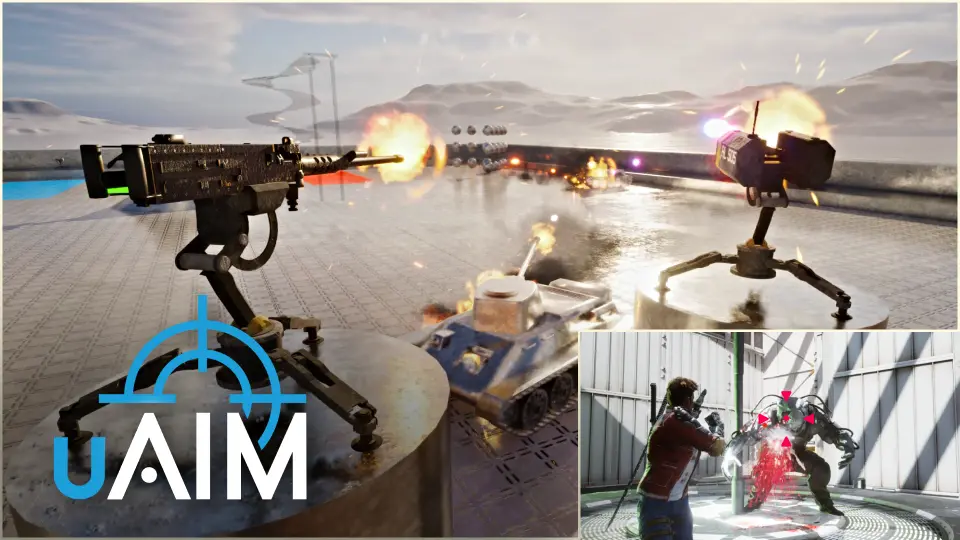
UAim is not limited to player-controlled camera targeting. The asset includes Flexible Targeting for Custom Systems, and the creator specifically calls out turret implementations as an included example. This means the targeting logic can be separated from the player camera and applied to actors that must acquire and track targets independently.
The package includes Simple Procedural Turret-Animations created with uAim features. These animations are not pre-baked sequences that play back at fixed intervals. They respond to the targeting data the system generates, meaning the turret barrels and rotating elements adjust based on where the predicted target position sits. This procedural approach allows the turret visuals to align with the targeting logic without requiring separate animation assets for each possible tracking scenario.
Turret customization extends across multiple contexts. The documentation covers turret customization in general, an animated custom turret setup, and a vehicle turret tutorial. The inclusion of a vehicle turret example signals that the system can handle targeting on actors that are themselves in motion, where the turret must account for both its own base movement and the target's predicted trajectory simultaneously.
General Purpose Lock-On Functions and C++ Support
Beyond the specific camera and turret implementations, uAim provides General Purpose Lock-On Functions. These act as a library of targeting operations that can be applied to custom systems outside the included examples. A developer building a specializedCombat mechanic, a remote drone targeting interface, or a context-sensitive aim assist can pull from these functions without needing to reverse-engineer the entire system.
C++ support is a core part of the package. The inclusion of Full Source-Code means that teams can inspect, modify, and extend the underlying logic at the C++ level rather than being confined to Blueprint interaction alone. The documentation reflects this dual path: tutorials cover both Blueprint Lock-On Integration for Player Character and C++ Lock-On Integration for Player Character. A team can begin with Blueprint integration to prototype quickly, then transition the implementation to C++ as the project's performance or structural needs evolve.
Unreal Engine Compatibility and Version Guidance
The asset supports Unreal Engine versions 5.4 through 5.7. For projects running on earlier versions, the documentation includes a dedicated segment on using uAim on Unreal 5.3 and lower. This guidance ensures that teams on slightly older engine installations can still implement the system without an immediate forced upgrade, though the supported range begins at 5.4.
The release includes a suite of video documentation that walks through the practical setup and installation process. The uAim Lock-On Component Main Features tutorial breaks down the core component, while separate videos cover installation and getting started. This structured video library provides a direct reference for teams integrating the system, reducing the need to test blindly until the behavior matches expectations.
Included Showcase Content and Learning Resources
All Showcase-Demo content is included with the package. This means the playable demo, which the creator makes available for evaluation, ships with the asset itself. Designers can open the demo content inside the engine, inspect how the lock-on and prediction systems are configured, and use those setups as reference points for their own implementations.
The tutorial library extends beyond the core features. In addition to the turret-focused videos, the documentation set includes walkthroughs for animated custom turrets and vehicle turrets, reinforcing the system's flexibility in non-player-character targeting scenarios. A showcase trailer is also available, providing a direct look at the system in motion for teams who need to evaluate its behavior visually before committing to integration. For ongoing questions, a dedicated Discord server is available, providing direct interaction with the creator.
Where uAim Fits in a Production Workflow
This system occupies the middle layer of a combat or targeting implementation. It does not replace the need for character animation logic or damage handling downstream. Instead, it provides the targeting data and prediction math that those downstream systems consume.
For a melee combat game, the character camera lock-on would feed into the player's movement and animation state machine, ensuring attacks chain toward the acquired target. For a shooter or vehicle game, the turret targeting and homing projectile prediction would deliver the intercept data that the firing logic uses to spawn and guide munitions. The C++ foundation means that this data flow can be optimized and extended without the overhead of Blueprint-only processing for performance-critical calculations.
The procedural turret animations exemplify this middle-layer role. The targeting system generates the predicted position, and the turret's procedural animation responds to that data. The animation does not exist independently; it listens to the targeting output. This data-driven relationship is what allows a single targeting asset to serve camera lock-on, turret tracking, and homing projectile pursuit without requiring three separate logic paths.
Evaluating the System for a Project
Teams considering uAim can download and play the showcase demo before committing to implementation. The demo provides a hands-on look at how the character camera lock-on feels in motion and how the turret systems behave under target movement. Since the demo content itself is included in the package, designers can immediately deconstruct any behavior they see in the demo by opening the corresponding content in the engine.
The presence of General Purpose Lock-On Functionsgives the system utility beyond the showcased scenarios. A developer who needs targeting logic for a mechanic not covered by the included examples can use these functions as the base, building custom acquisition and tracking logic on top of the same core operations, while leveraging the prediction math, C++ foundation, and Unreal Engine 5.4 through 5.7 compatibility as needed.
 Game Mechanics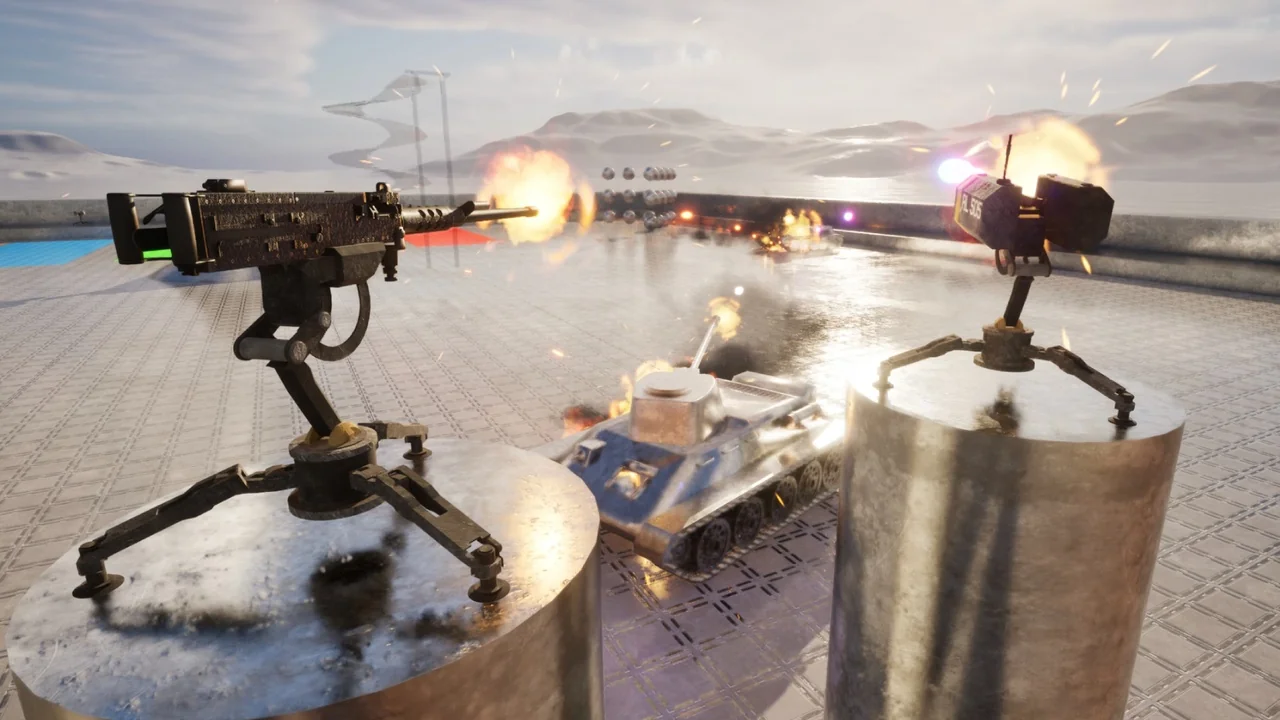
 Gameplay Features
 Game Mechanics
 Game Mechanics