"c68a05d5e51405b3"{"id":"1000695","slug":"unreal-engine-5-create-a-top-down-2d-survivors-style-game","title":"Unreal Engine 5: Create a top-down 2D survivors style game","category":"Unreal Engine","engine":"File Content: video + English subtitles","assetVersion":"Video Language: English","engineVersion":"File Content: video + English subtitles","tag":"Unreal Engine","accent":"blue","visual":"mech","summary":"Intermediate Unreal Engine 5 course teaching top-down 2D roguelike development with Blueprints, pooling systems, skill modules, shop mechanics, and real-time le","platform":"Unreal Engine","publishedAt":"2026-07-23T12:33:28.920Z","updatedAt":"2026-07-23T12:33:28.920Z","sourceNotes":[],"fileContents":[],"compatibility":["Unreal Engine","Video Language: English","File Content: video + English subtitles"],"featuredImage":{"alt":"Unreal Engine 5: Create a top-down 2D survivors style game","src":"/wp-content/uploads/published/2026/07/2ec25d9d06f4-5653334-0375-8-7d5dfb7cd3.webp"},"hasDownloadLink":true,"downloads":0,"terms":[{"taxonomy":"category","slug":"tutoriallibrary-unrealengine","name":"Unreal Engine"}],"galleryImages":[],"accessPanel":{"kind":"video-resource","title":"Download this video resource","eyebrow":"Free Download","message":"Log in or create a free account to start your download.","fileName":"Unreal Engine 5 Create a top-down 2D survivors style game.7z","safetyNote":"Resources are manually reviewed before listing to improve quality and reduce obvious risks.","actionLabel":"Download Free","resourceType":"Video download"},"contentHtml":"\u003cp\u003eA 16-hour intermediate course focused on building a top-down 2D vampire-survival roguelike game from scratch in Unreal Engine 5. The instruction centers entirely on Blueprint visual scripting, covering everything from foundational actor handling to performance optimization and live competitive systems. Taught by Howl Chang, the curriculum spans more than 70 lectures across eight modules, taking developers through basic setup, pooling frameworks, skill design, horde patterns, shop mechanics, and leaderboard integration.\u003c/p\u003e\n\n\u003ch2\u003eBlueprint Fundamentals and Actor Management\u003c/h2\u003e\n\u003cp\u003eThe course begins with an introduction and basic setup before moving into the core of Unreal Engine Blueprint fundamentals. Rather than relying on C++ code, the instruction uses the visual scripting system exclusively to handle various actors across the game. This includes building behaviors for more than 20 distinct mob types alongside two boss encounters. The actor management work forms the technical baseline for the rest of the game systems, establishing how enemies, projectiles, and items are spawned and controlled during gameplay.\u003c/p\u003e\n\n\n\u003cp\u003eBeyond simple instantiation, the Blueprint instruction covers the relationships between different actor types and how they interact within a top-down 2D environment. The mob and boss actor setups feed directly into the wave-based gameplay, where enemy hordes follow different spawn patterns. This means the foundational Blueprint work is not isolated tutorial material but connects to the horde patterns and special skill module covered later in the curriculum.\u003c/p\u003e\n\n\u003ch2\u003ePooling Framework for Performance Optimization\u003c/h2\u003e\n\u003cp\u003eA dedicated pooling framework module addresses one of the most pressing performance concerns in survivor-style games: managing large numbers of simultaneous actors. The course teaches how to create pools that store active instances rather than repeatedly spawning and destroying objects. Three specific actor categories are covered under this system: enemies, bullets, and pickup items.\u003c/p\u003e\n\n\n\u003cp\u003eThe pooling approach matters because top-down survival games generate continuous streams of projectiles, enemies, and dropped resources throughout a match. By storing and reusing instances, the framework reduces the overhead that comes with constant actor creation and garbage collection. The module covers pooling for each actor type in a unified framework, so the same underlying mechanics apply to mobs, bullets, and items alike.\u003c/p\u003e\n\n\u003ch3\u003eSkill Module and Roguelike Upgrade Mechanics\u003c/h3\u003e\n\u003cp\u003eThe course dedicates a full module to designing a skill upgrade system with roguelike mechanics. Developers learn to build ten or more unique skills, split between active and passive types. Active skills require player input or trigger conditions, while passive skills modify character behavior continuously. This active/passive split mirrors the roguelike decision-making common in survivor-style games, where players choose upgrades mid-run.\u003c/p\u003e\n\n\n\u003cp\u003eThe skill module connects directly to the horde patterns and special skill module that follows in the curriculum. Enemy waves are designed with different patterns, and the experience system ties into the skill upgrade loop. An experience item and a magnet item are included as pickup types, with the magnet drawing collected resources toward the player. These pickups exist within the pooling framework, so the technical implementation of item collection relies on the earlier pooling work.\u003c/p\u003e\n\n\n\u003ch2\u003eShop System with Auto-Save and Loading\u003c/h2\u003e\n\n\u003cp\u003eThe shop module adds a meta-progression layer where players can increase character stats by spending in-game resources. The system includes a refund function, allowing players to reverse purchases and reallocate resources. This requires a saving and loading system that tracks resource totals and stat levels between sessions.\u003c/p\u003e\n\n\u003cp\u003eThe auto-save and loading system is integrated directly into the shop, meaning that resource spending, stat increases, and refund operations all persist across game restarts. The course treats saving not as a standalone feature but as a connected component of the shop workflow. This ties the economic decisions players make during a run to their long-term progression, which is a structural pattern common in roguelike design.\u003c/p\u003e\n\n\n\u003ch3\u003eReal-Time Leaderboard Integration\u003c/h3\u003e\n\u003cp\u003eA leaderboard module rounds out the curriculum with a free real-time competitive system. The leaderboard encourages players to pursue high scores by comparing their results against other players. The module is positioned as a way to add replayability and competitive drive to the finished game, giving players an external goal beyond surviving each individual run.\u003c/p\u003e\n\n\u003cp\u003eThe real-time aspect means the leaderboard is not local-only but connects players across sessions. This module appears at the end of the curriculum, building on the gameplay systems established earlier. By the time the leaderboard is implemented, the game already has its core loop, progression systems, and performance framework in place.\u003c/p\u003e\n\n\u003ch2\u003eCourse Structure and Workflow Placement\u003c/h2\u003e\n\u003cp\u003eThe curriculum progresses through eight modules: Introduction, Basic Setup, Blueprint Fundamentals, Pooling Framework, Skill Module, Horde Patterns and Special Skills, Shop Module, and Leaderboard Module. This sequence reflects a practical production workflow where foundational systems come first, gameplay mechanics build on those foundations, and meta-systems like shop and leaderboards layer on top of the working game loop.\u003c/p\u003e\n\n\n\u003cp\u003eWith a total workload of 16 hours and 26 minutes, the course was published on August 1, 2025, and sits at an intermediate level. The instruction targets multiple audiences: junior game developers interested in visual scripting, developers looking for a top-down 2D development guide specific to Unreal Engine, and intermediate or experienced developers who want to expand their Blueprint workflow. The fully visual scripting approach means the entire game is built without leaving the Blueprint system, which keeps the development process accessible to developers coming from non-programming backgrounds.\u003c/p\u003e\n\n\u003cp\u003eFor a production workflow, the course is structured to take a developer from an empty project to a game with enemy AI, skill progression, economic persistence, and competitive scoring. The pooling framework provides the technical backbone for handling the actor density that the genre demands, while the skill and shop modules handle the player-facing progression systems. The leaderboard closes the loop with a retention-focused feature that gives players a reason to return after completing a run.\u003c/p\u003e\n\n\u003cp\u003eBy the end of the course, developers have a complete genre-specific implementation covering the systems that define survivor-style roguelikes: dense actor management, varied enemy behavior, active and passive skill selection, persistent stat progression with refunding, and live competitive scoring.\u003c/p\u003e\n\n\u003ch2\u003eMore From The Same Workflow\u003c/h2\u003e\n\u003cul\u003e\n\u003cli\u003e\u003ca href=\"https://3dcghub.com/the-ultimate-2d-top-down-unreal-engine-course/\" title=\"The Ultimate 2D Top Down Unreal Engine Course\"\u003eThe Ultimate 2D Top Down Unreal Engine Course\u003c/a\u003e\u003c/li\u003e\n\u003cli\u003e\u003ca href=\"https://3dcghub.com/learn-how-to-create-a-survival-horror-in-unreal-engine/\" title=\"Learn How To Create A Survival Horror In Unreal Engine\"\u003eLearn How To Create A Survival Horror In Unreal Engine\u003c/a\u003e\u003c/li\u003e\n\u003cli\u003e\u003ca href=\"https://3dcghub.com/how-to-create-a-weapon-customization-system-in-ue5/\" title=\"How To Create a Weapon Customization System in UE5\"\u003eHow To Create a Weapon Customization System in UE5\u003c/a\u003e\u003c/li\u003e\n\u003cli\u003e\u003ca href=\"https://3dcghub.com/unreal-engine-5-create-professional-cinematics-and-trailers/\" title=\"Unreal Engine 5 - Create Professional Cinematics \u0026amp; Trailers!\"\u003eUnreal Engine 5 - Create Professional Cinematics \u0026amp; Trailers!\u003c/a\u003e\u003c/li\u003e\n\u003cli\u003e\u003ca href=\"https://3dcghub.com/create-zelda-like-skills-with-c-in-unreal-engine-5/\" title=\"Create Zelda-like skills with C++ in unreal engine 5\"\u003eCreate Zelda-like skills with C++ in unreal engine 5\u003c/a\u003e\u003c/li\u003e\n\u003c/ul\u003e","contentTextLength":7124,"navigation":{"current":1309,"total":3860,"previous":{"id":"1000696","slug":"unreal-engine-5-gameplay-ability-system-gas-crash-course","title":"Unreal Engine 5 Gameplay Ability System (GAS) Crash Course","category":"Unreal Engine","platform":"Unreal Engine","updatedAt":"2026-07-23T15:15:12.089Z"},"next":{"id":"1000694","slug":"unreal-5-niagara-advanced-niagara","title":"Unreal 5 Niagara - Advanced Niagara","category":"Unreal Engine","platform":"Unreal Engine","updatedAt":"2026-07-23T12:15:10.822Z"}},"relatedResources":[{"id":"24575","slug":"the-ultimate-2d-top-down-unreal-engine-course","title":"The Ultimate 2D Top Down Unreal Engine Course","category":"Unreal Engine","engine":"Video language: English","assetVersion":"Video language: English","engineVersion":"File content: video + supporting files + English subtitles","tag":"Unreal Engine","accent":"blue","visual":"audio","summary":"This Unreal Engine 5 course focuses on Paper 2D and PaperZD for building 2D top-down games and 2D/3D hybrid top-down projects. It moves through Paper 2D basics, three project builds, Sequencer cutscenes, dialogue systems, and Blueprint usage from the basics...","platform":"Unreal Engine","publishedAt":"2026-04-15T13:45:13.000Z","updatedAt":"2026-04-20T06:12:44.000Z","sourceNotes":[],"fileContents":[],"compatibility":["Unreal Engine","Video language: English","File content: video + supporting files + English subtitles"],"featuredImage":{"alt":"The Ultimate 2D Top Down Unreal Engine Course","src":"https://3dcghub.com/wp-content/uploads/2026/04/e485d7881def_6155939_4d44.webp"},"hasDownloadLink":true,"downloads":2},{"id":"1001153","slug":"easily-create-captivating-environments-in-unreal-engine","title":"Easily Create Captivating Environments in Unreal Engine","category":"Unreal Engine","engine":"File Content: video + English subtitles","assetVersion":"Video Language: English","engineVersion":"File Content: video + English subtitles","tag":"Unreal Engine","accent":"blue","visual":"city","summary":"Learn to build photorealistic environments in Unreal Engine 4 using Quixel Megascans, structured map layout, foliage placement, and post-processing.","platform":"Unreal Engine","publishedAt":"2026-09-10T23:37:52.970Z","updatedAt":"2026-09-10T23:57:53.448Z","sourceNotes":[],"fileContents":[],"compatibility":["Unreal Engine","Video Language: English","File Content: video + English subtitles"],"featuredImage":{"alt":"Easily Create Captivating Environments in Unreal Engine","src":"/wp-content/uploads/published/2026/09/9c0b1db53d69-708b68fb1c82-w1200-3350e4d46d.webp"},"hasDownloadLink":true,"downloads":1},{"id":"1000910","slug":"unreal-blueprints-create-games-with-visual-scripting-in-unreal-5-6","title":"Unreal Blueprints: Create Games with Visual Scripting in Unreal 5.6","category":"Unreal Engine","engine":"File Content: video + English subtitles","assetVersion":"Video Language: English","engineVersion":"File Content: video + English subtitles","tag":"Unreal Engine","accent":"blue","visual":"mech","summary":"Build three complete games—Marble Run, Crystal Caverns, and Mars Marine—using Unreal 5.6's Blueprint visual scripting. A beginner-friendly course from GameDev.t","platform":"Unreal Engine","publishedAt":"2026-08-06T13:20:33.760Z","updatedAt":"2026-08-06T13:20:33.760Z","sourceNotes":[],"fileContents":[],"compatibility":["Unreal Engine","Video Language: English","File Content: video + English subtitles"],"featuredImage":{"alt":"Unreal Blueprints: Create Games with Visual Scripting in Unreal 5.6","src":"/wp-content/uploads/published/2026/08/8a135189a0df-ragzbmpcjb5j-2f97113de1.webp"},"hasDownloadLink":true,"downloads":3}]}
Unreal Engine
Unreal Engine 5: Create a top-down 2D survivors style game
Intermediate Unreal Engine 5 course teaching top-down 2D roguelike development with Blueprints, pooling systems, skill modules, shop mechanics, and real-time le
Category:Unreal EnginePlatform: Unreal EngineVideo Language: EnglishFile Content: video + English subtitlesPublished: Jul 23, 2026
Unreal Engine
Resource overview
A 16-hour intermediate course focused on building a top-down 2D vampire-survival roguelike game from scratch in Unreal Engine 5. The instruction centers entirely on Blueprint visual scripting, covering everything from foundational actor handling to performance optimization and live competitive systems. Taught by Howl Chang, the curriculum spans more than 70 lectures across eight modules, taking developers through basic setup, pooling frameworks, skill design, horde patterns, shop mechanics, and leaderboard integration.
Blueprint Fundamentals and Actor Management
The course begins with an introduction and basic setup before moving into the core of Unreal Engine Blueprint fundamentals. Rather than relying on C++ code, the instruction uses the visual scripting system exclusively to handle various actors across the game. This includes building behaviors for more than 20 distinct mob types alongside two boss encounters. The actor management work forms the technical baseline for the rest of the game systems, establishing how enemies, projectiles, and items are spawned and controlled during gameplay.
Beyond simple instantiation, the Blueprint instruction covers the relationships between different actor types and how they interact within a top-down 2D environment. The mob and boss actor setups feed directly into the wave-based gameplay, where enemy hordes follow different spawn patterns. This means the foundational Blueprint work is not isolated tutorial material but connects to the horde patterns and special skill module covered later in the curriculum.
Pooling Framework for Performance Optimization
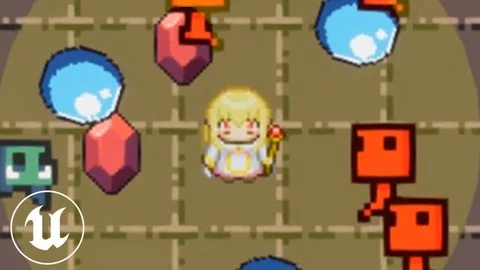
A dedicated pooling framework module addresses one of the most pressing performance concerns in survivor-style games: managing large numbers of simultaneous actors. The course teaches how to create pools that store active instances rather than repeatedly spawning and destroying objects. Three specific actor categories are covered under this system: enemies, bullets, and pickup items.
The pooling approach matters because top-down survival games generate continuous streams of projectiles, enemies, and dropped resources throughout a match. By storing and reusing instances, the framework reduces the overhead that comes with constant actor creation and garbage collection. The module covers pooling for each actor type in a unified framework, so the same underlying mechanics apply to mobs, bullets, and items alike.
Skill Module and Roguelike Upgrade Mechanics
The course dedicates a full module to designing a skill upgrade system with roguelike mechanics. Developers learn to build ten or more unique skills, split between active and passive types. Active skills require player input or trigger conditions, while passive skills modify character behavior continuously. This active/passive split mirrors the roguelike decision-making common in survivor-style games, where players choose upgrades mid-run.
The skill module connects directly to the horde patterns and special skill module that follows in the curriculum. Enemy waves are designed with different patterns, and the experience system ties into the skill upgrade loop. An experience item and a magnet item are included as pickup types, with the magnet drawing collected resources toward the player. These pickups exist within the pooling framework, so the technical implementation of item collection relies on the earlier pooling work.
Shop System with Auto-Save and Loading
The shop module adds a meta-progression layer where players can increase character stats by spending in-game resources. The system includes a refund function, allowing players to reverse purchases and reallocate resources. This requires a saving and loading system that tracks resource totals and stat levels between sessions.
The auto-save and loading system is integrated directly into the shop, meaning that resource spending, stat increases, and refund operations all persist across game restarts. The course treats saving not as a standalone feature but as a connected component of the shop workflow. This ties the economic decisions players make during a run to their long-term progression, which is a structural pattern common in roguelike design.
Real-Time Leaderboard Integration
A leaderboard module rounds out the curriculum with a free real-time competitive system. The leaderboard encourages players to pursue high scores by comparing their results against other players. The module is positioned as a way to add replayability and competitive drive to the finished game, giving players an external goal beyond surviving each individual run.
The real-time aspect means the leaderboard is not local-only but connects players across sessions. This module appears at the end of the curriculum, building on the gameplay systems established earlier. By the time the leaderboard is implemented, the game already has its core loop, progression systems, and performance framework in place.
Course Structure and Workflow Placement
The curriculum progresses through eight modules: Introduction, Basic Setup, Blueprint Fundamentals, Pooling Framework, Skill Module, Horde Patterns and Special Skills, Shop Module, and Leaderboard Module. This sequence reflects a practical production workflow where foundational systems come first, gameplay mechanics build on those foundations, and meta-systems like shop and leaderboards layer on top of the working game loop.
With a total workload of 16 hours and 26 minutes, the course was published on August 1, 2025, and sits at an intermediate level. The instruction targets multiple audiences: junior game developers interested in visual scripting, developers looking for a top-down 2D development guide specific to Unreal Engine, and intermediate or experienced developers who want to expand their Blueprint workflow. The fully visual scripting approach means the entire game is built without leaving the Blueprint system, which keeps the development process accessible to developers coming from non-programming backgrounds.
For a production workflow, the course is structured to take a developer from an empty project to a game with enemy AI, skill progression, economic persistence, and competitive scoring. The pooling framework provides the technical backbone for handling the actor density that the genre demands, while the skill and shop modules handle the player-facing progression systems. The leaderboard closes the loop with a retention-focused feature that gives players a reason to return after completing a run.
By the end of the course, developers have a complete genre-specific implementation covering the systems that define survivor-style roguelikes: dense actor management, varied enemy behavior, active and passive skill selection, persistent stat progression with refunding, and live competitive scoring.
 Unreal Engine
 Unreal Engine
 Unreal Engine
 Unreal Engine