"b00678cacce53329"{"id":"1002875","slug":"tempest-combat-framework-v2-0-action-combat-system","title":"Tempest Combat Framework - V2.0 Action Combat System","category":"Gameplay Features","engine":"5.0 - 5.5","assetVersion":"Asset Version: 1.0 - 2.0","engineVersion":"Engine Version: 5.0 - 5.5","tag":"Gameplay Features","accent":"blue","visual":"mech","summary":"Explore the Tempest Combat Framework V2.0, a modular C++ and Blueprint action system for building responsive third-person melee encounters in Unreal Engine.","platform":"Unreal Engine","indexPolicy":"index","publishedAt":"2026-11-20T18:10:17.970Z","updatedAt":"2026-11-20T18:10:17.970Z","sourceNotes":[],"fileContents":[],"compatibility":["Unreal Engine","Asset Version: 1.0 - 2.0","Engine Version: 5.0 - 5.5"],"featuredImage":{"alt":"Tempest Combat Framework - V2.0 Action Combat System","src":"/wp-content/uploads/published/2026/11/3720a1f7d667-f70b4e87-330e-46fc-996a-e7f690439848-134aba9130.webp"},"fileSizeBytes":5504571128,"hasDownloadLink":true,"downloads":0,"terms":[{"taxonomy":"category","slug":"gameplay-features-tools-and-plugins","name":"Gameplay Features"}],"galleryImages":[{"src":"/wp-content/uploads/published/2026/11/e1d73d15cad0-07c1f3d2-1569-458e-be33-45331a03ce0d-266e718270.webp","alt":"Tempest Combat Framework - V2.0 Action Combat System"},{"src":"/wp-content/uploads/published/2026/11/aceae5aeaa65-e4e6f8c3-de6e-45e6-bf0a-3f5c403dd813-3e2a80c6f7.webp","alt":"Tempest Combat Framework - V2.0 Action Combat System"},{"src":"/wp-content/uploads/published/2026/11/4afb082eb267-f24fc545-1555-463e-90d2-37354a416e57-e93c4531c6.webp","alt":"Tempest Combat Framework - V2.0 Action Combat System"},{"src":"/wp-content/uploads/published/2026/11/5bfff4994718-80bd7023-4d0f-4d1a-9305-97a4643c844f-7ee35029d8.webp","alt":"Tempest Combat Framework - V2.0 Action Combat System"},{"src":"/wp-content/uploads/published/2026/11/813ec3f7a311-cc36931c-da5e-4ca9-8c30-333aec6b0cd6-5b699e47cf.webp","alt":"Tempest Combat Framework - V2.0 Action Combat System"},{"src":"/wp-content/uploads/published/2026/11/7210b9eae471-d95e5264-868c-4da1-b373-10e0f916e26f-96d143fa80.webp","alt":"Tempest Combat Framework - V2.0 Action Combat System"},{"src":"/wp-content/uploads/published/2026/11/0db470bd4c92-e92d2228-fd01-48b8-ac79-8399b72d3487-3e01a3cafc.webp","alt":"Tempest Combat Framework - V2.0 Action Combat System"},{"src":"/wp-content/uploads/published/2026/11/2a74a8c77c92-a47e805b-b8a3-4b64-8b45-f08d44d7fc5e-c43f01fa67.webp","alt":"Tempest Combat Framework - V2.0 Action Combat System"},{"src":"/wp-content/uploads/published/2026/11/6f3cdd465641-01159ee2-1e3d-437c-8113-f6b6b3f7ad94-31e63a8d9f.webp","alt":"Tempest Combat Framework - V2.0 Action Combat System"},{"src":"/wp-content/uploads/published/2026/11/02fb46d56340-bd6fb479-34f7-4370-b24c-fbd5fed92898-0f5193e17c.webp","alt":"Tempest Combat Framework - V2.0 Action Combat System"}],"accessPanel":{"kind":"resource","title":"Get this resource","safetyNote":"Resources are manually reviewed before listing to improve quality and reduce obvious risks.","fileName":"Tempest Combat Framework.7z","resourceType":"Resource archive","versions":[]},"contentHtml":"\u003ch2\u003eModular Foundation in the Tempest Combat Framework Architecture\u003c/h2\u003e\n\u003cp\u003eThird-person melee design often breaks down under the weight of tightly coupled systems. When a character’s attack animation, hit registration, movement lock, and camera adjustments are forced into a single monolithic blueprint, minor balance adjustments can introduce game-breaking edge cases. Tempest Combat Framework V2.0 approaches action combat from an decoupled perspective, isolating each functional domain into self-contained components that operate independently.\u003c/p\u003e\n\u003cp\u003eAt its technical base, the framework is distributed across three focused runtime modules: \u003ccode\u003eTempestCombatFramework\u003c/code\u003e, \u003ccode\u003eTempestCameraSystems\u003c/code\u003e, and \u003ccode\u003eTempestCore\u003c/code\u003e. Rather than relying solely on visual scripting or hiding logic in closed binaries, the architecture delivers 100 fully exposed C++ classes alongside 315 modular Blueprints. This split allows developers to leverage high-performance native code for tick-heavy mechanics while retaining editable Blueprints for design iteration. Because every subsystem acts as an independent component, developers can inspect, replace, or build on top of individual modules without altering the surrounding codebase.\u003c/p\u003e \u003ch2\u003eState Management and Hit Resolution Under the Hood\u003c/h2\u003e\n\u003cp\u003eResponsive action combat relies heavily on how a game engine arbitrates player states. The framework features an isolated State Manager built to expand character conditions without risking regression in existing mechanics. Whether introducing an invulnerability window, a stagger reaction, an aerial recovery, or a knockdown state, each condition is registered as an independent module. This eliminates cascade bugs where introducing a block state unintentionally breaks dodge cancel timings.\u003c/p\u003e\n\u003cp\u003eParallel to state processing is the Collision Manager, which handles weapon hit detection. In fast-paced melee encounters, common trace implementations often suffer from double-hit registrations or missed swings caused by frame drops. The Collision Manager executes per-swing tracing that accounts for blade velocity and trajectory, delivering precise contact points on hit surfaces. By governing strike windows through isolated notification windows rather than unchecked tick traces, the system prevents double-tap damage errors across single animation swings, keeping damage application clean against single opponents, dense mobs, or multi-phase boss encounters.\u003c/p\u003e \u003ch2\u003eAction Responsiveness Through Enhanced Input and Buffering\u003c/h2\u003e\n\u003cp\u003eThe perceived feel of third-person melee gameplay hinges on input fidelity. A rigid animation lock makes movement feel sluggish, while instantaneous animation cancellation destroys weapon weight. The framework integrates Unreal Engine's Enhanced Input alongside an action queue buffer to manage these interactions. Player commands—such as chain light attacks, parry attempts, heavy charges, and directional evades—are held inside a dedicated buffer queue that listens for gameplay-tagged execution windows.\u003c/p\u003e\n\u003cp\u003eWhen an active attack enters its recovery frames, the buffer evaluates the stored inputs and transitions immediately into the next queued ability. This structure gives developers precise control over commitment windows, allowing designers to balance agile hack-and-slash combos against the heavy, deliberate pacing characteristic of Souls-like titles. Ability integration itself operates as a plug-and-play mechanic, enabling new attacks, defensive counters, and special abilities to be connected to gameplay tag triggers in a matter of minutes.\u003c/p\u003e \u003ch2\u003eTarget Acquisition and Dynamic Camera Systems\u003c/h2\u003e\n\u003cp\u003eCombat pacing shifts drastically between free exploration and locked melee skirmishes. The framework incorporates a Lock-On Targeting system suited to reliable target selection and seamless mid-fight re-targeting. When engaging multiple adversaries, the targeting logic calculates distance, screen-space position, and line of sight, allowing players to flick between active hostiles or switch priorities to high-threat boss units without jarring camera snapping.\u003c/p\u003e\n\u003cp\u003eWorking in tandem with target tracking is the dedicated \u003ccode\u003eTempestCameraSystems\u003c/code\u003e Runtime module. Rather than enforcing a static camera distance, the system arbitrates transitions between exploration perspectives and combat-focused framing. As combat engages or lock-on triggers, the camera smoothly re-centers, pulls out for wide-angle encounter clarity, or adjusts pitch to keep both player character and towering foes within view, preventing visual obstruction during close-quarters action.\u003c/p\u003e \u003ch2\u003eData-Driven Weapon Customization and Statistical Attributes\u003c/h2\u003e\n\u003cp\u003eManaging weapon variety across an action RPG can quickly become a pipeline bottleneck if each weapon requires custom scripting. The framework bypasses this via a data-driven weapon model paired with an attributes architecture. Stats, weapon behaviors, and ability sets are configured through Data Assets, removing the necessity of writing or recompiling C++ to introduce new gear.\u003c/p\u003e\n\u003cp\u003eWeapons store references to specific move lists, trace profiles, and attribute modifications directly within their asset files. Swapping from a heavy two-handed greatsword to a rapid dual-blade setup is a matter of changing assigned Data Assets. The Attributes System monitors core statistics—such as posture, stamina, health, and poise—operating directly against these data definitions. This design permits rapid iteration during combat balancing, where combat designers can tune damage curves, poise damage thresholds, and ability costs entirely inside the Unreal Engine editor interface.\u003c/p\u003e \u003ch2\u003eProduction Readiness and Technical Boundaries\u003c/h2\u003e\n\u003cp\u003eDeveloped and refined since 2022, the framework has established its stability in production titles, including active projects like \u003cem\u003eKaidan\u003c/em\u003e And \u003cem\u003eKnight's Path\u003c/em\u003e, with over 100 developers employing its architecture. The system is paired with comprehensive documentation, step-by-step tutorial series, an example project, and an active developer Discord for direct support. A playable demo is available to evaluate the execution and responsiveness firsthand, though developers should note that demo art assets are not included in the framework package.\u003c/p\u003e\n\u003cp\u003eFrom an architectural standpoint, the system is suited to single-player environments running on Windows 64-bit platforms and does not feature network replication out of the box. Teams planning multiplayer implementations will need to construct their own network serialization layers over the runtime modules. The framework assumes an intermediate proficiency with Unreal Engine 5, specifically requiring familiarity with Blueprints, Enhanced Input, and Gameplay Tags to effectively navigate and extend its 315 Blueprints and 100 C++ classes.\u003c/p\u003e\n\n\u003ch2\u003eRelated Resources Worth Checking\u003c/h2\u003e\n\u003cul\u003e\n\u003cli\u003e\u003ca href=\"https://3dcghub.com/action-adventure-movement-system/\" rel=\"noopener noreferrer\"\u003eAction-Adventure Movement System\u003c/a\u003e\u003c/li\u003e\n\u003cli\u003e\u003ca href=\"https://3dcghub.com/close-combat-swordsman/\" rel=\"noopener noreferrer\"\u003eClose Combat: Swordsman\u003c/a\u003e\u003c/li\u003e\n\u003cli\u003e\u003ca href=\"https://3dcghub.com/euphoria-close-combat/\" rel=\"noopener noreferrer\"\u003eEuphoria - Close Combat\u003c/a\u003e\u003c/li\u003e\n\u003cli\u003e\u003ca href=\"https://3dcghub.com/action-camera-manager-2/\" rel=\"noopener noreferrer\"\u003eAction Camera Manager\u003c/a\u003e\u003c/li\u003e\n\u003cli\u003e\u003ca href=\"https://3dcghub.com/action-camera-manager/\" rel=\"noopener noreferrer\"\u003eAction Camera Manager\u003c/a\u003e\u003c/li\u003e\n\u003c/ul\u003e","contentTextLength":6834,"navigation":{"current":4,"total":4797,"previous":{"id":"1001493","slug":"mesh-ops-mesh-operations-plugin","title":"Mesh Ops - Mesh Operations Plugin","category":"Engine Tools","platform":"Unreal Engine","updatedAt":"2026-11-20T19:38:51.401Z"},"next":{"id":"1002874","slug":"ynnk-voice-lipsync","title":"Ynnk Voice Lipsync","category":"Animations","platform":"Unreal Engine","updatedAt":"2026-11-20T18:07:59.515Z"}},"relatedResources":[{"id":"1001032","slug":"action-adventure-movement-system","title":"Action-Adventure Movement System","category":"Gameplay Features","engine":"5.3+","assetVersion":"Asset Version: 1.3.3","engineVersion":"Engine Version: 5.3+","tag":"Gameplay Features","accent":"blue","visual":"mech","summary":"A 100% Blueprint Unreal Engine framework with 475+ animations covering parkour, climbing, swimming, grappling, ropes, rail grinding, interactions, and multiplay","platform":"Unreal Engine","indexPolicy":"index","publishedAt":"2026-08-23T13:56:31.671Z","updatedAt":"2026-08-23T13:56:31.671Z","sourceNotes":[],"fileContents":[],"compatibility":["Unreal Engine","Asset Version: 1.3.3","Engine Version: 5.3+"],"featuredImage":{"alt":"Action-Adventure Movement System","src":"/wp-content/uploads/published/2026/08/f6ca4747d539-f55a9c3a-5939-4fc7-b9c9-20258a3197bf-86a0ba7a37.webp"},"fileSizeBytes":906702553,"hasDownloadLink":true,"downloads":15},{"id":"1000803","slug":"close-combat-swordsman","title":"Close Combat: Swordsman","category":"Gameplay Features","engine":"5.0+","assetVersion":"","engineVersion":"Engine Version: 5.0+","tag":"Gameplay Features","accent":"blue","visual":"mech","summary":"Close Combat: Swordsman builds a combat, movement, leveling, and skill template for action games, RPGs, slashers, and fighting games with melee swordplay system","platform":"Unreal Engine","indexPolicy":"index","publishedAt":"2026-07-30T23:17:13.049Z","updatedAt":"2026-07-30T23:17:13.049Z","sourceNotes":[],"fileContents":[],"compatibility":["Unreal Engine","Engine Version: 5.0+"],"featuredImage":{"alt":"Close Combat: Swordsman","src":"/wp-content/uploads/published/2026/07/538fb59b9a20-d1fddabc-3782-4bdd-83c2-39e1f39f2c83-1d9aab6c4b.webp"},"fileSizeBytes":216124427,"hasDownloadLink":true,"downloads":2},{"id":"1000820","slug":"euphoria-close-combat","title":"Euphoria - Close Combat","category":"Gameplay Features","engine":"5.3+","assetVersion":"","engineVersion":"Engine Version: 5.3+","tag":"Gameplay Features","accent":"blue","visual":"mech","summary":"A high fidelity data-driven close combat framework for realistic, cinematic Unreal Engine games with advanced environment interaction and Motion Warping Transfo","platform":"Unreal Engine","indexPolicy":"index","publishedAt":"2026-07-31T11:39:00.360Z","updatedAt":"2026-07-31T11:39:00.360Z","sourceNotes":[],"fileContents":[],"compatibility":["Unreal Engine","Engine Version: 5.3+"],"featuredImage":{"alt":"Euphoria - Close Combat","src":"/wp-content/uploads/published/2026/07/e2f9b34d706d-executionsystempreview-1920x1080-e8d62f36f0315be38-66dd487364.webp"},"fileSizeBytes":317140071,"hasDownloadLink":true,"downloads":0}]}
Resource screenshots
1 / 10
Join our channel
Follow 3DCGHUB on Telegram for new resource drops, migration updates, and community notices.
Resources are manually reviewed before listing to improve quality and reduce obvious risks.
No account required
Gameplay Features
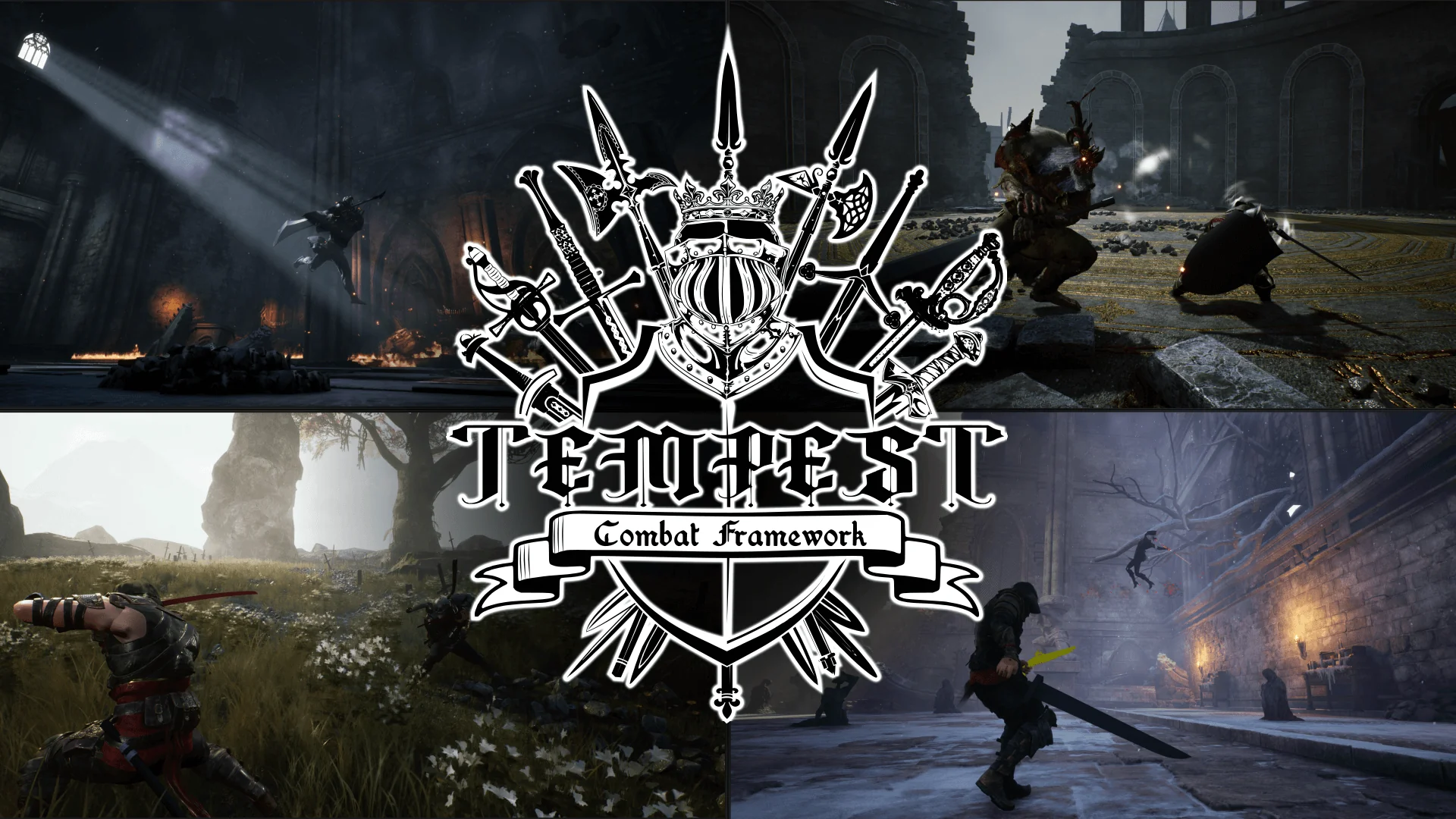
Tempest Combat Framework - V2.0 Action Combat System
Explore the Tempest Combat Framework V2.0, a modular C++ and Blueprint action system for building responsive third-person melee encounters in Unreal Engine.
Modular Foundation in the Tempest Combat Framework Architecture
Third-person melee design often breaks down under the weight of tightly coupled systems. When a character’s attack animation, hit registration, movement lock, and camera adjustments are forced into a single monolithic blueprint, minor balance adjustments can introduce game-breaking edge cases. Tempest Combat Framework V2.0 approaches action combat from an decoupled perspective, isolating each functional domain into self-contained components that operate independently.
At its technical base, the framework is distributed across three focused runtime modules: TempestCombatFramework, TempestCameraSystems, and TempestCore. Rather than relying solely on visual scripting or hiding logic in closed binaries, the architecture delivers 100 fully exposed C++ classes alongside 315 modular Blueprints. This split allows developers to leverage high-performance native code for tick-heavy mechanics while retaining editable Blueprints for design iteration. Because every subsystem acts as an independent component, developers can inspect, replace, or build on top of individual modules without altering the surrounding codebase.
State Management and Hit Resolution Under the Hood
Responsive action combat relies heavily on how a game engine arbitrates player states. The framework features an isolated State Manager built to expand character conditions without risking regression in existing mechanics. Whether introducing an invulnerability window, a stagger reaction, an aerial recovery, or a knockdown state, each condition is registered as an independent module. This eliminates cascade bugs where introducing a block state unintentionally breaks dodge cancel timings.
Parallel to state processing is the Collision Manager, which handles weapon hit detection. In fast-paced melee encounters, common trace implementations often suffer from double-hit registrations or missed swings caused by frame drops. The Collision Manager executes per-swing tracing that accounts for blade velocity and trajectory, delivering precise contact points on hit surfaces. By governing strike windows through isolated notification windows rather than unchecked tick traces, the system prevents double-tap damage errors across single animation swings, keeping damage application clean against single opponents, dense mobs, or multi-phase boss encounters.
Action Responsiveness Through Enhanced Input and Buffering
The perceived feel of third-person melee gameplay hinges on input fidelity. A rigid animation lock makes movement feel sluggish, while instantaneous animation cancellation destroys weapon weight. The framework integrates Unreal Engine's Enhanced Input alongside an action queue buffer to manage these interactions. Player commands—such as chain light attacks, parry attempts, heavy charges, and directional evades—are held inside a dedicated buffer queue that listens for gameplay-tagged execution windows.
When an active attack enters its recovery frames, the buffer evaluates the stored inputs and transitions immediately into the next queued ability. This structure gives developers precise control over commitment windows, allowing designers to balance agile hack-and-slash combos against the heavy, deliberate pacing characteristic of Souls-like titles. Ability integration itself operates as a plug-and-play mechanic, enabling new attacks, defensive counters, and special abilities to be connected to gameplay tag triggers in a matter of minutes.
Target Acquisition and Dynamic Camera Systems
Combat pacing shifts drastically between free exploration and locked melee skirmishes. The framework incorporates a Lock-On Targeting system suited to reliable target selection and seamless mid-fight re-targeting. When engaging multiple adversaries, the targeting logic calculates distance, screen-space position, and line of sight, allowing players to flick between active hostiles or switch priorities to high-threat boss units without jarring camera snapping.
Working in tandem with target tracking is the dedicated TempestCameraSystems Runtime module. Rather than enforcing a static camera distance, the system arbitrates transitions between exploration perspectives and combat-focused framing. As combat engages or lock-on triggers, the camera smoothly re-centers, pulls out for wide-angle encounter clarity, or adjusts pitch to keep both player character and towering foes within view, preventing visual obstruction during close-quarters action.
Data-Driven Weapon Customization and Statistical Attributes
Managing weapon variety across an action RPG can quickly become a pipeline bottleneck if each weapon requires custom scripting. The framework bypasses this via a data-driven weapon model paired with an attributes architecture. Stats, weapon behaviors, and ability sets are configured through Data Assets, removing the necessity of writing or recompiling C++ to introduce new gear.
Weapons store references to specific move lists, trace profiles, and attribute modifications directly within their asset files. Swapping from a heavy two-handed greatsword to a rapid dual-blade setup is a matter of changing assigned Data Assets. The Attributes System monitors core statistics—such as posture, stamina, health, and poise—operating directly against these data definitions. This design permits rapid iteration during combat balancing, where combat designers can tune damage curves, poise damage thresholds, and ability costs entirely inside the Unreal Engine editor interface.
Production Readiness and Technical Boundaries
Developed and refined since 2022, the framework has established its stability in production titles, including active projects like Kaidan And Knight's Path, with over 100 developers employing its architecture. The system is paired with comprehensive documentation, step-by-step tutorial series, an example project, and an active developer Discord for direct support. A playable demo is available to evaluate the execution and responsiveness firsthand, though developers should note that demo art assets are not included in the framework package.
From an architectural standpoint, the system is suited to single-player environments running on Windows 64-bit platforms and does not feature network replication out of the box. Teams planning multiplayer implementations will need to construct their own network serialization layers over the runtime modules. The framework assumes an intermediate proficiency with Unreal Engine 5, specifically requiring familiarity with Blueprints, Enhanced Input, and Gameplay Tags to effectively navigate and extend its 315 Blueprints and 100 C++ classes.
 Gameplay Features
 Gameplay Features
 Gameplay Features