"6c6413bef81af556"{"id":"1000820","slug":"euphoria-close-combat","title":"Euphoria - Close Combat","category":"Gameplay Features","engine":"5.3+","assetVersion":"","engineVersion":"Engine Version: 5.3+","tag":"Gameplay Features","accent":"blue","visual":"mech","summary":"A high fidelity data-driven close combat framework for realistic, cinematic Unreal Engine games with advanced environment interaction and Motion Warping Transfo","platform":"Unreal Engine","publishedAt":"2026-07-31T11:39:00.360Z","updatedAt":"2026-07-31T11:39:00.360Z","sourceNotes":[],"fileContents":[],"compatibility":["Unreal Engine","Engine Version: 5.3+"],"featuredImage":{"alt":"Euphoria - Close Combat","src":"/wp-content/uploads/published/2026/07/e2f9b34d706d-executionsystempreview-1920x1080-e8d62f36f0315be38-66dd487364.webp"},"hasDownloadLink":true,"downloads":0,"terms":[{"taxonomy":"category","slug":"gameplay-features","name":"Gameplay Features"}],"galleryImages":[{"src":"/wp-content/uploads/published/2026/07/8f590625c5f3-closecombatpreview-1920x1080-39e940d928f6aa105bd64-63229379f6.webp","alt":"Euphoria - Close Combat"},{"src":"/wp-content/uploads/published/2026/07/ab9a20f3c384-waitfornewupdatespreview-1920x1080-358445b59bdc2ca-5e658c61b2.webp","alt":"Euphoria - Close Combat"}],"accessPanel":{"kind":"resource","title":"Download this resource","eyebrow":"Free Download","message":"Log in or create a free account to start your download.","fileName":"EuphoriaCloseCombat.7z","safetyNote":"Resources are manually reviewed before listing to improve quality and reduce obvious risks.","actionLabel":"Download Free","resourceType":"Resource archive"},"contentHtml":"\u003ch2\u003eStarting from a Data-Driven Combat Foundation\u003c/h2\u003e\n\u003cp\u003eImplementing close combat that holds up under cinematic scrutiny requires a framework that does not rely on hard-coded animation sequences alone. \u003cem\u003eEuphoria - Close Combat\u003c/em\u003e approaches this by being explicitly data-driven, meaning the combat logic reads from structured data rather than fixed script paths. This design choice changes how a developer sets up the system. Instead of authoring every punch, dodge, and environmental reaction inside isolated Animation Blueprints, the framework pulls combat parameters from Data Assets that define how interactions unfold. When a character engages an opponent or a prop, the system consults that data to determine positioning, timing, and the spatial relationship between the attacker and the target.\u003c/p\u003e\n\n\u003cp\u003eThe high-fidelity label here points to the precision required for realistic, cinematic games where combat needs to read cleanly on camera. A data-driven pipeline helps maintain that fidelity because each combat beat can be tuned through data entries without rebuilding core logic. Adjustments to reach, arc, or environmental alignment happen at the data level, keeping the implementation path consistent whether the scene involves a one-on-one brawl or a more complex multi-actor exchange.\u003c/p\u003e\n\n\u003ch2\u003eMotion Warping Transform as the Spatial Anchor\u003c/h2\u003e\n\u003cp\u003eAt the center of the framework's interaction model is UE's Motion Warping system. In practical setup terms, Motion Warping Transform lets the system dynamically reposition a character so that attacks, grabs, and follow-through movements land precisely relative to the target. Rather than relying solely on Root Motion carrying a character to the right spot, the warping transform adjusts the character's pose and position to match the combat context defined in the data.\u003c/p\u003e\n\n\u003cp\u003eThis matters most when the combat needs to feel grounded. A strike aimed at a specific body part or a throw that has to align with a nearby surface benefits from transform-based correction. The developer configures where the character needs to end up relative to the target, and the warping system handles the spatial interpolation. Because the framework is data-driven, these warp targets can be exposed as data fields, allowing designers to set distinct alignment rules for different attack types without touching the underlying transform logic each time.\u003c/p\u003e\n\n\u003ch3\u003eAdvanced Interaction with the Environment\u003c/h3\u003e\n\u003cp\u003eEnvironment interaction is treated as a core part of close combat rather than a separate layer. The framework supports advanced interaction with the environment, which in implementation means combat actions can account for props, surfaces, and spatial features present in the scene. A character can be positioned to strike against a wall, use a nearby object for leverage, or align body position to a surface during a takedown. Motion Warping plays directly into this by providing the spatial correction needed so that characters meet the environment at the correct contact points.\u003c/p\u003e\n\n\u003cp\u003eBuilding combat that respects the environment requires continuous awareness of where the character and opponent are relative to nearby geometry. The data-driven approach allows environment-based alignment parameters to live alongside standard combat data. When a combat sequence triggers an environmental interaction, the system can read the relevant data entry, determine the intended spatial relationship, and use the warping transform to place the character accordingly. This keeps environmental combat from feeling like disconnected scripted moments and instead folds it into the same framework governing ordinary exchanges.\u003c/p\u003e\n\n\u003ch2\u003eFitting Realistic, Cinematic Games\u003c/h2\u003e\n\u003cp\u003eThe framework is built for realistic, cinematic games, which defines both its scope and its constraints. Cinematic combat demands that every contact reads with precision, and the integration of Motion Warping ensures that alignment is not left to chance or approximate Root Motion. Realistic combat, in turn, grounds these interactions in believable spatial logic where characters move and react based on their environment and their target's position.\u003c/p\u003e\n\n\u003cp\u003eProjects that lean into grounded melee—where the camera lingers on impacts, where environmental context shapes the choreography, and where combatants need to be repositioned fluidly mid-action—are the ones that align most naturally with this package. The data-driven foundation means that as a project's combat design grows more elaborate, the framework can absorb new attack definitions and interaction types without requiring structural rewrites. The system's reliance on Data Assets for combat behavior makes it suitable for teams that need to iterate on combat feel through tuning rather than through constant Blueprint modifications.\u003c/p\u003e\n\n\u003ch3\u003eProduction-Readiness and Maintenance Through Data\u003c/h3\u003e\n\u003cp\u003eMaintaining a combat system across a production cycle becomes more manageable when behavior lives in data rather than being scattered across nodes. \u003cem\u003eEuphoria - Close Combat\u003c/em\u003e is structured so that combat definitions, warp targets, and interaction rules can be adjusted in a centralized way. If a scene calls for a new environmental takedown, the path involves creating the appropriate data entry and letting Motion Warping handle the spatial placement. This reduces the need to author bespoke logic for every possible combat scenario and keeps the system extensible as design needs evolve.\u003c/p\u003e\n\n\u003cp\u003eFor developers working on realistic, cinematic Unreal Engine projects, the framework provides a grounded implementation path: define combat behavior in data, let Motion Warping handle precise character placement, and use the advanced environment interaction to tie choreography directly to the scene. This combination keeps combat consistent, maintains high visual fidelity, and gives designers a clear route for expanding combat without rebuilding the core system.\u003c/p\u003e\n\n\u003ch2\u003eMore From The Same Workflow\u003c/h2\u003e\n\u003cul\u003e\n\u003cli\u003e\u003ca href=\"https://3dcghub.com/close-combat-swordsman/\" title=\"Close Combat: Swordsman\"\u003eClose Combat: Swordsman\u003c/a\u003e\u003c/li\u003e\n\u003cli\u003e\u003ca href=\"https://3dcghub.com/close-combat-fighter/\" title=\"Close Combat: Fighter\"\u003eClose Combat: Fighter\u003c/a\u003e\u003c/li\u003e\n\u003cli\u003e\u003ca href=\"https://3dcghub.com/true-fighting-game-engine/\" title=\"TRUE Fighting Game Engine\"\u003eTRUE Fighting Game Engine\u003c/a\u003e\u003c/li\u003e\n\u003cli\u003e\u003ca href=\"https://3dcghub.com/combat-drone/\" title=\"Combat Drone\"\u003eCombat Drone\u003c/a\u003e\u003c/li\u003e\n\u003cli\u003e\u003ca href=\"https://3dcghub.com/dynamic-combat-system-archery/\" title=\"Dynamic Combat System - Archery\"\u003eDynamic Combat System - Archery\u003c/a\u003e\u003c/li\u003e\n\u003c/ul\u003e","contentTextLength":5980,"navigation":{"current":405,"total":3140,"previous":{"id":"1000819","slug":"ethereal-tentacle-fx","title":"Ethereal Tentacle FX","category":"Spells \u0026 Combat","platform":"Unreal Engine","updatedAt":"2026-07-31T11:39:17.799Z"},"next":{"id":"1000818","slug":"easyxmlparser","title":"EasyXMLParser","category":"Engine Tools","platform":"Unreal Engine","updatedAt":"2026-07-31T11:29:36.777Z"}},"relatedResources":[{"id":"1001049","slug":"character-interaction","title":"Character Interaction","category":"Gameplay Features","engine":"5.3+","assetVersion":"","engineVersion":"Engine Version: 5.3+","tag":"Gameplay Features","accent":"blue","visual":"character","summary":"Blueprint-based character interaction system for UE5 with IK, first-person support, weapon switcher, vehicles, AI enemies, and close combat. Includes CI Add-on","platform":"Unreal Engine","publishedAt":"2026-08-27T16:20:39.102Z","updatedAt":"2026-08-27T16:20:39.102Z","sourceNotes":[],"fileContents":[],"compatibility":["Unreal Engine","Engine Version: 5.3+"],"featuredImage":{"alt":"Character Interaction","src":"/wp-content/uploads/published/2026/08/c04328b89794-30343517-c1fe-4277-9c93-7f18419493c9-612ecb684f.webp"},"hasDownloadLink":true,"downloads":2},{"id":"1000803","slug":"close-combat-swordsman","title":"Close Combat: Swordsman","category":"Gameplay Features","engine":"5.0+","assetVersion":"","engineVersion":"Engine Version: 5.0+","tag":"Gameplay Features","accent":"blue","visual":"mech","summary":"Close Combat: Swordsman builds a combat, movement, leveling, and skill template for action games, RPGs, slashers, and fighting games with melee swordplay system","platform":"Unreal Engine","publishedAt":"2026-07-30T23:17:13.049Z","updatedAt":"2026-07-30T23:17:13.049Z","sourceNotes":[],"fileContents":[],"compatibility":["Unreal Engine","Engine Version: 5.0+"],"featuredImage":{"alt":"Close Combat: Swordsman","src":"/wp-content/uploads/published/2026/07/538fb59b9a20-d1fddabc-3782-4bdd-83c2-39e1f39f2c83-1d9aab6c4b.webp"},"hasDownloadLink":true,"downloads":1},{"id":"10677","slug":"close-combat-fighter","title":"Close Combat: Fighter","category":"Gameplay Features","engine":"4.26+,5.0+","assetVersion":"Engine version: 4.26+,5.0+","engineVersion":"4.18","tag":"Gameplay Features","accent":"blue","visual":"animation","summary":"Close Combat: Fighter provides a versatile foundation for developers building action-packed titles. This template includes essential systems for movement, skills, and character progression.","platform":"Unreal Engine","publishedAt":"2026-03-03T15:58:31.000Z","updatedAt":"2026-04-19T15:49:57.000Z","sourceNotes":[],"fileContents":[],"compatibility":["Unreal Engine","Engine version: 4.26+,5.0+"],"featuredImage":{"alt":"Close Combat: Fighter","src":"https://3dcghub.com/wp-content/uploads/2026/03/4de6eeb7-9df9-4c76-9a99-8058524224ee.webp"},"hasDownloadLink":true,"downloads":1}]}
Gameplay Features
Euphoria - Close Combat
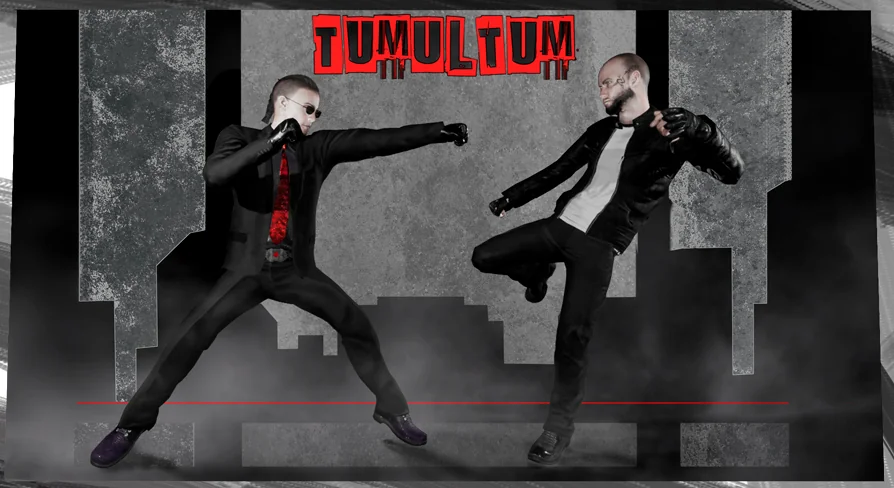
A high fidelity data-driven close combat framework for realistic, cinematic Unreal Engine games with advanced environment interaction and Motion Warping Transfo
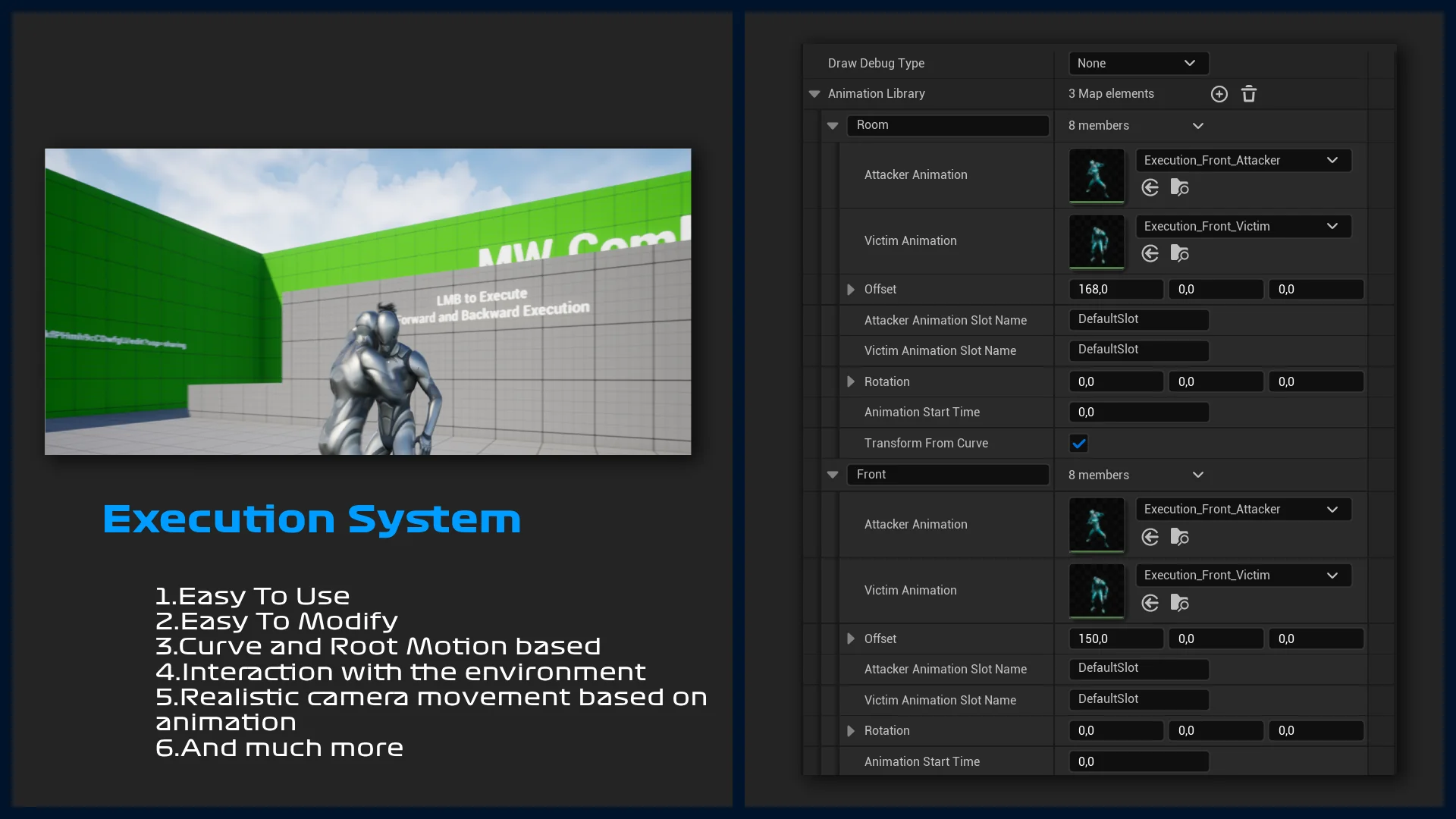
Implementing close combat that holds up under cinematic scrutiny requires a framework that does not rely on hard-coded animation sequences alone. Euphoria - Close Combat approaches this by being explicitly data-driven, meaning the combat logic reads from structured data rather than fixed script paths. This design choice changes how a developer sets up the system. Instead of authoring every punch, dodge, and environmental reaction inside isolated Animation Blueprints, the framework pulls combat parameters from Data Assets that define how interactions unfold. When a character engages an opponent or a prop, the system consults that data to determine positioning, timing, and the spatial relationship between the attacker and the target.
The high-fidelity label here points to the precision required for realistic, cinematic games where combat needs to read cleanly on camera. A data-driven pipeline helps maintain that fidelity because each combat beat can be tuned through data entries without rebuilding core logic. Adjustments to reach, arc, or environmental alignment happen at the data level, keeping the implementation path consistent whether the scene involves a one-on-one brawl or a more complex multi-actor exchange.
Motion Warping Transform as the Spatial Anchor
At the center of the framework's interaction model is UE's Motion Warping system. In practical setup terms, Motion Warping Transform lets the system dynamically reposition a character so that attacks, grabs, and follow-through movements land precisely relative to the target. Rather than relying solely on Root Motion carrying a character to the right spot, the warping transform adjusts the character's pose and position to match the combat context defined in the data.
This matters most when the combat needs to feel grounded. A strike aimed at a specific body part or a throw that has to align with a nearby surface benefits from transform-based correction. The developer configures where the character needs to end up relative to the target, and the warping system handles the spatial interpolation. Because the framework is data-driven, these warp targets can be exposed as data fields, allowing designers to set distinct alignment rules for different attack types without touching the underlying transform logic each time.
Advanced Interaction with the Environment
Environment interaction is treated as a core part of close combat rather than a separate layer. The framework supports advanced interaction with the environment, which in implementation means combat actions can account for props, surfaces, and spatial features present in the scene. A character can be positioned to strike against a wall, use a nearby object for leverage, or align body position to a surface during a takedown. Motion Warping plays directly into this by providing the spatial correction needed so that characters meet the environment at the correct contact points.
Building combat that respects the environment requires continuous awareness of where the character and opponent are relative to nearby geometry. The data-driven approach allows environment-based alignment parameters to live alongside standard combat data. When a combat sequence triggers an environmental interaction, the system can read the relevant data entry, determine the intended spatial relationship, and use the warping transform to place the character accordingly. This keeps environmental combat from feeling like disconnected scripted moments and instead folds it into the same framework governing ordinary exchanges.
Fitting Realistic, Cinematic Games
The framework is built for realistic, cinematic games, which defines both its scope and its constraints. Cinematic combat demands that every contact reads with precision, and the integration of Motion Warping ensures that alignment is not left to chance or approximate Root Motion. Realistic combat, in turn, grounds these interactions in believable spatial logic where characters move and react based on their environment and their target's position.
Projects that lean into grounded melee—where the camera lingers on impacts, where environmental context shapes the choreography, and where combatants need to be repositioned fluidly mid-action—are the ones that align most naturally with this package. The data-driven foundation means that as a project's combat design grows more elaborate, the framework can absorb new attack definitions and interaction types without requiring structural rewrites. The system's reliance on Data Assets for combat behavior makes it suitable for teams that need to iterate on combat feel through tuning rather than through constant Blueprint modifications.
Production-Readiness and Maintenance Through Data
Maintaining a combat system across a production cycle becomes more manageable when behavior lives in data rather than being scattered across nodes. Euphoria - Close Combat is structured so that combat definitions, warp targets, and interaction rules can be adjusted in a centralized way. If a scene calls for a new environmental takedown, the path involves creating the appropriate data entry and letting Motion Warping handle the spatial placement. This reduces the need to author bespoke logic for every possible combat scenario and keeps the system extensible as design needs evolve.
For developers working on realistic, cinematic Unreal Engine projects, the framework provides a grounded implementation path: define combat behavior in data, let Motion Warping handle precise character placement, and use the advanced environment interaction to tie choreography directly to the scene. This combination keeps combat consistent, maintains high visual fidelity, and gives designers a clear route for expanding combat without rebuilding the core system.
 Gameplay Features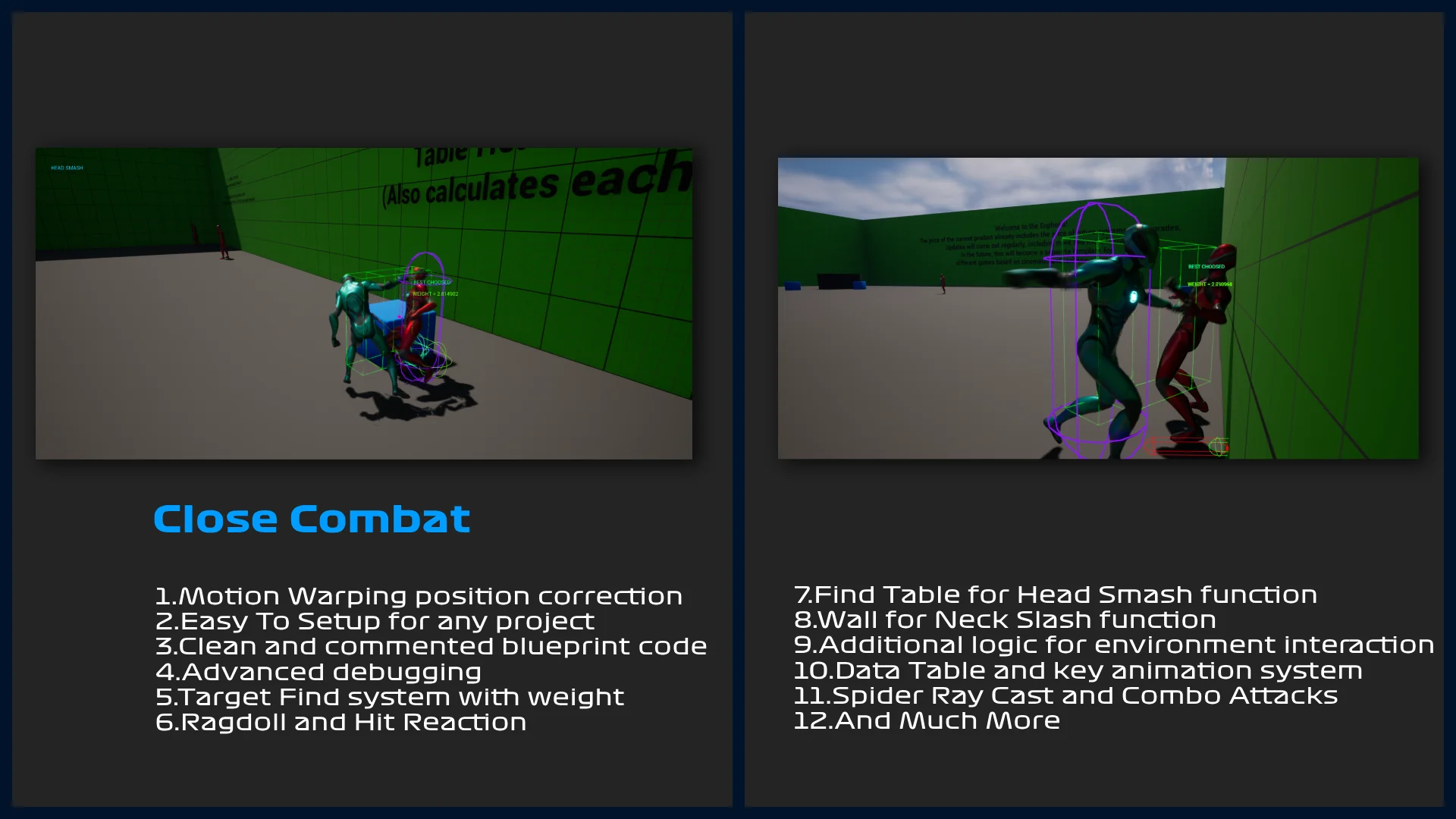
 Gameplay Features
 Gameplay Features
 Gameplay Features