"7b46a695175d8694"{"id":"1001459","slug":"suburbs-vol-11-rugs-nanite-and-low-poly","title":"Suburbs VOL.11 - Rugs (Nanite and Low Poly)","category":"Buildings \u0026 Architecture","engine":"5.1+","assetVersion":"","engineVersion":"Engine Version: 5.1+","tag":"Buildings","accent":"blue","visual":"mech","summary":"Explore Suburbs VOL.11 - Rugs featuring 30 Nanite and low-poly meshes, 4K channel-packed textures, master materials, and Lumen support in Unreal Engine.","platform":"Unreal Engine","publishedAt":"2026-10-08T01:04:12.761Z","updatedAt":"2026-10-08T01:04:12.761Z","sourceNotes":[],"fileContents":[],"compatibility":["Unreal Engine","Engine Version: 5.1+"],"featuredImage":{"alt":"Suburbs VOL.11 - Rugs (Nanite and Low Poly)","src":"/wp-content/uploads/published/2026/10/0586d3855e14-a9bb8f28-4c7f-4dd4-916f-6d288e7880b4-2b15276468.webp"},"hasDownloadLink":true,"downloads":0,"terms":[{"taxonomy":"category","slug":"buildings-and-architecture","name":"Buildings \u0026 Architecture"}],"galleryImages":[{"src":"/wp-content/uploads/published/2026/10/204d782b9e28-468fa0d4-62b9-438a-bdbd-bfbdd5a5d348-be0d4c601e.webp","alt":"Suburbs VOL.11 - Rugs (Nanite and Low Poly)"},{"src":"/wp-content/uploads/published/2026/10/357450794caa-227d2705-f1c0-4f5b-bbbf-ff90af71d81d-019829f2ac.webp","alt":"Suburbs VOL.11 - Rugs (Nanite and Low Poly)"},{"src":"/wp-content/uploads/published/2026/10/7b7a965fa0f4-802477dc-3c4c-41de-9e6d-976ba86365ca-2113298950.webp","alt":"Suburbs VOL.11 - Rugs (Nanite and Low Poly)"},{"src":"/wp-content/uploads/published/2026/10/7e2cd0eff3b8-e2fc4882-42a4-4c36-b159-0023caa8271c-f1aa13a002.webp","alt":"Suburbs VOL.11 - Rugs (Nanite and Low Poly)"},{"src":"/wp-content/uploads/published/2026/10/972dca95b7e7-2d9f61de-18d4-4a9f-be8f-e8a4693c87d4-7c49f04b4e.webp","alt":"Suburbs VOL.11 - Rugs (Nanite and Low Poly)"},{"src":"/wp-content/uploads/published/2026/10/3fdd481ea410-7dda91c7-8663-424a-b602-4620954d7ba0-33d08b8c8b.webp","alt":"Suburbs VOL.11 - Rugs (Nanite and Low Poly)"},{"src":"/wp-content/uploads/published/2026/10/5cfe8b43dc9c-f0cb40c6-d51e-4a31-b228-4df0aaf1cfb5-a0d5d0d898.webp","alt":"Suburbs VOL.11 - Rugs (Nanite and Low Poly)"},{"src":"/wp-content/uploads/published/2026/10/281ffefabdf6-530814da-c815-4875-a867-e72b2c98262e-fbfbd8328c.webp","alt":"Suburbs VOL.11 - Rugs (Nanite and Low Poly)"},{"src":"/wp-content/uploads/published/2026/10/e618a6fb83fe-e36478ed-afcf-4874-b82e-f1b24d555d66-9440e6d4a1.webp","alt":"Suburbs VOL.11 - Rugs (Nanite and Low Poly)"},{"src":"/wp-content/uploads/published/2026/10/a8b9f0045dd5-adcad90b-7df0-4e2e-b144-f549ecf1a769-48a4c8a7f1.webp","alt":"Suburbs VOL.11 - Rugs (Nanite and Low Poly)"}],"accessPanel":{"kind":"resource","title":"Download this resource","eyebrow":"Free Download","message":"Log in or create a free account to start your download.","fileName":"Content.7z","safetyNote":"Resources are manually reviewed before listing to improve quality and reduce obvious risks.","actionLabel":"Download Free","resourceType":"Resource archive"},"contentHtml":"\u003ch2\u003eGrounding Suburban Interiors with 30 Nanite and Low Poly Meshes\u003c/h2\u003e\n\u003cp\u003ePlacing floor textiles into an architectural scene dictates how light settles across wide floorboards, concrete slabs, or tiled rooms. Suburbs VOL.11 - Rugs supplies 30 individual meshes divided evenly between high-density Nanite geometry and low-poly equivalents for each rug design. This dual-pipeline setup addresses contrasting pipeline demands without requiring manual retopology. Projects building on modern geometry streaming can load Nanite versions to capture microscopic surface transitions, while projects adhering to conventional geometry caps can deploy the low-poly variants to stay strictly within strict frame budgets.\u003c/p\u003e\n\u003cp\u003eEvery mesh in the collection represents realistic AAA visual standards with an aesthetic leaning toward 1980s, retro, industrial, and suburban domestic layouts. Rugs serve as foundational anchors beneath furniture, breaking up repetitive floor tile patterns and providing immediate geographic context to a room. Because the assets are modeled completely from all sides, placement is not restricted to flat surfaces. Rug edges can roll over steps, drape over furniture edges, or sit slightly turned over on an unfinished floor without revealing untextured backfaces or missing polygons.\u003c/p\u003e \u003ch2\u003eMaster Material Controls for Albedo, Roughness, and Normals\u003c/h2\u003e\n\u003cp\u003eMaterial flexibility dictates how well a prop library integrates into varying interior art styles. This package utilizes a centralized master material network that governs the majority of the props and models across the set. Instanced variations give artists direct access to surface properties, eliminating the need to modify source textures when altering a scene's visual tone.\u003c/p\u003e\n\u003cp\u003eExposed parameters grant precise adjustment over:\u003c/p\u003e\n\u003cul\u003e \u003cli\u003e\u003cstrong\u003eRoughness values:\u003c/strong\u003e Adjusting fabric sheen, dampening light response on worn pile, or accentuating dry weave patterns across the floor.\u003c/li\u003e \u003cli\u003e\u003cstrong\u003eAlbedo controls:\u003c/strong\u003e Tinting, balancing values, and altering base color palettes to fit specific suburban or architectural color grading schemes.\u003c/li\u003e \u003cli\u003e\u003cstrong\u003eNormal map intensity:\u003c/strong\u003e Scaling weave depth, thread relief, and structural creasing to match close-up cinematic shots or distant environmental views.\u003c/li\u003e\n\u003c/ul\u003e\n\u003cp\u003eCentralizing these controls within a unified master material keeps memory draw predictable and minimizes shader compilation overhead when dressing expansive indoor maps.\u003c/p\u003e \u003ch2\u003eChannel-Packed 4K Textures and Game-Ready Shading Architecture\u003c/h2\u003e\n\u003cp\u003eHigh-resolution texturing ensures surface wear, thread weave, and pattern degradation hold up under high-density camera inspections. The set uses full 4K texture sets tailored for game deployment. These high-fidelity texture maps provide sharp micro-detail across the surface of each carpet, capturing realistic manufacturing variations and surface distress.\u003c/p\u003e\n\u003cp\u003eTo preserve runtime memory and cut down on texture sampler calls, the shaders rely on a channel-packed texture configuration:\u003c/p\u003e\n\u003cul\u003e \u003cli\u003e\u003cstrong\u003eRed Channel:\u003c/strong\u003e Roughness\u003c/li\u003e \u003cli\u003e\u003cstrong\u003eGreen Channel:\u003c/strong\u003e Metalness\u003c/li\u003e \u003cli\u003e\u003cstrong\u003eBlue Channel:\u003c/strong\u003e Ambient Occlusion\u003c/li\u003e\n\u003c/ul\u003e\n\u003cp\u003eChannel packing combines three individual grayscale grayscale maps into a single image asset. This pipeline standard keeps draw calls lean, optimizes graphics memory bandwidth, and ensures that material shading accurately calculates cavity shadows and surface reflectivity simultaneously. Paired with high-resolution normal maps and rich albedo layers, the channel-packed maps allow fabrics to capture the subtle tactile qualities of aged domestic carpets.\u003c/p\u003e \u003ch2\u003eLumen Lighting Integration and Custom Look Up Table Adjustments\u003c/h2\u003e\n\u003cp\u003eFabric surfaces react uniquely to indirect illumination, catching soft bounce light along low-angle viewing axes. Suburbs VOL.11 - Rugs provides verified compatibility with Lumen dynamic global illumination inside Unreal Engine 5.0 and newer versions. As dynamic directional lights, interior lamps, or skylights shift, the rug surfaces process bounce light naturally, avoiding harsh specular hot spots or artificial backscattering.\u003c/p\u003e\n\u003cp\u003eThe project setup includes dedicated post-process configurations and an included Look Up Table (LUT). The LUT balances tonal contrast, highlights, and shadow depth across the included preview maps, establishing a realistic cinematic foundation straight out of the box. Level designers can retain this look for cohesive environmental presentations or adapt the master post-process settings to align with existing project-wide grading profiles.\u003c/p\u003e \u003ch2\u003eDouble-Sided Asset Modeling and Production Clearance\u003c/h2\u003e\n\u003cp\u003eIn environmental set dressing, standard single-sided planes often present severe limitations when rugs are placed near dynamic objects, displaced by debris, or viewed from unorthodox angles. The assets created by Dekogon Studios Artists are modeled with geometry and texturing intact on all faces. This ensures that flipped corners, loose fringe, and underside textures maintain physical plausibility regardless of viewport orientation.\u003c/p\u003e\n\u003cp\u003eCommercial deployment often encounters friction when prop packs rely on recognizable commercial insignias or unlicensed product patterns. All labeling, texturing patterns, and branding across this collection are original designs produced internally by the studio artists. The absence of proprietary logos and commercial trademarks ensures the assets can drop directly into shipping titles without clearing external licensing hurdles.\u003c/p\u003e\n\n\u003ch2\u003eMore From The Same Workflow\u003c/h2\u003e\n\u003cul\u003e\n\u003cli\u003e\u003ca href=\"https://3dcghub.com/suburbs-vol-10-fireplaces-nanite-and-low-poly/\" title=\"Suburbs VOL.10 - Fireplaces (Nanite and Low Poly)\"\u003eSuburbs VOL.10 - Fireplaces (Nanite and Low Poly)\u003c/a\u003e\u003c/li\u003e\n\u003cli\u003e\u003ca href=\"https://3dcghub.com/signage-vol-4-small-town/\" title=\"Signage VOL.4 - Small Town\"\u003eSignage VOL.4 - Small Town\u003c/a\u003e\u003c/li\u003e\n\u003cli\u003e\u003ca href=\"https://3dcghub.com/oil-refinery-pack/\" title=\"Oil Refinery Pack\"\u003eOil Refinery Pack\u003c/a\u003e\u003c/li\u003e\n\u003cli\u003e\u003ca href=\"https://3dcghub.com/wood-structures/\" title=\"Wood Structures\"\u003eWood Structures\u003c/a\u003e\u003c/li\u003e\n\u003cli\u003e\u003ca href=\"https://3dcghub.com/foliage-vol-23-ivy-low-poly/\" title=\"Foliage VOL.23 - Ivy (Low Poly)\"\u003eFoliage VOL.23 - Ivy (Low Poly)\u003c/a\u003e\u003c/li\u003e\n\u003c/ul\u003e","contentTextLength":5487,"navigation":{"current":88,"total":3481,"previous":{"id":"1001460","slug":"suburbs-vol-12-interior-decor-nanite-and-low-poly","title":"Suburbs VOL.12 - Interior Decor (Nanite and Low Poly)","category":"Plants","platform":"Unreal Engine","updatedAt":"2026-10-08T01:05:12.025Z"},"next":{"id":"1001458","slug":"suburbs-vol-10-fireplaces-nanite-and-low-poly","title":"Suburbs VOL.10 - Fireplaces (Nanite and Low Poly)","category":"Buildings \u0026 Architecture","platform":"Unreal Engine","updatedAt":"2026-10-08T01:01:52.468Z"}},"relatedResources":[{"id":"1001458","slug":"suburbs-vol-10-fireplaces-nanite-and-low-poly","title":"Suburbs VOL.10 - Fireplaces (Nanite and Low Poly)","category":"Buildings \u0026 Architecture","engine":"5.1+","assetVersion":"","engineVersion":"Engine Version: 5.1+","tag":"Buildings","accent":"blue","visual":"mech","summary":"Examine Suburbs VOL.10 - Fireplaces for Unreal Engine, featuring Nanite and low-poly meshes, 4K packed textures, Lumen lighting, and master materials.","platform":"Unreal Engine","publishedAt":"2026-10-08T01:01:52.468Z","updatedAt":"2026-10-08T01:01:52.468Z","sourceNotes":[],"fileContents":[],"compatibility":["Unreal Engine","Engine Version: 5.1+"],"featuredImage":{"alt":"Suburbs VOL.10 - Fireplaces (Nanite and Low Poly)","src":"/wp-content/uploads/published/2026/10/e0dcd09a87f4-ee618294-2a9c-4769-9118-aca415fe5b06-1dfe033979.webp"},"hasDownloadLink":true,"downloads":0},{"id":"1000025","slug":"signage-vol-4-small-town","title":"Signage VOL.4 - Small Town","category":"Buildings \u0026 Architecture","engine":"5.1+","assetVersion":"","engineVersion":"5.1+","tag":"Buildings","accent":"blue","visual":"mech","summary":"A small-town signage collection for Unreal Engine with 416 meshes, 4K textures, Nanite and low poly versions, master materials, and Lumen support.","platform":"Unreal Engine","publishedAt":"2026-05-20T13:23:30.361Z","updatedAt":"2026-05-20T13:23:30.361Z","sourceNotes":[],"fileContents":[],"compatibility":["Unreal Engine","Engine version: 5.1+"],"featuredImage":{"alt":"Signage VOL.4 - Small Town","src":"/wp-content/uploads/published/2026/05/06d30df1da7b-994ddd19-8eac-4094-a2c8-3b1bc01234cb-7bf0bec89d.webp"},"hasDownloadLink":true,"downloads":0},{"id":"1000474","slug":"oil-refinery-pack","title":"Oil Refinery Pack","category":"Buildings \u0026 Architecture","engine":"4.27,5.0+","assetVersion":"","engineVersion":"Engine Version: 4.27,5.0+","tag":"Buildings","accent":"blue","visual":"mech","summary":"Real-world scaled low-poly oil refinery asset pack with 46 unique meshes, complex collision, Nanite support, and PBR textures for Unreal Engine.","platform":"Unreal Engine","publishedAt":"2026-07-11T18:37:51.055Z","updatedAt":"2026-07-11T18:37:51.055Z","sourceNotes":[],"fileContents":[],"compatibility":["Unreal Engine","Engine Version: 4.27,5.0+"],"featuredImage":{"alt":"Oil Refinery Pack","src":"/wp-content/uploads/published/2026/07/ad4481259130-266202c7-b4eb-441e-8fbf-ef44680dca4b-d7d7205c5e.webp"},"hasDownloadLink":true,"downloads":0}]}
Buildings
Suburbs VOL.11 - Rugs (Nanite and Low Poly)
Explore Suburbs VOL.11 - Rugs featuring 30 Nanite and low-poly meshes, 4K channel-packed textures, master materials, and Lumen support in Unreal Engine.
Grounding Suburban Interiors with 30 Nanite and Low Poly Meshes
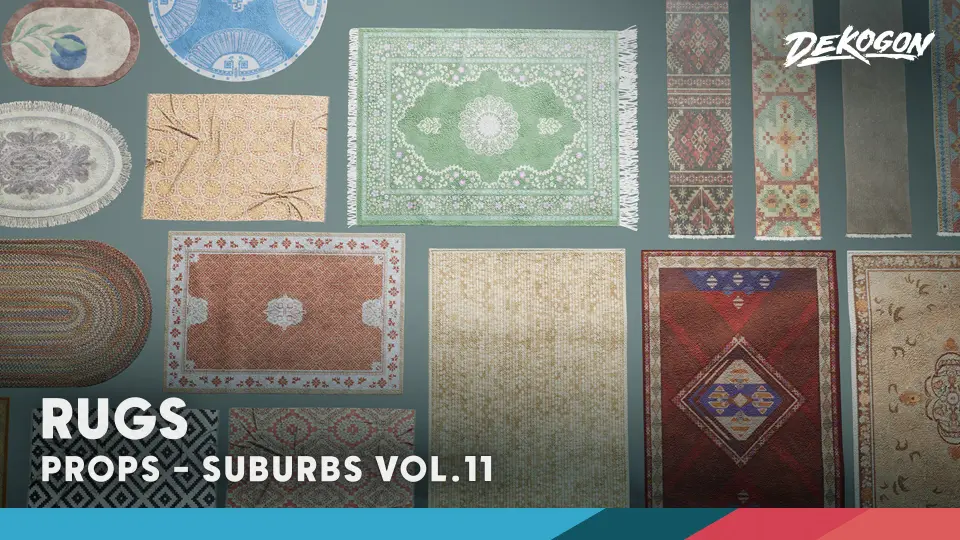
Placing floor textiles into an architectural scene dictates how light settles across wide floorboards, concrete slabs, or tiled rooms. Suburbs VOL.11 - Rugs supplies 30 individual meshes divided evenly between high-density Nanite geometry and low-poly equivalents for each rug design. This dual-pipeline setup addresses contrasting pipeline demands without requiring manual retopology. Projects building on modern geometry streaming can load Nanite versions to capture microscopic surface transitions, while projects adhering to conventional geometry caps can deploy the low-poly variants to stay strictly within strict frame budgets.
Every mesh in the collection represents realistic AAA visual standards with an aesthetic leaning toward 1980s, retro, industrial, and suburban domestic layouts. Rugs serve as foundational anchors beneath furniture, breaking up repetitive floor tile patterns and providing immediate geographic context to a room. Because the assets are modeled completely from all sides, placement is not restricted to flat surfaces. Rug edges can roll over steps, drape over furniture edges, or sit slightly turned over on an unfinished floor without revealing untextured backfaces or missing polygons.
Master Material Controls for Albedo, Roughness, and Normals
Material flexibility dictates how well a prop library integrates into varying interior art styles. This package utilizes a centralized master material network that governs the majority of the props and models across the set. Instanced variations give artists direct access to surface properties, eliminating the need to modify source textures when altering a scene's visual tone.
Exposed parameters grant precise adjustment over:
Roughness values: Adjusting fabric sheen, dampening light response on worn pile, or accentuating dry weave patterns across the floor.
Albedo controls: Tinting, balancing values, and altering base color palettes to fit specific suburban or architectural color grading schemes.
Normal map intensity: Scaling weave depth, thread relief, and structural creasing to match close-up cinematic shots or distant environmental views.
Centralizing these controls within a unified master material keeps memory draw predictable and minimizes shader compilation overhead when dressing expansive indoor maps.
Channel-Packed 4K Textures and Game-Ready Shading Architecture
High-resolution texturing ensures surface wear, thread weave, and pattern degradation hold up under high-density camera inspections. The set uses full 4K texture sets tailored for game deployment. These high-fidelity texture maps provide sharp micro-detail across the surface of each carpet, capturing realistic manufacturing variations and surface distress.
To preserve runtime memory and cut down on texture sampler calls, the shaders rely on a channel-packed texture configuration:
Red Channel: Roughness
Green Channel: Metalness
Blue Channel: Ambient Occlusion
Channel packing combines three individual grayscale grayscale maps into a single image asset. This pipeline standard keeps draw calls lean, optimizes graphics memory bandwidth, and ensures that material shading accurately calculates cavity shadows and surface reflectivity simultaneously. Paired with high-resolution normal maps and rich albedo layers, the channel-packed maps allow fabrics to capture the subtle tactile qualities of aged domestic carpets.
Lumen Lighting Integration and Custom Look Up Table Adjustments
Fabric surfaces react uniquely to indirect illumination, catching soft bounce light along low-angle viewing axes. Suburbs VOL.11 - Rugs provides verified compatibility with Lumen dynamic global illumination inside Unreal Engine 5.0 and newer versions. As dynamic directional lights, interior lamps, or skylights shift, the rug surfaces process bounce light naturally, avoiding harsh specular hot spots or artificial backscattering.
The project setup includes dedicated post-process configurations and an included Look Up Table (LUT). The LUT balances tonal contrast, highlights, and shadow depth across the included preview maps, establishing a realistic cinematic foundation straight out of the box. Level designers can retain this look for cohesive environmental presentations or adapt the master post-process settings to align with existing project-wide grading profiles.
Double-Sided Asset Modeling and Production Clearance
In environmental set dressing, standard single-sided planes often present severe limitations when rugs are placed near dynamic objects, displaced by debris, or viewed from unorthodox angles. The assets created by Dekogon Studios Artists are modeled with geometry and texturing intact on all faces. This ensures that flipped corners, loose fringe, and underside textures maintain physical plausibility regardless of viewport orientation.
Commercial deployment often encounters friction when prop packs rely on recognizable commercial insignias or unlicensed product patterns. All labeling, texturing patterns, and branding across this collection are original designs produced internally by the studio artists. The absence of proprietary logos and commercial trademarks ensures the assets can drop directly into shipping titles without clearing external licensing hurdles.
 Buildings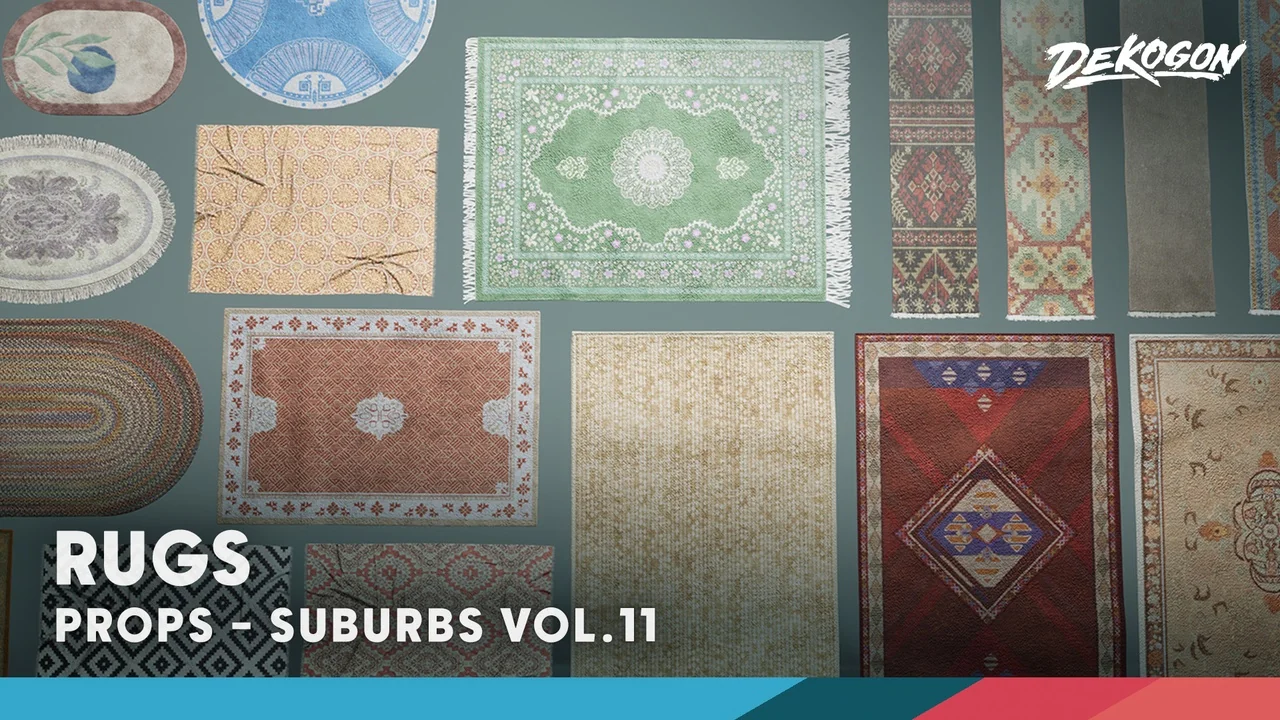
 Buildings
 Buildings
 Buildings