"b00678cacce53329"{"id":"1002864","slug":"stylized-vfx-starter-pack","title":"Stylized VFX Starter Pack","category":"Variety","engine":"4.25+,5.0+","assetVersion":"","engineVersion":"Engine Version: 4.25+,5.0+","tag":"Variety","accent":"blue","visual":"mech","summary":"Explore the Niagara-based Stylized VFX Starter Pack, featuring 3-tier upgradable spells, customizable shields, VR-ready shaders, and combat feedback effects.","platform":"Unreal Engine","indexPolicy":"index","publishedAt":"2026-11-20T12:47:00.035Z","updatedAt":"2026-11-20T12:47:00.035Z","sourceNotes":[],"fileContents":[],"compatibility":["Unreal Engine","Engine Version: 4.25+,5.0+"],"featuredImage":{"alt":"Stylized VFX Starter Pack","src":"/wp-content/uploads/published/2026/11/24d9e4c66083-5cb26478-d6cd-4f23-aac9-f7669f3f6994-b28293f9e9.webp"},"fileSizeBytes":78698261,"hasDownloadLink":true,"downloads":0,"terms":[{"taxonomy":"category","slug":"variety-vfx","name":"Variety"}],"galleryImages":[{"src":"/wp-content/uploads/published/2026/11/5b98cb9fd41b-bcbde5b3-9183-48a3-a300-dc110029bb8b-ebe359e0ff.webp","alt":"Stylized VFX Starter Pack"},{"src":"/wp-content/uploads/published/2026/11/7cba1ded8999-c4bdc53a-9cd9-41b4-a712-b260a7a453b2-1f823a346a.webp","alt":"Stylized VFX Starter Pack"},{"src":"/wp-content/uploads/published/2026/11/e2a023743a3d-56eeaf3d-94c4-4e2d-a99e-265b84b1c815-7cf96e0a06.webp","alt":"Stylized VFX Starter Pack"},{"src":"/wp-content/uploads/published/2026/11/7cd6a21e4a3a-34008ec3-3917-4a28-852e-6979f2f13448-d6a646331d.webp","alt":"Stylized VFX Starter Pack"},{"src":"/wp-content/uploads/published/2026/11/724dadb1bd04-c6466400-d6f9-4c75-9135-52424a7248e6-b0430b6587.webp","alt":"Stylized VFX Starter Pack"},{"src":"/wp-content/uploads/published/2026/11/b9599688bc6c-3a747146-6cf5-4178-97f1-59b0ae01ef86-74c658db83.webp","alt":"Stylized VFX Starter Pack"},{"src":"/wp-content/uploads/published/2026/11/43be00dbdeb3-cbdd1e53-1310-4834-8a81-c5f50381bceb-51a1dd5736.webp","alt":"Stylized VFX Starter Pack"},{"src":"/wp-content/uploads/published/2026/11/4387cb20ca4c-2f4a0768-a082-4e8a-a158-4bc61d06ff5f-abb85d6447.webp","alt":"Stylized VFX Starter Pack"},{"src":"/wp-content/uploads/published/2026/11/990e224f39cc-7c7d6944-46e7-410b-bcea-b50f9161d692-e2718f4592.webp","alt":"Stylized VFX Starter Pack"},{"src":"/wp-content/uploads/published/2026/11/2754326638b1-5bf35222-16fd-4e19-9c1c-f3f01b86695f-8c5927369a.webp","alt":"Stylized VFX Starter Pack"}],"accessPanel":{"kind":"resource","title":"Get this resource","safetyNote":"Resources are manually reviewed before listing to improve quality and reduce obvious risks.","fileName":"Content.7z","resourceType":"Resource archive","versions":[]},"contentHtml":"\u003cp\u003eVibrant spell trajectories, swirling elemental vortices, and sharp visual impacts establish the pacing and tactile responsiveness of stylized fantasy combat. On an active battlefield, clear visual effects separate a routine strike from a decisive, tide-turning ability. High-fantasy encounters demand visual hierarchy: a low-tier spark must read differently to a player than a fully escalated burst of energy, while defensive barriers and teleportation portals need distinct spatial bounds. The Stylized VFX Starter Pack addresses these scene-building requirements by collecting a broad catalog of Niagara-powered combat visuals, utility cues, and defensive barriers tuned for real-time action gameplay.\u003c/p\u003e \u003ch2\u003eStylized Combat Magic and Multi-Tier Spell Progression\u003c/h2\u003e \u003cp\u003eDirect combat spells in this collection are constructed around a structured three-tier progression model. Rather than providing isolated one-off particles, the pack provides three distinct upgrade tiers across its projectile lines, explosive bursts, focused lasers, and wide area-of-effect abilities. In game design terms, this enables visual continuity across a character's skill tree. A basic attack spell can scale visually into an intermediate bolt and ultimately into an authoritative late-game release without departing from the established art style.\u003c/p\u003e \u003cp\u003eThe projectile systems themselves accommodate varied trajectory dynamics to match different combat behaviors:\u003c/p\u003e\n\u003cul\u003e\n\u003cli\u003e\u003cstrong\u003eClassic bolts:\u003c/strong\u003e Linear, direct-line projectiles suitable for rapid-fire casting or standard ranged attacks.\u003c/li\u003e\n\u003cli\u003e\u003cstrong\u003eElectric charges:\u003c/strong\u003e Erratic, high-frequency energy paths that convey lightning and elemental discharge.\u003c/li\u003e\n\u003cli\u003e\u003cstrong\u003eSnaking projectiles:\u003c/strong\u003e Weaving, undulating paths that fit homing spells, serpentine curses, or organic magical projectiles.\u003c/li\u003e\n\u003cli\u003e\u003cstrong\u003eEnergy balls:\u003c/strong\u003e Concentrated spherical masses of magical force suitable for charged releases or slow-moving hazards.\u003c/li\u003e\n\u003c/ul\u003e \u003cp\u003eThese projectiles can operate with or without gravity calculations enabled. Toggling gravity alters the gameplay utility immediately, converting a linear laser or forward dart into an arcing mortar shell, a lobbed elemental flask, or a ballistic falling meteor. Matching explosions correspond to each projectile type, allowing creators to pair impact bursts directly to the elemental identity of the incoming strike, whether expressing fiery detonations, electrical arcs, or icy blasts.\u003c/p\u003e \u003ch2\u003eNiagara VFX Architecture and Defensive Shield Configurator\u003c/h2\u003e \u003cp\u003eBuilt entirely on the modern Niagara simulation framework, the visual effects rely on exposed parameters to facilitate asset reuse across varied scene aesthetics. Color is a primary tunable parameter. Artists and technical directors can tint elemental emitters to transition between frost and fire, poison bile, or holy radiance without rebuilding emitter stacks from scratch. This parameterization extends deep into the barrier and ward systems.\u003c/p\u003e \u003cp\u003eDefensive setups in combat titles require structural versatility, and the shield modules within the package allow developers to choose from multiple underlying geometry types:\u003c/p\u003e\n\u003cul\u003e\n\u003cli\u003e\u003cstrong\u003eSpherical shields:\u003c/strong\u003e Classic full-coverage bubbles that encase an entire actor during high-impact defensive stances.\u003c/li\u003e\n\u003cli\u003e\u003cstrong\u003eBarrier walls:\u003c/strong\u003e Directional deployable screens placed in the world to deflect incoming frontal fire or protect tactical chokepoints.\u003c/li\u003e\n\u003cli\u003e\u003cstrong\u003eCustom static meshes:\u003c/strong\u003e Meshes defined by the user to project magical barriers over arbitrary environmental structures or unique gameplay props.\u003c/li\u003e\n\u003cli\u003e\u003cstrong\u003eSkeletal meshes:\u003c/strong\u003e Dynamic defensive coatings that conform directly to character geometry, outlining animated limbs and torsos with defensive particle energy.\u003c/li\u003e\n\u003c/ul\u003e \u003cp\u003eThe functional behavior of these shields is governed by dedicated runtime parameters. Developers can configure barriers as endless structures that persist indefinitely, destructible fields that shatter under fire, or staged defenses calibrated to break after a predetermined number of incoming hits. This direct link between particle state and gameplay health mechanics reduces the scripting overhead required to convey defensive degradation to the player.\u003c/p\u003e \u003ch2\u003eElemental Area Spells and Utility Feedback FX\u003c/h2\u003e \u003cp\u003eZone-control encounters and crowd-control mechanics rely on ground-targeted area-of-effect (AOE) abilities. Four specific AOE spells are included, each supported by the three-level progression framework: Storm, Heal, Splash, and Tornado. The Splash effect provides liquid, water-based impact dynamics, while the Tornado delivers swirling vortex forces. The Storm spell drops sustained aerial punishment across a designated footprint, and the Heal spell projects positive recovery fields to distinguish supportive buff zones from damaging ground hazards.\u003c/p\u003e \u003cp\u003eBeyond offensive and defensive combat spells, the collection provides critical gameplay utility cues that maintain player orientation during chaotic encounters:\u003c/p\u003e\n\u003cul\u003e\n\u003cli\u003e\u003cstrong\u003eBifrost:\u003c/strong\u003e A radiant pillar effect intended for teleportation mechanics, spawn points, and sudden spatial relocations.\u003c/li\u003e\n\u003cli\u003e\u003cstrong\u003eBlood:\u003c/strong\u003e Stylized physical impact feedback that confirms direct physical or cutting weapon hits.\u003c/li\u003e\n\u003cli\u003e\u003cstrong\u003eHit cues:\u003c/strong\u003e Universal strike flashes that communicate damage registration across non-organic or armored targets.\u003c/li\u003e\n\u003cli\u003e\u003cstrong\u003ePick Up:\u003c/strong\u003e Environmental collection markers to emphasize loot drops, consumables, or floating collectibles.\u003c/li\u003e\n\u003cli\u003e\u003cstrong\u003eLevel UP:\u003c/strong\u003e Ascending ceremonial bursts that visually punctuate character progression and milestone achievements.\u003c/li\u003e\n\u003c/ul\u003e \u003ch2\u003eDeploying the Pack Across Mobile and Virtual Reality Targets\u003c/h2\u003e \u003cp\u003eBecause stylized visuals frequently target diverse hardware platforms, rendering overhead remains a pivotal concern. The collection was recognized as a selected product during the Epic MegaJam 2020 and has received continuous structural revisions across versions 1.2, 1.3, and 1.4. Performance scaling is addressed through dedicated accommodations for immersion-focused platforms, including a specific subfolder containing reworked effects tuned for virtual reality environments.\u003c/p\u003e \u003cp\u003eIn the VR-optimized folder, shaders are tuned to maintain a fully green shader complexity profile in engine visualization modes, minimizing excessive instruction counts and overdraw penalties. When deploying to VR hardware, the current setup requires disabling Instanced Stereo. While the optimized shaders provide a solid foundation for desktop VR setups, standalone or autonomous VR headsets with constrained mobile processors may require further individualized optimization depending on particle density and concurrent emitter limits. Mobile developers working on handheld action titles can likewise benefit from these lighter shader configurations to maintain high framerates during heavy multi-spell engagements.\u003c/p\u003e \u003ch2\u003eFramework Synergy and Project Suitability\u003c/h2\u003e \u003cp\u003eBecause the effects provide discrete gameplay triggers—including hit counts, destructible shields, tiered spell upgrades, and directional impacts—they align cleanly with third-party gameplay templates such as the Flexible Combat System framework. Integrating these Niagara emitters into established combat pipelines requires minimal glue logic, as the particles cleanly demarcate start, sustain, and impact phases.\u003c/p\u003e \u003cp\u003eTeams building stylized third-person action RPGs, top-down arena brawlers, mobile battle titles, or arcade-style VR dueling experiences will find the greatest utility in this toolkit. The modularity of its three-tier upgrade path, coupled with the balance of aggressive spells, defensive geometry wrappers, and practical user-interface world cues, makes it an adaptable visual foundation for expressive, mechanics-driven combat.\u003c/p\u003e\n\n\u003ch2\u003eMore From The Same Workflow\u003c/h2\u003e\n\u003cul\u003e\n\u003cli\u003e\u003ca href=\"https://3dcghub.com/niagara-realistic-starter-vfx-pack/\" rel=\"noopener noreferrer\"\u003eNiagara Realistic Starter VFX Pack\u003c/a\u003e\u003c/li\u003e\n\u003cli\u003e\u003ca href=\"https://3dcghub.com/2d-anime-vfx-pack/\" rel=\"noopener noreferrer\"\u003e2D Anime VFX Pack\u003c/a\u003e\u003c/li\u003e\n\u003cli\u003e\u003ca href=\"https://3dcghub.com/stylized-small-fishes-niagara/\" rel=\"noopener noreferrer\"\u003eStylized Small Fishes [Niagara]\u003c/a\u003e\u003c/li\u003e\n\u003cli\u003e\u003ca href=\"https://3dcghub.com/stylized-fx-3/\" rel=\"noopener noreferrer\"\u003eStylized FX 3\u003c/a\u003e\u003c/li\u003e\n\u003cli\u003e\u003ca href=\"https://3dcghub.com/stylized-fx-2/\" rel=\"noopener noreferrer\"\u003eStylized FX 2\u003c/a\u003e\u003c/li\u003e\n\u003c/ul\u003e","contentTextLength":7633,"navigation":{"current":16,"total":4797,"previous":{"id":"1002865","slug":"niagara-death-effects-vol-1","title":"Niagara Death Effects Vol.1","category":"Spells \u0026 Combat","platform":"Unreal Engine","updatedAt":"2026-11-20T12:49:12.930Z"},"next":{"id":"1002863","slug":"magic-circles-and-shields","title":"Magic Circles and Shields","category":"Spells \u0026 Combat","platform":"Unreal Engine","updatedAt":"2026-11-20T12:45:36.364Z"}},"relatedResources":[{"id":"1002278","slug":"niagara-realistic-starter-vfx-pack","title":"Niagara Realistic Starter VFX Pack","category":"Variety","engine":"4.25+,5.0+","assetVersion":"","engineVersion":"Engine Version: 4.25+,5.0+","tag":"Variety","accent":"blue","visual":"mech","summary":"Examine the Niagara Realistic Starter VFX Pack, featuring 148 particle systems, transform-based scaling, and comprehensive environmental and combat effects.","platform":"Unreal Engine","indexPolicy":"index","publishedAt":"2026-10-29T16:36:27.991Z","updatedAt":"2026-10-29T16:36:27.991Z","sourceNotes":[],"fileContents":[],"compatibility":["Unreal Engine","Engine Version: 4.25+,5.0+"],"featuredImage":{"alt":"Niagara Realistic Starter VFX Pack","src":"/wp-content/uploads/published/2026/10/926adaa76d87-2c37688c-2dc0-4683-8cf4-d600fcea15d4-f5feac6fed.webp"},"fileSizeBytes":960341083,"hasDownloadLink":true,"downloads":2},{"id":"1001925","slug":"2d-anime-vfx-pack","title":"2D Anime VFX Pack","category":"Variety","engine":"4.26+,5.0+","assetVersion":"","engineVersion":"Engine Version: 4.26+,5.0+","tag":"Variety","accent":"blue","visual":"mech","summary":"Hand-painted 2D anime VFX featuring explosions, muzzleflashes, warp, fire, smoke, and trail effects with instanced material color control for stylized games.","platform":"Unreal Engine","indexPolicy":"index","publishedAt":"2026-10-24T11:04:02.324Z","updatedAt":"2026-10-24T11:04:02.324Z","sourceNotes":[],"fileContents":[],"compatibility":["Unreal Engine","Engine Version: 4.26+,5.0+"],"featuredImage":{"alt":"2D Anime VFX Pack","src":"/wp-content/uploads/published/2026/10/57ac03a27daf-4d6ea1ad-6522-47a1-9f93-a3d7d0b6648d-757b4018a8.webp"},"fileSizeBytes":11043115,"hasDownloadLink":true,"downloads":2},{"id":"1002866","slug":"stylized-fx-6","title":"Stylized FX 6","category":"Variety","engine":"4.16+,5.0+","assetVersion":"","engineVersion":"Engine Version: 4.16+,5.0+","tag":"Variety","accent":"blue","visual":"mech","summary":"Stylized FX 6 delivers focused real-time visual effects for non-photorealistic game projects, emphasizing silhouette clarity, timing, and bold artistic style.","platform":"Unreal Engine","indexPolicy":"index","publishedAt":"2026-11-20T12:53:23.890Z","updatedAt":"2026-11-20T12:53:23.890Z","sourceNotes":[],"fileContents":[],"compatibility":["Unreal Engine","Engine Version: 4.16+,5.0+"],"featuredImage":{"alt":"Stylized FX 6","src":"/wp-content/uploads/published/2026/11/0a2e8bbe656b-1ef4dc10-f2ff-47d4-bdc0-f8fa091c8df2-228260cee1.webp"},"fileSizeBytes":73365834,"hasDownloadLink":true,"downloads":0}]}
Resource screenshots
1 / 10
Join our channel
Follow 3DCGHUB on Telegram for new resource drops, migration updates, and community notices.
Vibrant spell trajectories, swirling elemental vortices, and sharp visual impacts establish the pacing and tactile responsiveness of stylized fantasy combat. On an active battlefield, clear visual effects separate a routine strike from a decisive, tide-turning ability. High-fantasy encounters demand visual hierarchy: a low-tier spark must read differently to a player than a fully escalated burst of energy, while defensive barriers and teleportation portals need distinct spatial bounds. The Stylized VFX Starter Pack addresses these scene-building requirements by collecting a broad catalog of Niagara-powered combat visuals, utility cues, and defensive barriers tuned for real-time action gameplay.
Stylized Combat Magic and Multi-Tier Spell Progression
Direct combat spells in this collection are constructed around a structured three-tier progression model. Rather than providing isolated one-off particles, the pack provides three distinct upgrade tiers across its projectile lines, explosive bursts, focused lasers, and wide area-of-effect abilities. In game design terms, this enables visual continuity across a character's skill tree. A basic attack spell can scale visually into an intermediate bolt and ultimately into an authoritative late-game release without departing from the established art style.
The projectile systems themselves accommodate varied trajectory dynamics to match different combat behaviors:
Classic bolts: Linear, direct-line projectiles suitable for rapid-fire casting or standard ranged attacks.
Electric charges: Erratic, high-frequency energy paths that convey lightning and elemental discharge.
Snaking projectiles: Weaving, undulating paths that fit homing spells, serpentine curses, or organic magical projectiles.
Energy balls: Concentrated spherical masses of magical force suitable for charged releases or slow-moving hazards.
These projectiles can operate with or without gravity calculations enabled. Toggling gravity alters the gameplay utility immediately, converting a linear laser or forward dart into an arcing mortar shell, a lobbed elemental flask, or a ballistic falling meteor. Matching explosions correspond to each projectile type, allowing creators to pair impact bursts directly to the elemental identity of the incoming strike, whether expressing fiery detonations, electrical arcs, or icy blasts.
Niagara VFX Architecture and Defensive Shield Configurator
Built entirely on the modern Niagara simulation framework, the visual effects rely on exposed parameters to facilitate asset reuse across varied scene aesthetics. Color is a primary tunable parameter. Artists and technical directors can tint elemental emitters to transition between frost and fire, poison bile, or holy radiance without rebuilding emitter stacks from scratch. This parameterization extends deep into the barrier and ward systems.
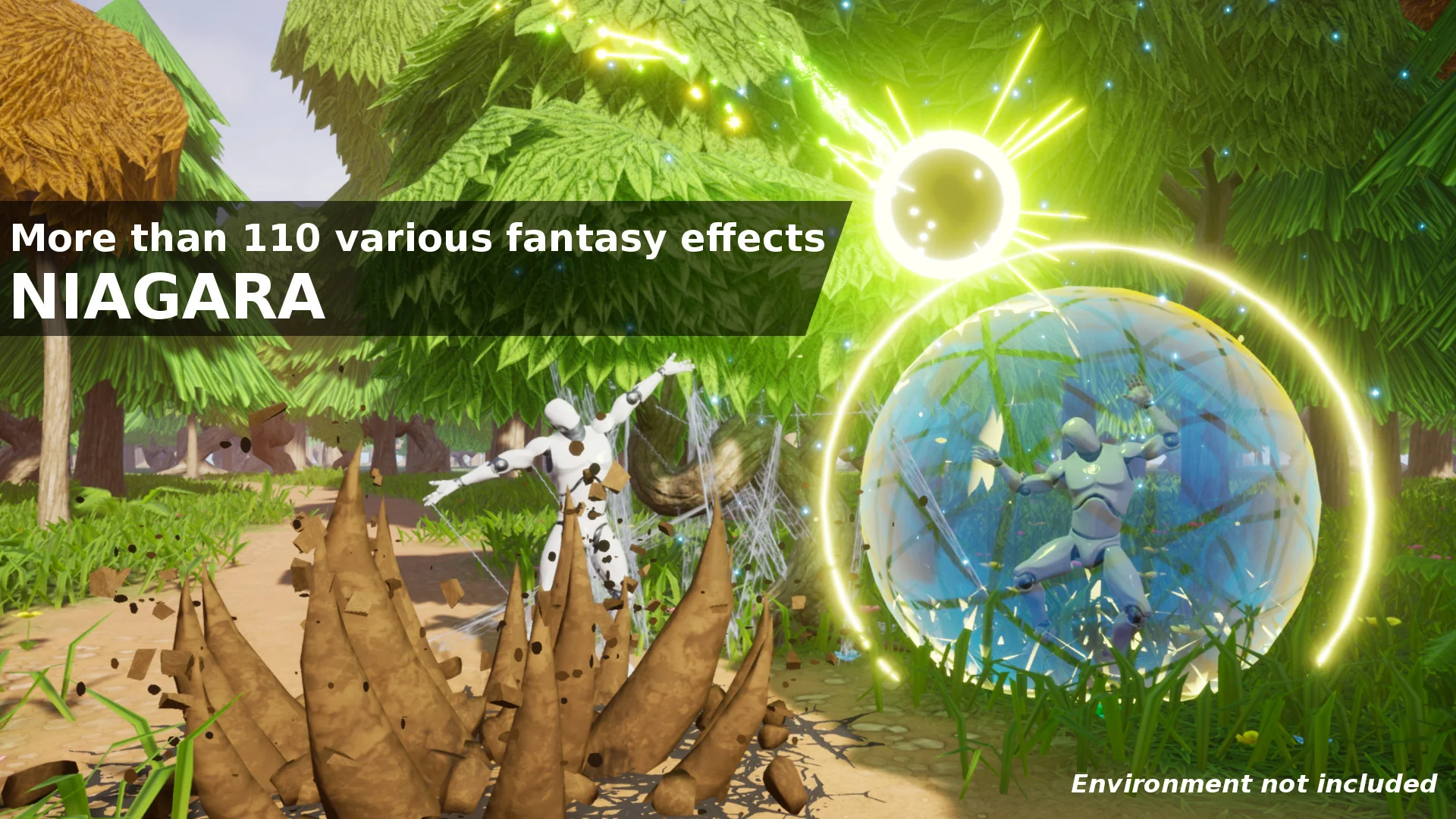
Defensive setups in combat titles require structural versatility, and the shield modules within the package allow developers to choose from multiple underlying geometry types:
Spherical shields: Classic full-coverage bubbles that encase an entire actor during high-impact defensive stances.
Barrier walls: Directional deployable screens placed in the world to deflect incoming frontal fire or protect tactical chokepoints.
Custom static meshes: Meshes defined by the user to project magical barriers over arbitrary environmental structures or unique gameplay props.
Skeletal meshes: Dynamic defensive coatings that conform directly to character geometry, outlining animated limbs and torsos with defensive particle energy.
The functional behavior of these shields is governed by dedicated runtime parameters. Developers can configure barriers as endless structures that persist indefinitely, destructible fields that shatter under fire, or staged defenses calibrated to break after a predetermined number of incoming hits. This direct link between particle state and gameplay health mechanics reduces the scripting overhead required to convey defensive degradation to the player.
Elemental Area Spells and Utility Feedback FX
Zone-control encounters and crowd-control mechanics rely on ground-targeted area-of-effect (AOE) abilities. Four specific AOE spells are included, each supported by the three-level progression framework: Storm, Heal, Splash, and Tornado. The Splash effect provides liquid, water-based impact dynamics, while the Tornado delivers swirling vortex forces. The Storm spell drops sustained aerial punishment across a designated footprint, and the Heal spell projects positive recovery fields to distinguish supportive buff zones from damaging ground hazards.
Beyond offensive and defensive combat spells, the collection provides critical gameplay utility cues that maintain player orientation during chaotic encounters:
Bifrost: A radiant pillar effect intended for teleportation mechanics, spawn points, and sudden spatial relocations.
Blood: Stylized physical impact feedback that confirms direct physical or cutting weapon hits.
Hit cues: Universal strike flashes that communicate damage registration across non-organic or armored targets.
Pick Up: Environmental collection markers to emphasize loot drops, consumables, or floating collectibles.
Level UP: Ascending ceremonial bursts that visually punctuate character progression and milestone achievements.
Deploying the Pack Across Mobile and Virtual Reality Targets
Because stylized visuals frequently target diverse hardware platforms, rendering overhead remains a pivotal concern. The collection was recognized as a selected product during the Epic MegaJam 2020 and has received continuous structural revisions across versions 1.2, 1.3, and 1.4. Performance scaling is addressed through dedicated accommodations for immersion-focused platforms, including a specific subfolder containing reworked effects tuned for virtual reality environments.
In the VR-optimized folder, shaders are tuned to maintain a fully green shader complexity profile in engine visualization modes, minimizing excessive instruction counts and overdraw penalties. When deploying to VR hardware, the current setup requires disabling Instanced Stereo. While the optimized shaders provide a solid foundation for desktop VR setups, standalone or autonomous VR headsets with constrained mobile processors may require further individualized optimization depending on particle density and concurrent emitter limits. Mobile developers working on handheld action titles can likewise benefit from these lighter shader configurations to maintain high framerates during heavy multi-spell engagements.
Framework Synergy and Project Suitability
Because the effects provide discrete gameplay triggers—including hit counts, destructible shields, tiered spell upgrades, and directional impacts—they align cleanly with third-party gameplay templates such as the Flexible Combat System framework. Integrating these Niagara emitters into established combat pipelines requires minimal glue logic, as the particles cleanly demarcate start, sustain, and impact phases.
Teams building stylized third-person action RPGs, top-down arena brawlers, mobile battle titles, or arcade-style VR dueling experiences will find the greatest utility in this toolkit. The modularity of its three-tier upgrade path, coupled with the balance of aggressive spells, defensive geometry wrappers, and practical user-interface world cues, makes it an adaptable visual foundation for expressive, mechanics-driven combat.
 Variety
 Variety
 Variety