"b00678cacce53329"{"id":"1002843","slug":"stylized-small-fishes-niagara","title":"Stylized Small Fishes [Niagara]","category":"Variety","engine":"4.25+,5.0+","assetVersion":"","engineVersion":"Engine Version: 4.25+,5.0+","tag":"Variety","accent":"blue","visual":"mech","summary":"Stylized Small Fishes provides 30 animated fish species, 60 Niagara flock systems, 20 atlas-mapped seaweeds, and emission textures for underwater scenes.","platform":"Unreal Engine","indexPolicy":"index","publishedAt":"2026-11-20T12:24:51.712Z","updatedAt":"2026-11-20T12:24:51.712Z","sourceNotes":[],"fileContents":[],"compatibility":["Unreal Engine","Engine Version: 4.25+,5.0+"],"featuredImage":{"alt":"Stylized Small Fishes [Niagara]","src":"/wp-content/uploads/published/2026/11/fa481ca6f307-43514160-6148-49d1-9cb7-bf23fc2e16f6-cd7da6286d.webp"},"fileSizeBytes":384547347,"hasDownloadLink":true,"downloads":0,"terms":[{"taxonomy":"category","slug":"variety-vfx","name":"Variety"}],"galleryImages":[{"src":"/wp-content/uploads/published/2026/11/d31b7b0fae4a-b0e44301-3522-4373-8841-68b2fb1c3c9f-dea3d1c7fd.webp","alt":"Stylized Small Fishes [Niagara]"},{"src":"/wp-content/uploads/published/2026/11/ee3ecebdd13c-e79477c4-c101-4f74-9494-b74d0c8c363f-7a7ddc010e.webp","alt":"Stylized Small Fishes [Niagara]"},{"src":"/wp-content/uploads/published/2026/11/356ec2806a02-876ccc03-ade4-48eb-9301-a7ae6a24fb59-4d6583b906.webp","alt":"Stylized Small Fishes [Niagara]"},{"src":"/wp-content/uploads/published/2026/11/12fd7dc35af5-51504d03-1306-4bed-963e-44157f15428d-e7c56b4acb.webp","alt":"Stylized Small Fishes [Niagara]"},{"src":"/wp-content/uploads/published/2026/11/0157d67092ab-bd3375a6-fc8f-4bbc-a2ab-1e4f0b71c814-1b056432a4.webp","alt":"Stylized Small Fishes [Niagara]"},{"src":"/wp-content/uploads/published/2026/11/92b81e50eb90-fbd7dd0d-46d3-4c05-b988-7df1dfac14ea-678426f91d.webp","alt":"Stylized Small Fishes [Niagara]"},{"src":"/wp-content/uploads/published/2026/11/623e04d42127-f446f1a2-b1c3-4103-99b9-a90336989569-897d75b606.webp","alt":"Stylized Small Fishes [Niagara]"},{"src":"/wp-content/uploads/published/2026/11/e7a1ac1f71ef-4c1a03c3-3f43-47f4-8b02-f85ba4a71b37-a15eba0b52.webp","alt":"Stylized Small Fishes [Niagara]"},{"src":"/wp-content/uploads/published/2026/11/c0ca5f84dea7-d62dbd98-3f0c-401d-bc28-babcbb179425-c0fcc351d6.webp","alt":"Stylized Small Fishes [Niagara]"},{"src":"/wp-content/uploads/published/2026/11/b4444a228cd6-23679a8d-a682-4a5f-89b3-a134ba58e216-e1217cced4.webp","alt":"Stylized Small Fishes [Niagara]"}],"accessPanel":{"kind":"resource","title":"Get this resource","safetyNote":"Resources are manually reviewed before listing to improve quality and reduce obvious risks.","fileName":"Content.7z","resourceType":"Resource archive","versions":[]},"contentHtml":"\u003cp\u003ePopulating stylized ocean levels requires assets that balance visual charm with strict real-time performance. The Stylized Small Fishes [Niagara] collection supplies a complete underwater environment kit based on low-poly fish, flexible particle schooling behaviors, and matching aquatic vegetation. Rather than offering isolated props, the collection pairs dual-pipeline meshes with dedicated Niagara systems and Blueprint structure, allowing creators to drop active schools and seabed scatter directly into stylized or fantasy marine projects.\u003c/p\u003e\u003ch2\u003eLow-Poly Fishes Across Skeletal and Material Workflows\u003c/h2\u003e\u003cp\u003eThe core of the collection consists of 30 distinct low-poly fish models. To accommodate different performance targets and production constraints, every fish model is provided in two separate asset configurations: as a skeletal mesh and as an animated static mesh. This dual approach gives developers direct control over how animation overhead is distributed across the CPU and GPU.\u003c/p\u003e\u003cp\u003eFor projects requiring traditional transform hierarchies, the 30 skeletal meshes each feature an individual baked swimming animation. These skeletal rigs handle cyclical swimming motions through conventional skinning, making them straightforward to place as independent background actors, cinematic subjects, or hero props interacting with path-following logic. Because the meshes remain strictly low-poly, they maintain clean silhouettes without taxing the geometry pipeline.\u003c/p\u003e\u003cp\u003eAlongside the skeletal versions, the package includes 30 static mesh equivalents that reproduce swimming motion entirely through material shaders. By transferring vertex displacement to the material, these static meshes bypass skeletal evaluation entirely. In dense underwater environments where hundreds of fish must occupy the frame simultaneously, running swimming cycles inside the material avoids skeletal tick costs and keeps draw calls lightweight.\u003c/p\u003e\u003cp\u003eTexture allocation remains modular and tidy across the entire school. Each individual fish relies on a single dedicated texture map paired with an individual emission texture. This structure keeps asset management predictable: every fish model is self-contained with its own visual texture data, avoiding large, monolithic multi-asset dependencies while keeping draw-call setup straightforward.\u003c/p\u003e\u003ch2\u003eNiagara Flocks Configured for Meshes and Planes\u003c/h2\u003e\u003cp\u003eLarge-scale marine environments rarely display fish in isolation. To recreate natural schooling movements, the collection provides 60 distinct Niagara flock emitters, separated evenly into 30 mesh-based flock systems and 30 plane-based flock systems.\u003c/p\u003e\u003cp\u003eThe 30 mesh flock setups feed the 3D low-poly geometry directly into Niagara's particle simulation. These mesh-driven particles are suited for medium-range to foreground schooling, where camera angles sweep past individual fins and bodies. Because they retain true volumetric form, the fish catch directional lighting, receive shadows naturally, and maintain accurate perspective as they twist and bank through curved swimming paths.\u003c/p\u003e\u003cp\u003eFor background schools, distant horizons, or massive high-density swarms, the collection provides 30 plane-based Niagara flocks. These setups swap geometry for camera-facing or aligned planar particles mapped with fish textures. Replacing full meshes with lightweight planes drastically cuts triangle counts, allowing scenes to render expansive schools spanning thousands of agents across distant underwater trenches without dragging down frame rates.\u003c/p\u003e\u003cp\u003eGrouping the particle systems into dedicated variations per species ensures that each flock exhibits movement patterns tailored to specific fish types. Developers can layer plane-based swarms into deep background layers while reserving mesh-based flocks for the immediate playable space, achieving rich visual depth without wasting rendering budgets on unseen polygons.\u003c/p\u003e\u003ch2\u003eSeaweed Foliage Unified by an Atlas Texture\u003c/h2\u003e\u003cp\u003eSeabeds require structure to contextualize schooling fish, which the package addresses through 20 low-poly seaweed meshes. These vegetation models provide the necessary vertical scatter to anchor rocky outcroppings, sandy floors, and reef edges within stylized aquatic scenes.\u003c/p\u003e\u003cp\u003eUnlike the fish, which each carry dedicated texture sets, all 20 seaweed assets are mapped to a single shared atlas texture. Using an atlas texture consolidates material draws across the entire vegetation scatter. When dozens or hundreds of seaweed clusters are distributed across an ocean floor, the engine can batch or instance them efficiently because they sample the same texture memory space.\u003c/p\u003e\u003cp\u003eThe low-poly nature of the seaweeds ensures that broad underwater meadows can be scattered across expansive terrains using standard foliage painting tools or procedural placement graphs without geometry bottlenecks. Their geometry complements the clean facets of the fish models, producing a cohesive visual language from seabed to surface.\u003c/p\u003e\u003ch2\u003eEmission Texturing for Stylized and Fantasy Environments\u003c/h2\u003e\u003cp\u003eWhile low-poly styling often emphasizes clean diffuse tones, every object in this collection—encompassing all 30 fish variants and all 20 seaweeds—features its own emission texture. This inclusion significantly expands the package's thematic range from ordinary sunlit waters into fantasy and deep-abyssal settings.\u003c/p\u003e\u003cp\u003eBy driving color and intensity through the emission channels, developers can transform basic tropical schools into bioluminescent deep-sea organisms. Glowing lateral lines, luminous fins, or radiant seaweed frills can be illuminated to create contrast in dark, sunless underwater levels. In stylized fantasy projects, these emission textures allow artists to introduce vivid neon accents, magical underwater biomes, or glowing hazards without rebuilding the base materials from scratch.\u003c/p\u003e\u003cp\u003eThe emission maps also integrate smoothly with engine post-processing pipelines. When combined with bloom filters and localized volumetric fog, the glowing elements cast soft halos into surrounding murky water, emphasizing depth and focal points across dark cavern networks or moonlit ocean floors.\u003c/p\u003e\u003ch2\u003eBlueprint Deployment in Real-Time Ocean Scenes\u003c/h2\u003e\u003cp\u003eBringing all these technical components together in a level is supported by integrated Blueprint functionality. Rather than forcing creators to assemble particle emitters, material parameters, and mesh assignments manually inside the editor viewport, the Blueprint setup serves as an operational bridge between the raw assets and active gameplay levels.\u003c/p\u003e\u003cp\u003eBlueprints allow for quick placement and management of flocking volumes, species swapping, and material parameter control within level instances. Whether staging a tranquil coral reef populated by solitary skeletal fish or deploying high-velocity Niagara particle swarms through open water, the provided Blueprint architecture ensures the package functions as an accessible, unified production toolset rather than a loose collection of disparate models.\u003c/p\u003e\n\n\u003ch2\u003eMore From The Same Workflow\u003c/h2\u003e\n\u003cul\u003e\n\u003cli\u003e\u003ca href=\"https://3dcghub.com/stylized-vfx-minipack/\" rel=\"noopener noreferrer\"\u003eStylized Vfx Minipack\u003c/a\u003e\u003c/li\u003e\n\u003cli\u003e\u003ca href=\"https://3dcghub.com/mixed-vfx-pack-4-niagara/\" rel=\"noopener noreferrer\"\u003eMixed Vfx Pack 4 (Niagara)\u003c/a\u003e\u003c/li\u003e\n\u003cli\u003e\u003ca href=\"https://3dcghub.com/niagarastylizedfx_03/\" rel=\"noopener noreferrer\"\u003eNiagaraStylizedFX_03\u003c/a\u003e\u003c/li\u003e\n\u003cli\u003e\u003ca href=\"https://3dcghub.com/vfx-impacts/\" rel=\"noopener noreferrer\"\u003eVFX Impacts\u003c/a\u003e\u003c/li\u003e\n\u003cli\u003e\u003ca href=\"https://3dcghub.com/butterfly-particles/\" rel=\"noopener noreferrer\"\u003eButterfly Particles\u003c/a\u003e\u003c/li\u003e\n\u003c/ul\u003e","contentTextLength":7069,"navigation":{"current":37,"total":4797,"previous":{"id":"1002844","slug":"super-powers","title":"Super Powers","category":"Gameplay Features","platform":"Unreal Engine","updatedAt":"2026-11-20T12:25:43.122Z"},"next":{"id":"1002842","slug":"stylized-shooting-vfx-niagara-muzzle-bullet-trail-impact","title":"Stylized Shooting VFX Niagara (Muzzle - Bullet Trail - Impact)","category":"Fire \u0026 Explosions","platform":"Unreal Engine","updatedAt":"2026-11-20T12:23:46.116Z"}},"relatedResources":[{"id":"1002864","slug":"stylized-vfx-starter-pack","title":"Stylized VFX Starter Pack","category":"Variety","engine":"4.25+,5.0+","assetVersion":"","engineVersion":"Engine Version: 4.25+,5.0+","tag":"Variety","accent":"blue","visual":"mech","summary":"Explore the Niagara-based Stylized VFX Starter Pack, featuring 3-tier upgradable spells, customizable shields, VR-ready shaders, and combat feedback effects.","platform":"Unreal Engine","indexPolicy":"index","publishedAt":"2026-11-20T12:47:00.035Z","updatedAt":"2026-11-20T12:47:00.035Z","sourceNotes":[],"fileContents":[],"compatibility":["Unreal Engine","Engine Version: 4.25+,5.0+"],"featuredImage":{"alt":"Stylized VFX Starter Pack","src":"/wp-content/uploads/published/2026/11/24d9e4c66083-5cb26478-d6cd-4f23-aac9-f7669f3f6994-b28293f9e9.webp"},"fileSizeBytes":78698261,"hasDownloadLink":true,"downloads":0},{"id":"1002283","slug":"stylized-vfx-minipack","title":"Stylized Vfx Minipack","category":"Variety","engine":"4.26+,5.0+","assetVersion":"","engineVersion":"Engine Version: 4.26+,5.0+","tag":"Variety","accent":"blue","visual":"mech","summary":"A close look at the Stylized Vfx Minipack, detailing its 25 Niagara systems, pickup effects, burst states, hit impacts, and torch Blueprints.","platform":"Unreal Engine","indexPolicy":"index","publishedAt":"2026-10-29T17:02:34.482Z","updatedAt":"2026-10-29T17:02:34.482Z","sourceNotes":[],"fileContents":[],"compatibility":["Unreal Engine","Engine Version: 4.26+,5.0+"],"featuredImage":{"alt":"Stylized Vfx Minipack","src":"/wp-content/uploads/published/2026/10/cdc6833df901-6ea2efd6-0434-49a6-b72f-3df5190b595a-062781cfcc.webp"},"fileSizeBytes":49225268,"hasDownloadLink":true,"downloads":1},{"id":"1002327","slug":"mixed-vfx-pack-4-niagara","title":"Mixed Vfx Pack 4 (Niagara)","category":"Variety","engine":"4.26+,5.0+","assetVersion":"","engineVersion":"Engine Version: 4.26+,5.0+","tag":"Variety","accent":"blue","visual":"mech","summary":"Mixed Vfx Pack 4 (Niagara) contains 15 stylized effects: waterfall blueprints, anime thrusters, flame orbs, trails, portals, burnout, explosion, speed running.","platform":"Unreal Engine","indexPolicy":"index","publishedAt":"2026-11-06T06:32:51.943Z","updatedAt":"2026-11-06T06:32:51.943Z","sourceNotes":[],"fileContents":[],"compatibility":["Unreal Engine","Engine Version: 4.26+,5.0+"],"featuredImage":{"alt":"Mixed Vfx Pack 4 (Niagara)","src":"/wp-content/uploads/published/2026/11/1c3adb0e24ff-5063006f-5d69-4a6a-8a1a-c472dad6e22e-bf3701c3a0.webp"},"fileSizeBytes":137697824,"hasDownloadLink":true,"downloads":0}]}
Resource screenshots
1 / 10
Join our channel
Follow 3DCGHUB on Telegram for new resource drops, migration updates, and community notices.
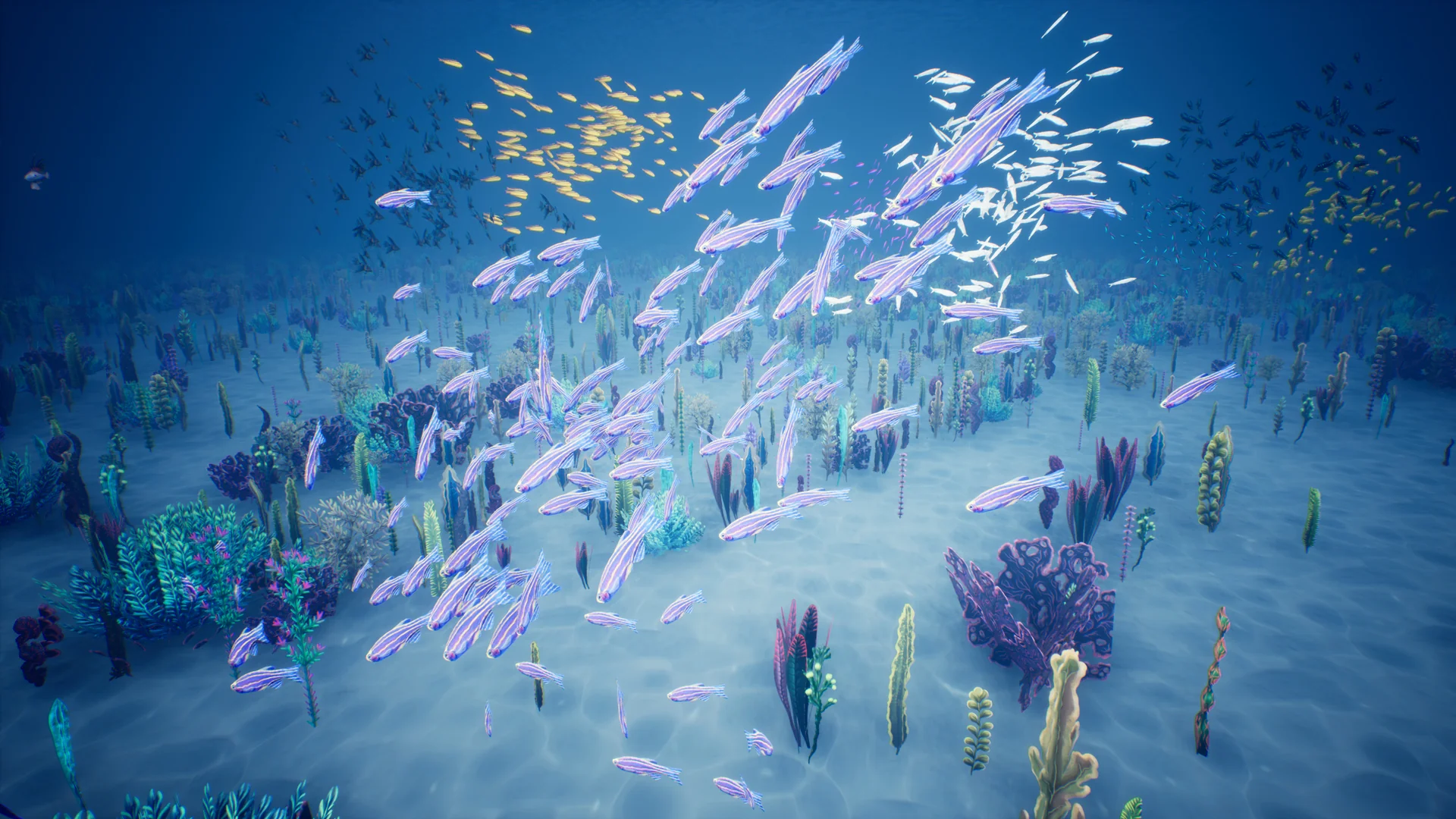
Populating stylized ocean levels requires assets that balance visual charm with strict real-time performance. The Stylized Small Fishes [Niagara] collection supplies a complete underwater environment kit based on low-poly fish, flexible particle schooling behaviors, and matching aquatic vegetation. Rather than offering isolated props, the collection pairs dual-pipeline meshes with dedicated Niagara systems and Blueprint structure, allowing creators to drop active schools and seabed scatter directly into stylized or fantasy marine projects.
Low-Poly Fishes Across Skeletal and Material Workflows
The core of the collection consists of 30 distinct low-poly fish models. To accommodate different performance targets and production constraints, every fish model is provided in two separate asset configurations: as a skeletal mesh and as an animated static mesh. This dual approach gives developers direct control over how animation overhead is distributed across the CPU and GPU.
For projects requiring traditional transform hierarchies, the 30 skeletal meshes each feature an individual baked swimming animation. These skeletal rigs handle cyclical swimming motions through conventional skinning, making them straightforward to place as independent background actors, cinematic subjects, or hero props interacting with path-following logic. Because the meshes remain strictly low-poly, they maintain clean silhouettes without taxing the geometry pipeline.
Alongside the skeletal versions, the package includes 30 static mesh equivalents that reproduce swimming motion entirely through material shaders. By transferring vertex displacement to the material, these static meshes bypass skeletal evaluation entirely. In dense underwater environments where hundreds of fish must occupy the frame simultaneously, running swimming cycles inside the material avoids skeletal tick costs and keeps draw calls lightweight.
Texture allocation remains modular and tidy across the entire school. Each individual fish relies on a single dedicated texture map paired with an individual emission texture. This structure keeps asset management predictable: every fish model is self-contained with its own visual texture data, avoiding large, monolithic multi-asset dependencies while keeping draw-call setup straightforward.
Niagara Flocks Configured for Meshes and Planes
Large-scale marine environments rarely display fish in isolation. To recreate natural schooling movements, the collection provides 60 distinct Niagara flock emitters, separated evenly into 30 mesh-based flock systems and 30 plane-based flock systems.
The 30 mesh flock setups feed the 3D low-poly geometry directly into Niagara's particle simulation. These mesh-driven particles are suited for medium-range to foreground schooling, where camera angles sweep past individual fins and bodies. Because they retain true volumetric form, the fish catch directional lighting, receive shadows naturally, and maintain accurate perspective as they twist and bank through curved swimming paths.
For background schools, distant horizons, or massive high-density swarms, the collection provides 30 plane-based Niagara flocks. These setups swap geometry for camera-facing or aligned planar particles mapped with fish textures. Replacing full meshes with lightweight planes drastically cuts triangle counts, allowing scenes to render expansive schools spanning thousands of agents across distant underwater trenches without dragging down frame rates.
Grouping the particle systems into dedicated variations per species ensures that each flock exhibits movement patterns tailored to specific fish types. Developers can layer plane-based swarms into deep background layers while reserving mesh-based flocks for the immediate playable space, achieving rich visual depth without wasting rendering budgets on unseen polygons.
Seaweed Foliage Unified by an Atlas Texture
Seabeds require structure to contextualize schooling fish, which the package addresses through 20 low-poly seaweed meshes. These vegetation models provide the necessary vertical scatter to anchor rocky outcroppings, sandy floors, and reef edges within stylized aquatic scenes.
Unlike the fish, which each carry dedicated texture sets, all 20 seaweed assets are mapped to a single shared atlas texture. Using an atlas texture consolidates material draws across the entire vegetation scatter. When dozens or hundreds of seaweed clusters are distributed across an ocean floor, the engine can batch or instance them efficiently because they sample the same texture memory space.
The low-poly nature of the seaweeds ensures that broad underwater meadows can be scattered across expansive terrains using standard foliage painting tools or procedural placement graphs without geometry bottlenecks. Their geometry complements the clean facets of the fish models, producing a cohesive visual language from seabed to surface.
Emission Texturing for Stylized and Fantasy Environments
While low-poly styling often emphasizes clean diffuse tones, every object in this collection—encompassing all 30 fish variants and all 20 seaweeds—features its own emission texture. This inclusion significantly expands the package's thematic range from ordinary sunlit waters into fantasy and deep-abyssal settings.
By driving color and intensity through the emission channels, developers can transform basic tropical schools into bioluminescent deep-sea organisms. Glowing lateral lines, luminous fins, or radiant seaweed frills can be illuminated to create contrast in dark, sunless underwater levels. In stylized fantasy projects, these emission textures allow artists to introduce vivid neon accents, magical underwater biomes, or glowing hazards without rebuilding the base materials from scratch.
The emission maps also integrate smoothly with engine post-processing pipelines. When combined with bloom filters and localized volumetric fog, the glowing elements cast soft halos into surrounding murky water, emphasizing depth and focal points across dark cavern networks or moonlit ocean floors.
Blueprint Deployment in Real-Time Ocean Scenes
Bringing all these technical components together in a level is supported by integrated Blueprint functionality. Rather than forcing creators to assemble particle emitters, material parameters, and mesh assignments manually inside the editor viewport, the Blueprint setup serves as an operational bridge between the raw assets and active gameplay levels.
Blueprints allow for quick placement and management of flocking volumes, species swapping, and material parameter control within level instances. Whether staging a tranquil coral reef populated by solitary skeletal fish or deploying high-velocity Niagara particle swarms through open water, the provided Blueprint architecture ensures the package functions as an accessible, unified production toolset rather than a loose collection of disparate models.
 Variety
 Variety
 Variety