"cadbdd4ea746864c"{"id":"1002959","slug":"skeleton-lightweight","title":"Skeleton Lightweight","category":"Creatures \u0026 Monsters","engine":"4.26+,5.0+","assetVersion":"","engineVersion":"Engine Version: 4.26+,5.0+","tag":"Creatures","accent":"blue","visual":"character","summary":"Explore the Skeleton Lightweight asset featuring realistic human anatomy, sword and metal shield combat gear, and integrated animation blueprints.","platform":"Unreal Engine","indexPolicy":"index","publishedAt":"2026-11-22T12:48:27.937Z","updatedAt":"2026-11-22T12:48:27.937Z","sourceNotes":[],"fileContents":[],"compatibility":["Unreal Engine","Engine Version: 4.26+,5.0+"],"featuredImage":{"alt":"Skeleton Lightweight","src":"/wp-content/uploads/published/2026/11/5a03119891f6-c1728bc4-81ac-4b02-aeb2-e423ad43f3e7-6366d45b49.webp"},"hasDownloadLink":true,"downloads":0,"terms":[{"taxonomy":"category","slug":"creatures-and-monsters","name":"Creatures \u0026 Monsters"}],"galleryImages":[{"src":"/wp-content/uploads/published/2026/11/64cb5ba4e8b7-35c6a727-b332-4b39-80d4-9319d711eedb-c56c34b61c.webp","alt":"Skeleton Lightweight"},{"src":"/wp-content/uploads/published/2026/11/fb99b62ba184-42d177ac-eea8-4038-929d-64be5a75c129-dbc3ab731d.webp","alt":"Skeleton Lightweight"},{"src":"/wp-content/uploads/published/2026/11/3673a4a4e1e4-6afab93e-49ad-4400-81ac-dc55fa9025e2-7a6f605622.webp","alt":"Skeleton Lightweight"},{"src":"/wp-content/uploads/published/2026/11/38a08792778a-a6b221fb-cb73-49cd-8890-899d234cdea8-3f0878f1fb.webp","alt":"Skeleton Lightweight"},{"src":"/wp-content/uploads/published/2026/11/17d959d6658e-f2b3d1bc-acaa-4b19-a0c1-4235ef658d58-95c0e07210.webp","alt":"Skeleton Lightweight"},{"src":"/wp-content/uploads/published/2026/11/80ef46ec0e67-19ffdf3e-d3fd-4015-bb0d-aed8d798b72c-422e60be56.webp","alt":"Skeleton Lightweight"},{"src":"/wp-content/uploads/published/2026/11/7031f9e55fa1-76ea1e6c-7fdc-43e7-82dd-2d14d2ecac16-e88748343b.webp","alt":"Skeleton Lightweight"}],"accessPanel":{"kind":"resource","title":"Get this resource","safetyNote":"Resources are manually reviewed before listing to improve quality and reduce obvious risks.","fileName":"Content.7z","resourceType":"Resource archive","versions":[]},"contentHtml":"\u003ch2\u003eFraming the Skeleton Lightweight in Necromantic Encounters\u003c/h2\u003e\n\u003cp\u003eCrypts, ruined battlefields, and desecrated burial grounds often require enemy figures that convey decay and dread without relying on exaggerated fantasy bulk. Skeleton Lightweight serves precisely this context by presenting an undead human warrior revived through dark sorcery. Established as a former human who fell under the power of Lord Necromancer, this character reflects the direct consequences of reanimation within an undead hierarchy. Stripped down to bare functional death, the figure lacks flesh, armor, and soul, focusing purely on the skeletal structure holding basic military arms.\u003c/p\u003e\n\u003cp\u003eDeploying this type of creature immediately changes the visual hierarchy of an encounter. In dark fantasy spaces, armored adversaries usually signal high durability and slow momentum. By removing all chestplates, greaves, and helmets, this variant establishes an entirely different silhouette. The bare bones are exposed directly to the environment, showing the raw remnants of a human frame compelled into servitude. This unadorned state reinforces the concept of an expendable shock trooper or tireless guardian raised by necromantic power to enforce the will of its master across catacombs and dungeon passages.\u003c/p\u003e \u003ch2\u003eArmament Dynamics in the Skeleton Lightweight Form\u003c/h2\u003e\n\u003cp\u003eDespite being designated as an unarmored combatant, the character is equipped as a martial combatant. It carries a sword and a metal shield, balancing its fragile physical presence against legitimate defensive and offensive capabilities. This specific pairing of a fleshless, unarmored skeleton with authentic knight armaments creates a distinct visual tension. The metal shield becomes the primary physical barrier for the figure, substituting for the body armor it completely lacks.\u003c/p\u003e\n\u003cp\u003eFrom an implementation perspective, configuring an unarmored fighter with a metal shield requires clear physical logic. Because there is no flesh or padding to dissipate kinetic force, every interaction between the character and its equipment feels stark and mechanical. The grip on the sword hilt and the strap of the metal shield attach directly to bare wrist and forearm bones. This juxtaposition emphasizes the creature's state as a stranding death—an entity suspended between former human knighthood and mindless necromantic servitude. The metal shield provides substantial visual weight, ensuring that even without bodily mass, the character presents a clear combat challenge when facing players in tight hallways or open ruins.\u003c/p\u003e \u003ch2\u003eAnimation Blueprint Logic for Animated Skeleton Servants\u003c/h2\u003e\n\u003cp\u003eThe functional value of this character asset relies heavily on its mechanical execution, supported by animated motion, scripting, and an integrated animation blueprint. An animation blueprint is central to organizing how an undead combatant navigates world space while maintaining responsiveness to gameplay events. For a sword-and-shield fighter, the animation graph must coordinate upper-body combat stances with lower-body locomotion, ensuring that strikes, blocks, and directional movement transition smoothly without breaking the skeletal silhouette.\u003c/p\u003e\n\u003cp\u003eIntegrating script functionality alongside the animation blueprint allows the creature to respond to environmental stimuli and combat triggers effectively. When the skeleton detects an opponent or receives an instruction to engage, the scripting logic dictates state changes—switching between patrol routines, aggressive tracking, or defensive stances behind the metal shield. The animation blueprint takes those states and blends the appropriate poses, ensuring that the movement of the bare human bones mirrors the relentless, unyielding cadence of an animated corpse. Because the character has no flesh or muscle deformation to mask joint alignment, clean skeletal motion is paramount; every rotation of the shoulder, elbow, and spine must read convincingly as a rigid bone structure driven by necromantic will rather than organic tension.\u003c/p\u003e \u003ch2\u003eRealistic Monster Character Presentation and Human Anatomy\u003c/h2\u003e\n\u003cp\u003eThe inclusion of realistic, monster, knight, and human attributes defines the artistic direction of this skeletal servant. Rather than adopting stylized or cartoonish proportions, the realistic treatment emphasizes authentic human skeletal anatomy. Every element—from the curvature of the ribs to the articulation of the vertebrae and limb bones—adheres to genuine human proportions, reminding the viewer of what this creature once was before Lord Necromancer took claim of the corpse.\u003c/p\u003e\n\u003cp\u003eThis commitment to realism heightens the horror of the undead. Transforming a recognizable human skeleton into a monster knight without draping it in tattered cloth or broken chainmail forces the viewer to confront the harsh reality of physical death. The contrast between ancient bone and cold metal weaponry—the sword and shield—underlines the tragic remnants of a fallen warrior. Because there is no soul remaining, the facial bones remain fixed in an eternal, emotionless expression, eliminating human hesitation from its combat behavior. It functions purely as an instrument of destruction, fulfilling its role as a dedicated servant of the undead world.\u003c/p\u003e \u003ch2\u003ePractical Deployment of the Lightweight Undead\u003c/h2\u003e\n\u003cp\u003ePlacing the Skeleton Lightweight into game environments offers developers a versatile baseline adversary for encounter design. Because the asset operates with an animation blueprint and dedicated scripting structure, it can be dropped into various combat scenarios without requiring bespoke rigging or supplementary mesh layers. Whether acting as an unyielding sentry at an ancient altar, emerging from shallow graves in a swamp, or forming the vanguard of a necromancer's legion, its profile remains instantly readable to players.\u003c/p\u003e\n\u003cp\u003eThe combination of zero armor, genuine human bone structure, and traditional sword-and-shield equipment makes the character an intuitive opponent. Players immediately understand that the creature's vulnerability lies in its unarmored torso and limbs, while its danger stems from the metal shield that deflects front-facing attacks and the sword that delivers swift, lethal strikes. By embodying the concept of death animated into servitude, this lightweight variant delivers a focused, highly functional asset for projects requiring grounded, realistic undead enemies.\u003c/p\u003e\n\n\u003ch2\u003eContinue Browsing Similar Packs\u003c/h2\u003e\n\u003cul\u003e\n\u003cli\u003e\u003ca href=\"https://3dcghub.com/skeleton-army/\" rel=\"noopener noreferrer\"\u003eSkeleton Army\u003c/a\u003e\u003c/li\u003e\n\u003cli\u003e\u003ca href=\"https://3dcghub.com/zombies-pack-01/\" rel=\"noopener noreferrer\"\u003eZombies Pack 01\u003c/a\u003e\u003c/li\u003e\n\u003cli\u003e\u003ca href=\"https://3dcghub.com/orc-collection/\" rel=\"noopener noreferrer\"\u003eOrc Collection\u003c/a\u003e\u003c/li\u003e\n\u003cli\u003e\u003ca href=\"https://3dcghub.com/demon-10/\" rel=\"noopener noreferrer\"\u003eDemon 10\u003c/a\u003e\u003c/li\u003e\n\u003cli\u003e\u003ca href=\"https://3dcghub.com/cave-troll-lightweight/\" rel=\"noopener noreferrer\"\u003eCave Troll Lightweight\u003c/a\u003e\u003c/li\u003e\n\u003c/ul\u003e","contentTextLength":6460,"navigation":{"current":9,"total":4889,"previous":{"id":"1002960","slug":"stylized-modular-skeletons-bandits","title":"Stylized Modular Skeletons (Bandits)","category":"Characters \u0026 Creatures","platform":"Unreal Engine","updatedAt":"2026-11-22T12:49:50.211Z"},"next":{"id":"1002958","slug":"skeleton-crew-bundle-hand-painted-series","title":"Skeleton Crew Bundle - Hand Painted Series","category":"Characters \u0026 Creatures","platform":"Unreal Engine","updatedAt":"2026-11-22T12:47:09.571Z"}},"relatedResources":[{"id":"1002398","slug":"skeleton-army","title":"Skeleton Army","category":"Creatures \u0026 Monsters","engine":"4.12+,5.0+","assetVersion":"","engineVersion":"Engine Version: 4.12+,5.0+","tag":"Creatures","accent":"blue","visual":"character","summary":"A breakdown of the Skeleton Army package, detailing its four animated character classes, bone counts, mesh budgets, props, and siege weapon compatibility.","platform":"Unreal Engine","indexPolicy":"index","publishedAt":"2026-11-10T04:26:44.584Z","updatedAt":"2026-11-10T04:26:44.584Z","sourceNotes":[],"fileContents":[],"compatibility":["Unreal Engine","Engine Version: 4.12+,5.0+"],"featuredImage":{"alt":"Skeleton Army","src":"/wp-content/uploads/published/2026/11/cf397b5c8944-638f1475-c936-48d7-952d-8f3bde16101d-d9515b9625.webp"},"fileSizeBytes":186568593,"hasDownloadLink":true,"downloads":0},{"id":"1001570","slug":"zombies-pack-01","title":"Zombies Pack 01","category":"Creatures \u0026 Monsters","engine":"4.18+,5.0+","assetVersion":"","engineVersion":"Engine Version: 4.18+,5.0+","tag":"Creatures","accent":"blue","visual":"character","summary":"Implement Zombies Pack 01 with 6 low-poly undead characters optimized for high frame rates, Epic skeleton compatibility, and animation blueprints.","platform":"Unreal Engine","indexPolicy":"index","publishedAt":"2026-10-10T04:04:49.317Z","updatedAt":"2026-10-10T04:04:49.317Z","sourceNotes":[],"fileContents":[],"compatibility":["Unreal Engine","Engine Version: 4.18+,5.0+"],"featuredImage":{"alt":"Zombies Pack 01","src":"/wp-content/uploads/published/2026/10/dd4a0dc2a8b3-58688057-e894-4bec-908e-64dda430cf0b-e8eba0369c.webp"},"fileSizeBytes":712739836,"hasDownloadLink":true,"downloads":1},{"id":"1001541","slug":"orc-collection","title":"Orc Collection","category":"Creatures \u0026 Monsters","engine":"4.18+,5.0+","assetVersion":"","engineVersion":"Engine Version: 4.18+,5.0+","tag":"Creatures","accent":"blue","visual":"character","summary":"A technical breakdown of the Orc Collection featuring five modular character models, Epic Skeleton rigs, texture setups, and engine cloth configurations.","platform":"Unreal Engine","indexPolicy":"index","publishedAt":"2026-10-09T17:34:05.651Z","updatedAt":"2026-10-09T17:34:05.651Z","sourceNotes":[],"fileContents":[],"compatibility":["Unreal Engine","Engine Version: 4.18+,5.0+"],"featuredImage":{"alt":"Orc Collection","src":"/wp-content/uploads/published/2026/10/9ff3bb5a9361-628d553e-be49-4cb9-9960-86f1d5ed21f2-13ae042025.webp"},"fileSizeBytes":5148554675,"hasDownloadLink":true,"downloads":0}]}[{"id":4225,"sourceId":4225,"taxonomyId":4225,"taxonomy":"category","slug":"asset-library","name":"Asset Library","parentId":null,"count":4743,"hasChildren":true,"href":"/","seoTitle":"Free Game Assets Library | 3DCGHUB","seoDescription":"Browse free Unreal Engine, Unity, Blender assets and game development tutorials on 3DCGHUB with previews, compatibility notes, and secure downloads.","sitemapEnabled":true,"children":[{"id":4227,"sourceId":4227,"taxonomyId":4227,"taxonomy":"category","slug":"blender-add-ons-plugins","name":"Blender Add-ons \u0026 Plugins","parentId":4225,"count":10,"hasChildren":false,"href":"/category/blender-add-ons-plugins/","seoTitle":"Free Blender Add-ons \u0026 Plugins | 3DCGHUB","seoDescription":"Browse free Blender Add-ons \u0026 Plugins tools for Blender on 3DCGHUB: curated downloads with preview images, compatibility notes and secure download access.","sitemapEnabled":true},{"id":514,"sourceId":514,"taxonomyId":514,"taxonomy":"category","slug":"unity-2","name":"Unity","parentId":4225,"count":453,"hasChildren":true,"href":"/category/unity-2/","seoTitle":"Free Unity Assets | 3DCGHUB","seoDescription":"Browse free Unity resources on 3DCGHUB: curated downloads with preview images, compatibility notes and secure download access.","sitemapEnabled":true,"children":[{"id":523,"sourceId":523,"taxonomyId":523,"taxonomy":"category","slug":"2d","name":"2D","parentId":514,"count":1,"hasChildren":true,"href":"/category/2d/","seoTitle":"Free Unity 2D | 3DCGHUB","seoDescription":"Browse free 2D assets for Unity on 3DCGHUB: curated downloads with preview images, compatibility notes and secure download access.","sitemapEnabled":true},{"id":515,"sourceId":515,"taxonomyId":515,"taxonomy":"category","slug":"3d-unity-2","name":"3D","parentId":514,"count":162,"hasChildren":true,"href":"/category/3d-unity-2/","seoTitle":"Free Unity 3D Assets | 3DCGHUB","seoDescription":"Browse free 3D assets for Unity on 3DCGHUB: curated downloads with preview images, compatibility notes and secure download access.","sitemapEnabled":true},{"id":565,"sourceId":565,"taxonomyId":565,"taxonomy":"category","slug":"add-ons","name":"Add-Ons","parentId":514,"count":2,"hasChildren":false,"href":"/category/add-ons/","seoTitle":"Free Unity Add-Ons | 3DCGHUB","seoDescription":"Browse free Add-Ons assets for Unity on 3DCGHUB: curated downloads with preview images, compatibility notes and secure download access.","sitemapEnabled":true},{"id":529,"sourceId":529,"taxonomyId":529,"taxonomy":"category","slug":"audio-unity-2","name":"Audio","parentId":514,"count":1,"hasChildren":true,"href":"/category/audio-unity-2/","seoTitle":"Free Unity Audio | 3DCGHUB","seoDescription":"Browse free Audio for Unity on 3DCGHUB: curated downloads with preview images, compatibility notes and secure download access.","sitemapEnabled":true},{"id":557,"sourceId":557,"taxonomyId":557,"taxonomy":"category","slug":"templates","name":"Templates","parentId":514,"count":36,"hasChildren":true,"href":"/category/templates/","seoTitle":"Free Unity Templates | 3DCGHUB","seoDescription":"Browse free Unity project templates on 3DCGHUB. Starter kits with previews, compatibility notes, and secure download access.","sitemapEnabled":true},{"id":533,"sourceId":533,"taxonomyId":533,"taxonomy":"category","slug":"tools-unity-2","name":"Tools","parentId":514,"count":0,"hasChildren":true,"href":"/category/tools-unity-2/","sitemapEnabled":true},{"id":554,"sourceId":554,"taxonomyId":554,"taxonomy":"category","slug":"vfx-unity-2","name":"VFX","parentId":514,"count":4,"hasChildren":true,"href":"/category/vfx-unity-2/","seoTitle":"Free Unity VFX | 3DCGHUB","seoDescription":"Browse free VFX for Unity on 3DCGHUB: curated downloads with preview images, compatibility notes and secure download access.","sitemapEnabled":true}]},{"id":511,"sourceId":511,"taxonomyId":511,"taxonomy":"category","slug":"unreal-engine-2","name":"Unreal Engine","parentId":4225,"count":4281,"hasChildren":true,"href":"/category/unreal-engine-2/","seoTitle":"Free Unreal Engine Assets | 3DCGHUB","seoDescription":"Browse free Unreal Engine resources on 3DCGHUB: curated downloads with preview images, compatibility notes and secure download access.","sitemapEnabled":true,"children":[{"id":54,"sourceId":54,"taxonomyId":54,"taxonomy":"category","slug":"3d","name":"3D","parentId":511,"count":2427,"hasChildren":true,"href":"/category/3d/","seoTitle":"Free Unreal Engine 3D | 3DCGHUB","seoDescription":"Browse free 3D assets for Unreal Engine on 3DCGHUB: curated downloads with preview images, compatibility notes and secure download access.","sitemapEnabled":true},{"id":441,"sourceId":441,"taxonomyId":441,"taxonomy":"category","slug":"animations","name":"Animations","parentId":511,"count":245,"hasChildren":true,"href":"/category/animations/","seoTitle":"Free Unreal Engine Animations | 3DCGHUB","seoDescription":"Browse free Animations for Unreal Engine on 3DCGHUB: curated downloads with preview images, compatibility notes and secure download access.","sitemapEnabled":true},{"id":446,"sourceId":446,"taxonomyId":446,"taxonomy":"category","slug":"audio","name":"Audio","parentId":511,"count":63,"hasChildren":true,"href":"/category/audio/","seoTitle":"Free Unreal Engine Audio Resources | 3DCGHUB","seoDescription":"Browse free Unreal Engine audio resources including sound effects, voices, dialogue, and ambient sounds. Curated free downloads on 3DCGHUB.","sitemapEnabled":true},{"id":466,"sourceId":466,"taxonomyId":466,"taxonomy":"category","slug":"game-systems","name":"Game Systems","parentId":511,"count":356,"hasChildren":true,"href":"/category/game-systems/","seoTitle":"Free Unreal Engine Game Systems | 3DCGHUB","seoDescription":"Browse free Game Systems tools for Unreal Engine on 3DCGHUB: curated downloads with preview images, compatibility notes and secure download access.","sitemapEnabled":true},{"id":478,"sourceId":478,"taxonomyId":478,"taxonomy":"category","slug":"game-templates","name":"Game Templates","parentId":511,"count":150,"hasChildren":true,"href":"/category/game-templates/","seoTitle":"Free Unreal Engine Game Templates | 3DCGHUB","seoDescription":"Browse free Game Templates for Unreal Engine on 3DCGHUB: curated downloads with preview images, compatibility notes and secure download access.","sitemapEnabled":true},{"id":432,"sourceId":432,"taxonomyId":432,"taxonomy":"category","slug":"hdri","name":"HDRI","parentId":511,"count":6,"hasChildren":true,"href":"/category/hdri/","seoTitle":"Free Unreal Engine HDRI | 3DCGHUB","seoDescription":"Browse free Unreal Engine HDRI skies and lighting maps on 3DCGHUB. Environment lighting with previews and secure downloads.","sitemapEnabled":true},{"id":228,"sourceId":228,"taxonomyId":228,"taxonomy":"category","slug":"material-and-textures","name":"Material \u0026 Textures","parentId":511,"count":172,"hasChildren":true,"href":"/category/material-and-textures/","seoTitle":"Free Unreal Engine Material \u0026 Textures | 3DCGHUB","seoDescription":"Browse free Material \u0026 Textures for Unreal Engine on 3DCGHUB: curated downloads with preview images, compatibility notes and secure download access.","sitemapEnabled":true},{"id":298,"sourceId":298,"taxonomyId":298,"taxonomy":"category","slug":"sprites-and-flipbooks","name":"Sprites \u0026 Flipbooks","parentId":511,"count":17,"hasChildren":true,"href":"/category/sprites-and-flipbooks/","seoTitle":"Free Unreal Engine Sprites \u0026 Flipbooks | 3DCGHUB","seoDescription":"Browse free Sprites \u0026 Flipbooks assets for Unreal Engine on 3DCGHUB: curated downloads with preview images, compatibility notes and secure download access.","sitemapEnabled":true},{"id":489,"sourceId":489,"taxonomyId":489,"taxonomy":"category","slug":"tools-and-plugins","name":"Tools \u0026 Plugins","parentId":511,"count":390,"hasChildren":true,"href":"/category/tools-and-plugins/","seoTitle":"Free Unreal Engine Tools \u0026 Plugins | 3DCGHUB","seoDescription":"Browse free Tools \u0026 Plugins for Unreal Engine on 3DCGHUB: curated downloads with preview images, compatibility notes and secure download access.","sitemapEnabled":true},{"id":459,"sourceId":459,"taxonomyId":459,"taxonomy":"category","slug":"ui","name":"UI","parentId":511,"count":43,"hasChildren":true,"href":"/category/ui/","seoTitle":"Free Unreal Engine UI | 3DCGHUB","seoDescription":"Browse free UI for Unreal Engine on 3DCGHUB: curated downloads with preview images, compatibility notes and secure download access.","sitemapEnabled":true},{"id":450,"sourceId":450,"taxonomyId":450,"taxonomy":"category","slug":"vfx","name":"VFX","parentId":511,"count":412,"hasChildren":true,"href":"/category/vfx/","seoTitle":"Free Unreal Engine VFX | 3DCGHUB","seoDescription":"Browse free VFX for Unreal Engine on 3DCGHUB: curated downloads with preview images, compatibility notes and secure download access.","sitemapEnabled":true}]}]},{"id":4222,"sourceId":4222,"taxonomyId":4222,"taxonomy":"category","slug":"tutorial-library","name":"Tutorial Library","parentId":null,"count":117,"hasChildren":false,"href":"/tutorials/","seoTitle":"Free Game Development Tutorial Library | 3DCGHUB","seoDescription":"Browse free game development tutorials for Unreal Engine, Unity, Blender, and more on 3DCGHUB with practical workflows and secure downloads.","sitemapEnabled":true}]
Resource screenshots
1 / 7
Join our channel
Follow 3DCGHUB on Telegram for new resource drops, migration updates, and community notices.
Framing the Skeleton Lightweight in Necromantic Encounters
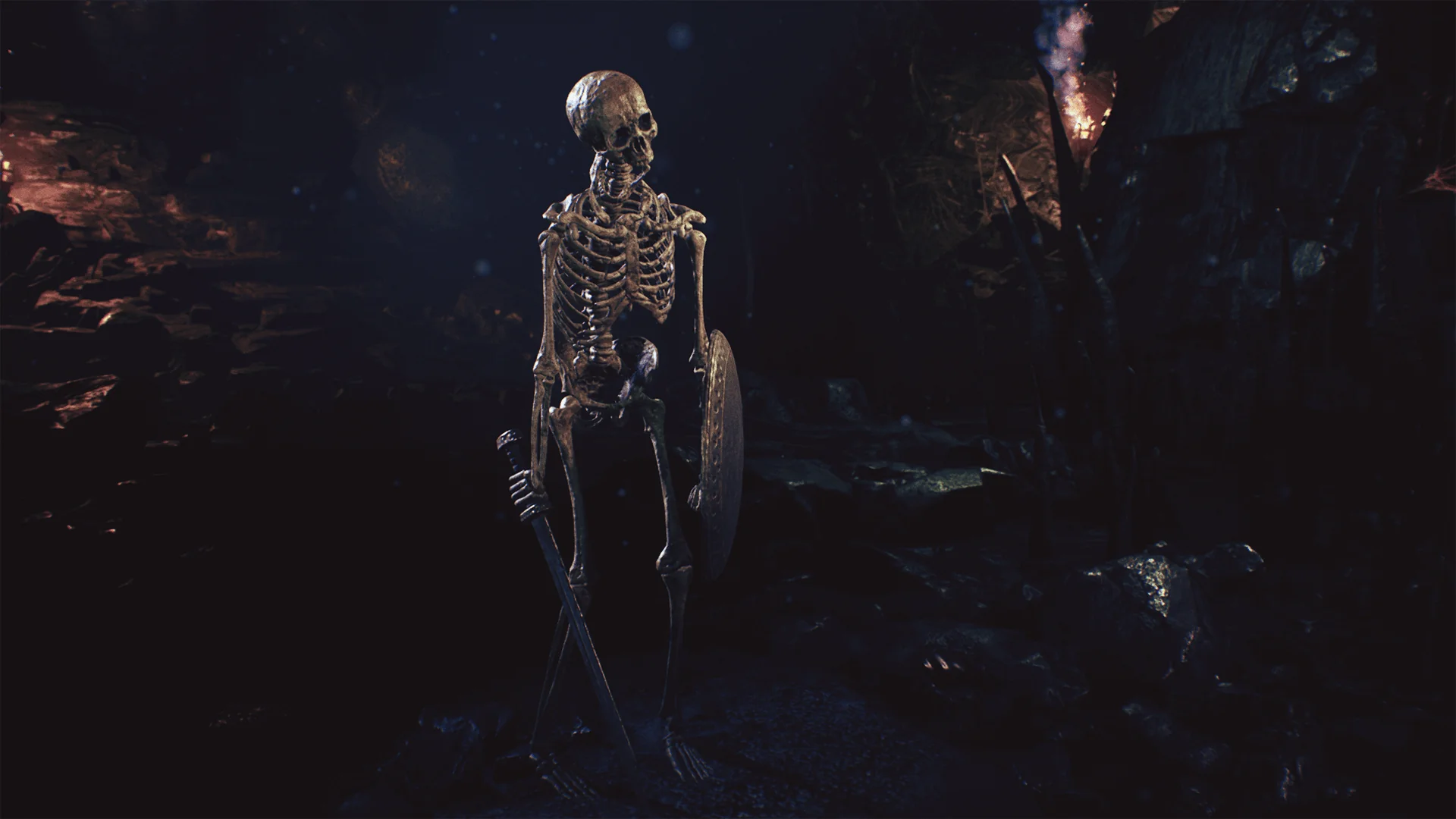
Crypts, ruined battlefields, and desecrated burial grounds often require enemy figures that convey decay and dread without relying on exaggerated fantasy bulk. Skeleton Lightweight serves precisely this context by presenting an undead human warrior revived through dark sorcery. Established as a former human who fell under the power of Lord Necromancer, this character reflects the direct consequences of reanimation within an undead hierarchy. Stripped down to bare functional death, the figure lacks flesh, armor, and soul, focusing purely on the skeletal structure holding basic military arms.
Deploying this type of creature immediately changes the visual hierarchy of an encounter. In dark fantasy spaces, armored adversaries usually signal high durability and slow momentum. By removing all chestplates, greaves, and helmets, this variant establishes an entirely different silhouette. The bare bones are exposed directly to the environment, showing the raw remnants of a human frame compelled into servitude. This unadorned state reinforces the concept of an expendable shock trooper or tireless guardian raised by necromantic power to enforce the will of its master across catacombs and dungeon passages.
Armament Dynamics in the Skeleton Lightweight Form
Despite being designated as an unarmored combatant, the character is equipped as a martial combatant. It carries a sword and a metal shield, balancing its fragile physical presence against legitimate defensive and offensive capabilities. This specific pairing of a fleshless, unarmored skeleton with authentic knight armaments creates a distinct visual tension. The metal shield becomes the primary physical barrier for the figure, substituting for the body armor it completely lacks.
From an implementation perspective, configuring an unarmored fighter with a metal shield requires clear physical logic. Because there is no flesh or padding to dissipate kinetic force, every interaction between the character and its equipment feels stark and mechanical. The grip on the sword hilt and the strap of the metal shield attach directly to bare wrist and forearm bones. This juxtaposition emphasizes the creature's state as a stranding death—an entity suspended between former human knighthood and mindless necromantic servitude. The metal shield provides substantial visual weight, ensuring that even without bodily mass, the character presents a clear combat challenge when facing players in tight hallways or open ruins.
Animation Blueprint Logic for Animated Skeleton Servants
The functional value of this character asset relies heavily on its mechanical execution, supported by animated motion, scripting, and an integrated animation blueprint. An animation blueprint is central to organizing how an undead combatant navigates world space while maintaining responsiveness to gameplay events. For a sword-and-shield fighter, the animation graph must coordinate upper-body combat stances with lower-body locomotion, ensuring that strikes, blocks, and directional movement transition smoothly without breaking the skeletal silhouette.
Integrating script functionality alongside the animation blueprint allows the creature to respond to environmental stimuli and combat triggers effectively. When the skeleton detects an opponent or receives an instruction to engage, the scripting logic dictates state changes—switching between patrol routines, aggressive tracking, or defensive stances behind the metal shield. The animation blueprint takes those states and blends the appropriate poses, ensuring that the movement of the bare human bones mirrors the relentless, unyielding cadence of an animated corpse. Because the character has no flesh or muscle deformation to mask joint alignment, clean skeletal motion is paramount; every rotation of the shoulder, elbow, and spine must read convincingly as a rigid bone structure driven by necromantic will rather than organic tension.
Realistic Monster Character Presentation and Human Anatomy
The inclusion of realistic, monster, knight, and human attributes defines the artistic direction of this skeletal servant. Rather than adopting stylized or cartoonish proportions, the realistic treatment emphasizes authentic human skeletal anatomy. Every element—from the curvature of the ribs to the articulation of the vertebrae and limb bones—adheres to genuine human proportions, reminding the viewer of what this creature once was before Lord Necromancer took claim of the corpse.
This commitment to realism heightens the horror of the undead. Transforming a recognizable human skeleton into a monster knight without draping it in tattered cloth or broken chainmail forces the viewer to confront the harsh reality of physical death. The contrast between ancient bone and cold metal weaponry—the sword and shield—underlines the tragic remnants of a fallen warrior. Because there is no soul remaining, the facial bones remain fixed in an eternal, emotionless expression, eliminating human hesitation from its combat behavior. It functions purely as an instrument of destruction, fulfilling its role as a dedicated servant of the undead world.
Practical Deployment of the Lightweight Undead
Placing the Skeleton Lightweight into game environments offers developers a versatile baseline adversary for encounter design. Because the asset operates with an animation blueprint and dedicated scripting structure, it can be dropped into various combat scenarios without requiring bespoke rigging or supplementary mesh layers. Whether acting as an unyielding sentry at an ancient altar, emerging from shallow graves in a swamp, or forming the vanguard of a necromancer's legion, its profile remains instantly readable to players.
The combination of zero armor, genuine human bone structure, and traditional sword-and-shield equipment makes the character an intuitive opponent. Players immediately understand that the creature's vulnerability lies in its unarmored torso and limbs, while its danger stems from the metal shield that deflects front-facing attacks and the sword that delivers swift, lethal strikes. By embodying the concept of death animated into servitude, this lightweight variant delivers a focused, highly functional asset for projects requiring grounded, realistic undead enemies.
 Creatures
 Creatures
 Creatures