"fb5ea1e7d1b41445"{"id":"1002398","slug":"skeleton-army","title":"Skeleton Army","category":"Creatures \u0026 Monsters","engine":"4.12+,5.0+","assetVersion":"","engineVersion":"Engine Version: 4.12+,5.0+","tag":"Creatures","accent":"blue","visual":"character","summary":"A breakdown of the Skeleton Army package, detailing its four animated character classes, bone counts, mesh budgets, props, and siege weapon compatibility.","platform":"Unreal Engine","indexPolicy":"index","publishedAt":"2026-11-10T04:26:44.584Z","updatedAt":"2026-11-10T04:26:44.584Z","sourceNotes":[],"fileContents":[],"compatibility":["Unreal Engine","Engine Version: 4.12+,5.0+"],"featuredImage":{"alt":"Skeleton Army","src":"/wp-content/uploads/published/2026/11/cf397b5c8944-638f1475-c936-48d7-952d-8f3bde16101d-d9515b9625.webp"},"hasDownloadLink":true,"downloads":0,"terms":[{"taxonomy":"category","slug":"creatures-and-monsters","name":"Creatures \u0026 Monsters"}],"galleryImages":[{"src":"/wp-content/uploads/published/2026/11/a37c2f6cfd52-a2fa29c3-6cea-4b4d-a883-fb6a54f182f5-0d5130592f.webp","alt":"Skeleton Army"},{"src":"/wp-content/uploads/published/2026/11/c877a4734860-680e2f2f-8c60-4599-bf5e-9dc26f13ae35-fee2787ddb.webp","alt":"Skeleton Army"},{"src":"/wp-content/uploads/published/2026/11/28c4b87943bd-7a29a1f9-ec38-4040-8c54-7016cd1e7bfd-9a074fc799.webp","alt":"Skeleton Army"},{"src":"/wp-content/uploads/published/2026/11/95fbca8fb485-5e626417-2f34-4ae5-8729-ba64f00465a0-aef6937960.webp","alt":"Skeleton Army"},{"src":"/wp-content/uploads/published/2026/11/581c336d1e0e-f3b1a3a6-d79c-4129-8ea5-07aa2bc6934c-6538431d50.webp","alt":"Skeleton Army"},{"src":"/wp-content/uploads/published/2026/11/600f2e932f0b-09642391-2eca-42fa-9bd1-79b2bef19dd6-aa72d0b4ca.webp","alt":"Skeleton Army"},{"src":"/wp-content/uploads/published/2026/11/a74529a181c3-a4d7f70b-a438-44cc-b7a7-b7c53e4a9404-242da7053c.webp","alt":"Skeleton Army"},{"src":"/wp-content/uploads/published/2026/11/cdb31359b4c1-f4d8d062-2256-4207-8855-8283d44aa4aa-145f5b1865.webp","alt":"Skeleton Army"},{"src":"/wp-content/uploads/published/2026/11/c480e48ad99c-2ce8d89a-a6ea-4ad1-8c1b-6675523d9131-a6147f17b1.webp","alt":"Skeleton Army"},{"src":"/wp-content/uploads/published/2026/11/af45eb0977fe-15fa37cd-6da3-46be-b506-0fe4e440899a-aea86c419e.webp","alt":"Skeleton Army"}],"accessPanel":{"kind":"resource","title":"Get this resource","eyebrow":"Free resource","message":"Download this resource in your browser.","fileName":"Content.7z","safetyNote":"Resources are manually reviewed before listing to improve quality and reduce obvious risks.","actionLabel":"Get this resource","resourceType":"Resource archive","versions":[]},"contentHtml":"\u003cp\u003eConstructing believable undead encounters requires a balance between character differentiation, performance-friendly geometry, and sufficient animation support. Skeleton Army addresses this need by providing four distinct skeletal combatants alongside a set of pre-posed static props. Built to depict organized ranks of undead soldiers, the collection ranges from basic frontline troops to specialized spellcasters and commanders, all configured with unified rigging parameters and clean polygon budgets.\u003c/p\u003e \u003ch2\u003eFour Combat Roles in the Skeleton Army\u003c/h2\u003e\n\u003cp\u003eThe collection divides its mobile undead forces into four specific character classes: the Skeleton Warlord, the Skeleton Sorcerer, the Skeleton Archer, and the Skeleton Footman. Each unit is equipped to fulfill a distinct tactical role on a virtual battlefield, supported by a tailored suite of unique animations suited to their combat style.\u003c/p\u003e\n\u003cp\u003eLeading the force is the Skeleton Warlord, backed by 45 animations. Designed as an imposing command presence or elite adversary, the Warlord possesses the movement vocabulary necessary for authoritative strikes, heavy posture adjustments, and aggressive engagement sequences. Working alongside the command tier is the Skeleton Footman, supplied with 46 animations. The Footman represents the rank-and-file melee soldier, providing the standard attack chains, guard positions, hit reactions, and strides required to fill out defensive lines or shambling hordes.\u003c/p\u003e\n\u003cp\u003eRanged support is split between physical and magical archetypes. The Skeleton Archer features 48 animations, giving it the widest range of movement states among the roster. This animation library encompasses draw cycles, arrow releases, aiming transitions, and evasive maneuvers typical of bow-wielding skirmishers. For mystical encounters, the Skeleton Sorcerer includes 47 animations centered around incantations, spell casting gestures, channeling poses, and ritualistic idling. Across all four active units, the package delivers a collective total of 186 animation clips, ensuring that each archetype exhibits distinct physical behavior rather than recycling a single generic motion set.\u003c/p\u003e \u003ch2\u003eRigging Architecture across the Skeleton Roster\u003c/h2\u003e\n\u003cp\u003eEach animated figure in the roster utilizes a skeletal rig structured between 39 and 49 bones. By keeping the bone hierarchy within this specific range, the skeletons maintain sufficient articulation for fluid limbs, spine movement, and weapon handling without introducing unnecessary computational overhead. Lower bone counts are particularly advantageous when populating dense battlefields or managing dozens of active units simultaneously, as skinning calculations remain lightweight during real-time rendering passes.\u003c/p\u003e\n\u003cp\u003eThe rig setup supports integration with Animation Blueprints and custom character scripts. Because the bone structure is standardized across the range of 39 to 49 joints, developers can construct shared state machines, blend spaces, and procedural logic nodes that handle locomotion, attack triggers, flinch reactions, and death sequences across the entire troop roster. This structural consistency simplifies the implementation of state changes, allowing smooth handoffs between wandering patrol states, alert stances, and direct melee exchanges.\u003c/p\u003e \u003ch2\u003eGeometric Budgets for Base and Armored Skeleton Models\u003c/h2\u003e\n\u003cp\u003eGeometric density in the package is strictly managed to balance visual anatomical clarity against processing efficiency. The foundational unarmored skeleton model consists of 7,292 polygons, 13,676 triangles, and 7,200 vertexes. This base mesh captures the exposed ribcage, vertebral column, skull contours, and articulated limb bones with enough surface resolution to read cleanly under dynamic lighting while avoiding unnecessary micro-geometry.\u003c/p\u003e\n\u003cp\u003eWhen fitted with battle gear, the skeletons with armor and weapons scale to approximately 8,000 to 10,000 polygons, 15,000 to 18,000 triangles, and 8,000 to 10,000 vertexes. The modest delta between the bare skeleton and the fully outfitted variants indicates an efficient use of accessory meshes. Equipment pieces such as plating, mail, helmets, bladed weapons, staves, and bows integrate tightly against the underlying bone topology, preserving silhouette definition without causing sudden spikes in memory consumption or draw calls during mass troop deployments.\u003c/p\u003e \u003ch2\u003eEnvironmental Staging with Skeleton Props\u003c/h2\u003e\n\u003cp\u003eBeyond its mobile combatants, the package includes four static props configured for scenic dressing and non-combat worldbuilding. These assets include a Skeleton T-pose prop, a Skeleton Lying prop, a Skeleton Standing prop, and a Skeleton Sitting prop. Unlike their animated counterparts, these props are designed to remain stationary within levels, providing immediate narrative detail without the operational cost of continuous skeletal mesh updates.\u003c/p\u003e\n\u003cp\u003eThe Lying and Sitting variations are well-suited for dungeon floors, crypt alcoves, prison cells, or decayed battlefields where fallen remains establish historical atmosphere. The Standing prop functions effectively as an inert display, a withered sentry post, or a decorative cage occupant. The T-pose prop offers an unrigged reference sculpture suitable for visual staging or baseline scaling tests within level geometry. By supplying these pre-arranged poses as dedicated props, scenes can be populated with environmental remains without converting full character actors into dormant background fixtures.\u003c/p\u003e \u003ch2\u003eSiege Integration and Battlefield Roles\u003c/h2\u003e\n\u003cp\u003eThe Skeleton Army maintains explicit compatibility with Animated Siege Weapons, expanding its functional scope from close-quarters dungeon crawls to expansive castle assaults and fortification defense. The movement repertoire of the Footman and Warlord can be paired directly with large-scale machinery such as ballistas, catapults, and battering engines. In siege environments, the Sorcerer and Archer can be positioned along ramparts or defensive trenches to deliver long-range bombardments while foot soldiers man field equipment.\u003c/p\u003e\n\u003cp\u003eThis capability makes the package practical for games featuring staged wave defenses, fortified encampments, and siege warfare scenarios. Between the modular combat roles, the controlled polygon and bone counts, the dedicated prop variations, and the built-in readiness for Animation Blueprints and siege engines, the resource delivers a fully grounded framework for deploying disciplined undead armies.\u003c/p\u003e\n\n\u003ch2\u003eContinue Browsing Similar Packs\u003c/h2\u003e\n\u003cul\u003e\n\u003cli\u003e\u003ca href=\"https://3dcghub.com/zombies-pack-01/\" rel=\"noopener noreferrer\"\u003eZombies Pack 01\u003c/a\u003e\u003c/li\u003e\n\u003cli\u003e\u003ca href=\"https://3dcghub.com/orc-collection/\" rel=\"noopener noreferrer\"\u003eOrc Collection\u003c/a\u003e\u003c/li\u003e\n\u003cli\u003e\u003ca href=\"https://3dcghub.com/demon-10/\" rel=\"noopener noreferrer\"\u003eDemon 10\u003c/a\u003e\u003c/li\u003e\n\u003cli\u003e\u003ca href=\"https://3dcghub.com/undead-knight/\" rel=\"noopener noreferrer\"\u003eUndead Knight\u003c/a\u003e\u003c/li\u003e\n\u003cli\u003e\u003ca href=\"https://3dcghub.com/demon-7/\" rel=\"noopener noreferrer\"\u003eDemon 7\u003c/a\u003e\u003c/li\u003e\n\u003c/ul\u003e","contentTextLength":6501,"navigation":{"current":21,"total":4340,"previous":{"id":"1002399","slug":"sword-elf","title":"Sword Elf","category":"Humans","platform":"Unreal Engine","updatedAt":"2026-11-10T04:28:30.060Z"},"next":{"id":"1002397","slug":"skeleton-archer","title":"Skeleton Archer","category":"Characters \u0026 Creatures","platform":"Unreal Engine","updatedAt":"2026-11-10T04:25:54.909Z"}},"relatedResources":[{"id":"1001570","slug":"zombies-pack-01","title":"Zombies Pack 01","category":"Creatures \u0026 Monsters","engine":"4.18+,5.0+","assetVersion":"","engineVersion":"Engine Version: 4.18+,5.0+","tag":"Creatures","accent":"blue","visual":"character","summary":"Implement Zombies Pack 01 with 6 low-poly undead characters optimized for high frame rates, Epic skeleton compatibility, and animation blueprints.","platform":"Unreal Engine","indexPolicy":"index","publishedAt":"2026-10-10T04:04:49.317Z","updatedAt":"2026-10-10T04:04:49.317Z","sourceNotes":[],"fileContents":[],"compatibility":["Unreal Engine","Engine Version: 4.18+,5.0+"],"featuredImage":{"alt":"Zombies Pack 01","src":"/wp-content/uploads/published/2026/10/dd4a0dc2a8b3-58688057-e894-4bec-908e-64dda430cf0b-e8eba0369c.webp"},"hasDownloadLink":true,"downloads":1},{"id":"1001541","slug":"orc-collection","title":"Orc Collection","category":"Creatures \u0026 Monsters","engine":"4.18+,5.0+","assetVersion":"","engineVersion":"Engine Version: 4.18+,5.0+","tag":"Creatures","accent":"blue","visual":"character","summary":"A technical breakdown of the Orc Collection featuring five modular character models, Epic Skeleton rigs, texture setups, and engine cloth configurations.","platform":"Unreal Engine","indexPolicy":"index","publishedAt":"2026-10-09T17:34:05.651Z","updatedAt":"2026-10-09T17:34:05.651Z","sourceNotes":[],"fileContents":[],"compatibility":["Unreal Engine","Engine Version: 4.18+,5.0+"],"featuredImage":{"alt":"Orc Collection","src":"/wp-content/uploads/published/2026/10/9ff3bb5a9361-628d553e-be49-4cb9-9960-86f1d5ed21f2-13ae042025.webp"},"hasDownloadLink":true,"downloads":0},{"id":"1998","slug":"demon-10","title":"Demon 10","category":"Creatures \u0026 Monsters","engine":"4.26+,5.0+","assetVersion":"Engine version: 4.26+,5.0+","engineVersion":"4.24","tag":"Creatures","accent":"blue","visual":"character","summary":"Boost your game's horror factor with Demon 10. This 4K PBR creature features Epic Skeleton compatibility, 23 animations, and deep customization options.","platform":"Unreal Engine","indexPolicy":"index","publishedAt":"2026-02-06T22:48:18.000Z","updatedAt":"2026-04-19T15:58:26.000Z","sourceNotes":[],"fileContents":[],"compatibility":["Unreal Engine","Engine version: 4.26+,5.0+"],"featuredImage":{"alt":"Demon 10","src":"https://3dcghub.com/wp-content/uploads/2026/02/90425239-5cb2-4a90-b49b-119596e4f7e5.webp"},"hasDownloadLink":true,"downloads":1}]}
Creatures
Skeleton Army
A breakdown of the Skeleton Army package, detailing its four animated character classes, bone counts, mesh budgets, props, and siege weapon compatibility.
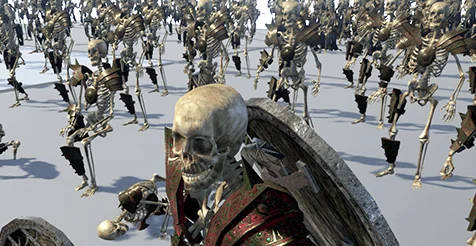
Constructing believable undead encounters requires a balance between character differentiation, performance-friendly geometry, and sufficient animation support. Skeleton Army addresses this need by providing four distinct skeletal combatants alongside a set of pre-posed static props. Built to depict organized ranks of undead soldiers, the collection ranges from basic frontline troops to specialized spellcasters and commanders, all configured with unified rigging parameters and clean polygon budgets.
Four Combat Roles in the Skeleton Army
The collection divides its mobile undead forces into four specific character classes: the Skeleton Warlord, the Skeleton Sorcerer, the Skeleton Archer, and the Skeleton Footman. Each unit is equipped to fulfill a distinct tactical role on a virtual battlefield, supported by a tailored suite of unique animations suited to their combat style.
Leading the force is the Skeleton Warlord, backed by 45 animations. Designed as an imposing command presence or elite adversary, the Warlord possesses the movement vocabulary necessary for authoritative strikes, heavy posture adjustments, and aggressive engagement sequences. Working alongside the command tier is the Skeleton Footman, supplied with 46 animations. The Footman represents the rank-and-file melee soldier, providing the standard attack chains, guard positions, hit reactions, and strides required to fill out defensive lines or shambling hordes.
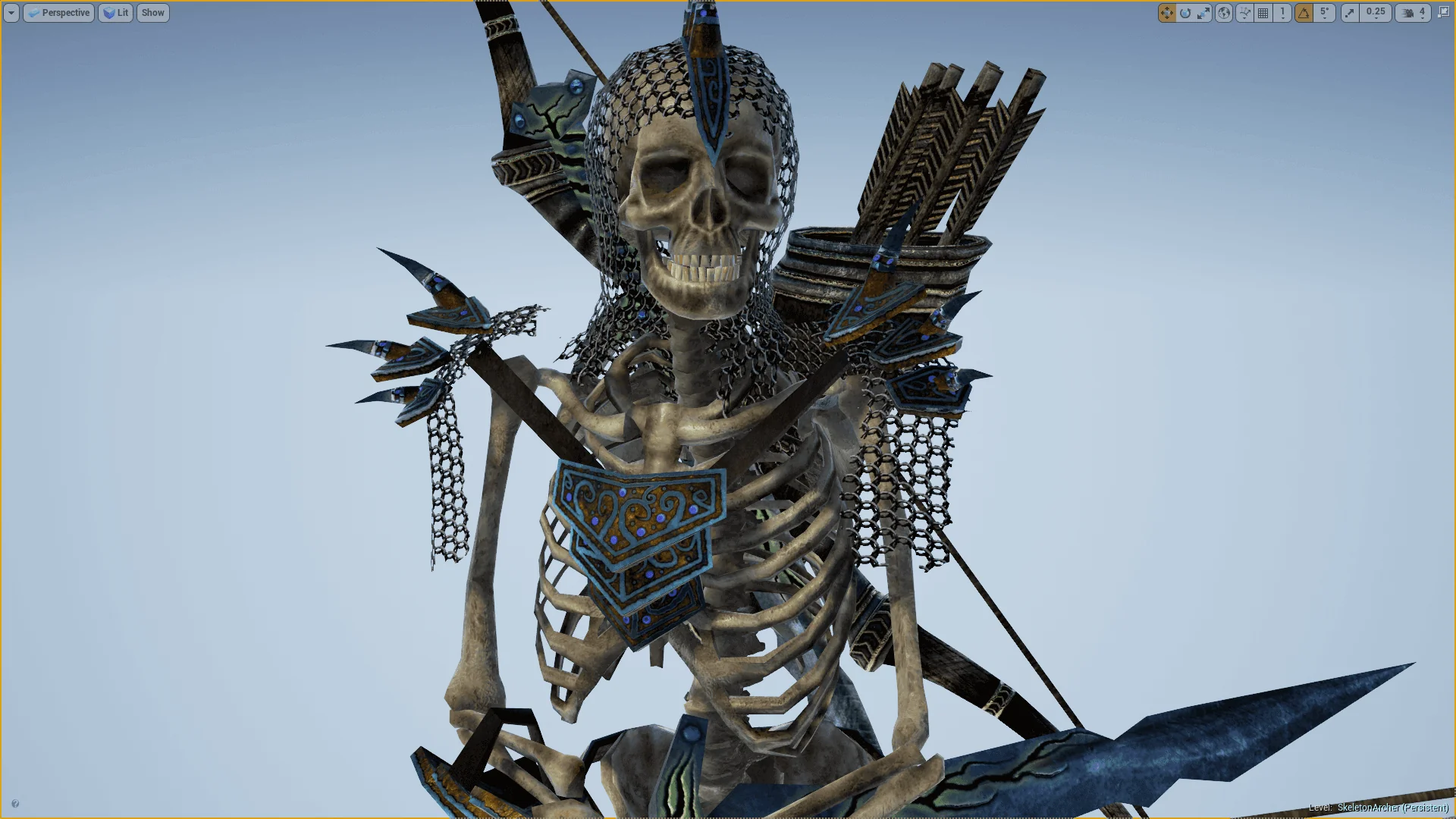
Ranged support is split between physical and magical archetypes. The Skeleton Archer features 48 animations, giving it the widest range of movement states among the roster. This animation library encompasses draw cycles, arrow releases, aiming transitions, and evasive maneuvers typical of bow-wielding skirmishers. For mystical encounters, the Skeleton Sorcerer includes 47 animations centered around incantations, spell casting gestures, channeling poses, and ritualistic idling. Across all four active units, the package delivers a collective total of 186 animation clips, ensuring that each archetype exhibits distinct physical behavior rather than recycling a single generic motion set.
Rigging Architecture across the Skeleton Roster
Each animated figure in the roster utilizes a skeletal rig structured between 39 and 49 bones. By keeping the bone hierarchy within this specific range, the skeletons maintain sufficient articulation for fluid limbs, spine movement, and weapon handling without introducing unnecessary computational overhead. Lower bone counts are particularly advantageous when populating dense battlefields or managing dozens of active units simultaneously, as skinning calculations remain lightweight during real-time rendering passes.
The rig setup supports integration with Animation Blueprints and custom character scripts. Because the bone structure is standardized across the range of 39 to 49 joints, developers can construct shared state machines, blend spaces, and procedural logic nodes that handle locomotion, attack triggers, flinch reactions, and death sequences across the entire troop roster. This structural consistency simplifies the implementation of state changes, allowing smooth handoffs between wandering patrol states, alert stances, and direct melee exchanges.
Geometric Budgets for Base and Armored Skeleton Models
Geometric density in the package is strictly managed to balance visual anatomical clarity against processing efficiency. The foundational unarmored skeleton model consists of 7,292 polygons, 13,676 triangles, and 7,200 vertexes. This base mesh captures the exposed ribcage, vertebral column, skull contours, and articulated limb bones with enough surface resolution to read cleanly under dynamic lighting while avoiding unnecessary micro-geometry.
When fitted with battle gear, the skeletons with armor and weapons scale to approximately 8,000 to 10,000 polygons, 15,000 to 18,000 triangles, and 8,000 to 10,000 vertexes. The modest delta between the bare skeleton and the fully outfitted variants indicates an efficient use of accessory meshes. Equipment pieces such as plating, mail, helmets, bladed weapons, staves, and bows integrate tightly against the underlying bone topology, preserving silhouette definition without causing sudden spikes in memory consumption or draw calls during mass troop deployments.
Environmental Staging with Skeleton Props
Beyond its mobile combatants, the package includes four static props configured for scenic dressing and non-combat worldbuilding. These assets include a Skeleton T-pose prop, a Skeleton Lying prop, a Skeleton Standing prop, and a Skeleton Sitting prop. Unlike their animated counterparts, these props are designed to remain stationary within levels, providing immediate narrative detail without the operational cost of continuous skeletal mesh updates.
The Lying and Sitting variations are well-suited for dungeon floors, crypt alcoves, prison cells, or decayed battlefields where fallen remains establish historical atmosphere. The Standing prop functions effectively as an inert display, a withered sentry post, or a decorative cage occupant. The T-pose prop offers an unrigged reference sculpture suitable for visual staging or baseline scaling tests within level geometry. By supplying these pre-arranged poses as dedicated props, scenes can be populated with environmental remains without converting full character actors into dormant background fixtures.
Siege Integration and Battlefield Roles
The Skeleton Army maintains explicit compatibility with Animated Siege Weapons, expanding its functional scope from close-quarters dungeon crawls to expansive castle assaults and fortification defense. The movement repertoire of the Footman and Warlord can be paired directly with large-scale machinery such as ballistas, catapults, and battering engines. In siege environments, the Sorcerer and Archer can be positioned along ramparts or defensive trenches to deliver long-range bombardments while foot soldiers man field equipment.
This capability makes the package practical for games featuring staged wave defenses, fortified encampments, and siege warfare scenarios. Between the modular combat roles, the controlled polygon and bone counts, the dedicated prop variations, and the built-in readiness for Animation Blueprints and siege engines, the resource delivers a fully grounded framework for deploying disciplined undead armies.
 Creatures
 Creatures
 Creatures
 Creatures