"7260b86ec05199e6"{"id":"1001570","slug":"zombies-pack-01","title":"Zombies Pack 01","category":"Creatures \u0026 Monsters","engine":"4.18+,5.0+","assetVersion":"","engineVersion":"Engine Version: 4.18+,5.0+","tag":"Creatures","accent":"blue","visual":"character","summary":"Implement Zombies Pack 01 with 6 low-poly undead characters optimized for high frame rates, Epic skeleton compatibility, and animation blueprints.","platform":"Unreal Engine","publishedAt":"2026-10-10T04:04:49.317Z","updatedAt":"2026-10-10T04:04:49.317Z","sourceNotes":[],"fileContents":[],"compatibility":["Unreal Engine","Engine Version: 4.18+,5.0+"],"featuredImage":{"alt":"Zombies Pack 01","src":"/wp-content/uploads/published/2026/10/dd4a0dc2a8b3-58688057-e894-4bec-908e-64dda430cf0b-e8eba0369c.webp"},"hasDownloadLink":true,"downloads":0,"terms":[{"taxonomy":"category","slug":"creatures-and-monsters","name":"Creatures \u0026 Monsters"}],"galleryImages":[{"src":"/wp-content/uploads/published/2026/10/9cc1efbdda1c-2449b921-6938-4c3d-901c-058af092c267-785d4058d5.webp","alt":"Zombies Pack 01"},{"src":"/wp-content/uploads/published/2026/10/6d39f2763da7-90b91dfb-d4c5-4acd-b238-1674e6d166ac-59cacddc58.webp","alt":"Zombies Pack 01"},{"src":"/wp-content/uploads/published/2026/10/35f4874f32e4-e9c7bb85-179b-43e6-9530-d598e61305c9-9b2e5da037.webp","alt":"Zombies Pack 01"}],"accessPanel":{"kind":"resource","title":"Download this resource","eyebrow":"Free Download","message":"Log in or create a free account to start your download.","fileName":"Content.7z","safetyNote":"Resources are manually reviewed before listing to improve quality and reduce obvious risks.","actionLabel":"Download Free","resourceType":"Resource archive"},"contentHtml":"\u003ch2\u003eIntegrating Zombies Pack 01 with the Epic Skeleton\u003c/h2\u003e\u003cp\u003eDeploying character assets directly into an active project pipeline begins with skeletal hierarchy alignment. Zombies Pack 01 provides six distinct character models engineered specifically around the Epic skeleton, removing the friction often associated with custom bone mapping. Because each undead mesh conforms to this standard bone layout, binding the characters to existing player or non-player character rigs requires zero destructive retargeting. Technical directors can point existing control rigs, retarget chains, or master pose components straight to these meshes without needing to reconstruct socket placements or rebuild standard humanoid weight profiles.\u003c/p\u003e\u003cp\u003eStandardized skeletal configurations make swapping character meshes during runtime straightforward. In systems handling dynamic enemy spawning, having six distinct character variations sharing a uniform skeletal layout enables developers to assign meshes pseudo-randomly across base AI blueprints. The mesh skinning respects standard deformation norms across key joints, including elbows, knees, and the spine, ensuring that complex motion patterns translate cleanly across all six models without unintended vertex tearing or unnatural geometry collapse.\u003c/p\u003e\u003ch2\u003eLocomotion Setup Using the Zombie Walk Reference and Animation Blueprint\u003c/h2\u003e\u003cp\u003eValidating motion fidelity requires a baseline movement cycle, which the package addresses by supplying a dedicated zombie walk animation. This walk cycle operates as an immediate technical benchmark. By assigning the reference walk to an Animation Blueprint, technical animators can instantly verify root motion handling, joint rotation limits, and foot-to-ground contact alignment before building out elaborate locomotion graphs.\u003c/p\u003e\u003cp\u003eBuilding an animation blueprint around this foundation allows developers to establish core state machines for undead locomotion. The walk cycle provides the structural reference needed to configure speed-based blending, directional offsets, and transition thresholds between idle, shambling, and alert states. Because the assets are tagged for script and animation blueprint workflows, connecting movement component variables—such as acceleration, velocity, and actor rotation—into the underlying state machine yields responsive, believable undead traversal with minimal setup overhead.\u003c/p\u003e\u003cp\u003eFor projects requiring complex behavioral scripting, the shared skeleton and reference movement provide a clean foundation for event-driven animation triggers. Footstep anim notices, attack traces, hit-react montages, and stagger animations can be calibrated once on the master skeletal asset and inherited seamlessly across all six zombie variants.\u003c/p\u003e\u003ch2\u003ePerformance Optimization for High Frame Rates and Horde Spawning\u003c/h2\u003e\u003cp\u003eHorror and apocalyptic game modes frequently demand multiple hostiles on screen simultaneously, placing a heavy tax on draw calls and vertex processing. Zombies Pack 01 addresses this bottleneck through low-poly asset construction optimized specifically for high frame rates. Reducing triangle density while maintaining distinct silhouette definition ensures that render threads remain unburdened, even when scenes introduce dozens of active monsters into a single viewport.\u003c/p\u003e\u003cp\u003eTargeting sustained frame rates is particularly critical in dense survival scenarios where combat, particle effects, dynamic lighting, and pathfinding calculations compete for GPU and CPU cycles. Because the geometry across all six figures is intentionally streamlined, rendering pipelines can process large groups of these undead models without encountering severe performance spikes. The low-poly structure also works efficiently alongside standard dynamic shadow systems and automated level-of-detail systems, maintaining visual clarity at medium and long viewing distances.\u003c/p\u003e\u003ch2\u003eThematic Alignment Across Horror, Terror, and Apocalyptic Scenarios\u003c/h2\u003e\u003cp\u003eThe visual variety within the pack supports grim, atmospheric scene construction across terror and horror genres. Rather than presenting a single monster mesh with slight texture swaps, the six separate characters supply genuine visual divergence. This breadth allows level designers and environment artists to populate urban ruins, abandoned research facilities, contaminated bunkers, and desolate wilderness locations without breaking immersion through immediate model repetition.\u003c/p\u003e\u003cp\u003eIn post-apocalyptic settings, encounters with the infected or undead serve as core tension drivers. The anatomical styling of the models leans into monster and terror tropes, providing immediate visual cues to the player regarding hostile intent. Whether used as passive environmental props, scripted jump-scare antagonists, or roaming perimeter guards, the figures fit cleanly into bleak, decaying worlds where survivability depends on quick target identification.\u003c/p\u003e\u003ch2\u003eCross-Pack Compatibility with Gangs Pack 01\u003c/h2\u003e\u003cp\u003eProjects blending human survivor factions with infected threats benefit directly from the interoperability between Zombies Pack 01 and Gangs Pack 01. Because both packages share common technical underpinnings within the wider ecosystem, utilizing them together establishes visual and mechanical continuity across an entire project.\u003c/p\u003e\u003cp\u003eThis compatibility simplifies mixed-encounter design. A scenario involving hostile human raiders clashing with encroaching undead can pull character assets from both collections without introducing disparate skeletal formats or clashing visual fidelity. Technical teams can share locomotion blueprints, ragdoll physics assets, and gameplay interaction scripts across characters from both packs, drastically reducing the time spent configuring separate logic for human combatants and zombie adversaries.\u003c/p\u003e\u003ch2\u003eProduction-Ready Deployment in Real-Time AI Systems\u003c/h2\u003e\u003cp\u003eTransitioning these assets into full production requires minimal intermediary adjustment. Once imported, the characters plug directly into standard navigation mesh traversal and behavior tree structures. The low overhead of the meshes ensures that pathfinding queries and crowd-avoidance algorithms remain performant during peak enemy density.\u003c/p\u003e\u003cp\u003eThe combination of six optimized character meshes, full Epic skeleton compliance, dedicated animation blueprint compatibility, and an initial walk animation reference makes Zombies Pack 01 a focused, functional kit for real-time survival horror development. Teams can move straight from asset import to tuning AI behavior, confident that the models will hold their performance profile across heavy combat sequences.\u003c/p\u003e\n\n\u003ch2\u003eRelated Resources Worth Checking\u003c/h2\u003e\n\u003cul\u003e\n\u003cli\u003e\u003ca href=\"https://3dcghub.com/orc-collection/\" title=\"Orc Collection\"\u003eOrc Collection\u003c/a\u003e\u003c/li\u003e\n\u003cli\u003e\u003ca href=\"https://3dcghub.com/orc-warrior/\" title=\"Orc Warrior\"\u003eOrc Warrior\u003c/a\u003e\u003c/li\u003e\n\u003cli\u003e\u003ca href=\"https://3dcghub.com/allosaurus-dinosaur-character-rig-and-animations/\" title=\"Allosaurus Dinosaur Character Rig and Animations\"\u003eAllosaurus Dinosaur Character Rig and Animations\u003c/a\u003e\u003c/li\u003e\n\u003cli\u003e\u003ca href=\"https://3dcghub.com/ork-rogue-2/\" title=\"Ork Rogue\"\u003eOrk Rogue\u003c/a\u003e\u003c/li\u003e\n\u003cli\u003e\u003ca href=\"https://3dcghub.com/tyrannosaurus-rex/\" title=\"Tyrannosaurus Rex\"\u003eTyrannosaurus Rex\u003c/a\u003e\u003c/li\u003e\n\u003c/ul\u003e","contentTextLength":6680,"navigation":{"current":42,"total":3549,"previous":{"id":"1001571","slug":"racing-track","title":"Racing Track","category":"Streets \u0026 Construction","platform":"Unreal Engine","updatedAt":"2026-10-10T04:05:33.498Z"},"next":{"id":"1001569","slug":"water-slide-system","title":"Water Slide System","category":"Procedural Systems","platform":"Unreal Engine","updatedAt":"2026-10-10T04:03:38.258Z"}},"relatedResources":[{"id":"1001541","slug":"orc-collection","title":"Orc Collection","category":"Creatures \u0026 Monsters","engine":"4.18+,5.0+","assetVersion":"","engineVersion":"Engine Version: 4.18+,5.0+","tag":"Creatures","accent":"blue","visual":"character","summary":"A technical breakdown of the Orc Collection featuring five modular character models, Epic Skeleton rigs, texture setups, and engine cloth configurations.","platform":"Unreal Engine","publishedAt":"2026-10-09T17:34:05.651Z","updatedAt":"2026-10-09T17:34:05.651Z","sourceNotes":[],"fileContents":[],"compatibility":["Unreal Engine","Engine Version: 4.18+,5.0+"],"featuredImage":{"alt":"Orc Collection","src":"/wp-content/uploads/published/2026/10/9ff3bb5a9361-628d553e-be49-4cb9-9960-86f1d5ed21f2-13ae042025.webp"},"hasDownloadLink":true,"downloads":0},{"id":"1001005","slug":"orc-warrior","title":"Orc Warrior","category":"Creatures \u0026 Monsters","engine":"4.26+,5.0+","assetVersion":"","engineVersion":"Engine Version: 4.26+,5.0+","tag":"Creatures","accent":"blue","visual":"character","summary":"A rigged low-poly orc with a weapon, 11 animations, a control rig, plus 4096x4096 Color, Normal, and AORM textures for real-time fantasy work.","platform":"Unreal Engine","publishedAt":"2026-08-22T10:59:41.214Z","updatedAt":"2026-08-22T10:59:41.214Z","sourceNotes":[],"fileContents":[],"compatibility":["Unreal Engine","Engine Version: 4.26+,5.0+"],"featuredImage":{"alt":"Orc Warrior","src":"/wp-content/uploads/published/2026/08/07a81bcdb165-a721db55-38ea-4d04-a1d7-b62b48c726b0-dc71636e7b.webp"},"hasDownloadLink":true,"downloads":2},{"id":"1000937","slug":"allosaurus-dinosaur-character-rig-and-animations","title":"Allosaurus Dinosaur Character Rig and Animations","category":"Creatures \u0026 Monsters","engine":"4.26+,5.0+","assetVersion":"","engineVersion":"Engine Version: 4.26+,5.0+","tag":"Creatures","accent":"blue","visual":"animation","summary":"Allosaurus rig with 15 animations: idles, root-motion 360-degree turns, 200cm/sec walks, 500cm/sec run, roar, attack, hits, death. Built for VR.","platform":"Unreal Engine","publishedAt":"2026-08-10T02:52:27.202Z","updatedAt":"2026-08-10T02:52:27.202Z","sourceNotes":[],"fileContents":[],"compatibility":["Unreal Engine","Engine Version: 4.26+,5.0+"],"featuredImage":{"alt":"Allosaurus Dinosaur Character Rig and Animations","src":"/wp-content/uploads/published/2026/08/4a17638d37c8-d30086b0-95fc-484e-bb27-6f8c77633eb3-20dee40414.webp"},"hasDownloadLink":true,"downloads":2}]}
Creatures
Zombies Pack 01
Implement Zombies Pack 01 with 6 low-poly undead characters optimized for high frame rates, Epic skeleton compatibility, and animation blueprints.
Integrating Zombies Pack 01 with the Epic Skeleton
Deploying character assets directly into an active project pipeline begins with skeletal hierarchy alignment. Zombies Pack 01 provides six distinct character models engineered specifically around the Epic skeleton, removing the friction often associated with custom bone mapping. Because each undead mesh conforms to this standard bone layout, binding the characters to existing player or non-player character rigs requires zero destructive retargeting. Technical directors can point existing control rigs, retarget chains, or master pose components straight to these meshes without needing to reconstruct socket placements or rebuild standard humanoid weight profiles.
Standardized skeletal configurations make swapping character meshes during runtime straightforward. In systems handling dynamic enemy spawning, having six distinct character variations sharing a uniform skeletal layout enables developers to assign meshes pseudo-randomly across base AI blueprints. The mesh skinning respects standard deformation norms across key joints, including elbows, knees, and the spine, ensuring that complex motion patterns translate cleanly across all six models without unintended vertex tearing or unnatural geometry collapse.
Locomotion Setup Using the Zombie Walk Reference and Animation Blueprint
Validating motion fidelity requires a baseline movement cycle, which the package addresses by supplying a dedicated zombie walk animation. This walk cycle operates as an immediate technical benchmark. By assigning the reference walk to an Animation Blueprint, technical animators can instantly verify root motion handling, joint rotation limits, and foot-to-ground contact alignment before building out elaborate locomotion graphs.
Building an animation blueprint around this foundation allows developers to establish core state machines for undead locomotion. The walk cycle provides the structural reference needed to configure speed-based blending, directional offsets, and transition thresholds between idle, shambling, and alert states. Because the assets are tagged for script and animation blueprint workflows, connecting movement component variables—such as acceleration, velocity, and actor rotation—into the underlying state machine yields responsive, believable undead traversal with minimal setup overhead.
For projects requiring complex behavioral scripting, the shared skeleton and reference movement provide a clean foundation for event-driven animation triggers. Footstep anim notices, attack traces, hit-react montages, and stagger animations can be calibrated once on the master skeletal asset and inherited seamlessly across all six zombie variants.
Performance Optimization for High Frame Rates and Horde Spawning
Horror and apocalyptic game modes frequently demand multiple hostiles on screen simultaneously, placing a heavy tax on draw calls and vertex processing. Zombies Pack 01 addresses this bottleneck through low-poly asset construction optimized specifically for high frame rates. Reducing triangle density while maintaining distinct silhouette definition ensures that render threads remain unburdened, even when scenes introduce dozens of active monsters into a single viewport.
Targeting sustained frame rates is particularly critical in dense survival scenarios where combat, particle effects, dynamic lighting, and pathfinding calculations compete for GPU and CPU cycles. Because the geometry across all six figures is intentionally streamlined, rendering pipelines can process large groups of these undead models without encountering severe performance spikes. The low-poly structure also works efficiently alongside standard dynamic shadow systems and automated level-of-detail systems, maintaining visual clarity at medium and long viewing distances.
Thematic Alignment Across Horror, Terror, and Apocalyptic Scenarios
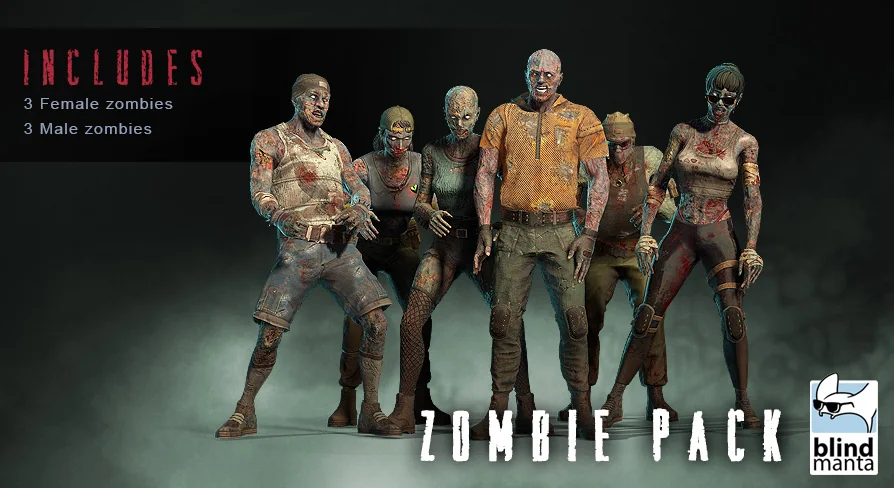
The visual variety within the pack supports grim, atmospheric scene construction across terror and horror genres. Rather than presenting a single monster mesh with slight texture swaps, the six separate characters supply genuine visual divergence. This breadth allows level designers and environment artists to populate urban ruins, abandoned research facilities, contaminated bunkers, and desolate wilderness locations without breaking immersion through immediate model repetition.
In post-apocalyptic settings, encounters with the infected or undead serve as core tension drivers. The anatomical styling of the models leans into monster and terror tropes, providing immediate visual cues to the player regarding hostile intent. Whether used as passive environmental props, scripted jump-scare antagonists, or roaming perimeter guards, the figures fit cleanly into bleak, decaying worlds where survivability depends on quick target identification.
Cross-Pack Compatibility with Gangs Pack 01
Projects blending human survivor factions with infected threats benefit directly from the interoperability between Zombies Pack 01 and Gangs Pack 01. Because both packages share common technical underpinnings within the wider ecosystem, utilizing them together establishes visual and mechanical continuity across an entire project.
This compatibility simplifies mixed-encounter design. A scenario involving hostile human raiders clashing with encroaching undead can pull character assets from both collections without introducing disparate skeletal formats or clashing visual fidelity. Technical teams can share locomotion blueprints, ragdoll physics assets, and gameplay interaction scripts across characters from both packs, drastically reducing the time spent configuring separate logic for human combatants and zombie adversaries.
Production-Ready Deployment in Real-Time AI Systems
Transitioning these assets into full production requires minimal intermediary adjustment. Once imported, the characters plug directly into standard navigation mesh traversal and behavior tree structures. The low overhead of the meshes ensures that pathfinding queries and crowd-avoidance algorithms remain performant during peak enemy density.
The combination of six optimized character meshes, full Epic skeleton compliance, dedicated animation blueprint compatibility, and an initial walk animation reference makes Zombies Pack 01 a focused, functional kit for real-time survival horror development. Teams can move straight from asset import to tuning AI behavior, confident that the models will hold their performance profile across heavy combat sequences.
 Creatures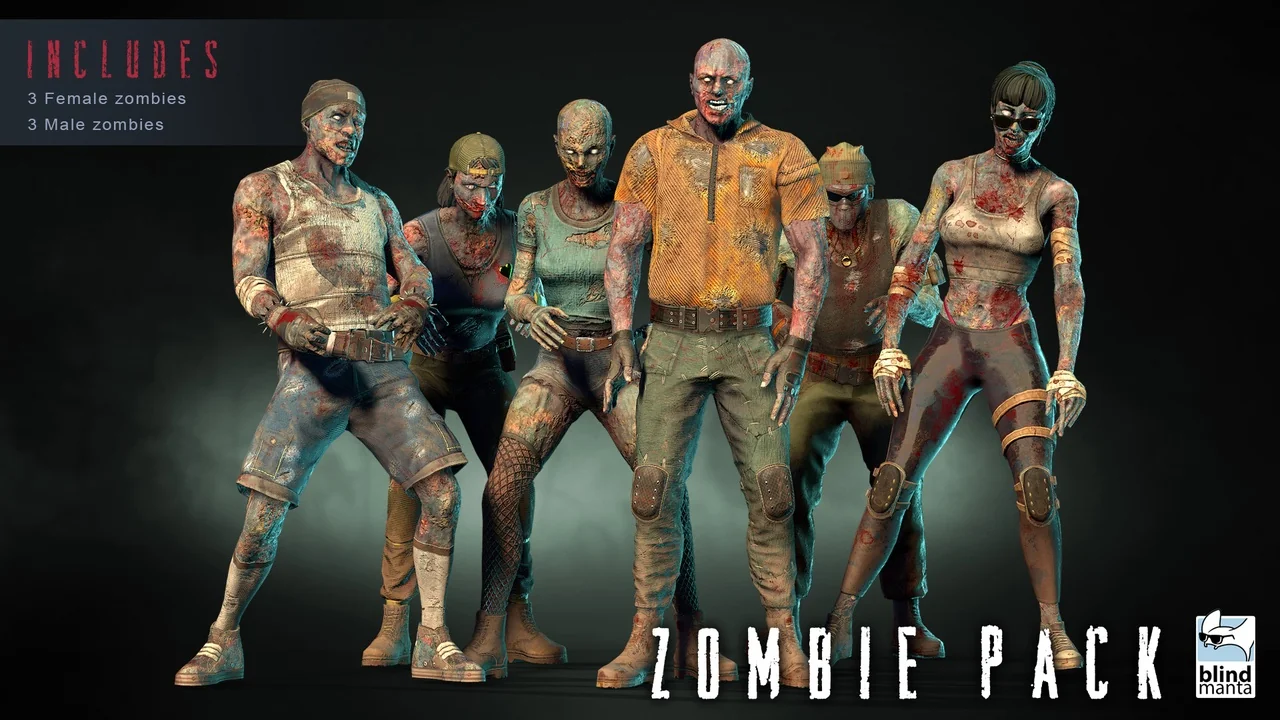
 Creatures
 Creatures
 Creatures