"ddd0e3fb95b0aec2"{"id":"1001552","slug":"sci-fi-creatures-cryo-capsules-room-2","title":"Sci-Fi Creatures Cryo Capsules Room 2","category":"Sci-Fi","engine":"4.26+,5.0+","assetVersion":"","engineVersion":"Engine Version: 4.26+,5.0+","tag":"Sci-Fi","accent":"blue","visual":"character","summary":"Explore Sci-Fi Creatures Cryo Capsules Room 2, featuring modular stasis chambers, mid-poly alien specimens, liquid glass shaders, and dual room skins.","platform":"Unreal Engine","publishedAt":"2026-10-10T03:40:19.964Z","updatedAt":"2026-10-10T03:40:19.964Z","sourceNotes":[],"fileContents":[],"compatibility":["Unreal Engine","Engine Version: 4.26+,5.0+"],"featuredImage":{"alt":"Sci-Fi Creatures Cryo Capsules Room 2","src":"/wp-content/uploads/published/2026/10/4604bfbaa3ed-bfe35e5c-04a5-4fb3-a46d-3ac5269f2001-51dfb23017.webp"},"hasDownloadLink":true,"downloads":0,"terms":[{"taxonomy":"category","slug":"sci-fi","name":"Sci-Fi"}],"galleryImages":[{"src":"/wp-content/uploads/published/2026/10/349baa1a1966-79cdf21d-30d2-4392-b9ad-6cf3dff83605-d93e000c60.webp","alt":"Sci-Fi Creatures Cryo Capsules Room 2"},{"src":"/wp-content/uploads/published/2026/10/e8fb7b3e5a91-c9be2323-7fa2-45a1-8843-516a118de66c-19ed02609b.webp","alt":"Sci-Fi Creatures Cryo Capsules Room 2"},{"src":"/wp-content/uploads/published/2026/10/b9fae81cea82-6abc87b9-0946-4066-8a2c-436f39aaf8a5-48e1f4a384.webp","alt":"Sci-Fi Creatures Cryo Capsules Room 2"},{"src":"/wp-content/uploads/published/2026/10/46171ddde74a-9e4c0cd1-f60b-4290-b73e-671865ed7ead-790a7c6f47.webp","alt":"Sci-Fi Creatures Cryo Capsules Room 2"},{"src":"/wp-content/uploads/published/2026/10/8a1fab66a786-a600b875-8b1b-4261-9b67-e0f8f67f3448-6b087ef968.webp","alt":"Sci-Fi Creatures Cryo Capsules Room 2"},{"src":"/wp-content/uploads/published/2026/10/c28a3f8a0014-e6d6a2d5-550f-4736-a6df-703776434145-27db8f8866.webp","alt":"Sci-Fi Creatures Cryo Capsules Room 2"},{"src":"/wp-content/uploads/published/2026/10/53772c187879-102472b1-4963-4b3d-85e4-6eecc250487d-9a23a4b136.webp","alt":"Sci-Fi Creatures Cryo Capsules Room 2"},{"src":"/wp-content/uploads/published/2026/10/42282be5ed84-02d30543-d100-4360-81bd-b3f59f2b421c-cdac5255ae.webp","alt":"Sci-Fi Creatures Cryo Capsules Room 2"},{"src":"/wp-content/uploads/published/2026/10/7ce29fe9594f-e7981756-6aa7-4b25-aa3a-184687bbd9db-c6e1af11f9.webp","alt":"Sci-Fi Creatures Cryo Capsules Room 2"},{"src":"/wp-content/uploads/published/2026/10/2bb2bd0307c8-31e49a09-ee27-43e9-9969-7740161bbf6a-7c6ca7b3f4.webp","alt":"Sci-Fi Creatures Cryo Capsules Room 2"}],"accessPanel":{"kind":"resource","title":"Download this resource","eyebrow":"Free Download","message":"Log in or create a free account to start your download.","fileName":"Content.7z","safetyNote":"Resources are manually reviewed before listing to improve quality and reduce obvious risks.","actionLabel":"Download Free","resourceType":"Resource archive"},"contentHtml":"\u003cp\u003eDeep-space outposts, quarantine bays, and extraterrestrial research laboratories often hinge on a single visual centerpiece: contained alien life preserved for study. Sci-Fi Creatures Cryo Capsules Room 2 provides that exact focal point, packaging a self-contained cryogenic chamber complete with two distinct alien specimens frozen inside transparent pods. The package directly targets environments where biological containment forms the narrative core, offering an out-of-the-box solution for spaceships, deep-space stations, and interactive virtual reality simulations.\u003c/p\u003e \u003ch2\u003eStasis Chambers in Space Station and Laboratory Environments\u003c/h2\u003e\n\u003cp\u003eReal-time sci-fi sets frequently call for specialized staging areas to convey scientific exploration or impending biological threat. In narrative adventure scenes, medical wing levels, or sci-fi horror games, an occupied cryo chamber instantly signals that an installation is actively processing alien biology. The architectural elements in this set are laid out to direct player focus toward the central pods, turning preserved specimens into primary environmental landmarks.\u003c/p\u003e \u003cp\u003eVirtual reality projects benefit particularly well from this arrangement. Because VR relies heavily on spatial presence and direct inspection, an enclosed chamber containing transparent containment units gives the user a distinct focal subject to approach and inspect from multiple angles. Enclosing strange life forms behind transparent barriers creates an innate tension suited for both clinical research stations and decaying spaceship interiors where containment failure is a central thematic element.\u003c/p\u003e \u003ch2\u003eSimulating Suspension with Liquid Glass and Hologram Shaders\u003c/h2\u003e\n\u003cp\u003eThe visual believability of a cryogenic stasis pod depends heavily on how the containment boundary interacts with light. Cryo capsules in this environment utilize specialized transparent surfaces paired with a dedicated glass shader tailored to simulate liquid inside the cylinder. Rather than relying on simple empty glass geometry, the shader mimics the optical density and presence of fluid surrounding the trapped organism, reinforcing the illusion of active cryogenic preservation.\u003c/p\u003e \u003cp\u003eAccompanying the fluid simulation is a dedicated hologram shader intended for environmental displays and terminal readouts. These surfaces inject futuristic illumination into the scene without demanding complex external light setups. Ambient monitor faces and control displays integrated into the set feature synthetic, abstract visual patterns. By utilizing AI-generated visual motifs that deliberately omit readable text or concrete data, the monitors maintain a consistent technological tone without locking the scene to a specific real-world language or fictional alphabet.\u003c/p\u003e \u003ch2\u003eStatic Alien Creatures and Mid-Poly Mesh Construction\u003c/h2\u003e\n\u003cp\u003eAt the center of each capsule rests an alien organism. The package includes two separate creature meshes frozen in static postures. These organisms are built explicitly as static meshes rather than animated characters; they contain no skeletal rigs, bone hierarchies, or skinning data. This structural decision eliminates unnecessary CPU overhead associated with skeletal mesh updates, making the assets purely architectural specimens that populate containment tanks without requiring animation blueprint configuration or physics calculations.\u003c/p\u003e \u003cp\u003eBoth the creatures and the surrounding architectural elements use mid-poly mesh budgets supported by high-quality PBR materials. Balancing polygon counts at a mid-tier level ensures the silhouettes remain smooth under close inspection—such as when a player walks directly up to a pod in a first-person title or VR headset—while keeping vertex counts predictable. Texturing follows standard physically based rendering workflows, allowing metallic surfaces, damp creature skins, and pod frameworks to react accurately to whatever dynamic lighting pipeline the broader scene employs.\u003c/p\u003e \u003ch2\u003eModular Room Layouts with Sliding Doors and Dual Skins\u003c/h2\u003e\n\u003cp\u003eThe demo level included with the set demonstrates a modular room framework that can be adapted to larger facility layouts. Access to the chamber is controlled through two sliding doors, providing logical connection points to corridors, decontamination airlocks, or adjacent laboratories. Because the room is built from modular components, level artists can reconfigure the wall and floor assemblies to expand the footprint or integrate the pods into larger interconnected floor plans.\u003c/p\u003e \u003cp\u003eA notable technical characteristic of the structural pieces is that meshes are modeled as one-sided geometry. Environmental artists constructing corridors or adjoining structures need to account for this backface culling, ensuring exterior geometry covers backfaces when designing multi-room facilities. To offer immediate aesthetic flexibility, the room features two distinct texture skins: a clean, sterile white variant fitting clinical research laboratories, and an industrial metallic finish well suited for rugged orbital outposts, mining vessels, or military installations.\u003c/p\u003e \u003ch2\u003eWorkflows and Scene Integration for Environment Artists\u003c/h2\u003e\n\u003cp\u003eThis room asset operates effectively as an isolated showcase or as part of a broader thematic compound. Because it shares stylistic roots with related scientific settings—such as cloning facilities, conference chambers, briefing rooms, and specimen exhibits—the structural language easily matches secondary laboratory props like robotic drones, medical furniture, or scientific apparatus. Combining the contained specimens with utility props allows teams to quickly dress a fully realized scientific outpost without stylistic friction.\u003c/p\u003e \u003cp\u003eLevel designers, VR developers, and sci-fi environment artists building contained interior levels will gain the most traction from this package. By providing complete, fluid-filled stasis capsules with zero-overhead static specimens and two distinct aesthetic finishes, the room removes the heavy lifting of authoring custom containment shaders and creature sculpts from scratch.\u003c/p\u003e\n\n\u003ch2\u003eMore From The Same Workflow\u003c/h2\u003e\n\u003cul\u003e\n\u003cli\u003e\u003ca href=\"https://3dcghub.com/survivor-girl-3-modular/\" title=\"Survivor Girl 3 (Modular)\"\u003eSurvivor Girl 3 (Modular)\u003c/a\u003e\u003c/li\u003e\n\u003cli\u003e\u003ca href=\"https://3dcghub.com/modular-sci-fi-station/\" title=\"Modular Sci-Fi Station\"\u003eModular Sci-Fi Station\u003c/a\u003e\u003c/li\u003e\n\u003cli\u003e\u003ca href=\"https://3dcghub.com/city-skyline-restaurant-and-piano-bar/\" title=\"City Skyline Restaurant \u0026amp; Piano Bar\"\u003eCity Skyline Restaurant \u0026amp; Piano Bar\u003c/a\u003e\u003c/li\u003e\n\u003cli\u003e\u003ca href=\"https://3dcghub.com/cyberpunk-street-assets/\" title=\"Cyberpunk street assets\"\u003eCyberpunk street assets\u003c/a\u003e\u003c/li\u003e\n\u003cli\u003e\u003ca href=\"https://3dcghub.com/modular-sci-fi-quarry-environment/\" title=\"Modular Sci-Fi Quarry Environment\"\u003eModular Sci-Fi Quarry Environment\u003c/a\u003e\u003c/li\u003e\n\u003c/ul\u003e","contentTextLength":6189,"navigation":{"current":22,"total":3511,"previous":{"id":"1001553","slug":"scifi-modern-flat-themed-gui-ui-kit-6-themes-psd-ai-sources","title":"Scifi / Modern flat themed GUI / UI kit - 6 themes + PSD, AI sources","category":"UI Kits / HUDs","platform":"Unreal Engine","updatedAt":"2026-10-10T03:40:56.893Z"},"next":{"id":"1001551","slug":"sci-fi-barrier-toolkit","title":"Sci-Fi Barrier Toolkit","category":"Building \u0026 Human-made","platform":"Unreal Engine","updatedAt":"2026-10-10T03:37:17.822Z"}},"relatedResources":[{"id":"1000402","slug":"survivor-girl-3-modular","title":"Survivor Girl 3 (Modular)","category":"Sci-Fi","engine":"5.1+","assetVersion":"","engineVersion":"Engine Version: 5.1+","tag":"Sci-Fi","accent":"blue","visual":"mech","summary":"A fully rigged, modular female character designed for survival games, featuring an Epic Skeleton rig, facial mocap blendshapes, and PBR 4K textures.","platform":"Unreal Engine","publishedAt":"2026-07-08T07:28:30.566Z","updatedAt":"2026-07-08T07:28:30.566Z","sourceNotes":[],"fileContents":[],"compatibility":["Unreal Engine","Engine Version: 5.1+"],"featuredImage":{"alt":"Survivor Girl 3 (Modular)","src":"/wp-content/uploads/published/2026/07/bbf5ce430335-0dd6c68b-cb07-49ef-b09c-1e3f64d69683-fd68741e0b.webp"},"hasDownloadLink":true,"downloads":0},{"id":"1001555","slug":"scifi-industrial-level-kit-2-0","title":"SciFi/Industrial Level Kit 2.0","category":"Sci-Fi","engine":"4.19+,5.0+","assetVersion":"","engineVersion":"Engine Version: 4.19+,5.0+","tag":"Sci-Fi","accent":"blue","visual":"mech","summary":"SciFi/Industrial Level Kit 2.0 delivers over 1500 modular meshes and Blueprints with PBR/IBL lighting and multi-resolution textures for sci-fi environments.","platform":"Unreal Engine","publishedAt":"2026-10-10T03:45:25.139Z","updatedAt":"2026-10-10T03:45:25.139Z","sourceNotes":[],"fileContents":[],"compatibility":["Unreal Engine","Engine Version: 4.19+,5.0+"],"featuredImage":{"alt":"SciFi/Industrial Level Kit 2.0","src":"/wp-content/uploads/published/2026/10/21759bf57f6e-da6da6ce-23c5-402b-8cc5-45bd1e8ecea9-a2e57d98d6.webp"},"hasDownloadLink":true,"downloads":0},{"id":"1001142","slug":"modular-sci-fi-station","title":"Modular Sci-Fi Station","category":"Sci-Fi","engine":"4.16+,5.0+","assetVersion":"","engineVersion":"Engine Version: 4.16+,5.0+","tag":"Sci-Fi","accent":"blue","visual":"mech","summary":"Construct diverse sci-fi rooms, hallways, and spaceship interiors with the low-poly Modular Sci-Fi Station kit featuring high-resolution PBR textures.","platform":"Unreal Engine","publishedAt":"2026-09-09T05:35:44.412Z","updatedAt":"2026-10-09T15:37:29.142Z","sourceNotes":[],"fileContents":[],"compatibility":["Unreal Engine","Engine Version: 4.16+,5.0+"],"featuredImage":{"alt":"Modular Sci-Fi Station","src":"/wp-content/uploads/published/2026/09/a4c5f3ab3f03-8001c386-d63a-49cc-b8df-63595e3c4c42-c1137ad880.webp"},"hasDownloadLink":true,"downloads":0}]}
Category:Unreal Engine,Sci-FiPlatform: Unreal EngineEngine Version: 4.26+,5.0+Published: Oct 10, 2026
Sci-Fi
Resource overview
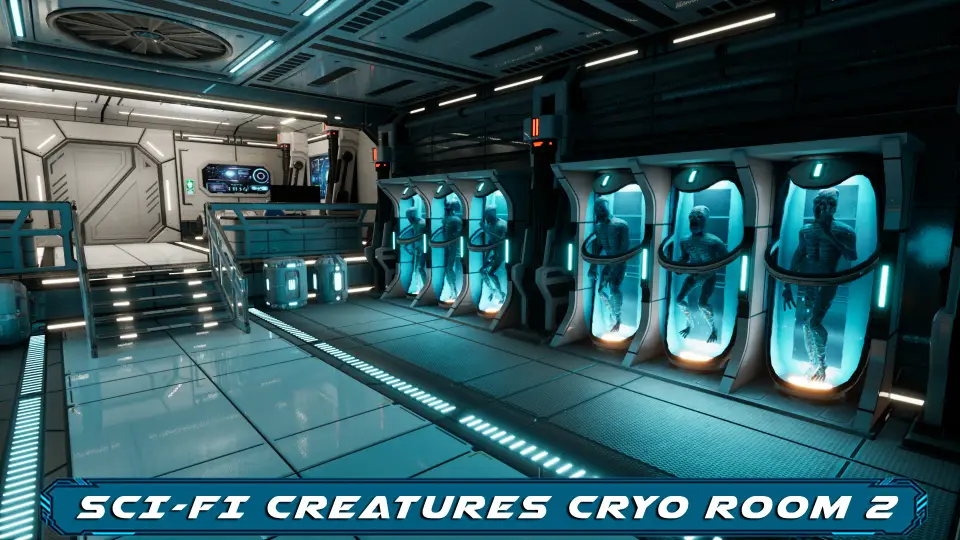
Deep-space outposts, quarantine bays, and extraterrestrial research laboratories often hinge on a single visual centerpiece: contained alien life preserved for study. Sci-Fi Creatures Cryo Capsules Room 2 provides that exact focal point, packaging a self-contained cryogenic chamber complete with two distinct alien specimens frozen inside transparent pods. The package directly targets environments where biological containment forms the narrative core, offering an out-of-the-box solution for spaceships, deep-space stations, and interactive virtual reality simulations.
Stasis Chambers in Space Station and Laboratory Environments
Real-time sci-fi sets frequently call for specialized staging areas to convey scientific exploration or impending biological threat. In narrative adventure scenes, medical wing levels, or sci-fi horror games, an occupied cryo chamber instantly signals that an installation is actively processing alien biology. The architectural elements in this set are laid out to direct player focus toward the central pods, turning preserved specimens into primary environmental landmarks.
Virtual reality projects benefit particularly well from this arrangement. Because VR relies heavily on spatial presence and direct inspection, an enclosed chamber containing transparent containment units gives the user a distinct focal subject to approach and inspect from multiple angles. Enclosing strange life forms behind transparent barriers creates an innate tension suited for both clinical research stations and decaying spaceship interiors where containment failure is a central thematic element.
Simulating Suspension with Liquid Glass and Hologram Shaders
The visual believability of a cryogenic stasis pod depends heavily on how the containment boundary interacts with light. Cryo capsules in this environment utilize specialized transparent surfaces paired with a dedicated glass shader tailored to simulate liquid inside the cylinder. Rather than relying on simple empty glass geometry, the shader mimics the optical density and presence of fluid surrounding the trapped organism, reinforcing the illusion of active cryogenic preservation.
Accompanying the fluid simulation is a dedicated hologram shader intended for environmental displays and terminal readouts. These surfaces inject futuristic illumination into the scene without demanding complex external light setups. Ambient monitor faces and control displays integrated into the set feature synthetic, abstract visual patterns. By utilizing AI-generated visual motifs that deliberately omit readable text or concrete data, the monitors maintain a consistent technological tone without locking the scene to a specific real-world language or fictional alphabet.
Static Alien Creatures and Mid-Poly Mesh Construction
At the center of each capsule rests an alien organism. The package includes two separate creature meshes frozen in static postures. These organisms are built explicitly as static meshes rather than animated characters; they contain no skeletal rigs, bone hierarchies, or skinning data. This structural decision eliminates unnecessary CPU overhead associated with skeletal mesh updates, making the assets purely architectural specimens that populate containment tanks without requiring animation blueprint configuration or physics calculations.
Both the creatures and the surrounding architectural elements use mid-poly mesh budgets supported by high-quality PBR materials. Balancing polygon counts at a mid-tier level ensures the silhouettes remain smooth under close inspection—such as when a player walks directly up to a pod in a first-person title or VR headset—while keeping vertex counts predictable. Texturing follows standard physically based rendering workflows, allowing metallic surfaces, damp creature skins, and pod frameworks to react accurately to whatever dynamic lighting pipeline the broader scene employs.
Modular Room Layouts with Sliding Doors and Dual Skins
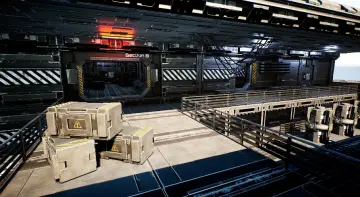
The demo level included with the set demonstrates a modular room framework that can be adapted to larger facility layouts. Access to the chamber is controlled through two sliding doors, providing logical connection points to corridors, decontamination airlocks, or adjacent laboratories. Because the room is built from modular components, level artists can reconfigure the wall and floor assemblies to expand the footprint or integrate the pods into larger interconnected floor plans.
A notable technical characteristic of the structural pieces is that meshes are modeled as one-sided geometry. Environmental artists constructing corridors or adjoining structures need to account for this backface culling, ensuring exterior geometry covers backfaces when designing multi-room facilities. To offer immediate aesthetic flexibility, the room features two distinct texture skins: a clean, sterile white variant fitting clinical research laboratories, and an industrial metallic finish well suited for rugged orbital outposts, mining vessels, or military installations.
Workflows and Scene Integration for Environment Artists
This room asset operates effectively as an isolated showcase or as part of a broader thematic compound. Because it shares stylistic roots with related scientific settings—such as cloning facilities, conference chambers, briefing rooms, and specimen exhibits—the structural language easily matches secondary laboratory props like robotic drones, medical furniture, or scientific apparatus. Combining the contained specimens with utility props allows teams to quickly dress a fully realized scientific outpost without stylistic friction.
Level designers, VR developers, and sci-fi environment artists building contained interior levels will gain the most traction from this package. By providing complete, fluid-filled stasis capsules with zero-overhead static specimens and two distinct aesthetic finishes, the room removes the heavy lifting of authoring custom containment shaders and creature sculpts from scratch.
 Sci-Fi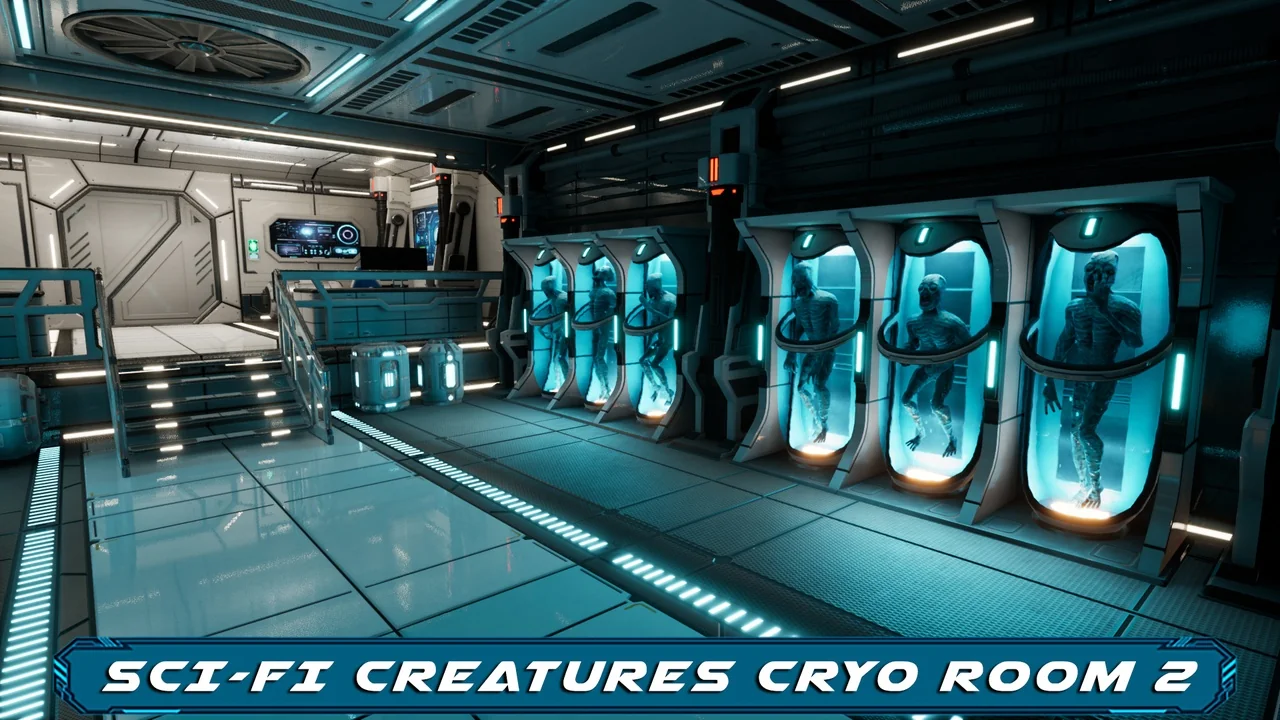
 Sci-Fi
 Sci-Fi
 Sci-Fi