"f0d304d7232d0332"{"id":"1002723","slug":"sci-fi-creatures-research-lab","title":"Sci-Fi Creatures Research Lab","category":"Sci-Fi","engine":"5.0+","assetVersion":"","engineVersion":"Engine Version: 5.0+","tag":"Sci-Fi","accent":"blue","visual":"character","summary":"Explore the Sci-Fi Creatures Research Lab environment, featuring cryogenic stasis pods, six alien specimens, modular walls, and specialized shaders.","platform":"Unreal Engine","indexPolicy":"index","publishedAt":"2026-11-17T18:57:53.943Z","updatedAt":"2026-11-17T18:57:53.943Z","sourceNotes":[],"fileContents":[],"compatibility":["Unreal Engine","Engine Version: 5.0+"],"featuredImage":{"alt":"Sci-Fi Creatures Research Lab","src":"/wp-content/uploads/published/2026/11/408900a24134-b1f2eb9a-ae4a-4367-9725-2f3757dff225-d38ec923da.webp"},"fileSizeBytes":855732382,"hasDownloadLink":true,"downloads":0,"terms":[{"taxonomy":"category","slug":"sci-fi","name":"Sci-Fi"}],"galleryImages":[{"src":"/wp-content/uploads/published/2026/11/f9b35323ed88-12869925-e921-4383-a066-42e27cb3ec2f-c4ec520ffe.webp","alt":"Sci-Fi Creatures Research Lab"},{"src":"/wp-content/uploads/published/2026/11/581f30274945-eb2fc389-9950-43a6-b0a5-1dd5fd419ff8-372d3a232d.webp","alt":"Sci-Fi Creatures Research Lab"},{"src":"/wp-content/uploads/published/2026/11/afca1b0a5859-fc866309-d182-466d-95fb-a02deb99494c-92fbf4befd.webp","alt":"Sci-Fi Creatures Research Lab"},{"src":"/wp-content/uploads/published/2026/11/25b7376ae173-ca730d46-1f40-4c98-bbea-4e6bcd1de78b-553c7c4db7.webp","alt":"Sci-Fi Creatures Research Lab"},{"src":"/wp-content/uploads/published/2026/11/824a1756e5aa-5e692cb0-fea8-4823-a089-a5714d33f44a-fbf76cc567.webp","alt":"Sci-Fi Creatures Research Lab"},{"src":"/wp-content/uploads/published/2026/11/442cc30966b1-e6f84d66-039a-477b-bdfb-c6e73c8c738e-94f874b724.webp","alt":"Sci-Fi Creatures Research Lab"},{"src":"/wp-content/uploads/published/2026/11/e2fa88adf270-4940f22c-7e90-44ca-b237-b91d7a8f3dd4-0386d4e0eb.webp","alt":"Sci-Fi Creatures Research Lab"},{"src":"/wp-content/uploads/published/2026/11/3503434b7b29-cf986b16-7567-473f-9507-11989e4bef60-64c7ed92cb.webp","alt":"Sci-Fi Creatures Research Lab"},{"src":"/wp-content/uploads/published/2026/11/6f9b59b12a5e-00a281e4-5f01-4ad7-9d39-c48e15decf96-a6df88304c.webp","alt":"Sci-Fi Creatures Research Lab"},{"src":"/wp-content/uploads/published/2026/11/34b2f16111a6-0efe3e76-0f1a-4987-8463-bb557b791570-2b8de2eac3.webp","alt":"Sci-Fi Creatures Research Lab"}],"accessPanel":{"kind":"resource","title":"Get this resource","safetyNote":"Resources are manually reviewed before listing to improve quality and reduce obvious risks.","fileName":"Content.7z","resourceType":"Resource archive","versions":[]},"contentHtml":"\u003cp\u003eA high-tech containment setting requires visual cues that instantly communicate isolation, scientific observation, and volatile biological study. The Sci-Fi Creatures Research Lab establishes this atmosphere through a self-contained control room lined with cryogenic stasis capsules and technical operator stations. Intended for futuristic, cyberpunk, and deep-space interior environments, the environment delivers a specialized staging ground where scientific inquiry meets extraterrestrial containment.\u003c/p\u003e \u003ch2\u003eSpecimen Containment and the Six Alien Creatures\u003c/h2\u003e\n\u003cp\u003eAt the center of the facility's narrative purpose are six alien creatures positioned inside transparent cryogenic pods. Rather than acting as dynamic, interactive entities or wandering AI threats, these life forms serve entirely as static environment props. Each organism is represented as a static mesh frozen in a fixed pose, suspended in place within its respective stasis pod. Because the meshes are unrigged, their function is purely architectural and atmospheric, serving as visual centerpieces for laboratories focused on cloning, genetic experimentation, or biological quarantine.\u003c/p\u003e \u003cp\u003ePreserving the creatures in fixed configurations influences how an environment designer frames the scene. The unmoving poses work naturally within the narrative logic of deep cryogenic suspension, where life signs are muted and physical movement has been halted by chemical or thermal processes. Encasing these distinct alien forms within upright stasis chambers provides instant environmental context, allowing spaceships, orbital stations, and subterranean genetics facilities to present high-threat bio-specimens without demanding complex character animation setups.\u003c/p\u003e \u003ch2\u003eStructural Layout of the Sci-Fi Modular Environment\u003c/h2\u003e\n\u003cp\u003eThe architectural foundation relies on mid-poly modular components that assemble into a single, cohesive research room. The package focuses strictly on one self-contained control room rather than a sprawling multi-wing compound. The modular wall, ceiling, and floor sections allow level builders to understand the room's proportions directly from the included game-ready demo level, providing an organized staging ground for laboratory terminals and specimen tanks.\u003c/p\u003e \u003cp\u003eA crucial technical consideration lies in the mesh construction: the structural module pieces are modeled as one-sided geometry. This backface culling approach keeps polygon overhead lean and optimizes rendering performance within closed room interiors. Level designers must account for this single-sided modeling when planning sightlines, lighting setups, or exterior camera paths. If a camera passes beyond the interior room boundary, unbacked geometry will appear transparent. Consequently, the modular pieces perform best when enclosed within tight interior bounds or placed against matching structural framework.\u003c/p\u003e \u003cp\u003eTo support different aesthetic styles, the environment comes with two distinct surface skins:\u003c/p\u003e\n\u003cul\u003e \u003cli\u003e\u003cstrong\u003eClean White Finish:\u003c/strong\u003e A clinical, high-visibility aesthetic suited for sterile cloning laboratories, corporate medical facilities, and pristine corporate stations.\u003c/li\u003e \u003cli\u003e\u003cstrong\u003eDark Metallic Finish:\u003c/strong\u003e A shadowy, industrial treatment fitting for deep-space derelicts, secretive military black-sites, or covert alien autopsy bunkers.\u003c/li\u003e\n\u003c/ul\u003e \u003ch2\u003eAtmospheric Shaders and Control Lab Display Systems\u003c/h2\u003e\n\u003cp\u003eMaterial definition across the laboratory meshes relies on high-quality PBR workflows, giving metal panels, structural supports, and workstation surfaces accurate roughness, metallic, and ambient occlusion responses under dynamic or baked lighting. The visual weight of the lab is heavily bolstered by several specialized shader setups that address the unique technical requirements of futuristic research hardware.\u003c/p\u003e \u003cp\u003eA dedicated glass shader provides the visual illusion of liquid filling each capsule. This shader simulates internal fluid density, refracting the static alien specimens trapped inside and scattering light across the curved cylindrical surfaces of the stasis pods. By handling fluid presence through shader logic rather than heavy volumetric simulations or geometric fluid bodies, the capsule assets maintain clean runtime efficiency while preserving the look of a functioning chemical suspension unit.\u003c/p\u003e \u003cp\u003eComplementing the liquid enclosures are display screen shaders and hologram materials applied to laboratory terminals and monitoring workstations. These screen surfaces project technical telemetry, biological status graphs, and diagnostic readouts across the control stations. The interface graphics displayed on these monitors are AI-generated visual elements engineered intentionally without legible language or specific real-world text. This deliberate omission keeps the facility agnostic to specific languages, fictional alphabets, or real-world timelines, allowing developers to drop the control stations into any fictional lore without conflicting worldbuilding text.\u003c/p\u003e \u003ch2\u003eDeploying the Research Lab in Sci-Fi Pipelines\u003c/h2\u003e\n\u003cp\u003eBecause the pack concentrates on a single room with static specimen meshes, its practical application is distinct from general-purpose creature packs or wide-open world kits. The assets shine brightest when deployed as dedicated narrative focal points: a discovery chamber at the heart of an abandoned starship, a bio-containment breach room that players encounter during an infiltration, or an investigative point-of-interest where genetic secrets are uncovered.\u003c/p\u003e \u003cp\u003eThe mid-poly budget balances silhouette clarity against system overhead, making the room well-suited for real-time applications where interior performance needs to remain steady alongside post-processing and volumetric lighting effects. Lighting artists can leverage the contrast between ambient room illumination and the internal glow of the stasis pod glass shaders, casting colored light through the liquid and framing the alien forms in silhouette.\u003c/p\u003e \u003cp\u003eFor productions assembling comprehensive sci-fi complexes, this single-room control lab operates as a specialized set piece. It pairs naturally with adjacent hallway structures, decontamination airlocks, and broader institutional spaces such as briefing halls, specimen exhibits, and robotics maintenance bays. By treating the room as an isolated research node, technical artists and level designers can establish a compact, visually dense scene built entirely around the tension of captive alien biology.\u003c/p\u003e\n\n\u003ch2\u003eMore From The Same Workflow\u003c/h2\u003e\n\u003cul\u003e\n\u003cli\u003e\u003ca href=\"https://3dcghub.com/survivor-girl-3-modular/\" rel=\"noopener noreferrer\"\u003eSurvivor Girl 3 (Modular)\u003c/a\u003e\u003c/li\u003e\n\u003cli\u003e\u003ca href=\"https://3dcghub.com/sci-fi-creatures-cryo-capsules-room-2/\" rel=\"noopener noreferrer\"\u003eSci-Fi Creatures Cryo Capsules Room 2\u003c/a\u003e\u003c/li\u003e\n\u003cli\u003e\u003ca href=\"https://3dcghub.com/sci-fi-corridor-low-poly-environment/\" rel=\"noopener noreferrer\"\u003eSci-Fi Corridor - Low Poly Environment\u003c/a\u003e\u003c/li\u003e\n\u003cli\u003e\u003ca href=\"https://3dcghub.com/sci-fi-bio-laboratory/\" rel=\"noopener noreferrer\"\u003eSci-Fi Bio Laboratory\u003c/a\u003e\u003c/li\u003e\n\u003cli\u003e\u003ca href=\"https://3dcghub.com/modular-sci-fi-base-indoor/\" rel=\"noopener noreferrer\"\u003eModular Sci-Fi Base - Indoor\u003c/a\u003e\u003c/li\u003e\n\u003c/ul\u003e","contentTextLength":6555,"navigation":{"current":17,"total":4660,"previous":{"id":"1002724","slug":"scifi-dark-fantasy-environment-the-orb","title":"SciFi Dark Fantasy Environment — 'The Orb'","category":"Sci-Fi","platform":"Unreal Engine","updatedAt":"2026-11-17T18:59:59.947Z"},"next":{"id":"1002722","slug":"sci-fi-corridor-low-poly-environment","title":"Sci-Fi Corridor - Low Poly Environment","category":"Sci-Fi","platform":"Unreal Engine","updatedAt":"2026-11-17T18:56:47.879Z"}},"relatedResources":[{"id":"1000402","slug":"survivor-girl-3-modular","title":"Survivor Girl 3 (Modular)","category":"Sci-Fi","engine":"5.1+","assetVersion":"","engineVersion":"Engine Version: 5.1+","tag":"Sci-Fi","accent":"blue","visual":"mech","summary":"A fully rigged, modular female character designed for survival games, featuring an Epic Skeleton rig, facial mocap blendshapes, and PBR 4K textures.","platform":"Unreal Engine","indexPolicy":"index","publishedAt":"2026-07-08T07:28:30.566Z","updatedAt":"2026-07-08T07:28:30.566Z","sourceNotes":[],"fileContents":[],"compatibility":["Unreal Engine","Engine Version: 5.1+"],"featuredImage":{"alt":"Survivor Girl 3 (Modular)","src":"/wp-content/uploads/published/2026/07/bbf5ce430335-0dd6c68b-cb07-49ef-b09c-1e3f64d69683-fd68741e0b.webp"},"fileSizeBytes":1037203156,"hasDownloadLink":true,"downloads":0},{"id":"1001552","slug":"sci-fi-creatures-cryo-capsules-room-2","title":"Sci-Fi Creatures Cryo Capsules Room 2","category":"Sci-Fi","engine":"4.26+,5.0+","assetVersion":"","engineVersion":"Engine Version: 4.26+,5.0+","tag":"Sci-Fi","accent":"blue","visual":"character","summary":"Explore Sci-Fi Creatures Cryo Capsules Room 2, featuring modular stasis chambers, mid-poly alien specimens, liquid glass shaders, and dual room skins.","platform":"Unreal Engine","indexPolicy":"index","publishedAt":"2026-10-10T03:40:19.964Z","updatedAt":"2026-10-10T03:40:19.964Z","sourceNotes":[],"fileContents":[],"compatibility":["Unreal Engine","Engine Version: 4.26+,5.0+"],"featuredImage":{"alt":"Sci-Fi Creatures Cryo Capsules Room 2","src":"/wp-content/uploads/published/2026/10/4604bfbaa3ed-bfe35e5c-04a5-4fb3-a46d-3ac5269f2001-51dfb23017.webp"},"fileSizeBytes":528844031,"hasDownloadLink":true,"downloads":0},{"id":"1002722","slug":"sci-fi-corridor-low-poly-environment","title":"Sci-Fi Corridor - Low Poly Environment","category":"Sci-Fi","engine":"5.0+","assetVersion":"","engineVersion":"Engine Version: 5.0+","tag":"Sci-Fi","accent":"blue","visual":"city","summary":"Assemble cyberpunk interiors, laboratories, and space stations using the modular assets, texture atlases, and blueprints in Sci-Fi Corridor - Low Poly Environme","platform":"Unreal Engine","indexPolicy":"index","publishedAt":"2026-11-17T18:56:47.879Z","updatedAt":"2026-11-17T18:56:47.879Z","sourceNotes":[],"fileContents":[],"compatibility":["Unreal Engine","Engine Version: 5.0+"],"featuredImage":{"alt":"Sci-Fi Corridor - Low Poly Environment","src":"https://media.fab.com/image_previews/gallery_images/0256de13-e113-4345-95c0-10e255ca0dc7/0668f8f3-db67-4e0d-9987-96f0f3c6a027.png"},"fileSizeBytes":306687794,"hasDownloadLink":true,"downloads":0}]}
Resource screenshots
1 / 10
Join our channel
Follow 3DCGHUB on Telegram for new resource drops, migration updates, and community notices.
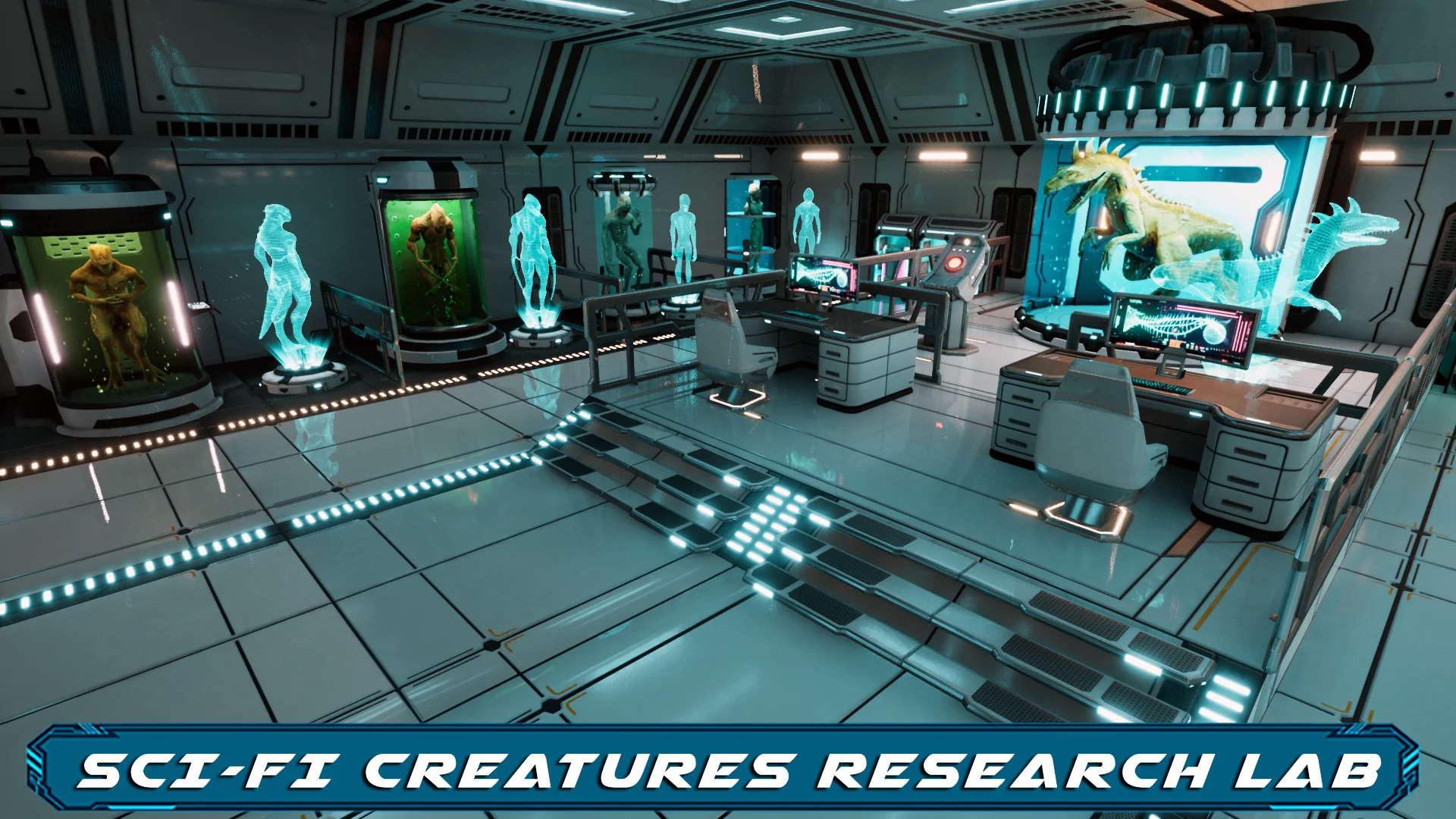
A high-tech containment setting requires visual cues that instantly communicate isolation, scientific observation, and volatile biological study. The Sci-Fi Creatures Research Lab establishes this atmosphere through a self-contained control room lined with cryogenic stasis capsules and technical operator stations. Intended for futuristic, cyberpunk, and deep-space interior environments, the environment delivers a specialized staging ground where scientific inquiry meets extraterrestrial containment.
Specimen Containment and the Six Alien Creatures
At the center of the facility's narrative purpose are six alien creatures positioned inside transparent cryogenic pods. Rather than acting as dynamic, interactive entities or wandering AI threats, these life forms serve entirely as static environment props. Each organism is represented as a static mesh frozen in a fixed pose, suspended in place within its respective stasis pod. Because the meshes are unrigged, their function is purely architectural and atmospheric, serving as visual centerpieces for laboratories focused on cloning, genetic experimentation, or biological quarantine.
Preserving the creatures in fixed configurations influences how an environment designer frames the scene. The unmoving poses work naturally within the narrative logic of deep cryogenic suspension, where life signs are muted and physical movement has been halted by chemical or thermal processes. Encasing these distinct alien forms within upright stasis chambers provides instant environmental context, allowing spaceships, orbital stations, and subterranean genetics facilities to present high-threat bio-specimens without demanding complex character animation setups.
Structural Layout of the Sci-Fi Modular Environment
The architectural foundation relies on mid-poly modular components that assemble into a single, cohesive research room. The package focuses strictly on one self-contained control room rather than a sprawling multi-wing compound. The modular wall, ceiling, and floor sections allow level builders to understand the room's proportions directly from the included game-ready demo level, providing an organized staging ground for laboratory terminals and specimen tanks.
A crucial technical consideration lies in the mesh construction: the structural module pieces are modeled as one-sided geometry. This backface culling approach keeps polygon overhead lean and optimizes rendering performance within closed room interiors. Level designers must account for this single-sided modeling when planning sightlines, lighting setups, or exterior camera paths. If a camera passes beyond the interior room boundary, unbacked geometry will appear transparent. Consequently, the modular pieces perform best when enclosed within tight interior bounds or placed against matching structural framework.
To support different aesthetic styles, the environment comes with two distinct surface skins:
Clean White Finish: A clinical, high-visibility aesthetic suited for sterile cloning laboratories, corporate medical facilities, and pristine corporate stations.
Dark Metallic Finish: A shadowy, industrial treatment fitting for deep-space derelicts, secretive military black-sites, or covert alien autopsy bunkers.
Atmospheric Shaders and Control Lab Display Systems
Material definition across the laboratory meshes relies on high-quality PBR workflows, giving metal panels, structural supports, and workstation surfaces accurate roughness, metallic, and ambient occlusion responses under dynamic or baked lighting. The visual weight of the lab is heavily bolstered by several specialized shader setups that address the unique technical requirements of futuristic research hardware.
A dedicated glass shader provides the visual illusion of liquid filling each capsule. This shader simulates internal fluid density, refracting the static alien specimens trapped inside and scattering light across the curved cylindrical surfaces of the stasis pods. By handling fluid presence through shader logic rather than heavy volumetric simulations or geometric fluid bodies, the capsule assets maintain clean runtime efficiency while preserving the look of a functioning chemical suspension unit.
Complementing the liquid enclosures are display screen shaders and hologram materials applied to laboratory terminals and monitoring workstations. These screen surfaces project technical telemetry, biological status graphs, and diagnostic readouts across the control stations. The interface graphics displayed on these monitors are AI-generated visual elements engineered intentionally without legible language or specific real-world text. This deliberate omission keeps the facility agnostic to specific languages, fictional alphabets, or real-world timelines, allowing developers to drop the control stations into any fictional lore without conflicting worldbuilding text.
Deploying the Research Lab in Sci-Fi Pipelines
Because the pack concentrates on a single room with static specimen meshes, its practical application is distinct from general-purpose creature packs or wide-open world kits. The assets shine brightest when deployed as dedicated narrative focal points: a discovery chamber at the heart of an abandoned starship, a bio-containment breach room that players encounter during an infiltration, or an investigative point-of-interest where genetic secrets are uncovered.
The mid-poly budget balances silhouette clarity against system overhead, making the room well-suited for real-time applications where interior performance needs to remain steady alongside post-processing and volumetric lighting effects. Lighting artists can leverage the contrast between ambient room illumination and the internal glow of the stasis pod glass shaders, casting colored light through the liquid and framing the alien forms in silhouette.
For productions assembling comprehensive sci-fi complexes, this single-room control lab operates as a specialized set piece. It pairs naturally with adjacent hallway structures, decontamination airlocks, and broader institutional spaces such as briefing halls, specimen exhibits, and robotics maintenance bays. By treating the room as an isolated research node, technical artists and level designers can establish a compact, visually dense scene built entirely around the tension of captive alien biology.
 Sci-Fi
 Sci-Fi
 Sci-Fi