"4b3b2df4304d6533"{"id":"1001452","slug":"roman-temple-ruins-roman-temple-ruins-historical-building-building-rome","title":"Roman Temple Ruins ( Roman Temple Ruins Historical Building Building Rome )","category":"Historical","engine":"4.22+,5.0+","assetVersion":"","engineVersion":"Engine Version: 4.22+,5.0+","tag":"Historical","accent":"blue","visual":"mech","summary":"Explore the Roman Temple Ruins environment pack featuring 130 unique meshes, a preassembled scene, and integrated Ultimate Level Art Tool workflows.","platform":"Unreal Engine","indexPolicy":"index","publishedAt":"2026-10-08T00:55:54.084Z","updatedAt":"2026-10-08T00:55:54.084Z","sourceNotes":[],"fileContents":[],"compatibility":["Unreal Engine","Engine Version: 4.22+,5.0+"],"featuredImage":{"alt":"Roman Temple Ruins ( Roman Temple Ruins Historical Building Building Rome )","src":"/wp-content/uploads/published/2026/10/caf3f57d89ea-eb43117b-6c44-4bd8-a842-67db63551db6-c90eceb5e4.webp"},"fileSizeBytes":1037636974,"hasDownloadLink":true,"downloads":0,"terms":[{"taxonomy":"category","slug":"historical","name":"Historical"}],"galleryImages":[{"src":"/wp-content/uploads/published/2026/10/2c4632394d12-23fa1707-0a49-4371-b867-66d7ac556aa7-fc56544455.webp","alt":"Roman Temple Ruins ( Roman Temple Ruins Historical Building Building Rome )"},{"src":"/wp-content/uploads/published/2026/10/975d28cea7bc-8208e56c-1ea6-4ed4-97ec-deb0e7edbcbc-a20fa20f25.webp","alt":"Roman Temple Ruins ( Roman Temple Ruins Historical Building Building Rome )"},{"src":"/wp-content/uploads/published/2026/10/32eff1741267-3cbfad8c-6a45-40c4-bdfc-3ffdd5da9018-a6d61d0d7f.webp","alt":"Roman Temple Ruins ( Roman Temple Ruins Historical Building Building Rome )"},{"src":"/wp-content/uploads/published/2026/10/9c30f743c49c-2cb61899-6839-4749-b53c-d0ba55d9b24c-d854f4adba.webp","alt":"Roman Temple Ruins ( Roman Temple Ruins Historical Building Building Rome )"},{"src":"/wp-content/uploads/published/2026/10/471114ad2476-e20c6e35-1866-4055-bb3c-ff198676d631-2740fb8e3f.webp","alt":"Roman Temple Ruins ( Roman Temple Ruins Historical Building Building Rome )"},{"src":"/wp-content/uploads/published/2026/10/4273e6d76f52-053b2e33-c77b-43e4-892b-691ac8686f06-8e3a488605.webp","alt":"Roman Temple Ruins ( Roman Temple Ruins Historical Building Building Rome )"},{"src":"/wp-content/uploads/published/2026/10/be0c019adb81-94f0dfc9-fbfa-41ea-b395-ce39cbc006e7-7b3d105a4c.webp","alt":"Roman Temple Ruins ( Roman Temple Ruins Historical Building Building Rome )"},{"src":"/wp-content/uploads/published/2026/10/b3838a09a38c-b9900204-886d-4e99-8583-4a3aa6959c94-423ad02641.webp","alt":"Roman Temple Ruins ( Roman Temple Ruins Historical Building Building Rome )"},{"src":"/wp-content/uploads/published/2026/10/353469450a5f-66024df4-06c6-4b1a-ab53-80a31d07c643-7d3c7d8c1b.webp","alt":"Roman Temple Ruins ( Roman Temple Ruins Historical Building Building Rome )"},{"src":"/wp-content/uploads/published/2026/10/ef7dfd9b82be-d69a1c97-d318-4f9a-8a43-d807e166885a-1cda34eb61.webp","alt":"Roman Temple Ruins ( Roman Temple Ruins Historical Building Building Rome )"}],"accessPanel":{"kind":"resource","title":"Get this resource","safetyNote":"Resources are manually reviewed before listing to improve quality and reduce obvious risks.","fileName":"Content.7z","resourceType":"Resource archive","versions":[]},"contentHtml":"\u003ch2\u003eDeploying the Preassembled Roman Temple Ruins Scene\u003c/h2\u003e\u003cp\u003eWorking with classical architecture in real-time engines begins with structural staging. Loading the Roman Temple Ruins environment reveals a fully preassembled scene constructed to demonstrate the visual range and density possible with historical assets. For teams building runtime games or setting up real-time stages for Virtual Production, having immediate access to a prebuilt level bypasses the blank-canvas phase. The layout establishes line of sight, natural elevation shifts, and the interaction between classical stone architecture and environmental open-air backdrops.\u003c/p\u003e\u003cp\u003eThe preassembled layout serves as both a reference configuration and a direct staging environment. Virtual Production camera teams can immediately frame shots against standing columns, fractured lintels, and collapsed stone foundations without first assembling structural blocks from scratch. Because the entire space is arranged with attention to composition, depth, and scale, it reveals how individual modules fit together to form monumental public sanctuaries. Lighting configurations within the scene show how shadowed colonnades and direct sunlight interact across weathered stonework, giving technical artists a baseline for real-time performance calibration.\u003c/p\u003e\u003ch2\u003eModular Construction with 130 Unique Meshes\u003c/h2\u003e\u003cp\u003eAt the center of the environment is an asset library comprising 130 unique meshes. Rather than delivering a single, static temple monolithic asset, the collection divides classical Roman architecture into flexible, functional pieces. This modular approach allows level designers to construct complete, pristine sanctuaries or break them down into varying stages of decay, ranging from minor structural settling to sprawling, timeworn ruins.\u003c/p\u003e\u003cp\u003eEach piece within the 130-mesh library is prepared for game-ready performance, balancing visual detail against runtime overhead. Classical Roman buildings require specific architectural components: fluted columns, ornate capitals, pediment fragments, stepped podiums, archways, and heavy flagstone floors. Having separate assets for these components allows level artists to alter footprints, build multi-tiered temple steps, and scatter collapsed pillars across terrain contours.\u003c/p\u003e\u003cp\u003eLevel designers can isolate individual elements to construct custom passageways, ruined temple interiors, or broad plazas. Because the assets are optimized with game-ready levels of detail, scenes maintain consistent draw performance even when clustering high volumes of stone props in tight spatial configurations. The mesh topology supports both close-up player interaction and expansive vistas, allowing background ruins to blend smoothly with playable foreground zones.\u003c/p\u003e\u003ch2\u003eAccelerating Layouts with the Ultimate Level Art Tool\u003c/h2\u003e\u003cp\u003eManual placement of individual blocks across a massive historical site can quickly consume production time. To address this, the environment package integrates the Ultimate Level Art Tool (ULAT). Originally created under the project title of a modular design development tool for mobile and web-based systems, ULAT is specifically engineered to streamline the creation of custom modular buildings and automate the natural population of game scenes.\u003c/p\u003e\u003cp\u003eBecause the Roman Temple Ruins pack is fully compatible with ULAT, level artists do not need to align structural modules manually on a strict grid. The tool enables rapid assembly routines, allowing teams to generate custom temple configurations, wall variations, and compound structures with reduced manual overhead. ULAT reads the modular properties of the meshes, facilitating intuitive snapping, algorithmic distribution, and organic prop scattering.\u003c/p\u003e\u003cp\u003ePopulating a sprawling ancient ruin requires placing fractured stone segments, fallen architraves, and scattered rubble in believable ways. Using ULAT within this environment allows technical artists to scatter historical debris naturally across temple floors. This semi-automated distribution creates organic clutter along baseboards, fallen columns, and cracked staircases, preventing the artificial look that often comes from purely hand-placed modular kits.\u003c/p\u003e\u003ch2\u003eSystem Compatibility and Virtual Production Workflows\u003c/h2\u003e\u003cp\u003eProduction environments demand smooth pipelines across level assembly, camera setups, and toolchains. The Roman Temple Ruins environment extends beyond basic asset placement through compatibility with advanced toolsets, including the NWIRO AI Integration Kit (Unreal Copilot, MCP, IK, and Ultimate AI Bridge MCP). Integrating modern helper toolsets alongside the Ultimate Level Art Tool gives technical directors room to experiment with assisted level population, automated camera positioning, and accelerated procedural dressing routines.\u003c/p\u003e\u003cp\u003eFor games set during classical antiquity, archaeological adventures, or fantasy RPG explorations, the asset kit handles diverse spatial demands. The 130 unique meshes provide the foundational geometry needed for grand temple halls, derelict shrines, crumbling forum complexes, and remote historical landmarks. Virtual Production teams benefit equally from the preassembled scene, which is prepared for immediate real-time rendering on LED volumes or green screen stages where high-fidelity stone surfaces and authentic classical proportions are critical.\u003c/p\u003e\u003cp\u003eMaintaining balance between fidelity and game-ready optimization ensures that these Roman architectural assets can scale smoothly from desktop titles to intricate cinematic sequences. By pairing a comprehensive 130-mesh modular library with the preassembled scene and dedicated ULAT workflows, the pack delivers an adaptable foundation for historical environment production.\u003c/p\u003e\n\n\u003ch2\u003eExplore Similar Assets\u003c/h2\u003e\n\u003cul\u003e\n\u003cli\u003e\u003ca href=\"https://3dcghub.com/polygon-ancient-empire/\" rel=\"noopener noreferrer\"\u003ePOLYGON - Ancient Empire\u003c/a\u003e\u003c/li\u003e\n\u003cli\u003e\u003ca href=\"https://3dcghub.com/victorian-interior-environment-victorian-steampunk-vintage-antique-interior/\" rel=\"noopener noreferrer\"\u003eVictorian Interior Environment ( Victorian Steampunk Vintage Antique Interior )\u003c/a\u003e\u003c/li\u003e\n\u003cli\u003e\u003ca href=\"https://3dcghub.com/florence-cathedral-pack-cathedral-environment-cathedral-cathedral-church-old/\" rel=\"noopener noreferrer\"\u003eFlorence Cathedral Pack ( Cathedral Environment Cathedral Cathedral Church Old )\u003c/a\u003e\u003c/li\u003e\n\u003cli\u003e\u003ca href=\"https://3dcghub.com/us-capitol-exterior-environment-building-exterior-usa-capitol/\" rel=\"noopener noreferrer\"\u003eUS Capitol Exterior Environment ( Building Exterior USA Capitol )\u003c/a\u003e\u003c/li\u003e\n\u003cli\u003e\u003ca href=\"https://3dcghub.com/egypt-ruins-environment/\" rel=\"noopener noreferrer\"\u003eEgypt Ruins Environment\u003c/a\u003e\u003c/li\u003e\n\u003c/ul\u003e","contentTextLength":5980,"navigation":{"current":1579,"total":4889,"previous":{"id":"1001453","slug":"ryan-picker-page","title":"Ryan Picker Page","category":"Engine Tools","platform":"Unreal Engine","updatedAt":"2026-10-08T00:56:30.493Z"},"next":{"id":"1001451","slug":"ring-world-city-station","title":"Ring World City Station","category":"Sci-Fi","platform":"Unreal Engine","updatedAt":"2026-10-08T00:54:45.110Z"}},"relatedResources":[{"id":"1001745","slug":"modular-ancient-ruins","title":"Modular Ancient Ruins","category":"Historical","engine":"4.26+,5.0+","assetVersion":"","engineVersion":"Engine Version: 4.26+,5.0+","tag":"Historical","accent":"blue","visual":"mech","summary":"Modular Ancient Ruins pairs modular ruin meshes and flexible materials with biome-specific plants, starter layouts, and broad stylistic versatility.","platform":"Unreal Engine","indexPolicy":"index","publishedAt":"2026-10-20T02:51:08.967Z","updatedAt":"2026-10-20T02:51:08.967Z","sourceNotes":[],"fileContents":[],"compatibility":["Unreal Engine","Engine Version: 4.26+,5.0+"],"featuredImage":{"alt":"Modular Ancient Ruins","src":"/wp-content/uploads/published/2026/10/772d7890cd77-c93248a4-9dfe-42e2-8e71-1f715921f251-58b712778f.webp"},"fileSizeBytes":4530543520,"hasDownloadLink":true,"downloads":0},{"id":"1001128","slug":"victorian-interior-environment-victorian-steampunk-vintage-antique-interior","title":"Victorian Interior Environment ( Victorian Steampunk Vintage Antique Interior )","category":"Historical","engine":"4.26+,5.0+","assetVersion":"","engineVersion":"Engine Version: 4.26+,5.0+","tag":"Historical","accent":"blue","visual":"city","summary":"78 Unreal Engine assets for Victorian interiors, with ULAT modular building, a preassembled scene, and daytime/nighttime maps to light a period world.","platform":"Unreal Engine","indexPolicy":"index","publishedAt":"2026-09-07T13:46:41.075Z","updatedAt":"2026-09-07T13:46:41.075Z","sourceNotes":[],"fileContents":[],"compatibility":["Unreal Engine","Engine Version: 4.26+,5.0+"],"featuredImage":{"alt":"Victorian Interior Environment ( Victorian Steampunk Vintage Antique Interior )","src":"/wp-content/uploads/published/2026/09/c5ae328ff4e3-c9f0f3ee-214c-48a2-aabf-45dc57b54a47-c5ad7fcfd9.webp"},"fileSizeBytes":500609146,"hasDownloadLink":true,"downloads":1},{"id":"8443","slug":"us-capitol-exterior-environment-building-exterior-usa-capitol","title":"US Capitol Exterior Environment ( Building Exterior USA Capitol )","category":"Historical","engine":"4.26+,5.0+","assetVersion":"Engine version: 4.26+,5.0+","engineVersion":"4.26","tag":"Historical","accent":"blue","visual":"city","summary":"Discover a high-quality, modular environment pack featuring the iconic US Capitol building. Optimized for Unreal Engine, this resource includes a powerful level art tool for rapid scene creation.","platform":"Unreal Engine","indexPolicy":"noindex","publishedAt":"2026-02-23T17:19:20.000Z","updatedAt":"2026-04-19T15:55:27.000Z","sourceNotes":[],"fileContents":[],"compatibility":["Unreal Engine","Engine version: 4.26+,5.0+"],"featuredImage":{"alt":"US Capitol Exterior Environment ( Building Exterior USA Capitol )","src":"https://3dcghub.com/wp-content/uploads/2026/02/42036031-76aa-4d19-b33a-d94ac9d692b2.webp"},"fileSizeBytes":1815373242,"hasDownloadLink":true,"downloads":1}]}[{"id":4225,"sourceId":4225,"taxonomyId":4225,"taxonomy":"category","slug":"asset-library","name":"Asset Library","parentId":null,"count":4744,"hasChildren":true,"href":"/","seoTitle":"Free Game Assets Library | 3DCGHUB","seoDescription":"Browse free Unreal Engine, Unity, Blender assets and game development tutorials on 3DCGHUB with previews, compatibility notes, and secure downloads.","sitemapEnabled":true,"children":[{"id":4227,"sourceId":4227,"taxonomyId":4227,"taxonomy":"category","slug":"blender-add-ons-plugins","name":"Blender Add-ons \u0026 Plugins","parentId":4225,"count":10,"hasChildren":false,"href":"/category/blender-add-ons-plugins/","seoTitle":"Free Blender Add-ons \u0026 Plugins | 3DCGHUB","seoDescription":"Browse free Blender Add-ons \u0026 Plugins tools for Blender on 3DCGHUB: curated downloads with preview images, compatibility notes and secure download access.","sitemapEnabled":true},{"id":514,"sourceId":514,"taxonomyId":514,"taxonomy":"category","slug":"unity-2","name":"Unity","parentId":4225,"count":453,"hasChildren":true,"href":"/category/unity-2/","seoTitle":"Free Unity Assets | 3DCGHUB","seoDescription":"Browse free Unity resources on 3DCGHUB: curated downloads with preview images, compatibility notes and secure download access.","sitemapEnabled":true,"children":[{"id":523,"sourceId":523,"taxonomyId":523,"taxonomy":"category","slug":"2d","name":"2D","parentId":514,"count":1,"hasChildren":true,"href":"/category/2d/","seoTitle":"Free Unity 2D | 3DCGHUB","seoDescription":"Browse free 2D assets for Unity on 3DCGHUB: curated downloads with preview images, compatibility notes and secure download access.","sitemapEnabled":true},{"id":515,"sourceId":515,"taxonomyId":515,"taxonomy":"category","slug":"3d-unity-2","name":"3D","parentId":514,"count":162,"hasChildren":true,"href":"/category/3d-unity-2/","seoTitle":"Free Unity 3D Assets | 3DCGHUB","seoDescription":"Browse free 3D assets for Unity on 3DCGHUB: curated downloads with preview images, compatibility notes and secure download access.","sitemapEnabled":true},{"id":565,"sourceId":565,"taxonomyId":565,"taxonomy":"category","slug":"add-ons","name":"Add-Ons","parentId":514,"count":2,"hasChildren":false,"href":"/category/add-ons/","seoTitle":"Free Unity Add-Ons | 3DCGHUB","seoDescription":"Browse free Add-Ons assets for Unity on 3DCGHUB: curated downloads with preview images, compatibility notes and secure download access.","sitemapEnabled":true},{"id":529,"sourceId":529,"taxonomyId":529,"taxonomy":"category","slug":"audio-unity-2","name":"Audio","parentId":514,"count":1,"hasChildren":true,"href":"/category/audio-unity-2/","seoTitle":"Free Unity Audio | 3DCGHUB","seoDescription":"Browse free Audio for Unity on 3DCGHUB: curated downloads with preview images, compatibility notes and secure download access.","sitemapEnabled":true},{"id":557,"sourceId":557,"taxonomyId":557,"taxonomy":"category","slug":"templates","name":"Templates","parentId":514,"count":36,"hasChildren":true,"href":"/category/templates/","seoTitle":"Free Unity Templates | 3DCGHUB","seoDescription":"Browse free Unity project templates on 3DCGHUB. Starter kits with previews, compatibility notes, and secure download access.","sitemapEnabled":true},{"id":533,"sourceId":533,"taxonomyId":533,"taxonomy":"category","slug":"tools-unity-2","name":"Tools","parentId":514,"count":0,"hasChildren":true,"href":"/category/tools-unity-2/","sitemapEnabled":true},{"id":554,"sourceId":554,"taxonomyId":554,"taxonomy":"category","slug":"vfx-unity-2","name":"VFX","parentId":514,"count":4,"hasChildren":true,"href":"/category/vfx-unity-2/","seoTitle":"Free Unity VFX | 3DCGHUB","seoDescription":"Browse free VFX for Unity on 3DCGHUB: curated downloads with preview images, compatibility notes and secure download access.","sitemapEnabled":true}]},{"id":511,"sourceId":511,"taxonomyId":511,"taxonomy":"category","slug":"unreal-engine-2","name":"Unreal Engine","parentId":4225,"count":4282,"hasChildren":true,"href":"/category/unreal-engine-2/","seoTitle":"Free Unreal Engine Assets | 3DCGHUB","seoDescription":"Browse free Unreal Engine resources on 3DCGHUB: curated downloads with preview images, compatibility notes and secure download access.","sitemapEnabled":true,"children":[{"id":54,"sourceId":54,"taxonomyId":54,"taxonomy":"category","slug":"3d","name":"3D","parentId":511,"count":2428,"hasChildren":true,"href":"/category/3d/","seoTitle":"Free Unreal Engine 3D | 3DCGHUB","seoDescription":"Browse free 3D assets for Unreal Engine on 3DCGHUB: curated downloads with preview images, compatibility notes and secure download access.","sitemapEnabled":true},{"id":441,"sourceId":441,"taxonomyId":441,"taxonomy":"category","slug":"animations","name":"Animations","parentId":511,"count":245,"hasChildren":true,"href":"/category/animations/","seoTitle":"Free Unreal Engine Animations | 3DCGHUB","seoDescription":"Browse free Animations for Unreal Engine on 3DCGHUB: curated downloads with preview images, compatibility notes and secure download access.","sitemapEnabled":true},{"id":446,"sourceId":446,"taxonomyId":446,"taxonomy":"category","slug":"audio","name":"Audio","parentId":511,"count":63,"hasChildren":true,"href":"/category/audio/","seoTitle":"Free Unreal Engine Audio Resources | 3DCGHUB","seoDescription":"Browse free Unreal Engine audio resources including sound effects, voices, dialogue, and ambient sounds. Curated free downloads on 3DCGHUB.","sitemapEnabled":true},{"id":466,"sourceId":466,"taxonomyId":466,"taxonomy":"category","slug":"game-systems","name":"Game Systems","parentId":511,"count":356,"hasChildren":true,"href":"/category/game-systems/","seoTitle":"Free Unreal Engine Game Systems | 3DCGHUB","seoDescription":"Browse free Game Systems tools for Unreal Engine on 3DCGHUB: curated downloads with preview images, compatibility notes and secure download access.","sitemapEnabled":true},{"id":478,"sourceId":478,"taxonomyId":478,"taxonomy":"category","slug":"game-templates","name":"Game Templates","parentId":511,"count":150,"hasChildren":true,"href":"/category/game-templates/","seoTitle":"Free Unreal Engine Game Templates | 3DCGHUB","seoDescription":"Browse free Game Templates for Unreal Engine on 3DCGHUB: curated downloads with preview images, compatibility notes and secure download access.","sitemapEnabled":true},{"id":432,"sourceId":432,"taxonomyId":432,"taxonomy":"category","slug":"hdri","name":"HDRI","parentId":511,"count":6,"hasChildren":true,"href":"/category/hdri/","seoTitle":"Free Unreal Engine HDRI | 3DCGHUB","seoDescription":"Browse free Unreal Engine HDRI skies and lighting maps on 3DCGHUB. Environment lighting with previews and secure downloads.","sitemapEnabled":true},{"id":228,"sourceId":228,"taxonomyId":228,"taxonomy":"category","slug":"material-and-textures","name":"Material \u0026 Textures","parentId":511,"count":172,"hasChildren":true,"href":"/category/material-and-textures/","seoTitle":"Free Unreal Engine Material \u0026 Textures | 3DCGHUB","seoDescription":"Browse free Material \u0026 Textures for Unreal Engine on 3DCGHUB: curated downloads with preview images, compatibility notes and secure download access.","sitemapEnabled":true},{"id":298,"sourceId":298,"taxonomyId":298,"taxonomy":"category","slug":"sprites-and-flipbooks","name":"Sprites \u0026 Flipbooks","parentId":511,"count":17,"hasChildren":true,"href":"/category/sprites-and-flipbooks/","seoTitle":"Free Unreal Engine Sprites \u0026 Flipbooks | 3DCGHUB","seoDescription":"Browse free Sprites \u0026 Flipbooks assets for Unreal Engine on 3DCGHUB: curated downloads with preview images, compatibility notes and secure download access.","sitemapEnabled":true},{"id":489,"sourceId":489,"taxonomyId":489,"taxonomy":"category","slug":"tools-and-plugins","name":"Tools \u0026 Plugins","parentId":511,"count":390,"hasChildren":true,"href":"/category/tools-and-plugins/","seoTitle":"Free Unreal Engine Tools \u0026 Plugins | 3DCGHUB","seoDescription":"Browse free Tools \u0026 Plugins for Unreal Engine on 3DCGHUB: curated downloads with preview images, compatibility notes and secure download access.","sitemapEnabled":true},{"id":459,"sourceId":459,"taxonomyId":459,"taxonomy":"category","slug":"ui","name":"UI","parentId":511,"count":43,"hasChildren":true,"href":"/category/ui/","seoTitle":"Free Unreal Engine UI | 3DCGHUB","seoDescription":"Browse free UI for Unreal Engine on 3DCGHUB: curated downloads with preview images, compatibility notes and secure download access.","sitemapEnabled":true},{"id":450,"sourceId":450,"taxonomyId":450,"taxonomy":"category","slug":"vfx","name":"VFX","parentId":511,"count":412,"hasChildren":true,"href":"/category/vfx/","seoTitle":"Free Unreal Engine VFX | 3DCGHUB","seoDescription":"Browse free VFX for Unreal Engine on 3DCGHUB: curated downloads with preview images, compatibility notes and secure download access.","sitemapEnabled":true}]}]},{"id":4222,"sourceId":4222,"taxonomyId":4222,"taxonomy":"category","slug":"tutorial-library","name":"Tutorial Library","parentId":null,"count":117,"hasChildren":false,"href":"/tutorials/","seoTitle":"Free Game Development Tutorial Library | 3DCGHUB","seoDescription":"Browse free game development tutorials for Unreal Engine, Unity, Blender, and more on 3DCGHUB with practical workflows and secure downloads.","sitemapEnabled":true}]
Resource screenshots
1 / 10
Free Pro Draw
Weekly Free Pro Giveaway
Follow 3DCGHUB on Telegram for weekly free Pro account giveaways and the latest asset drops.
Deploying the Preassembled Roman Temple Ruins Scene
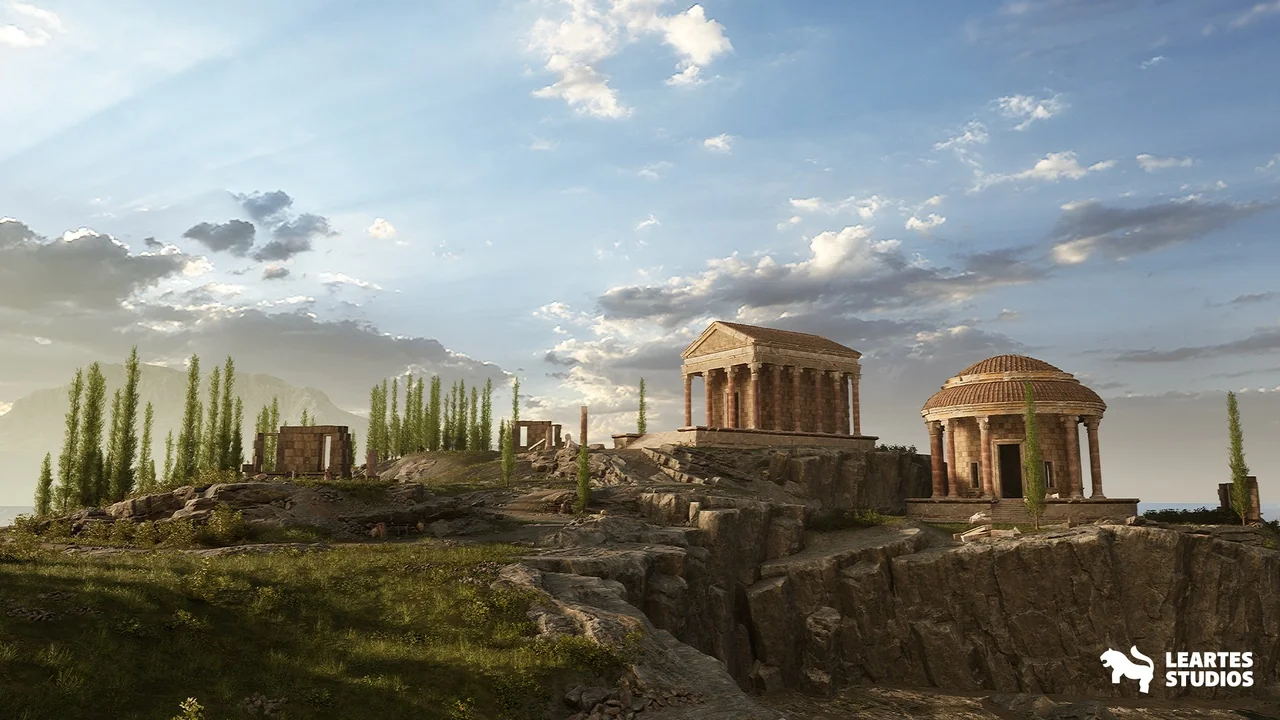
Working with classical architecture in real-time engines begins with structural staging. Loading the Roman Temple Ruins environment reveals a fully preassembled scene constructed to demonstrate the visual range and density possible with historical assets. For teams building runtime games or setting up real-time stages for Virtual Production, having immediate access to a prebuilt level bypasses the blank-canvas phase. The layout establishes line of sight, natural elevation shifts, and the interaction between classical stone architecture and environmental open-air backdrops.
The preassembled layout serves as both a reference configuration and a direct staging environment. Virtual Production camera teams can immediately frame shots against standing columns, fractured lintels, and collapsed stone foundations without first assembling structural blocks from scratch. Because the entire space is arranged with attention to composition, depth, and scale, it reveals how individual modules fit together to form monumental public sanctuaries. Lighting configurations within the scene show how shadowed colonnades and direct sunlight interact across weathered stonework, giving technical artists a baseline for real-time performance calibration.
Modular Construction with 130 Unique Meshes
At the center of the environment is an asset library comprising 130 unique meshes. Rather than delivering a single, static temple monolithic asset, the collection divides classical Roman architecture into flexible, functional pieces. This modular approach allows level designers to construct complete, pristine sanctuaries or break them down into varying stages of decay, ranging from minor structural settling to sprawling, timeworn ruins.
Each piece within the 130-mesh library is prepared for game-ready performance, balancing visual detail against runtime overhead. Classical Roman buildings require specific architectural components: fluted columns, ornate capitals, pediment fragments, stepped podiums, archways, and heavy flagstone floors. Having separate assets for these components allows level artists to alter footprints, build multi-tiered temple steps, and scatter collapsed pillars across terrain contours.
Level designers can isolate individual elements to construct custom passageways, ruined temple interiors, or broad plazas. Because the assets are optimized with game-ready levels of detail, scenes maintain consistent draw performance even when clustering high volumes of stone props in tight spatial configurations. The mesh topology supports both close-up player interaction and expansive vistas, allowing background ruins to blend smoothly with playable foreground zones.
Accelerating Layouts with the Ultimate Level Art Tool
Manual placement of individual blocks across a massive historical site can quickly consume production time. To address this, the environment package integrates the Ultimate Level Art Tool (ULAT). Originally created under the project title of a modular design development tool for mobile and web-based systems, ULAT is specifically engineered to streamline the creation of custom modular buildings and automate the natural population of game scenes.
Because the Roman Temple Ruins pack is fully compatible with ULAT, level artists do not need to align structural modules manually on a strict grid. The tool enables rapid assembly routines, allowing teams to generate custom temple configurations, wall variations, and compound structures with reduced manual overhead. ULAT reads the modular properties of the meshes, facilitating intuitive snapping, algorithmic distribution, and organic prop scattering.
Populating a sprawling ancient ruin requires placing fractured stone segments, fallen architraves, and scattered rubble in believable ways. Using ULAT within this environment allows technical artists to scatter historical debris naturally across temple floors. This semi-automated distribution creates organic clutter along baseboards, fallen columns, and cracked staircases, preventing the artificial look that often comes from purely hand-placed modular kits.
System Compatibility and Virtual Production Workflows
Production environments demand smooth pipelines across level assembly, camera setups, and toolchains. The Roman Temple Ruins environment extends beyond basic asset placement through compatibility with advanced toolsets, including the NWIRO AI Integration Kit (Unreal Copilot, MCP, IK, and Ultimate AI Bridge MCP). Integrating modern helper toolsets alongside the Ultimate Level Art Tool gives technical directors room to experiment with assisted level population, automated camera positioning, and accelerated procedural dressing routines.
For games set during classical antiquity, archaeological adventures, or fantasy RPG explorations, the asset kit handles diverse spatial demands. The 130 unique meshes provide the foundational geometry needed for grand temple halls, derelict shrines, crumbling forum complexes, and remote historical landmarks. Virtual Production teams benefit equally from the preassembled scene, which is prepared for immediate real-time rendering on LED volumes or green screen stages where high-fidelity stone surfaces and authentic classical proportions are critical.
Maintaining balance between fidelity and game-ready optimization ensures that these Roman architectural assets can scale smoothly from desktop titles to intricate cinematic sequences. By pairing a comprehensive 130-mesh modular library with the preassembled scene and dedicated ULAT workflows, the pack delivers an adaptable foundation for historical environment production.
 Historical
 Historical
 Historical