"7b46a695175d8694"{"id":"1001451","slug":"ring-world-city-station","title":"Ring World City Station","category":"Sci-Fi","engine":"4.26+,5.0+","assetVersion":"","engineVersion":"Engine Version: 4.26+,5.0+","tag":"Sci-Fi","accent":"blue","visual":"city","summary":"Build detailed sci-fi environments with Ring World City Station, featuring modular streets, bar interiors, spline blueprints, and Unreal Engine 5 Lumen support.","platform":"Unreal Engine","publishedAt":"2026-10-08T00:54:45.110Z","updatedAt":"2026-10-08T00:54:45.110Z","sourceNotes":[],"fileContents":[],"compatibility":["Unreal Engine","Engine Version: 4.26+,5.0+"],"featuredImage":{"alt":"Ring World City Station","src":"/wp-content/uploads/published/2026/10/b6b13533b57b-0cafe81c-c894-4f8d-9f15-09c6951558b9-9dafca5de0.webp"},"hasDownloadLink":true,"downloads":0,"terms":[{"taxonomy":"category","slug":"sci-fi","name":"Sci-Fi"}],"galleryImages":[{"src":"/wp-content/uploads/published/2026/10/c21f658c461f-66b120ea-0d95-4fe9-a42e-dd0c10b8aa2c-68186871b0.webp","alt":"Ring World City Station"},{"src":"/wp-content/uploads/published/2026/10/8db9d2affa9a-86bda5aa-cfc3-459d-bb2a-bce39224876f-73e97be71e.webp","alt":"Ring World City Station"},{"src":"/wp-content/uploads/published/2026/10/a1fa45b7b761-5393a2a9-78a0-4d79-85d1-a01a36aa1072-b4b7f8c485.webp","alt":"Ring World City Station"},{"src":"/wp-content/uploads/published/2026/10/02b390330d22-fff0aa27-907b-48b8-abc3-e51254d30290-84ced5c85e.webp","alt":"Ring World City Station"},{"src":"/wp-content/uploads/published/2026/10/0594b0f18cad-9eae50c3-f858-4c9f-9664-9b948ed96e82-8cd9637226.webp","alt":"Ring World City Station"},{"src":"/wp-content/uploads/published/2026/10/bd272206816d-21d08184-e4c0-4421-8e49-f691fababf0a-5211693982.webp","alt":"Ring World City Station"},{"src":"/wp-content/uploads/published/2026/10/1a1439f76fb7-cb683835-a4b9-4795-bcb5-811ab8e0b2ed-0e26b20a24.webp","alt":"Ring World City Station"},{"src":"/wp-content/uploads/published/2026/10/4f9b31574c3f-c29c6da7-68b9-468b-9e11-14754e0e1520-b8ac680caa.webp","alt":"Ring World City Station"}],"accessPanel":{"kind":"resource","title":"Download this resource","eyebrow":"Free Download","message":"Log in or create a free account to start your download.","fileName":"Content.7z","safetyNote":"Resources are manually reviewed before listing to improve quality and reduce obvious risks.","actionLabel":"Download Free","resourceType":"Resource archive"},"contentHtml":"\u003cp\u003eEstablishing a believable extraterrestrial metropolis requires balancing wide skyline perspectives with detailed ground-level interaction. Ring World City Station provides an all-in-one framework for crafting expansive science-fiction urban zones in Unreal Engine, connecting distant vista horizons directly with explorable pedestrian walkways and enclosed hospitality spaces. The environment delivers the structural and mechanical components needed to construct high-tech settlements, whether intended for background set-dressing in cinematic sequences or interactive exploration in real-time games.\u003c/p\u003e \u003ch2\u003eAssembling Ring World City Station Across Macro Vistas and Ground Streets\u003c/h2\u003e\n\u003cp\u003eThe core layout of this environment centers on an interconnected urban fabric that spans multiple scales. Developers can establish the broader urban perimeter using dedicated vista buildings, framing massive structural silhouettes that suggest an immense orbital or surface installation. These backdrop structures set the mood and industrial tone before users even step foot into playable territory.\u003c/p\u003e \u003cp\u003eMoving from the skyline down to the playable surfaces, the collection provides full street geometry, architectural facades, and urban infrastructure. The physical framework accommodates multi-level city blocks, letting creators stage bustling pedestrian sectors or desolate, high-tech back alleys. Rather than limiting the setting to exterior views, the assets transition directly into dedicated social hubs, including a complete sci-fi bar and accompanying interior props. Furnishing interior rooms with tailored props establishes a tactile human scale that grounds the grander sci-fi architecture, linking large-scale civil engineering with everyday lived-in spaces.\u003c/p\u003e \u003ch2\u003eBlueprints and Spline Trajectories for Spaceships and Flying Robots\u003c/h2\u003e\n\u003cp\u003ePopulating a sprawling futuristic station demands visible motion throughout the surrounding airspace. Ring World City Station tackles this staging problem through built-in Blueprints that rely on spline paths to drive automated traffic and airborne mechanical units. Instead of manually animating moving vehicles frame by frame, creators can route custom flight lines through city canyons, around sky towers, and across vista gaps.\u003c/p\u003e \u003cp\u003eThe included Blueprints are set up to handle spaceships and flying robots along these user-defined splines, injecting constant kinetic activity into backgrounds and flybys:\u003c/p\u003e\n\u003cul\u003e \u003cli\u003e\u003cstrong\u003eSpline Pathing:\u003c/strong\u003e Draw curved trajectories directly inside the level viewport to determine flight corridors for ships and aerial drones.\u003c/li\u003e \u003cli\u003e\u003cstrong\u003eAutonomous Movement:\u003c/strong\u003e Let automated vehicles sweep past skyscrapers, patrol station sectors, or hover near docking bays with minimal manual setup.\u003c/li\u003e \u003cli\u003e\u003cstrong\u003eVista Building Customization:\u003c/strong\u003e Adjust and configure background architectural structures using the dedicated Blueprint tools to alter the skyline profile.\u003c/li\u003e\n\u003c/ul\u003e \u003cp\u003eUsing splines for secondary environmental animation ensures that cities never feel frozen or dormant. Background spaceships can cruise along designated transit lanes while flying robots sweep close to street walkways, generating a continuous sense of life and metropolitan scale throughout the playable volume.\u003c/p\u003e \u003ch2\u003eConfiguring Lumen, Global Illumination, and Distance Fields in UE5\u003c/h2\u003e\n\u003cp\u003eLighting plays a critical role in sci-fi environments where metal materials, emissive panels, and shadowed alleys converge. Ring World City Station is engineered to leverage modern rendering capabilities, offering full support for Lumen in Unreal Engine 5.0 and newer versions. Operating with Lumen ensures that indirect bounces, multi-source neon reflections, and cavernous exterior street shadowing calculate accurately in real time.\u003c/p\u003e \u003cp\u003eTo realize the intended visual presentation of the station, specific lighting systems must be enabled in project settings. Users should confirm that both global illumination and mesh distance fields are active across the project. Distance fields supply the engine with the geometric information required to compute soft ambient occlusion, detailed contact shadows, and realistic light transfer underneath overpasses, behind pipes, and across intricate building facades.\u003c/p\u003e \u003cp\u003eWhen combined with Lumen, dynamic lighting reacts convincingly to metallic PBR surfaces, giving spaceship hulls, reflective street surfaces, and neon-lit bar counters believable material responses. Scenes benefit from rich color bleeding between signage and architecture, maintaining deep contrasts without crushing subtle ambient details in shadowed alcoves.\u003c/p\u003e \u003ch2\u003eOptimization Footprint: Collision, LODs, and Lightmap Workflows\u003c/h2\u003e\n\u003cp\u003eBalancing dense architectural modules against performance limits requires dependable asset preparation under the hood. The meshes comprising Ring World City Station arrive pre-configured with levels of detail (LODs), allowing the engine to reduce geometric overhead automatically as assets recede toward the horizon. This LOD pipeline helps sustain frame rates when rendering sprawling vistas filled with high-rise structures, complex ground fixtures, and moving vessels.\u003c/p\u003e \u003cp\u003eCollision meshes are pre-integrated into structural and street assets, simplifying character and vehicle navigation without demanding secondary geometry authoring. Characters can traverse walkways, enter the bar interior, and interact with urban obstacles immediately upon placing the pieces into a level.\u003c/p\u003e \u003cp\u003eFor pipelines utilizing baked illumination or mixed lighting approaches, the package includes dedicated lightmaps across its structural library. These UV channels ensure that precomputed lighting data bakes cleanly without overlap artifacts or seams, giving developers the freedom to target static rendering pipelines alongside fully dynamic Lumen workflows.\u003c/p\u003e \u003ch2\u003eDeployment Scenarios for Real-Time Games and Sci-Fi Cinematics\u003c/h2\u003e\n\u003cp\u003eThe versatility of the included modules makes Ring World City Station well-suited for diverse production pipelines. In real-time video games, the modular layout allows level designers to construct distinct gameplay beats, guiding players from wide external transit plazas into tightly packed, atmospheric interior venues like the bar. The collision geometry and modular snap points support rapid prototyping of multi-tiered station sectors.\u003c/p\u003e \u003cp\u003eFor cinematic and virtual production workflows, the combination of spline-driven vehicles, expansive vista building controls, and native Lumen support provides a turn-key staging ground. Directors can frame wide-angle tracking shots of spaceships entering the atmosphere or capture close-up character dialogue against high-tech interior props without rebuilding assets from scratch. By supplying both the overarching structural framework and fine localized props, the environment enables rapid realization of cohesive, futuristic cityscapes.\u003c/p\u003e\n\n\u003ch2\u003eMore From The Same Workflow\u003c/h2\u003e\n\u003cul\u003e\n\u003cli\u003e\u003ca href=\"https://3dcghub.com/iss-international-space-station/\" title=\"ISS INTERNATIONAL SPACE STATION\"\u003eISS INTERNATIONAL SPACE STATION\u003c/a\u003e\u003c/li\u003e\n\u003cli\u003e\u003ca href=\"https://3dcghub.com/lisbon-streets/\" title=\"Lisbon Streets\"\u003eLisbon Streets\u003c/a\u003e\u003c/li\u003e\n\u003cli\u003e\u003ca href=\"https://3dcghub.com/cyberpunk-urban-steel/\" title=\"Cyberpunk - Urban Steel\"\u003eCyberpunk - Urban Steel\u003c/a\u003e\u003c/li\u003e\n\u003cli\u003e\u003ca href=\"https://3dcghub.com/sci-fi-interior-04/\" title=\"Sci-Fi Interior 04\"\u003eSci-Fi Interior 04\u003c/a\u003e\u003c/li\u003e\n\u003cli\u003e\u003ca href=\"https://3dcghub.com/modular-sci-fi-station/\" title=\"Modular Sci-Fi Station\"\u003eModular Sci-Fi Station\u003c/a\u003e\u003c/li\u003e\n\u003c/ul\u003e","contentTextLength":6882,"navigation":{"current":96,"total":3481,"previous":{"id":"1001452","slug":"roman-temple-ruins-roman-temple-ruins-historical-building-building-rome","title":"Roman Temple Ruins ( Roman Temple Ruins Historical Building Building Rome )","category":"Historical","platform":"Unreal Engine","updatedAt":"2026-10-08T00:55:54.084Z"},"next":{"id":"1001450","slug":"retro-sci-fi-futuristic-city-pack","title":"Retro Sci-Fi Futuristic City Pack","category":"Sci-Fi","platform":"Unreal Engine","updatedAt":"2026-10-08T00:53:49.996Z"}},"relatedResources":[{"id":"1000372","slug":"iss-international-space-station","title":"ISS INTERNATIONAL SPACE STATION","category":"Sci-Fi","engine":"4.26+,5.0+","assetVersion":"","engineVersion":"Engine Version: 4.26+,5.0+","tag":"Sci-Fi","accent":"blue","visual":"mech","summary":"An exterior-only environment of the International Space Station featuring 4K PBR textures, real-world scale, and an automated Earth day-night cycle.","platform":"Unreal Engine","publishedAt":"2026-07-06T16:12:36.535Z","updatedAt":"2026-07-06T16:12:36.535Z","sourceNotes":[],"fileContents":[],"compatibility":["Unreal Engine","Engine Version: 4.26+,5.0+"],"featuredImage":{"alt":"ISS INTERNATIONAL SPACE STATION","src":"/wp-content/uploads/published/2026/07/128bbc70e107-558794d1-ddb8-41c4-9021-a69253776357-894047899d.webp"},"hasDownloadLink":true,"downloads":1},{"id":"7207","slug":"lisbon-streets","title":"Lisbon Streets","category":"Cities","engine":"4.27,5.0+","assetVersion":"Engine version: 4.27,5.0+","engineVersion":"4.25","tag":"Cities","accent":"blue","visual":"city","summary":"Explore a beautiful yet battle-worn vision of Portugal's capital with this Lisbon Streets environment pack. This handcrafted set combines stylized art with futuristic sci-fi elements to create a unique game world.","platform":"Unreal Engine","publishedAt":"2026-02-20T18:15:18.000Z","updatedAt":"2026-04-19T15:56:02.000Z","sourceNotes":[],"fileContents":[],"compatibility":["Unreal Engine","Engine version: 4.27,5.0+"],"featuredImage":{"alt":"Lisbon Streets","src":"https://3dcghub.com/wp-content/uploads/2026/02/7c1ec5b5-f337-46ee-9e09-5c4586fa16bf.webp"},"hasDownloadLink":true,"downloads":0},{"id":"7535","slug":"cyberpunk-urban-steel","title":"Cyberpunk - Urban Steel","category":"Cyberpunk","engine":"5.0+","assetVersion":"Engine version: 5.0+","engineVersion":"5.0","tag":"Cyberpunk","accent":"blue","visual":"city","summary":"Transform your game world with Cyberpunk - Urban Steel. This modular kit offers everything you need to build futuristic cities, including background traffic and automated route systems.","platform":"Unreal Engine","publishedAt":"2026-02-21T16:45:40.000Z","updatedAt":"2026-04-19T15:55:58.000Z","sourceNotes":[],"fileContents":[],"compatibility":["Unreal Engine","Engine version: 5.0+"],"featuredImage":{"alt":"Cyberpunk - Urban Steel","src":"https://3dcghub.com/wp-content/uploads/2026/02/ce86f745-eda0-4784-a844-a3d8b0e0b0ea.webp"},"hasDownloadLink":true,"downloads":0}]}
Sci-Fi
Ring World City Station
Build detailed sci-fi environments with Ring World City Station, featuring modular streets, bar interiors, spline blueprints, and Unreal Engine 5 Lumen support.
Category:Unreal Engine,Sci-FiPlatform: Unreal EngineEngine Version: 4.26+,5.0+Published: Oct 8, 2026
Sci-Fi
Resource overview
Establishing a believable extraterrestrial metropolis requires balancing wide skyline perspectives with detailed ground-level interaction. Ring World City Station provides an all-in-one framework for crafting expansive science-fiction urban zones in Unreal Engine, connecting distant vista horizons directly with explorable pedestrian walkways and enclosed hospitality spaces. The environment delivers the structural and mechanical components needed to construct high-tech settlements, whether intended for background set-dressing in cinematic sequences or interactive exploration in real-time games.
Assembling Ring World City Station Across Macro Vistas and Ground Streets
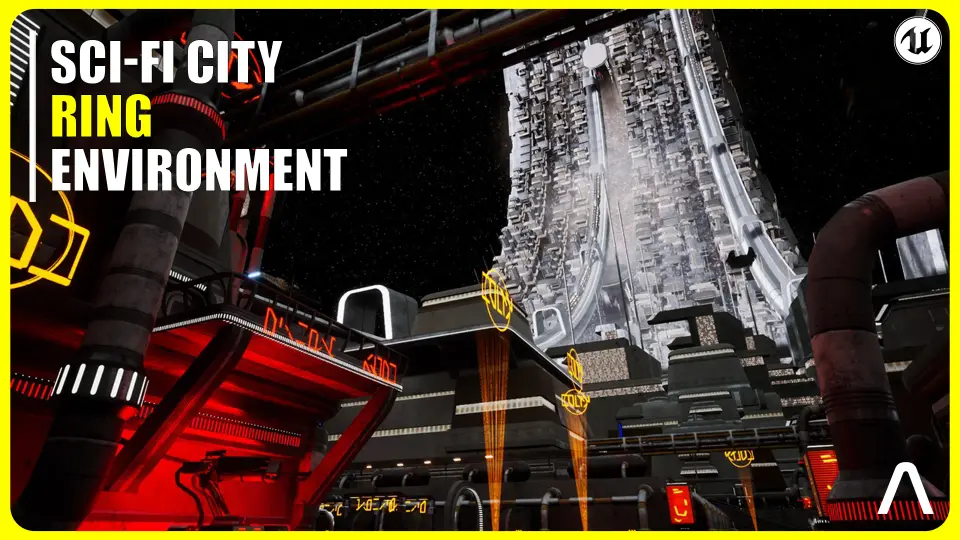
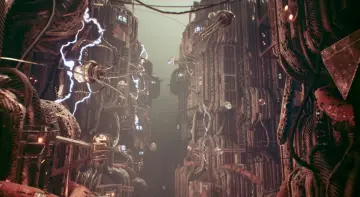
The core layout of this environment centers on an interconnected urban fabric that spans multiple scales. Developers can establish the broader urban perimeter using dedicated vista buildings, framing massive structural silhouettes that suggest an immense orbital or surface installation. These backdrop structures set the mood and industrial tone before users even step foot into playable territory.
Moving from the skyline down to the playable surfaces, the collection provides full street geometry, architectural facades, and urban infrastructure. The physical framework accommodates multi-level city blocks, letting creators stage bustling pedestrian sectors or desolate, high-tech back alleys. Rather than limiting the setting to exterior views, the assets transition directly into dedicated social hubs, including a complete sci-fi bar and accompanying interior props. Furnishing interior rooms with tailored props establishes a tactile human scale that grounds the grander sci-fi architecture, linking large-scale civil engineering with everyday lived-in spaces.
Blueprints and Spline Trajectories for Spaceships and Flying Robots
Populating a sprawling futuristic station demands visible motion throughout the surrounding airspace. Ring World City Station tackles this staging problem through built-in Blueprints that rely on spline paths to drive automated traffic and airborne mechanical units. Instead of manually animating moving vehicles frame by frame, creators can route custom flight lines through city canyons, around sky towers, and across vista gaps.
The included Blueprints are set up to handle spaceships and flying robots along these user-defined splines, injecting constant kinetic activity into backgrounds and flybys:
Spline Pathing: Draw curved trajectories directly inside the level viewport to determine flight corridors for ships and aerial drones.
Autonomous Movement: Let automated vehicles sweep past skyscrapers, patrol station sectors, or hover near docking bays with minimal manual setup.
Vista Building Customization: Adjust and configure background architectural structures using the dedicated Blueprint tools to alter the skyline profile.
Using splines for secondary environmental animation ensures that cities never feel frozen or dormant. Background spaceships can cruise along designated transit lanes while flying robots sweep close to street walkways, generating a continuous sense of life and metropolitan scale throughout the playable volume.
Configuring Lumen, Global Illumination, and Distance Fields in UE5
Lighting plays a critical role in sci-fi environments where metal materials, emissive panels, and shadowed alleys converge. Ring World City Station is engineered to leverage modern rendering capabilities, offering full support for Lumen in Unreal Engine 5.0 and newer versions. Operating with Lumen ensures that indirect bounces, multi-source neon reflections, and cavernous exterior street shadowing calculate accurately in real time.
To realize the intended visual presentation of the station, specific lighting systems must be enabled in project settings. Users should confirm that both global illumination and mesh distance fields are active across the project. Distance fields supply the engine with the geometric information required to compute soft ambient occlusion, detailed contact shadows, and realistic light transfer underneath overpasses, behind pipes, and across intricate building facades.
When combined with Lumen, dynamic lighting reacts convincingly to metallic PBR surfaces, giving spaceship hulls, reflective street surfaces, and neon-lit bar counters believable material responses. Scenes benefit from rich color bleeding between signage and architecture, maintaining deep contrasts without crushing subtle ambient details in shadowed alcoves.
Optimization Footprint: Collision, LODs, and Lightmap Workflows
Balancing dense architectural modules against performance limits requires dependable asset preparation under the hood. The meshes comprising Ring World City Station arrive pre-configured with levels of detail (LODs), allowing the engine to reduce geometric overhead automatically as assets recede toward the horizon. This LOD pipeline helps sustain frame rates when rendering sprawling vistas filled with high-rise structures, complex ground fixtures, and moving vessels.
Collision meshes are pre-integrated into structural and street assets, simplifying character and vehicle navigation without demanding secondary geometry authoring. Characters can traverse walkways, enter the bar interior, and interact with urban obstacles immediately upon placing the pieces into a level.
For pipelines utilizing baked illumination or mixed lighting approaches, the package includes dedicated lightmaps across its structural library. These UV channels ensure that precomputed lighting data bakes cleanly without overlap artifacts or seams, giving developers the freedom to target static rendering pipelines alongside fully dynamic Lumen workflows.
Deployment Scenarios for Real-Time Games and Sci-Fi Cinematics
The versatility of the included modules makes Ring World City Station well-suited for diverse production pipelines. In real-time video games, the modular layout allows level designers to construct distinct gameplay beats, guiding players from wide external transit plazas into tightly packed, atmospheric interior venues like the bar. The collision geometry and modular snap points support rapid prototyping of multi-tiered station sectors.
For cinematic and virtual production workflows, the combination of spline-driven vehicles, expansive vista building controls, and native Lumen support provides a turn-key staging ground. Directors can frame wide-angle tracking shots of spaceships entering the atmosphere or capture close-up character dialogue against high-tech interior props without rebuilding assets from scratch. By supplying both the overarching structural framework and fine localized props, the environment enables rapid realization of cohesive, futuristic cityscapes.
 Sci-Fi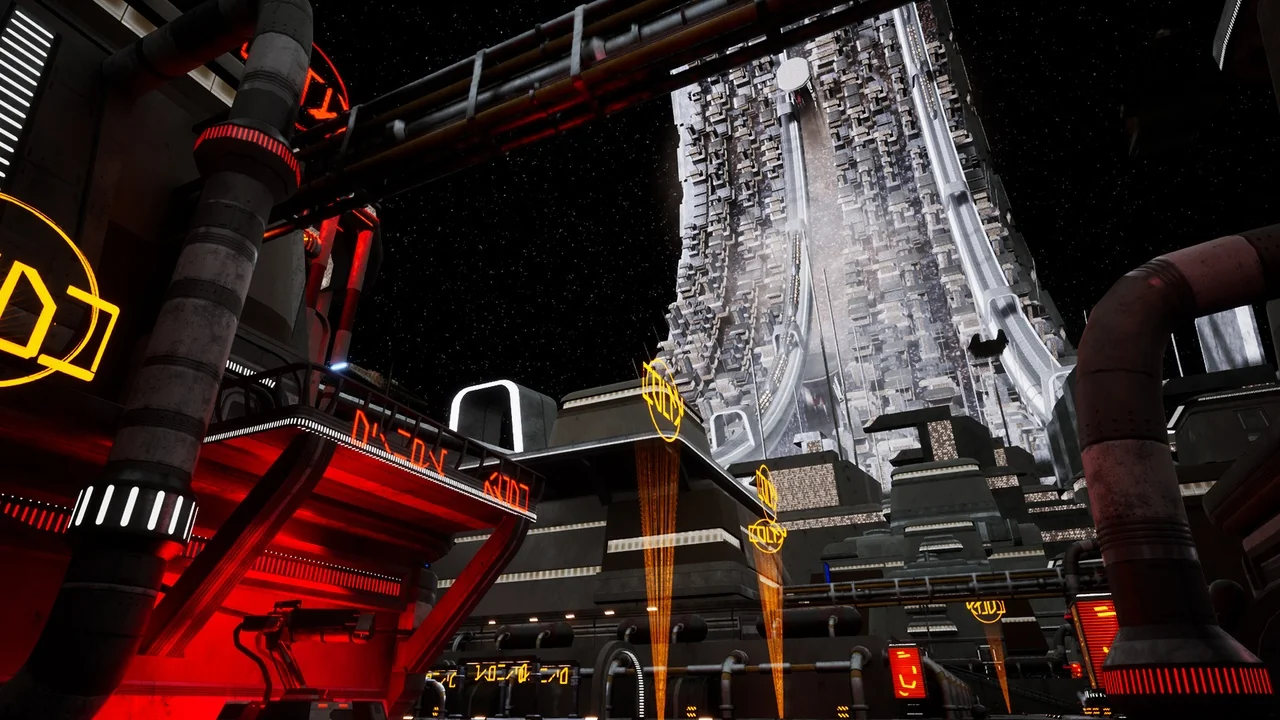
 Sci-Fi
 Cities
 Cyberpunk