"c14ff6bd758dadb1"{"id":"1001745","slug":"modular-ancient-ruins","title":"Modular Ancient Ruins","category":"Historical","engine":"4.26+,5.0+","assetVersion":"","engineVersion":"Engine Version: 4.26+,5.0+","tag":"Historical","accent":"blue","visual":"mech","summary":"Modular Ancient Ruins pairs modular ruin meshes and flexible materials with biome-specific plants, starter layouts, and broad stylistic versatility.","platform":"Unreal Engine","publishedAt":"2026-10-20T02:51:08.967Z","updatedAt":"2026-10-20T02:51:08.967Z","sourceNotes":[],"fileContents":[],"compatibility":["Unreal Engine","Engine Version: 4.26+,5.0+"],"featuredImage":{"alt":"Modular Ancient Ruins","src":"/wp-content/uploads/published/2026/10/772d7890cd77-c93248a4-9dfe-42e2-8e71-1f715921f251-58b712778f.webp"},"hasDownloadLink":true,"downloads":0,"terms":[{"taxonomy":"category","slug":"historical","name":"Historical"}],"galleryImages":[{"src":"/wp-content/uploads/published/2026/10/8620b261a39e-9fcb14be-29ca-4e72-a2ce-ba68a2b19bf5-8e0892d2cf.webp","alt":"Modular Ancient Ruins"},{"src":"/wp-content/uploads/published/2026/10/54b4606bf557-1fbd262d-2db3-4c47-a9d4-70f16293d1ea-42302b0f84.webp","alt":"Modular Ancient Ruins"},{"src":"/wp-content/uploads/published/2026/10/0d56ddea8cb2-84f5c264-cae7-4c8b-af05-14ab879fe049-637d1bc4ef.webp","alt":"Modular Ancient Ruins"},{"src":"/wp-content/uploads/published/2026/10/da441fc4c011-f3aaedb9-f216-40ac-b244-a9bda6959516-868b89ab48.webp","alt":"Modular Ancient Ruins"},{"src":"/wp-content/uploads/published/2026/10/2a91c2033992-c2bd0e02-3e9d-4072-82bf-694e168d8cfc-478327fdea.webp","alt":"Modular Ancient Ruins"},{"src":"/wp-content/uploads/published/2026/10/1924f2fec0db-e14e9984-7722-441d-9844-9334de887abf-baadfaf4b2.webp","alt":"Modular Ancient Ruins"},{"src":"/wp-content/uploads/published/2026/10/2be0c943fb97-1279482b-5fb2-4fab-94b0-a5d37c47eadf-f6c6b21b63.webp","alt":"Modular Ancient Ruins"},{"src":"/wp-content/uploads/published/2026/10/eb1be9e2e7a9-dcd139b5-ab16-4bc6-8b0a-86b13304d1cd-057da34327.webp","alt":"Modular Ancient Ruins"},{"src":"/wp-content/uploads/published/2026/10/ff06d5ca1e99-5eb428f2-0a0d-4f9d-8b8a-36fd94bd3c33-ec131c34a5.webp","alt":"Modular Ancient Ruins"},{"src":"/wp-content/uploads/published/2026/10/d421a0ae1a84-7850d7a9-47aa-4a34-90cb-b216434f36a1-140a10c100.webp","alt":"Modular Ancient Ruins"}],"accessPanel":{"kind":"resource","title":"Download this resource","eyebrow":"Free Download","message":"Log in or create a free account to start your download.","fileName":"Content.7z","safetyNote":"Resources are manually reviewed before listing to improve quality and reduce obvious risks.","actionLabel":"Download Free","resourceType":"Resource archive"},"contentHtml":"\u003cp\u003eModular Ancient Ruins delivers a structural kit designed around modular meshes, flexibly customizable materials, and environment-specific vegetation. The package supplies distinct biomes paired with dedicated plant assets, allowing environment artists and level designers to assemble historic stone layouts that fit smoothly into different natural contexts. Alongside these core assets, an included demonstration map displays the basic elements in an operational configuration, giving creators an immediate reference point for scaling, material behavior, and prop arrangement.\u003c/p\u003e \u003ch2\u003eModular Meshes for Ancient Architectural Assembly\u003c/h2\u003e\n\u003cp\u003eAt the center of the package is a collection of modular meshes representing weathered stone components. These individual structural units are designed to snap, intersect, and align across different orientations, granting precise control over how an ancient site takes shape. Designers can lay out sprawling temple courtyards, subterranean crypts, collapsed stone archways, or broken defensive perimeters without relying on unique, one-off hero assets for every wall or doorway.\u003c/p\u003e\n\u003cp\u003eModularity in historical scene building relies heavily on variation in assembly. Because stone structures degrade unevenly over centuries, the ability to regulate, reorient, and recombine individual ruin meshes keeps architectural layouts from looking repetitive. Shifting the rotation of a broken column, reversing a damaged wall section, or staggering stone steps introduces authentic structural damage while keeping production workflows lean. The modular components provide the structural backbone, whether a scene demands expansive exterior remains or tight interior ruins.\u003c/p\u003e \u003ch2\u003eMaterial Customization and Stylized Textures Mega Pack Compatibility\u003c/h2\u003e\n\u003cp\u003eThe visual impact of ancient stone relies directly on surface response. Modular Ancient Ruins includes flexibly customizable materials that allow artists to adjust the look of stone surfaces according to the specific demands of their project. These adjustments allow the geometry to fit diverse lighting models, whether a scene features harsh midday sunlight revealing deep stone erosion or dim torches casting soft specular highlights across subterranean stone blocks.\u003c/p\u003e\n\u003cp\u003eCompatibility with the Stylized Textures Mega Pack expands this material adaptability even further. While the base assets carry the fidelity required for realistic or horror atmospheres, the ability to introduce alternative texture treatments gives teams working in stylized visual frameworks a direct path to adapt the ruins. Adjusting surface parameters and integrating stylized surface textures changes how the masonry reads, enabling a smooth transition from decayed, gritty realism to clean, painterly fantasy art styles without requiring custom mesh alterations.\u003c/p\u003e \u003ch2\u003eBiome Diversity and Plant Distribution\u003c/h2\u003e\n\u003cp\u003eRuins do not exist in isolation from their geography. To provide environmental context, the package includes a selection of distinct biomes, each supported by its own collection of plants. Foliage elements are matched to these ecological profiles, allowing stone ruins to feel reclaimed by nature rather than floating detached from the surrounding landscape. Creeping vines, ground vegetation, and regional flora break up hard architectural silhouettes and establish a tangible sense of passage of time.\u003c/p\u003e\n\u003cp\u003eThis biome structure is not locked to predefined presets. Artists can regulate objects, swap foliage distributions, and adjust environmental elements to construct entirely new biomes suited to distinct game regions. Combining assets across biome categories makes it possible to create dry, sunbaked ruins scattered with desert brush, damp forest ruins choked with undergrowth, or cold, barren stone outposts where only hardy scrub persists. This flexibility ensures that the modular meshes can anchor multiple distinct map zones while maintaining cohesive underlying architecture.\u003c/p\u003e \u003ch2\u003eStarter Map Setup and Level Layout Workflows\u003c/h2\u003e\n\u003cp\u003eThe package includes a quick-start map that gathers and arranges the basic elements within an active scene. Rather than forcing level designers to inspect individual pieces in an asset browser, the starter map demonstrates how the modular meshes, plants, and materials interface under standard scene conditions. It acts as an interactive staging ground where scale relationships, material adjustments, and collision placements can be audited directly.\u003c/p\u003e\n\u003cp\u003eFor fast-paced production schedules, this starter map serves as a practical testing arena. Designers can prototype room layouts, test sightlines for combat or exploration, and assess how plants interact with ruined surfaces before committing to full environment blockouts. By seeing the kit assembled into functional architectural fragments, teams can duplicate structural groupings, break them apart, or borrow curated assemblies directly into working game levels.\u003c/p\u003e \u003ch2\u003eAdapting Between Fantasy, Horror, and Realistic Environments\u003c/h2\u003e\n\u003cp\u003eThe range of tags tied to Modular Ancient Ruins—encompassing realistic, fantasy, and horror aesthetics—reflects how pliable the underlying assets are under different lighting and compositional setups. Ancient ruins carry an inherent narrative weight that fits naturally into each of these three broad environment types, depending on how objects and surfaces are regulated.\u003c/p\u003e\n\u003cp\u003eIn realistic historical scenes, the modular masonry grounds archaeological sites, abandoned fortifications, or forgotten settlements under natural daylight. When shifted into fantasy world-building, those same arches and walls can be dressed with mystical focal points or combined with unconventional biome plant selections to suggest lost civilizations with otherworldly connections. Under horror lighting conditions, the broken geometry lends itself to claustrophobic framing, jagged silhouettes, and deep shadow casting. By adjusting material settings, changing the density of decaying plant life, and regulating object placement, developers can deploy the asset collection across radically different narrative genres.\u003c/p\u003e\n\n\u003ch2\u003eExplore Similar Assets\u003c/h2\u003e\n\u003cul\u003e\n\u003cli\u003e\u003ca href=\"https://3dcghub.com/egypt-ruins-environment/\" title=\"Egypt Ruins Environment\"\u003eEgypt Ruins Environment\u003c/a\u003e\u003c/li\u003e\n\u003cli\u003e\u003ca href=\"https://3dcghub.com/ancient-mayan-ruins/\" title=\"Ancient Mayan Ruins\"\u003eAncient Mayan Ruins\u003c/a\u003e\u003c/li\u003e\n\u003cli\u003e\u003ca href=\"https://3dcghub.com/roman-volcanic-temple-ancient-medieval-village-greek-buildings-city-street/\" title=\"Roman Volcanic Temple ( Ancient Medieval Village Greek Buildings City Street )\"\u003eRoman Volcanic Temple ( Ancient Medieval Village Greek Buildings City Street )\u003c/a\u003e\u003c/li\u003e\n\u003cli\u003e\u003ca href=\"https://3dcghub.com/ancient-cave-ruins-ancient-temple-ruins-ancient-valley/\" title=\"Ancient Cave Ruins (Ancient Temple Ruins, Ancient Valley )\"\u003eAncient Cave Ruins (Ancient Temple Ruins, Ancient Valley )\u003c/a\u003e\u003c/li\u003e\n\u003cli\u003e\u003ca href=\"https://3dcghub.com/ancient-mountain-temple-nanite/\" title=\"Ancient Mountain Temple (Nanite)\"\u003eAncient Mountain Temple (Nanite)\u003c/a\u003e\u003c/li\u003e\n\u003c/ul\u003e","contentTextLength":6271,"navigation":{"current":38,"total":3719,"previous":{"id":"1001746","slug":"modular-sci-fi-outpost-sci-fi-outpost-sci-fi-base-sci-fi-outpost-base","title":"Modular Sci Fi Outpost (Sci Fi Outpost, Sci Fi Base, Sci Fi , Outpost, Base)","category":"Sci-Fi","platform":"Unreal Engine","updatedAt":"2026-10-20T02:51:54.338Z"},"next":{"id":"1001744","slug":"mocap-wizard-academy-animation-library","title":"Mocap - Wizard Academy Animation Library","category":"Variety","platform":"Unreal Engine","updatedAt":"2026-10-20T02:50:02.754Z"}},"relatedResources":[{"id":"8389","slug":"egypt-ruins-environment","title":"Egypt Ruins Environment","category":"Historical","engine":"4.27,5.0+","assetVersion":"Engine version: 4.27,5.0+","engineVersion":"4.26","tag":"Historical","accent":"blue","visual":"city","summary":"Transform your digital world with a high-quality Egypt Ruins Environment. This asset pack offers modular components and realistic textures perfect for creating immersive desert levels and historical adventure games.","platform":"Unreal Engine","publishedAt":"2026-02-23T17:06:48.000Z","updatedAt":"2026-04-19T15:55:28.000Z","sourceNotes":[],"fileContents":[],"compatibility":["Unreal Engine","Engine version: 4.27,5.0+"],"featuredImage":{"alt":"Egypt Ruins Environment","src":"https://3dcghub.com/wp-content/uploads/2026/02/65e67c05-43b4-4a3f-8c23-87cee1d3e9b2.webp"},"hasDownloadLink":true,"downloads":0},{"id":"25055","slug":"ancient-mayan-ruins","title":"Ancient Mayan Ruins","category":"Historical","engine":"5.2+","assetVersion":"Engine version: 5.2+","engineVersion":"5.2","tag":"Historical","accent":"blue","visual":"city","summary":"Ancient Mayan Ruins brings together weathered stone architecture, ruined temple forms, and jungle atmosphere in a compact environment. It fits historical and adventure scenes that need a clear ancient identity without a large level footprint.","platform":"Unreal Engine","publishedAt":"2026-04-18T16:36:05.000Z","updatedAt":"2026-04-20T06:12:33.000Z","sourceNotes":[],"fileContents":[],"compatibility":["Unreal Engine","Engine version: 5.2+"],"featuredImage":{"alt":"Ancient Mayan Ruins","src":"https://3dcghub.com/wp-content/uploads/2026/04/c004353b90eb_f01535e2-4bc8-4d12-bf45-2cb3c0a2f2ae.webp"},"hasDownloadLink":true,"downloads":1},{"id":"8425","slug":"roman-volcanic-temple-ancient-medieval-village-greek-buildings-city-street","title":"Roman Volcanic Temple ( Ancient Medieval Village Greek Buildings City Street )","category":"Historical","engine":"5.0+","assetVersion":"Engine version: 5.0+","engineVersion":"5.0","tag":"Historical","accent":"blue","visual":"city","summary":"Create breathtaking historical landscapes with this professional environment pack. Featuring 178 unique meshes and advanced modular tools, it is perfectly optimized for modern game engines.","platform":"Unreal Engine","publishedAt":"2026-02-23T17:15:27.000Z","updatedAt":"2026-04-19T15:55:27.000Z","sourceNotes":[],"fileContents":[],"compatibility":["Unreal Engine","Engine version: 5.0+"],"featuredImage":{"alt":"Roman Volcanic Temple ( Ancient Medieval Village Greek Buildings City Street )","src":"https://3dcghub.com/wp-content/uploads/2026/02/8467189c-8385-4dbb-8cdb-da000bb759bb.webp"},"hasDownloadLink":true,"downloads":0}]}
Historical
Modular Ancient Ruins
Modular Ancient Ruins pairs modular ruin meshes and flexible materials with biome-specific plants, starter layouts, and broad stylistic versatility.
Category:Unreal Engine,HistoricalPlatform: Unreal EngineEngine Version: 4.26+,5.0+Published: Oct 20, 2026
Historical
Resource overview
Modular Ancient Ruins delivers a structural kit designed around modular meshes, flexibly customizable materials, and environment-specific vegetation. The package supplies distinct biomes paired with dedicated plant assets, allowing environment artists and level designers to assemble historic stone layouts that fit smoothly into different natural contexts. Alongside these core assets, an included demonstration map displays the basic elements in an operational configuration, giving creators an immediate reference point for scaling, material behavior, and prop arrangement.
Modular Meshes for Ancient Architectural Assembly
At the center of the package is a collection of modular meshes representing weathered stone components. These individual structural units are designed to snap, intersect, and align across different orientations, granting precise control over how an ancient site takes shape. Designers can lay out sprawling temple courtyards, subterranean crypts, collapsed stone archways, or broken defensive perimeters without relying on unique, one-off hero assets for every wall or doorway.
Modularity in historical scene building relies heavily on variation in assembly. Because stone structures degrade unevenly over centuries, the ability to regulate, reorient, and recombine individual ruin meshes keeps architectural layouts from looking repetitive. Shifting the rotation of a broken column, reversing a damaged wall section, or staggering stone steps introduces authentic structural damage while keeping production workflows lean. The modular components provide the structural backbone, whether a scene demands expansive exterior remains or tight interior ruins.
Material Customization and Stylized Textures Mega Pack Compatibility
The visual impact of ancient stone relies directly on surface response. Modular Ancient Ruins includes flexibly customizable materials that allow artists to adjust the look of stone surfaces according to the specific demands of their project. These adjustments allow the geometry to fit diverse lighting models, whether a scene features harsh midday sunlight revealing deep stone erosion or dim torches casting soft specular highlights across subterranean stone blocks.
Compatibility with the Stylized Textures Mega Pack expands this material adaptability even further. While the base assets carry the fidelity required for realistic or horror atmospheres, the ability to introduce alternative texture treatments gives teams working in stylized visual frameworks a direct path to adapt the ruins. Adjusting surface parameters and integrating stylized surface textures changes how the masonry reads, enabling a smooth transition from decayed, gritty realism to clean, painterly fantasy art styles without requiring custom mesh alterations.
Biome Diversity and Plant Distribution
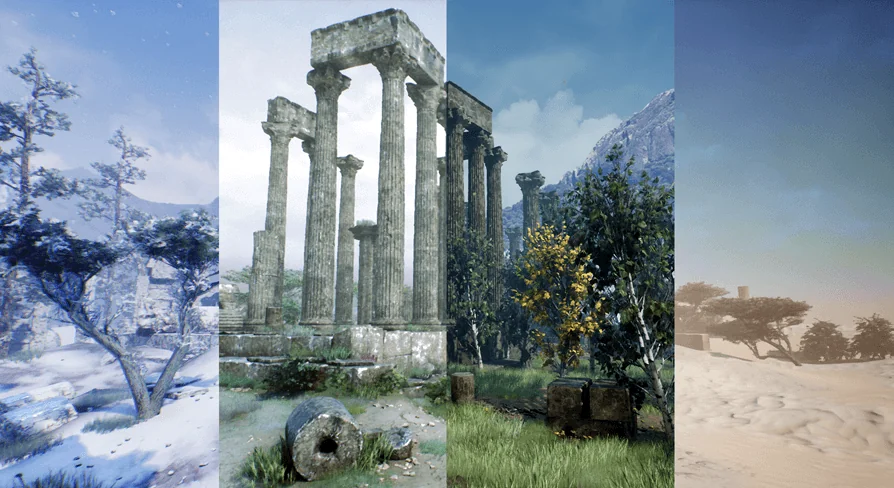
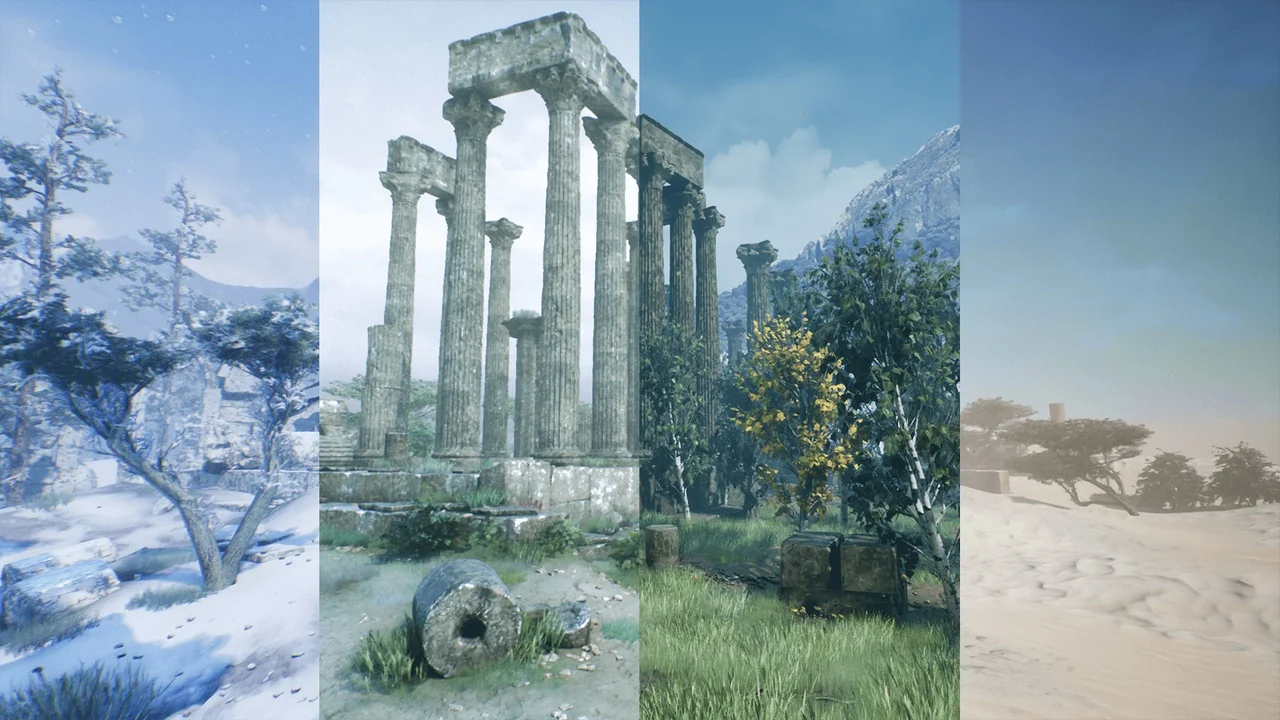
Ruins do not exist in isolation from their geography. To provide environmental context, the package includes a selection of distinct biomes, each supported by its own collection of plants. Foliage elements are matched to these ecological profiles, allowing stone ruins to feel reclaimed by nature rather than floating detached from the surrounding landscape. Creeping vines, ground vegetation, and regional flora break up hard architectural silhouettes and establish a tangible sense of passage of time.
This biome structure is not locked to predefined presets. Artists can regulate objects, swap foliage distributions, and adjust environmental elements to construct entirely new biomes suited to distinct game regions. Combining assets across biome categories makes it possible to create dry, sunbaked ruins scattered with desert brush, damp forest ruins choked with undergrowth, or cold, barren stone outposts where only hardy scrub persists. This flexibility ensures that the modular meshes can anchor multiple distinct map zones while maintaining cohesive underlying architecture.
Starter Map Setup and Level Layout Workflows
The package includes a quick-start map that gathers and arranges the basic elements within an active scene. Rather than forcing level designers to inspect individual pieces in an asset browser, the starter map demonstrates how the modular meshes, plants, and materials interface under standard scene conditions. It acts as an interactive staging ground where scale relationships, material adjustments, and collision placements can be audited directly.
For fast-paced production schedules, this starter map serves as a practical testing arena. Designers can prototype room layouts, test sightlines for combat or exploration, and assess how plants interact with ruined surfaces before committing to full environment blockouts. By seeing the kit assembled into functional architectural fragments, teams can duplicate structural groupings, break them apart, or borrow curated assemblies directly into working game levels.
Adapting Between Fantasy, Horror, and Realistic Environments
The range of tags tied to Modular Ancient Ruins—encompassing realistic, fantasy, and horror aesthetics—reflects how pliable the underlying assets are under different lighting and compositional setups. Ancient ruins carry an inherent narrative weight that fits naturally into each of these three broad environment types, depending on how objects and surfaces are regulated.
In realistic historical scenes, the modular masonry grounds archaeological sites, abandoned fortifications, or forgotten settlements under natural daylight. When shifted into fantasy world-building, those same arches and walls can be dressed with mystical focal points or combined with unconventional biome plant selections to suggest lost civilizations with otherworldly connections. Under horror lighting conditions, the broken geometry lends itself to claustrophobic framing, jagged silhouettes, and deep shadow casting. By adjusting material settings, changing the density of decaying plant life, and regulating object placement, developers can deploy the asset collection across radically different narrative genres.
 Historical
 Historical
 Historical
 Historical