"7779633244466edf"{"id":"1003049","slug":"pedestrian-walks-mocap-pack","title":"Pedestrian Walks - MoCap Pack","category":"Locomotion / Gaits","engine":"4.26+,5.0+","assetVersion":"","engineVersion":"4.26+,5.0+","tag":"Locomotion / Gaits","accent":"blue","visual":"animation","summary":"Explore the Pedestrian Walks - MoCap Pack, featuring 30 unique walking styles, looped and long takes, root motion options, and UE4 to UE5 skeleton retargeting.","platform":"Unreal Engine","indexPolicy":"index","publishedAt":"2026-11-26T14:04:12.860Z","updatedAt":"2026-11-26T14:04:12.860Z","sourceNotes":[],"fileContents":[],"compatibility":["Unreal Engine","Engine Version: 4.26+,5.0+"],"featuredImage":{"alt":"Pedestrian Walks - MoCap Pack","src":"/wp-content/uploads/published/2026/11/2ce8753e46fc-880b1ac5-b1b1-4921-b0bb-884464058d59-888b23faa2.webp"},"fileSizeBytes":74903009,"hasDownloadLink":true,"downloads":0,"terms":[{"taxonomy":"category","slug":"locomotion-gaits","name":"Locomotion / Gaits"}],"galleryImages":[{"src":"/wp-content/uploads/published/2026/11/0d663a3a2cf0-5a179e61-7554-4ad0-95e8-4fc5e06bfcd2-e4669df9d4.webp","alt":"Pedestrian Walks - MoCap Pack"},{"src":"/wp-content/uploads/published/2026/11/9450da1b9e99-612b8ec7-11b0-46b1-a8ef-5912aa7fbdca-c2df1ee82d.webp","alt":"Pedestrian Walks - MoCap Pack"},{"src":"/wp-content/uploads/published/2026/11/b3a39e64a9c4-69336083-9e63-4625-98d8-f237e1327555-90635ab2fb.webp","alt":"Pedestrian Walks - MoCap Pack"}],"accessPanel":{"kind":"resource","title":"Get this resource","safetyNote":"Resources are manually reviewed before listing to improve quality and reduce obvious risks.","fileFormat":".7z","resourceType":"Resource archive","versions":[]},"contentHtml":"\u003cp\u003ePopulating a believable digital environment depends heavily on how background characters navigate their spaces. Whether designing sprawling metropolitan sidewalks, busy commercial centers, transit hubs, or industrial complexes, uniform locomotion immediately undermines the realism of a scene. Authentic pedestrian crowds do not walk in uniform cycles; they exhibit diverse body languages driven by intent, urgency, mood, and the everyday distractions of modern life. Incorporating varied locomotion profiles transforms static background figures into living participants within an environment.\u003c/p\u003e \u003ch2\u003eGait Profiles Across the Pedestrian Walks Collection\u003c/h2\u003e\n\u003cp\u003eTo avoid the visual monotony common to digital crowds, the library provides 15 distinct walking styles spanning 30 unique animation types. Each movement profile communicates a different psychological state or physical requirement, allowing artists and technical animators to assign tailored behaviors across a crowd.\u003c/p\u003e\n\u003cp\u003eCasual and everyday environments benefit from low-energy movement profiles. The relaxed stroll provides an unhurried, natural gait suitable for public parks, suburban pathways, and retail shopping plazas. In contrast, the cheerful walk introduces an upbeat, buoyant energy that signals optimism or leisure. Everyday urban distractions are addressed through specialized behaviors, such as texting while walking and conducting a phone call. In these sequences, characters multitask as they navigate, balancing real-world modern mannerisms with consistent forward momentum.\u003c/p\u003e\n\u003cp\u003eHigher-tempo scenarios are covered by purposeful, accelerated styles. The power walk incorporates an energetic, determined stride suited for fitness sequences, athletic characters, or commuters pressing through congested transit stations. For scenes where time is of the essence, the running late behavior captures frantic, hurried body dynamics without transitioning fully into a dead sprint. On the eccentric end of the emotional spectrum, the happy dance animation introduces an uninhibited, whimsical celebration, providing an expressive, joyful performance that stands out in narrative beats or vibrant city streets. Conversely, cautious creeping drops the pace entirely, offering slow, measured footing intended for stealth scenes, suspenseful exploration, or careful navigation through hazardous zones.\u003c/p\u003e \u003ch2\u003eStructural Variations and Long-Take Animation Data\u003c/h2\u003e\n\u003cp\u003eRepetition is one of the most persistent hurdles when building background simulations or real-time character systems. Standard walk cycles that repeat every second or two quickly reveal their synthetic nature when observed over extended periods. To overcome this limitation, every single walking style in the library includes both a full-length capture and an optimized looped version.\u003c/p\u003e\n\u003cp\u003eThe standard long-form animations exceed 30 seconds of continuous capture per style. These extended takes preserve micro-variations, subtle shifts in weight balance, and natural irregularities that occur during extended human locomotion. The happy dance animation serves as an extended highlight, presenting 80 seconds of continuous dancing packed with movement variations. Across the 15 distinct styles, the collection supplies 60 files in total, pairing sustained captures with tight loops to give technical animators the exact duration needed for linear cinematics, open-world background traffic, or interactive character controllers.\u003c/p\u003e \u003ch2\u003eTechnical Integration in the MoCap Pack\u003c/h2\u003e\n\u003cp\u003eFlexibility across varied animation pipelines requires adaptable motion data. The animations are delivered configured for both Root Motion and In-Place implementation. Root Motion preserves the true spatial velocity and trajectory embedded in the performance, making it ideal for high-fidelity cinematics, realistic physics interactions, and games where physical movement must align precisely with the animated skeleton. In-Place setups allow programmers and technical designers to drive character displacement programmatically through velocity curves, pathfinding networks, or crowd simulation algorithms.\u003c/p\u003e\n\u003cp\u003eDirectional flexibility is further expanded through mirrored movements, ensuring that asymmetrical character stances and handedness can be swapped seamlessly to increase visual diversity across identical character meshes. Every animation has also been carefully pose-matched. This careful alignment ensures that transitions between different walking temperaments, speeds, or secondary character actions blend naturally without foot slipping or abrupt torso snaps.\u003c/p\u003e\n\u003cp\u003eAssets are delivered within an Unreal Project file alongside independent source.FBX files. The animations are built natively on the standard UE4 Skeleton, securing straightforward integration across existing production setups. For projects operating in modern Unreal Engine environments, custom IK-Retargeters facilitate fast and precise retargeting to the standard UE5 Manny character. This retargeting workflow guarantees correct bone alignment, joint constraints, and procedural adjustments across contemporary character rigs. Bonus A-pose and T-pose files are included to establish clean base configurations for custom retargeting profiles across third-party skeletal meshes.\u003c/p\u003e \u003ch2\u003eArticulated Hands and Secondary Expressive Detailing\u003c/h2\u003e\n\u003cp\u003eA frequent shortcoming in crowd locomotion packs is the presence of static, rigid hands. When a character’s body is in motion while their fingers remain frozen in default poses, the visual contrast breaks immersion. The animations in this collection feature fully realized, expressive finger motion designed to complement each movement profile.\u003c/p\u003e\n\u003cp\u003eThis hand articulation is critical during specific multi-tasking actions. In texting and phone call animations, the fingers, wrists, and hands articulate naturally to support holding a mobile device, typing on a screen, or gesturing during conversation. Even during standard strides, energetic walks, or the expressive extensions of the happy dance, the hands relax, clench, and sway in cadence with the physical momentum of the upper body, ensuring that secondary movement reinforces the character's primary intent.\u003c/p\u003e \u003ch2\u003eDeployment Across Simulations and Production Environments\u003c/h2\u003e\n\u003cp\u003eCrafted by Motus Digital, a team bringing over 30 years of game industry performance capture experience, the asset library is suited for interactive life simulations, architectural visualizations, urban open-world development, and narrative cinematics. The dual delivery of long-duration takes and looped sequences allows developers to alternate between continuous background crowd systems and focused narrative scenes without changing asset pools.\u003c/p\u003e\n\u003cp\u003eWhether configuring automated sidewalk foot traffic, populating an industrial shipping yard with purposeful workers, or directing a solo character creeping through an alley, the collection provides the foundational variety and technical readiness required to bring believable human presence to virtual spaces.\u003c/p\u003e\n\n\u003ch2\u003eRelated Resources Worth Checking\u003c/h2\u003e\n\u003cul\u003e\n\u003cli\u003e\u003ca href=\"https://3dcghub.com/mobility-pro-mocap-pack/\" rel=\"noopener noreferrer\"\u003eMobility Pro - MoCap Pack\u003c/a\u003e\u003c/li\u003e\n\u003cli\u003e\u003ca href=\"https://3dcghub.com/female-movement-animset-pro/\" rel=\"noopener noreferrer\"\u003eFemale Movement Animset Pro\u003c/a\u003e\u003c/li\u003e\n\u003cli\u003e\u003ca href=\"https://3dcghub.com/climbing-ladder-pro-mocap-animation-pack/\" rel=\"noopener noreferrer\"\u003eClimbing Ladder Pro - MoCap Animation Pack\u003c/a\u003e\u003c/li\u003e\n\u003cli\u003e\u003ca href=\"https://3dcghub.com/26-zombie-animations-starter-pack-with-blueprints/\" rel=\"noopener noreferrer\"\u003e26 Zombie Animations Starter Pack With Blueprints\u003c/a\u003e\u003c/li\u003e\n\u003cli\u003e\u003ca href=\"https://3dcghub.com/mocap-online-free-animation-pack-unreal-3d-character-animations-for-fab-market/\" rel=\"noopener noreferrer\"\u003eMoCap Online Free Animation Pack | UNREAL 3D Character Animations for FAB Market\u003c/a\u003e\u003c/li\u003e\n\u003c/ul\u003e","contentTextLength":7203,"navigation":{"current":244,"total":5166,"previous":{"id":"1003050","slug":"pistol-pro-mocap-pack","title":"Pistol Pro - MoCap Pack","category":"Combat","platform":"Unreal Engine","updatedAt":"2026-11-26T14:04:51.215Z"},"next":{"id":"1003048","slug":"parkour-animations","title":"Parkour Animations","category":"Variety","platform":"Unreal Engine","updatedAt":"2026-11-26T14:02:55.986Z"}},"relatedResources":[{"id":"1003041","slug":"mobility-pro-mocap-pack","title":"Mobility Pro - MoCap Pack","category":"Locomotion / Gaits","engine":"4.9+,5.0+","assetVersion":"","engineVersion":"4.9+,5.0+","tag":"Locomotion / Gaits","accent":"blue","visual":"animation","summary":"Examine the Mobility Pro MoCap Pack for Unreal Engine, featuring over 223 locomotion animations, root motion, and custom speed curve data.","platform":"Unreal Engine","indexPolicy":"index","publishedAt":"2026-11-25T17:55:41.107Z","updatedAt":"2026-11-25T17:55:41.107Z","sourceNotes":[],"fileContents":[],"compatibility":["Unreal Engine","Engine Version: 4.9+,5.0+"],"featuredImage":{"alt":"Mobility Pro - MoCap Pack","src":"/wp-content/uploads/published/2026/11/e4f42c31847b-3f165c9a-8487-470b-918d-3d960a70d581-525d225d01.webp"},"fileSizeBytes":109849952,"hasDownloadLink":true,"downloads":1},{"id":"1003090","slug":"zombie-pro-mocap-pack","title":"Zombie Pro - MoCap Pack","category":"Locomotion / Gaits","engine":"4.25+,5.0+","assetVersion":"","engineVersion":"4.25+,5.0+","tag":"Locomotion / Gaits","accent":"blue","visual":"animation","summary":"MoCap Online's pack delivers 265 motion-captured zombie animations, covering shambles, hyper attacks, and crawls with Root Motion and In-Place support.","platform":"Unreal Engine","indexPolicy":"index","publishedAt":"2026-11-28T08:24:14.117Z","updatedAt":"2026-11-28T08:24:14.117Z","sourceNotes":[],"fileContents":[],"compatibility":["Unreal Engine","Engine Version: 4.25+,5.0+"],"featuredImage":{"alt":"Zombie Pro - MoCap Pack","src":"/wp-content/uploads/published/2026/11/asset-0-e7d0d25768.webp"},"fileSizeBytes":104305249,"hasDownloadLink":true,"downloads":0},{"id":"1002302","slug":"female-movement-animset-pro","title":"Female Movement Animset Pro","category":"Locomotion / Gaits","engine":"4.26+,5.0+","assetVersion":"","engineVersion":"4.26+,5.0+","tag":"Locomotion / Gaits","accent":"blue","visual":"animation","summary":"Female Movement Animset Pro packs 180 mocap clips, FBX source files, and a game character model for seamless third-person female locomotion.","platform":"Unreal Engine","indexPolicy":"index","publishedAt":"2026-11-05T10:03:37.017Z","updatedAt":"2026-11-05T10:03:37.017Z","sourceNotes":[],"fileContents":[],"compatibility":["Unreal Engine","Engine Version: 4.26+,5.0+"],"featuredImage":{"alt":"Female Movement Animset Pro","src":"/wp-content/uploads/published/2026/11/478cf9783bf2-b87a9a86-bc56-4917-b149-a15bb653a672-de68413cac.webp"},"fileSizeBytes":1700498240,"hasDownloadLink":true,"downloads":1}]}[{"id":4225,"sourceId":4225,"taxonomyId":4225,"taxonomy":"category","slug":"asset-library","name":"Asset Library","parentId":null,"count":0,"hasChildren":true,"href":"/","seoTitle":"Free Game Assets Library | 3DCGHUB","seoDescription":"Browse free Unreal Engine, Unity, Blender assets and game development tutorials on 3DCGHUB with previews, compatibility notes, and secure downloads.","sitemapEnabled":true,"children":[{"id":4227,"sourceId":4227,"taxonomyId":4227,"taxonomy":"category","slug":"blender-add-ons-plugins","name":"Blender Add-ons \u0026 Plugins","parentId":4225,"count":0,"hasChildren":false,"href":"/category/blender-add-ons-plugins/","seoTitle":"Free Blender Add-ons \u0026 Plugins | 3DCGHUB","seoDescription":"Browse free Blender Add-ons \u0026 Plugins tools for Blender on 3DCGHUB: curated downloads with preview images, compatibility notes and secure download access.","sitemapEnabled":true},{"id":514,"sourceId":514,"taxonomyId":514,"taxonomy":"category","slug":"unity-2","name":"Unity","parentId":4225,"count":0,"hasChildren":true,"href":"/category/unity-2/","seoTitle":"Free Unity Assets | 3DCGHUB","seoDescription":"Browse free Unity resources on 3DCGHUB: curated downloads with preview images, compatibility notes and secure download access.","sitemapEnabled":true,"children":[{"id":523,"sourceId":523,"taxonomyId":523,"taxonomy":"category","slug":"2d","name":"2D","parentId":514,"count":0,"hasChildren":true,"href":"/category/2d/","seoTitle":"Free Unity 2D | 3DCGHUB","seoDescription":"Browse free 2D assets for Unity on 3DCGHUB: curated downloads with preview images, compatibility notes and secure download access.","sitemapEnabled":true},{"id":515,"sourceId":515,"taxonomyId":515,"taxonomy":"category","slug":"3d-unity-2","name":"3D","parentId":514,"count":0,"hasChildren":true,"href":"/category/3d-unity-2/","seoTitle":"Free Unity 3D Assets | 3DCGHUB","seoDescription":"Browse free 3D assets for Unity on 3DCGHUB: curated downloads with preview images, compatibility notes and secure download access.","sitemapEnabled":true},{"id":565,"sourceId":565,"taxonomyId":565,"taxonomy":"category","slug":"add-ons","name":"Add-Ons","parentId":514,"count":0,"hasChildren":false,"href":"/category/add-ons/","seoTitle":"Free Unity Add-Ons | 3DCGHUB","seoDescription":"Browse free Add-Ons assets for Unity on 3DCGHUB: curated downloads with preview images, compatibility notes and secure download access.","sitemapEnabled":true},{"id":529,"sourceId":529,"taxonomyId":529,"taxonomy":"category","slug":"audio-unity-2","name":"Audio","parentId":514,"count":0,"hasChildren":true,"href":"/category/audio-unity-2/","seoTitle":"Free Unity Audio | 3DCGHUB","seoDescription":"Browse free Audio for Unity on 3DCGHUB: curated downloads with preview images, compatibility notes and secure download access.","sitemapEnabled":true},{"id":557,"sourceId":557,"taxonomyId":557,"taxonomy":"category","slug":"templates","name":"Templates","parentId":514,"count":0,"hasChildren":true,"href":"/category/templates/","seoTitle":"Free Unity Templates | 3DCGHUB","seoDescription":"Browse free Unity project templates on 3DCGHUB. Starter kits with previews, compatibility notes, and secure download access.","sitemapEnabled":true},{"id":533,"sourceId":533,"taxonomyId":533,"taxonomy":"category","slug":"tools-unity-2","name":"Tools","parentId":514,"count":0,"hasChildren":true,"href":"/category/tools-unity-2/","sitemapEnabled":true},{"id":554,"sourceId":554,"taxonomyId":554,"taxonomy":"category","slug":"vfx-unity-2","name":"VFX","parentId":514,"count":0,"hasChildren":true,"href":"/category/vfx-unity-2/","seoTitle":"Free Unity VFX | 3DCGHUB","seoDescription":"Browse free VFX for Unity on 3DCGHUB: curated downloads with preview images, compatibility notes and secure download access.","sitemapEnabled":true}]},{"id":511,"sourceId":511,"taxonomyId":511,"taxonomy":"category","slug":"unreal-engine-2","name":"Unreal Engine","parentId":4225,"count":0,"hasChildren":true,"href":"/category/unreal-engine-2/","seoTitle":"Free Unreal Engine Assets | 3DCGHUB","seoDescription":"Browse free Unreal Engine resources on 3DCGHUB: curated downloads with preview images, compatibility notes and secure download access.","sitemapEnabled":true,"children":[{"id":54,"sourceId":54,"taxonomyId":54,"taxonomy":"category","slug":"3d","name":"3D","parentId":511,"count":0,"hasChildren":true,"href":"/category/3d/","seoTitle":"Free Unreal Engine 3D | 3DCGHUB","seoDescription":"Browse free 3D assets for Unreal Engine on 3DCGHUB: curated downloads with preview images, compatibility notes and secure download access.","sitemapEnabled":true},{"id":441,"sourceId":441,"taxonomyId":441,"taxonomy":"category","slug":"animations","name":"Animations","parentId":511,"count":0,"hasChildren":true,"href":"/category/animations/","seoTitle":"Free Unreal Engine Animations | 3DCGHUB","seoDescription":"Browse free Animations for Unreal Engine on 3DCGHUB: curated downloads with preview images, compatibility notes and secure download access.","sitemapEnabled":true},{"id":446,"sourceId":446,"taxonomyId":446,"taxonomy":"category","slug":"audio","name":"Audio","parentId":511,"count":0,"hasChildren":true,"href":"/category/audio/","seoTitle":"Free Unreal Engine Audio Resources | 3DCGHUB","seoDescription":"Browse free Unreal Engine audio resources including sound effects, voices, dialogue, and ambient sounds. Curated free downloads on 3DCGHUB.","sitemapEnabled":true},{"id":466,"sourceId":466,"taxonomyId":466,"taxonomy":"category","slug":"game-systems","name":"Game Systems","parentId":511,"count":0,"hasChildren":true,"href":"/category/game-systems/","seoTitle":"Free Unreal Engine Game Systems | 3DCGHUB","seoDescription":"Browse free Game Systems tools for Unreal Engine on 3DCGHUB: curated downloads with preview images, compatibility notes and secure download access.","sitemapEnabled":true},{"id":478,"sourceId":478,"taxonomyId":478,"taxonomy":"category","slug":"game-templates","name":"Game Templates","parentId":511,"count":0,"hasChildren":true,"href":"/category/game-templates/","seoTitle":"Free Unreal Engine Game Templates | 3DCGHUB","seoDescription":"Browse free Game Templates for Unreal Engine on 3DCGHUB: curated downloads with preview images, compatibility notes and secure download access.","sitemapEnabled":true},{"id":432,"sourceId":432,"taxonomyId":432,"taxonomy":"category","slug":"hdri","name":"HDRI","parentId":511,"count":0,"hasChildren":true,"href":"/category/hdri/","seoTitle":"Free Unreal Engine HDRI | 3DCGHUB","seoDescription":"Browse free Unreal Engine HDRI skies and lighting maps on 3DCGHUB. Environment lighting with previews and secure downloads.","sitemapEnabled":true},{"id":228,"sourceId":228,"taxonomyId":228,"taxonomy":"category","slug":"material-and-textures","name":"Material \u0026 Textures","parentId":511,"count":0,"hasChildren":true,"href":"/category/material-and-textures/","seoTitle":"Free Unreal Engine Material \u0026 Textures | 3DCGHUB","seoDescription":"Browse free Material \u0026 Textures for Unreal Engine on 3DCGHUB: curated downloads with preview images, compatibility notes and secure download access.","sitemapEnabled":true},{"id":298,"sourceId":298,"taxonomyId":298,"taxonomy":"category","slug":"sprites-and-flipbooks","name":"Sprites \u0026 Flipbooks","parentId":511,"count":0,"hasChildren":true,"href":"/category/sprites-and-flipbooks/","seoTitle":"Free Unreal Engine Sprites \u0026 Flipbooks | 3DCGHUB","seoDescription":"Browse free Sprites \u0026 Flipbooks assets for Unreal Engine on 3DCGHUB: curated downloads with preview images, compatibility notes and secure download access.","sitemapEnabled":true},{"id":489,"sourceId":489,"taxonomyId":489,"taxonomy":"category","slug":"tools-and-plugins","name":"Tools \u0026 Plugins","parentId":511,"count":0,"hasChildren":true,"href":"/category/tools-and-plugins/","seoTitle":"Free Unreal Engine Tools \u0026 Plugins | 3DCGHUB","seoDescription":"Browse free Tools \u0026 Plugins for Unreal Engine on 3DCGHUB: curated downloads with preview images, compatibility notes and secure download access.","sitemapEnabled":true},{"id":459,"sourceId":459,"taxonomyId":459,"taxonomy":"category","slug":"ui","name":"UI","parentId":511,"count":0,"hasChildren":true,"href":"/category/ui/","seoTitle":"Free Unreal Engine UI | 3DCGHUB","seoDescription":"Browse free UI for Unreal Engine on 3DCGHUB: curated downloads with preview images, compatibility notes and secure download access.","sitemapEnabled":true},{"id":450,"sourceId":450,"taxonomyId":450,"taxonomy":"category","slug":"vfx","name":"VFX","parentId":511,"count":0,"hasChildren":true,"href":"/category/vfx/","seoTitle":"Free Unreal Engine VFX | 3DCGHUB","seoDescription":"Browse free VFX for Unreal Engine on 3DCGHUB: curated downloads with preview images, compatibility notes and secure download access.","sitemapEnabled":true}]}]},{"id":4222,"sourceId":4222,"taxonomyId":4222,"taxonomy":"category","slug":"tutorial-library","name":"Tutorial Library","parentId":null,"count":0,"hasChildren":false,"href":"/tutorials/","seoTitle":"Free Game Development Tutorial Library | 3DCGHUB","seoDescription":"Browse free game development tutorials for Unreal Engine, Unity, Blender, and more on 3DCGHUB with practical workflows and secure downloads.","sitemapEnabled":true}]
Resource screenshots
1 / 3
Asset drops
Daily Asset Drops
Follow 3DCGHUB on Telegram for daily Unreal, Unity & Blender drops and curated CC0 releases.
Resources are manually reviewed before listing to improve quality and reduce obvious risks.
Reviewed archive
Locomotion / Gaits
Pedestrian Walks - MoCap Pack
Explore the Pedestrian Walks - MoCap Pack, featuring 30 unique walking styles, looped and long takes, root motion options, and UE4 to UE5 skeleton retargeting.
Populating a believable digital environment depends heavily on how background characters navigate their spaces. Whether designing sprawling metropolitan sidewalks, busy commercial centers, transit hubs, or industrial complexes, uniform locomotion immediately undermines the realism of a scene. Authentic pedestrian crowds do not walk in uniform cycles; they exhibit diverse body languages driven by intent, urgency, mood, and the everyday distractions of modern life. Incorporating varied locomotion profiles transforms static background figures into living participants within an environment.
Gait Profiles Across the Pedestrian Walks Collection
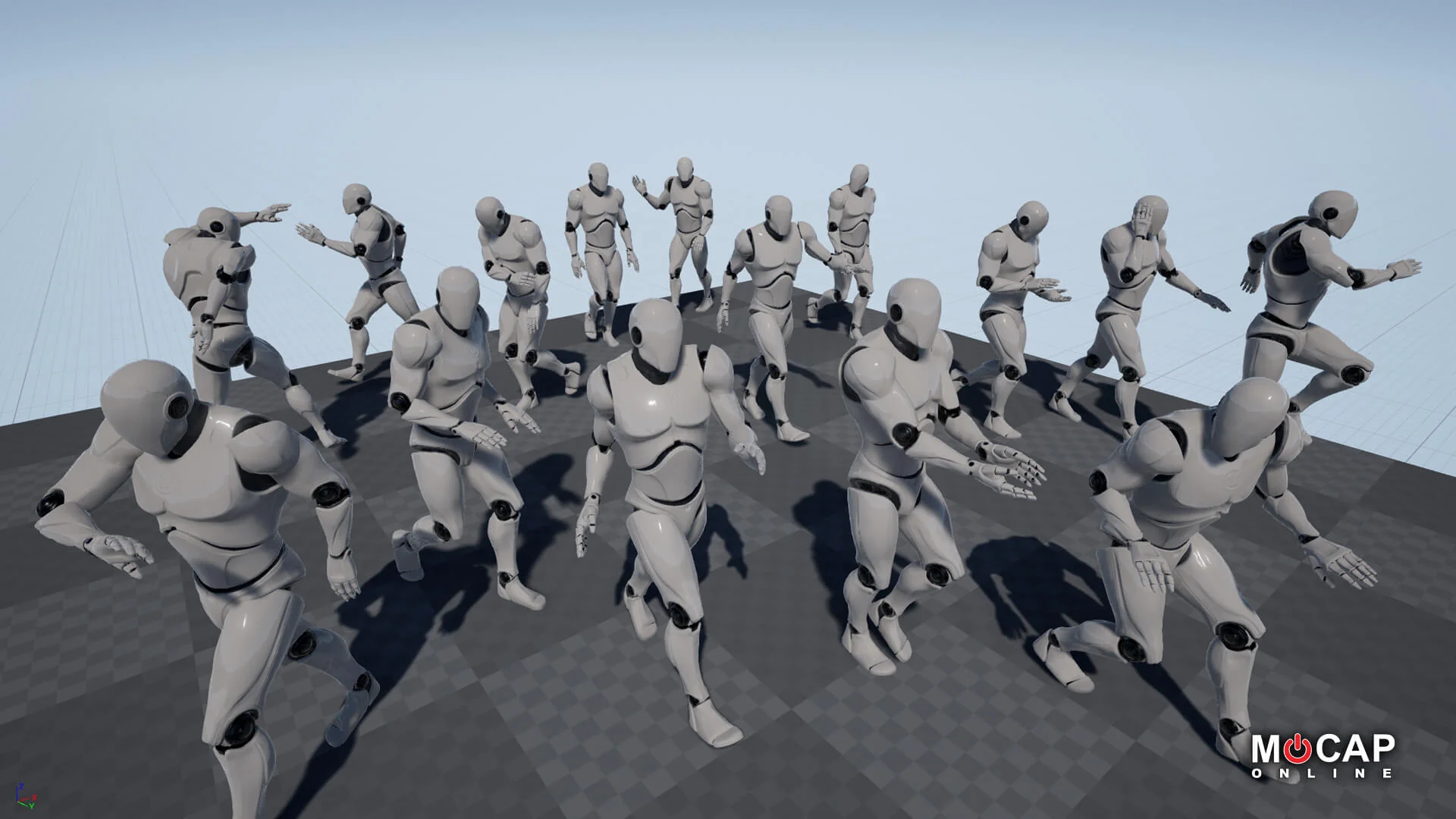
To avoid the visual monotony common to digital crowds, the library provides 15 distinct walking styles spanning 30 unique animation types. Each movement profile communicates a different psychological state or physical requirement, allowing artists and technical animators to assign tailored behaviors across a crowd.
Casual and everyday environments benefit from low-energy movement profiles. The relaxed stroll provides an unhurried, natural gait suitable for public parks, suburban pathways, and retail shopping plazas. In contrast, the cheerful walk introduces an upbeat, buoyant energy that signals optimism or leisure. Everyday urban distractions are addressed through specialized behaviors, such as texting while walking and conducting a phone call. In these sequences, characters multitask as they navigate, balancing real-world modern mannerisms with consistent forward momentum.
Higher-tempo scenarios are covered by purposeful, accelerated styles. The power walk incorporates an energetic, determined stride suited for fitness sequences, athletic characters, or commuters pressing through congested transit stations. For scenes where time is of the essence, the running late behavior captures frantic, hurried body dynamics without transitioning fully into a dead sprint. On the eccentric end of the emotional spectrum, the happy dance animation introduces an uninhibited, whimsical celebration, providing an expressive, joyful performance that stands out in narrative beats or vibrant city streets. Conversely, cautious creeping drops the pace entirely, offering slow, measured footing intended for stealth scenes, suspenseful exploration, or careful navigation through hazardous zones.
Structural Variations and Long-Take Animation Data
Repetition is one of the most persistent hurdles when building background simulations or real-time character systems. Standard walk cycles that repeat every second or two quickly reveal their synthetic nature when observed over extended periods. To overcome this limitation, every single walking style in the library includes both a full-length capture and an optimized looped version.
The standard long-form animations exceed 30 seconds of continuous capture per style. These extended takes preserve micro-variations, subtle shifts in weight balance, and natural irregularities that occur during extended human locomotion. The happy dance animation serves as an extended highlight, presenting 80 seconds of continuous dancing packed with movement variations. Across the 15 distinct styles, the collection supplies 60 files in total, pairing sustained captures with tight loops to give technical animators the exact duration needed for linear cinematics, open-world background traffic, or interactive character controllers.
Technical Integration in the MoCap Pack
Flexibility across varied animation pipelines requires adaptable motion data. The animations are delivered configured for both Root Motion and In-Place implementation. Root Motion preserves the true spatial velocity and trajectory embedded in the performance, making it ideal for high-fidelity cinematics, realistic physics interactions, and games where physical movement must align precisely with the animated skeleton. In-Place setups allow programmers and technical designers to drive character displacement programmatically through velocity curves, pathfinding networks, or crowd simulation algorithms.
Directional flexibility is further expanded through mirrored movements, ensuring that asymmetrical character stances and handedness can be swapped seamlessly to increase visual diversity across identical character meshes. Every animation has also been carefully pose-matched. This careful alignment ensures that transitions between different walking temperaments, speeds, or secondary character actions blend naturally without foot slipping or abrupt torso snaps.
Assets are delivered within an Unreal Project file alongside independent source.FBX files. The animations are built natively on the standard UE4 Skeleton, securing straightforward integration across existing production setups. For projects operating in modern Unreal Engine environments, custom IK-Retargeters facilitate fast and precise retargeting to the standard UE5 Manny character. This retargeting workflow guarantees correct bone alignment, joint constraints, and procedural adjustments across contemporary character rigs. Bonus A-pose and T-pose files are included to establish clean base configurations for custom retargeting profiles across third-party skeletal meshes.
Articulated Hands and Secondary Expressive Detailing
A frequent shortcoming in crowd locomotion packs is the presence of static, rigid hands. When a character’s body is in motion while their fingers remain frozen in default poses, the visual contrast breaks immersion. The animations in this collection feature fully realized, expressive finger motion designed to complement each movement profile.
This hand articulation is critical during specific multi-tasking actions. In texting and phone call animations, the fingers, wrists, and hands articulate naturally to support holding a mobile device, typing on a screen, or gesturing during conversation. Even during standard strides, energetic walks, or the expressive extensions of the happy dance, the hands relax, clench, and sway in cadence with the physical momentum of the upper body, ensuring that secondary movement reinforces the character's primary intent.
Deployment Across Simulations and Production Environments
Crafted by Motus Digital, a team bringing over 30 years of game industry performance capture experience, the asset library is suited for interactive life simulations, architectural visualizations, urban open-world development, and narrative cinematics. The dual delivery of long-duration takes and looped sequences allows developers to alternate between continuous background crowd systems and focused narrative scenes without changing asset pools.
Whether configuring automated sidewalk foot traffic, populating an industrial shipping yard with purposeful workers, or directing a solo character creeping through an alley, the collection provides the foundational variety and technical readiness required to bring believable human presence to virtual spaces.