"7779633244466edf"{"id":"1003050","slug":"pistol-pro-mocap-pack","title":"Pistol Pro - MoCap Pack","category":"Combat","engine":"4.8+,5.0+","assetVersion":"","engineVersion":"4.8+,5.0+","tag":"Combat","accent":"blue","visual":"mech","summary":"A technical breakdown of the Pistol Pro - MoCap Pack, featuring over 370 one-handed pistol animations, dual-stance locomotion, and UE5 retargeting.","platform":"Unreal Engine","indexPolicy":"index","publishedAt":"2026-11-26T14:04:51.215Z","updatedAt":"2026-11-26T14:04:51.215Z","sourceNotes":[],"fileContents":[],"compatibility":["Unreal Engine","Engine Version: 4.8+,5.0+"],"featuredImage":{"alt":"Pistol Pro - MoCap Pack","src":"/wp-content/uploads/published/2026/11/bbb9213edf58-b153eb83-cbf9-4af7-86a0-172a840bda1f-30a07d68fc.webp"},"fileSizeBytes":76697155,"hasDownloadLink":true,"downloads":0,"terms":[{"taxonomy":"category","slug":"combat","name":"Combat"}],"galleryImages":[{"src":"/wp-content/uploads/published/2026/11/8cfe5e7f98fa-c185835a-dd1d-43fb-af8f-215e139f5e3e-9f06fe591d.webp","alt":"Pistol Pro - MoCap Pack"},{"src":"/wp-content/uploads/published/2026/11/ad7b4005dec0-ee94a254-f98b-416c-b078-57d8e136b3b5-42e9aeb302.webp","alt":"Pistol Pro - MoCap Pack"},{"src":"/wp-content/uploads/published/2026/11/3fba0068b250-32c21089-a837-47de-be81-880b14913a29-44d25d408b.webp","alt":"Pistol Pro - MoCap Pack"},{"src":"/wp-content/uploads/published/2026/11/967597814445-e5e44b5f-5aee-43a9-a14f-a854ff619009-abe022f719.webp","alt":"Pistol Pro - MoCap Pack"},{"src":"/wp-content/uploads/published/2026/11/e07c3941f5ae-a08ff601-dfe0-4b94-a56b-f6b626116286-ac48fa4305.webp","alt":"Pistol Pro - MoCap Pack"}],"accessPanel":{"kind":"resource","title":"Get this resource","safetyNote":"Resources are manually reviewed before listing to improve quality and reduce obvious risks.","fileFormat":".7z","resourceType":"Resource archive","versions":[]},"contentHtml":"\u003ch2\u003eBuilding Tactical Shooter Mechanics with Pistol Pro\u003c/h2\u003e\n\u003cp\u003eClose-quarters combat spaces, industrial warehouse firefights, and urban security checkpoints demand character movement that reflects the distinct physical handling of a sidearm. While two-handed carbines and rifles force a squared-off posture, a single-handed firearm requires a more dynamic, asymmetrical silhouette. The Pistol Pro - MoCap Pack targets this exact gameplay style, providing character animators and gameplay programmers with a foundational movement set built specifically around one-handed pistol handling. Created by Motus Digital, a team bringing over thirty years of game industry experience, the collection centers on creating responsive, realistic character movement across intense third-person action and tactical shooter environments.\u003c/p\u003e\n\u003cp\u003eDelivered on the standard UE4 Skeleton inside an Unreal Project file alongside source.FBX assets, the pack contains over 370 motion-captured animations. These assets span basic locomotion, evasive actions, detailed firearm manipulations, and directional deaths. Rather than offering isolated shooting poses, the entire library is structured to support comprehensive character controllers where a character can shift cleanly between patrolling a sector and engaging targets under fire.\u003c/p\u003e \u003ch2\u003eDual-Stance Locomotion Across the Pistol Animation Library\u003c/h2\u003e\n\u003cp\u003eA core architectural challenge in tactical shooters is managing the transition between non-aggressive exploration and active combat. To resolve this, the library provides parallel sets of animations separated into two specific operational stances: pistol-down (relaxed) and pistol-up (combat-ready). Every primary movement asset exists in both states. Idle poses, ambient fidgets, and weapon-drawn stances all share these dual profiles, preventing visual snapping when a player character switches from passive navigation to high-alert shooting.\u003c/p\u003e\n\u003cp\u003eLocomotion covers walking, jogging, and running across eight cardinal and diagonal directions. Characters maintain natural momentum whether pushing forward into a room, backpedaling away from incoming pressure, or moving laterally along corridors. Because every directional walk, jog, and sprint is animated in both relaxed and ready variations, game systems can programmatically link player inputs—such as aiming down sights or drawing down on a target—directly to stance shifts without interrupting locomotion playback.\u003c/p\u003e\n\u003cp\u003eThe system extends this dual-state structure into low-profile movement. Crouching features its own collection of stationary idles, crouch walks, and crouch turns, each balanced across the pistol-up and pistol-down profiles. The animations enforce a consistent crouch height throughout these variations. This geometric consistency ensures that characters remain reliably behind standard cover geometry, preventing head clipping or sudden height pops while players maneuver along barricades and window ledges.\u003c/p\u003e \u003ch2\u003eTurning, Jumping, and Weapon Handling Mechanics\u003c/h2\u003e\n\u003cp\u003eCombat encounters require sharp directional corrections and split-second repositioning. The pack accounts for quick target acquisition through turn animations keyed to multiple movement states, covering standing, walking, jogging, running, and crouching. These turns are calibrated at 45-degree, 90-degree, 135-degree, and 180-degree angles, enabling clean rotation without foot sliding. When players choose to strafe rather than rotate, the lateral and diagonal strafing sequences maintain weapon aim directly toward the reticle, sustaining tactical precision during firefights.\u003c/p\u003e\n\u003cp\u003eDynamic movement across uneven terrain or obstacles is handled through dedicated jump sequences. The assets divide jumps into take-off, in-air sustain, and landing phases across standing, walking, jogging, and running velocities. Split jumps feature distinct variations initiated from either the left foot or the right foot, reflecting true athletic momentum. Like the ground locomotion, all jump components include both pistol-up and pistol-down versions so characters can clear obstacles without dropping their guard or unnaturally holding an aim pose while leaping.\u003c/p\u003e\n\u003cp\u003eFirearm interaction is detailed across multiple functional layers:\u003c/p\u003e\n\u003cul\u003e\n\u003cli\u003eAim offsets suited to targeted weapon tracking across vertical and horizontal arcs.\u003c/li\u003e\n\u003cli\u003eLooking and scanning cycles with firearm control.\u003c/li\u003e\n\u003cli\u003eSingle-handed firing sequences tailored to realistic recoil response.\u003c/li\u003e\n\u003cli\u003eMagazine reloads, holstering, unholstering, and weapon swapping transitions.\u003c/li\u003e\n\u003cli\u003eMulti-directional death animations that depict characters falling forward, backward, left, and right while retaining the weapon.\u003c/li\u003e\n\u003c/ul\u003e \u003ch2\u003eRoot Motion, Curve Attributes, and the MoCap Pack Pipeline\u003c/h2\u003e\n\u003cp\u003eTo support different programming architectures, the animations are supplied in two distinct technical implementations: Root Motion and In-Place (IPC). Projects relying on physics capsules or procedural velocity curves can deploy the In-Place versions, which include custom curve attributes containing continuous speed and rotation data. These embedded data curves provide gameplay programmers with exact velocity and turning rates directly from the animation data, allowing code-driven character controllers to synchronize ground displacement with foot contact cleanly.\u003c/p\u003e\n\u003cp\u003eFor studios relying on root-driven gameplay where the skeletal transform dictates movement, the Root Motion files transfer motion-captured trajectory directly to the root bone. All animations have been pose-matched at their key entry and exit frames, providing smooth blending inside Unreal Engine state machines and blend spaces. This meticulous pose matching minimizes the need for extensive transitional blend times, reducing unwanted blending artifacts such as foot floating or torso twisting during rapid gameplay inputs.\u003c/p\u003e \u003ch2\u003eVersion 2.7A2 Iterations and Unreal Retargeting Workflows\u003c/h2\u003e\n\u003cp\u003eThe pack reflects ongoing technical refinement, visible in the version 2.7A2 update. This release reworked the split jump sequences to deliver more convincing take-offs, balanced in-air loops, and stable landings. Crouch turns were lowered in height to match environmental cover bounds more tightly during directional shifts. Aim turns received stabilization updates to reduce upper-body jitter during continuous rotation, and additional relaxed locomotion variations—including alternative walks, jogs, and crouch walks—were added to expand non-combat movement options.\u003c/p\u003e\n\u003cp\u003eWhile natively bound to the UE4 skeleton, the pack integrates into modern Unreal Engine 5 pipelines. It features customized IK-Retargeters configured for quick retargeting to UE5’s Manny character. These retargeting assets address bone alignment differences between mannequin generations, ensuring that finger placement, arm angles, and root transforms transfer accurately without manual bone remapping. Between the native.FBX files, the ready-to-run Unreal project, and the modular retargeting assets, the collection delivers a complete, production-ready framework for single-handed pistol gameplay across tactical simulations, narrative action adventures, and third-person shooters.\u003c/p\u003e\n\n\u003ch2\u003eExplore Similar Assets\u003c/h2\u003e\n\u003cul\u003e\n\u003cli\u003e\u003ca href=\"https://3dcghub.com/pistol-starter-mocap-pack/\" rel=\"noopener noreferrer\"\u003ePistol Starter - MoCap Pack\u003c/a\u003e\u003c/li\u003e\n\u003cli\u003e\u003ca href=\"https://3dcghub.com/pistol-animations-pack/\" rel=\"noopener noreferrer\"\u003ePistol Animations Pack\u003c/a\u003e\u003c/li\u003e\n\u003cli\u003e\u003ca href=\"https://3dcghub.com/ninja-pro-mocap-pack/\" rel=\"noopener noreferrer\"\u003eNinja Pro - MoCap Pack\u003c/a\u003e\u003c/li\u003e\n\u003cli\u003e\u003ca href=\"https://3dcghub.com/fps-pistol-single/\" rel=\"noopener noreferrer\"\u003eFPS Pistol (Single)\u003c/a\u003e\u003c/li\u003e\n\u003cli\u003e\u003ca href=\"https://3dcghub.com/gunfu-pistol-attacks/\" rel=\"noopener noreferrer\"\u003eGunFu Pistol Attacks\u003c/a\u003e\u003c/li\u003e\n\u003c/ul\u003e","contentTextLength":7210,"navigation":{"current":243,"total":5166,"previous":{"id":"14365","slug":"prismatiscape-interaction-plugin","title":"Prismatiscape Interaction Plugin","category":"Engine Tools","platform":"Unreal Engine","updatedAt":"2026-11-26T14:09:22.109Z"},"next":{"id":"1003049","slug":"pedestrian-walks-mocap-pack","title":"Pedestrian Walks - MoCap Pack","category":"Locomotion / Gaits","platform":"Unreal Engine","updatedAt":"2026-11-26T14:04:12.860Z"}},"relatedResources":[{"id":"1001173","slug":"pistol-starter-mocap-pack","title":"Pistol Starter - MoCap Pack","category":"Combat","engine":"5.0+","assetVersion":"","engineVersion":"5.0+","tag":"Combat","accent":"blue","visual":"mech","summary":"A tactical motion-capture animation set featuring military pistol locomotion, aim offsets, split jumps, and UE5 Manny IK retargeting.","platform":"Unreal Engine","indexPolicy":"index","publishedAt":"2026-09-17T03:39:51.564Z","updatedAt":"2026-09-17T03:39:51.564Z","sourceNotes":[],"fileContents":[],"compatibility":["Unreal Engine","Engine Version: 5.0+"],"featuredImage":{"alt":"Pistol Starter - MoCap Pack","src":"/wp-content/uploads/published/2026/09/bc412458d5f0-d902fb1a-2161-48f5-b1c5-a7ff441f5d61-18aff54e86.webp"},"fileSizeBytes":33238084,"hasDownloadLink":true,"downloads":3},{"id":"5837","slug":"pistol-animations-pack","title":"Pistol Animations Pack","category":"Combat","engine":"5.1+","assetVersion":"","engineVersion":"5.1+","tag":"Combat","accent":"blue","visual":"animation","summary":"Boost your game's realism with 61 professional mocap pistol animations. Optimized for Unreal Engine, these assets are perfect for AAA games and cinematic films.","platform":"Unreal Engine","indexPolicy":"noindex","publishedAt":"2026-02-18T15:42:06.000Z","updatedAt":"2026-04-19T15:56:38.000Z","sourceNotes":[],"fileContents":[],"compatibility":["Unreal Engine","Engine version: 5.1+"],"featuredImage":{"alt":"Pistol Animations Pack","src":"https://3dcghub.com/wp-content/uploads/2026/02/47c73fcf-3cc5-4f7a-a5c5-4c9b951b29dc.webp"},"fileSizeBytes":334717075,"hasDownloadLink":true,"downloads":3},{"id":"1001748","slug":"ninja-pro-mocap-pack","title":"Ninja Pro - MoCap Pack","category":"Combat","engine":"4.26+,5.0+","assetVersion":"","engineVersion":"4.26+,5.0+","tag":"Combat","accent":"blue","visual":"mech","summary":"Explore Ninja Pro - MoCap Pack by Motus Digital, featuring over 170 ninja combat, platform interaction, and acrobatic locomotion animations.","platform":"Unreal Engine","indexPolicy":"index","publishedAt":"2026-10-20T02:53:40.995Z","updatedAt":"2026-10-20T02:53:40.995Z","sourceNotes":[],"fileContents":[],"compatibility":["Unreal Engine","Engine Version: 4.26+,5.0+"],"featuredImage":{"alt":"Ninja Pro - MoCap Pack","src":"/wp-content/uploads/published/2026/10/940c8a441109-b712fb9b-7efd-4190-8396-3e0bfae8af63-d31adbfca4.webp"},"fileSizeBytes":45802200,"hasDownloadLink":true,"downloads":0}]}[{"id":4225,"sourceId":4225,"taxonomyId":4225,"taxonomy":"category","slug":"asset-library","name":"Asset Library","parentId":null,"count":0,"hasChildren":true,"href":"/","seoTitle":"Free Game Assets Library | 3DCGHUB","seoDescription":"Browse free Unreal Engine, Unity, Blender assets and game development tutorials on 3DCGHUB with previews, compatibility notes, and secure downloads.","sitemapEnabled":true,"children":[{"id":4227,"sourceId":4227,"taxonomyId":4227,"taxonomy":"category","slug":"blender-add-ons-plugins","name":"Blender Add-ons \u0026 Plugins","parentId":4225,"count":0,"hasChildren":false,"href":"/category/blender-add-ons-plugins/","seoTitle":"Free Blender Add-ons \u0026 Plugins | 3DCGHUB","seoDescription":"Browse free Blender Add-ons \u0026 Plugins tools for Blender on 3DCGHUB: curated downloads with preview images, compatibility notes and secure download access.","sitemapEnabled":true},{"id":514,"sourceId":514,"taxonomyId":514,"taxonomy":"category","slug":"unity-2","name":"Unity","parentId":4225,"count":0,"hasChildren":true,"href":"/category/unity-2/","seoTitle":"Free Unity Assets | 3DCGHUB","seoDescription":"Browse free Unity resources on 3DCGHUB: curated downloads with preview images, compatibility notes and secure download access.","sitemapEnabled":true,"children":[{"id":523,"sourceId":523,"taxonomyId":523,"taxonomy":"category","slug":"2d","name":"2D","parentId":514,"count":0,"hasChildren":true,"href":"/category/2d/","seoTitle":"Free Unity 2D | 3DCGHUB","seoDescription":"Browse free 2D assets for Unity on 3DCGHUB: curated downloads with preview images, compatibility notes and secure download access.","sitemapEnabled":true},{"id":515,"sourceId":515,"taxonomyId":515,"taxonomy":"category","slug":"3d-unity-2","name":"3D","parentId":514,"count":0,"hasChildren":true,"href":"/category/3d-unity-2/","seoTitle":"Free Unity 3D Assets | 3DCGHUB","seoDescription":"Browse free 3D assets for Unity on 3DCGHUB: curated downloads with preview images, compatibility notes and secure download access.","sitemapEnabled":true},{"id":565,"sourceId":565,"taxonomyId":565,"taxonomy":"category","slug":"add-ons","name":"Add-Ons","parentId":514,"count":0,"hasChildren":false,"href":"/category/add-ons/","seoTitle":"Free Unity Add-Ons | 3DCGHUB","seoDescription":"Browse free Add-Ons assets for Unity on 3DCGHUB: curated downloads with preview images, compatibility notes and secure download access.","sitemapEnabled":true},{"id":529,"sourceId":529,"taxonomyId":529,"taxonomy":"category","slug":"audio-unity-2","name":"Audio","parentId":514,"count":0,"hasChildren":true,"href":"/category/audio-unity-2/","seoTitle":"Free Unity Audio | 3DCGHUB","seoDescription":"Browse free Audio for Unity on 3DCGHUB: curated downloads with preview images, compatibility notes and secure download access.","sitemapEnabled":true},{"id":557,"sourceId":557,"taxonomyId":557,"taxonomy":"category","slug":"templates","name":"Templates","parentId":514,"count":0,"hasChildren":true,"href":"/category/templates/","seoTitle":"Free Unity Templates | 3DCGHUB","seoDescription":"Browse free Unity project templates on 3DCGHUB. Starter kits with previews, compatibility notes, and secure download access.","sitemapEnabled":true},{"id":533,"sourceId":533,"taxonomyId":533,"taxonomy":"category","slug":"tools-unity-2","name":"Tools","parentId":514,"count":0,"hasChildren":true,"href":"/category/tools-unity-2/","sitemapEnabled":true},{"id":554,"sourceId":554,"taxonomyId":554,"taxonomy":"category","slug":"vfx-unity-2","name":"VFX","parentId":514,"count":0,"hasChildren":true,"href":"/category/vfx-unity-2/","seoTitle":"Free Unity VFX | 3DCGHUB","seoDescription":"Browse free VFX for Unity on 3DCGHUB: curated downloads with preview images, compatibility notes and secure download access.","sitemapEnabled":true}]},{"id":511,"sourceId":511,"taxonomyId":511,"taxonomy":"category","slug":"unreal-engine-2","name":"Unreal Engine","parentId":4225,"count":0,"hasChildren":true,"href":"/category/unreal-engine-2/","seoTitle":"Free Unreal Engine Assets | 3DCGHUB","seoDescription":"Browse free Unreal Engine resources on 3DCGHUB: curated downloads with preview images, compatibility notes and secure download access.","sitemapEnabled":true,"children":[{"id":54,"sourceId":54,"taxonomyId":54,"taxonomy":"category","slug":"3d","name":"3D","parentId":511,"count":0,"hasChildren":true,"href":"/category/3d/","seoTitle":"Free Unreal Engine 3D | 3DCGHUB","seoDescription":"Browse free 3D assets for Unreal Engine on 3DCGHUB: curated downloads with preview images, compatibility notes and secure download access.","sitemapEnabled":true},{"id":441,"sourceId":441,"taxonomyId":441,"taxonomy":"category","slug":"animations","name":"Animations","parentId":511,"count":0,"hasChildren":true,"href":"/category/animations/","seoTitle":"Free Unreal Engine Animations | 3DCGHUB","seoDescription":"Browse free Animations for Unreal Engine on 3DCGHUB: curated downloads with preview images, compatibility notes and secure download access.","sitemapEnabled":true},{"id":446,"sourceId":446,"taxonomyId":446,"taxonomy":"category","slug":"audio","name":"Audio","parentId":511,"count":0,"hasChildren":true,"href":"/category/audio/","seoTitle":"Free Unreal Engine Audio Resources | 3DCGHUB","seoDescription":"Browse free Unreal Engine audio resources including sound effects, voices, dialogue, and ambient sounds. Curated free downloads on 3DCGHUB.","sitemapEnabled":true},{"id":466,"sourceId":466,"taxonomyId":466,"taxonomy":"category","slug":"game-systems","name":"Game Systems","parentId":511,"count":0,"hasChildren":true,"href":"/category/game-systems/","seoTitle":"Free Unreal Engine Game Systems | 3DCGHUB","seoDescription":"Browse free Game Systems tools for Unreal Engine on 3DCGHUB: curated downloads with preview images, compatibility notes and secure download access.","sitemapEnabled":true},{"id":478,"sourceId":478,"taxonomyId":478,"taxonomy":"category","slug":"game-templates","name":"Game Templates","parentId":511,"count":0,"hasChildren":true,"href":"/category/game-templates/","seoTitle":"Free Unreal Engine Game Templates | 3DCGHUB","seoDescription":"Browse free Game Templates for Unreal Engine on 3DCGHUB: curated downloads with preview images, compatibility notes and secure download access.","sitemapEnabled":true},{"id":432,"sourceId":432,"taxonomyId":432,"taxonomy":"category","slug":"hdri","name":"HDRI","parentId":511,"count":0,"hasChildren":true,"href":"/category/hdri/","seoTitle":"Free Unreal Engine HDRI | 3DCGHUB","seoDescription":"Browse free Unreal Engine HDRI skies and lighting maps on 3DCGHUB. Environment lighting with previews and secure downloads.","sitemapEnabled":true},{"id":228,"sourceId":228,"taxonomyId":228,"taxonomy":"category","slug":"material-and-textures","name":"Material \u0026 Textures","parentId":511,"count":0,"hasChildren":true,"href":"/category/material-and-textures/","seoTitle":"Free Unreal Engine Material \u0026 Textures | 3DCGHUB","seoDescription":"Browse free Material \u0026 Textures for Unreal Engine on 3DCGHUB: curated downloads with preview images, compatibility notes and secure download access.","sitemapEnabled":true},{"id":298,"sourceId":298,"taxonomyId":298,"taxonomy":"category","slug":"sprites-and-flipbooks","name":"Sprites \u0026 Flipbooks","parentId":511,"count":0,"hasChildren":true,"href":"/category/sprites-and-flipbooks/","seoTitle":"Free Unreal Engine Sprites \u0026 Flipbooks | 3DCGHUB","seoDescription":"Browse free Sprites \u0026 Flipbooks assets for Unreal Engine on 3DCGHUB: curated downloads with preview images, compatibility notes and secure download access.","sitemapEnabled":true},{"id":489,"sourceId":489,"taxonomyId":489,"taxonomy":"category","slug":"tools-and-plugins","name":"Tools \u0026 Plugins","parentId":511,"count":0,"hasChildren":true,"href":"/category/tools-and-plugins/","seoTitle":"Free Unreal Engine Tools \u0026 Plugins | 3DCGHUB","seoDescription":"Browse free Tools \u0026 Plugins for Unreal Engine on 3DCGHUB: curated downloads with preview images, compatibility notes and secure download access.","sitemapEnabled":true},{"id":459,"sourceId":459,"taxonomyId":459,"taxonomy":"category","slug":"ui","name":"UI","parentId":511,"count":0,"hasChildren":true,"href":"/category/ui/","seoTitle":"Free Unreal Engine UI | 3DCGHUB","seoDescription":"Browse free UI for Unreal Engine on 3DCGHUB: curated downloads with preview images, compatibility notes and secure download access.","sitemapEnabled":true},{"id":450,"sourceId":450,"taxonomyId":450,"taxonomy":"category","slug":"vfx","name":"VFX","parentId":511,"count":0,"hasChildren":true,"href":"/category/vfx/","seoTitle":"Free Unreal Engine VFX | 3DCGHUB","seoDescription":"Browse free VFX for Unreal Engine on 3DCGHUB: curated downloads with preview images, compatibility notes and secure download access.","sitemapEnabled":true}]}]},{"id":4222,"sourceId":4222,"taxonomyId":4222,"taxonomy":"category","slug":"tutorial-library","name":"Tutorial Library","parentId":null,"count":0,"hasChildren":false,"href":"/tutorials/","seoTitle":"Free Game Development Tutorial Library | 3DCGHUB","seoDescription":"Browse free game development tutorials for Unreal Engine, Unity, Blender, and more on 3DCGHUB with practical workflows and secure downloads.","sitemapEnabled":true}]
Resource screenshots
1 / 5
Asset drops
Daily Asset Drops
Follow 3DCGHUB on Telegram for daily Unreal, Unity & Blender drops and curated CC0 releases.
Building Tactical Shooter Mechanics with Pistol Pro
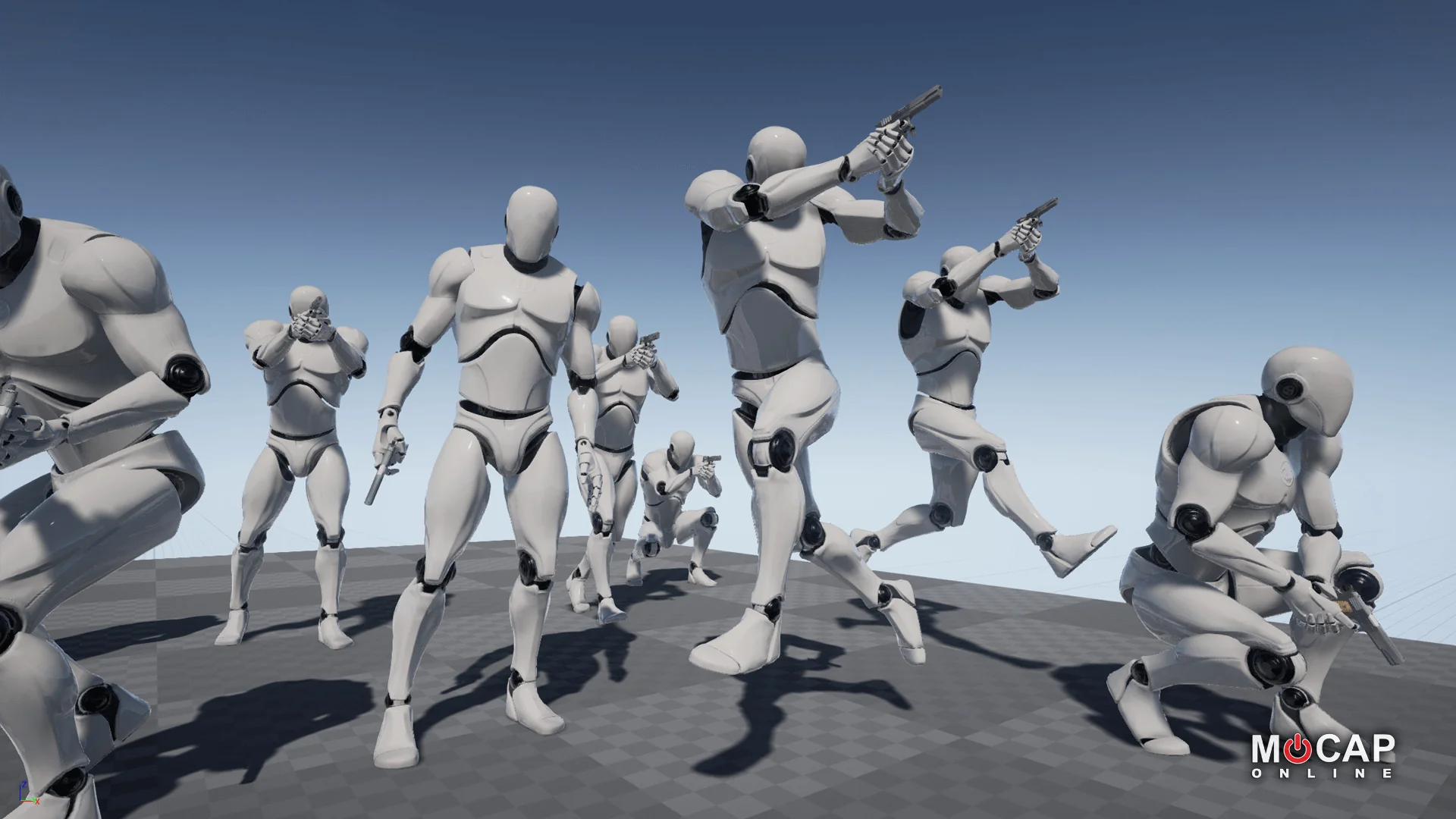
Close-quarters combat spaces, industrial warehouse firefights, and urban security checkpoints demand character movement that reflects the distinct physical handling of a sidearm. While two-handed carbines and rifles force a squared-off posture, a single-handed firearm requires a more dynamic, asymmetrical silhouette. The Pistol Pro - MoCap Pack targets this exact gameplay style, providing character animators and gameplay programmers with a foundational movement set built specifically around one-handed pistol handling. Created by Motus Digital, a team bringing over thirty years of game industry experience, the collection centers on creating responsive, realistic character movement across intense third-person action and tactical shooter environments.
Delivered on the standard UE4 Skeleton inside an Unreal Project file alongside source.FBX assets, the pack contains over 370 motion-captured animations. These assets span basic locomotion, evasive actions, detailed firearm manipulations, and directional deaths. Rather than offering isolated shooting poses, the entire library is structured to support comprehensive character controllers where a character can shift cleanly between patrolling a sector and engaging targets under fire.
Dual-Stance Locomotion Across the Pistol Animation Library
A core architectural challenge in tactical shooters is managing the transition between non-aggressive exploration and active combat. To resolve this, the library provides parallel sets of animations separated into two specific operational stances: pistol-down (relaxed) and pistol-up (combat-ready). Every primary movement asset exists in both states. Idle poses, ambient fidgets, and weapon-drawn stances all share these dual profiles, preventing visual snapping when a player character switches from passive navigation to high-alert shooting.
Locomotion covers walking, jogging, and running across eight cardinal and diagonal directions. Characters maintain natural momentum whether pushing forward into a room, backpedaling away from incoming pressure, or moving laterally along corridors. Because every directional walk, jog, and sprint is animated in both relaxed and ready variations, game systems can programmatically link player inputs—such as aiming down sights or drawing down on a target—directly to stance shifts without interrupting locomotion playback.
The system extends this dual-state structure into low-profile movement. Crouching features its own collection of stationary idles, crouch walks, and crouch turns, each balanced across the pistol-up and pistol-down profiles. The animations enforce a consistent crouch height throughout these variations. This geometric consistency ensures that characters remain reliably behind standard cover geometry, preventing head clipping or sudden height pops while players maneuver along barricades and window ledges.
Turning, Jumping, and Weapon Handling Mechanics
Combat encounters require sharp directional corrections and split-second repositioning. The pack accounts for quick target acquisition through turn animations keyed to multiple movement states, covering standing, walking, jogging, running, and crouching. These turns are calibrated at 45-degree, 90-degree, 135-degree, and 180-degree angles, enabling clean rotation without foot sliding. When players choose to strafe rather than rotate, the lateral and diagonal strafing sequences maintain weapon aim directly toward the reticle, sustaining tactical precision during firefights.
Dynamic movement across uneven terrain or obstacles is handled through dedicated jump sequences. The assets divide jumps into take-off, in-air sustain, and landing phases across standing, walking, jogging, and running velocities. Split jumps feature distinct variations initiated from either the left foot or the right foot, reflecting true athletic momentum. Like the ground locomotion, all jump components include both pistol-up and pistol-down versions so characters can clear obstacles without dropping their guard or unnaturally holding an aim pose while leaping.
Firearm interaction is detailed across multiple functional layers:
Aim offsets suited to targeted weapon tracking across vertical and horizontal arcs.
Looking and scanning cycles with firearm control.
Single-handed firing sequences tailored to realistic recoil response.
Magazine reloads, holstering, unholstering, and weapon swapping transitions.
Multi-directional death animations that depict characters falling forward, backward, left, and right while retaining the weapon.
Root Motion, Curve Attributes, and the MoCap Pack Pipeline
To support different programming architectures, the animations are supplied in two distinct technical implementations: Root Motion and In-Place (IPC). Projects relying on physics capsules or procedural velocity curves can deploy the In-Place versions, which include custom curve attributes containing continuous speed and rotation data. These embedded data curves provide gameplay programmers with exact velocity and turning rates directly from the animation data, allowing code-driven character controllers to synchronize ground displacement with foot contact cleanly.
For studios relying on root-driven gameplay where the skeletal transform dictates movement, the Root Motion files transfer motion-captured trajectory directly to the root bone. All animations have been pose-matched at their key entry and exit frames, providing smooth blending inside Unreal Engine state machines and blend spaces. This meticulous pose matching minimizes the need for extensive transitional blend times, reducing unwanted blending artifacts such as foot floating or torso twisting during rapid gameplay inputs.
Version 2.7A2 Iterations and Unreal Retargeting Workflows
The pack reflects ongoing technical refinement, visible in the version 2.7A2 update. This release reworked the split jump sequences to deliver more convincing take-offs, balanced in-air loops, and stable landings. Crouch turns were lowered in height to match environmental cover bounds more tightly during directional shifts. Aim turns received stabilization updates to reduce upper-body jitter during continuous rotation, and additional relaxed locomotion variations—including alternative walks, jogs, and crouch walks—were added to expand non-combat movement options.
While natively bound to the UE4 skeleton, the pack integrates into modern Unreal Engine 5 pipelines. It features customized IK-Retargeters configured for quick retargeting to UE5’s Manny character. These retargeting assets address bone alignment differences between mannequin generations, ensuring that finger placement, arm angles, and root transforms transfer accurately without manual bone remapping. Between the native.FBX files, the ready-to-run Unreal project, and the modular retargeting assets, the collection delivers a complete, production-ready framework for single-handed pistol gameplay across tactical simulations, narrative action adventures, and third-person shooters.