"7779633244466edf"{"id":"1003048","slug":"parkour-animations","title":"Parkour Animations","category":"Variety","engine":"5.0+","assetVersion":"","engineVersion":"5.0+","tag":"Variety","accent":"blue","visual":"animation","summary":"Explore the Parkour Animations pack featuring over 340 clips, covering vaults, ledge climbs, wall runs, drops, and motion warping traversal.","platform":"Unreal Engine","indexPolicy":"index","publishedAt":"2026-11-26T14:02:55.986Z","updatedAt":"2026-11-26T14:02:55.986Z","sourceNotes":[],"fileContents":[],"compatibility":["Unreal Engine","Engine Version: 5.0+"],"featuredImage":{"alt":"Parkour Animations","src":"/wp-content/uploads/published/2026/11/8833ddb00fec-fea7d809-c80e-442e-a2e7-3bbfa1fd8e8d-62d5fb45e9.webp"},"fileSizeBytes":324681355,"hasDownloadLink":true,"downloads":0,"terms":[{"taxonomy":"category","slug":"variety-animations","name":"Variety"}],"galleryImages":[{"src":"/wp-content/uploads/published/2026/11/629c73dc4bc1-2e9d3f03-6834-4185-b287-986a15246b31-2202e69f18.webp","alt":"Parkour Animations"},{"src":"/wp-content/uploads/published/2026/11/ed67fd31ce37-bac427df-01f1-4ac8-a1ca-e3f89db8828c-2cefa3a809.webp","alt":"Parkour Animations"},{"src":"/wp-content/uploads/published/2026/11/804f59c5e7b3-40be474d-ecd2-49f9-a673-15c43d1a0949-5297432569.webp","alt":"Parkour Animations"},{"src":"/wp-content/uploads/published/2026/11/92bcbf0e349a-7bd49e46-29ff-4944-b925-1a1b7ed00009-1735042246.webp","alt":"Parkour Animations"},{"src":"/wp-content/uploads/published/2026/11/f86b6c671031-bf2ff6d1-e191-46e1-8faf-132f2e335624-01f2abdeb7.webp","alt":"Parkour Animations"},{"src":"/wp-content/uploads/published/2026/11/d0da4efd2ce9-81bbd779-8b2b-453e-a2f1-262181aec0b8-e01492e8a8.webp","alt":"Parkour Animations"},{"src":"/wp-content/uploads/published/2026/11/c0f8b0ea1cdb-9122eb73-77ea-4676-9963-a4cdf083f446-b8f4f6278c.webp","alt":"Parkour Animations"}],"accessPanel":{"kind":"resource","title":"Get this resource","safetyNote":"Resources are manually reviewed before listing to improve quality and reduce obvious risks.","fileFormat":".7z","resourceType":"Resource archive","versions":[]},"contentHtml":"\u003cp\u003eA character navigating an urban obstacle course demands rapid transitions between sprinting, clearance, hanging, and impact absorption. The Parkour Animations collection provides over 250 base animation assets alongside an update containing more than 90 additional movement clips, assembling a library exceeding 340 sequences tailored specifically for high-momentum traversal.\u003c/p\u003e \u003ch2\u003eLocomotion and Directional Footwork in Parkour Animations\u003c/h2\u003e\n\u003cp\u003eResponsive baseline navigation requires continuous speed modulation and clean directional pivoting. The core locomotion set provides 26 animations separated cleanly into in-place and root-motion configurations, allowing animators and gameplay programmers to pick the approach matching their character controller architecture. Basic movement cycles feature walk, run, and sprint cycles complete with dedicated start and stop animations to handle acceleration and deceleration states without abrupt frame cutting.\u003c/p\u003e\n\u003cp\u003eTurning profiles account for sudden changes in momentum. The pack includes distinct stationary turning animations split into left and right rotations at 45, 90, and 180 degrees. For characters in active motion, specialized arc sequences—such as Walk_Arc, Run_Arc, and Sprint_Arc for both left and right directions—maintain believable body banking. High-velocity reversals are addressed through discrete 180-degree turnaround clips for both running and sprinting states, letting an actor spin and drive off the opposite foot while preserving visual weight.\u003c/p\u003e \u003ch2\u003eVaulting Mechanics and Obstacle Clearance\u003c/h2\u003e\n\u003cp\u003eObstacle clearance makes up the largest segment of the asset set, featuring 38 base vaults, 12 wall vaults, and an expansion of 11 distinct vault styles that introduce executions starting directly from a stationary idle. The variety spans utilitarian hurdle techniques to elaborate, acrobatic street-running moves, providing appropriate coverage for low fences, medium barricades, and elevated surfaces.\u003c/p\u003e\n\u003cp\u003eStraightforward obstacles utilize two-handed push-offs, safety vaults, and speed vaults modeled across left and right hand placements. When dealing with wider obstacles, specialized movements take over. The asset set details dedicated sequences for monkey vaults, dash vaults, and kash vaults, as well as several iterations of the kong vault: standard kong clearance, double kong reaches for extended spans, and rotational kong 360 maneuvers executed toward either side. Fluid momentum carries into roll vaults, slide vaults, dive rolls, and 360-degree dive roll variations.\u003c/p\u003e\n\u003cp\u003eNot every clearance assumes clearing an obstacle entirely. Many situations require getting onto the surface itself. Specific climb-on animations—such as TwoHand_On, Jump_On, Roll_On, and Monkey_On—allow a character to perch atop a barrier rather than clearing over it. Step variations provide low-impact leg plants on small elevations, maintaining horizontal velocity without triggering a full vault sequence.\u003c/p\u003e \u003ch2\u003eLedge Navigation, Beams, and Vertical Pipe Traversal\u003c/h2\u003e\n\u003cp\u003eVerticality depends heavily on hanging mechanics, for which the base collection supplies 30 specialized ledge animations. The ledge framework handles the entire sequence of engagement: attaching to a lip, settling into an idle hanging posture, and shimmying laterally across straight edges. Lateral movement along ledges is provided in both root-motion and in-place formats to simplify network replication and local collision handling.\u003c/p\u003e\n\u003cp\u003eNavigating complex architecture is supported by inner and outer corner transitions for left and right turns, enabling characters to follow wall perimeters seamlessly. Dismounting options are equally varied. A character can drop straight down, release into a 180-degree outward fall, execute lateral ledge hops to catch adjacent grip points, or launch into powered upward leaps to scale higher segments. Pulling up onto the surface utilizes multiple techniques, including monkey climb-ups, safety climb-ups, thief vaults, and reverse climbs that transition directly from a hang into an upright vault over the upper lip.\u003c/p\u003e\n\u003cp\u003eExpanded movement states extend past standard flat stone ledges. The update adds 26 beam hanging animations and 8 beam balancing movements, enabling characters to tightrope across narrow horizontal structures or hang beneath them. Vertical architecture is addressed by 16 pipe animations, accommodating clambering, climbing, and dismounting from vertical conduits.\u003c/p\u003e \u003ch2\u003eAerial Arcs, Drops, and Impact Dissipation\u003c/h2\u003e\n\u003cp\u003eManaging the phase between launching off an obstacle and striking the floor requires distinct airborne posing and ground recovery. The library includes 6 jump variations, including precision jump starts and finishes aimed at sticking landing spots on narrow perimeters. Vertical high jumps and directional running takeoffs feature left- and right-foot plant starts, complemented by 4 mid-air flight loops designed to represent close drops, steep descents, outward leaps, and upward vertical momentum.\u003c/p\u003e\n\u003cp\u003eControlled drops from elevated platforms utilize 10 specialized drop animations. These allow a character to peel away from a ledge or obstacle through dedicated moves, including monkey drops, dash drops, speed drops, and two-handed releases on either side. These transitions prevent the stiffness of generic falling loops when departing from a mantle or rail.\u003c/p\u003e\n\u003cp\u003eGround contact is handled through 14 landing animations designed around varying degrees of downward velocity. Soft landings capture drops from modest elevations, while heavy downward impacts settle the character into a deep brace. To carry forward kinetic energy, directional landings link straight into forward momentum, side rolls, or dedicated back rolls. Rolling recoveries feature distinct Roll A and Roll B variations mapped to both the left and right shoulders, giving control over recovery paths and preventing repetitive landing frames.\u003c/p\u003e \u003ch2\u003eWall Interaction and Parkour Animations Integration\u003c/h2\u003e\n\u003cp\u003eVertical walls offer additional pathways through 4 primary wall runs alongside an expanded update featuring 12 horizontal wall runs and jumps. These allow characters to stride across flat vertical surfaces before kicking off toward distant perimeters. Sharp angular rebounds are covered by 12 tic-tac maneuvers, simulating the fast single-foot kick off a wall used to convert forward speed into upward or lateral trajectory. Ground sliding is handled by 8 slide animations covering entries and exits from both directions.\u003c/p\u003e\n\u003cp\u003eFor implementation within an active project, the animation set is structured to integrate with the Parkour Motion Warping System blueprint. Because parkour clips rely on hands and feet striking varied surface heights, motion warping systems adjust the root trajectory and target contact points of these animations dynamically to match environmental collision geometry. The extensive breakdown of left, right, in-place, and root-motion variations across vaults, wall moves, and ledge catches ensures that dynamic motion adjustment can snap accurately to world geometry without unnatural stretching or visible sliding.\u003c/p\u003e\n\n\u003ch2\u003eMore From The Same Workflow\u003c/h2\u003e\n\u003cul\u003e\n\u003cli\u003e\u003ca href=\"https://3dcghub.com/dynamic-parkour-trace-system/\" rel=\"noopener noreferrer\"\u003eDynamic Parkour Trace System\u003c/a\u003e\u003c/li\u003e\n\u003cli\u003e\u003ca href=\"https://3dcghub.com/swimming-animations/\" rel=\"noopener noreferrer\"\u003eSwimming Animations\u003c/a\u003e\u003c/li\u003e\n\u003cli\u003e\u003ca href=\"https://3dcghub.com/mc-skydive-animation-pack/\" rel=\"noopener noreferrer\"\u003eMC Skydive Animation Pack\u003c/a\u003e\u003c/li\u003e\n\u003cli\u003e\u003ca href=\"https://3dcghub.com/medieval-npc-animation-pack/\" rel=\"noopener noreferrer\"\u003eMedieval NPC Animation Pack\u003c/a\u003e\u003c/li\u003e\n\u003cli\u003e\u003ca href=\"https://3dcghub.com/mocap-wizard-academy-animation-library/\" rel=\"noopener noreferrer\"\u003eMocap - Wizard Academy Animation Library\u003c/a\u003e\u003c/li\u003e\n\u003c/ul\u003e","contentTextLength":7219,"navigation":{"current":245,"total":5166,"previous":{"id":"1003049","slug":"pedestrian-walks-mocap-pack","title":"Pedestrian Walks - MoCap Pack","category":"Locomotion / Gaits","platform":"Unreal Engine","updatedAt":"2026-11-26T14:04:12.860Z"},"next":{"id":"1003047","slug":"orientalism-dual-blade-anim-set","title":"Orientalism Dual Blade Anim Set","category":"Combat","platform":"Unreal Engine","updatedAt":"2026-11-26T14:01:54.972Z"}},"relatedResources":[{"id":"10803","slug":"dynamic-parkour-trace-system","title":"Dynamic Parkour Trace System","category":"Gameplay Features","engine":"5.5+","assetVersion":"","engineVersion":"5.5+","tag":"Gameplay Features","accent":"blue","visual":"audio","summary":"Enhance your game with the Dynamic Parkour Trace System, a powerful tool for creating fluid climbing and vaulting mechanics. This system utilizes advanced tracing and data-driven animation selection for professional results.","platform":"Unreal Engine","indexPolicy":"noindex","publishedAt":"2026-03-03T16:17:06.000Z","updatedAt":"2026-04-19T15:49:55.000Z","sourceNotes":[],"fileContents":[],"compatibility":["Unreal Engine","Engine version: 5.5+"],"featuredImage":{"alt":"Dynamic Parkour Trace System","src":"https://3dcghub.com/wp-content/uploads/2026/03/e0232b6e-d747-4264-9f92-0e727c9e6e57.webp"},"fileSizeBytes":295658133,"hasDownloadLink":true,"downloads":0},{"id":"1001851","slug":"swimming-animations","title":"Swimming Animations","category":"Variety","engine":"5.3+","assetVersion":"","engineVersion":"5.3+","tag":"Variety","accent":"blue","visual":"animation","summary":"A close look at Swimming Animations, featuring 16 motion capture clips covering breaststroke, kayaking, diving, and frog style water movement.","platform":"Unreal Engine","indexPolicy":"index","publishedAt":"2026-10-21T08:45:18.934Z","updatedAt":"2026-10-21T08:45:18.934Z","sourceNotes":[],"fileContents":[],"compatibility":["Unreal Engine","Engine Version: 5.3+"],"featuredImage":{"alt":"Swimming Animations","src":"/wp-content/uploads/published/2026/10/4ca983fec693-690efbbe-88cd-49f6-9c89-48cccadaadda-e8d25f3f19.webp"},"fileSizeBytes":287534420,"hasDownloadLink":true,"downloads":1},{"id":"1003040","slug":"mc-skydive-animation-pack","title":"MC Skydive Animation Pack","category":"Variety","engine":"5.0+","assetVersion":"","engineVersion":"5.0+","tag":"Variety","accent":"blue","visual":"animation","summary":"Explore the MC Skydive Animation Pack featuring over 50 motion-captured skydiving, wingsuit, and parachute sequences configured for the UE5 Mannequin rig.","platform":"Unreal Engine","indexPolicy":"index","publishedAt":"2026-11-25T17:10:17.168Z","updatedAt":"2026-11-25T17:10:17.168Z","sourceNotes":[],"fileContents":[],"compatibility":["Unreal Engine","Engine Version: 5.0+"],"featuredImage":{"alt":"MC Skydive Animation Pack","src":"/wp-content/uploads/published/2026/11/b4f25dab4235-5084c6c0-0793-42c6-9136-5764bb174515-083c7e7f9b.webp"},"fileSizeBytes":315208573,"hasDownloadLink":true,"downloads":0}]}[{"id":4225,"sourceId":4225,"taxonomyId":4225,"taxonomy":"category","slug":"asset-library","name":"Asset Library","parentId":null,"count":0,"hasChildren":true,"href":"/","seoTitle":"Free Game Assets Library | 3DCGHUB","seoDescription":"Browse free Unreal Engine, Unity, Blender assets and game development tutorials on 3DCGHUB with previews, compatibility notes, and secure downloads.","sitemapEnabled":true,"children":[{"id":4227,"sourceId":4227,"taxonomyId":4227,"taxonomy":"category","slug":"blender-add-ons-plugins","name":"Blender Add-ons \u0026 Plugins","parentId":4225,"count":0,"hasChildren":false,"href":"/category/blender-add-ons-plugins/","seoTitle":"Free Blender Add-ons \u0026 Plugins | 3DCGHUB","seoDescription":"Browse free Blender Add-ons \u0026 Plugins tools for Blender on 3DCGHUB: curated downloads with preview images, compatibility notes and secure download access.","sitemapEnabled":true},{"id":514,"sourceId":514,"taxonomyId":514,"taxonomy":"category","slug":"unity-2","name":"Unity","parentId":4225,"count":0,"hasChildren":true,"href":"/category/unity-2/","seoTitle":"Free Unity Assets | 3DCGHUB","seoDescription":"Browse free Unity resources on 3DCGHUB: curated downloads with preview images, compatibility notes and secure download access.","sitemapEnabled":true,"children":[{"id":523,"sourceId":523,"taxonomyId":523,"taxonomy":"category","slug":"2d","name":"2D","parentId":514,"count":0,"hasChildren":true,"href":"/category/2d/","seoTitle":"Free Unity 2D | 3DCGHUB","seoDescription":"Browse free 2D assets for Unity on 3DCGHUB: curated downloads with preview images, compatibility notes and secure download access.","sitemapEnabled":true},{"id":515,"sourceId":515,"taxonomyId":515,"taxonomy":"category","slug":"3d-unity-2","name":"3D","parentId":514,"count":0,"hasChildren":true,"href":"/category/3d-unity-2/","seoTitle":"Free Unity 3D Assets | 3DCGHUB","seoDescription":"Browse free 3D assets for Unity on 3DCGHUB: curated downloads with preview images, compatibility notes and secure download access.","sitemapEnabled":true},{"id":565,"sourceId":565,"taxonomyId":565,"taxonomy":"category","slug":"add-ons","name":"Add-Ons","parentId":514,"count":0,"hasChildren":false,"href":"/category/add-ons/","seoTitle":"Free Unity Add-Ons | 3DCGHUB","seoDescription":"Browse free Add-Ons assets for Unity on 3DCGHUB: curated downloads with preview images, compatibility notes and secure download access.","sitemapEnabled":true},{"id":529,"sourceId":529,"taxonomyId":529,"taxonomy":"category","slug":"audio-unity-2","name":"Audio","parentId":514,"count":0,"hasChildren":true,"href":"/category/audio-unity-2/","seoTitle":"Free Unity Audio | 3DCGHUB","seoDescription":"Browse free Audio for Unity on 3DCGHUB: curated downloads with preview images, compatibility notes and secure download access.","sitemapEnabled":true},{"id":557,"sourceId":557,"taxonomyId":557,"taxonomy":"category","slug":"templates","name":"Templates","parentId":514,"count":0,"hasChildren":true,"href":"/category/templates/","seoTitle":"Free Unity Templates | 3DCGHUB","seoDescription":"Browse free Unity project templates on 3DCGHUB. Starter kits with previews, compatibility notes, and secure download access.","sitemapEnabled":true},{"id":533,"sourceId":533,"taxonomyId":533,"taxonomy":"category","slug":"tools-unity-2","name":"Tools","parentId":514,"count":0,"hasChildren":true,"href":"/category/tools-unity-2/","sitemapEnabled":true},{"id":554,"sourceId":554,"taxonomyId":554,"taxonomy":"category","slug":"vfx-unity-2","name":"VFX","parentId":514,"count":0,"hasChildren":true,"href":"/category/vfx-unity-2/","seoTitle":"Free Unity VFX | 3DCGHUB","seoDescription":"Browse free VFX for Unity on 3DCGHUB: curated downloads with preview images, compatibility notes and secure download access.","sitemapEnabled":true}]},{"id":511,"sourceId":511,"taxonomyId":511,"taxonomy":"category","slug":"unreal-engine-2","name":"Unreal Engine","parentId":4225,"count":0,"hasChildren":true,"href":"/category/unreal-engine-2/","seoTitle":"Free Unreal Engine Assets | 3DCGHUB","seoDescription":"Browse free Unreal Engine resources on 3DCGHUB: curated downloads with preview images, compatibility notes and secure download access.","sitemapEnabled":true,"children":[{"id":54,"sourceId":54,"taxonomyId":54,"taxonomy":"category","slug":"3d","name":"3D","parentId":511,"count":0,"hasChildren":true,"href":"/category/3d/","seoTitle":"Free Unreal Engine 3D | 3DCGHUB","seoDescription":"Browse free 3D assets for Unreal Engine on 3DCGHUB: curated downloads with preview images, compatibility notes and secure download access.","sitemapEnabled":true},{"id":441,"sourceId":441,"taxonomyId":441,"taxonomy":"category","slug":"animations","name":"Animations","parentId":511,"count":0,"hasChildren":true,"href":"/category/animations/","seoTitle":"Free Unreal Engine Animations | 3DCGHUB","seoDescription":"Browse free Animations for Unreal Engine on 3DCGHUB: curated downloads with preview images, compatibility notes and secure download access.","sitemapEnabled":true},{"id":446,"sourceId":446,"taxonomyId":446,"taxonomy":"category","slug":"audio","name":"Audio","parentId":511,"count":0,"hasChildren":true,"href":"/category/audio/","seoTitle":"Free Unreal Engine Audio Resources | 3DCGHUB","seoDescription":"Browse free Unreal Engine audio resources including sound effects, voices, dialogue, and ambient sounds. Curated free downloads on 3DCGHUB.","sitemapEnabled":true},{"id":466,"sourceId":466,"taxonomyId":466,"taxonomy":"category","slug":"game-systems","name":"Game Systems","parentId":511,"count":0,"hasChildren":true,"href":"/category/game-systems/","seoTitle":"Free Unreal Engine Game Systems | 3DCGHUB","seoDescription":"Browse free Game Systems tools for Unreal Engine on 3DCGHUB: curated downloads with preview images, compatibility notes and secure download access.","sitemapEnabled":true},{"id":478,"sourceId":478,"taxonomyId":478,"taxonomy":"category","slug":"game-templates","name":"Game Templates","parentId":511,"count":0,"hasChildren":true,"href":"/category/game-templates/","seoTitle":"Free Unreal Engine Game Templates | 3DCGHUB","seoDescription":"Browse free Game Templates for Unreal Engine on 3DCGHUB: curated downloads with preview images, compatibility notes and secure download access.","sitemapEnabled":true},{"id":432,"sourceId":432,"taxonomyId":432,"taxonomy":"category","slug":"hdri","name":"HDRI","parentId":511,"count":0,"hasChildren":true,"href":"/category/hdri/","seoTitle":"Free Unreal Engine HDRI | 3DCGHUB","seoDescription":"Browse free Unreal Engine HDRI skies and lighting maps on 3DCGHUB. Environment lighting with previews and secure downloads.","sitemapEnabled":true},{"id":228,"sourceId":228,"taxonomyId":228,"taxonomy":"category","slug":"material-and-textures","name":"Material \u0026 Textures","parentId":511,"count":0,"hasChildren":true,"href":"/category/material-and-textures/","seoTitle":"Free Unreal Engine Material \u0026 Textures | 3DCGHUB","seoDescription":"Browse free Material \u0026 Textures for Unreal Engine on 3DCGHUB: curated downloads with preview images, compatibility notes and secure download access.","sitemapEnabled":true},{"id":298,"sourceId":298,"taxonomyId":298,"taxonomy":"category","slug":"sprites-and-flipbooks","name":"Sprites \u0026 Flipbooks","parentId":511,"count":0,"hasChildren":true,"href":"/category/sprites-and-flipbooks/","seoTitle":"Free Unreal Engine Sprites \u0026 Flipbooks | 3DCGHUB","seoDescription":"Browse free Sprites \u0026 Flipbooks assets for Unreal Engine on 3DCGHUB: curated downloads with preview images, compatibility notes and secure download access.","sitemapEnabled":true},{"id":489,"sourceId":489,"taxonomyId":489,"taxonomy":"category","slug":"tools-and-plugins","name":"Tools \u0026 Plugins","parentId":511,"count":0,"hasChildren":true,"href":"/category/tools-and-plugins/","seoTitle":"Free Unreal Engine Tools \u0026 Plugins | 3DCGHUB","seoDescription":"Browse free Tools \u0026 Plugins for Unreal Engine on 3DCGHUB: curated downloads with preview images, compatibility notes and secure download access.","sitemapEnabled":true},{"id":459,"sourceId":459,"taxonomyId":459,"taxonomy":"category","slug":"ui","name":"UI","parentId":511,"count":0,"hasChildren":true,"href":"/category/ui/","seoTitle":"Free Unreal Engine UI | 3DCGHUB","seoDescription":"Browse free UI for Unreal Engine on 3DCGHUB: curated downloads with preview images, compatibility notes and secure download access.","sitemapEnabled":true},{"id":450,"sourceId":450,"taxonomyId":450,"taxonomy":"category","slug":"vfx","name":"VFX","parentId":511,"count":0,"hasChildren":true,"href":"/category/vfx/","seoTitle":"Free Unreal Engine VFX | 3DCGHUB","seoDescription":"Browse free VFX for Unreal Engine on 3DCGHUB: curated downloads with preview images, compatibility notes and secure download access.","sitemapEnabled":true}]}]},{"id":4222,"sourceId":4222,"taxonomyId":4222,"taxonomy":"category","slug":"tutorial-library","name":"Tutorial Library","parentId":null,"count":0,"hasChildren":false,"href":"/tutorials/","seoTitle":"Free Game Development Tutorial Library | 3DCGHUB","seoDescription":"Browse free game development tutorials for Unreal Engine, Unity, Blender, and more on 3DCGHUB with practical workflows and secure downloads.","sitemapEnabled":true}]
Resource screenshots
1 / 7
Asset drops
Daily Asset Drops
Follow 3DCGHUB on Telegram for daily Unreal, Unity & Blender drops and curated CC0 releases.
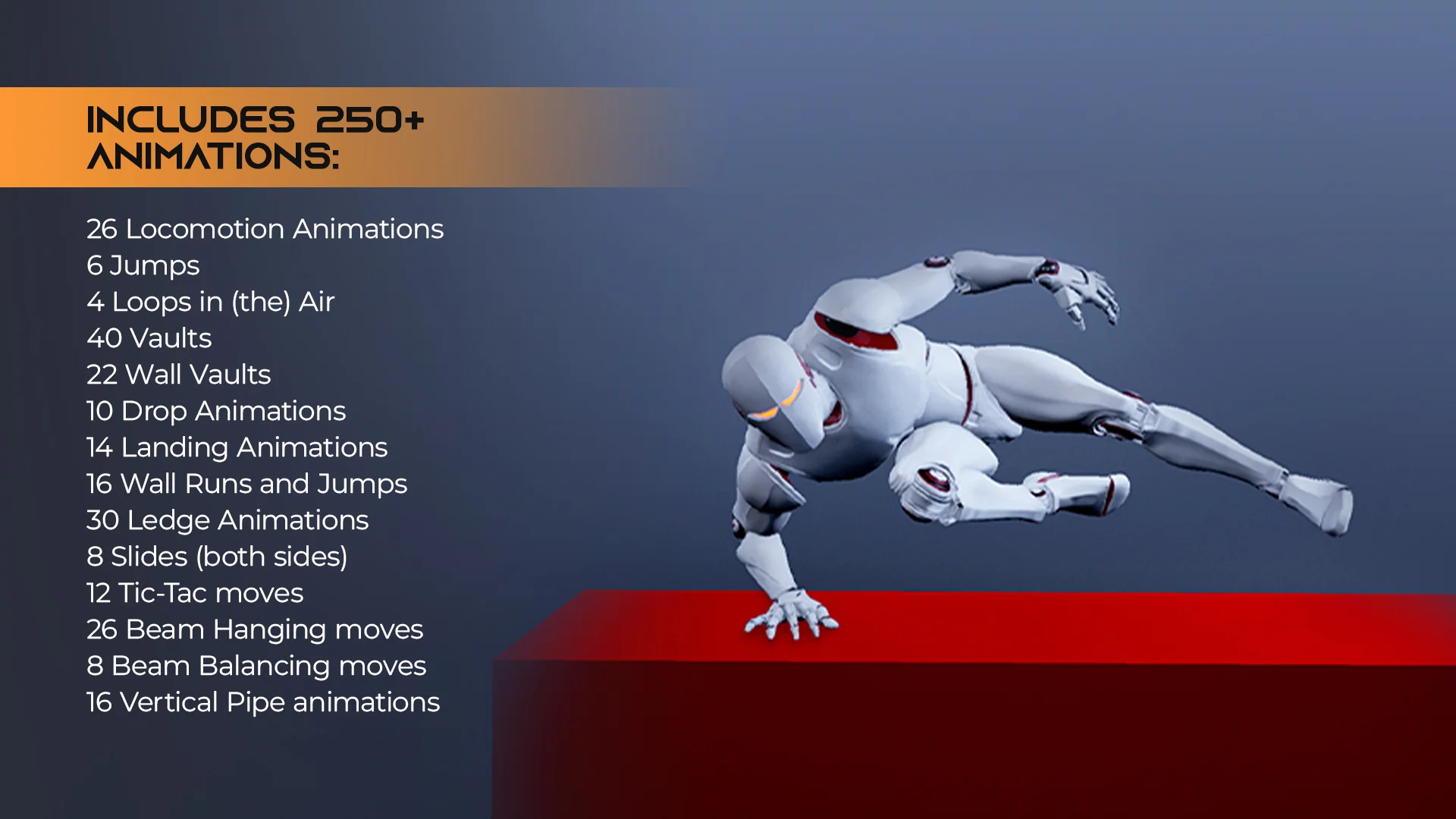
A character navigating an urban obstacle course demands rapid transitions between sprinting, clearance, hanging, and impact absorption. The Parkour Animations collection provides over 250 base animation assets alongside an update containing more than 90 additional movement clips, assembling a library exceeding 340 sequences tailored specifically for high-momentum traversal.
Locomotion and Directional Footwork in Parkour Animations
Responsive baseline navigation requires continuous speed modulation and clean directional pivoting. The core locomotion set provides 26 animations separated cleanly into in-place and root-motion configurations, allowing animators and gameplay programmers to pick the approach matching their character controller architecture. Basic movement cycles feature walk, run, and sprint cycles complete with dedicated start and stop animations to handle acceleration and deceleration states without abrupt frame cutting.
Turning profiles account for sudden changes in momentum. The pack includes distinct stationary turning animations split into left and right rotations at 45, 90, and 180 degrees. For characters in active motion, specialized arc sequences—such as Walk_Arc, Run_Arc, and Sprint_Arc for both left and right directions—maintain believable body banking. High-velocity reversals are addressed through discrete 180-degree turnaround clips for both running and sprinting states, letting an actor spin and drive off the opposite foot while preserving visual weight.
Vaulting Mechanics and Obstacle Clearance
Obstacle clearance makes up the largest segment of the asset set, featuring 38 base vaults, 12 wall vaults, and an expansion of 11 distinct vault styles that introduce executions starting directly from a stationary idle. The variety spans utilitarian hurdle techniques to elaborate, acrobatic street-running moves, providing appropriate coverage for low fences, medium barricades, and elevated surfaces.
Straightforward obstacles utilize two-handed push-offs, safety vaults, and speed vaults modeled across left and right hand placements. When dealing with wider obstacles, specialized movements take over. The asset set details dedicated sequences for monkey vaults, dash vaults, and kash vaults, as well as several iterations of the kong vault: standard kong clearance, double kong reaches for extended spans, and rotational kong 360 maneuvers executed toward either side. Fluid momentum carries into roll vaults, slide vaults, dive rolls, and 360-degree dive roll variations.
Not every clearance assumes clearing an obstacle entirely. Many situations require getting onto the surface itself. Specific climb-on animations—such as TwoHand_On, Jump_On, Roll_On, and Monkey_On—allow a character to perch atop a barrier rather than clearing over it. Step variations provide low-impact leg plants on small elevations, maintaining horizontal velocity without triggering a full vault sequence.
Ledge Navigation, Beams, and Vertical Pipe Traversal
Verticality depends heavily on hanging mechanics, for which the base collection supplies 30 specialized ledge animations. The ledge framework handles the entire sequence of engagement: attaching to a lip, settling into an idle hanging posture, and shimmying laterally across straight edges. Lateral movement along ledges is provided in both root-motion and in-place formats to simplify network replication and local collision handling.
Navigating complex architecture is supported by inner and outer corner transitions for left and right turns, enabling characters to follow wall perimeters seamlessly. Dismounting options are equally varied. A character can drop straight down, release into a 180-degree outward fall, execute lateral ledge hops to catch adjacent grip points, or launch into powered upward leaps to scale higher segments. Pulling up onto the surface utilizes multiple techniques, including monkey climb-ups, safety climb-ups, thief vaults, and reverse climbs that transition directly from a hang into an upright vault over the upper lip.
Expanded movement states extend past standard flat stone ledges. The update adds 26 beam hanging animations and 8 beam balancing movements, enabling characters to tightrope across narrow horizontal structures or hang beneath them. Vertical architecture is addressed by 16 pipe animations, accommodating clambering, climbing, and dismounting from vertical conduits.
Aerial Arcs, Drops, and Impact Dissipation
Managing the phase between launching off an obstacle and striking the floor requires distinct airborne posing and ground recovery. The library includes 6 jump variations, including precision jump starts and finishes aimed at sticking landing spots on narrow perimeters. Vertical high jumps and directional running takeoffs feature left- and right-foot plant starts, complemented by 4 mid-air flight loops designed to represent close drops, steep descents, outward leaps, and upward vertical momentum.
Controlled drops from elevated platforms utilize 10 specialized drop animations. These allow a character to peel away from a ledge or obstacle through dedicated moves, including monkey drops, dash drops, speed drops, and two-handed releases on either side. These transitions prevent the stiffness of generic falling loops when departing from a mantle or rail.
Ground contact is handled through 14 landing animations designed around varying degrees of downward velocity. Soft landings capture drops from modest elevations, while heavy downward impacts settle the character into a deep brace. To carry forward kinetic energy, directional landings link straight into forward momentum, side rolls, or dedicated back rolls. Rolling recoveries feature distinct Roll A and Roll B variations mapped to both the left and right shoulders, giving control over recovery paths and preventing repetitive landing frames.
Wall Interaction and Parkour Animations Integration
Vertical walls offer additional pathways through 4 primary wall runs alongside an expanded update featuring 12 horizontal wall runs and jumps. These allow characters to stride across flat vertical surfaces before kicking off toward distant perimeters. Sharp angular rebounds are covered by 12 tic-tac maneuvers, simulating the fast single-foot kick off a wall used to convert forward speed into upward or lateral trajectory. Ground sliding is handled by 8 slide animations covering entries and exits from both directions.
For implementation within an active project, the animation set is structured to integrate with the Parkour Motion Warping System blueprint. Because parkour clips rely on hands and feet striking varied surface heights, motion warping systems adjust the root trajectory and target contact points of these animations dynamically to match environmental collision geometry. The extensive breakdown of left, right, in-place, and root-motion variations across vaults, wall moves, and ledge catches ensures that dynamic motion adjustment can snap accurately to world geometry without unnatural stretching or visible sliding.
 Gameplay Features
 Variety
 Variety